Commercial Low Earth Orbit Economy - Performance.gov
←
→
Page content transcription
If your browser does not render page correctly, please read the page content below
Agency Priority Goal Action Plan

  Commercial Low Earth Orbit Economy

Goal Leader: Phil McAlister, Human Exploration and Operations Mission
Directorate (HEOMD)

Deputy Goal Leader: Angela Hart, LEO Commercialization Manager, Johnson
Space Center (JSC)

                                                       Fiscal Year 2020, Quarter 4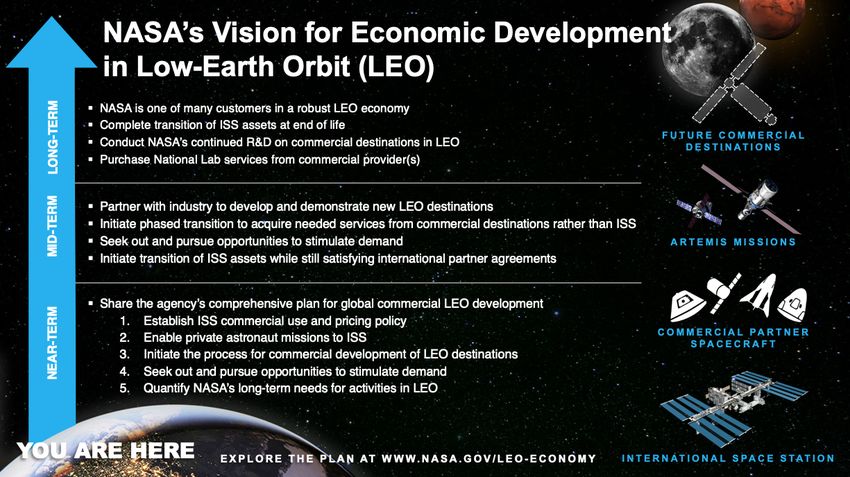
Overview
  Goal Statement
       o Enable a robust commercial low Earth orbit economy in which transportation,
           habitation, and on-orbit services are available for purchase by NASA and
           other customers. By September 30, 2021, NASA will support the development
           of commercial services, including through releasing new business
           opportunities, supporting demonstration flights, beginning certification
           activities, and demonstrating commercial capabilities.
  Challenge
       o Achieving safe, reliable, and cost-effective access to and from low Earth orbit
           and the ISS through the development of U.S. commercial crew space
           transportation capabilities. Partnering with industry to develop commercial
           destinations that will enable transition from the ISS, while stimulating growth
           of sustainable demand so NASA can be one of many customers.
  Opportunity
       o Enabling a U.S. industry-based capability can facilitate growth of a commercial
           market, providing new high-technology jobs, securing U.S. leadership, and
           reducing the cost of human access to and operations in space.
       o Further opening the frontier for space exploration will support a robust
           economy in low-Earth orbit.
                                                                                       2
Leadership & Implementation Team

                         Human Exploration and Operations Mission Directorate
                                            Kathy Lueders
                                       Associate Administrator

                                 Commercial Spaceflight Development
                                           Phil McAlister
                                         Division Director

         International                           LEO                             Commercial
         Space Station                     Commercialization                    Crew Program
         Robyn Gatens                         Angela Hart                         Steve Stich

                                                                                                3
Goal Structure & Strategies
• Enable crew and cargo
transportation capabilities that
support establishment of a
Commercial LEO economy.
• Support establishment of
commercial LEO transportation
systems and destinations for use by
future customers, including
industry, other US government
agencies, other National and the
general public.
• Partner with industry to support
growth of sustainable demand for
products and services in the LEO
economy.
• Contributing Programs include
NASA’s Commercial Crew Program,
Commercial LEO Development, and
the International Space Station
Program.
4Summary of Progress – FY 2020 Q4
• The SpaceX Demo-2 mission successfully concluded with the Dragon Spacecraft’s splashdown in the Gulf of
Mexico, near Pensacola, Florida. The Demo-2 Crewmembers were transported back to Johnson Space Center
for post-flight recovery, and the spacecraft was returned to SpaceX for post-flight processing and to begin
refurbishment for the upcoming Crew-2 mission.
• At the end of FY 2020, Boeing continued processing the CST-100, Starliner, in preparation for their re-flight of
the Orbital Flight Test (OFT). As a result, NASA did not achieve the FY 2020 Q4 milestone for both
commercial partners to complete demonstration missions.
• NASA’s Commercial Crew Program and SpaceX continued making progress toward a Crew-1 launch this fall,
with the Crew-1 Dragon completing final integration and checkout. Transport to Pad 39A for integration with
the Falcon 9 launch vehicle was completed in FY 2021 Q1, to meet a planned Crew-1 launch this fall.
• NASA’s Commercial Crew Program released a Request for Information (RFI) to industry in Q4, requesting
suborbital system qualification and availability of commercial, crewed suborbital space transportation
services data. NASA will use the 11 industry responses to inform the Suborbital Commercial (SubC) activity.
• While NASA’s response to COVID-19 restricted access to some NASA and contractor facilities, mission specific
work continued to be performed in support of the successful SpaceX Demo-2 launch, mission operations,
and safe return of the crew.
• The heroic efforts of the entire industry/government team allowed projects to make notable progress
toward enabling a robust commercial LEO economy during the COVID-19 pandemic. However, because NASA
did not complete two milestones – make awards for the free-flyer solicitation and both commercial partners
complete demonstration missions – this APG is rated red for FY 2020.
5Data Accuracy and Reliability
Verification and Validation:
o NASA monitors and tracks its progress towards this goal using various Agency
documents and reports, including Directorate Program Management Council (DPMC)
materials, reports from the industry partners, and other program-internal documents.
Data Source(s):
o Email(s), press releases, and program-internal documents indicating that NASA’s
industry partners continue to make progress maturing their transportation system
technical and certification/verification efforts, including Baseline Performance Reviews.
Level of Accuracy Required for Intended Use:
o Using the documents and reports referenced above, the Agency is able to accurately
report at the end of each quarter on whether or not it has met its planned milestones.
Data Limitations:
o Materials provided by NASA's industry partners may include company-proprietary
information. Data are sufficiently accurate for their intended use.
How the Agency Compensates for Data Limitations:
o NASA has not identified any data limitations that would preclude it from reporting
accurate, reliable, and timely performance information.
6Additional Information
Contributing Programs
NASA Program Activities:
o Commercial Crew Program: Facilitates the development of safe, reliable, and cost-effective human
space transportation by the U.S. commercial industry to and from low Earth orbit and the
International Space Station (ISS).
o ISS Program: Develops and maintains the transportation service, interface, and safety requirements
associated with crewed flights to and from the ISS.
o Launch Services Program (LSP): Manages NASA’s launch vehicle services, dedicated to launching all
types of science and operational spacecraft.
o Commercial LEO Development: Partners with industry to support development of commercial LEO
destinations and growth of sustainable demand leading to a robust economy in low-Earth orbit.
Other Federal Activities:
o Federal Aviation Administration (FAA), Office of Commercial Space Transportation: Ensures that
commercially-developed, human-rated transportation systems meet FAA licensing requirements for
launch and entry, and works with NASA on cross-agency licensing issues.
o United States Air Force, 45th Space Wing: Addresses launch range safety and crew rescue.
o Department of Commerce: Champion growth of space commerce.
Stakeholder/Congressional Consultations
NASA provides quarterly updates to Congress on the status of required milestones under the Commercial
Crew Transportation Capability contracts, as well as through other contracts and partnerships. NASA also
consults regularly with experts from industry and academia, such as the NASA Advisory Council.
7Key Milestones
Progress update for the Commercial LEO Economy APG.
Current Status Forecast
FY 2020 Q1 FY 2020 Q2 FY 2020 Q3
FY 2020 Q4 FY 2021 Q1
Quarterly Rating Yellow Yellow Yellow Red 1
Milestones Achieved 0 out of 1 1 out of 2 2 out of 3 2 out of 4 1 of 4
Milestone Summary
Milestones Milestone Due Date Comments
Make awards for the port solicitation – NextStep 2 Broad Agency Announcement FY 2020 Q1
Completed in January 2020.
(Appendix I).
Make awards for the free-flyer solicitation – NextStep 2 Broad Agency Announcement FY 2020 Q2 The awards for the Free-
(Appendix K) Flyer solicitation have been
delayed.
Initiate astronaut training for initial private astronaut mission under a reimbursable space FY 2020 Q3 Completed, with two SAA’s
act agreement signed and in place.
Both commercial crew industry partners complete demonstration missions FY 2020 Q4 SpaceX completed their
Demo-2 mission. Boeing
continues to work toward
the OFT re-flight.
Execute an outreach and communication campaign to expand pipeline of new entrants FY 2021 Q1
into the LEO economy
Complete Preliminary Design Review for at least one port solicitation awardee FY 2021 Q2
Complete Preliminary Design Review for at least one free-flyer solicitation awardee FY 2021 Q3 8
Commence regular commercial crew operations FY 2021 Q4You can also read


