Community Needs Assessment Survey Results - Whitney Roberts, MLD February 24, 2021 - Wisconsin ...
←
→
Page content transcription
If your browser does not render page correctly, please read the page content below
Community Needs
Assessment Survey Results
       Whitney Roberts, MLD
         February 24, 2021
Presentation Overview
   I.   Survey Overview & Scope
  II.   State Level Results Summary
 III.   CRA Region Level Results Summaries
        A.   Northwest
        B.   North Central
        C.   Northeast
        D.   Southwest
        E.   South Central
        F.   Southeast
 IV.    Next Steps
  V.    Questions
Survey Overview & Scope
Purpose | Identify previous gaps and new gaps in the safety net needed to advance best practice
programs to encourage accelerated, successful outcomes for low and moderate income groups. The
survey tool is intended to gather actionable data in order to spur increased investment.
Timeline | June 2020-March 2021
Goals
1. Gather local, regional and statewide needs assessment reports that have a mission to serve or
document needs of their communities (ALICE reports, CAP Agency Reports, etc)
2. Form a working group to leverage multiple sector expertise in the development of a survey tool
3. Develop and send a survey to gather results to assist policy and/or funding recommendations
related to improving low and moderate income neighborhoods & communitiesSurvey Overview & Scope
Topics Progress
● Housing & Homelessness
● Healthcare Working Group Formed (June 2020) ✓
● Childcare
● Employment Survey Framework Approved ✓
● Transportation
● Financial Literacy Survey Questions Approved ✓
● Education & Training
Survey Developed & Launched (October 2020) ✓
Audience
● Workforce Development Boards Survey Closed (December 2020) ✓
● Housing Authorities
● Community Action Programs Data Analysis (January -February 2021) ✓
● United Ways
● Regional Plan Commissions Summary Presentations - in process
● Non-Profit Hospitals
● CDFIs / Financial Institutions Regional Presentations
● Tribal Nation Leadership
Online Database ReleasedWorking Group Participants Chair: Dawn Follendorf CRA Officer, Incredible Bank Dennis Lawrence Executive Director, North Central Wisconsin Survey Partner: Kristin Runge Principal Investigator at Economic Regional Planning Commission Development Administration University Center, UW-Madison Bryce Lord Business Manager, Associate Director Helen Bader Tim Size Executive Director Rural Wisconsin Health Cooperative Institute for Nonprofit Management Kelliann Blazek Former Director of the Office of Rural Prosperity, WEDC Mike Mathews President, Economic Growth Advisors, LLC Melissa Borino Director CRA Governance, BMO Harris Bank- Brookfield Charlene Mouille Executive Director, United Way of Wisconsin (Katie Tessa Conroy Economic Development Specialist and Assistant Professor, McMullen) Center for Community and Economic Development - UW Madison Brad Paul Executive Director, Wisconsin Community Action Program Ana Thompson Director, Community & Economic Development, Wisconsin Association (WISCAP) Housing and Economic Development Authority (WHEDA) Tony Shields President and CEO, Wisconsin Philanthropy Network Todd Berry Ph.D., Rep for Wisconsin Economic Development Institute, David Wiese Vice President of Community Relations, Wells Fargo Former President - Wisconsin Taxpayers Alliance Whitney Roberts Project Lead and Consultant, For the Good, LLC Doug Ihrke Ph.D. Executive Director, Helen Bader Institute for Nonprofit Brian Doudna Former Executive Director, WEDA Management - UW Milwaukee
Survey Reach

               97%
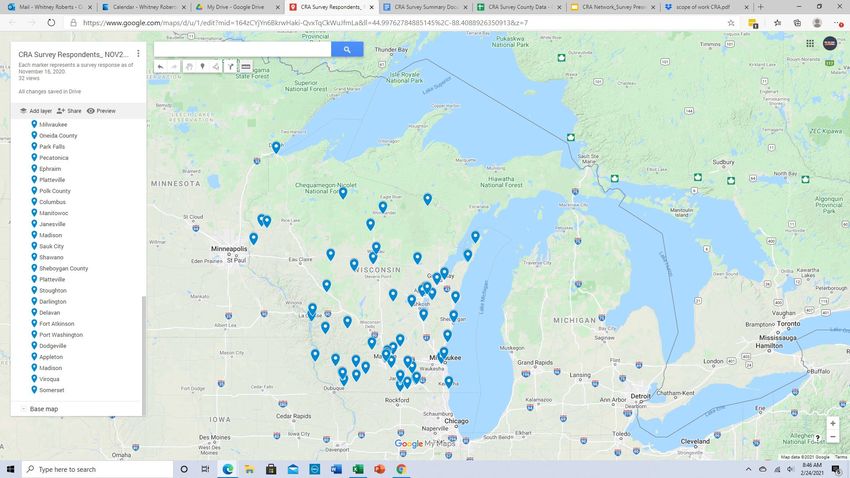
               Counties represented
State Level Overview
Themes across all responses related to priority
needs in their service areas:
● affordable housing
● affordable and quality childcare
● mental healthcare 132 Total Responses - 13.5% Response Rate
● available workforce ● 93% serve rural (or rural & urban) WI
● access to broadband
counties
There is general anxiety about the impacts on local
Dates active: 10/19/20 - 12/11/20
economies from the pandemic and respondents note they
need more resources from the state government to
respond.
Racism and economic equality are also highlighted as
existing challenges needing leadership and designated
focus.“Rural Wisconsin needs greater attention by “The need for food has been outstanding,
the State of Wisconsin. Broadband internet is which exemplifies how close to the edge so
extremely important for the economic survival
many families live.”
or rural areas, especially now with Covid-19.”
“We need to invest in more low income “The legacy of discrimination and segregation
housing with incentives to work programs and is so pervasive that it will take concerted
hold classes stating ‘this is temporary housing’ efforts, on multiple fronts, to address racial
to get people where they need to be.” wealth gaps, and ensure that every
credit-worthy borrower has equal access to
fairly-priced credit to purchase, rehab or
“Childcare needs solving. It is the lynch pin for
refinance a home, or to create or build a
everything: businesses finding employees,
business. CRA is one of the incredibly
quality early childhood for the strong future of important tools that we can use in that work.”
kids. THIS is critical!”Northwest North Central Northeast Southwest South Central Southeast
Ashland Adams Brown Buffalo Columbia Kenosha
Barron Florence Calumet Crawford Dane Milwaukee
Bayfield Forest Door Grant Dodge Ozaukee
Burnett Green Lake Fond du Lac Green Jefferson Racine
Chippewa Langlade Kewaunee Iowa Rock Walworth
Clark Lincoln Manitowoc Jackson Washington
Douglas Marathon Marinette Juneau
Dunn Marquette Oconto La Crosse
Eau Claire Menominee Outagamie Lafayette
Iron Oneida Sheboygan Monroe
Pepin Portage Winnebago Richland
Pierce Shawano Sauk
Polk Vilas Trempealeau
Price Waupaca Vernon
Rusk Waushara
Sawyer Wood
St. Croix
Taylor
Washburn
CRA Regions by CountyCRA Region Level Responses - Northwest
11 Responses
● 2 Healthcare
● 2 Economic Development/CDFI
● 1 Housing “Diversity in housing by type and cost are a real
● 1 Workforce Development struggle especially in small towns that are able and
● 5 Other trying to grow. The jobs are here but the housing is
27% provide services tied to income verification not. PLUS, we need to have BROADBAND NOW!
Our communities can serve all but connectivity and
Top 5 Issues: housing are the base that must be obtained.”
1. Affordable / available housing
2. Access to broadband
3. Affordable health care
4. Mental health care
5. Reliable transportationKey data points: Northwest
● Rate availability of safe and updated homes for purchase by low to moderate
income households: 100% “very scarce” or “scarce”
● What percentage of overall demand for affordable housing will be met by
existing stock or new housing starts over the next two years? (housing
authorities): 11%
● Top 3 client-based issues addressed by workforce development
professionals: Stable housing, childcare, financial constraints
● Thinking ahead to 2021, how much does your organization (healthcare)
anticipate working on the following? - Availability of resources to meet needs
(safe housing, food): 100% “significant effort” or “a great deal of effort”CRA Region Level Responses - North Central
29 Responses
● 10 Economic Development/CDFI
● 7 Workforce Development
● 1 Healthcare “I still have many community leaders who don't
● 11 Other
understand CRA credits, how they sit inside the
48% provide services tied to income verification many programs that are already in existence. I
Top 5 Issues: believe TECHNICAL ASSISTANCE is urgently
needed in our rural communities, and
1. Access to affordable housing INVESTMENT in many opportunities would
2. Broadband access
3. COVID relief make a difference.”
4. Workforce availability & talent development
5. Healthcare and mental health servicesKey data points: North Central
● How would you rate the following in the communities your organization serves? - Availability of affordable
homes for purchase by low or moderate income households: 59% “very scarce” or “scarce”
● How would you rate the accessibility of the following in your area? - Financial products serving underserved or
underbanked populations: 60% “difficult” or “very difficult to access”
● Which of the following hurdles or barriers are you (financial institutions) working with applicants most frequently
to overcome? - Lack of a business plan: 100% “frequently”
● Is it difficult for businesses to get loans less than $1 million in your service area? If so, what might be some of
the underlying reasons that your organization has observed? “Yes. Federal HUD and WI DOA forced the
counties to permanently close our RLF loan programs originally funded by CDBG grants. This
$500,000 pool of funds was very helpful. We wrote on average 3 loans per year at roughly $50,000 per
loan. I am currently working on a USDA RBDG to hopefully obtain a new RLF loan pool, but this grant
is limited to $99,000 plus whatever match I can generate from area banks.”CRA Region Level Responses - Northeast
41 Responses
● 8 Workforce Development
● 7 Economic Development
● 3 Healthcare
● 2 Housing Authority “Our county is unique in many ways. It is a
● 19 Other
● 2 No response
close-knit community, so those that can help out
others tend to step up and support each other. But
46% provide services tied to income verification
the need for food has been outstanding, which
Top 5 Issues: exemplifies how close to the edge so many families
1. Affordable housing live.”
2. Safe and affordable childcare
3. Available workforce
4. Broadband access
5. Small business support/financingKey data points: Northeast
● How would you rate the following in the communities your organization
serves? - Availability of affordable homes for purchase by low or moderate
income households: 80% Scarce or very scarce
● Which of the following hurdles or barriers are you (financial institutions)
working with applicants most frequently to overcome? - Lack of a business
plan: 100% frequently or always
● To the best of your knowledge (housing authorities), what percentage of
overall demand for affordable housing will be met by existing stock or new
housing starts over the next two years? 5-25%CRA Region Level Responses - Southwest
14 Responses
“We encourage financial institutions to be proactive in
● 3 Economic Development building relationships and serving communities of color.
● 3 Healthcare Many financial institutions have programs or staff
● 1 Housing Authority training to address racial bias but in reviewing mortgage
● 1 Workforce Development
data, mortgage disparities between populations of color
● 6 Other
and the white population are still very large. This means
43% provide services tied to income verification current work is not, by itself, effective. We would like to
see financial institutions diversify their lending staff,
Top 5 Issues: proactively build relationships with communities of color,
1. Affordable housing offer more effective programs designed to reduce
2. Childcare barriers for people of color by first building trust, and
3. Small business financing/support provide ongoing training - by experts - on unintentional
4. COVID relief bias. The financial institutions have a strong role to play
5. Mental Health resource in addressing disparities in a proactive way.”Key data points: Southwest
● ...has your organization identified specific hurdles or circumstances facing entrepreneurs? If yes,
would you share a little bit about the hurdles you've identified? “Classes introducing the business
planning process to the would be entrepreneur would be a step in the right direction.”
“Access to bridge or gap financing, many of the revolving loan programs have been
dissolved by the State. Resources for business planning and financial management are
limited. Area financial institutions are very conservative and risk adverse (sic), and so our
entrepreneurs search for financing outside the area.”
● How would you rate the following in the communities your organization serves? - Availability of
affordable homes for purchase by low or moderate income households. 86% “very scarce” or
“scarce”
● How would you rate the following in the communities your organization serves? - Availability of
reliable and robust public transportation. 71% “very scarce” or “scarce”CRA Region Level Responses - South Central
21 Responses
● 3 Economic Development “The economic crises (sic) and related fall-out due to
● 3 Healthcare
● 3 Workforce Development COVID, will require solutions that look beyond the
● 1 Housing Authority customary or traditional playbooks that follow
● 8 Others
● 3 No response recessions. Fundamentally, more affordable funding -
for businesses and consumers - needs to be made
33% provide services tied to income verification
available. Without having this type of liquidity pumped
Top 5 Issues: into the markets, economies will have a very difficult
1. Affordable housing time recovering from COVID. As such, there should be
2. COVID relief some significant attention provided to stabilize, reduce
3. Reliable transportation
4. Available workforce and/or prevent foreclosures and bankruptcies.”
5. Support for small businessKey data points: South Central
● Is Internet access, in general, a barrier for your clients? 87% Yes
● How would you rate the following in the communities your organization serves? - Availability of affordable
homes for purchase by low or moderate income households 97 % “Very scarce” or “scarce”
● Availability of safe and updated homes for rent by low to moderate income households - 100% “very scarce”
or “scarce”
● Which of the following hurdles or barriers are you (financial institutions) working with applicants most frequently
to overcome? - Too much existing debt - 100% “frequently” Lack of a business plan- 100% “frequently”
● ...has your organization identified specific hurdles or circumstances facing entrepreneurs? If yes, would you
share a little bit about the hurdles you've identified? Overall, WI lacks access to a sustainable source of
funding for traditional businesses that are not linked to IPO's, bio-tech, the Internet of Things, etc.
Funding for small, service and goods producing firms is increasingly in short supply - especially at
affordable interest rates.CRA Region Level Responses - Southeast
15 Responses
● 3 Economic Development “There are a huge number of Black-owned small
● 3 Workforce Development
● 1 Healthcare businesses in Milwaukee that are persisting, and could
● 1 Housing Authority generate more wealth and potentially expand if
● 4 Others supported with technical assistance and financing.
● 3 No response
53% provide services tied to income verification Additionally, the north side of Milwaukee has
experienced disinvestment over decades.
Top 5 Issues:
Compounded with redlining and segregation, this has
1. Affordable housing led to a depressed market that struggles to attract
2. Racial equity
3. Transportation capital.”
4. Jobs with livable wages
5. Available workforceKey data points: Southeast
● How would you rate the following in the communities your organization serves? - Availability of safe and
updated homes for purchase by low to moderate income households. 93% “very scarce” or “scarce”
● Which of the following hurdles or barriers are you working with applicants most frequently to overcome? -
Insufficient collateral- 100% “frequently”
● Is it difficult for businesses to get loans less than $1 million in your service area? If so, what might be some of
the underlying reasons that your organization has observed? “Yes, this is difficult. We have observed that
smaller loans take just as much staff effort (time to process) as larger loans, but the payoff for the
lender is so small that smaller loans may not be considered worthwhile.
Our CDFI has specialized in filling that gap, offering small business loans between $100,000 to
$700,000. This is significantly larger than "micro-lenders," but still in a segment of the market that
typically goes unserved.”
● There are many reasons that employment placements may fail. How often are the following factors in a failed
employment relationship? - Mental health challenges 100% “frequently”Next Steps 1. Continued analysis of the data at regional levels 2. Website build out for sharing full results & supporting agency reports 3. Presentation of results to stakeholder groups 4. Summary and regional level reports released
Questions   Whitney Roberts, Project Lead
            wroberts@weda.org
You can also read


