Constructing Text: Wiki as a Toolkit for (Collaborative?) Learning
←
→
Page content transcription
If your browser does not render page correctly, please read the page content below
Constructing Text:
                       Wiki as a Toolkit for (Collaborative?) Learning
                                                               Andrea Forte and Amy Bruckman
                                                                               GVU Center
                                                                     Georgia Institute of Technology
                                                                  85 5th Street, NW Atlanta, GA 30332
                                                               aforte@cc.gatech.edu, asb@cc.gatech.edu

Abstract                                                                                     educational institutions and other publishers. Literacy
Writing a book from which others can learn is itself a                                       involves both becoming able to interpret information and
powerful learning experience. Based on this proposition,                                     becoming an adept participant in the construction of new
we have launched Science Online, a wiki to support                                           knowledge. Distributed models of cognition and
learning in high school science classrooms through the                                       intelligence have become increasingly prevalent both in
collaborative production of an online science resource. Our                                  scholarly [18, 34] and, more recently, popular literature
approach to designing educational uses of technology is                                      [35] and have often been associated with educational
based on an approach to education called constructionism,                                    approaches that underscore the importance of collaborative
which advocates learning by working on personally                                            problem solving and group work (i.e. [31, 32]). The
meaningful projects. Our research examines the ways that                                     production of media is a critical component of knowledge
constructionism connects to collective models of                                             work. Educational experiences should prepare students to
knowledge production and learning such as Knowledge                                          become skilled collaborators and producers of knowledge,
Building. In this paper, we explore ways that collaboration                                  not mere consumers. But to what extent can we expect
using wiki tools fits into the constructionist approach, we                                  students to take on such roles of cognitive and social
examine learning goals for youth growing up in a read-                                       responsibility?
write culture, and we discuss preliminary findings in an                                     The idea of turning over responsibility for knowledge
ongoing year-long study of Science Online in the                                             production to students is sometimes met with confusion
classroom. Despite the radically open collaboration                                          and resistance. Surely we cannot imagine that students will
afforded by wiki, we observe that many factors conspired                                     participate in the production of, for example, a real
to stymie collaborative writing on the site. We expected to                                  information resource, lesson plans for other students, or
find cultural barriers to wiki adoption in schools.                                          other useful educational materials. They are, after all, still
Unexpectedly, we are also finding that the design of the                                     learning. The design of learning materials and the
wiki tool itself contributed barriers to collaborative writing                               experience of learning are commonly perceived as two
in the classroom.                                                                            distinct endeavors; one space is inhabited by teachers and
                                                                                             more knowledgeable elders, the other inhabited by
Categories and Subject Descriptors K.3.1                                                     compliant neophytes. John Dewey suggested that education
[COMPUTERS AND EDUCATION]: Computer Uses in                                                  should be seen as a vital form of participation in the
Education – Collaborative learning                                                           intellectual life of the word: “Education is a social process;
General Terms Design, Human Factors                                                          education is growth; education is not a preparation for life
                                                                                             but is life itself” [10]. Contemporary educational leaders
Keywords Wiki, Education, Collaboration, Open Content,                                       like Marlene Scardamalia, Carl Bereiter, Jean Lave, and
Constructionism, Knowledge Building                                                          Etienne Wenger have long argued that the dissociation of
1. Growing Up in a Wiki World                                                                educational experiences from real-world communities of
                                                                                             practice is not only detrimental to learning, but also
In a read/write world, information literacy means more than                                  undervalues learners’ potential to contribute legitimately to
knowing where to find information or how to interpret                                        the intellectual work of the world [20, 32]. As technologies
messages from advertisers, government agencies,                                              like wikis and blogs are adopted to support creative
                                                                                             projects for both work and play, intellectual work is
Permission to make digital or hard copies of all or part of this work for personal or        happening more and more frequently and with ever broader
classroom use is granted without fee provided that copies are not made or
distributed for profit or commercial advantage and that copies bear this notice and
                                                                                             participation in collaborative spaces online. Students can
the full citation on the first page. To copy otherwise, or republish, to post on             easily contribute to meaningful intellectual projects. The
servers or to redistribute to lists, requires prior specific permission and/or a fee.        stage is set and the barriers are low.
WikiSym’07 October 21–23, 2007, Montréal, Québec, Canada.
Copyright © 2007 ACM 978-1-59593-861-9/07/0010…$5.00.

                                                                                        31
We stated that literacy in a read/write world involves both to simple robot construction [28], to software design [16]
becoming able to interpret information and becoming an and text-based virtual worlds [7].
adept participant in the construction of new knowledge.
All of these construction kits allow learners to create some
These are our goals for introducing wiki to the science
public artifact, and, in doing so, engage with some
classroom: to establish a public place for engaging in
particular set of problems. For example, in the case of
collaborative knowledge construction where students can
MOOSE Crossing, a text-based virtual world, the
not only learn about science, but also become better, more
construction kit was plain text. In MOOSE Crossing,
critical consumers of information and begin to see
participants co-constructed a fantasy world not only by
themselves as genuine participants in the process of
engaging in creative writing activities to describe its
knowledge production.
features, but also by using the scripting language MOOSE
to bring that world “to life.” Wiki also provides a textual
2. Social Constructionism
construction kit, albeit of a different nature. In wikis,
If we want to use wikis successfully in schools to begin participants also use text to collaboratively construct a
engaging students in public knowledge building activities, shared, public artifact, but with different sets of
we must understand how these activities support learning. technological affordances and constraints. Different wiki
In this paper, we use the lens of constructionism to bring platforms have been adapted to support diverse goals, and
into focus opportunities for learning in wiki worlds. therefore provide somewhat different construction kits that
support and constrain writing activities in unique ways, but
Constructionism is an approach to learning that emphasizes
all of them support collaborative construction of text.
the production of public artifacts as a way of engaging with
and learning about the world. From its roots in the logo Constructing texts is a powerful learning experience.
programming language for children, to its inspiration of Research on writing-to-learn has identified cognitive
projects like One Laptop Per Child (OLPC), aspects of writing that result in students learning about the
constructionism has had a profound effect on the way many topic at hand as they become better authors. In her
researchers think about technology and education. Seymour influential treatise on “Writing as a Mode of Learning,”
Papert illustrated the basic idea of constructionism by Emig observed that writing “requires the establishment of
suggesting that the kind of pride, creativity, persistence and systematic connections and relationships. Clear writing by
sociality that surrounds the creation of soap-sculptures in a definition is that writing which signals without ambiguity
junior high school art class could also exist in other areas the nature of conceptual relationships, whether they be
of learning—for example, mathematics [26]. Papert’s coordinate, subordinate, superordinate, causal, or
vision of constructionism assumes that, given a chance to something other” [11 p.126]. In other words, through
pursue their interests in a creative fashion, learners are writing, one comes to understanding. Scardamalia and
capable, curious and tenacious. Constructionism as a way Bereiter operationalized that process in The Psychology of
of thinking about education carries with it an ideology of Written Composition, wherein they described a trajectory
empowerment and choice. Ideally, learners choose what it from novice writing strategies that simply recount
is they want to do and learn through the process of information to more sophisticated, expert strategies that
engaging in open-ended, unstructured, playful but result in a transformation of knowledge [2]. Of course, the
productive construction activities. term “writing” refers to an extensive array of activities:
taking notes during a lecture, making a diary entry, writing
The defining feature of any constructionist learning
a literature review, capturing a sunset in poetry, instant
environment is the construction kit, or the materials that
messaging a friend, and scrawling graffiti on a bathroom
learners use to construct their artifacts [29]. Different
wall. Occasional restroom epiphanies notwithstanding,
construction kits facilitate different learning outcomes
these experiences are not equivalent in terms of learning
because they allow for the exploration of some ideas and
and knowledge production. This raises several questions.
constrain the exploration of others. For example, one can
What kinds of writing do wikis support well? Are they
think of the archetypal model rocket as a construction kit
aligned with the kinds of textual construction that we
that facilitates exploration of concepts like aerodynamics
expect to lead to learning and knowledge building, and are
and force. Viewed from the constructionist perspective,
there ways to improve wiki construction kits to better
Kay and Goldberg’s classic characterization of computers
facilitate writing-to-learn?
as a “metamedium,” or medium that can support the
creation of all other media [19], frames computers as the We have illustrated elsewhere how the construction of
mother of all construction kits. In fact, most of the work encyclopedia articles in Wikipedia represents a learning
that has been done to define the constructionist ideology opportunity for participants [12]; however, MediaWiki,
has been done using computational construction kits like most wikis, was not designed to explicitly support
ranging from modeling and simulation environments [27], writing as a learning activity. It is a wiki platform that was
32developed to support the construction of encyclopedia 3. A History of Wiki in Education
articles. Salient characteristics of an encyclopedia are
The promise of wiki to support learning activities in formal
expressed as features of the wiki environment. For
education has been explored primarily in post-secondary
example, separating an article into several sections
contexts. In recent years, wikis have also been appearing
automatically generates a hyperlinked outline of contents at
more frequently in secondary schools (high schools).
the top of the page. Note that this feature does not constrain
Publications on wikis in education range from descriptive
the construction of articles in any way. It does not prevent
efforts to characterize wiki learning activities and cultures,
writers from creating one long string of text; however, it
prescriptive efforts to establish guidelines for implementing
simplifies the practice of segmenting articles into relevant
wiki learning activities, and a few design reports that
sections. Arguably, encouraging article segmentation may
document technological innovations to support classroom
also encourage reflection on what those sections should be
use. To date, very little work has been done to measure
and how the article could best be organized. This is one
learning outcomes explicitly and connect them with
example of how a textual construction kit might bring
learners’ wiki experiences.
about specific kinds of productive learning activities like
reflection on the organization of text. The earliest documented uses of wiki in education were at
the college level. In late 1997, researchers at Georgia
Wikis explicitly facilitate collaborative text production.
Institute of Technology built the initial version of CoWeb,
The early work with programming that led Seymour Papert
a variation on Ward Cunningham’s original WikiWikiWeb,
to articulate the constructionist approach was first
but implemented in Squeak Smalltalk [21]. Since then,
conceived as a way to support individual learning [25].
CoWeb has been refined and used to support hundreds of
From these initial efforts grew projects that explicitly
courses at Georgia Tech. Instead of designing activities for
support constructionist learning through opportunities for
instructors, researchers primarily supported wiki use in
social interaction [6]. Social theories of learning have
courses by simply making it available and responding to
found favor among many educational researchers. In part,
instructors’ needs. By observing the resultant profusion of
this is because such theories provide insight about the
wiki activity, researchers were able to characterize patterns
situated nature of learning and can help us begin to explain
of and barriers to adoption among instructors and students
relationships among multiple agents in complex learning
[30]. In some cases, a learning culture that emphasized
environments. One particularly relevant example is
individual accomplishment and competition presented a
Scardamalia and Bereiter’s Knowledge Building.
barrier to adopting radically collaborative activities [14].
Knowledge Building (capitalized) is not used here as a
Still, the extreme flexibility and lightweight nature of the
generic description of a social or cognitive process of
technology also led to inventive and successful new uses of
creating new knowledge. It refers to a specific approach to
the wiki among many instructors [15]. In some cases,
education that shares with constructionism a deep respect
instructors simply took advantage of the easily editable
for learners and support for public artifact construction, but
website to disseminate information, in other cases they
also emphasizes the collective nature of knowledge
used it as a place for individual peer review and critique,
construction. (see [32]) Perhaps one of the most obvious
and in some cases instructors invented ways to use the wiki
ways that wiki can be leveraged in formal educational
as a construction kit to engage students in collaborative,
environments is not just as a construction kit for writing-to-
creative construction activities.
learn, but a construction kit that supports public
Knowledge Building activities in schools. While wiki use was steadily becoming part of the standard
academic toolkit for many Georgia Tech courses,
Together, the theoretical substrate of social constructionist
researchers and instructors at other institutions also began
learning, our early research findings, and the goal of
experimenting with CoWeb and other flavors of wiki. Not
engaging young people in the public collaborative
surprisingly, many of the documented early explorations of
production of new knowledge suggest a specialized wiki
wiki uses in higher education played out in computer
construction kit. If we want to prepare young people to
science (CS) courses. The first wiki, Ward Cunningham’s
participate in public, collaborative production of
Portland Pattern Repository, was created to support the
knowledge by using wikis, we must provide construction
collection of computer programming design patterns [21],
kits that support the writing practices we want to
so it is not surprising that computer scientists were among
encourage. Furthermore, if we hope to support such
the first to notice and appropriate wikis more broadly. In
activities in a formal learning environment, teachers’
addition, technological resources and expertise in CS
practices also need to be taken into account. Before we
schools supported early adoption. At University of
describe our efforts to build a wiki construction kit for high
Colorado, CoWeb was adopted in 2001 to support
school science writing and the results of integrating it in a
Knowledge Building activities among students working on
classroom, we will examine the literature to date on using
open source programming projects. Scharff found that
wikis in educational contexts.
33students used the wiki extensively to coordinate their best appropriate new technologies. As Lund and Smørdal
activities and adopted it as a space to construct group point out, “an inherent part of being a teacher is to plan
project deliverables. Furthermore, they used it far more learning activities. The nature of these plans may be
frequently than the traditional and more familiar course challenged by the emergent use of wikis as reported in the
mailing list [33]. (For more examples of wiki uses in literature and as we have observed” [22] p43. Fortunately,
CS/Information Technology education, see [3, 4, 5, 24].) wikis are also beginning to appear in teacher training and
professional development.
Over the past few years, Wikipedia has more broadly
popularized the idea of wiki and brought it to the attention Honegger describes how wikis are being adopted as part of
of educators. The number of wiki-in-education related teacher education at some German-speaking universities
projects and publications has increased dramatically: a [17]. In Alcona, Italy, TWiki was adopted to support
search for the term “wiki” in the Educational Resources teacher professional development in order to allow local
Information Center (ERIC) returns one publication in 2003, teachers to share best practices and teaching materials. Da
two in 2004, three in 2005 and thirteen in 2006. Educators Lio et. al. studied teachers’ uses of the site and share a
have been quick to respond to the wiki trend. Experience familiar story of initially limited success due to
reports and personal observations of wiki use in the technological and cultural barriers. They observe that
classroom have also proliferated as teachers begin “[c]ollaboration is not a current practice in Italian schools.
experimenting and sharing their practices [23]. As wiki use The widespread individualistic approach to teaching makes
in education has become more visible, wikis have also the development of a collective sense difficult for
begun appearing at secondary school levels around the professionals to even contemplate” [8] p86.
world in subjects ranging from computer science to
Despite the frequently encountered cultural barriers in the
language arts, to social studies to physics. Easily accessible
teaching community, maverick early adopters are becoming
wiki and community hosting services that target school
involved in wiki projects to support knowledge sharing
communities create easy opportunities for teachers to
among education professionals. Many proponents of the
experiment with wiki writing assignments. (See
open education movement have embraced wiki as a
pbwiki.com, schools.wikia.com for examples.)
platform to support the collaborative production and wide
With the move from wiki use in colleges and universities to distribution of free educational materials. Projects like
secondary schools, we see increased concern for Curriki (www.curriki.org) and Wikimedia’s Wikibooks
understanding how structure and freedom can be balanced (www.wikibooks.org) and Wikiversity
in learning activities. Lund and Smørdal describe wiki (www.wikiversity.org) are taking advantage of the peer
learning activities in a secondary school in Norway in production model to create textbooks, course materials,
which students in an English as a Foreign Language (EFL) curricula, classroom activities and other documents that can
class used MediaWiki to support collective Knowledge be used to organize educational activities.
Building activities while practicing their language skills
Cultural barriers to adoption in various forms are
[22]. In these EFL classes, they explicitly examine the role
frequently documented in studies of wiki use in education.
of the teacher in Knowledge Building activities and
Technological barriers to adoption are also sometimes
describe how teacher intervention and guidance support the
noted although they are not cited as primary barriers in
collective construction of knowledge. They find that
post-secondary, secondary and teacher education. Still,
teacher intervention is mainly located outside the wiki
even in cases where a wiki-based community appears to be
through in-class comments and feedback and suggest that
thriving, usability issues such as the lack of a WYSIWYG
wiki tools for education could better facilitate teacher
editor can limit participation [36]. What might we expect to
intervention in the online environment.
find if wikis are used with still younger students? Usability
The relationship between teacher and student is a central issues become increasingly salient with younger users who
issue for any educational research agenda. Research on are less experienced both as writers and as computer users.
novel technologies in the classroom often highlights the Désilets et. al. tested a custom wiki platform called The
ways that teacher-student relationships are altered when Lizzy Wiki with eight and nine year olds in French-
new communication technologies become part of the speaking Canada [9]. They found that usability issues
learning context. Generally these changes are framed by associated with hyperlinking by far posed the most
researchers as beneficial to the student. From early work problems for the children and suggest that this is because
using chat in the 1980s [1] to recent work on Knowledge the representation of hyperlinks in wikitext does not
Building communities [32], technologies that shift control provide an adequate model of hypertext.
from the teacher to the student have been understood as
There has been little work done that explores technical
having a positive effect on learning. Still, teachers may not
modifications to wiki in response to observed cultural and
always be comfortable with that shift or understand how to
technological barriers to successful adoption in formal
34education. For example, Wang and Turner developed wiki The design of ReferenceTools was guided by examining
extensions to address characteristics of wiki they deemed features of commercial academic bibliographic tools and
“undesirable” in the classroom context, such as students refined in consultation with a local high school science
having the ability to edit any page and a lack of private teacher. Usability tests were conducted to further improve
spaces for writing [37]; however, it is unclear how the user experience before in-situ field observations began.
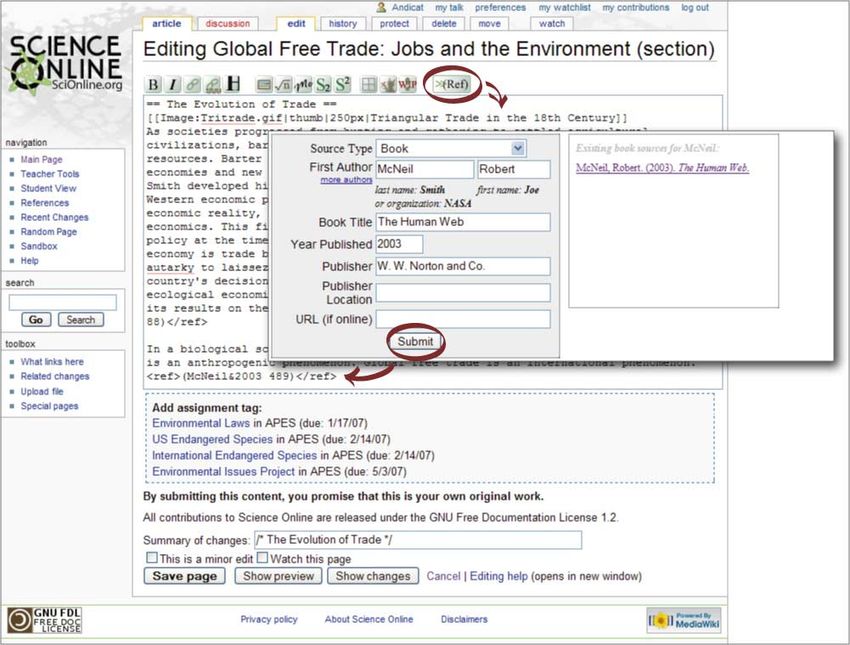
undesirability of such features was determined. In the next ReferenceTools allows students to enter their information
sections, we present the second iteration in a series of sources as they edit a wiki page. An “insert reference”
studies designed to explore and innovate both in terms of button calls a separate data entry window where the
technological design of wiki tools and social organization relevant citation data can be entered into a form. (See
of learning activities. Figure 1.) When the student saves the reference (or selects
an existing reference) a special reference tag is added to the
4. Science Online wiki text. Upon saving, the tag is rendered as an in-text
parenthetical reference and a list of works cited appears at
In 2005 we proposed the creation of Science Online, a
the bottom of the page. It is important to note that
wiki-based learning environment where student authors
references are saved in the database, so although each
construct articles about science topics. We are currently in
citation is initially associated with a specific article, the
the second design and research iteration of the project.
bibliography is shared across the wiki, so each information
After an initial pilot study using CoWeb to explore the
source need only be entered once and can be used to
desirable features of a wiki construction kit for writing-to-
support multiple articles. If the reference tag is removed
learn, we adopted the MediaWiki platform and built special
from all articles, the reference itself persists and can still be
extensions to support critical academic writing skills and
used. When a reference is entered into the database, a wiki
classroom use. The design of the extensions was based
page is automatically generated for that reference where its
partly on the results of a pilot study using wikis to support
contents can be discussed or summarized. The reference
academic writing in a freshman-level American
page allows users to modify the reference information, see
Government class (see [12]), partly on literature review,
a history of all modifications, and revert changes if
and partly on the writing practices we hoped to encourage
necessary. The reference page also provides a reverse
in the science classroom.
citation index in that it lists all articles where the reference
is currently cited.
4.1 Wiki Extensions for Academic Writing
As noted in the introductory section, we are interested in In addition to ReferenceTools, we also created extensions
understanding how students think about information to support classroom use: TeacherTools and StudentView.
sources and raising levels of information literacy. In order In our pilot study, we found that one of the aggravations
to support critical use of information sources through associated with using wikis to support classroom work was
careful citation, we built a bibliographic extension for information sprawl and a resulting inability of teachers and
MediaWiki called ReferenceTools. In the current version students to find one-another’s work and understand who
of MediaWiki, references are normally associated with one had done what [12]. The TeacherTools extension provides
article. All the relevant information (author, title, etc) is teachers with a central place to manage their classes,
entered using a special syntax in a reference tag in the wiki students, and assignments. StudentView provides
text, which is rendered as a footnote when the text is saved. essentially the same functionality for students—it
References in MediaWiki are subordinate to specific automatically groups together pages that describe their
articles. Because we want to support explicit, critical assignments in one place, and lists their classmates so that
reflection on information sources and because citation they can contact one another easily. In addition, teachers
plays a central role in the social construction of knowledge and students have access to the SendMessage extension,
in the sciences, we wanted to embed critical citation which allows them to place a message on the talk pages of
practices in the design of the wiki authoring environment. all class members or any subset of class members at once.
ReferenceTools elevates references to first-class objects in
the system.
35Figure 1: Using the ReferenceTools MediaWiki extension to insert a reference
4.2 Science Online in the Classroom class with 9 in each section. In total, 19 students both
assented to participate and turned in signed consent forms
In the 2006-2007 school year, we invited two classes of from their parents. 10 of the study participants used the
high school environmental science students to write articles wiki for an entire school year; 4 used it in the first semester
on Science Online. We spent one full academic year only, 5 it in the second semester only. All participants were
inspecting student and teacher experiences with the wiki. either high school juniors or seniors.
Our goals in examining classroom and online activity are
threefold: 1) to understand the ways that the wiki 4.2.2 Data Collection
construction kit creates a social landscape for classroom
To understand how the wiki was adopted by students and
writing activities and possibilities for reflection, interaction
teachers in the class and how they made sense of the
and learning; 2) to contribute to the design dialogue in the
technology, the interactions it afforded, and the problems
wiki community and help further sensitize other
they encountered, we conducted in-class observations as
researchers and developers to critical design issues in
well as interviews with students and the teacher at different
classrooms; and 3) to assess student learning.
points throughout the school year. A researcher was present
in the classroom on 47 days throughout the year. On 20 of
4.2.1 Participants
these days, students used computers in class to work on
The classes we invited to use the wiki were two Advanced wikis or other assignments; on the other days they were
Placement Environmental Science (APES) taught by the doing labs, other collaborative work, presenting material to
same teacher. We began the year in fall with one class of the class or having more traditional lecture/discussion days.
15 students; in spring the teacher taught two sections of the
36To assess student learning, we created document-based 4.2.3 Overview of Assigned Wiki Writing Activities
question pre- and post-tests that require students to use a
Initially, we envisioned Science Online as a place for
set of information resources to answer an environmental
students to write what would traditionally be thought of as
science question in essay form. By observing differences in
group research projects about science topics of their choice.
pre- and post-test sourcing practices, comparing these to
Instead of writing a paper that dies on the teacher’s desk,
students’ writing practices on the wiki, and listening to
student research projects would become living documents
student’s accounts of their own sourcing practices, we
and resources for others. Not surprisingly, the teacher who
intend to trace changes, if any, in students’ use of science
used the wiki adopted the site and appropriated it in new
information resources over the course of the wiki
and unexpected ways in order to balance curricular
assignments. Pre-tests showed that most students did not
demands, time constraints, and personal teaching style.
look at markers of information resource quality to
Rather than use the wiki to support one primary
understand science issues and resolve conflicts in
collaborative article-writing project and an introductory
information as they wrote.
assignment as initially envisioned, the teacher
Table 1: Study Participant Activity experimented over the course of the school year with seven
varieties of discrete wiki assignments that varied in terms
Unique
Avg. Edits Total of length, collaboration, specific editing and sourcing
Names* Pages
per Week** Edits requirements, and that were interleaved with different kinds
Edited***
of in-class activities. These assignments can be thought of
Reagan 5 97 18 as design iterations on wiki writing activities as the teacher
John 6 36 6 adapted his expectations based on previous assignments.
Sylvia 7 67 9 The assignments were:
Heather 7 221 31
Fall 2006
Paige 9 111 13
Ella 13 116 9 1. Create a User Page - October
This informal, individual assignment was designed by
Amanda 13 231 18
the researchers to be used as an introduction to the
Jill 14 382 27
wiki. This was the only assignment that was not
Carrie 16 204 13 designed primarily by the teacher.
Ed 17 271 16
2. Biogeochemical Cycles Project - October
Carl 18 72 4
Students authored articles in groups of three. They
David 18 256 14 created relatively short articles about a
Anne 19 194 10 biogeochemical cycle and explained the information
Brian 23 180 8 to the class in a 7-10 minute in-class presentation
Larry 26 153 6 using the wiki as a visual aid.
Gary 29 234 8 3. Biomes Articles - November
Kelly 30 384 13 Each student selected a biome from a list that was
Alex 45 404 9 provided by the teacher and individually authored a
Susan 49 779 16 wiki article about that biome. For this assignment, the
Avg. 19 231 13 teacher encouraged students to be creative and discuss
St. Dev. 12 171 7 where their biomes appeared in popular culture and
* All names have been changed. literature in addition to providing information and
** Avg edits per week is used to control for the fact that images. During this project, some students began
some students participated for 10 weeks, some 17, and getting more creative and tried out advanced
some 27. formatting techniques.
*** Number includes articles, userpages and talk pages. 4. Human Population Dynamics - December
At the time of this writing, data collection is ongoing. Each student selected a country or international
Student work on the wiki was recently completed; post- organization and individually created an article that
testing and post-interviewing is not yet complete. The discussed its laws and cultural issues that affect
preliminary findings we present here are based primarily on human population growth. At the end of the wiki
in-class observations and interviews that took place writing segment of the project, the class convened for
throughout the school year with both the students and the an in-class debate about human population in which
teacher. each represented the government or organization they
had investigated.
37Spring 2007 In the first semester, students were introduced to the wiki
during the first week of October. They created user pages
5. Environmental Laws - January
and a researcher demonstrated the use of features like the
This was a short wiki assignment. Approximately 10
“talk page” to leave one another messages.
new students joined the class during the second
semester. This individual assignment helped bring One of the most notable features of the first-semester
them up to speed. Each student created a short article assignments was the collaboration. The first teacher-
that described a particular international, US, or state designed wiki assignment, Biogeochemical Cycles Project,
law that impacts the environment. was a project on which students collaborated in groups of
three. Both students and teacher struggled with the
6. Endangered Species - February
collaborative aspects of the assignment. Students often
Students found one American and one international
worked in parallel during class and found that edit conflicts
threatened or endangered species of plant or animal
frequently slowed their progress. In interviews, several
and individually created an article about it. In order to
students commented on the awkwardness of having to rely
facilitate studying for the end-of-year exam, the
on other students to complete a project, regardless of the
teacher asked if we could create a special template for
technology used to write. Because it was the first
making animal “trading cards.” We created the
substantial assignment, students were not yet comfortable
template and added a “species box” button to the
with the wiki. They had difficulty recovering from errors
editing tool bar to make the template syntax easier for
and formatting their articles, which seemed to exacerbate
students to use.
their frustration with groupmates. Several students
7. Environmental Issues Project – March/April/May appealed to the teacher to grade them based on individual
The final project of the semester was longer and more rather than collective effort.
involved than the previous ones. Each student selected
Mr. Grant likewise had difficulty grading the collaborative
a contemporary environmental issue to investigate in
assignment. He found parsing page histories laborious and
depth and had approximately six weeks to research the
uninformative and had difficulty understanding how each
issue, assemble a bibliography, construct a wiki
student had contributed to the collaboration. Although he
article, and prepare a power point or other form of
had originally observed that the wiki would allow him to
presentation.
grade collaborative work more effectively, he found that it
4.2.4 Preliminary Observations was too much work to understand patterns of collaboration
and use them for assessment. After the Biogeochemical
Over the course of the school year, wiki activity varied Cycles Project ended in October, the students were not
widely from participant to participant. See Table 1 for asked to collaborate on articles again. They almost never
numbers of edits per student. Although we have not yet touched one another’s pages in later assignments.
completed data collection and analysis, a story of wiki
appropriation and resistance is beginning to emerge from In early interviews, students were positive about the wiki
our observations and interviews. Most significantly, in this assignments but noted difficulty in uploading images,
classroom context, instead of affording easy opportunities formatting and collaborating with other students. By the
to collaboratively construct text, the wiki construction kit end of the semester, classroom observations indicate that
seemed to present several barriers to collaboration. most of the study participants had become proficient wiki
editors. Many of them had begun using advanced
Before the school year began, researchers held several formatting techniques by copy and pasting text from one of
discussions with the teacher, Mr. Grant, who was the researcher’s user page. By December, early bugs
enthusiastic about the idea of using wiki to support caused by the reference extension had been mostly resolved
collaborative writing activities in high schools. He was and students only infrequently asked for assistance.
particularly positive about wiki in comparison to blogs,
which were becoming popular among teachers in his In the second semester, nine new students joined Mr.
school district, but which he felt were not well suited as a Grant’s class; of these, five consented to participate in our
platform for student writing assignments. We initially study. Because half of his students were experienced wiki
discussed the possibility of two wiki writing assignments, editors, the teacher provided less time for introduction to
but as noted, he chose to introduce seven wiki assignments the wiki in the second semester. The user page assignment
over the course of the year. As the school year progressed, was not given and researchers gave less upfront instruction;
Mr. Grant observed many limitations in the wiki toolkit as that meant nine of the students received less instruction in
he attempted to appropriate it in ways that would support using the wiki.
students in demonstrating proficiency on the advanced In the second semester, Mr. Grant became more emphatic
placement test at the end of the year. about ways that the wiki construction kit was not quite
38synchronized with his needs as a teacher. Some of his outcomes associated with it. We have observed elsewhere
concerns centered on the openness of the site. He became that MediaWiki readily supports collaborative text
increasingly concerned that students might be publishing construction and Knowledge Building discourse in other
things in a public place over which he had not had contexts, such as Wikipedia [12]. Indeed, wiki publishing
sufficient oversight. Design suggestions that emerged from environments are being used to support thousands of online
these concerns included a privacy feature that would keep communities in the open “wilds” of the Internet. Often,
student work private until the students and the teacher had wiki-based online communities are associated with a
designated it as worthy of public consumption, possibly culture of openness and are radically permissive in their
integrating it with a “rating” feature that could allow membership policies, requiring only that contributors do no
students and teachers to vote content into the public eye. harm and promote community goals, which themselves are
He was apprehensive that students might write something often open to revision.
publicly that would cause parents to complain. He
In stark contrast, wikis are also being adopted for closely
frequently expressed concern that since students could see
circumscribed uses by communities with carefully
others’ work, he could not ask several of them to write up
restricted membership and firmly routinized existing
the same topic to prepare for tests.
practices such as schools and corporations. The social
As he designed the second semester assignments, Mr. context for learning varies dramatically in these different
Grant also became increasingly concerned with designing cultural contexts and demands innovative designs. In our
ways of supporting the students in studying for the classroom, we saw evidence that not only did cultural and
Advanced Placement (AP) exam at the end of the year. institutional barriers stymie collaboration, but the design of
the collaborative tool itself contributed to resistance among
Further data analysis and final assessment data will allow
students and from the teacher. If wiki is to become a
us to tell a more nuanced story of students’ learning
readily adoptable construction kit that supports Knowledge
experiences and whether or not the wiki writing
Building communities in schools, the tools need to foster
assignments have helped bring about the desired effects on
collaborative practices by making it easy for students to
sourcing practices and information literacy.
work together and for teachers to assess collaborative
work. If teachers cannot assess collaborative wiki work,
5. Looking Forward
then we cannot expect wiki to be adopted for formal
Cultural and institutional factors influenced the adoption of education, despite the potential learning gains for students.
wiki in this classroom as a primarily individual (albeit
As open models of content production become an
shared and public) toolkit for the construction of texts.
increasingly familiar form of creating new knowledge,
Conflict between a culture of individual assessment and
educational experiences should prepare students to become
desired collaborative practices has emerged in many studies
careful, critical, and competent participants in Knowledge
of wiki in education. (See [14, 22].) Just as Da Lio
Building activities both online and off. Moving forward,
observed that Italian teachers were unprepared to adopt
we are completing data analysis to examine learning
collective ways of thinking to make use of the wiki [8],
outcomes for information literacy skills and are exploring
Grant found in her case study of wiki adoption in a UK
directions for more sophisticated teacher tools to support
secondary school that students were socially unprepared to
assessment of collaborative student work. We are working
use the wiki in a collaborative fashion. She recognizes that
to design wiki features to help close the gap between
“the social and cultural practices of collaborative working
existing classroom practices and the “real world” practices
that need to accompany the use of the software in order to
of Knowledge Building communities.
take advantage of the functional affordances of the tool
were not in the students’ repertoire of shared practices.
Instead, they imported practices of individualized written 6. Acknowledgments
assessment that they saw as important from the broader The Science Online project is supported by a grant from the
economy of education and the practices of the school National Science Foundation (#0537251).
community” [13 p.10].
7. References
Our students and teacher also employed familiar strategies
for designing and completing assignments when [1] Batson, T. The origins of Enfi. Network-Based
collaboration proved challenging. We see this cultural Classrooms: Promises and Realities, 1993, 87-112.
mismatch as an opportunity for design. Tools are a
[2] Bereiter, C. and Scardamalia, M. The Psychology of
fundamental component of any system of human activity.
Written Composition. Lawrence Erlbaum, Hillsdale,
Constructionism as a way of thinking about human learning
NJ, 1987.
reminds us that well-designed tools have the potential to
deeply affect the character of activity and the learning
39[3] Bergin, J. Teaching on the wiki web. 7th annual [16] Harel, I. and Seymour, P. Software design as a
conference on Innovation and Technology in learning environment. Constructionism, Ablex,
Computer Science Education ITiCSE, 34, (Aarhus, Norwood, NY, 1991, 41-84.
Denmark) 195-195, 2002.
[17] Honegger, B. Wikis - a rapidly growing phenomenon
[4] Bower, M., Woo, K., Roberts, M. and Watters, P. Wiki in the german-speaking school community. WikiSym
pedagogy: a tale of two wikis. International (San Diego, CA). 2005, 113-116.
Conference on Information Technology Based Higher
[18] Hutchins, E. Cognition in the Wild. MIT Press,
Education and Training, 191-202, 2006.
Cambridge, 1995.
[5] Brereton, M., Donovan, J. and Viller, S. Talking about
[19] Kay, A. and Goldberg, A. Personal Dynamic Media.
watching: using the video card game and wiki-web
Computer, 1977, 31-41.
technology to engage IT students in developing
observational skills. Fifth Australasian Conference on [20] Lave, J. and Wenger, E. Situated Learning: legitimate
Computing Education, 20, (Adelaide, Australia). 2003, peripheral participation. Cambridge University Press,
195-207. Cambridge, 1991.
[6] Bruckman, A. Community support for constructionist [21] Leuf, B. and Cunningham, W. The Wiki Way.
learning. Computer Supported Collaborative Work: Addison-Wesley, Boston, 2001.
The Journal of Collaborative Computing, 7, 1998, 47-
[22] Lund, A. and Smordal, O. Is there a space for the
86.
teacher in a wiki? WikiSym (Odense, Denmark). 2006,
[7] Bruckman, A. Co-Evolution of technological design 37-46.
and pedagogy in an online learning community.
[23] Mader, S. Using Wiki in Education.
Designing for Virtual Communities in the Service of
http://www.wikiineducation.com (last accessed
Learning, 2004, 239-255.
05/02/2007) 2006.
[8] Da Lio, E., Fraboni, L. and Leo, T. TWiki-based
[24] O'Neill, M. Automated use of a wiki for collaborative
facilitation in a newly formed academic community of
lecture notes. 36th SIGCSE technical symposium on
practice. WikiSym (San Diego, CA). 2005, 85-97.
Computer science education (St. Louis, MO). 2005,
[9] Desilets, A., Paquet, S. and Vinson, N. Are wikis 267-271.
usable? WikiSym (San Diego, CA). 2005, 3-15.
[25] Papert, S. Mindstorms: Children, Computers and
[10] Dewey, J. Experience and Education. Collier, New Powerful Ideas. Basic, New York, 1980.
York, 1938.
[26] Papert, S. Situating Constructionism. Constructionism:
[11] Emig, J. Writing as a mode of learning. College research reports and essays, 1985-1990, Ablex,
Composition and Communication, 28, 1977, 122-127. Norwood, NY, 1991, 1-11.
[12] Forte, A. and Bruckman, A. From Wikipedia to the [27] Resnick, M. Beyond the centralized mindset. Journal
classroom: exploring online publication and learning. of the Learning Sciences, 5, 1 (1996), 1-22.
International Conference of the Learning Sciences
[28] Resnick, M., Bruckman, A. and Martin, F. Pianos, not
(Bloomington, IN). 2006, 182-188.
stereos: creating computational construction kits.
[13] Grant, L. Using Wikis in Schools: a Case Study. Interactions, 3, 6 (1996), 41-49.
http://www.futurelab.org.uk/download/pdfs/research/d
[29] Resnick, M., Bruckman, A. and Martin, F.
isc_papers/Wikis_in_Schools.pdf (last accessed
Constructional design: creating new construction kits
05/02/2007), 2006.
for kids. The Design of Children's Technology,
[14] Guzdial, M., Ludovice, P., Realff, M., Marley, T. and Morgan Kaufmann, San Francisco, 1998.
Carroll, K. When Collaboration Doesn't Work.
[30] Rick, J. and Guzdial, M. Situating CoWeb: a
International Conference of Learning Sciences, 2002,
scholarship of application. International Journal of
125-130.
Computer-Supported Collaborative Learning, 1, 1,
[15] Guzdial, M., Rick, J. and Kehoe, C. Beyond adoption (2006) 89-115.
to invention: teacher-created collaborative activities in
[31] Roschelle, J. Learning by Collaborating: convergent
higher education. Journal of the Learning Sciences,
conceptual change. CSCL: Theory and Practice of an
10, 3 (2001), 265-279.
Emerging Paradigm, 1996, 209-248.
40[32] Scardamalia, M. Collective cognitive responsibility for [35] Surowiecki, J. The Wisdom of Crowds: Why the Many
the advancement of knowledge. Liberal education in a Are Smarter Than the Few and How Collective
knowledge society, 2002, 67-98. Wisdom Shapes Business, Economies, Societies and
Nations. Anchor Books, New York, 2004.
[33] Scharff, E.D. Open Source: A Conceptual Framework
for Collaborative Artifact and Knowledge [36] Wales, J. Opening Remarks. Wikimania (Cambridge,
Construction. Ph.D. Thesis, University of Colorado- MA), 2006.
Boulder, CO, 2002.
[37] Wang, C. and Turner, D. Extending the wiki paradigm
[34] Suchman, L.A. Plans and Situated Actions: The for use in the classroom. International Conference on
Problem of Human-Computer Communication, Information Technology: Coding and Computing,
Cambridge University Press, Cambridge, 1987. 2004, 255-259.
41You can also read


