Coronavirus and international students - October 2020 Peter Hurley - Victoria University
←
→
Page content transcription
If your browser does not render page correctly, please read the page content below
Coronavirus
and international
students

October 2020
Peter Hurley
About us
The Mitchell Institute for Education and Health Policy at Victoria University is one of the
country’s leading education and health policy think tanks and trusted thought leaders. Our
focus is on improving our education and health systems so more Australians can engage with
and benefit from these services, supporting a healthier, fairer and more productive society.

Acknowledgements
The author would like to thank Sergio Macklin, Dr. Philippa Moylan and Dr Nina Van Dyke for
their advice and input on previous versions of this paper.
The author would also like to acknowledge the Department of Education, Skills and
Employment and the Department of Home Affairs who have, since the start of the pandemic,
provided data detailing the impact of the coronavirus pandemic on international students. This
report and analysis would not be possible without this data.

This report uses visualisations from the mapdeck and tmap packages in r. The author would
like to acknowledge the creators of these packages whose work makes these visualisations
possible.

Suggested citation
Hurley, P. (2020). Coronavirus and international students. Mitchell Institute, Victoria University.
Melbourne.

                                                                                                 1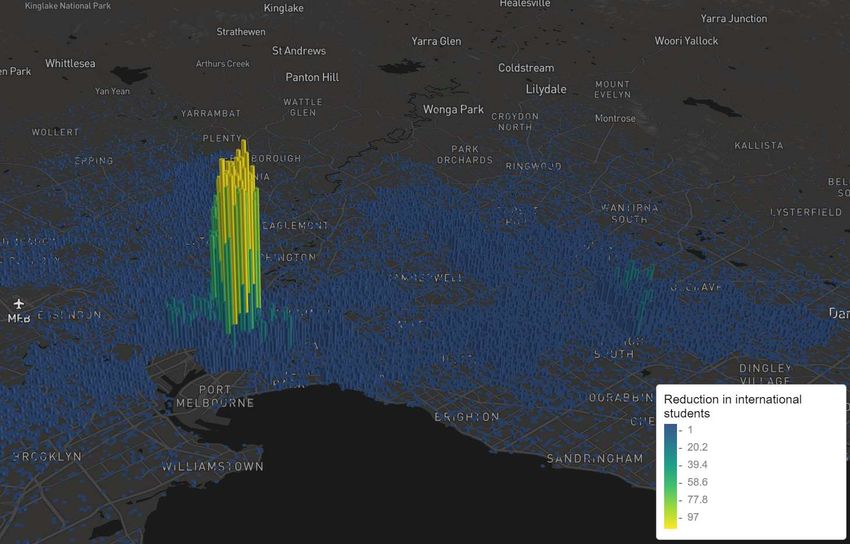
Table of Contents
International student update .................................................................................................. 3
Key points ............................................................................................................................. 4
International student applications .......................................................................................... 5
Currently enrolled international students ............................................................................... 7
What will be the impact of continuing travel restrictions? ....................................................... 9
Where has been affected the most? .....................................................................................11
Policy implications ................................................................................................................19
   Losses related to international student will continue to grow .............................................19
   Current policy responses may have limited impact ...........................................................19
   The problem is bigger than just the education sector ........................................................20
   Role of migration policy.....................................................................................................20
References ...........................................................................................................................22
Appendix 1: Top ten areas with the greatest reduction in international students by state and
territory .................................................................................................................................23
Appendix 2: Technical Appendix ..........................................................................................27
   Calculating student numbers.............................................................................................27
   Modelling changes to international student figures ............................................................27
   Limitations ........................................................................................................................27

                                                                                                                                           2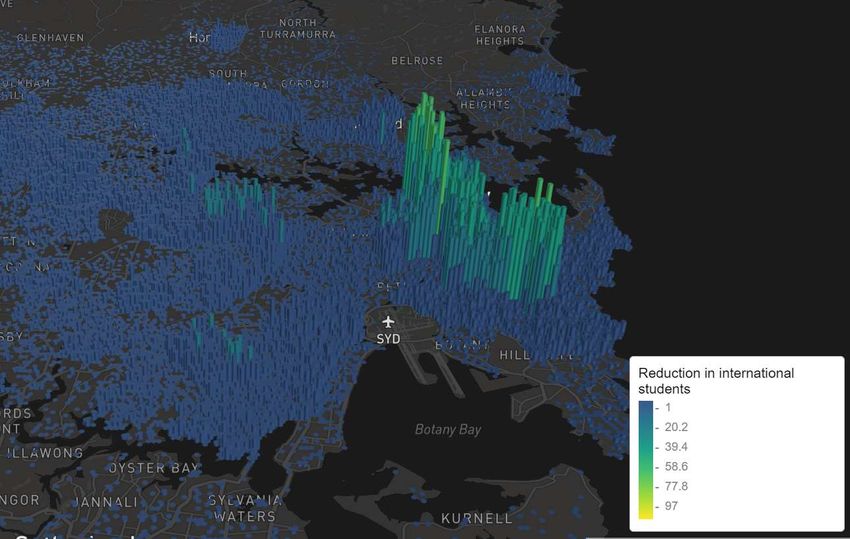
International student update
This report provides an update on issues caused by the Coronavirus disease (COVID-19)
pandemic that affect international students and the international education sector.
Previous Mitchell Institute reports have highlighted how problems affecting international
students impact Australia's universities, Australia's economy and local communities (Hurley,
2020; Hurley & Van Dyke, 2020). These reports showed that international students have
transformed our cities and that issues experienced by international students will affect many
Australians.
This report uses the most up-to-date available data to refine previous research. The analysis
in this report shows that Australia's international education industry is facing severe disruption
characterised by a continuing reduction in both currently enrolled international students and
the number of international students inside Australia.
This disruption will have long-term consequences. For universities, this includes continuing
uncertainty and losses in revenue. For the broader Australian community, the impact of the
international student crisis will affect cities, and communities within cities, differently.
When the worst effects of the coronavirus pandemic are over, Australia will have a radically
different international education sector. Re-building the sector is a priority for all levels of
government and this report concludes by considering some of the policy implications. While
the crisis may not be over, the time is right to start planning how the international education
sector should function in a post-coronavirus environment.

                                                                                                3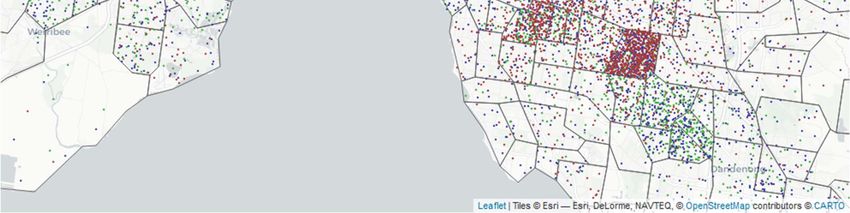
Key points
Applications for international student visas have collapsed. Applications for student visas
for individuals who are outside Australia are approximately 80–90% below what they were
at the same time in 2019.
There are approximately 210,000 fewer international students in Australia than would
otherwise be expected. From the 29th of March to October 25th 2020, there was a reduction
of around 75,000 currently enrolled international students. As of October 25th 2020, there
were approximately 135,000 international students outside Australia and 400,000 in
Australia.
The longer the travel restrictions remain in place, the greater the losses associated with
the international education sector. Modelling based on the rate of decline experienced in
the first six months of the pandemic suggests that, compared to October 2019, there will
be an approximate 50% reduction in international students inside Australia by July 2021.
If the travel restrictions remain in place until July 2022, the modelling suggests about
165,000 international students will remain inside Australia, a reduction of over 410,000
compared to October 2019.
The current international education crisis is not just a university problem. Approximately
57%, or $21.4 billion, of the $37.5 billion in annual revenue associated with international
education comes in the form of goods and services spent in the wider economy. The
reduction in international students living in Australia will affect the many Australian jobs
and businesses that rely on international education.
The impact of fewer international students will vary by city. For instance, Sydney and
Melbourne have likely experienced a substantial reduction in international students.
However, the loss is more concentrated in Melbourne's CBD area whereas in Sydney the
reduction is more evenly spread throughout the city.
It is unclear whether programs that enable currently enrolled international students outside
Australia to return will have a substantial impact. This is because many international
students inside Australia are choosing to leave the country.
There is a strong association between migration policy and the international education
sector. This current crisis may be an opportunity to implement policy reform that builds a
more sustainable international education sector.
4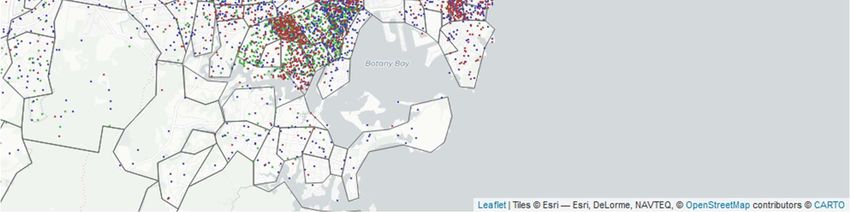
International student applications
International student visa applications have fallen sharply since the beginning of the pandemic.
Figure 1 compares the number of student visa applications for the fourth quarter of the financial
year (April to June) from 2006 to 2020. Selecting only the fourth quarter in each year enables
a better comparison of the impact of the coronavirus on international student applications. This
is because the April to June 2020 quarter was the first full quarter to be impacted by the
widespread travel restrictions that began in March 2020.

Figure 1: International student visa applications for April to June (financial quarter 4) 2006 to
2020.

Source: Department of Home Affairs (2020a)

This data show that applications for April to June 2020 were down by approximately 62%
compared to the same period in 2019.
While there is a significant drop in April to June 2020, the above figure may mask the severity
of the impact of the coronavirus on new international student applications. This is because
overall applications will include individuals who are already in Australia such as currently
enrolled students who are applying for another course, or those on tourist visas who are
applying for a student visa.

                                                                                                5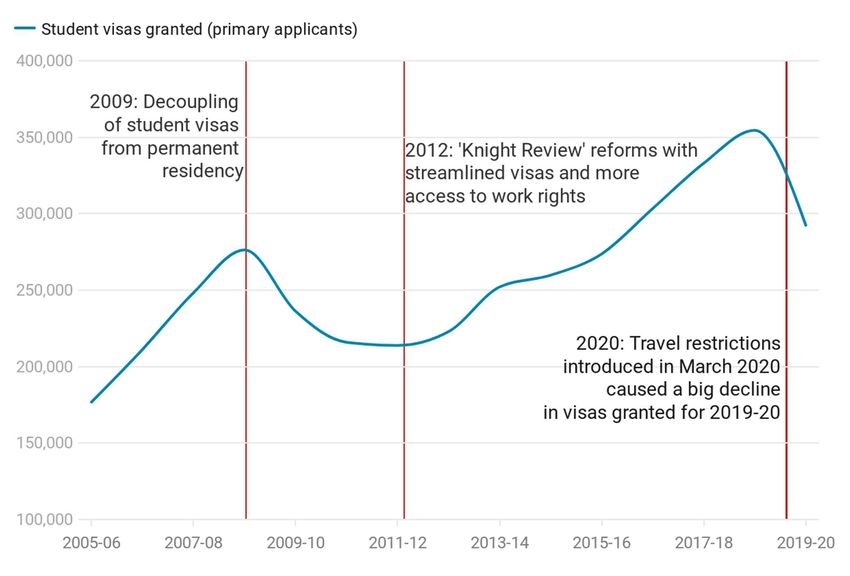
Data showing the location of applicants provides readers with a better understanding of the
impact on future international students. Figure 2 shows the number of student visa applications
where the applicant is outside Australia. It shows available monthly data for 2019 and 2020.

Figure 2: Student visa applications where applicant is outside Australia

Source: Department of Home Affairs (2020a)

This figure shows there has been a much more dramatic drop in international student visa
applications where the applicant is outside Australia. This is important because applicants from
outside Australia will replace those students who finish their studies and return home. This
suggests there will be a substantial impact on overall international student figures for some
time, as new students from outside Australia are unable to start their courses.

                                                                                              6
Currently enrolled international students
Since the beginning of the pandemic, the Australian Government has released detailed data
showing the location of international students inside and outside Australia. Table 1 summarises
this information using data from the 29th March 2020 compared to data from 25th October 2020.

Table 1: International students inside and outside Australia

Source: Department of Home Affairs (2020b)

This table shows that at the end of March, approximately 116,000 international students were
outside Australia, of which Chinese international students made up the largest number. This is
because the Australian Government first applied travel restrictions for foreign nationals coming
from China in February 2020. The Australian Government introduced broader travel
restrictions in March, after the start of the first semester in higher education. This meant that
many non-Chinese international students were able to return or commence their studies before
broader travel restrictions began.
The data provided by the Australia Government helps highlight several points about the impact
of the coronavirus pandemic on international student enrolments. These include:

                                                                                               7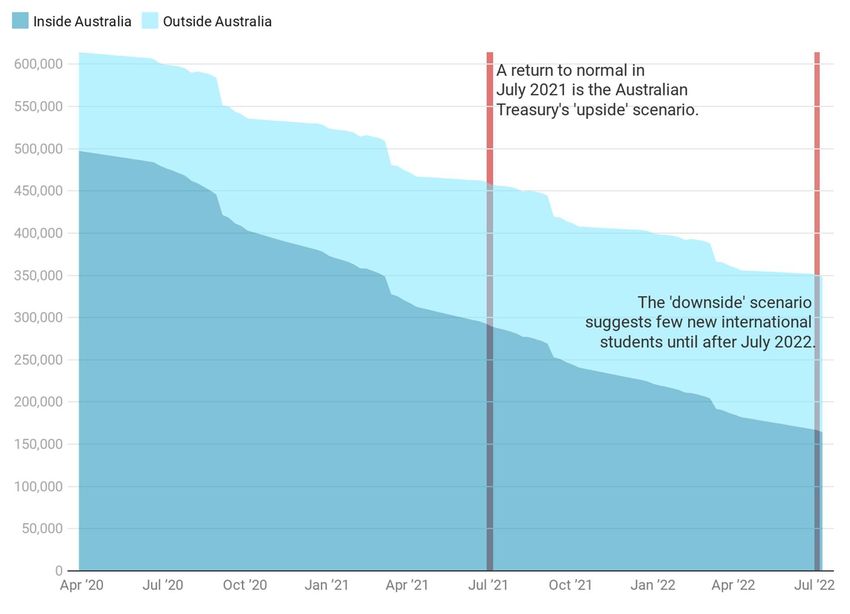
1. The number of international students outside Australia has risen to over 135,000
   since March 2020. This suggests that many international students are returning to their
   home country while remaining enrolled.
2. The number of enrolled international students has declined by approximately
   75,500, or 12.3%, since late March. The largest drop occurred in the first week of
   September, where there was a reduction of approximately 32,400 international
   students (in the week between August 30th 2020 and September 6th 2020). This is likely
   because the visas for the semester one 2020 higher education cohort expired at the
   end of August and these students either returned home or transitioned to other visas.
3. Australia is facing the dual problem of fewer international students and a drop in
   international students living in Australia. This is important to consider because the
   location of international students will affect their overall contribution to the economy.
   The Australian Bureau of Statistics (2020) estimates that international education
   contributed about $21.4 billion in goods and services to the Australian economy in
   2018–19. While international students are outside Australia they will not be spending
   on property or retail, which previous Mitchell Institute research shows accounts for
   approximately 70% of international student general expenditure in the wider economy
   (Hurley, 2020).

                                                                                          8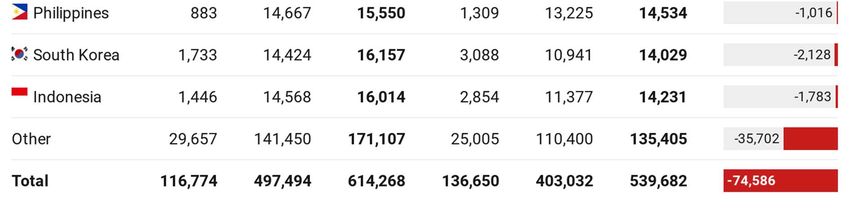
What will be the impact of continuing travel
restrictions?
There is now six months of available data on the impact of COVID-19 on international student
enrolments. Based on this data, the Mitchell Institute has modelled the impact of continuing
travel restrictions on international student enrolments in Australia.
For the six months from March 29th 2020, the data show that international student enrolments
have decreased by approximately 12%. During the same period, the number of international
students who are outside Australia has increased by approximately 13%, or 15,440.
The data also show there is a very strong seasonal aspect to international student enrolments.
There has been a steady weekly decline in currently international student enrolments, and a
steady increase in international students outside Australia. At the end of the semester, there
is a significant drop in enrolments as students who completed in the previous semester
transition off student visas.
Using the data, the modelling adopts a seasonal naïve approach to forecast future changes in
international student enrolments if borders remained closed. That is, what would future weekly
international student enrolments look like if total enrolments continued to decline, and currently
enrolled international students continued to leave Australia, at the same rate as what occurred
in the six months since March 29th 2020?
It is important to emphasise that this modelling assumes borders remain closed. If international
students outside Australia are able to return to Australia, and new students can commence
onshore, this will affect the forecast.
Figure 3 shows the results of this modelling. This figure also highlight two dates identified by
the Australian Government in the 2020-21 Federal Budget. The first date is July 2021 which
the Australian Government uses to describe an 'upside' scenario. In this scenario, an early
vaccine results in a quicker recovery and a return of international student enrolments in the
second half of 2021. The second date of July 2022 aligns to the 'downside' scenario where
waves of "rolling outbreaks necessitate the reimposition of severe containment measures on
around 25 per cent of the national economy from 1 January 2021 to 30 June 2022" (Australian
Treasury, 2020, pp. 2-15). This 'downside' scenario suggests a continuation of the travel
restrictions that inhibits the flow of new international student enrolments.

                                                                                                9
Figure 3: Change in future international student enrolments (actual and forecast)
Source: Mitchell Institute analysis of Department of Home Affairs (2020b) data.
This figure shows that the longer borders remain shut the more international student
enrolments will decline. The estimates in this figure suggest that without some major change,
by July 2021 there will be approximately 457,000 enrolled international students, with less than
290,000 of those inside Australia. This is a reduction of approximately 50% compared to
October 2019 figures which show there were about 578,000 international students inside
Australia (Department of Home Affairs, 2020a).
The 'downside' scenario identified by the Australian Treasury is even more dramatic. In this
scenario, total enrolments will continue to decline to 350,000. The number of international
students living in Australia is likely to be only 165,000.
10Where has been affected the most?
International students contribute to local communities and economies. Identifying the parts of
Australia most affected by the international student crisis is important because it assists with
understanding the impact of problems with the international education sector at a local level
and responding to these challenges.
Data provided by the Australian Government provides accurate information on the impact of
the coronavirus on international students at a state and territory level.
Table 2 below shows the number of international students by state in March 2020 compared
to data from October 25 2020. The October 25 2020 data shows both the reduction in
international students and those international students who are currently outside Australia.
Comparing data in this way helps estimate the reduction in international students living in
various parts of Australia because of the coronavirus.
Table 2: International students by state or territory (2020)
Change in
Change in Estimated change in
international
enrolled international
State or International students
international students living in
territory of students outside
students (to state/territory due to
institution (March 2020) Australia (to
October 25 coronavirus (to
October 25
2020) October 25 2020)
2020)
NSW 221,795 -27,304 -52,415 -79,719 -35.94%
VIC 185,250 -21,390 -45,465 -66,855 -36.09%
QLD 109,771 -17,267 -20,066 -37,333 -34.01%
WA 33,502 -4,210 -4,775 -8,985 -26.82%
SA 37,627 -232 -7,843 -8,075 -21.46%
TAS 6,584 -739 -1,463 -2,202 -33.44%
ACT 13,037 -1,451 -4,054 -5,505 -42.23%
NT 1,914 -177 -93 -270 -14.11%
Not 4,788 -1,816 -476 -2,292 -47.87%
available
Total 614,268 -74,586 -136,650 -211,236 -34.39%
Source: Department of Home Affairs (2020b).
This table shows that the biggest reduction has occurred in New South Wales and the biggest
proportional fall has occurred in the Australian Capital Territory. This is likely because these
regions have a higher number and proportion of Chinese international students.
11The reduction in international students will be experienced differently at a local level as the
density of international students varies across Australian cities. Indeed, previous Mitchell
Institute research showed that international students have had a transformative impact on
Australian cities (Hurley, 2020). The large growth in international students since 2006 meant
that in 2019, before the coronavirus pandemic, international students made up over 30% of
the resident population in some suburbs.
Generally, it is inner-city areas and suburbs near university campuses that have the largest
populations of international students. However, the Mitchell Institute research also showed that
many outer suburbs had significant populations of international students, especially those
areas with more affordable housing and good public transport links.
It is possible to extend previous analysis and estimate where international students live
according to their country of birth. This is useful because, as Table 1 shows, the impact of
coronavirus on international students varies by country of citizenship. Identifying where
international students from different countries live can help understand where the impact has
been the greatest.
In order to estimate pre-coronavirus levels of international students, this analysis uses the most
recent data from March 2020 and assumes that all enrolled students would be living in the
state where their institution is located. The analysis takes this approach because the March
2020 figures are the most recent and comprehensive available data outlining international
students by country of citizenship and state of institution. Some limitations to this approach are
outlined in Appendix 2.
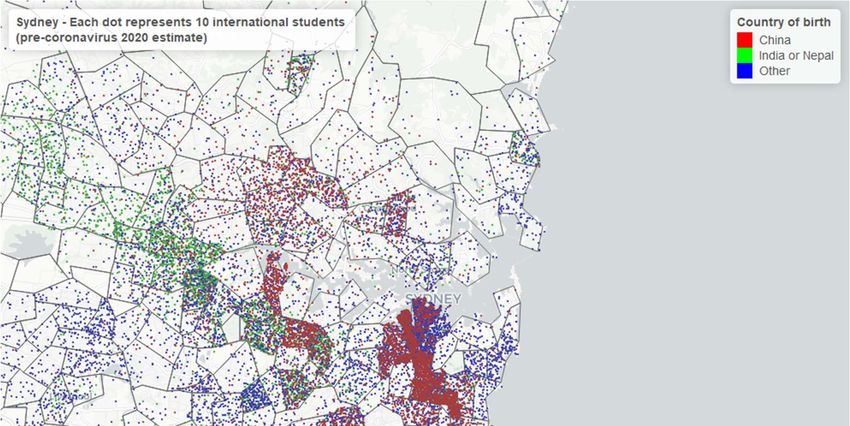
Figure 4 estimates where international students lived in Greater Sydney by country of birth
before the coronavirus pandemic. This figure uses recent data outlining the total number of
international students in New South Wales and combines it with census data to map where
international students are most likely to be living based on their country of birth. This figure
shows international students from China in red, India and Nepal in green, and other countries
in blue.
12Figure 4: Dot density map of Sydney estimating the place of usual residence of international
students by country of birth where each dot represents ten international students (pre-
coronavirus 2020 estimate)
Source: Mitchell Institute analysis of Department of Home Affairs (2020b) and Australian Bureau of Statistics (2016) data.
This figure shows that where international students live in Greater Sydney can vary greatly
according to their country of birth. Chinese international students generally live in inner Sydney
with pockets of high Chinese student populations in Hurstville and in Strathfield/Burwood. By
contrast, international students from India and Nepal live in greater numbers further west,
especially around Parramatta.
Table 2 shows that there are approximately 80,000 fewer international students living in New
South Wales because of the coronavirus. The Mitchell Institute estimates this will equate to
approximately 72,000 fewer international students living in the Greater Sydney area. However,
this reduction is unlikely to be spread evenly throughout the city. Those regions with a higher
proportion of Chinese international students are more likely to be experiencing a reduction in
international students.
To visualise where this loss has occurred in the Greater Sydney region, Figure 5 is a three-
dimensional map that estimates where those 72,000 international students would be living if
not for coronavirus. Essentially, the higher the column, the greater the reduction in international
students and the greater the impact on local business and communities.
13Figure 5: Three-dimensional map showing the reduction in international students in the
Greater Sydney area because of the coronavirus pandemic (October 2020 estimate)
Source: Mitchell Institute analysis of Department of Home Affairs (2020b) and Australian Bureau of Statistics (2016) data.
This figure shows that Sydney's inner suburbs are likely to be experiencing the biggest fall in
international students. Areas such as Hurstville and Strathfield will also have a significant
reduction in international students, likely because of their higher proportion of Chinese
international students.
The impact of coronavirus on international students will vary by city and by suburbs within
cities. For instance, Melbourne also has a large international student population with a high
proportion of Chinese international students.
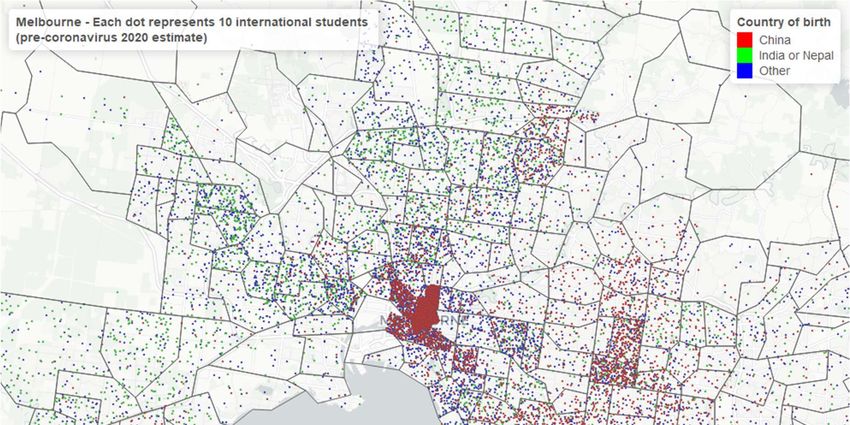
Figure 6 is a dot density map that estimates where international students lived in Greater
Melbourne by country of birth before the coronavirus pandemic. This figure shows international
students from China in red, from India and Nepal in green, and from other countries in blue.
14Figure 6: Dot density map of Melbourne estimating the place of usual residence of
international students by country of birth where each dot represents ten international students
(pre-coronavirus 2020 estimate)
Source: Mitchell Institute analysis of Department of Home Affairs (2020b) and Australian Bureau of Statistics (2016) data.
This figure shows, similar to Greater Sydney, the geographical location of international
students can differ by country of birth. There are more Chinese international students living in
Melbourne's CBD and south-eastern suburbs. Indian and Nepalese international students are
more likely to live in the west and north of Melbourne, as well as in south-eastern regions such
as Dandenong.
This geographical distribution of international students means that the impact of the
coronavirus on local populations of international students in Melbourne will differ by suburb.
Figure 7 visualises the estimated reduction in international students using a three-dimensional
map. There are about an estimated 64,000 fewer international students living in Melbourne
because of the coronavirus pandemic. The figure below uses the same colour scale as Figure
5, enabling an easier comparison of the relative impact of coronavirus between Melbourne and
Sydney.
Figure 7: Three-dimensional map showing the reduction in international students in the
Greater Melbourne area because of the coronavirus (October 2020 estimate)
15Source: Mitchell Institute analysis of Department of Home Affairs (2020b) and Australian Bureau of Statistics (2016) data.
This figure shows that the largest reduction in international students has been in the Melbourne
CBD. Compared to Sydney the loss is much more concentrated in the central city area, with a
notable reduction in Melbourne's south-east, surrounding the Clayton campus of Monash
University.
This different distribution in the reduction in international students in Australia's two largest
cities also appears in rental vacancy data. As there are fewer international students in
Australia, there are likely to be fewer properties rented by international students, resulting in
an increase in rental vacancy rates.
Table 3 and Table 4 show the top ten areas in Greater Sydney and Greater Melbourne that
the Mitchell Institute estimates are experiencing a reduction in international students. The table
also shows rental vacancy rates for September 2020 compared to September 20191.
Table 3: Estimated reduction in international students and rental vacancy rates in Greater
Sydney.
Greater Sydney
Suburb (SA2) Estimated September September
reduction in 2020 2019
1
Rental vacancy is drawn from unofficial data published by SQM Research.
16international vacancy vacancy
students rates rates (%)
Waterloo – Beaconsfield 3,550 5.9% 2.8%
Sydney – Haymarket – The Rocks 3,380 12.8% 4.3%
Kingsford 2,840 8.4% 2.7%
Pyrmont – Ultimo 2,690 8.3% 3.2%
Redfern – Chippendale 2,420 8.4% 2.1%
Burwood – Croydon 2,120 7.4% 2.6%
Kensington (NSW) 2,030 7.5% 3.1%
Macquarie Park – Marsfield 1,910 8.7% 4.7%
Concord West – North Strathfield 1,890 3.8% 2.8%
Hurstville 1,610 5.4% 4.3%
Source: Mitchell Institute analysis of Department of Home Affairs (2020b) and SQM Research (2020) data.
17Table 4: Estimated reduction in international students and rental vacancy rates in Greater
Melbourne.
Greater Melbourne
Suburb (SA2) Estimated September September
reduction in 2020 2019
international vacancy vacancy
students rates rates
Melbourne 7,670 10.8% 3.2%
Clayton 4,020 7.8% 2%
Carlton 3,910 8.4% 2.8%
North Melbourne 1,810 6.8% 3.2%
Southbank 1,530 16.8% 4.1%
Box Hill 1,370 5.7% 3.3%
Burwood 1,290 5.3% 3.9%
Malvern East 950 9.8% 2.8%
Docklands 930 17.4% 3.2%
Carnegie 900 4.6% 1.4%
Source: Mitchell Institute analysis of Department of Home Affairs (2020b) and SQM Research (2020) data.
This table shows that rental vacancy rates have increased in all suburbs where the Mitchell
Institute estimates there has been a significant reduction in international students. Areas close
to Melbourne's CBD have experienced some of the biggest increases in rental vacancies, with
the Docklands and Southbank areas reporting a rental vacancy rate of more than 16%.
The top ten regions experiencing a reduction in population because of the coronavirus in each
state and territory are shown in Appendix 1.
18Policy implications
The above data and analysis suggest that issues facing the sector will continue for some time.
The Mitchell Institute had forecast losses to the university sector using a model that assumed
a return to international student commencements by mid-2021. This timeline now seems
unlikely. Indeed, the point at which Australia's international student enrolments stops declining
is unknown. This uncertain environment has a number of policy implications, with key
implications discussed below.
Losses related to international student will continue to grow
International student enrolments function like a pipeline. Many international students begin in
a pathway or English language course before progressing to a formal VET or higher education
course. The process can take several years. As some international students finish their
courses, new international students commencing their courses replace them.
The coronavirus has severely disrupted this pipeline. There has now been a compromised
intake for semester one 2020 and a missed intake for semester two 2020. It seems likely that
there will be another missed intake for semester one 2021 with the earliest possible resumption
of onshore commencements occurring in semester two 2021.
The data outlining international applications suggests that these missed intakes have not
accumulated, so when new international students can commence their courses, there is
unlikely to be three semesters' worth of international students arriving. Applications have
largely dried up, suggesting there is little built-up demand.
As currently enrolled international students finish their courses, the number of enrolled
international students will continue to decline. Moreover, currently enrolled international
students continue to leave Australia, hastening the reduction in onshore international students.
Current policy responses may have limited impact
Since the start of the pandemic, there have been many attempts to enable international
students stranded outside Australia to return, and to enable new international students to enrol.
In June 2020, the ACT was announced as a trial site for the return of 350 international students
(Lowrey & Borys, 2020). This trial is yet to proceed. In September 2020, the Northern Territory
government announced a similar pilot program to return 70 international students to Australia
(James, 2020).
It is unclear whether such measures will have a substantial impact on the international
education crisis. Many currently enrolled international students are choosing to leave the
country. The number of international students outside Australia has grown since the start of
the pandemic, up from approximately 117,000 in March 2020 to over 135,000 in October 2020
(Department of Home Affairs, 2020b). Consequently, programs to bring international students
stranded overseas into the country may not be able to counter the steady reduction of
international students living in Australia.
However, the current crisis also brings opportunities. Australia competes with other countries
in the international education market, especially the United Kingdom, Canada and the United
States. Australia's handling of the pandemic means it may be in a better position to take a
19greater share of the international student market, and present itself as a COVID-safe
destination for international students.
The problem is bigger than just the education sector
Often debates concerning international students involve the contribution these students make
to the economy and the dependence of universities on international student revenue. However,
it is also important to highlight the wide-ranging impact of international students on Australian
communities.
International students contribute to local communities. In an economic sense, this contribution
is substantial. In 2018–19, approximately 57%, or $21.4 billion, of the $37.5 billion in annual
revenue associated with international education came in the form of goods and services spent
in the wider economy (Australian Bureau of Statistics, 2020).
This means that issues affecting international students will also be impacting those who have
close connections to them. Indeed, international students are more than just an export revenue
stream, and for many Australians they will be neighbours, friends, partners, tenants,
colleagues, classmates and customers.
These students' varied roles support the need for a policy response that considers the situation
of international students and the unique challenges they face.
Hundreds of thousands of international students have had their studies interrupted by the
pandemic. Many have had to rely on handouts. International students are not eligible for certain
support programs such as JobKeeper. In contrast, some countries have included international
students in such support programs, such as New Zealand's COVID-19 wage subsidy program
(NZ Governmnent, 2020).
It is clear that many international students are struggling. One report found six out of ten
international students who were working lost their job when the pandemic began (Morris et al.,
2020). Implementing policies that minimise the losses experienced by international students
are an important component of the coronavirus response.
Another example of a possible policy response is the implementation of more flexible visa
arrangements. Such arrangements will enable international students to adjust their study plans
without fear of contravening the requirements of their visa.
Role of migration policy
Migration policy has an enormous influence on Australia's international education sector. The
current crisis is largely the cause of a migration policy in the sense that Australia has shut its
international borders and restricted the movement of people.
Figure 8 below highlights the relationship between migration policy and international education.
The figure shows international student visas granted per year from 2005–06 to 2019–20. This
figure also identifies three significant changes in migration policy relating to international
students. The first major change refers to policies introduced around 2009 that 'de-coupled'
student visas from permanent residency visas, making it more difficult to use a student visa as
a pathway to permanent residency (Ferguson & Sherrell, 2019). The second major change
came following the 'Knight Review', which loosened some of the visa eligibility criteria for
international students and created more opportunities for graduates to work in Australia after
20their studies (Birrell, 2019). The third change is when the government implemented travel
restrictions in response to COVID-19.
Figure 8: International student visas granted (primary applicants) 2005–06 to 2019–20
Source: Department of Home Affairs (2020a)
This figure shows that the decoupling of student visas from the permanent residency pathway
in around 2009 led to a drop in the number of international student visas granted. The number
of international student visas granted began to rise again in 2012 after the introduction of
reforms following the 'Knight Review'. In 2019–20, the number of international student visas
granted again began to fall as the impact of the coronavirus pandemic began to be felt.
As Australia is experiencing an extraordinary disruption to the international student market, it
may be an opportune time to revisit the relationship between international education and
migration policy. Prior to the coronavirus pandemic, there had been many concerns regarding
institutional reliance on international students as well as reports of exploitation (Birrell, 2019;
Hurley & Van Dyke, 2020).
The sharp reduction in international students means Australia will be able to better position
itself in how it would like to shape any future growth in international students. Indeed, while
this paper identifies the extraordinary challenges facing the international education sector, it
seems not a case of if international students will return but when. From a policy perspective, it
seems wise to add how to the policy discussions. Effort should work towards a more
sustainable, equitable, and fairer international student education model that delivers benefits
for all stakeholders, including international students themselves.
21References
Australian Bureau of Statistics. (2016). Australian census. Canberra: Commonwealth of
Australia
Australian Bureau of Statistics. (2020). 5368.0.55.003 - International Trade: Supplementary
Information, Financial Year, 2018-19. Canberra: Commonwealth of Australia
Australian Treasury. (2020). Budget Strategy and Outlook Budget Paper No. 1 2020–21.
Birrell, B. (2019). Overseas students are driving Australia’s Net Overseas Migration tide. The
Australian Population Research Institute.
Department of Home Affairs. (2020a). Student visa program. Canberra: Commonwealth of
Australia
Department of Home Affairs. (2020b). Visa holders location by citizenship. Canberra:
Commonwealth of Australia
Ferguson, H., & Sherrell, H. (2019). Overseas students in Australian higher education: a
quick guide. Canberra: Parliament of Australia
Hurley, P. (2020). International students vital to coronavirus recovery. Melbourne: Mitchell
Institute
Hurley, P., & Van Dyke, N. (2020). Australian investment in education: higher education.
Melbourne: Mitchell Institute
Hyndman, R., & Athanasopoulos, G. (2018). Forecasting: principles and practice (2nd edition
ed.). Melbourne, Australia.: OTexts.
James, F. (2020, 29 September). International students could soon fly to Darwin from
Singapore, but questions about cost still remain.
Lowrey, T., & Borys, S. (2020, 18 June). Proposal to fly hundreds of international students
back to Canberra university campuses. ABC News.
Morris, A., Hastings, C., Wilson, S., Mitchell, E., Ramia, G., & Overgaard, C. (2020). The
experience of international students before and during COVID-19: Housing, work,
study and wellbeing. Sydney: Sydney: University of Technology Sydney
NZ Governmnent. (2020). COVID-19 information for students, agents and the international
education sector.
SQM Research. (2020). Residential Vacancy Rates.
22Appendix 1: Top ten areas with the greatest
reduction in international students by state and
territory
Suburb (SA2) October estimated
reduction
NSW
Waterloo - Beaconsfield 3560
Sydney - Haymarket - The 3380
Rocks
Kingsford 2840
Pyrmont - Ultimo 2700
Redfern - Chippendale 2430
Burwood - Croydon 2120
Kensington (NSW) 2030
Macquarie Park - Marsfield 1910
Concord West - North 1890
Strathfield
Hurstville 1620
VIC
Melbourne 7710
Clayton 4040
Carlton 3940
North Melbourne 1820
Southbank 1540
Box Hill 1380
Burwood 1300
Malvern East 950
23Suburb (SA2) October estimated
reduction
Docklands 940
Carnegie 900
QLD
St Lucia 1950
Kelvin Grove - Herston 1270
Brisbane City 1100
Surfers Paradise 1020
Sunnybank Hills 890
Eight Mile Plains 810
Runcorn 790
Sunnybank 780
Calamvale - Stretton 760
Southport - North 760
SA
Adelaide 1510
Plympton 340
Richmond (SA) 290
Windsor Gardens 260
Rostrevor - Magill 230
Enfield - Blair Athol 220
Mawson Lakes - Globe 220
Derby Park
Hindmarsh - Brompton 210
Unley - Parkside 210
Payneham - Felixstow 200
WA
24Suburb (SA2) October estimated
reduction
Bentley - Wilson - St James 700
Perth City 590
Nedlands - Dalkeith - 520
Crawley
Cannington - Queens Park 360
Rivervale - Kewdale - 250
Cloverdale
Victoria Park - Lathlain - 190
Burswood
Manning - Waterford 190
East Victoria Park - Carlisle 190
Nollamara - Westminster 180
Wembley - West Leederville - 160
Glendalough
TAS
Sandy Bay 730
Mount Nelson - Dynnyrne 220
Newnham - Mayfield 180
Hobart 180
Mowbray 140
South Hobart - Fern Tree 70
New Town 60
Glenorchy 40
Invermay 40
West Moonah 40
ACT
Civic 810
25Suburb (SA2) October estimated
reduction
Belconnen 610
Bruce 550
Acton 350
Franklin 300
Harrison 240
Braddon 280
Gungahlin 220
Turner 170
Kaleen 160
NT
Brinkin - Nakara 30
Darwin City 20
Coconut Grove 10
Stuart Park 10
Nightcliff 10
Lyons (NT) 10
Larrakeyah 10
Wagaman 10
Millner 10
Rapid Creek 10
Mitchell Institute analysis of Department of Home Affairs (2020b) and Australian Bureau of Statistics (2016) data.
26Appendix 2: Technical Appendix
Calculating student numbers
This report used Australian Bureau of Statistics (ABS) census data and data from the
Department of Home Affairs to calculate international student numbers and the location of
international students by place of usual residence.
International student data by state/territory and country of citizenship are determined using
data provided by the Department of Home Affairs, which has released weekly data since the
start of the pandemic on the location of international students.
This data will provide accurate information on enrolments in each state and territory. To
estimate where international students are living by place of usual residence within each state
and territory, ABS 2016 census data was analysed using TableBuilder. Data was drawn from
the following categories:
CITP Citizenship type (Not Australian) + TYPP Type of educational institution attending
(University or Other + TAFE or other vocational college) + Country of birth by SA2 area,
place of usual residence.
The Mitchell Institute used the census data to estimate the proportion of international students
living in each state and territory by Statistical Area 2 (SA2) region. This proportion was then
combined with actual state and territory international student data to estimate the total
population of international students in a given area.
Modelling changes to international student figures
To model the changes in international student figures, the Mitchell Institute used a seasonal
naïve method (Hyndman & Athanasopoulos, 2018). This method uses observations from the
previous seasonal period to predict future changes.
International student data follows a six-monthly seasonal pattern. This is because there are
two main intakes each year at the start of semester one and semester two. The forecasts sets
the seasonal period as the six months beginning from March 26th 2020. The weekly rate of
change was ascertained and then applied to future six monthly periods to model changes in
international student figures.
Limitations
All forms of data analysis have limitations and it is important to understand how these
limitations will affect analyses and interpretations of data.
27Data outlining the location of international students in each state and territory relies on
information from the ABS census. This information was collected in 2016 and between 2016
and 2020 there will be changes to where international students live.
ABS census data does not identify whether an individual has an international student visa and,
where census data is used, the citizenship status of individuals enrolled in a post-secondary
institution is used as a proxy for determining international student status.
The modelling assumes that future seasonal periods will follow the same pattern as the six
months from March 29th 2020. Changes in government policy, especially relating to border
closures, will affect this modelling.
To estimate pre-coronavirus international student levels this analysis uses total student
enrolment data from March 2020 and includes international students inside and outside
Australia. This is because these figures are the most detailed available dataset outlining
international students by country of citizenship and location of enrolling institution. Actual pre-
coronavirus levels may differ from this dataset.
28Mitchell Institute for Education and Health Policy
300 Queen Street, Melbourne, Victoria 3000
+61 3 9919 1820
info@mitchellinstitute.org.au
mitchellinstitute.org.au
1You can also read


