Corporate courts versus the climate - Global Justice Now
←
→
Page content transcription
If your browser does not render page correctly, please read the page content below

corporate courts
versus the climate

© Jiri Rezac / Greenpeace

    Fossil fuel companies
    are using secretive
    tribunals written into
    trade deals to sue
    governments for more
    than $18 billion
    over climate policy.
    These big polluters
    should be paying
    to fix the climate
    crisis they caused,
    but instead they
    want a payout.

2
© REUTERS / Alamy Stock Photo

Energy Charter treaty
Fossil fuel companies are
using tribunals set up outside
of national legal systems
specifically for corporations
to use – effectively they
are ‘corporate courts’. It’s
a system written into trade
and investment deals which
allows foreign corporations
to sue governments for vast
amounts. Formally, it is known
as investor-state dispute
settlement or ISDS.

The Energy Charter Treaty
is a giant corporate court
deal which many of the fossil
fuel companies are using
to sue. The UK government
is also trying to include
corporate courts in several
new trade deals.

Right: Members of the European
Parliament protest against ISDS

                                                             3
© Jiri Rezac / Greenpeace

    Tar sands oil
    The owners of the Keystone XL
    pipeline, Canadian company
    TC Energy, are suing the
    US after President Biden
    cancelled the pipeline on
    climate change grounds.
    They are demanding an
    astronomical $15 billion.

    Keystone XL was intended to
    carry tar sands oil from Alberta
    in Canada to the US. It would
    have increased the market for
    tar sands oil and encouraged
    more extraction. We know
    we need to leave all types of
    fossil fuel in the ground to have
    any chance of stemming the
    climate crisis, and tar sands
    are particularly devastating.

    Right: Tar sands oil operations in Alberta

4
© Jiri Rezac / Greenpeace

Tar sands are a sludgy
mix of sand, clay, water
and sticky, thick oil. The
oil extraction produces
more climate gases than
conventional oil, and a
large proportion of the
extraction is done by
strip mining the surface.
It leaves behind toxic
waste and pollution.

                                                    5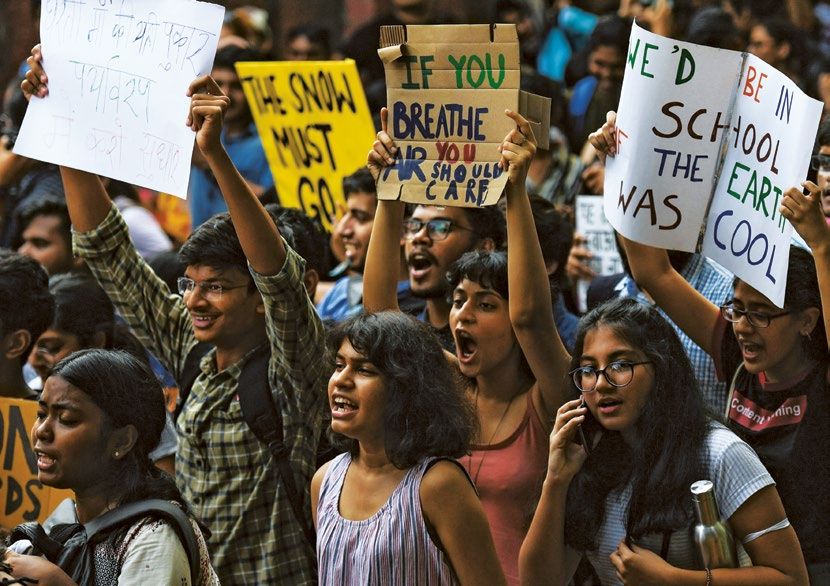
© Onfokus

    The Canadian tar sands are in
    northern Alberta, underneath
    an area of boreal forest which
    is seven times the size of Wales.

    Production took off in the
    last two decades and whole
    swathes of land are now
    covered with mines, increasing
    emissions and destroying forest.

    The mines have also displaced
    First Nations communities and
    polluted their air and water.

6
© Greenpeace / Colin O’Conner

                  The Keystone XL pipeline was proposed in 2008.
                  Its route would have crossed further Indigenous
                  lands, water sources and environmentally
                  sensitive regions, with risks of leaks which have
                  happened with other pipelines in the region.
© Michael Kodas

              Above: Jean L’Hommecourt outside of her cabin near Fort
              McKay First Nation’s village. She used to gather berries or
              hunt moose nearby with her mother. Now she’s surrounded
              by tar sands mines.
              Right: Clear cutting of forest to make way for tar sands mines.

                                                                                                           7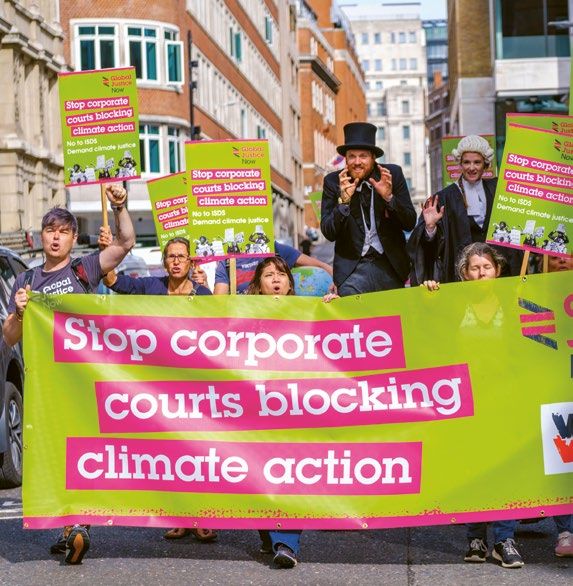
Joe Brusky CC: BY-NC-2.0

         Resistance to the pipeline built with protests, rallies
         and blockades. Eventually this people power turned
         things around and in 2015 Obama rejected the
         permit for the pipeline. The pipeline owners started
         threatening a corporate court case, but when
         Trump was elected, he reinstated the pipeline.

                                                                   On Biden’s first day in office in
                                                                   2021, he cancelled it again, saying
                                                                   it was incompatible with the
                                                                   ‘climate imperative’. The owners
                                                                   promptly launched an ISDS case.

8
© Catstyecam

Coal phase out
In 2015, the year of the Paris climate
summit, the Netherlands seemed to
be heading in the wrong direction.
Despite the lofty goals of the global
summit, the Dutch government had
just allowed energy company RWE to
open a new coal-fired power station.
The following year, a further new
coal-fired plant was opened by
another company, Uniper.

It seemed to sum up all the frustrations
of climate campaigning over recent
decades. The need for action to
tackle the climate emergency had
never been clearer, but governments
were dragging their feet and the fossil
fuel industry was taking advantage.
Climate activist group Urgenda had
resorted to taking the government
to court over its failure to set more
ambitious carbon emission targets,
winning an initial ruling.

Right: Uniper’s new coal power station,
Maasvlakte 3, in Rotterdam

                                                     9
But the pressure from
     climate activists did not
     let up. There were many
     demonstrations and
     protests in the Netherlands
     in those years, and the
     Urgenda court ruling
     was confirmed by the
     supreme court in 2019.

     At the end of that year in
     response to this pressure,
     a law was passed by
     the Dutch parliament
     to phase out the use of
     coal altogether, requiring
     the shutdown of coal
     power stations.
     Photo: Climate activists hold a
     protest during the Rotterdam
     Harbour Festival, September 2019

10                                      © Romy Arroyo Fernandez/NurPhoto via Getty Images
Now both Uniper and RWE are
© SOPA Images Limited / Alamy Stock Photo
suing the Dutch government in
the hope of getting a massive
payout. These companies profited
first from the government’s
inaction and the government is
actually offering compensation.
But they’re trying their luck to see
if they can profit more through
corporate court cases. RWE
wants €1.4bn and Uniper €900m.
This is holding climate action to
ransom.
The implications of these cases
are wider and more dangerous
than just the cost for the public
purse in the Netherlands.
Corporate court cases can often
be secretive and hard to find out
about, but Uniper and RWE have
been public and vocal in their
threats. So much so that it would
seem the target is not just the
Netherlands, but to send a warning
to any other country that might be
considering passing similar laws. Global climate strike, Utrecht, September 2021
11© Money Sharma/AFP via Getty Images
Governments in Germany,
Denmark and New Zealand
have already admitted restricting
their climate policies because of
the dangers of being sued in
corporate courts. And the risks
are especially high for developing
countries, for whom the amounts
at stake are a far higher
proportion of their budgets.
Fridays for Future youth climate strike, This affects our future.
New Delhi, India, September 2019
12Tanenhaus CC: BY-2.0
Open cast mining
Cerrejón is an open cast coal
mine in Colombia – the largest
in Latin America. Much of its
coal is exported to Europe.
It has been controversial for
decades. Over 30 communities
have been displaced to make
way for the mine, and people
living nearby have suffered
health problems, environmental
damage, and violence and
intimidation for raising concerns.
In 2017 local communities
won a case in the Colombian
supreme court against the
diversion of a river to expand
the mine. The mine owners,
including Anglo-American, are
now turning to corporate courts
to challenge that decision.
13Colonial origins
How did we end up with such forerunners of ExxonMobil,
Wikimedia CC:BY-SA-3.0
an unjust system as corporate Total, Rio Tinto and more,
courts? If it seems designed to got together. They drafted
favour the interests of fossil fuel the prototype for ISDS
firms and big business, that’s agreements, specifically
because it was. in order to protect oil and
other big business interests.
Back in the 1950s and 1960s,
a group of businessmen were So the corporate court
worried about the policies of system was created to
newly independent countries. protect fossil fuel companies
These former colonies were from the threat posed by the
talking about now being able anti-colonial struggle. It is no
to control their own resources. surprise that it is the system
A group led by Hermann Abs, a fossil fuel companies turn to
banker, and Hartley Shawcross, now to protect themselves
a lawyer at that point working against the struggle for
for Royal Dutch Shell, and climate justice.
including others from the
Hermann Abs
14© Jess Hurd
take action
The risk to climate action
from corporate courts is only
going to grow. We know
industry insiders themselves
expect that more ambitious
climate policy will drive
an increase in cases. The
amounts at stake could be
over $9 trillion – that’s more
than ten per cent of the
global economy.
We need to get rid of
corporate courts. And we
know that we can. Across
the world, countries such
as South Africa, India,
New Zealand, Bolivia,
Tanzania and the US
are rejecting corporate
courts. The UK needs to
step up and join them.
15© Romy Arroyo Fernandez/NurPhoto via Getty Images Global Justice Now works as part of a global movement to challenge the powerful and create a more just and equal world. Our local activists campaign around the country for a global economy where people come before profit. Find out more and get involved in the campaign on corporate courts: globaljustice.org.uk/trade Global Justice Now, 66 Offley Road, London SW9 0LS +44 20 7820 4900 • offleyroad@globaljustice.org.uk • globaljustice.org.uk @GlobalJusticeUK Global Justice Now @globaljusticenow Published 2022. Printed on 100% post-consumer waste recycled paper. Cover images : © Michael Kodas; © Onfokus. Design and layout: causeffectdesign.co.uk
You can also read


