Course Handbook 2021-2022 - For High School Students and Parents - Blyth Academy Qatar
←
→
Page content transcription
If your browser does not render page correctly, please read the page content below
Course Handbook
       2021-2022
For High School Students
            and Parents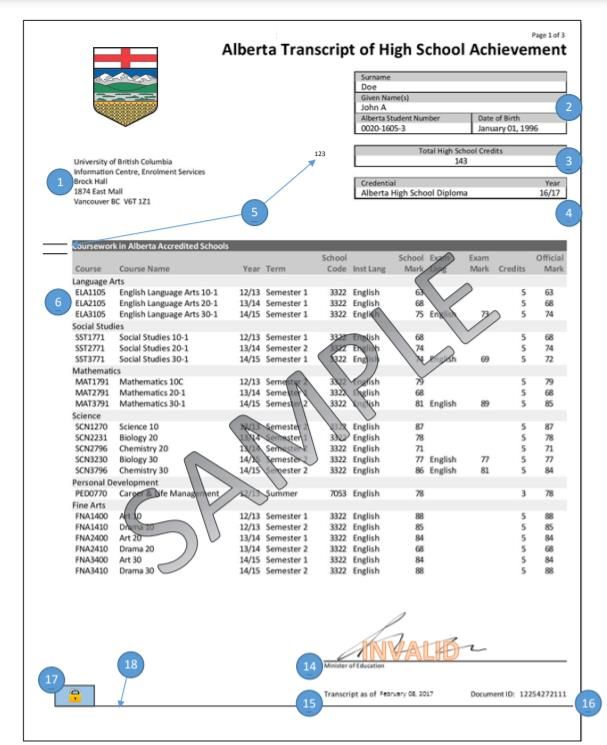
Introduction                                   Table of Contents
Welcome to High School! This is a big                              Introduction – page 1
transition for many students from Junior
                                                     High School Course System – page 2
High to Senior High, so we want to wish you
a warm welcome!                                       Graduation Requirements – page 3
There are many details to know about the              Report Cards/ Transcripts – page 4
transition into High School, course credits,
                                                 Diploma Exams/ Admission tests– page 5
what you need to graduate, and what you
need to get into the college or university               Course Descriptions – page 6-12
program you have in mind. We are here to
                                                           Options Courses – page 13-16
help you with that process. The choices
students make in High School can greatly                     Credit Calculator – page 17
influence post-secondary options. We want
                                                                   Useful links – page 18
to clarify that journey for you.
Reach out anytime to our administration
staff for answers. We are here to help!
Guidance Counselor: Laurie Thomas
Laurie.Thomas@blythacademyqatar.com
+974 4421 7553 / 54/ 56

Senior High School Lead Teacher:
Safiyya Punjani
Safiyya.Punjani@blythacademyqatar.com
+974 4421 7553/ 54/ 56

School Life Lead Teacher:
Jacob Caley
Jacob.Caley@blythacademyqatar.com
+974 4421 7553/ 54/ 56

Deputy Head: Daryl Thomas
Daryl.Thomas@blythacademyqatar.com
+974 4421 7553/ 54/ 56

Head of School: Darlene Sullivan
Darlene.Sullivan@blythacademyqatar.com
+974 4421 7553/ 54/ 56

1|Page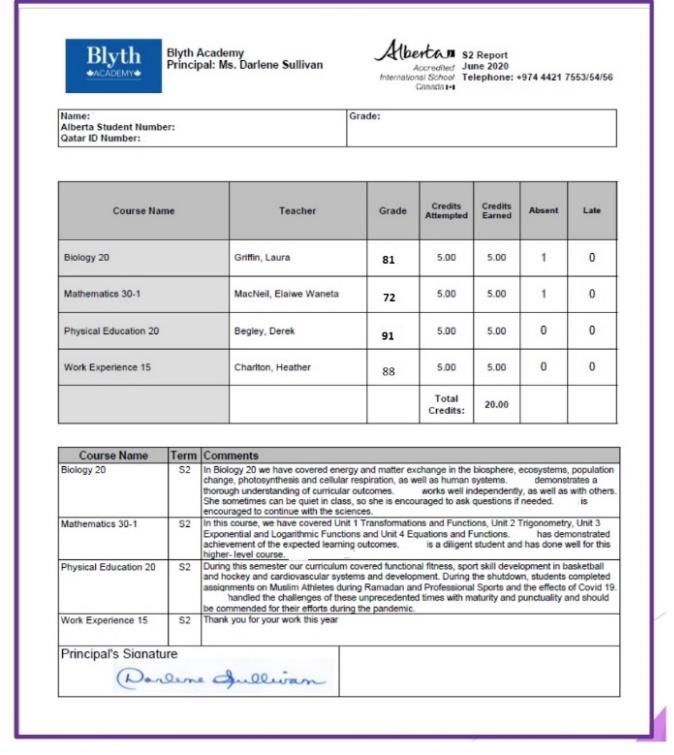
The High School Program uses the
High School                                 “Credit System.” Students accumulate
                                            credits throughout grades 10, 11 and
System                                      12 in order to gain enough credits for
                                            graduation.
Curriculum                                  Most students take Level 10 courses in
                                            Grade 10, Level 20 courses in Grade 11,
Blyth Academy Qatar uses the Alberta        and Level 30 courses in Grade 12.
Education Curriculum. Students who          However, students can take a course in
graduate with an Alberta Education          whatever year they choose, as long as
High School Diploma have an easy            they have the prerequisite, and follow
transition into Canadian colleges and       the course sequence (explained later).
universities as well as post-secondary
institutes in the United States and the     Students should aim for completing
United Kingdom.                             110 credits by the time they finish
                                            grade 12. Students must accumulate a
Semesters                                   minimum of 100 credits, which is
                                            required to achieve an Alberta
Each High School academic year is
                                            Education High School Diploma.
divided into 2 Semesters. Semester 1
runs from August to January, and            For students who are not able to
Semester 2 runs from January to June.       achieve a High School Diploma, they
Each semester is divided into two           can aim for a High School Certificate of
terms. Students take 4 courses each         Achievement. This requires 80 credits.
semester. They will complete 8 courses      This is not the equivalent of a High
in an academic year. In Grade 12,           School Diploma. Further studies are
students might complete fewer courses       required in order continue to the post-
if they choose a study block (“spare”).     secondary level.
     Semester 1            Semester 2
 Term 1     Term 2   Term 1       Term 2
 Aug –      Nov –    Jan –        April –
 Nov        Jan      April        June
       4 courses            4 courses

Credits
2|Page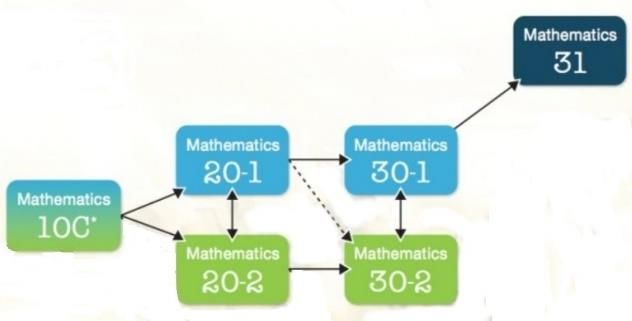
Levels of Classes (-1, -2)                  • 10 additional credits in 30-level
                                              courses
English, Social Studies, and Math all
offer -1 and -2 options. (Example:          Sequencing
English 10-1). All universities accept -1
                                            Students in 10, 20 and 30 level classes
courses. Most universities accept -2
                                            will have to follow a course ‘sequence’
options, but not all. If you are unsure,
                                            to ensure that the student has the
check with the university admissions
                                            proper prerequisite courses.
department to confirm the
requirements for the Program you are        If a student stays in -1 courses
applying to.                                throughout a subject area, their course
                                            sequencing would look like this:
Mandatory Courses for
                                              English       English       English
Graduation                                    10-1          20-1          30-1
In order for students to graduate with a
High School Diploma, there are certain      However, if a student is having
courses that are mandatory (required        challenges in -1, the Guidance
courses). The following courses must        Counselor can recommend a student
be completed in order to receive an         move into a -2. A sequence might look
Alberta Education High School               like this:
Diploma:                                      English       English     English
•   English 10, 20 and 30                     10-1          20-2        30-2
•   Social Studies 10, 20, 30
                                            For more detailed options in sequence
•   Math 10C, 20
                                            options, look at the Course
•   Science 10, Science 20-level
                                            Descriptions further in this handbook.
•   Physical Education 10
•   CALM (Career and Life                   Passing
    Management)
                                            Students are required to achieve 50%
Students must also achieve:                 in a course to pass. Alberta Education
• 10 additional credits in 20-level         follows the following mark legend:
  courses                                               A     80 – 100%
                                                        B     65-79%

3|Page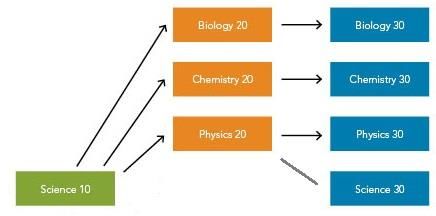
C     50-64%
            D     40-49%
            F     0-39%
            P     Pass

If a student does not pass a course,
they can retake the course. The highest
mark achieved will be the final mark
listed on the transcript. The student will
receive the credits for the course only
when the course is passed.

Report Cards
Parents will receive a report card
halfway through the first semester, at
                                             Transcripts
the end of Term 1. This is the “Midterm      Students will need a transcript to apply
Report Card.” This is an indicator for       for university. Transcripts are issued by
parents and students to gauge their          Alberta Education. Students will access
progress so far.                             and order their Official Transcripts
At the end of the course, after Term 2,      through MyPass. Students need their
students will receive their “Final Report    ASN (Alberta Student Number) and
Card.” These marks will be recorded on       date of birth to access MyPass.
their transcript.                            https://public.education.alberta.ca/PAS
                                             I/myPass/welcome Official transcripts
                                             cost $10 CAD each, (additional costs for
                                             Express Shipping), and they can be sent
                                             directly to the university of choice. On
                                             MyPass, students can access their final
                                             marks, credits, and diploma exam
                                             marks. They can download a DAR
                                             (Detailed Academic Report), or
                                             unofficial transcript at any time.

4|Page
scheduling platform for Blyth Academy.
Students will be required to have the
following information to log in to
PowerSchool:
• Alberta Student Number (ASN)
found at the top of their report
card
• Qatar ID Number
• Course Planning Sheet
At any time, if the student has
questions or concerns about what
courses to take, it is recommended
they make an appointment with the
Diploma Exams Guidance Counselor to discuss their
post-secondary plans.
Diploma Exams are only issued for 30-
Level courses, so most students will Post-secondary Admissions
take them in Grade 12, unless they are
taking a 30-level course in Grade 11.
Tests
Diploma exams are worth 30% of the Students might be required to take an
final mark, and are administered in the admissions test to get into university.
following courses: Some of the common ones are:
• Biology 30 • SAT or ACT (mostly used in
• Chemistry 30 American universities
• Physics 30 • TOEFL, IELTS or Duolingo (English
• Science 30 language proficiency test)
• English Language Arts 30 • Other (University customized
• Mathematics 30 admissions test)
• Social Studies 30 Most admissions tests can be taken
at any time in high school. Students
Course Selection
do not need to wait until Grade 12
Students will choose their courses to take them.
through PowerSchool this year, a new
5|Pagereports, poetry, and presentations/media.
Course Material will often have daily life or practical
applications for students. This course is designed
for students considering careers that require basic
Descriptions reading and communication skills and for those
interested in a range of post-secondary education
or other opportunities.
English Language Arts English Language Arts 20-1
(ELA)
• Credits: 5 / Accepted by all universities
English Language Arts 10-1 • Prerequisites: ELA 10-1
I want to explore literature more deeply and
• Credits: 5 / Accepted by all universities
develop my communication skills. In ELA 20-1,
• Prerequisites: none
students analyze and respond to literature,
I want to explore literature and develop strong including extended texts (a novel, a nonfiction
communication skills. In ELA10-1, students analyze book or feature film, and a Shakespearean play)
and respond to literature, including extended texts and shorter texts (poetry, short stories, visuals and
(a novel/nonfiction book, a feature film and a multimedia, and essays) that relate to cultural and
modern or Shakespearean play) and shorter texts societal issues in Canadian and global contexts.
(poetry, short stories, visuals and multimedia, and They also create their own texts; e.g., fiction,
essays) that relate to cultural and societal issues in nonfiction/persuasive writing,
Canadian and global contexts. They also create presentations/media, scripts. This course is for
their own texts; e.g., fiction, nonfiction, poetry, students considering careers that require strong
presentations/media. This course is for students reading and communication skills and for those
considering careers that require strong reading who may be interested in post-secondary
and communication skills and for those who may education.
be interested in post-secondary education.
English Language Arts 20-2
English Language Arts 10-2
• Credits: 5 / Accepted by most universities
• Credits: 5 / Accepted by most universities • Prerequisites: ELA 10-2, or ELA 10-1
• Prerequisites: none
I want to continue to study material that is
I want to begin to study material I am comfortable relevant to my life and that strengthens my
with and communicate well with others. In ELA 10- communication with others. In ELA 20-2, students
2, students with diverse abilities and goals study with diverse abilities and goals study different
different types of texts, written at various levels, types of texts, written at various levels, that
that explore issues in Canadian and global explore issues in Canadian and global contexts.
contexts. They study extended texts (a novel or They study extended texts (a novel, a nonfiction
nonfiction book, a feature film, and a modern or book or feature film, and a modern or
Shakespearean play) and shorter texts (poetry, Shakespearean play) and shorter texts (poetry,
short stories, visuals and multimedia, and popular short stories, visuals and multimedia, and popular
nonfiction). Students are also encouraged to nonfiction). Students are also encouraged to
create their own texts; e.g., fiction, nonfiction and create their own texts; e.g., fiction, nonfiction and
6|Pageproposals, scripts, and presentations/media. often have daily life or practical applications for
Material will often have daily life or practical students. This course is designed for students
applications for students. This course is designed considering careers that require basic reading and
for students considering careers that require basic communication skills and for those interested in a
reading and communication skills and for those range of post-secondary education or other
interested in a range of post-secondary education opportunities.
or other opportunities.
ELA Sequencing
English Language Arts 30-1
• Credits: 5 / Accepted by all universities
• Prerequisites: ELA 20-1
I want to demonstrate critical thinking about
literature and communication. In ELA 30-1,
students analyze and respond to literature,
including extended texts (a novel or nonfiction
book, a feature film or modern play, and a
Shakespearean play) and shorter texts (poetry,
ELA Resources
short stories, visuals and multimedia, essays, and A variety of digital and print resources, developed
popular nonfiction) that relate to cultural and by publishers, Alberta Education or Alberta
societal issues in Canadian and global contexts. teachers, are available to help students learn.
They also create their own texts; e.g., fiction, Teachers may select, and bring into the classroom,
nonfiction/persuasive writing, presentations/ numerous innovative and creative resources to
media. This course is for students considering create rich learning experiences for your child.
careers that may require strong reading and Visit new LearnAlberta.ca
communication skills and for those interested in https://new.learnalberta.ca/ to learn more about
post-secondary education. the resources your child may encounter.
English Language Arts 30-2
ELA Assessment
• Credits: 5 / Accepted by most universities
At the end of ELA 30-1 or ELA 30-2, your teen will
• Prerequisites: ELA 20-2, or ELA 20-1
write a provincial diploma examination. Your
I have a deeper understanding of relevant teen’s final mark in ELA 30-1 or ELA 30-2 is
materials and can communicate clearly with determined by taking 70% of the school-awarded
others. In ELA 30-2, students with diverse abilities mark and adding it to 30% of the diploma
and goals study different types of texts, written at examination mark. Your teen must achieve a final
various levels, that explore issues in Canadian and mark of 50% or higher to obtain credits for the
global contexts. They study extended texts (a course.
novel or nonfiction book, a feature film, and a
modern or Shakespearean play) and shorter texts
(poetry, short stories, visuals and multimedia,
essays, and popular nonfiction). Students are also Social Studies
encouraged to create their own texts; e.g., fiction,
nonfiction, presentations/media. Material will Social Studies 10-1
7|Page• Credits: 5 / Accepted by all universities Social Studies 30-1
• Prerequisites: none
• Credits: 5 / Accepted by all universities
What is globalization and how does it affect us?
• Prerequisites: Social Studies 20-1
Social Studies 10-1 students explore the changing
meaning of identity and citizenship in a globalizing What are ideologies and how do they affect us?
world, while also understanding the impacts of Social Studies 30-1 students examine multiple
globalization, both positive and negative, on perspectives on various ideologies and on the
people worldwide. influence of these ideologies, focusing particularly
on liberalism. They develop an understanding of
Social Studies 10-2 how ideologies can shape us and our world.
• Credits: 5 / Accepted by most universities Social Studies 30-2
• Prerequisites: none
• Credits: 5 / Accepted by most universities
What is globalization and how does it impact me?
• Prerequisites: Social Studies 20-2, or 20-1
Social Studies 10-2 students explore the history
and effects of globalization. They develop an What are ideologies and how do they affect us?
understanding of the impact that globalization has Social Studies 30-2 students will examine multiple
on people’s identity and citizenship, while perspectives on various ideologies, focusing in
addressing emerging issues that globalization particular on liberalism. They will develop an
presents. understanding of how ideologies can shape us and
our world.
Social Studies 20-1
• Credits: 5 / Accepted by all universities
Social Studies Sequencing
• Prerequisites: Social Studies 10-1
What is nationalism and how does it affect us?
Social Studies 20-1 students look at the origins and
effects of nationalism and weigh its benefits and
limitations. They examine issues related to
nationalism and consider impacts on individuals,
international relations and citizenship.
Social Studies 20-2 Social Studies Resources
A variety of digital and print resources, developed
• Credits: 5 / Accepted by most universities
by publishers, Alberta Education or Alberta
• Prerequisites: Social Studies 10-2, 10-1
teachers, are available to help students learn.
What is nationalism and how does it affect me? In Teachers may select, and bring into the classroom,
Social Studies 20-2, students examine the origins numerous innovative and creative resources to
and effects of nationalism from various create rich learning experiences for your child.
perspectives, developing an understanding of the Visit new LearnAlberta.ca
impact of nationalism on individuals, international https://new.learnalberta.ca/ to learn more about
relations and citizenship in Canada. the resources your child may encounter.
8|Pageways, and analyze the relationship between a
Social Studies Assessment function and its reciprocal.
At the end of a 30-level course, your teen will
Math 20-2
write a provincial diploma examination. Your
teen’s final mark in a 30-level course is • Credits: 5 / Accepted by some universities
determined by taking 70% of the school-awarded • Prerequisites: Math 10C
mark and adding it to 30% of the diploma
examination mark. Your teen must achieve a final Mathematics 20-2 students use proportional
mark of 50% or higher to obtain credits for the reasoning to solve real-life problems involving 2-D
course. shapes and 3-D objects. They use the properties of
angles and triangles, including the sine and cosine
laws, to solve problems; use reasoning to prove
conjectures; use spatial reasoning to solve puzzles;
Mathematics and solve problems that involve radicals. They
interpret statistical data, solve problems involving
Math 10C quadratics and research and present a
mathematical topic of their choice.
• Credits: 5 / Accepted by all universities
• Prerequisites: none Math 30-1 (Pre-Calculus)
Mathematics 10C students determine the surface • Credits: 5 / Accepted by all universities
area and volume of 3-D objects and use • Prerequisites: Math 20-1
trigonometric ratios to solve problems involving
right triangles. They simplify expressions that Mathematics 30-1 students investigate the
involve powers with integral and rational properties of logarithms; study the characteristics
exponents and simplify or factor polynomial and transformations of trigonometric, polynomial,
expressions. At this level, students also analyze exponential and logarithmic functions by sketching
linear relations, solve systems of linear equations and analyzing their graphs; and solve equations
and solve problems related to both of these sets and problems related to these functions. Students
of skills. also use basic counting principles to determine the
number of permutations or combinations of the
Math 20-1 elements of a set to solve problems. Includes
Diploma Exam.
• Credits: 5 / Accepted by all universities
• Prerequisites: Math 10C Math 30-2
Mathematics 20-1 students investigate arithmetic • Credits: 5 / Accepted by some universities
and geometric patterns and use the sine and • Prerequisites: Math 20-2
cosine laws to solve problems involving triangles.
They investigate the properties of radicals and Mathematics 30-2 students use numerical and
rational expressions. Mathematics 20-1 students logical reasoning to solve puzzles, and solve real-
also analyze the characteristics of absolute value life problems about the probability of events
functions and quadratic functions, solve quadratic occurring. They solve problems algebraically
equations and systems of equations in various involving rational equations; investigate
exponential, logarithmic, polynomial and sinusoidal
functions; and research and present a
9|Pagemathematical topic of their choice. Includes At the end of Mathematics 30-1 or Mathematics
Diploma Exam. 30-2, your teen will write a provincial diploma
examination. Your teen’s final mark in
Math 31 (Calculus) Mathematics 30-1 or Mathematics 30-2 is
determined by taking 70% of the school-awarded
• Credits: 5 / Accepted by all universities mark and adding it to 30% of the diploma
• Prerequisites: Math 30-1 (Pre-Calc) examination mark. Your teen must achieve a final
Mathematics 31 students determine the limit of a mark of 50% or higher to obtain credits for the
function at finite or infinite values of the course.
independent variable. They use derivative
theorems to determine the derivative of a
function, either explicitly or implicitly, and use
derivatives to sketch graphs of functions and solve Sciences
optimization problems. They also investigate the
relationship between differentiation and Science 10
integration. There is no Diploma Exam for this
• Credits: 5 / Accepted by all universities
course.
• Prerequisites: none
Math Sequencing What happened to that energy? Science 10
students are introduced to the biological,
chemical, physical and Earth sciences. By studying
chemical reactions, cellular and multicellular
processes that occur in plants, the conservation
and conversion of energy, and Earth’s climate,
they discover how energy is transformed.
Physics 20
• Credits: 5 / Accepted by all universities
Math Resources • Prerequisites: Science 10
A variety of digital and print resources, developed How does a lacrosse player know when to release
by publishers, Alberta Education or Alberta the ball? Physics 20 students investigate the
teachers, are available to help students learn. motion of objects. They apply Newton’s law of
Teachers may select, and bring into the classroom, universal gravitation to astronomical observations.
numerous innovative and creative resources to They also describe how energy is transmitted by
create rich learning experiences for your child. mechanical waves and how waves relate to
Visit new LearnAlberta.ca medical technologies, industry and musical
(https://new.learnalberta.ca/) to learn more about instruments.
the resources your child may encounter.
Biology 20
Math Assessment • Credits: 5 / Accepted by all universities
• Prerequisites: Science 10
10 | P a g eHow and why does energy flow through living
systems? Biology 20 students examine the
Why is there so much diversity? Biology 30
interactions of living systems to better understand
students conduct lab work and investigate how
the constant flow of energy and the cycling of
human systems sense and respond to the
matter. Specifically, students explore the
environment. They explore human reproduction
functioning of the human body and the
and development at the cellular level and at the
mechanisms that work to maintain balance in
organism level. Students investigate the basic
organisms—in ecosystems and in the biosphere.
structure and role of DNA and investigate the
Chemistry 20 inheritance of traits in individuals and populations.
They analyze the changes in populations resulting
• Credits: 5 / Accepted by all universities from natural and human-induced changes in the
• Prerequisites: Science 10 environment and discover that living systems are
dynamic.
How do atoms combine to form different
substances? Students explore matter and how it Science 30
changes in order to understand the natural world.
They investigate the chemical properties of • Credits: 5 / Accepted by all universities
solutions, and they apply their understanding of • Prerequisites: Any 20-level Science
chemical bonds to explain ionic and molecular
How do we sustain our energy resources? Students
compounds. Chemistry 20 students explain the
sharpen their scientific skills and explore a wide
behaviour of gases, using the gas laws, and also
range of scientific concepts to strengthen their
work to balance chemical equations.
foundations in science. They investigate human
Physics 30 systems and health, and environmentally
sustainable solutions for meeting global energy
• Credits: 5 / Accepted by all universities needs. They also examine the impacts of chemicals
• Prerequisites: Physics 20 in society and the environment and examine the
properties and applications of electromagnetic
When does a model or a theory need to change? energy.
Physics 30 students consider historical experiments
and explore why the model of the atom has
changed as a result of experiments and
Science Sequencing
observations of natural phenomena. Students
apply a quantitative approach to describe
conservation of momentum in an isolated system,
and they investigate applications and implications
of electric and magnetic forces and fields. They also
use the concept of wave-particle duality to
understand both wave and photon behaviour of
electromagnetic radiations.
Biology 30
• Credits: 5 / Accepted by all universities
• Prerequisites: Biology 20 Science Resources
11 | P a g eA variety of digital and print resources, developed Learning is assessed using a variety of tools
by publishers, Alberta Education or Alberta and strategies within the classroom. Ask the
teachers, are available to help students learn. teacher what methods they are using. The
Teachers may select, and bring into the classroom, different assessment methods tell you, your
numerous innovative and creative resources to teen and your teen’s teacher about your
create rich learning experiences for your child. teen’s strengths, the areas in which they
Visit new LearnAlberta.ca might grow and how well they are doing
(https://new.learnalberta.ca/) to learn more about throughout the course. At the end of the
the resources your child may encounter. course, your teen will be assessed and their
achievement will be reported so that you
Science Assessment know if they have achieved the expected
learning outcomes.
At the end of a 30-level course, your teen will
write a provincial diploma examination. Your
teen’s final mark in a 30-level course is
determined by taking 70% of the school-awarded
mark and adding it to 30% of the diploma
examination mark. Your teen must achieve a final
Physical Education
mark of 50% or higher to obtain credits for the
course. Physical Education (PE) 10
• Credits: 5 | REQUIRED COURSE
• Prerequisite: none
CALM (Career and Life Acquire skills through a variety of movement
activities, understand, experience and
Management) appreciate the health benefits and wellness
that result from physical activity, interact
• Credits: 3 | REQUIRED COURSE
positively with others, assume responsibility
• Prerequisite: none
to lead an active lifestyle. Continue to
• ONLINE option ONLY
enhance your wellness in optional PE 20 and
I want to make good choices in life. Your teen will 30 courses.
enhance their ability to make good choices today
and in the future. They will examine health
holistically: the emotional, intellectual, social,
spiritual and physical dimensions. They will learn
how to make responsible choices about money
and other resources, and they will learn that their
decisions are based on their values and goals. Your
teen will continue to plot out their career path as
they plan for life after high school.
CALM Assessment
12 | P a g eneed to understand they will be doing vigorous
Options Courses physical training on a consistent basis.
At the high school level, if you are looking to use
Physical Education (PE) 20, 30 Sports Performance 30 to enter university, you
must take 10, 20 and then 30. There is no diploma
• Credits: 5 exam for Sports Performance 30.
• Prerequisites
PE 20: PE 10 Foods 10, 20, 30
PE 30: PE 20
• Credits: 5 each
I want to have fun, learn skills and be healthy.
Through activities in the school and community, • Prerequisites:
your teen will explore their physical abilities and Foods 10: none
improve their fitness level. They will understand Foods 20: Foods 10
that fitness impacts well-being and body image. Foods 30: Foods 20
Communicating with others, your teen will
develop a sense of fair play and exercise their Do you love to eat? This options for you! In Foods
leadership abilities. They will discover the Studies at the junior and senior high levels you will
importance of safe, active living for life; set goals; be working in Blyth Academy’s brand-new foods
and challenge themselves as part of an active, lab to learn practical kitchen skills. Each day you
healthy lifestyle. There is no diploma exam for PE will walk out with a yummy treat, along with the
30. recipe and the skills to be able to repeat it for your
friends and family. You will learn 5 different styles
Sports Performance 10, 20, 30 of food each term. These may include baking,
snacks and appetizers, soups and sauces,
• Credits: 5 each traditional foods and much more.
• Prerequisites:
The foods courses build on each other each year
SP 10: none as you learn more advanced cooking techniques.
SP 20: SP 10 Each course will build up to a final culinary project
SP 30: SP 20 where students will plan, develop and create their
own meal. If you are looking to use Foods 30 to
Sports Performance at the junior and senior high enter university, you must take 10, 20 and then
level is a great course for students to explore high 30. Foods 30 is a university accepted course and
level athletics. It is highly recommended to those can often count as a science class as it falls under
students who are looking to be a part of Blyth nutrition for university.
Academy’s sports teams next year. It is also a good
course for any student looking to improve their This course is 100% practical; there are no quizzes
skill level at a multitude of sports at a high level. or unit exams, however you will need to
demonstrate your skills in the kitchen. For junior
Sports performance provides unique opportunities high, foods 7, 8, 9 will be building blocks for
for athletes to improve in the areas of skill and learning basic, fundamental skills that will prepare
leadership. It will focus on teaching students to be you for taking foods in high school. Each day you
the best well rounded athlete that they can be. will walk out with something tasty to eat! There is
This is a physically demanding course and students no diploma exam for Foods 30.
13 | P a g eBusiness 10, 20, 30 Media, Design and Communication
(MDC) 10, 20, 30
• Credits: 5 each
• Prerequisites: • Credits: 5 each
Business 10: none • Prerequisites:
Business 20: Business 10 MDC 10: none
Business 30: Business 20 MDC 20: MDC 10
MDC 30: MDC 20
At the junior and senior high level, the business
option will teach you about the different aspects MDC (previously knowns as CTS – Career and
of business. This ranges from marketing to Technology Studies) stands for Media, Design and
entrepreneurship to finance and more. Communication. At the junior and senior high level
you will be working in Blyth Academy’s computer
The business option will help students prepare for lab to take a hands-on approach to learning about
a possible career in the business world. It is also a the various faculties of technology. This will range
great option for anyone interested in personal from areas such as photography and web design
business knowledge. It will provide students with a to much more.
general overview of how money is traded,
invested and diversified. A multitude of technology-based career paths will
be explored and developed at the 10, 20 and 30
This is a practical project-based course at the 10, level. Students can expect to gain real world
20 and 30 level. Students will engage in school practical skills in the many different technology-
wide community building initiatives linked to the based fields. This option is perfect for those
business outcomes that they are learning. There looking to enter a career with a focus on
will be a focus on teaching students management technology or if you have a passion and a desire to
and leadership skills in a hands-on and practical improve your personal use of technology.
approach.
If you are looking to use MDC 30 to enter
If you are looking to use Business 30 to enter university, you must take 10, 20 and then 30. At
university, you must take 10, 20 and then 30. the junior high level, MDC will offer introductory
Business 30 is a university accepted course, which building blocks to technological knowledge that
can help you gain access to the business faculty, will prepare you for the high school MDC courses.
along with various other pathways. At the junior There is no diploma exam for Media, Design and
high level, business will offer introductory building Communication.
blocks to business knowledge that will prepare
you for taking business in high school. There is no
diploma exam for Business 30.
14 | P a g eArt 10, 20, 30 Drama 10, 20, 30
• Credits: 5 each • Credits: 5 each
• Prerequisites: • Prerequisites:
Art 10: none Drama 10: none
Art 20: Art 10 Drama 20: Drama 10
Art 30: Art 20 Drama 30: Drama 20
Art at the junior and senior high level will see I am creating, performing, studying, critiquing and
students exploring their artistic skills. At the high consuming drama as an art form! Students will
school level, students will create art by using a learn to communicate in various ways and work
variety of media. They will develop their artistic, creatively with others as they discover dramatic
technical and critical skills as they explore visual expression. Through eight dramatic disciplines—
expression. They will discover various ways to movement, speech, improvisation, acting, theatre
share their thoughts with others. studies, technical theatre design, playwriting and
directing—they will develop both performance
Looking at the history of art, students will study
and technical skills, becoming more confident in
various art styles. Outcomes will be consisting of
themselves and their ability to work together.
30 percent theory/presentation/write up/ artist
There is no diploma exam for Drama 30.
statement and 70 percent practical demonstration
to execute personal art style.
At the junior high level, students will be exploring
and investigating fundamental elements/ Languages
principals of design. Students will progress
through a variety of observational drawings French 10-3Y, 20-3Y, 30-3Y
through various mediums. Outcomes will be
consisting of 30 percent of theory/ understanding • Credits: 5 each
of vocabulary/ annotation/ overall concept • Prerequisites:
understanding and 70 percent of practical skill
Fr 10 – none
demonstration of observational Fr 20 – French 10
sketching/drawing. Fr 30 – French 20
If you are looking to use Art 30 to enter university,
I never thought I’d understand and speak some
you must take 10, 20 and then 30. There is no
French! Students with no experience in French will
diploma exam for Art 30.
learn to express simple messages about familiar
topics. They will explore and understand various
Francophone cultures and develop language
learning strategies that will help them learn a
second language or additional languages. There is
no diploma exam for French 30.
15 | P a g eArabic Language Arts 10, 20, 30 Studies are mandatory for Qatari and Muslim
students who are from an Arab nation and are
• Credits: 3 each / REQUIRED COURSE for applying for universities in Arab countries. Qatari
Qatari and Arab students who hold an Arab and Arab students must study both subjects for a
Passport. Discuss this option with your full academic year and obtain five credits each
semester. As for students of other nationalities,
Guidance Counselor.
they have the freedom to choose to study the two
• Prerequisites: subjects in only one semester. There is no diploma
Arabic Language Arts 10 – Arabic 9/ or knowledge exam for Arabic 30 or Arabic Language and Culture
of Arabic (Islamic) 35.
Arabic Language Arts 20 – Arabic Language Arts 10
Arabic Language Arts 30 – Arabic Language Arts 20 1. Blyth Academy will meet the hourly
requirements of 4 hours/week of Arabic
This course is designed for students who already language for first language speakers.
have a good understanding of Arabic. 2. Blyth Academy will meet the hourly
requirement of 3 hours/week of Islamic
studies for all Muslim students.
3. Blyth Academy will offer Arabic as a
Arabic Language and Culture (Islamic) second language for non-native speakers
in grades 1-9 and strive to meet the 4
15, 25, 35 hour/week requirement.
• Credits: 2 each / REQUIRED COURSE for 4. Blyth Academy will offer Islamic studies
for non-Arabic students taught in English
Qatari and Muslim students. Discuss this
and Arabic (as necessary) for grades 1-9
option with your Guidance Counselor.
and will meet the 3 hour/week
• Prerequisites: requirement.
Arabic Language and Culture 15 – none 5. In Grades 1-9 non-Arabic and Arabic
Arabic Language and Culture 25 – Arabic Language speakers will be taught in separate
and Culture 15 classes.
Arabic Language and Culture 35 – Arabic Language 6. In Grade 10-12 student who wish to
and Culture 25 continue to study Arabic will do so in
Arabic as first language classes unless
Overview of Qatar History, Arabic and Islamic there are a reasonable number of
Studies students wishing to learn Arabic as a
second Language.
Studying Arabic language and Islamic studies and
succeeding in these two subjects is an important Qatar history will be taught by classroom teachers
condition for the equivalency of the academic in grades 1-6 and by the Social Studies teacher in
certificate for students of all grades. grades 7,8,9. The Ministry of Education of the
State of Qatar books will be followed.
Arabic as a First Language and Islamic Studies are
required by the Ministry of Education in Qatar, as
Blyth Academy is accredited by the National
Accreditation Authority. Both Arabic and Islamic
16 | P a g eThis “Credit Calculator” is used throughout High School to ensure students are meeting Alberta Education Graduation Requirements. 17 | P a g e
Useful Websites:
Alberta Education: My Child’s Learning: A Parent’s Resource:
My Child's Learning: A Parent Resource (learnalberta.ca)

Alberta High School Diploma Graduation Requirements:
Alberta High School Diploma: graduation requirements (English) | Alberta.ca

Detailed High School Course Guide (Calgary Board of Education):
https://www.cbe.ab.ca/programs/high-school/Documents/Detailed-High-School-Course-
Guide.pdf

MyPass (for Official Transcripts)
https://public.education.alberta.ca/PASI/myPass/welcome

To study in Canada:
https://www.educanada.ca/programs-programmes/index.aspx?lang=eng

To Study in Ontario:
https://www.ouac.on.ca/

To Study in the United States
https://www.studyusa.com/

To Study in the UK:
https://www.ucas.com/

To register for the SAT test:
https://www.collegeboard.org/

To prepare for the SAT/ ACT test:
https://www.milliegroup.com/students/academic-mentoring/

To register for the IELTS (English Language Proficiency Test):
https://ieltsregistration.britishcouncil.org/test-chooser

To register for the TOEFL (English Language Proficiency Test):
https://www.ets.org/toefl/test-takers/ibt/take/register

To register for Duolingo (English Language Proficiency Test):
https://englishtest.duolingo.com/

18 | P a g e
You can also read


