Data-Driven Mobile Applications Based on AppSheet as Support in COVID-19 Crisis
←
→
Page content transcription
If your browser does not render page correctly, please read the page content below
Data-Driven Mobile Applications Based on
               AppSheet as Support in COVID-19 Crisis
                                       Nenad Petrović, Maša Radenković and Valentina Nejković

  Abstract—In this paper, it is explored how data-driven mobile                 data about persons with goal to provide early diagnosis,
applications can contribute to battle against the COVID-19                      enforce safety or guideline rules or help to patients and
pandemic. As proof of concept, two novel case studies are                       persons in isolation [11, 12]. On the other side, artificial
presented: indoor safety monitoring and resource planning                       intelligence algorithms enable extract meaningful knowledge
during pandemic crisis. AppSheet platform for automated                         and patterns from the collected sensor data to enable
development based on Google Sheets as data source was used for
implementation of corresponding multiplatform mobile                            predictions of future trends or detect certain state/behavior by
applications.                                                                   classifying observations [13]. Moreover, blockchain can be
                                                                                used to reduce the spread of misinformation during pandemics
  Index Terms—AppSheet; coronavirus; Google Sheets; mobile                      and trusted patient number tracking by ensuring authenticity
applications.                                                                   or even transaction execution between the involved parties for
                                                                                purpose of resource exchange [14, 15, 16]. Finally, mobile
                           I. INTRODUCTION                                      applications offer interface to the services provided by
   Since the beginning of this year, the world tackles the                      previous enabling technologies for timely adoption among the
novel, flu-alike and highly infectious respiratory disease                      targeted user groups [17, 18].
COVID-19 caused by SARS-Cov-2 virus (often referred to as                          In this paper, it is explored how AppSheet1 platform can be
coronavirus) [1]. It was discovered in Wuhan, China, but                        used for rapid mobile application development in order to
reached the other parts of the world in few weeks afterwards.                   support the society during COVID-19 pandemics. As
   The most common symptoms of this disease are: fever,                         outcome, two case studies making use of the previous enabler
short breath, dry cough, fatigue, loss of taste and smell [2]. It               technologies are presented: 1) indoor safety monitoring app
is transmitted both directly through respiratory droplets and                   for security guards based on computer vision-enabled IoT
indirectly, via surfaces [3]. Incubation period varies from case                solution 2) resource planning app for city representatives
to case, but could be quite long [4]. However, even                             relying on AI-based predictions and blockchain for resource
asymptomatic persons can spread the disease [5], while death                    exchange.
rate is quite high when it comes to older population and
persons with chronic diseases [6], which makes the situation                                       II. BACKGROUND AND RELATED WORK
almost impossible to handle. The adoption of face masks and                     A. AppSheet
hand sanitizers has shown promising results in case of disease
                                                                                  AppSheet is an online development platform which enables
spread reduction [7]. However, the main issue is the lack of
                                                                                easy creation and distribution of mobile, tablet and web
approved vaccine and medication [8].
                                                                                applications starting from cloud data sources, such as
   Due to all the mentioned facts, many protection and safety
                                                                                spreadsheets and databases without any coding. Its first
measures were taken by governments in order to reduce the
                                                                                version was released as independent project in 2014, while it
disease spread, such as obligatory indoor mask wearing, social
                                                                                was acquired by Google and became part of Google Cloud2 in
distancing, quarantine, self-isolation, working from home,
                                                                                January 2020. It mainly aims business use cases, such as
limiting citizens’ movement and tourism, prohibition and
                                                                                project management, customer relationship management and
cancellation of public events and gatherings [9]. Apart the
                                                                                personalized reporting. AppSheet analyzes the structure of
huge number of lost lives, the pandemic has also caused
                                                                                provided data sources and automatically generates the views
catastrophic financial losses and stagnation of economy [10],
                                                                                within the application. However, the user is also able to
leading towards overall global crisis.
                                                                                customize the generated user interface by showing or hiding
   When it comes to the global battle against COVID-19 and
                                                                                particular table columns, grouping or sorting data, creating
reduction of pandemic crisis consequences, it was concluded
                                                                                additional views and inserting computed values with respect
that state of the art technologies: artificial intelligence,
                                                                                to defined formulas. Apart from widely used textual and
blockchain, IoT and smartphone applications have huge
                                                                                numeric types, it gives the ability to embed the images and
potential. The main role of IoT devices is to collect sensor
                                                                                videos within the user interface as well. AppSheet is free to
                                                                                use for up to 10 beta/test users, while monthly fee has to be
    Nenad Petrović, Maša Radenković and Valentina Nejković are with the
Faculty of Electronic Engineering, University of Niš, Aleksandra Medvedeva      paid for commercial usage and larger user base. When it
14,    18000     Niš,   Serbia    (e-mails:    nenad.petrovic@elfak.ni.ac.rs,
                                                                                      1
masa.radenkovic@elfak.rs, valentina.nejkovic@elfak.ni.ac.rs).                             https://www.appsheet.com/
                                                                                      2
                                                                                          https://cloud.google.com/appsheet

                                                                          RTI 3.2.1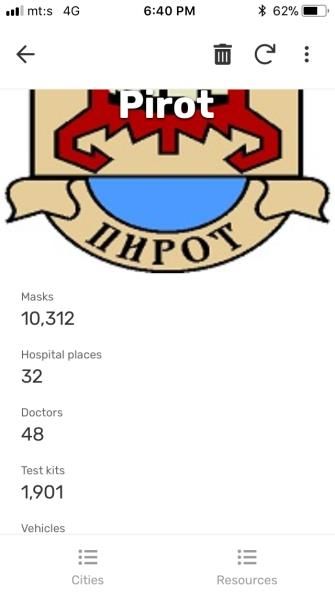
comes to more sophisticated features, the free version of                 self-isolation to ask for help and enable a fast, secure support
AppSheet supports embedding value prediction and optical                  by the community within 15 miles radius was presented. It
character recognition (OCR), while premium features include               was implemented using Flutter framework and supports both
sentiment analysis, anomaly detection, data clustering and                Android and iOS. On the other side, the AI-enabled mobile
many other commonly used machine learning techniques.                     application presented in [23] aims to reduce the spread of
There are some limitations, such as minimal number of data                COVID-19 disease by integrating the capabilities of user
rows needed for application creation (which is 4) and                     tracking,     notification    of    the    infected     persons’
prediction training (25 observations). In order to run software           employment/education institution and spread prediction based
created using AppSheet on mobile devices (Android or iOS),                on the recorded movement locations. Furthermore, the work
it is necessary to download and install the client application            presented in [24] presents the computer vision approach
from corresponding online store which serves as container for             which detects if face mask is worn properly using the image
user-created applications. However, active internet connection            taken by smartphone camera. In [25], a mobile app for
for their usage is required. In Fig. 1, an overview of typical            preliminary COVID-19 diagnosis based on cough samples
application creation workflow (starting from Google Sheets3               was shown. In [26], an approach for on-device COVID-19
as data source) using AppSheet is given.                                  screening using snapshots of chest X-ray targeting
                                                                          smartphones was introduced. Finally, [27] discusses how
                                                                          mobile applications leveraging AI and AR can be used to
                                                                          measure athlete’s performance without any physical contact
                                                                          with coach during the pandemic crisis. In Table I, overview of
                                   User                                   relevant COVID-19 support mobile applications with respect
                                      2                                   to their use cases is provided.
                                                                                                             TABLE I
                                                    Web app                                     COVID-19 SUPPORT MOBILE APPLICATIONS
                        1      AppSheet        3                                          Application                       Use case
  Spreadsheets                                                                            C-19 C                            Help in self-isolation
                                                                                          BreakTheChain                     Spread prediction
                                                   Mobile app                             CheckYourMask                     Mask detection/check
Fig. 1. Overview of typical AppSheet workflow: 1-Import data sources 2-                   AI4COVID-19                       Cough-based diagnosis
User customizations 3-Generated output.
                                                                                          COVID-MobileXpert                 Chest X-ray screening
   AppSheet-based mobile applications have been approved as
effective solution across many industrial areas so far. In [19],
AppSheet was used for real-time online monitoring of on-                     However, in this paper, the focus is on COVID-19
shelf availability in case of fast-moving consumer goods                  pandemic-related use cases not covered by the existing
(FMCG). On the other side, in [20], it was used for water                 literature, mainly resource planning and indoor safety
management application that calculates plant water                        monitoring, relying on the work from [16] and [28].
consumption within given area. When it comes to healthcare,
in [21], AppSheet was leveraged for development of                                                        III. CASE STUDIES
electronic record keeping system at a pediatric clinic.                   A. Indoor COVID-19 Safety Monitoring Security Guard App
   In this paper, AppSheet is adopted for COVID-19 support                    During the COVID-19 pandemic, it is very important for
mobile application development, as it enables rapid                       institutions and organizations to respect the COVID-19 safety
prototyping and delivery of data-driven mobile applications,              rules and guidelines in order to reduce the disease spread,
which is crucial in pandemic situation. As unexpected                     especially indoors [29].
changes (such as dramatic rise of new disease cases) might                   This case study builds upon the work from [28], making
occur quickly, it is of utmost importance to provide support              use of IoT-based computer vision system that consists of
services and respond to them timely in order to reduce the                Raspberry Pi devices equipped with camera. Each Raspberry
possible consequences [18]. Moreover, another advantage of                Pi is located at a different location inside a building (main
AppSheet is multiplatform support without additional efforts              entrance or specific room entrance, for example) and is used
and modifications. Finally, cross platform mobile                         to observe whether the passengers respect COVID-19 indoor
development frameworks such as Xamarin require solid                      safety guidelines: wearing masks and social distancing. For
programming skills, while AppSheet enables easy application               that purpose, computer vision algorithms are performed on-
creation by domain experts.                                               board in order to process the images coming from camera
B. Mobile support applications in COVID-19 crisis                         stream. In case that violation of safety rules is detected, then
                                                                          the Google Sheets API for Python4 is used to append new data
  In [22], a mobile application that allows people who are in

  3                                                                             4
      https://www.google.com/sheets/about/                                          https://developers.google.com/sheets/api/quickstart/python

                                                                    RTI 3.2.2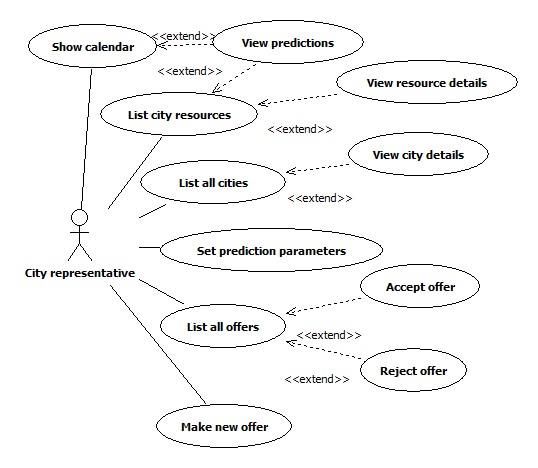
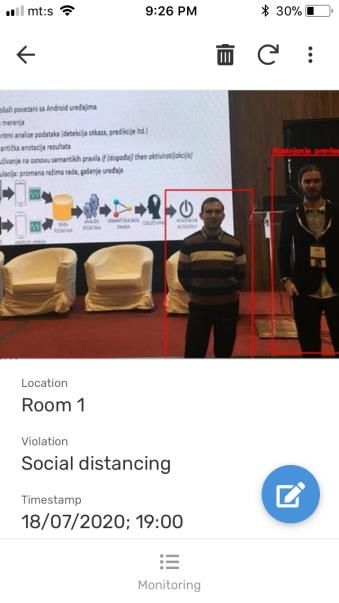
to the corresponding spreadsheet used as a log of rule                                    In Fig. 4, screenshots of security guard AppSheet mobile
violations at different locations within the building. Moreover,                       app run on iPhone SE is given. The first view (a) shows the
the camera image where violation was detected is uploaded to                           list of detected violations within the building, while the
server and its URL is also included within the log together                            second one (b) shows details for the selected rule violation.
with the timestamp of current time. Apart from that, the                               For each violation, it is possible to see the enlarged image,
corresponding security guard for a given location is                                   time/date when it occurred together with the location where it
determined using the remote call to the edge server and                                was detected and which device performed its detection. Once
procedure described in [28]. This information is also included                         security guard warns the persons breaking the safety rules, the
in the spreadsheet log, so the security guards can be notified                         violation event can be checked as resolved and removed from
which of the reported rule violations are under their                                  pending list. Moreover, security guards can set their
responsibility. In order to keep track of the violations, security                     availability status to determine whether they will be taken as
guards use mobile application developed using AppSheet,                                candidates by the server’s algorithm [28] for patrol task
based on the data available within the violation log                                   allocation or no.
spreadsheet. In Fig. 2, overview of this case study is given.
      1.5m
 Social distancing
                                     2          3
                1                                     AppSheet   4

                     IoT computer    Spreadsheets
                     vision system                                   Security guard
                                                                          app
   Mask check
Fig. 2. COVID-19 indoor safety mobile application overview: 1-Camera
stream analysis 2-Insert rule violation record 3-Update app 4-Notify security
guard.

  In Listing 1, the role of IoT system in context of security
guard mobile application for violation log creation is
described as pseudocode.
Input: image, sheet_id, location
Output: violations
Steps:
 1. distance_violation:=SocialDistanceCheck(image);
 2. mask_violation:=MaskCheck(image);
 3. if(distance_violation==false and mask_violation==false)
 4. violations:=“No violation”;
                                                                                       Fig. 4. Indoor safety security guard AppSheet iOS mobile app screenshots: (a)
 5. else
                                                                                       list of detected violations (b) detailed violation view.
 6. if(mask_violation==true)
 7.       violations:=violations+“No mask or worn improperly”;
 8. if(distance_violation==true)                                                         In Table II, the structure of the underlying Google Sheet
 9.       violations:=violations+“Social distancing not satisfied”;                    used for AppSheet application generation is illustrated.
 10. image_url:=UploadImage(image);
 11. guard_id:=RemoteCall.GetFreeGuard(location);                                                                   TABLE II
 12. t:=Now();                                                                                  INDOOR SAFETY APPLICATION GOOGLE SHEET STRUCTURE
 13. WriteToSheet(sheet_id, image_url, violations, location, t, guard_id);
 14. end if;                                                                             Location      Device     Violation    T      Guard      Image      Solved
 15. return violations;                                                                                                                id         url
 16. end.

Listing 1. IoT indoor safety monitoring system modifying log using Google              B. Resource Planning Mobile Application
Sheets API in pseudocode.
                                                                                          In pandemic, it is of utmost importance to plan resources
   In Fig. 3, the use case diagram of this application is shown.                       efficiently, but timely – either human, material resources or
                                                                                       equipment. The protection of health and the economy of a
                                                                                       country are linked tightly [30].
                                                                                          This mobile app follows up the framework for efficient city
                                                                                       resource planning during pandemic crisis from [16]. Its target
                                                                                       users are city administration/financial representatives. For
                                                                                       each city, relevant resources in context of pandemic crisis are
                                                                                       considered [16]: budget, available hospital places, test kits,
                                                                                       face masks, ambulance vehicles and doctors. Moreover, it is
                                                                                       possible to see the detailed information about availability of
                                                                                       resources and their prices.
                                                                                          For each day, the number of predicted new COVID-19
Fig. 3. Indoor safety security guard App use cases.

                                                                                 RTI 3.2.3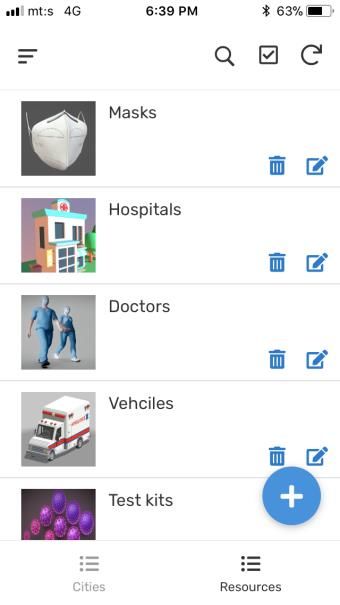
cases and deaths are taken into account in order to determine
whether the available city resources are sufficient to satisfy
the current demands. For daily case predictions, several
factors are considered, such as historical data about cases in
the considered city, weather parameters, safety measures
applied within the city (lockdown or limited movement,
gathering prohibitions, restaurant/bar working hours). The
first two parameters are automatically updated daily,
leveraging the publicly available online data from services,
such as [31], [32] and [33], while the others are entered
manually by users. Moreover, the new case predictions are
further used within the formulas for resource prediction as
described in [16]. The prediction mechanism completely relies
on AppSheet whose minimum number of observations for
training is 25. Moreover, calendar view of daily predictions is
also generated using AppSheet. Finally, city representatives
can make offers to other cities for resource exchange. If offer
is accepted, resource exchange between the cities relying on
                                                                                   Fig. 7. Resource planning AppSheet iOS mobile app screenshots: (a) city
blockchain and smart contracts will be performed building
                                                                                   overview (b) city resource view.
upon the work presented in [16] and [34]. In Fig. 5, an
overview of described applications is given.                                          Fig. 7. shows a screenshot of city resource views taken on
                                                                                   iPhone SE. The first screen (a) shows the list of available
                           Resource
                           planning                                                cities together with number of new cases that day. The second
                          framework                                                screen (b) shows summary of available resources for each of
                           1     7
                                                                                   the cities. Furthermore, Fig. 8 displays the details the list of
                                                                                   available resource types and details for each of them (b). In
                                      3                    4                       this case, the number of available places in hospitals for the
   Weather data       2
                                           AppSheet                                selected city is shown.
                      Spreadsheets6                        5

      Case history                                               Resource
                                                               planning app
Fig. 5. COVID-19 resource planning mobile app: 1-City resource model 2-
Online weather data and case history 3-Import spreadsheet 4-Generated data
view 5-User input parameter 6-Predictions 7-Import spreadsheet into resource
planning framework.

  In Fig. 6, an overview of resource planning app use cases is
given.

                                                                                   Fig. 8. Resource planning AppSheet iOS mobile app resource view
                                                                                   screenshots: (a) resource list (b) resource details.

                                                                                      In Fig. 9, the screenshots of case prediction view (a) and
                                                                                   offer list (b) are shown. When it comes to prediction view (a),
                                                                                   users can provide the input parameters for case predictions
                                                                                   (apart from those that are obtained from online sources
                                                                                   automatically) that are further used to determine the daily
                                                                                   demand of resources. On the other side, in offers view (b),
Fig. 6. City representative resource planning mobile app use case diagram.
                                                                                   user can see all the resource trading offers for the city under

                                                                             RTI 3.2.4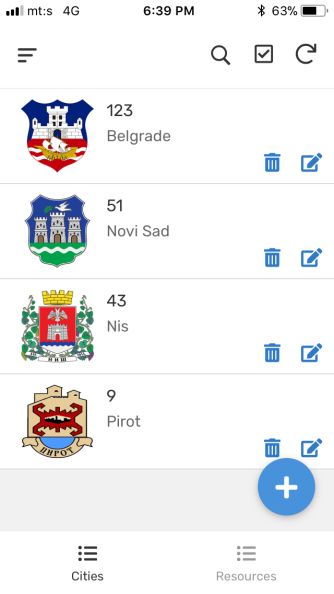
responsibility and accept/reject them.                                                with 50Mbps download/upload speed was used.
                                                                                         Various aspects of evaluation were considered: application
                                                                                      development time speed-up (compared to equivalent Android
                                                                                      application developed in Android Studio [28]), application
                                                                                      delivery time (how much it takes to see the application
                                                                                      modifications without re-installing), storage required for
                                                                                      AppSheet client, RAM memory utilization (for Android) and
                                                                                      average prediction accuracy of AppSheet’s predictor in case
                                                                                      of new cases and resource demand predictions. In Table IV,
                                                                                      the results achieved during the evaluation are given.
                                                                                                                  TABLE IV
                                                                                                              EVALUATION RESULTS
                                                                                                 Aspect                    Value
                                                                                                 Development               12 times
                                                                                                 speed-up [times]
                                                                                                 Delivery time [s]         iPhone       Redmi
                                                                                                                           4.12         3.26
                                                                                                 Client app size [MB]      iOS          Android
                                                                                                                           .ipa:59      .apk:13
                                                                                                                           total:96     total:77
Fig. 9. (a) Case prediction screenshot (b) Offer list screenshot.                                RAM utilization           Case A.      Case B.
                                                                                                 [MB]                      132          184
   A brief summary of the main Google Sheets used for
                                                                                                 Prediction                85.6%
generation of resource planning AppSheet mobile application
                                                                                                 accuracy [%]
is given in Table III.
                            TABLE III
 RESOURCE PLANNING APPLICATION GOOGLE SHEETS STRUCTURE OVERVIEW                          According to the achieved results, the proposed approach of
                                                                                      mobile application generation using AppSheet taking Google
      Sheet             Col1          Col2            Col3            Col4            Sheet as an input significantly speeds up the mobile
                                                                                      application development compared to native solutions. For
                                                                                      evaluation, the case study (A) was considered as native
    Resources                                        Hospital
                         City        Budget
                                                      places
                                                                    Test kits         Android mobile app was already developed in [28]. Using
                        [text]       [num]                           [num]
                                                      [num]                           AppSheet, around 30 minutes were needed, while it took
                                                                                      around 6h to develop similar application from scratch in
    Hospitals            City         Name         Free places        Cost            Android Studio. However, the native application uses
                        [text]        [text]         [num]           [num]            Message Queuing Telemetry Transport (MQTT) protocol and
                                                                                      libraries for message exchange, while AppSheet solution logs
     Test kits
                                                                                      the violations within spreadsheet.
                         City        Number           Type            Cost
                        [text]        [num]           [text]         [num]               When it comes to delivery time, it was faster in case of
                                                                                      Android device, as it is equipped with more powerful CPU
                                                                                      and larger RAM, while AppSheet client is larger in case of
    Prediction          Date          Cases        Temperature      Lockdown          iOS. Furthermore, resource planning tool occupies more
                     [dd/mm/yy]       [num]           [°C]            [y/n]
                                                                                      RAM than the indoor safety monitoring application, as it has
                                                                                      much more views and features, such as value prediction.
      Offer              City       Hospitals        Test kits        Price           However, indoor safety monitoring application is much
                        [text]       [num]            [num]          [num]            heavier than native application in terms of storage required
                                                                                      and RAM occupation, as native Android indoor safety
                                                                                      monitoring app was just 6MB, while only around 50MB of
          IV. EXPERIMENTS AND EVALUATION RESULTS                                      RAM was required.
   For purpose of evaluation, the following, the following                               Finally, when it comes to accuracy of case predictions, it
devices were used: a laptop equipped with Intel i7 7700-HQ                            was higher than in case of [16] which was around 72%, as
quad-core CPU running at 2.80GHz with 16GB of DDR4                                    much more data was available (whole May, June and July)
RAM and 1TB HDD acting as Edge server, iPhone SE 2016                                 and AppSheet’s prediction module is highly optimized, but
(dual-core, 2GB of RAM) as representative of iOS                                      still fast, as training took just several seconds.
smartphones and Xiaomi Redmi Note 7 (octa-core, 3GB of
RAM) as representative of Android smartphones. As active                                             V. CONCLUSION AND FUTURE WORK
internet connection was required to run the apps, 4G network                                According to the achieved results for case studies, the

                                                                                RTI 3.2.5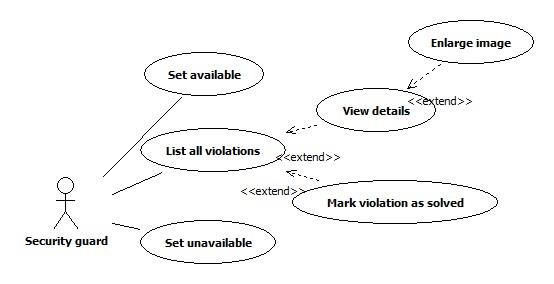
proposed approach of AppSheet-based COVID-19 support                                    Syndrome: Clinical Research & Reviews, Volume 14, Issue 4, 2020, pp.
                                                                                        337-339, 2020. https://doi.org/10.1016/j.dsx.2020.04.012
mobile application development has huge potential, as it                         [12]   R. P. Singh, M. Javaid, A. Haleem, R. Suman, “Internet of things (IoT)
provides rapid creation, fast delivery, relatively low hardware                         applications to fight against COVID-19 pandemic”, Diabetes &
requirement requirements and solid set of features at the same                          Metabolic Syndrome: Clinical Research & Reviews, Volume 14, Issue
                                                                                        4, 2020, pp. 521-524, 2020. https://doi.org/10.1016/j.dsx.2020.04.041
time. Unlike state-of-the-art cross platform frameworks, it
                                                                                 [13]   M. Nasajpur et al., “Internet of Things for Current COVID-19 and
requires almost no coding, while it provides more advanced                              Future Pandemics: An Exploratory Study” (preprint), pp. 1-19, 2020.
user interfaces, data visualization and AI-enabled capabilities                         https://arxiv.org/abs/2007.11147
compared to mobile version of Google Sheets. In one of the                       [14]   D. Marbouh et al., “Blockchain for COVID-19: Review, Opportunites
                                                                                        and a Trusted Tracking System” (preprint), pp. 1-17, 2020.
case studies, the prediction module was used to estimate the                            https://doi.org/10.36227/techrxiv.12609344.v2
daily number of new cases and according to that, the city                        [15]   T. Alam, “Internet of Things and Blockchain-Based Framework for
resource demand with satisfiable accuracy.                                              Coronavirus (COVID-19) Disease” (preprint), pp. 1-9, 2020.
                                                                                        https://doi.org/10.20944/preprints202007.0642.v1
   However, in future, it is planned to perform tighter                          [16]   N. Petrovic, Dj. Kocic, “Framework for Efficient Resource Planning in
integration with blockchain infrastructure in order to enable                           Pandemic Crisis”, CIIT 2020, pp. 1-6, 2020.
secure logging of the events that occur, case data and resource                  [17]   L. C. Ming et al., “Content Analysis and Review of Mobile Health
                                                                                        Applications on COVID-19”, JMIR mHealth and uHealth.
availability leveraging smart contracts. Finally, the integration                       30/06/2020:19796 (forthcoming/in press). https://doi.org/10.2196/19796
with framework for smart contract verification based on                          [18]   D. Drew et al., “Rapid implementation of mobile technology for real-
semantic technology [35] is also considered. Moreover, apart                            time epidemiology of COVID-19”, Science Vol. 368, Issue 6497, pp.
                                                                                        1362–1367, 2020. https://doi.org/10.1126/science.abc0473
from COVID-19 use cases, we plan to adopt AppSheet                               [19]   N. Harraz, “Online Monitoring of On-Shelf Availability”, International
applications for custom fitness training generation based on                            Conference on Industrial Engineering and Operations Management
user parameters (height, weight and other details) in future.                           2018, pp. 450-461, 2018.
                                                                                 [20]   P. Samutrak, C. Kangvaravoot, “Application to Calculate Potential
                                                                                        Evapotranspiration”, International Journal of Applied Computer
                          ACKNOWLEDGMENT                                                Technology and Information Systems: Volume 7, No.1, pp. 35-40,
                                                                                        2017.
  This work has been supported by the Ministry of Education,
                                                                                 [21]   D. S. Wijesekara et al., “Developing an electronic record keeping
Science and Technological Development of the Republic of                                system at a paediatric clinic in Colombo South Teaching Hospital, Sri
Serbia.                                                                                 Lanka”, Sri Lanka Journal of Child Health, 49(2), pp.116–124, 2020.
                                                                                 [22]   E. Ogunshile, K. Phung, S. Odongo, “C-19 C -A mobile application to
                                                                                        support the community during Covid-19 lockdown”, CONISOFT 2020,
                              REFERENCES                                                pp. 1-9, 2020.
[1]  V. C. Bala, P. Kumar, “Review on COVID-19: Rise of SARS-CoV-2               [23]   J. Vanathi, G. SriPradha, “BreakTheChain: A Proposed AI powered
     Pandemic Outbreak”, Borneo Journal of Pharmacy, 3(Special-1), pp.                  Mobile Application Framework to handle COVID-19 Pandemic”,
     103-120, 2020. https://doi.org/10.33084/bjop.v3iSpecial-1.1412                     Alochana Chakra Journal, Volume IX, Issue IV, April 2020, pp. 108-
[2] P. Zhai et al., “The epidemiology, diagnosis and treatment of COVID-                114, 2020.
     19”, International Journal of Antimicrobial Agents vol. 55 issue 5, May     [24]   K. Hammoudi, A. Cabani, H. Benhabiles, M. Melkemi, “Validating the
     2020,              105955,            pp.            1-13,          2020.          correct wearing of protection mask by taking a selfie: design of a mobile
     https://doi.org/10.1016/j.ijantimicag.2020.105955                                  application "CheckYourMask" to limit the spread of COVID-19”
[3] P. Dawson et al., “Loss of Taste and Smell as Distinguishing Symptoms               (preprint), pp. 1-5, 2020. https://hal.archives-ouvertes.fr/hal-02614790
     of COVID-19”, Clinical Infectious Diseases June 2020, pp. 1-4, 2020.        [25]   A. Imran et al., “AI4COVID-19: AI enabled preliminary diagnosis for
     https://doi.org/10.1093/cid/ciaa799                                                COVID-19 from cough samples via an app” (pre-proof), Informatics in
[4] Coronavirus        Incubation      Period     [online].    Available   on:          Medicine             Unlocked,            pp.           1-30,        2020.
     https://www.worldometers.info/coronavirus/coronavirus-                             https://doi.org/10.1016/j.imu.2020.100378
     incubationperiod/ , last accessed: 11/07/2020.                              [26]   X. Li, C. Li, D. Zhu, “COVID-MobileXpert: On-Device COVID-19
[5] D. Oran, E. Topol, Prevalence of Asymptomatic SARS-CoV-2                            Screening using Snapshots of Chest X-Ray” (preprint), pp. 1-14, 2020.
     Infection: A Narrative Review, Annals of Internal Medicine, June 2020,             https://arxiv.org/abs/2004.03042
     pp. 1-7, 2020. https://doi.org/10.7326/M20-3012                             [27]   J. Lim, “Measuring sports performance with mobile applications during
[6] Y. V. Chudasama, “Impact of COVID-19 on routine care for chronic                    the COVID-19 pandemic”, SPSR 2020, 103, v1, pp. 1-3, 2020.
     diseases: A global survey of views from healthcare professionals”,          [28]   N. Petrović, Đ. Kocić, “IoT-based System for COVID-19 Indoor Safety
     Diabetes & Metabolic Syndrome: Clinical Research & Reviews,                        Monitoring” (preprint), IcETRAN 2020, pp. 1-6, 2020.
     Volume         14,        Issue      5,      pp.       965-967,     2020.   [29]   L. Morawska, “How can airborne transmission of COVID-19 indoors be
     https://doi.org/10.1016/j.dsx.2020.06.042                                          minimised?”, Environment International vol. 142, September 2020,
[7] T. Dbouk, D. Drikakis, “On respiratory droplets and face masks”,                    105832, pp. 1-7, 2020. https://doi.org/10.1016/j.envint.2020.105832
     Physics      of      Fluids     32,     063303,     pp.     1-11,   2020.   [30]   P. Vanini, “Protection of the Population and the Economy in a
     https://doi.org/10.1063/5.0015044                                                  Pandemic” (preprint), pp. 1-21, 2020.
[8] Y. Song et al., “COVID-19 Treatment: Close to a Cure? – A Rapid              [31]   Statistika    COVID-19        u     Srbiji    [online].    Available    on:
     Review of Pharmacotherapies for the Novel Coronavirus” [preprint], pp.             https://covid19.data.gov.rs/, last accessed: 29/07/2020.
     1-25, 2020. https://doi.org/10.20944/preprints202003.0378.v1                [32]   Zaraženo          u       danu          [online].       Available       on:
[9] V. Balachandar et al., “COVID-19: emerging protective measures”,                    https://covid19.data.gov.rs/infected, last accessed: 29/07/2020.
     European Review for Medical and Pharmacological Sciences vol. 24            [33]   Serbia       weather      conditions        [online].     Available     on:
     (6),                  pp.                 3422-3425,                2020.          https://www.accuweather.com/en/rs/serbia-weather,          last   accessed:
     https://doi.org/10.26355/eurrev_202003_20713                                       29/07/2020.
[10] M. Nicola et al., “The socio-economic implications of the coronavirus       [34]   N. Petrović, Đ. Kocić, “Data-driven Framework for Energy-Efficient
     pandemic (COVID-19): A review”, International Journal of Surgery,                  Smart Cities”, Serbian Journal of Electrical Engineering, Vol. 17, No. 1,
     Volume         78,      June       2020,      pp.      185-193,     2020.          Feb. 2020, pp. 41-63. https://doi.org/10.2298/SJEE2001041P
     https://doi.org/10.1016/j.ijsu.2020.04.018                                  [35]   N. Petrović, M. Tošić, “Semantic Approach to Smart Contract
[11] R. Vaishya, M. Javaid, I. H. Khan, A. Haleem, “Artificial Intelligence             Verification”, Facta Universitatis Series Automatic Control and
     (AI) applications for COVID-19 pandemic”, Diabetes & Metabolic                     Robotics             19(1),            pp.            21-37,         2020.

                                                                           RTI 3.2.6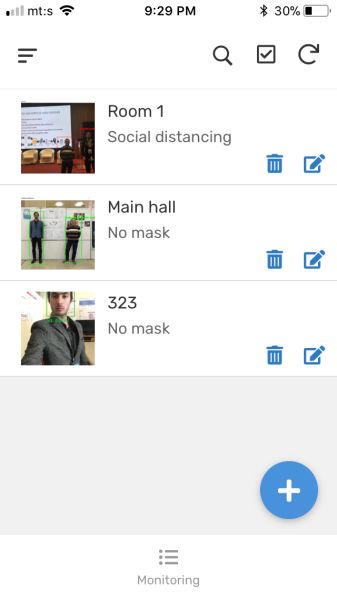
You can also read


