DBS Sample collection for Early Infant Diagnosis (EID) by PCR - Laboratory Services Division December 2015 - Naco
←
→
Page content transcription
If your browser does not render page correctly, please read the page content below
DBS Sample collection for Early
     Infant Diagnosis (EID) by PCR

Laboratory Services Division
December 2015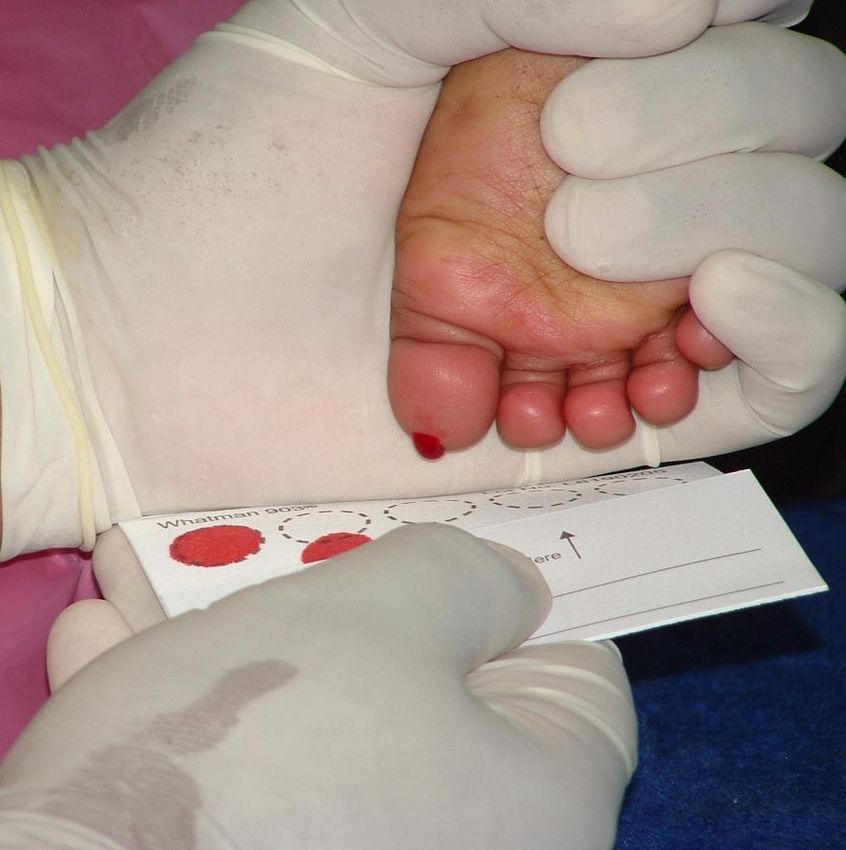
Agenda

I. Revised EID Algorithm
Background

•   HIV-infected babies are the most vulnerable of all patients with ~ mortality > 50% by
    age 2 in untreated patients

•   These patients would benefit the most from ART, but diagnosis is difficult due to the
    presence of maternal HIV antibodies transferred from mother to child during
    pregnancy, childbirth and breastfeeding

•   Most infants born to HIV+ mothers would test positive using standard HIV antibody
    tests such as ELISA or rapid tests until the level of maternal antibody falls below limit of
    detection at 18 months

•   Thus, in infants below 18 months of age, direct detection tests for the virus have to be
    conducted, and the current test of choice is the HIV-1 PCR which detects HIV pro-viral
    DNA & RNA

                                                                                                   3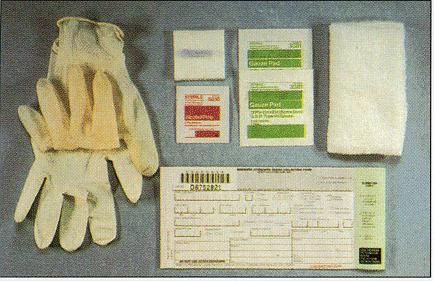
Background (cont.)

•   HIV-1 PCR testing involves amplification of target viral nucleic acid

•   The HIV-1 PCR test is:
     – Sensitive: 99.0%
     – Specific: 98%
     which means that a confirmatory test is critical to eliminate the rare cases of false
     positives

•   Window period for HIV-1 PCR is typically 6 weeks after last exposure

•   Dried Blood Spots (DBS)/ Plasma are the specimens that can be used to perform
    HIV-1 PCR testing

                                                                                             4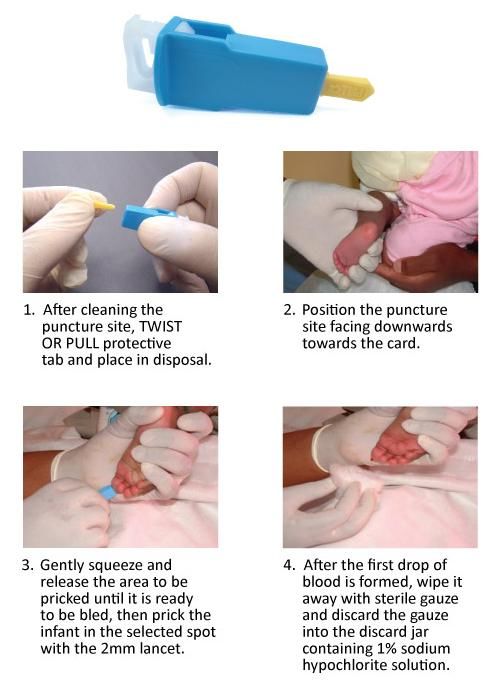
Background (cont.)
• Two types of infants who will need HIV diagnostic testing
Infants who are HIV- exposed (mother known HIV positive from ICTC)
Infants who are sick with signs and symptoms of HIV, even if unknown HIV
exposure status (referred by MO / Paediatrician)
5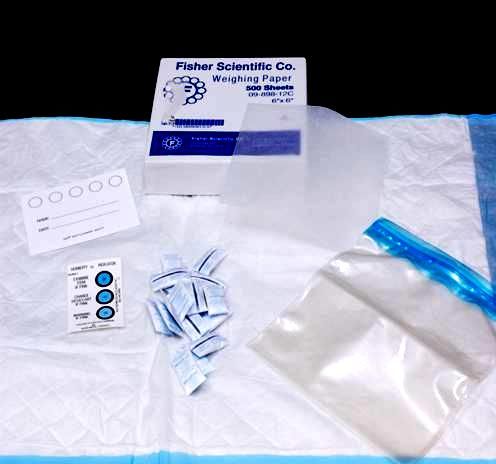
Objectives

1. Infant HIV testing algorithm to be universally followed and implemented on every HIV
   exposed infant to ensure equal and routine access

2. Linkage of the Exposed and infected infants to appropriate referral and care and treatment
   services to ensure timely intervention to reduce infant morbidity and mortality due to HIV
   infection

                                                                                                6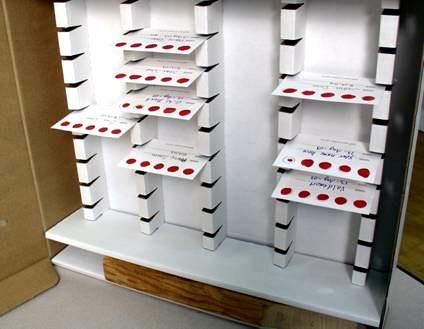
NATIONAL TESTING ALGORITHM FOR HIV- 1 EXPOSED INFANTS AND CHILDREN 6 months of age initiate mix feeding before 6 months of age and initiate complementary food after 6 months of
complementary food along with age If breastfed, continue breastfeeding till 1 year of age for ‘HIV-1 Not Detected’ baby, avoid mix feeding before 6 months of age and
breastfeeding Test for HIV Antibody for definitive diagnosis using all three serological tests at 18 initiate complementary food after 6 months of age
months of age at the ICTC Test for HIV Antibody for definitive diagnosis using all three serological tests at 18 months of age at the ICTC
UNIVERSAL ADVISORY
Serological test not recommended 1. Cotrimoxazole Preventive Therapy (CPT) to be initiated for all HIV exposed babies from 6 weeks of age and continued until proven HIV negative on all three serological tests at 18 months of age or later. In case the baby is
found to be HIV infected by final confirmatory diagnosis on all three serological tests, LPV/r based ART should be initiated and CPT should be continued until 5 years of age.
If baby is < 6 weeks of age: HIV-1 PCR
Test not recommended 2. Initiate babies on exclusive breastfeeding till 6 months of age, avoid mix feeding (any other milk products) before 6 months of age and add complementary food after 6 months of age. If the baby has been started on exclusive
replacement feeding, continue the same and add complementary food after 6 months of age.
6 weeks and above is the optimal age for a
routine first HIV-1 PCR Test 3. In rare cases of Serological-Discordance, i.e., the baby tests negative on any one or any two or all three serological tests after having been confirmed positive by HIV-1 PCR Test, continue ART and verify HIV-1 infection status
through PCR testing. Refer the chart on ‘18 month antibody testing algorithm for all babies’.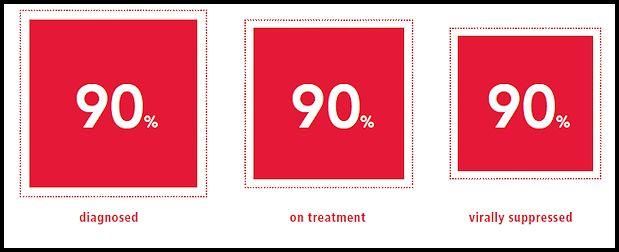
18 MONTH ANTIBODY TESTING ALGORITHM FOR ALL BABIES: 2015
Baby presents at the ICTC at 18 months of age or later
WHAT IS THE HIV-1 INFECTION
STATUS BY PREVIOUSLY DONE
PCR TESTS?
HIV-1 Detected by PCR HIV-1 Not Detected by PCR Never tested by PCR
Test for HIV antibody for a definitive diagnosis using Test for HIV antibody for a definitive diagnosis using
all three serological tests at the ICTC all three serological tests at the ICTC
Antibody Antibody Antibody Antibody Antibody Antibody Antibody Antibody
reactive on reactive on reactive on Non-reactive on reactive on reactive on reactive on Non-reactive on
all 3 tests 2 tests 1 test all three tests all 3 tests 2 tests 1 test all three tests
SEROLOGICAL-DISCORDANCE Baby is HIV-1
Collect two fresh DBS samples on two infected Indeterminate: Repeat
Confirm HIV-1
separate cards on the same visit for antibody testing after two
Initiate lifelong Not Detected
Verification PCR tests & send them to the weeks
ART
testing lab
DO NOT STOP ART
HIV-1 Detected on any
HIV-1 Not Detected
one or both DBS
on both DBS Samples
Samples
Baby is HIV-1
infected Contact NACO and email the baby’s details at
serodiscordance@gmail.com
Continue
lifelong ART DO NOT STOP ART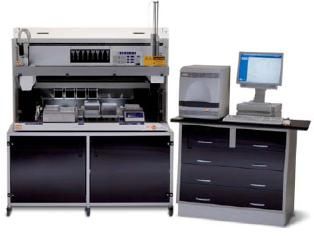
Algorithm for diagnosis of HIV infection at < 6 months of age

 •   At ICTC level: Collect & send Dried Blood Spot (DBS) of babies between 6 weeks to < 6
     months of age for HIV-1 PCR test to the PCR testing laboratory

      – HIV-1 Detected: Infant is probably HIV-1 infected. Lab will ask for another DBS
        sample.
          • If repeat sample is positive then baby is infected. Refer baby to ARTC for treatment.
          • If repeat sample is negative, then the lab will ask for another DBS sample and will
            rely on the result of this sample for establishing diagnosis.

      – HIV-1 Not Detected: Ask baby to visit at 6 months age for testing again or if the baby
        develops signs and symptoms of HIV (whichever is earlier).

                                                                                                    9
Algorithm for diagnosis of HIV infection at < 6 months of age (cont.)
• NOTE:
− Rapid antibody test is not recommended
− If baby is < 6 weeks old then PCR test is not recommended; 6 weeks and above is
the optimal age for a routine first PCR test
− If a DBS tests positive then another sample collected at a different time (not two
samples spotted at same time) should be sent for confirming diagnosis
10Algorithm for diagnosis of HIV infection at 6-18 months of age
• At ICTC level: Collect blood and test for HIV antibodies using all three serological
tests. Also prepare a Dried blood spot (DBS) for HIV-1 PCR test simultaneously.
• If all three or any 2 or any one serological test is positive
– Send Dried Blood Spot (DBS) of child for HIV-1 PCR test and follow the EID testing
algorithm
• If all three rapid serological tests are negative
– Baby does not need HIV-1 PCR test at this point
– Ask baby to come back for testing at 6 weeks after last breast milk feeding OR at
12 months OR if baby develops symptoms of HIV infection, whichever is earlier
11II. Overview of EID tests
Benefits of Early ART in Children

• Could mitigate negative effect of HIV on growth and development

• May help in immune recovery and reduce effects of HIV-induced chronic immune
  activation

                                                                                 13
Tests for Early Infant Diagnosis (EID) of HIV Infection
• Serology unreliable in infants (maternal antibodies cross placenta; can give a positive HIV
antibody test in baby)
• Testing for EID is by a qualitative nucleic acid test (NAT)
• NACO EID referral laboratories tested with the Roche Amplicor HIV-1 DNA test (version
1.5) based on conventional PCR and hybridization for proviral DNA, until it was phased
out by the manufacturer this year
• New tests detect total nucleic acid (TNA). The instrument can also be used for quantitative
testing (viral load assay)
14Tests for HIV Total Nucleic Acid
• Detect both RNA and DNA
• Examples
– Abbott Real Time HIV-1
– Roche COBAS AmpliPrep/COBAS TaqMan HIV-1
(ver. 2)
• Real-time PCR
– Quantitative test is FDA approved for determination of viral load on plasma
– Qualitative test has CE-mark and is WHO pre-qualified for testing DBS samples
• Limit of RNA detection in DBS (claimed by manufacturer)
– Roche: 300 copies/ml, Abbott: 2500 copies/ml (for hit-rate >95%); excellent
correlation between the two tests
15Abbott Real Time HIV-1
• Fully automated (sample preparation and RNA
extraction on m2000sp, test on m2000rt) and manual
extraction options
• Target: Highly conserved 172 nucleotide region of pol
(integrase) gene
• Internal control (IC)
– Unrelated to HIV-1 target; incorporated for each
assay
• Qualitative detection of HIV nucleic acid in DBS
16Target 2020: UNAIDS
17III. Dried Blood Spot (DBS) Sample collection at ICTC
Introduction

•   This presentation describes a procedure for collection of a dried blood spot (DBS)
    specimen from an infant below 18 months of age for the purpose of performing HIV-1
    PCR testing

•   Correct performance of the DBS collection using the aseptic technique is critical to
    ensure the safety of the procedure and to assure the quality of the test results
    obtained thereof

•   Optimal specimen collections contribute significantly to the comfort and satisfaction of
    the donors thus encouraging retesting
What is a dried blood spot (DBS)?
• Whole blood dried on filter paper provided (do not use ordinary filter paper)
• Usually obtained from pricking skin, not from phlebotomy
• Requires only a small amount of blood
• Easy to store
• Easy to transport
• Low biohazard
• A widely used method of specimen collection for HIV-1 PCR testing
• Performs comparably with whole blood collection methods in terms of sensitivity and
specificity for HIV using PCR assay
• Facilitate wider accessibility to the testing serviceResponsibility Dried blood spots (DBS) should be made only by persons who have been appropriately trained in both the making of dried blood spots and in standard work precautions: • MO/Pediatrician • Nurse on duty • Lab technician
Responsibilities: ICTC Technicians

•   Attend to exposed infants on a priority for collection of Dried Blood Spot (DBS)
    specimens everyday between 10 am and 1 pm
•   Check if the baby is born to an HIV positive mother or is carrying the referral for HIV-1
    PCR testing from MO/Paediatrician
•   Obtain consent from the parent/guardian after pre-test counselling
•   Ensure availability of materials for dried blood spot collection
•   Label DBS card and fill TRRF just before taking the specimen
•   Store DBS samples at 2-8°C until transported and package appropriately
•   Ensure packaging appropriate specimens after verifying the TRRF and delivery
    checklist
•   Ensure all required documents (TRRF, delivery checklist, self addressed envelopes)
    are present
•   Ensure transportation of samples to the PCR testing laboratory through post /
    registered mail / courier on every Tuesday of the month                                     22
Responsibilities: ICTC Technicians (cont.) – Unique Infant Code
• Every Infant will be allocated a 15 digit Unique Infant code, to be allocated on the
following basis:
– First 3 digits: DNA
– Next 2 digits: State code
– Next 3 digits: district code
– Next 2 digits: ICTC centre number
– Next 2 digits: Year
– Next 3 digits: Serial number of the Infant at the ICTC (001 onwards)
23Material for ICTCs
• Guidelines
• Chart for testing algorithm
• TRRF (Test Requisition and Result Form) pads
• Delivery checklist pads
• Consent form pad
• Algorithm poster
• Labels
• Envelopes for mailing DBS cards to respective linkage lab
• Stickers of respective linkage laboratory address
• Dried blood spot collection kit
24Materials required for DBS collection
• Sterile disposable lancet
• Sterile gauze and clean water
• Sterile alcohol preparation (70%
isopropanolol)
• Gloves (powderless)
• Test requisition cum result form (TRRF)
• DBS card [specially formulated
commercially available absorbent filter
paper]
• Discard jar with 1% Sodium hypochlorite
• Drying rack
25How to use the lancets provided
Please note that the pictures
are for illustration and are in
no way indicative of
endorsement by NACO of any
particular company or
product. The same holds true
for any commonly used
terminology which is/are
company specific
26Labeling the DBS Card
Clearly label the DBS card with:
•The patient’s name and ID number
•The date and time of specimen collection
•Other information such as age, center name
27Choosing the area to prick
• There are age specific recommendations Areas shown by the arrows are the right
for sites from where specimens are to be areas to prick
collected: Big toe
• Children aged 6 weeks to 4 months:
heel
• Children aged 4+ to 10 months: big
toe
• Children aged 10+ to 18 months:
finger prick- 3rd or 4th finger
• Use 2mm lancets
• Take care not to hit the bone of the child
when pricking
Heel-Prick
28Preparation for collection
• Ensure that the baby has been born to an HIV positive mother/referred by MO/Pediatrician with strong
suspicion of HIV infection
• Ensure completion of all lab records and proceed as below
• Introduce yourself and identify the patient (this is a critical step in specimen collection). Be warm and
reassuring though honesty in your manner
• Explain the procedure and obtain proper written informed consent from the parent/ guardian with
appropriate pre test counseling. Explain that if the child holds still, you are more likely to be successful
• Encourage parent involvement
• Obtain proper written informed consent from the parent/ guardian with appropriate pre test counseling
• Observe Standard work precautions at all times by wearing gloves and laboratory coat
• Put down a clean paper towel and lay out all the material you will need
• Complete the test requisition form with the details of the patient
• Label the DBS card (Patient Name / ID, date and time of specimen collection)
• Warm the area
• Position the baby
• Put on gloves, wash hands
29Common DBS sample collection steps
• After pricking discard the lancet safely into the discard jar for sharps containing 1% freshly
prepared Sodium hypochlorite solution.
• Wipe away first blood drop with sterile gauze pad
• Allow another LARGE blood drop to form.
• Lightly touch filter paper to LARGE blood drop. Apply blood to one side of filter paper only
(the side with printing).
• Allow blood to soak through and completely fill circle with SINGLE application to LARGE
blood drop. (To enhance blood flow, VERY GENTLE intermittent pressure may be applied
to area surrounding puncture site).
30Common collection steps after prick has been made - 2
• Do not contaminate filter paper circles by allowing the circles to come in contact with the
body part, spillage or by touching before or after blood collection
• Fill remaining circles in the same manner with successive blood drops.
• Take at least 3 to 4 good drops so that we have 3 to 4 complete circles filled with the
sample
• If blood flow is diminished, repeat from beginning with cleansing again
• Once the required amount of specimen has been collected, pressure must be applied
gently at the puncture site with a gauze to ensure that there is no further bleeding from the
site.
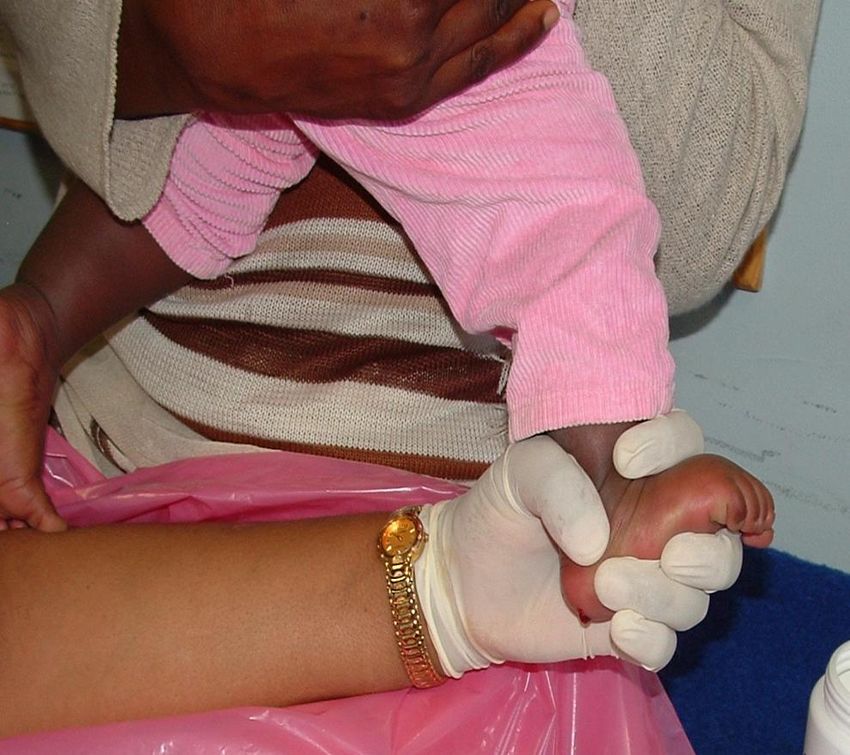
31The right way to hold the foot
Hold the whole foot. If necessary, apply moderate pressure to help
form large drops of blood
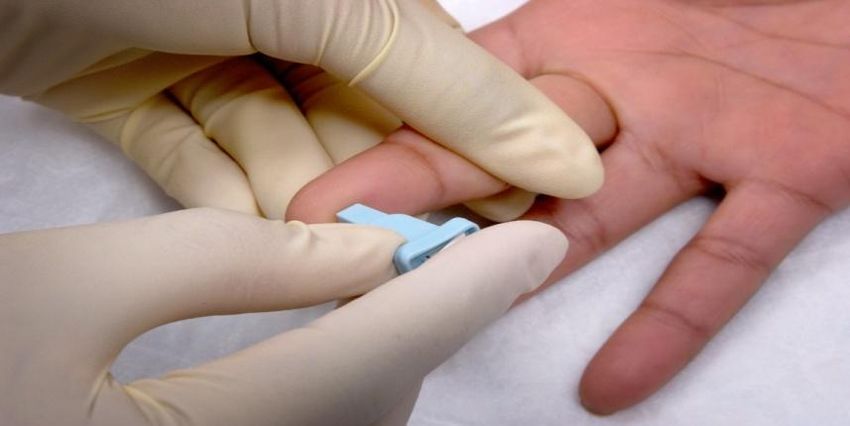
32Finger puncture 1. Position the hand palm side up. Select one of the 3rd or 4th 2. Massage finger to increase blood flow. fingers. Select the site on the - medial /lateral upper quadrant of the selected finger. 3. Clean the fingertip with alcohol. Work from the middle out 4. Grasp the finger and place a new sterile lancet on to reduce contamination. Allow the area to dry. the side of the fingertip.
Drying the DBS Cards

•   Dry blood spots on a drying rack if
                                                     Acceptable Sample:
    available or on a dry, clean, flat non-
    absorbent surface for a minimum of four
    hours- the part of the card carrying the
    DBS should overhang the edge of the
    surface (as shown in the next slide)
                                                     Unacceptable Sample:
•   Do not touch the part of the card where
    blood has been applied to see if the blood
    has dried.
•   As the blood dries on the filter paper it will
    change from a bright red color to a darker        NOTE: At least 3-4 printed circle should
    red-brown color, also the paper will              have been completely filled with blood –
    buckle slightly.                                  otherwise the sample will be rejected by
                                                      the lab

                                                                                                 34
Dry completely before packaging
• Place the DBS cards in the rack with the
blood spots oriented outwards
• Dry horizontallyInvalid DBS specimens
Circles not filled well
Specimen not dry before mailingInvalid DBS specimens (cont.)
Specimen exhibits serum rings
Alcohol not allowed to dry completely before puncture to draw bloodDocumentation
Document and maintain all requisition, delivery checklist and consent forms
All necessary documentation and information of every specimen collected must
be made in the designated register
Record of failed attempts at taking a DBS specimen must be recorded.
Accountability of documentation, sample collection, storage, packaging,
labeling and handing over to courier in time will lie with the MO/lab
technician/nurse (person who collected the sample)
38IV. Packaging & Transportation of DBS Samples
Materials required for DBS packaging

•   Gloves (powderless)
•   Glassine paper
•   Plastic zip lock packets
•   Desiccant sachets
•   Humidity indicator cards
•   Biohazard labels
•   Blank label
•   Plain paper envelopes
•   Self addressed envelopes
•   Padded paper envelopes
•   Stapler
•   Pen

                                       40
DBS Packaging and Storage
• If specimen is not to be immediately transported, keep DBS packaged in sealable
plastic bags refrigerated at 2-8° C until transported to testing lab (sent on every
Tuesday of the month). Do not freeze.
• Each such ziplock bag carrying the specimens must have pasted on it:
– a biohazard sticker
– a sticker specifying the identity of the specimens enclosed in that ziplock
bag -this information may be used to tally with the TRRF’s at the time of
packaging before handing over to the courier. This would also enable the
compilation of the delivery checklist and ensure that no specimen/TRRF is
missed out in final mailing/courier.
• File the TRRF’s (3 copies per specimen) separately until required to be packaged in
an envelope to go along with the specimens at the time of handing over the
specimens to the courier. 2 copies of the TRRF will accompany the specimens to
the testing lab and one copy will be retained at the centre for records
41DBS Packaging and Storage (cont.)
• Check the color of the humidity indicator card twice a week. Anytime during storage
or before packaging for handing over to the courier/mailing, if you notice a pinkish
tinge in the blue circles on the humidity indicator card, change the card and replace
the moist silica sachets with fresh dry silica sachets.
65oC (hot air oven )
PINK (High humidity) BLUE (Dry)
• In case the specimen is to be handed over to the courier or mailed, pull out the
stored package from the refrigerator 1 hour before the next steps of final
packaging
• When contents have come to air conditioned room temp (20-250C), place the zip-lock
bag containing the DBS inside an envelope.
42Transport of DBS specimens
• Use a reliable and tested courier/ mailing system for transportation of the specimen
packages
• Centre must dispatch these collected specimens to the testing laboratory on every
Tuesday of the month
• Take care to keep the DBS free from moisture and humidity.
• Postal and local transport regulations must be followed if using the postal or courier
services.
43State & Testing Laboratory linkage
Testing Testing Lab
State Lab in-charge
Lab location
AP, Telangana, Tamil Nadu, Kerala,
NIIRT Chennai Dr. Luke Hanna
Pondicherry, Andaman and Nicobar
Karnataka NIMHANS Bengaluru Dr. Anita Desai
Mumbai, MP, Gujrat, Goa, Dadra & Nagar Kasturba
Mumbai Dr. Jayanti Shashtri
Haveli Hospital
Maharashtra NARI Pune Dr. Sonali Kurle
J&K, Delhi, Chandigarh, UP, Haryana,
Uttaranchal, Rajasthan, Punjab, Himachal AIIMS New Delhi Dr. Lalit Dar
Pradesh
West Bengal, Assam, Manipur, Nagaland,
Mizoram, Orissa, Bihar, Jharkhand,
NICED Kolkata Dr. M.K. Saha
Chhattisgarh, Arunachal Pradesh, Meghalaya,
Sikkim
44Mailing Address: Testing Laboratory
1. Dr. Luke Elizabeth Hanna
HIV-AIDS Lab, Department of Clinical Research
NIIRT, Mayor V.R. Ramanathan Road , Chetput, Chennai 600031, TN
hannatrc@yahoo.com , Mob: 09840644376
2. Dr. Anita Desai
II Floor, Administrative Block, National Institute of Health & Neurosciences (NIMHANS) ,Bangalore
560029, Karnataka
anitasdesai@gmail.com , Mob: 093436022
3. Dr. Jayanthi Shashtri/Dr. Nilima Vaidya
Molecular Biology Laboratory, Kasturba Hospital, Sane Guruji Marg, Mumbai-400011
kasturba_hiv@yahoo.com , Mob: 09820549156 , 09323137017 (TO- Rahul)
4. Dr. Dhanshree Jagtap
Department of Molecular Virology, National AIDS Research Institute, Indian Council of Medical
Research, Block-G, Plot -73, MIDC, Bhosari, Pune- 411026
eidnarilab@gmail.com , Mob: 09321341919
45Mailing Address: Testing Laboratory
5. Dr. Lalit Dar
Department of Microbiology, Virology section, Room no. 2101 , Second Floor, Teaching Block , All
India Institute of Medical Sciences, New Delhi- 110029
lalitdar@gmail.com , Mob: 09818137078, 08750419517 (TO), Lab: 011-2659336
6. Dr. M. K. Saha
Room No. 308, NICED New Building, ID Hospital Campus, National Institute of Cholera and
Enteric Diseases, Beliaghata, Kolkata- 700010
sahamk@yahoo.com , Mob: 09433081013, 09830522198 (TO)
46RECAP: Dried Blood Spot Specimen Collection
Step 1: Counseling done and Consent form filled
Step 2: Make the child comfortable
Step 3: Fill out records
Step 4: Ensure availability of materials required for collection
Step 5: Preparation for collection (wash hands, wear gloves etc.)
Step 6: Collect the Dried Blood Spot (DBS) specimen
Step 7: Drying and packaging
Step 8: Storage and transportation
Step 9: Send to the testing laboratory
47V. Supply Chain Management
Materials being supplied by NACO for the program

 Recurring supplies provided by SACS   NACO supply
 • DBS cards                           • Guideline
                                       • Poster showing EID algorithm
 • Gloves
 • Lancets
 • Humidity indicators
 • Glassine envelopes
 • Ziplock bags
 • Drying Rack
 • Labels
 • Padded envelope for mailing
 • Consent forms
 • TRRF’s (Test Requisition and
   Referral Forms)
 • Delivery checklists
                                                                        49
Inventory Management Leads to High Quality Testing
Inventory management
• Ensures availability of materials and kits when needed
• Avoids the use of expired items
• Minimizes wasting and relocations
50Inventory Management Involves Knowing…
• What and how much stock you have
• When to order fresh supplies
• What and how much has been ordered, when it was ordered
• Where all supplies are stored
• When and how much fresh stock was received, and by whom
51Inventory Management Involves …
• Performing a “stock count”
• Maintaining proper inventory records
• Determining when to re-order
• Determining how much to re-order
• Placing orders properly
• Inspecting delivery of new orders
• Ensuring proper storage of inventory
52Inspect Delivery of New Orders
Upon receipt
• Verify contents of order received with requisition
• Check integrity of received supplies
• Date each item
• Note expiry date
• Store new supplies behind existing supplies
• Create or update records
53Key Messages
• Maintain an adequate inventory at all time to ensure uninterrupted service
• Don’t let any item run out before re-order.
• Never order more than your storage space can hold. Never order more
supplies than you can use before they are expired.
• All items in the inventory must be accounted for and recorded.
• Always inspect new shipment before accepting.
54DBS card MONTHLY STOCK REPORT- SITE LEVEL (to be sent to SACS)
55Thank You
eid.naco@gmail.com
labservices2.naco@gmail.com
Ph: 011-43509936
56You can also read


