Development Special Educational Needs - Plan - Surrey County Council
←
→
Page content transcription
If your browser does not render page correctly, please read the page content below
Surrey
  children and
 young people’s

Special Educational Needs
      and Disability

Development
    Plan
     2016 - 2020

 Published Spring 2016
Contents

Foreword              3-4   Part 1 High-level summary               11    Part 2 Summary workstream plans          20

                            The growing level of need for                 Transform the customer experience        21
Acknowledgements       5    SEND support                          12-13
                                                                          Rebuild the system around the customer   22
                            Understanding the financial picture   14-15
Development journey   6-9                                                 Reshape the local offer                  23
                            Working in partnership                  16
                                                                          Develop inclusive practice               24
                            Our approach                          17-19

                                                                          Annex 1 - Glossary                       26

                                                                          One page strategy                        27
Foreword

Children and young people will be happy,
healthy, safe and confident in their future.
This is our ambition for children and young people.
As partners and providers we work together day in, day out across Surrey to achieve this.

The SEND Partnership Board has launched          We have been listening to and collecting         We also know that numbers of children and
a major change programme to improve              feedback from families. We know we still have    young people with SEND are growing, so we
special educational needs and disability         work to do to improve our services and we are    need to ensure we manage our resources
(SEND) services in Surrey. The board consists    committed to making significant changes.         more efficiently and join up our education,
of representatives from health services,                                                          health and care services to improve the
education, parents and the local authority.      The SEND 2020 programme has four key             customer experience.
                                                 objectives, to:
We are doing this in response to the families,   • transform the customer experience              Most importantly, across all of these
staff and partners who have told us that the     • rebuild the system around the customer         challenges, is that we work with children,
system isn’t working as well as it should be     • reshape the SEND local offer                   young people and families to understand
for them. As a result, the programme, called     • develop inclusive practice.                    what needs to change to help us deliver
SEND 2020, will involve working differently to                                                    improvements and meet the new legislative
transform SEND services.                         The programme will address the main              requirements across the system.
                                                 challenges within the SEND system which
Legislation (the Children and Families           include making sure we give the right support    We have made a commitment to achieve the
Act 2014), also requires us to adopt a           to children and young people at the right time   Customer Service Excellence standard utilising
new approach.                                    and deliver the right outcomes based on their    a framework for continual improvement, as well
                                                 personal needs.                                  as visiting other local authorities to enhance
                                                                                                  our learning and identify good practice we
                                                                                                  can bring back to Surrey.

                                                                                                                                                3
Foreword

A SEND children and young people rights and
participation officer has now been appointed,
who has first-hand experience of our SEND
services. They will help us to ensure we have
the voice of the child or young person at the
centre of our service redesign.

Finally, we will continue to work with and
involve Family Voice Surrey, our parent/carer
forum, and other parent/carer groups
in developing better services.

We know we still have work to do to improve
our SEND services and we will continually
review whether we’re having the impact we
need to, to ensure children and young people
with SEND are getting the right support
at the right time.

We have set up a LinkedIn and Facebook
group - join us to keep up to date and let
us know your ideas and how you think
we’re doing.

LinkedIn: Search ‘Surrey County Council’
and join the SEND 2020 page
Facebook: www.facebook.com/send2020

Alternatively you can email send2020@
surreycc.gov.uk

4
Acknowledgements

Thank you to all those who have helped            The SEND Partnership Board:
develop this plan, either by contributing
to specific aspects or by shaping the             Rhona Barnfield                                           Clare Knight
whole plan.                                       Schools Forum Chair.                                      Surrey Health Provider, Central Surrey Health.

                                                  Ben Bartlett                                              Linda McQuaid
The SEND Partnership Board is chaired by          Secondary Phase Council, Specialist Units, Mainstream.    Surrey and Borders Partnership – Child and Adolescent
the Strategic Director of Children’s Services                                                               Mental Health Services.
and includes members from partner                 Anne Breaks
organisations across Surrey. It was established   Designated Clinical Officer for Special Educational       David Monk
                                                  Needs and Disability (SEND)                               Special Phase Council Chair.
to act on behalf of the Surrey Children and
Young People’s Partnership to oversee             Paula Chowdhury                                           Fran Morgan
improvements to the special educational           Strategic Finance Manager, Surrey County Council.         Co-Chair of Family Voice Surrey.
needs and disability (SEND) system.
                                                  Andrea Collings                                           Sarah Parker
                                                  Co-Chair of Family Voice Surrey.                          Director of Commissioning: children, young people and
                                                                                                            maternity (Surrey-wide), NHS Guildford and Waverley
                                                  Karen Cridland                                            Clinical Commissioning Group.
                                                  Surrey Health Provider, Virgin Care.
                                                                                                            Ron Searle
                                                  Jayne Dickinson                                           Secondary Phase Council Chair.
                                                  Principal and Chief Executive, East Surrey College.
                                                                                                            Julie Stockdale
                                                  Julie Fisher                                              Interim Assistant Director for Schools and Learning,
                                                  Strategic Director of Children’s Services, Deputy Chief   Surrey County Council.
                                                  Executive, Surrey County Council.
                                                                                                            Garath Symonds
                                                  Kate Keane                                                Assistant Director for Commissioning and Prevention,
                                                  Primary Phase Council Chair.                              Children, Schools and Families, Surrey County Council.

                                                  Linda Kemeny                                              Liz Uliasz
                                                  Cabinet Member for Schools, Skills and Educational        Deputy Director for Adult Social Care, Surrey County
                                                  Achievement, Surrey County Council.                       Council.

                                                                                                                                                                    5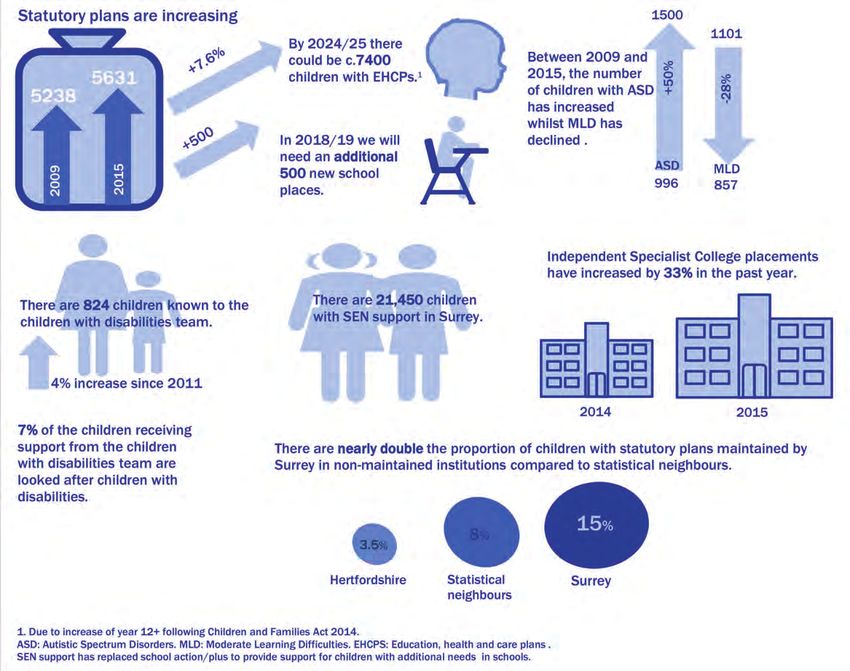
Development journey

                                    Oct 2015 – May 2016                                 June 2016 – Dec 2016                                      Jan 2017 – 2020

    Transform the         • We understand our customers’ experience and       • We have refreshed our recruitment, induction,     • We treat customers right, get it right and keep
                            how they would like it to be.                        training and development for staff to support an      them informed.
    customer experience   • Children, young people and families have            improved customer experience.                      • We actively involve children, young people and
                            helped us design an outcomes framework.            • We have redesigned communications to                 families in individual and strategic decisions.
                          • We understand our staff culture and how it          support an improved experience and to assist       • All practitioners take a person-centred approach
                            impacts our ability to meet customers’ needs.        families to find out about support and services.     to their practice in supporting and responding to
                          • We have agreed a framework for                    • We have put in place arrangements for ongoing       families.
                            co-production and participation with children,       review of the customer experience.                 • Services are accessible and responsive.
                            young people and families.                         • We have improved information for families         • Queries are dealt with at the first point of
                          • We have identified best practice models.            through our new local offer portal.                   contact whenever possible.
                          • We have co-designed a sustainable local offer     • Children, young people and families are working   • We have consistent quality standards across
                            portal that describes SEND provision and how         with us to develop solutions that increase            Surrey.
                            to access it and captures ongoing customer           children and young people’s confidence             • We secure well managed transitions at key
                            feedback.                                            and independence.                                     points.
                          • We have developed mediation arrangements.         • We have a practice guide and improved tools       • We deliver our service with open, honest and
                          • We understand how our customers’ experiences        for staff.                                            transparent communication.
                            compare to those nationally (through our
                            benchmarking).

    Rebuild the system    • We have identified best practice in process and   • We are developing a target operating model        • We treat customers right, get it right and keep
                            organisation design.                                 to include pathways, organisation, processes,        them informed.
    around the customer   • We have identified how our current statutory        policies, leadership, performance (including       • We actively involve children, young people and
                            and non-statutory pathways can be improved.          measurement of impact and outcomes)                  families in individual and strategic decisions.
                          • We understand our current staffing structures       and costs.                                         • We have well established mechanisms for
                            for SEND and how performance and costs             • We have co-designed new pathways and                delivering quality assurance, including setting
                            compare with similar local authorities.              implemented early improvements including             targets and monitoring performance and putting
                          • We understand what leadership culture and           reducing the time for completion of education,       in place corrective action.
                            behaviours are needed to enable an effective         health and care plans (EHCP) and improving         • We are delivering efficiencies and savings
                            SEND system.                                         communication and transparency.                      which will enable us to sustain services.
                          • We understand the policies that support the       • We have expanded personal budgets already         • We are able to accurately measure impact
                            system.                                              used in social care to SEND and health                and outcomes.
                          • We will have started to improve processes           services and integrated funding where possible.    • Our systems and processes are lean, joined up
                            to transfer statements and learning difficulty     • We have an agreed policy for personal budgets       and our data is accurate.
                            assessments to education, health and care            and have begun implementation.                     • Our system empowers families and puts them
                            plans (EHCP).                                      • We have an agreed plan for the phased               at the heart of the journey and decision making,
                                                                                 implementation of a new target operating             exercising choice and control.
                                                                                 model.                                             • Information will be simple, clear and provided in
                                                                                                                                      a timely and relevant manner.

6
Development journey

                             Oct 2015 – May 2016                                June 2016 – Dec 2016                                       Jan 2017 – 2020

Reshape the local   • We have identified best practice in the SEND    • We have a system that monitors and forecasts       • We have the right provision to meet children
                      market.                                            changing education, health and social care             and young people’s needs.
offer               • We understand the needs of children and young     needs and we use this to inform commissioning.      • The cost of our provision is in line with similar
                      people with SEND in Surrey and how these are     • We have identified savings from reviewing our        local authorities and within our available
                      likely to change in the next five years.           current relationships with suppliers.                 resources.
                    • We have mapped current provision, costs and     • We have designed and developed improved            • Children and young people can access high
                      performance.                                       provision that meets the needs of 0-25 year            quality, community-based local provision that
                    • We know when any existing procurement             olds.                                                  enables them to achieve the right outcomes
                      of SEND services is due to be reviewed           • We have designed and developed provision              based on their personal needs.
                      establishing a commissioning road map until        that supports special and mainstream schools        • Families can access early help and intervention.
                      2020.                                              to appropriately support more children in Surrey.   • We have developed short breaks, therapies
                    • Partners agree a joint approach to              • We have commissioned therapies that will              and other support to enable more local
                      commissioning for SEND.                            enable children and young people to be                 placements that meet the needs of children
                    • We understand how well provision meets needs      included in Surrey schools and colleges.               and young people.
                      (now and a forecast in the future) where there   • We are assessing and delivering value for          • Provision and pathways prepare young people
                      are gaps and opportunities to integrate.           money effectively.                                     for adulthood.
                    • We are clear what outcomes we want to           • We have planned supported accommodation            • We have invested in meeting the gaps in local
                      achieve for children and young people.             to allow young people to live, work and study          provision.
                                                                         independently.
                                                                       • We have designed provision and pathways
                                                                         that prepare young people aged 19 to 25 for
                                                                         adulthood.
                                                                       • We have agreed policies for SEND transport
                                                                         and begun work to reshape the way we deliver
                                                                         these services.
                                                                       • We have agreed criteria for residential school
                                                                         placements.

                                                                                                                                                                                    7
Development journey

                                 Oct 2015 – May 2016                                June 2016 – Dec 2016                                      Jan 2017 – 2020

    Develop inclusive   • We have identified key schools to work on       • We agree what makes an inclusive school           • Practitioners have a continual learning
                          phase 1 of developing inclusive practice.          setting for 0-25, inclusive practice and how          approach to developing their practice.
    practice            • We have established a methodology to support      to measure this.                                   • We have inclusive practice in universal settings.
                          schools/settings to develop their inclusive      • We are delivering tools and resources to          • All children and young people have improved
                          practice.                                          support inclusive school/setting improvement.         outcomes, including achievement, attendance,
                        • We have engaged with all state-funded schools   • We have a framework for partnership working          fewer exclusions and increased participation.
                          and educational settings.                          and support for schools.                           • Services and support is accessible and
                        • We have agreed methods to identify all those    • We celebrate good practice in inclusion.             equitable.
                          who require our services including those from    • We are developing inclusive communities with      • There is equal access to provision and
                          the most vulnerable groups.                        partners.                                             uniformity in admissions to early years settings,
                        • We have articulated our broad inclusion         • We are developing approaches to ensure the           schools and further education.
                          strategy.                                          most vulnerable children and young people          • Increased numbers of children with SEND have
                                                                             with SEND receive targeted support                    their needs effectively met in mainstream early
                                                                             where appropriate.                                    years, schools and further education.
                                                                           • We have agreed and published an                   • Schools and partners own transparent
                                                                              accessibility policy.                                decisions about the children and resources
                                                                           • We have identified local priorities for change.      within their wider community.
                                                                                                                                • The Index for Inclusion is used widely in
                                                                                                                                   schools as a tool for school improvement and
                                                                                                                                   our education system is based on a shared set
                                                                                                                                   of inclusive values.

8
Development journey

This diagram illustrates our focus on four main
areas of work to ensure that the child and
                                                                   n c e   Jou
                                                              ie
family are always at the centre of our work,
whether that be as part of the transformation
programme now, or as part of our new SEND
system and services in the future.

                                                                                 rn
                                                               r
                                                             pe

                                                                                    e y
                                                           x
                                                               Child, young
                                                          E    person and
                                                                  family
                                                        n

                                                                                     I n
                                                      o

                                                                                         c
                                                     i
                                                  is

                                                                                          l u
                                                                 v             sio
                                                             Pr o          n
                                                                                                9
10
Part 1 - High-level summary

High-level summary
In this part you will find a high-level summary description of
contextual information and an overview of our approach.

                                                                 11
Part 1 - High-level summary The growing level of need for SEND support Children and young people with special These changes are creating pressure on educational needs and disabilities (SEND) are provision for children and young people increasing in number, above the rate of school with SEND. The number of young people population growth. The Children and Families educated, often outside of Surrey’s provision, Act 2014 introduced 0-25 education, health in independent specialist colleges increased and care plans (EHCP), increasing education sharply in 2015, due to the Children and and training provision up to the age of 25. Families Act 2014 changes. This contrasts Our projections suggest there may be up to with 2011-2014 when more young people 7,400 children and young people with EHCPs were being educated closer to home in local by 2024/25, with particular increases among colleges, as a result of the development of young people aged 16+, although it is difficult new provision. Also, a much higher proportion to predict numbers who will need to continue of Surrey children and young people are with their EHCP after the age of 19. placed in non-maintained institutions when This growth is also reflected in increased compared to Surrey's statistical neighbour demand for support through children with local authorities. disabilities teams in Surrey's Children's Services, up 4% since 2011. The types of need that young people have has changed, with a 50% increase in young people with Autistic Spectrum Disorders since 2009. This is reflected in children's social care and mirrors national trends. Moderate learning difficulties have decreased by 28% over the same period. 12
Part 1 - High-level summary

The growing level of need for SEND support

                                             13
Part 1 - High-level summary
Understanding the financial picture
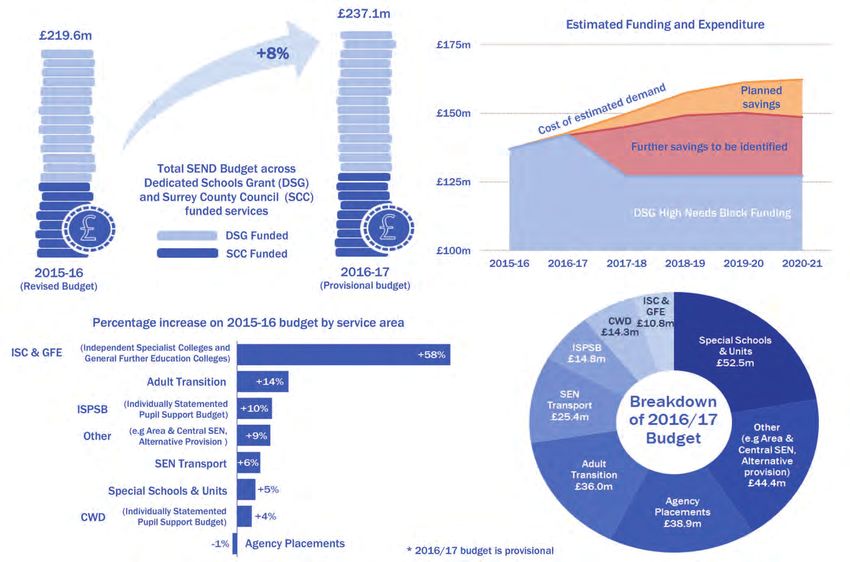
The total budget for SEND services to children This funding gap in Surrey will be exacerbated
and young people aged 0-25 in 2016/17 is by the introduction of a needs-based
£237m, which is an 8% increase on 2015/16. formula for distributing the HNB funding.
There is a significant pressure around The Government’s recent announcement
increased demand for SEND services in Surrey on school funding suggests some account
primarily due to an underlying increase in of historic spend and population will also
the population, an increase in the number of inform the distribution and there is a proposed
statements and education, health and care five year transition period, all of which will
plans (EHCPs) and changes to legislative potentially increase our significant funding gap.
requirements around the SEND reforms and
raising the SEN participation age to 25. There are significant savings planned for other
SEND services, for example for SEN transport
The funding sources for SEND services are the 2016/17 budget addresses the immediate
the county council and the High Needs Block pressures facing the service, but plans are
(HNB) within the Dedicated Schools Grant. being rolled out to reduce the budget over
The HNB funding has not automatically been the next five years by £7.5m.
increased for demographic and inflationary
pressures in recent years and this is presenting N.B. budget figures provided are provisional.
a significant funding gap given the increasing
demand. By 2017/18 the HNB funding gap is
forecast to be around £20m, which assumes
the realisation of £4m planned savings. These
savings will be realised by increasing our
in-house provision so we are less reliant on
independent sector providers which are more
expensive. This is a key strategic aim of the
SEND 2020 Programme.
14Part 1 - High-level summary
Understanding the financial picture
15Part 1 - High-level summary
Working in partnership
This development plan links to a number of
other strategies and plans that are in place Board/group Role Strategies/plans
within Surrey County Council and across
wider Surrey partnerships. This development SEND Partnership The SEND Partnership Board SEND 2020 strategy and SEND
plan is focused specifically on changes and Board has responsibility for providing development plan.
improvements to experiences, services and direction and oversight for the
provision for children and young people with development and implementation
SEND for which Surrey is responsible in of the SEND 2020 strategy.
partnership.
Health and To bring together partners across Joint health and wellbeing
These improvements require effective, whole Wellbeing Board a number of organisations to strategy.
system partnership working. (statutory) jointly plan services across health
and social care.
The table on the right sets out the respective
roles of some of the key boards and Surrey To coordinate safeguarding across SSCB improvement plan and
governance groups. Safeguarding different agencies and to promote other topic related plans.
Children Board the welfare of children in Surrey.
(statutory)
Corporate To enable looked after children Corporate parenting strategy.
Parenting Board and young people to grow up
(statutory) having the same opportunities as
their peers and to support children
leaving care to live independent
lives.
Surrey Children To provide strategic direction and Children and Young People’s
and Young leadership of the systems change Partnership plan.
People’s and joint commissioning needed
Partnership to deliver better outcomes across
the children’s system.
16Part 1 - High-level summary
Our approach
What are the principles that will drive the change?
Principle What it looks like in practice
Outcome-focused All partners, including parents, carers and voluntary, community and faith sector, work together to achieve the best
outcomes.
Person-centred The child or young person and family is at the centre of all we do and is treated, included and understood, as an
and personalised individual. Support is tailored to needs.
Fair and The system is co-produced and the customer experience is seamless. Decisions are based on evidence including need,
transparent demand, experiences, best practice, impact on outcomes and affordability.
Value for money We make interventions to drive improvement, efficiency and manage demand. We keep focused on realising the benefits
of change.
Timely and We provide early help to support children and families, preventing problems arising or getting worse.
preventative
Innovative The system anticipates and can adapt to change. We make opportunities to find and test new solutions.
17Part 1 - High-level summary Our approach Outcomes – where do we want to get to? We are co-designing a detailed outcomes framework with families, children and young people. The outcomes below are provided to us within the SEND Code of Practice and act as our guide. Positive experience of the SEND system for children, young people and their families • Parents, children and young people get the right support at the right time, feel that they are listened to and in control. • Planned and well-managed transition at key points. • A joined-up, transparent and accountable system. Positive outcomes for children, young people and their families • Improved progression and attainment at all ages. • Clear and appropriate expectations and aspirations leading to fulfilled lives. • More resilient families. Effective preparation for adulthood • Increased employment. • Choice and control over living arrangements/independent living. • Participation in the community. • Outcomes based on need and aspiration. 18
Part 1 - High-level summary

Our approach

The diagram below summarises the seven key        We are strengthening quality assurance         We will judge our efforts by whether it makes
areas of work that we will focus on in order      arrangements to ensure we know what is         a positive difference to the experience and
to strengthen our approach over the life of       and isn’t working and can continually learn    outcomes of children and young people.
our plan. These will lead to an improved          and improve what we do. Our workforce will
experience for children and young people.         have the right support, skills and tools to    Aim: To enable every child and young
                                                  make a difference.                             person in Surrey with special educational
We will develop strong and effective                                                             needs and/or disability to realise the same
leadership, management and governance,            By doing these things we will be able to get   ambition as any other child or young
which will create the conditions for a culture    things right consistently for children and     person and to empower them to contribute
and practice that makes a positive difference     young people with SEND.                        to and achieve this. Supporting children
to children and young people’s lives and                                                         and young people from birth to adulthood
their outcomes.                                                                                  by putting them at the centre of the
                                                                                                 integrated support provided by partners.

                                                 Leadership, management and governance

           Rebuild the system                                                                                Develop inclusive
                                                           Reshape the local offer
          around the customer                                                                                    practice

                                                               Transform the
          Workforce and skills                                                                               Quality assurance
                                                            customer experience

                                  Leading to an improved experience of children and young people
Part 2 - Summary workstream plans Summary workstream plans In this part you will find a high-level summary of each of the workstreams that underpin the programme of change. 20
Part 2 - Summary workstream plans

Transform the customer experience

Why we are focused on this: When this workstream is completed, customers will experience a system that is seamless, designed around the
needs of children and young people, and is person-centred. This means treating customers right, getting it right, keeping customers informed and
making it easy for them to navigate the process. Practice will be person-centred, strengths-based and we will actively listen to our customers.

Our strategy is to achieve excellence through the adoption of the Customer Service Excellence Framework and Standards and putting participation
at the heart of what we do, ensuring children, young people and customers are involved in the system re-design.

What we will achieve                                 How we will do this                                  What will be different?

Positive experience of the SEND system for           • Define a clear and accessible pathway to          • We treat customers right, get it right and
children, young people and their families              support a positive customer experience.               keep them informed.
• Parents, children and young people get the        • Deliver effective communication with partners     • We actively involve children, young people
   right support at the right time, feel that they     and families to support early engagement and          and families in individual and strategic
   are listened to, have a choice and are in           offer clear signposting.                              decisions.
   control.                                          • Develop a practice manual and toolkit to          • All practitioners take a person-centred
• Planned and well-managed transition at key          ensure all professionals working with a family       approach to their practice in supporting
   points.                                             are aware of their roles and responsibilities.       and responding to families.
• Transparent and effective communications.         • Define and set the success criteria for regular   • Services are accessible and responsive.
                                                       performance improvement.                           • Queries are dealt with at the first point of
Positive outcomes for children, young                • Create and implement plans to deliver the            contact whenever possible.
people and their families                              Customer Service Excellence Standards and          • We have consistent quality standards
• Clear defined outcomes leading to happy,            improve the customer experience.                      across Surrey.
  healthy and confident lives.                       • Develop mechanisms to systematically              • We secure well-managed transitions at
• More resilient families.                            capture feedback and satisfaction levels.             key points.
                                                                                                          • We deliver our service with open, honest
Effective preparation for adulthood                                                                          and transparent communication.
• Increased employment.
• Choice and control over living arrangements/
  independent living.
• Participation in the community.                                                                                                                          21
Part 2 - Summary workstream plans
Rebuild the system around the customer
Why we are focused on this: When this workstream is completed the SEND system for 0-25 year olds will be transformed. The journey
from the point of identification will be redesigned and rebuilt to be integrated across education, health and care services. Silos will be broken down
and transition points smoothed. A new operating model will be designed and built that supports the transformation of the customer experience and
delivers significantly improved performance at reduced cost.
Our strategy is to use digital technology to reshape the service and reorganise the system to make it seamless, faster and leaner, meaning more
customer focused delivery of pre-statutory and post-statutory services through education, health and care plans (EHCPs).
What we will achieve How we will do this What will be different?
Positive experience of the SEND system for • Review current pathways, processes and • We treat customers right, get it right and keep
children, young people and their families organisation of the SEND system. them informed.
• Focus on integrating education, health • We actively involve children, young people
• Parents, children and young people get the and care in assessment planning, delivery and families in individual and strategic
right support at the right time, feel that they and review. decisions.
are listened to and are in control. • Define new, integrated pathways with • We have well established mechanisms for
• Planned and well-managed transition at seamless transition points. delivering quality assurance, including setting
key points. • Optimise the system to deliver agreed targets and monitoring performance and
• A seamless, transparent and accountable outcomes in a way that delivers customer putting in place corrective action.
system across education, health and social satisfaction and an improved journey within • We are delivering efficiencies and savings
care which delivers holistic, person-centered agreed financial budgets. which will enable us to sustain services.
and outcome orientated solutions. • Design and embed an operating model that • We are able to accurately measure impacts
• Children, young people and families will have supports customers’ experiences and delivers and outcomes.
confidence and trust in services. improved performance. • Our systems and processes are lean, joined
• Ensure our service design supports up and our data is accurate.
accessibility and an early help approach. • Our system empowers families and puts
them at the heart of the journey and decision
making, exercising choice and control.
• Information will be simple, clear and provided
22 in a timely and relevant manner.Part 2 - Summary workstream plans
Reshape the local offer
Why we are focused on this: When this workstream is completed, opportunities in the SEND market for children and young people from birth
to adulthood will be reshaped so that the provision better meets the needs of children and young people and is affordable now and in the future.
Our strategy is to match provision with need, develop greater local provision, improve value for money and reduce unit costs in line with the
benchmark of our statistical neighbours.
What we will achieve How we will do this What will be different?
Positive experience of the SEND system for • Analyse children and young people’s • We have the right provision to meet children
children, young people and their families needs against current provision from and young people’s needs.
• Planned and well-managed transition at key birth to adulthood. • The cost of our provision is in line with
points. • Identify desired outcomes and measures to similar local authorities and within our
drive integrated commissioning and holistic available resources.
Positive outcomes for children, young provision. • Children and young people can access high
people and their families • Identify opportunities to innovate with partners quality, community-based local provision that
• Improved progression and attainment. across the sector. enables them to achieve the right outcomes
• Clearly defined outcomes leading to happy, • Create more early years specialist SEN based on their personal needs.
healthy and confident lives. placements, special school and special unit • Families can access early help and
• More resilient families. places, college placements and pathways to intervention.
adulthood including employment opportunities • We have developed short breaks, therapies
Effective preparation for adulthood and supported living to meet needs arising in and other support to enable more local
• Increased employment. the county. placements that meet the needs of children
• Choice and control over living arrangements/ • Agree processes and review provision with and young people.
independent living. our partners. • Provision and pathways prepare young
• Participation in the community. • Publish an annual summary. people for adulthood.
• Health outcomes based on need
and aspiration.
23Part 2 - Summary workstream plans Develop inclusive practice Why we are focused on this: When this workstream is completed, there will be a common understanding between all stakeholders of the term inclusion and a shared set of values which will set our culture in Surrey, demonstrated through effective practice. There will be equality of access to provision, barriers to progress will be removed and we will close the gap in the achievement of our most vulnerable groups. Providers of universal services will get the right support at the right time to meet the diverse needs of children and young people. There will be greater transparency and ownership of funding decisions from all stakeholders and partnership working will be at the forefront of all development. Our strategy is to develop effective partnership working, learn from each other and share best practice. We will create a shift in culture and practice to ensure all our young people have equality of access and provision. As part of our strategy we have selected the Index for Inclusion by Tony Booth as one of the tools that will enable us to deliver. The Index for Inclusion is a comprehensive document that supports the inclusive development of schools and helps everyone to find their own next steps in developing their setting. 24
Part 2 - Summary workstream plans

Develop inclusive practice

What we will achieve                              How we will do this                                  What will be different?

Positive outcomes for children, young             • Developing a shared set of values and             • Practitioners have a continual learning
people and their families                           understanding of what we mean by inclusion.           approach to developing their practice.
• Improved progression and attainment at all     • Developing local inclusive networks of            • We have inclusive practice in
  ages.                                             schools and sharing and celebrating good              universal settings.
• Clear and appropriate expectations and           practice.                                          • All children and young people have
  aspirations leading to fulfilled lives.         • Schools using the Index for Inclusion as a tool     improved outcomes, including achievement,
                                                    to drive school improvement.                         attendance, fewer exclusions and
Effective preparation for adulthood               • Supporting providers to deliver effective           increased participation.
• Increased employment.                            SEND intervention and support.                     • Services and support is accessible
• Choice and control over living arrangements/   • Effectively monitoring access for and                and equitable.
  independent living.                               outcomes of vulnerable groups.                     • There is equal access to provision and
                                                  • Developing effective local partnerships of all       uniformity in admissions to early years
                                                    stakeholders.                                         settings, schools and further education.
                                                  • Using early help approaches.                      • Increased numbers of children with
                                                  • Ensuring equality of support for children from       SEND have their needs effectively met.
                                                    birth to adulthood across Surrey.                  • Schools and partners own transparent
                                                                                                          decisions about the children and resources
                                                                                                          within their wider community.
                                                                                                       • The Index for Inclusion is used widely in
                                                                                                          schools as a tool for school improvement and
                                                                                                          our education system is based on a shared
                                                                                                          set of inclusive values.

                                                                                                                                                   25
Annex 1 - Glossary
Glossary
Below is a list of the common acronyms and professional terms used within the SEND
system, some of which are also featured in this plan.
ADD Attention Deficit Disorder DDA Disability Discrimination Act SEN Special Educational Needs
ADHD Attention Deficit Hyperactivity EHCP Education, Health and Care Plan SENCo Special Educational Needs
Disorder HI Hearing Impaired Coordinator
AEN Additional Educational Needs LDA Learning Difficulty Assessment SEND Special Educational Needs and
AS Asperger Syndrome LDD Learning Difficulties and Disabilities Disability
ASC Autistic Spectrum Condition MLD Moderate Learning Difficulty SLCN Speech, Language and
ASD Autistic Spectrum Disorder PDA Pathological Demand Avoidance Communication Needs
CAMHS Child and Adolescent Mental Health POET Personal Outcomes and Evaluation SLD Severe Learning Difficulty
Services Tool SPDs Sensory Processing Disorders
CAT County Autism Team ODD Oppositional Defiant Disorder SpLD Specific Learning Difficulty
COIN Communication and Interaction OT Occupational Therapist SSIASS Surrey SEND Information, Advice
Needs RAD Reactive Attachment Disorder and Support Service
CSCN Complex Social and Communication SLT Speech and Language Therapy
Needs
26Surrey special educational needs and disability
(SEND) 2020 programme for change
£
Outcomes
• improved
Context
progression and Key challenges
attainment at all ages
• clear and appropriate 1. We need to give 2. Numbers of children and 3. Customers do not 4. New 5. We need to work
expectations and the right support to young people with special always have a positive requirements from with children, young
aspirations leading to children and young educational needs and experience because legislation need to people, families and
fulfilled lives people to meet the disabilities (SEND) are education, health and be delivered across partners in order to
right outcomes growing. This means we need care services could be the SEND system. understand what
• more resilient
based on their to manage our resources more better joined up. needs to change
families personal needs. efficiently and bring them into and make it happen.
• increased line with other local authorities.
employment
• choice and control
over living Our strategic goals
arrangements
/independent living 1: Transform the 2: Re-build the system 3: Reshape the SEND 4: Develop inclusive
• participation in the customer experience around the customer local offer practice
community
• health outcomes Developing the culture of Redesigning the SEND Developing a joined up Developing practice and
based on need and our organisation, practice system and pathways from approach to commissioning culture to remove barriers
aspiration. of our staff, systems and the perspective of the with partners and working with to education and universal
communication tools in customer. Developing providers in the market to services, enabling more
Principles order to improve the systems which are achieve better outcomes for children and young people
experience for those who transparent, simple to children and young people to be supported in local
• outcome focused access our services. navigate, are seamless and with SEND and support them schools and provision so
• person centred and empowering families to in their preparation for that they achieve good
personalised identify and access the right adulthood. progress and outcomes.
• fair and transparent support at the right time.
• value for money
• timely and .
preventative Vision
• evidence-based Children and young people will be happy, healthy, safe and
• innovative. confident about their future
27Feedback If you have any thoughts or views on this plan or how well we are progressing please do contact us. Email: send2020@surreycc.gov.uk Connect with us on LinkedIn: search Surrey County Council and follow the SEND 2020 page. Join us on Facebook: www.facebook.com/SEND2020
You can also read


