Standards for children in
the youth justice system
          2019
←
→
Page content transcription
If your browser does not render page correctly, please read the page content below

Standards for children in
the youth justice system
2019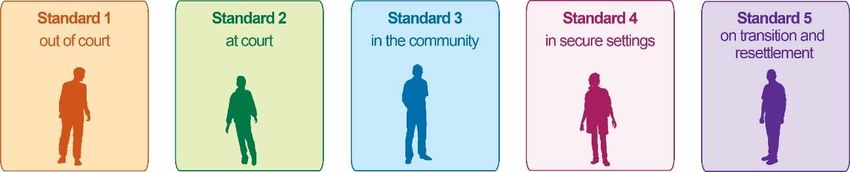
Contents

Ministerial foreword                                            2
Introduction                                                   3
Who the standards are for                                      4
   Systems                                                     4
   Policies specific to youth justice                          5
   Data Protection                                             5
   Disproportionality                                          5
Principles, oversight and monitoring                            6
Oversight of the standards                                      6
Monitoring the delivery of standards                            6
Standard 1: out of court disposals                              8
Standard 2: at court                                           10
Standard 3: in the community (court disposals)                 12
Standard 4: in secure settings                                 14
Standard 5: on transition and resettlement                     17
Legal provision                                                19
  Youth Justice Services                                       19
  Youth Justice Plans                                          21
  Youth offending teams (YOTs) composition and establishment   22
Glossary                                                       24

Ministerial foreword

The Government remains firmly committed to
maintaining a distinct youth justice system -
one which must both deliver justice for those
who are victims of crime and rehabilitate
offenders.
Children in the justice system often have
multiple and complex needs. Where possible,
we should seek to divert children from the
justice system entirely and address these needs. For those who do offend, our
core focus must continue to be rehabilitation, tackling the underlying causes of
youth offending, and delivering a system that gives children the support they
need to break the cycle of offending and build productive and fulfilling lives.
We have made significant progress over the past decade and services should
be empowered to deliver focussed outcomes, rather than being constrained by
processes. For that reason, I welcome the introduction of these Standards for
Children in the Youth Justice System (2019), which build on the progress made
and are intended to guide both strategic and operational services’
understanding of what is expected at each stage of a child’s journey through the
justice system.
The youth justice system is a complex landscape, involving numerous services
and agencies. I believe that these Standards will help to unite those supporting
children and empower those children to take control of their lives and futures.
The ‘child first, offender second’ principle, which runs throughout the Standards,
will enable practitioners to take tailored and focused approaches to working with
children.
Given the maturity of the youth justice system, now is the right time to move
from process-driven requirements to focusing on outcomes and positive
change. More than ever, these Standards provide a structure that gives
statutory youth justice services freedom in delivering services, and freedom to
innovate.
I look forward to seeing how these Standards are implemented, how they help
to achieve positive change for the children in our care and, ultimately, wider
society as a whole.

Edward Argar MP
Parliamentary Under-Secretary of State for Justice

                                                                   Page 2 of 25
Introduction
These standards for children in the youth justice system define the minimum
expectation for all agencies that provide statutory services to ensure good
outcomes for children in the youth justice system. They are set by the Secretary
of State for Justice on the advice of the Youth Justice Board (YJB).
The aim of these standards is to:
Provide a framework for youth justice practice and ensure that quality is
maintained
Encourage and support innovation and good practice to improve outcomes
for children who commit crime
ensure that every child lives a safe and crime-free life, and makes a positive
contribution to society
align with the YJB’s child first, offender second principle.
assist the YJB and inspectorates when they assess whether youth justice
services are meeting their statutory requirements.
About these standards
These standards replace National Standards for Youth Justice (2013).
They are intended to guide strategic and operational services’ understanding of
what is expected, but does not prescribe how services should be designed and
delivered. Each standard contains links to underpinning statutory guidance on
the delivery of services.
The five standards are:
How to find out more
Read a glossary of terms used in this document.
Links to both statutory and supplementary guidance are found after each
standard.
You can also read about the relevant legislation.
Page 3 of 25Who the standards are for
The Crime and Disorder Act 1998 lays out statutory requirements for youth
offending teams (YOTs).
Other relevant legislation includes the Powers of Criminal Courts (Sentencing)
Act 2000, the Criminal Justice and Immigration Act 2008 and the Legal Aid,
Sentencing and Punishment of Offenders Act 2012. These standards provide a
re-statement of the requirements, with updates determined by subsequent
legislation.
These standards should be read and followed by strategic and senior leaders in
local authorities to act in co-operation with:
The Secretary of State
police or local policing body
providers of probation services
local probation board
clinical commissioning group
local health board.
This is required to make sure that, where appropriate, all youth justice services
are available1.
YOT management boards should provide strategic direction with the aim of
preventing offending by children, and in accordance with section 40 of the
Crime and Disorder Act 19982, ensure that the work of the YOT is defined in a
publicly accessible youth justice plan that is co-ordinated with other local plans.
Management boards should be satisfied that the following systems and policies
are in place specific to children in justice:
Systems
quality-assurance systems built on feedback from key stakeholders
including courts, victims, children, parents and carers
records and information held on children in custodial establishments is
available and accessible to those who need it - to make sure there is the
proper co-ordination of services to support children when they are in
custody and when they are released.
identify and generate management information - including passing this
securely to the YJB or the Youth Custody Service and,
1 s38(1) Crime and Disorder Act 1998 https://www.legislation.gov.uk/ukpga/1998/38
2 s40 Crime and Disorder Act 1998 https://www.legislation.gov.uk/ukpga/1998/37/section/40
Page 4 of 25 management information is used for strategic planning and service
development and is passed securely to partners where necessary and in
compliance with the Data Protection Act 2018.
Policies specific to youth justice
Management boards should implement clear youth justice specific local policies
and protocols covering:
provision of persons to act as appropriate adults to safeguard the interests
of children detained or questioned by police officers3 in line with the
National Appropriate Adult Network's National Standards
provision for children who may be interviewed under the Police and Criminal
Evidence Act 1984 (PACE) while remanded or sentenced in youth detention
accommodation whether within or outside the local authority area
service to victims in line with the Code of practice for victims of crime
the quality of case management
public protection and desistance policies (including release and recall
arrangements for children on licence/supervision)
engagement and compliance with court orders, remand and bail
programmes, including responsibilities for undertaking enforcement action
where case management sits outside the YOT.
Data Protection
Services must have due regard to the relevant data protection principles which
allow them to share personal information, as provided for in the Data Protection
Act 2018 and the General Data Protection Regulation 2018 (GDPR).
Disproportionality
Agencies act in accordance with the Equality Act 2010. YOTs should uphold the
duty to have due regard to the requirement to eliminate discrimination, advance
equality of opportunity, and foster good relations between different people when
carrying out their activities.
Agencies need to uphold these responsibilities and have in place systems to
make sure all children are treated fairly and in accordance with their individual
needs.
3 s38(4)(a) CDA 1998 https://www.legislation.gov.uk/ukpga/1998/38
Page 5 of 25Principles, oversight and monitoring
The principle ‘child first’ guides the work of the YJB. These standards have
been designed to assist agencies adhere to that principle making sure that they:
1. Prioritise the best interests of children, recognising their needs, capacities,
rights and potential.
2. Build on children’s individual strengths and capabilities as a means of
developing a pro-social identity for sustainable desistance from crime. This
leads to safer communities and fewer victims. All work is constructive and
future-focused, built on supportive relationships that empower children to
fulfil their potential and make positive contributions to society.
3. Encourage children’s active participation, engagement and wider social
inclusion. All work is a meaningful collaboration with children and their
carers.
4. Promote a childhood removed from the justice system, using prevention,
diversion and minimal intervention. All work minimises criminogenic stigma
from contact with the system.
Oversight of the standards
The YJB is required4 to have oversight of the standards. This assists the YJB, in
carrying out its statutory function; to determine whether services are
demonstrating:
accountability e.g. for expenditure against the youth justice grant, to
stakeholders and the wider community.
improvements via evidence of local learning and decision making on the
design of services, operation and what works.
impact and Influence on local and national policy and contributing to the
evidence base about effectiveness.
Monitoring the delivery of standards
The YJB will monitor the delivery of the standards to confirm that they remain
relevant and to support services to achieve good outcomes.
The YJB must make sure any monitoring or self-assessment of standards by
youth justice services adhere to the child first principle and is:
focused and feasible in relation to local area available resources (i.e. any
information collected is based on a ‘need to know’ basis).
4
C&DA98 sec 41(5)(a
Page 6 of 25 useful and timely to inform and improve learning, decision making, and
influence allocation of time and resources.
useable by, and/or comparable to, data collected by other stakeholders so
it contributes to the wider evidence base.
credible, valid and reliable to the extent possible within local area
available resources.
Page 7 of 25Standard 1: out of court disposals
Youth offending team (YOT) management boards have mechanisms in
place which provide them with assurance that:
local strategies and services are in place to ensure positive outcomes
for children, including sustainable desistance from crime and to
prevent children from becoming involved in crime and/or anti-social
behaviour
point-of-arrest diversion is evident as a distinct and substantially
different response to formal out-of-court disposals
there is effective multi- agency partnership working arrangements for
timely information-sharing, planning, decision making and monitoring
with key agencies. Actions happen within agreed timescales and the
help and protection is provided to reduce risk and meet need
out-of-court disposals are prompt, robust and deliver targeted and
tailored interventions for sustainable desistance
all action should be taken to promote diversion into more suitable child-
focused systems, and the promotion of positive constructive behaviour
police services and YOTs have a joint protocol setting out locally
agreed practice for out-of-court disposals and a suitable means of joint
decision-making
quality assurance is evident and all decisions are recorded and
reviewed
analysis and action planning is in place to tackle any disproportionality
improvement is achieved in the quality of pre-court work.
YOTs must:
undertake a timely and accurate, suitable and sufficient assessment5
of risk and of need for all children referred to the YOT
5HMIP (2018) Youth Offending Services Inspection Domain Three Case Assessment Rules and Evidence
define suitable and sufficient assessment as:
Well-informed, analytical and personalised, actively involving the child or young person and their
parents/carers.
Page 8 of 25 formulate all intervention plans6 based on that assessment with a focus
on promoting a pro-social identity and aiding desistance from crime
involve children and their parents/carers in assessment, planning and
reviewing of individual programmes
make sure that they work closely with the police (and the Crown
Prosecution Service where relevant) for the out-of-court disposal
system to be effective7
build supportive relationships and deliver prompt, proportionate,
effective interventions.
How to apply the standards and statutory guidance:
Youth out-of-court disposals: guide for police and YOTs - GOV.UK
How to Use Out of Court Disposals
Code of Practice Youth Conditional Cautions
Reform of anti-social behaviour powers. Statutory guidelines for front
line professionals
6HMIP 2018) Youth Offending Services Inspection Domain Three Case Assessment Rules and Evidence
define planning as:
Well-informed, holistic and personalised, actively involving the child or young person and their
parents/carers
7When police are considering an out-of-court disposal, they should liaise with the YOT to agree an
appropriate course of action.
If an initial Youth Caution is given, the police must inform the YOT, and, where a second or subsequent
caution is being considered, a referral to the YOT will be required for assessment and joint decision-
making.
Page 9 of 25Standard 2: at court
Youth offending team (YOT) management boards have mechanisms in
place which provide them with assurance that:
operational YOT services provide suitable high-quality YJB approved
assessments/information and reports to all courts dealing with children
within the civil and criminal codes, and for any subsequent referral
order panel meetings.
all action is taken to minimise any delays brought about through
specialist assessment
court is reserved for children who cannot be dealt with by less formal
means
a strategy is in place to reduce the unnecessary use of youth detention
accommodation at the earliest stage in the criminal justice process8
individual reports prepared by the YOT
o focus on children’s best interests
o constructively promote their potential and desistance from crime
o are balanced and impartial
o take account of the impact on victims
o promote fairness by making sure that diverse needs are met
magistrates and the judiciary have reports which provide them with the
required range of recommendations to make informed decisions
regarding sentencing
magistrates, the judiciary (and youth offender panel members where
appropriate) have confidence in the effectiveness of recommended
supervision of children who offend
children and their parents and carers are provided with appropriate
information and support during the court process, and checks made to
ensure their understanding
all proceedings demonstrate that children’s voices are heard and that
they can participate effectively
communication is in line with Youth Custody Service requirements
when youth detention accommodation or sentence to custody is a
court outcome
8The term ‘unnecessary’ applies to those cases where it is possible that a child or young person could
have been safely supervised in the community on bail.
Page 10 of 25 quality assurance is evident including analysis of an action plan to
tackle any disproportionality.
YOTs must:
provide a court duty service including producing reports requested by
the court within the stipulated timeframe
base all reports on an up-to-date and relevant YJB approved
assessment, and demonstrate engagement with the child and
parents/carers
accurately record court outcomes
check that the custodial warrant issued by the court is appropriate for
children remanded or sentenced to youth detention accommodation
comply with the Youth Custody Service requirements when a child is
remanded/sentenced to the youth detention accommodation
inform the parents/carers of the court outcome, details of any youth
detention accommodation, including written information about the
youth detention accommodation and (where appropriate) the Assisted
Prison Visit Scheme
explain the outcome to the child and check that they understand.
How to apply the standards and statutory guidance:
Work in court
Reports for court
Placing young people in custody guide for youth justice practitioners
AssetPlus Joint Working Protocol
Community Sentences if you are under 18
Revised Referral Order Guidance
Page 11 of 25Standard 3: in the community (court
disposals)
Youth offending team (YOT) management boards have mechanisms in
place which provide them with assurance that:
all children entering the justice system receive a suitable and sufficient
YJB approved assessment. This should focus on strengths and
barriers to desistance to inform planning of appropriate interventions
for children
local practice prioritises children’s best interests, constructively
promotes their potential and desistance, encourages their active
engagement, and minimises the potential damage that contact with the
system can bring
court orders are managed in a way that reflect the aim of the youth
justice system; to enable children to live a safe, crime-free life and
make a positive contribution to society
effective communication and information exchange is in place for all
relevant stakeholders throughout the sentence
strategic partners have confidence in;
o the quality of services and the management of orders
o the effectiveness of supervision of children on court orders
children and their parents and carers are provided with appropriate
information and support during the sentence. There should be
evidence and recording of their understanding.
In managing an effective whole sentence YOTs must:
engage the child, parents and carers and demonstrate through
evidence their efforts to do so
establish a meaningful trusting relationship with children whom they
supervise
take diverse needs into account and promote equality in access and
engagement
assist the child to build a pro-social identity to enable sustainable
desistance
explain the child’s rights and responsibilities under the terms of the
order and check for understanding
Page 12 of 25 supervise the court order(s) in line with the YJB approved assessment
framework
produce a plan from the assessment to focus on:
o enabling a pro-social identity and desistance from offending
o public protection
o mitigating any prevailing issues relating to safety and wellbeing
o building on the positive elements of the child’s life
make sure that the assessment is dynamic and ongoing and is
commenced at the start of every order and for every pre-sentence
report. It should take account of the child’s broader context, previous
offending, impact on victims, public protection, safety and wellbeing,
and factors that influence desistance from crime
coordinate interventions with any other relevant specialist or agency,
specify the intended outcome, and commence promptly
make sure that reviews occur as required to reflect significant changes
in the child’s circumstances inclusive of engagement and compliance
with orders.
How to apply the standards and statutory guidance:
Use of community interventions
Revised Referral Order Guidance
National protocol for case responsibility
Support for parents of children in the youth justice system
Page 13 of 25Standard 4: in secure settings
Youth offending team (YOT) management boards and secure
establishment providers (inclusive of health commissioners and
providers) have mechanisms in place which provide them with
assurance that:
transport used for children, from court to their destination
establishment, to and from court while in custody, or used for other
destinations (e.g. health appointments), is appropriate for children, and
minimises delays
the needs and risks of children in secure establishments are identified,
addressed, coordinated, and managed to enable a suitable, effective
and constructive resettlement with a focus on continuing desistance
all services, including education and health care, prioritise children’s
best interests and recognises their needs, capacities, rights and
potential
services take all action to address the causes of a child’s offending
behaviour and any unmet social, emotional, health or educational
needs
the environment that children live in is rehabilitative and safe and one
where there is a culture that enables children to develop, grow and
learn
children are motivated by staff to have an opportunity to engage in
appropriate, high-quality education and training that helps them to
make good progress
effective communication and information exchange is in place for the
preparation and delivery of the secure and the community phase of
sentences
there is a robust approach to holding services and agencies to account
in the event of insufficient planning and delivery of the transition and or
resettlement plan for a child
communication between professionals is in line with Youth Custody
Service requirements
services, plans and interventions take account of diverse needs and
promote equality
safeguarding information is conveyed to relevant parties and agencies
without delay
strategic partnerships and secure establishment providers have
confidence in the quality of services and in the effectiveness of
supervision of children and
Page 14 of 25 all service provision prioritises the child’s best interest
children and their parents and carers are provided with appropriate
information and support during the secure phase of the sentence.
YOTs at court must:
when custody is the expected sentence, make sure that
communications and information exchange, through use of the Youth
Justice Application Framework (YJAF), are in line with Youth Custody
Service requirements when custody is expected
send the relevant post-court information within two hours of the child
being sentenced9
Secure providers must, on arrival of the child, or as soon as possible, arrange
a comprehensive assessment for the secure establishment, including, but not
limited to:
comprehensive health assessment
safety and risk of harm
education assessment
Staff in the establishment and the YOT must:
instigate appropriate safeguarding procedures where necessary10
work together with the individual child to deliver an effective sentence
in its entirety
This should include:
managing a safe stay in the establishment
the assessment, the plan, the reviews, and the management of risk
maintaining accurate timely records as and when required through
AssetPlus
maintaining community links and contact with the key people in the
child’s life to develop a pro-social identity with a constructive focus on
future desistance
supporting children to fulfil their potential during the whole sentence
identifying and planning for all transitions at the earliest opportunity
9 This is required 24 hours before the child is due to appear in court (except for short notice court
appearances and other unexpected remands and custodial sentences).
10
Expectations are set out in Working Together to Safeguard Children 2018 statutory guidance; this
applies to all organisations and agencies who have functions relating to children
Page 15 of 25 planning for successful resettlement
Initial planning should occur promptly and take account of all views (including
the child’s). The purpose should be to discuss and approve the plan, the
interventions and the resettlement plan in detail. Efforts meaningfully to
engage the child should be demonstrated in records
All subsequent sentence planning dates should be agreed at the initial
meeting to meet the needs of the child
Intervention planning should review progress against the plan, and towards
resettlement inclusive of:
planning for successful resettlement
suitability for the detention and training order early-release scheme
home detention curfew
temporary release (formerly release on temporary licence)
parole, and release on licence
a plan will be in place in response to a child who is identified as a risk of harm
to themselves or from others, or at risk of causing serious harm to others
within the secure establishment
Resettlement preparation should identify and address any outstanding actions
with clear lines of accountability
Final release preparation should agree the resettlement and reintegration
arrangements and the contents of the licence or Notice of Supervision
inclusive of risk management.
How to apply the standards and statutory guidance:
How to place a child in secure settings
Custody and Resettlement
Detention and Training Orders section 73 – 79 C&D 1998
Section 90 Criminal Justice Act 2003
Section 91 Criminal Justice Act 2003
Section 226 Criminal Justice Act 2003
Youth to adult transition protocol (England)
Youth to adult transition protocol (Wales)
Transfers for over 18s to young adult estate
Former looked after children in custody
SEND code of practice
Comprehensive Health Assessment Tool Manual
Children and young people in the secure estate national partnership
agreement
healthcare standards for children and young people in the secure
estate
Working together to safeguard children
Page 16 of 25Standard 5: on transition and
resettlement
Youth offending team (YOT) management boards and secure
establishments have mechanisms in place which provide them with
assurance that:
local systems and approaches recognise and reflect that moves /
transitions for children in the youth justice system can be frequent
local systems are in place that demonstrate flexibility and capacity for
continuity in assessment, planning and the delivery of interventions for
children in the youth justice system who make a transition / change
planning and leadership at all levels, together with strong governance
and clear responsibilities, are required to minimise, as far as is
reasonable and practicable, any potential for the negative impact that
any transition may have for a child
there is a robust approach to holding services and agencies to account
in the event of insufficient planning and delivery of the transition and or
resettlement plan for a child.
YOTs and where applicable secure establishments should provide:
A tailored plan for children in the youth justice system, who make a transition
This should be;
produced promptly
produced with active engagement from the child and their family.
it should set out;
the personal and structural support to be made available to support the
child develop a pro-social identity. Identify the child’s strengths and
capacities (and those of the wider community around them) and set out
how these factors will impact upon the activities and be built into a full
desistance plan
and it should be the subject of regular and joint review
In preparing that plan, all relevant agencies should work with the child,
parents and carers and should be in place for each transition inclusive but not
limited to the following:
children who move residence - e.g.
o across local authorities and boroughs
o to a different secure provision
Page 17 of 25o from a secure establishment for children into adult provision
o to a healthcare provision, such as a secure hospital, or to a
secure welfare placement
o from a secure establishment to home
children who move services - e.g.
o into adult probation services
o into looked after children provision, including new and different
placements
health - e.g.
o differing tiers of health provision
o community services to secure services and back again
o community forensic child and adolescent service
o adolescent forensic services
o learning disability services
o Child and Adolescent Mental Health Services - refer children to
age-appropriate, accessible services where they exist; tell
commissioners and providers where they do not exist and make
sure appropriate alternative arrangements are made to meet
children’s needs
o adult health services
education, training and employment - e.g.
o to and from mainstream schools and or alternative provision
o further education, training and or employment
accommodation/housing - e.g.
o transition home / into supported living
children who reach the end of a youth justice order
children who reach the end of a secure order but not the end of
sentence.
How to apply the standards and statutory guidance:
Custody and resettlement
Youth to adult transition protocol (England)
Youth to adult transition protocol (Wales)
How to make resettlement constructive
Beyond Youth Custody resources and research
Page 18 of 25Legal provision
Youth Justice Services
YOTs are required to coordinate ‘youth justice services’: s.38 Crime and Disorder Act
1998
Section Act Provision
37(2) Crime and Disorder Act 1998 Duty of all persons and bodies carrying out
functions in relation to the youth justice system
to have regard to principal aim of the youth
justice system - to prevent offending by
children and young persons
38(1) Crime and Disorder Act 1998 Duty on local authorities to act in co-operation
with police or local policing body, Secretary of
State, providers of probation services, local
probation board, clinical commissioning group,
Local Health Board, to secure that, to such
extent as is appropriate for their area, all youth
justice services are available there
38(3) Crime and Disorder Act 1998 Local Authority power to make payments
towards expenditure incurred in the provision
of youth justice services by making (a) direct
payments; or (b) contributing to a fund out of
which payments may be made
38(4)(a) Crime and Disorder Act 1998 Youth justice services -
Provide persons to act as appropriate adults to
safeguard the interests of children and young
persons detained or questioned by police
officers
38(4) (aa) Crime and Disorder Act 1998 Youth justice services -
Provide assistance to persons determining
whether youth cautions should be given under
section 66ZA
38(4)(b) Crime and Disorder Act 1998 Youth justice services -
Assess children/young persons, and provide
rehabilitation programmes, for the purposes of
section [66ZB (2) or (3)]
38(4) (ba) Crime and Disorder Act 1998 Youth justice services -
Provide assistance to persons determining
whether youth conditional cautions (within the
meaning of Chapter 1 of Part 4) should be
given and which conditions to attach to such
cautions
38(4) (bb) Crime and Disorder Act 1998 Youth justice services -
Supervise and rehabilitate persons to whom
youth conditional cautions (within the meaning
of Chapter 1 of Part 4) are given
Page 19 of 2538(4)(c) Crime and Disorder Act 1998 Youth justice services –
Provide support for children/young persons
remanded or committed on bail while awaiting
trial or sentence
38(4)(d) Crime and Disorder Act 1998 Youth justice services -
Place children / young persons remanded to
local authority accommodation to such
accommodation under section 91(3) of the
Legal Aid, Sentencing and Punishment of
Offenders Act 2012
38(4)(e) Crime and Disorder Act 1998 Youth justice services -
Provide reports or other information required
by courts in criminal proceedings against
children and young persons
38(4) (ee) Crime and Disorder Act 1998 Youth justice services -
Perform YOT functions under sections 25, 26
and 27 of the Anti-Social Behaviour Act 2003
38(4)(f) Crime and Disorder Act 1998 Youth justice services -
Provide persons to act as responsible officers
in relation to individual support orders,
parenting orders, child safety orders and
reparation orders
38(4) (fa) Crime and Disorder Act 1998 Youth justice services -
Provide persons to act as responsible officers
in relation to youth rehabilitation orders within
the meaning of Part 1 of the Criminal Justice
and Immigration Act 2008
38(4) (fb) Crime and Disorder Act 1998 Youth justice services -
Supervise children/young persons sentenced
to a youth rehabilitation order under that part
which includes a supervision requirement
(within the meaning of that part)
38(4)(h) Crime and Disorder Act 1998 Youth justice services -
Supervise children / young persons sentenced
to a detention and training order (including an
order under section 211 of the Armed Forces
Act 2006
38(4)(i) Crime and Disorder Act 1998 Youth justice services -
Conduct post-release supervision of children
and young persons under section 31 of the
Crime (Sentences) Act 1997 (“the 1997 Act”)
[or by virtue of conditions imposed under
section 250 of the Criminal Justice Act 2003
38(4)(j) Crime and Disorder Act 1998 Youth justice services -
Perform functions under subsection (1) of
section 102 of the Powers of Criminal Courts
(Sentencing) Act 2000 (period of detention and
training under detention and training orders) by
such persons as may be authorised by the
Secretary of State under that subsection
38(4)(k) Crime and Disorder Act 1998 Youth justice services -
Implement referral orders within the meaning
of the Powers of Criminal Courts (Sentencing)
Page 20 of 25Act 2000
38(5) Crime and Disorder Act 1998
The Secretary of State may by order extend,
restrict or otherwise alter the definition of
‘youth justice services’ and therefore impact on
the scope of
duties at 38(4)
Youth Justice Plans
Section Act Provisions
40(1) & (2) Crime and Disorder Act 1998
The local authority must, after consultation with
police or local policing body, Secretary of
State, providers of probation services, local
probation board, clinical commissioning group,
Local Health Board, formulate and implement
for each year a plan (a “youth justice plan”)
setting out how youth justice services in their
area are to be provided and funded; and how
the YOT/s established by them (whether alone
or jointly with one or more other local
authorities) are to be composed and funded,
how they are to operate, and what functions
they are to carry out.
40(3) Crime and Disorder Act 1998
Local authorities may assign functions to YOTs
including functions under paragraph 7(b) of
Schedule 2 to the Children Act 1989 Act (local
authority's duty to take reasonable steps
designed to encourage children and young
person’s not to commit offences).
40(4) Crime and Disorder Act 1998
A local authority must submit a youth justice
plan annually to the Youth Justice Board
setting out (a) how youth justice services are to
be provided and funded in their area and (b)
how the YOTs established by them are to be
composed and funded, how they are to
operate and what functions they are to carry
out. The plan must be published in such
manner and by such date as the Secretary of
State may direct.
Page 21 of 25Youth offending teams (YOTs) composition and establishment
Section Act Provisions
39(1) Crime and Disorder Act 1998
Each local authority, acting in co-operation with
any chief officer of police any part of whose
police area lies within the local authority's area,
the Secretary of State, providers of probation
services, local probation boards, clinical
commissioning groups, and Local Health
Boards, must establish for their area one or
more YOTs.
39(4) Crime and Disorder Act 1998
Local authority has the power to make
payments towards expenditure incurred by, or
for purposes connected with, YOTs either
directly or by contributing to a fund from which
payments can be made.
39(5) Crime and Disorder Act 1998
YOT to include at least one of each of the
following, an officer of a local probation board
or an officer of a provider of probation services;
a person with experience of social work in
relation to children nominated by the director of
children's services appointed by the local
authority under section 18 of the Children Act
2004 (England); a social worker of the local
authority (Wales); a police officer; a person
nominated by a clinical commissioning group
or a Local Health Board any part of whose
area lies within the local authority's area; a
person with experience in education nominated
by the director of children's services appointed
by the local authority under section 18 of the
Children Act 2004 (England); a person
nominated by the chief education officer
appointed by the local authority under section
532 of the Education Act 1996 (Wales).
39(6) Crime and Disorder Act 1998
YOT can also include other persons as the
local authority thinks appropriate after
appropriate consultation
39(7) Crime and Disorder Act 1998
YOTS must co-ordinate the provision of youth
justice services for all those in the authority's
area who need them; and to carry out such
functions as are assigned to the team or teams
in the youth justice plan formulated by the
authority under section 40(1)
39A Crime and Disorder Act 1998
The YOT must, when it becomes aware that a
child/young person has become subject to a
detention order and is detained in relevant
youth accommodation or, a child/young person
who is subject to a detention order has been
transferred from one place of accommodation
Page 22 of 25to another which is relevant youth
accommodation, notify the home local authority
and the host local authority of the place where
the child/young person is being detained. If
the YOT becomes aware that a person has
been released who was, immediately before
release, subject to a detention order, and
detained in relevant youth accommodation,
notify the home, host and any other local
authority in whose area the YOT
expect the person to live on release.
Page 23 of 25Glossary
Term Glossary
Children Anyone who has not yet reached
their 18th birthday. The fact that a
child has reached 16 years of age, is
living independently or is in further
education, is a member of the armed
forces, is in hospital or in custody in
the secure estate, does not change
their status or entitlements to
services or protection.
YOT management board A YOT management board should be
formed to provide strategic direction
with the aim of preventing offending
by children.
The role of the YOT management
board is to determine how the YOT(s)
is to be composed and funded and
how it:
operates and what functions it is
to carry out
determine how appropriate youth
justice services are to be
provided and funded
oversee the formulation each
year of a draft youth justice plan
oversee the appointment or
designation of a YOT manager
as part of the youth justice plan,
agree measurable objectives
linked to key performance
indicators, including the National
Standards for Youth Justice.
Members of a YOT management
board should be empowered with the
capacity to make strategic decisions.
The YOT management board
oversees the budget.
Page 24 of 25You can also read


