Developments in the Field The Montara Class Action Decision and Implications for Corporate Accountability for Australian Companies
←
→
Page content transcription
If your browser does not render page correctly, please read the page content below
Developments in the Field

               The Montara Class Action Decision and
               Implications for Corporate Accountability for
               Australian Companies

               Richard RYAN*                and Ellen PARRY**

                   Keywords: class action, corporate accountability, Montara, oil spill, transboundary pollution

                                                                 I. INTRODUCTION
               A ground-breaking judgment of the Australian Federal Court regarding the Montara oil
               spill in the Timor Sea in 2009, Sanda v PTTEP Australasia (Ashmore Cartier) Pty Ltd
               (No 7) (Sanda (No 7)),1 is one of the few Australian class actions to proceed to a
               favourable judgment for the claimants. It is also the first judgment against an
               Australian company for cross-border pollution loss suffered by foreign claimants.
                 The Federal Court upheld the claim of an Indonesian seaweed farmer, Daniel Sanda, on
               his own behalf and on behalf of a class of 15,500 Indonesian seaweed farmers, after oil
               and gas company PTTEP Australasia (Ashmore Cartier) Pty Ltd’s (PTTEPAA) negligent
               operation of the Montara well led to the worst oil spill in Australia’s offshore petroleum
               industry history, and the spread of oil into coastal waters in neighbouring Indonesia.
                 The decision is a timely reminder that Australian courts providing access to justice
               according to law, regardless of the size, influence or nationality of the parties before it, are
               one of the most powerful and honourable institutions Australia possesses.2 It further
               underscores that class actions can facilitate access to justice to large groups of vulnerable
               people who have been substantially affected by environmental misadventure and
               catastrophe.

               * Principal, Maurice Blackburn, Australia.
               ** Senior Associate, Maurice Blackburn, Australia. The views expressed in this article are the personal views of the
               authors and do not necessarily reflect views of Maurice Blackburn.
               Conflicts of interest: Both authors work for Maurice Blackburn, which acts for Mr Sanda and the seaweed farmers.
                1
                    [2021] FCA 237.
                2
                    John Gordon, ‘Down by the River: The OK Tedi Litigation’ (2000) 41 Plaintiff 6, 11. This observation made in
               relation to the Victorian Supreme Court is equally applicable to the Federal Court of Australia in the Montara class action.

              Business and Human Rights Journal, (2021), pp. 1–8                                    © The Author(s), 2021. Published by
              doi:10.1017/bhj.2021.39                                      Cambridge University Press. This is an Open Access article,
                                                              distributed under the terms of the Creative Commons Attribution licence
                                                      (http://creativecommons.org/licenses/by/4.0/), which permits unrestricted re-use,
Downloaded from https://www.cambridge.org/core. IP address:distribution
                                                            46.4.80.155,and reproduction,
                                                                         on 13             providedsubject
                                                                               Oct 2021 at 19:29:03, the original  article is properly
                                                                                                            to the Cambridge           cited.
                                                                                                                               Core terms  of use, available at
https://www.cambridge.org/core/terms. https://doi.org/10.1017/bhj.2021.39
2 Business and Human Rights Journal Vol. 0:0
Section II of this piece provides an analysis of the case, covering both procedural and
substantive aspects of the decision. Section III then outlines the authors’ views of the
implications of the decision for the corporate accountability of Australian oil and gas
companies.
II. CASE ANALYSIS
On 21 August 2009, there was a major blow-out at the Montara wellhead platform, which
caused oil and gas to flow unabated into the Timor Sea for over 10 weeks. On 3 August
2016, the class action was commenced in the Federal Court against the operator of the
well, PTTEPAA, a subsidiary of the national Thai oil and gas giant, PTT Exploration and
Production Public Company Limited (PTTEP). The class action alleged that oil from the
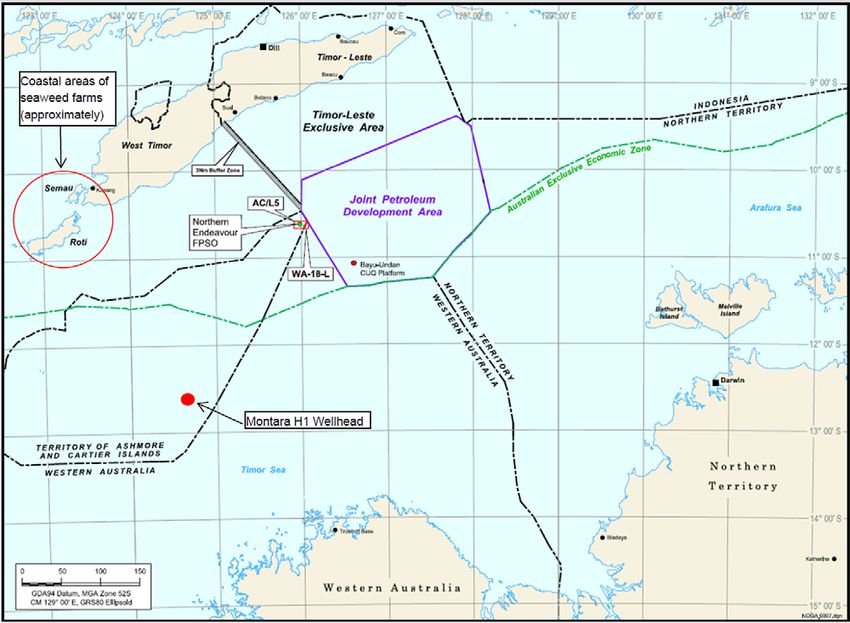
spill reached the coastal areas in and around 81 villages in the Rote/Kupang region of
Indonesia’s Nusa Tenggara Timur province, killing seaweed being cultivated by 15,500
seaweed farmers and causing production to dramatically fall for some years. See Figure 1
for a map of the region.
Mr Sanda’s claim was that PTTEPAA owed him and the group members a duty of care
when operating and suspending the operation of the Montara well, and that PTTEPAA
breached that duty of care by negligently enabling the oil spill that killed the seaweed,
causing financial loss. PTTEPAA denied that it owed, or breached, a duty of care to the
seaweed farmers. It claimed that Montara oil did not reach the Rote/Kupang region, or if it
had, that it did not damage seaweed because it was harmless by the time it reached the
area. It was not in dispute that PTTEPAA’s ‘gross incompetence’ in suspending the H1
Well caused the blow-out. Nor was it in dispute that there had been a widespread die-off of
seaweed in the Rote/Kupang region around the time of the spill.
A central challenge for Mr Sanda’s case was the lack of contemporaneous scientific
monitoring or appraisal of the transboundary spread and environmental impact of the oil
pollution in Indonesia. Australia’s response effort and a later Commission of Inquiry
focused on Australian territory, the cause of the spill and future prevention rather than any
transboundary environmental impact.3 The Commission report, however, noted that there was
evidence that oil entered both Indonesian and Timor Leste’s waters ‘to a significant degree’.4
With the paucity of contemporaneous scientific studies, evidence of the oil reaching the
coastal areas in Indonesia was instead provided by a number of Indonesian seaweed
farmers who gave first-hand eyewitness accounts of the arrival of oil and the subsequent
destruction of their seaweed. Key to the case was whether the Indonesian witnesses would
be believed and their evidence given weight.
From the outset, the class action has been funded by Harbour Litigation Funding.5
Harbour funded the detailed investigation and development of the claim, paid the legal
costs of Mr Sanda’s legal team throughout the course of the case and provided security for
3
Montara Commission of Inquiry, Report of the Montara Commission of Inquiry (June 2010).
4
Ibid, 26.
5
Harbour, https://harbourlitigationfunding.com/ (accessed 31 July 2021). All seaweed farmers part of the class action
have entered into a litigation funding agreement with Harbour. In return for funding the class action, Harbour will receive
Downloaded from https://www.cambridge.org/core. IP address: 46.4.80.155, on 13 Oct 2021 at 19:29:03, subject to the Cambridge Core terms of use, available at
https://www.cambridge.org/core/terms. https://doi.org/10.1017/bhj.2021.392021 The Montara Class Action Decision and Implications 3
Figure 1. Montara H1 Wellhead and Northern Endeavour locations in the Timor Sea.
Source: NOPSEMA as notated by Maurice Blackburn. The Montara oil field is located within the
Australian territorial waters of the Timor Sea approximately 250 kilometres northwest of the Western
Australian coast and approximately the same distance from the Rote and Kupang coastal areas of
Indonesia, the focus of the Montara Class Action (see map).
costs of the action. Harbour’s involvement assisted considerably in addressing what
otherwise would have been the power and resource imbalance between the Indonesian
seaweed farmers and the well-resourced PTTEPAA.
A. Procedural Aspects
The hearing was conducted in two broad phases: (i) the taking of lay evidence from
seaweed farmers in the Rote/Kupang region and other lay observers, and (ii) the taking of
extensive expert evidence from experts across a broad range of disciplines.
PTTEPAA required a significant number of the Indonesian seaweed farmers to attend
court in Australia to give evidence of their observations of oil, having rejected a proposal
that the Court take evidence of witnesses in Indonesia. A practical challenge was to then
get the farmers from their remote island communities to Sydney to give evidence. Only a
small number of the seaweed farmers had ever been out of their local region, and none
spoke English.
a percentage of any settlement or award in favour of the seaweed farmers. Such percentage will be subject to the Federal
Court’s review and approval.
Downloaded from https://www.cambridge.org/core. IP address: 46.4.80.155, on 13 Oct 2021 at 19:29:03, subject to the Cambridge Core terms of use, available at
https://www.cambridge.org/core/terms. https://doi.org/10.1017/bhj.2021.394 Business and Human Rights Journal Vol. 0:0
Farmers from approximately 30 of the 81 villages attended the Federal Court to give
evidence. They were selected on the basis that the 30 locations were sufficiently
representative of the broader coastal areas which were the subject of the claim, to enable
conclusions to be drawn about where the oil arrived in the region.6 Passports and visas were
obtained, consular assistance organised, flights and accommodation arranged, court-
approved interpreters appointed, and bi-lingual translators and ‘minders’ engaged to
facilitate communications. This was coordinated by Mr Sanda’s legal team.
PTTEPAA called no lay witnesses, despite it having been closely involved in the oil
surveillance and recovery operations during the blow-out (including engaging and
coordinating aircraft and vessel operators). Instead, it relied heavily on the expert
evidence of its largely United Sates-based expert witnesses, and most especially, their
oil spill modelling expert. The expert had prepared a detailed after-the-event trajectory
analysis which purported to show that oil from the blow-out could not have reached the
Rote/Kupang region. Notably, the expert was not asked to consider the seaweed farmers’
evidence of what they had seen.
The seaweed farmers were fortunate in having the trial heard in the second half of 2019,
at a time of open borders and frequent international air travel. They were also fortunate in
the way the trial was managed by the Court and the open mindedness with which they, and
Mr Sanda’s other lay witnesses, were received.
An integral feature of how the Federal Court manages its cases is the individual docket
system. This allocates a case to the docket of a particular judge at the time of filing (in this
instance Justice David Yates), with the intention that it remain with the same judge for
case management and disposition at trial.7 The over-arching purpose of civil practice and
procedure and case management within the individual docket system is to facilitate the
just resolution of disputes according to law as quickly, inexpensively and efficiently as
possible.8
This system allowed Justice Yates to flexibly apply the most appropriate and efficient
mechanisms for case management to the circumstances of the case. As managed by
Justice Yates, the system proved well suited to dealing with issues that arose during
the proceeding. For example, Justice Yates directed that six different Court-facilitated
concurrent expert conclaves be held, each of which produced joint reports. The
participating experts were then required to give their oral evidence concurrently, with
up to five experts participating at once. This saved a considerable amount of Court time
and identified the key issues in dispute sooner than would otherwise have occurred.
Mr Sanda and the group members were entitled to bring the claim in Australia despite
their being foreign national claimants. The jurisdictional ‘anchor’ of the Federal Court’s
authority at law to decide personal actions is based on its capacity to exercise power to
compel the defending party to submit to orders made, rather than the claimants’
connection with the jurisdiction.9 PTTEPAA’s connection to the jurisdiction was clear:
6
Mr Sanda read 43 affidavits, of whom 19 deponents were cross-examined at trial. In addition, Mr Sanda called
11 expert witnesses, while nine were called by PTTEPAA.
7
Federal Court Central Practice Note: National Court Framework and Case Management (CPN-1), para 4.1.
8
Federal Court of Australia Act 1976 (Commonwealth), sections 37M and 37N.
9
As recently confirmed by the Full Federal Court in BHP Group Limited v Impiombato [2021] FCAFC 93.
Downloaded from https://www.cambridge.org/core. IP address: 46.4.80.155, on 13 Oct 2021 at 19:29:03, subject to the Cambridge Core terms of use, available at
https://www.cambridge.org/core/terms. https://doi.org/10.1017/bhj.2021.392021 The Montara Class Action Decision and Implications 5
it is an Australian company and the registered holder of the relevant petroleum retention
lease, and the Montara oil field was located in Australian territorial waters. Moreover,
PTTEPAA admitted that the operation of the Montara oil field was an inherently
dangerous and extremely hazardous activity that carried the risk of harm and that it
was subject to the legal obligations imposed on it by Section 569 of the Offshore
Petroleum and Greenhouse Gas Storage Act 2006 (Commonwealth).10 Consequently,
PTTEPAA did not argue that the Indonesian seaweed farmers were unable to bring the
claims due to their being foreign nationals.
B. Substantive Aspects
In reaching his findings, Justice Yates took as his starting point the large body of evidence
of the seaweed farmers of the presence of (what they described as) oil, on the beaches and
coastal waters of the Rote/Kupang region in late 2009 and the impact on their seaweed
crops. His Honour found those observations provided a coherent and convincing body of
evidence containing recurring observations of features and effects which were consistent
with the material being weathered Montara oil.11
PTTEPAA criticised the seaweed farmers’ evidence on the basis that many of the
farmers had communications over the years (including some with lawyers) which must
have ‘infected’ their memories by ‘impressions formed in the telling and re-telling of
events’,12 such that their evidence was ‘contaminated to a very large extent’13 and could
not be relied upon. Justice Yates rejected that submission, finding that: ‘I am left in no
doubt that, at the time, all witnesses (seaweed farmers, village heads, and other lay
witnesses) witnessed a single, strikingly unusual, and unique event in the Rote/Kupang
region, which coincided with the quick and dramatic loss of local seaweed crops.’14
Justice Yates stated his impression was that all the lay witnesses spoke frankly on the
topic of what they observed, although he noted, some at times had difficulty in following
the line of questioning put to them. He suspected that, in part, might have been due to
cultural differences and the court setting in which they gave evidence, being far removed
from their normal, day-to-day experiences.15
Furthermore, Justice Yates found the lay evidence informed a number of the key expert
issues. For example, he found that it was a mistake for PTTEPAA to treat its after-the-
event oil spill trajectory model’s predictions as a true representation of what happens in
the real world, and that such predictions were to take ‘no precedence over the other
evidence including, in particular, the actual observations of witnesses in that area at the
time.’16 In addition, he determined that toxicological evidence needed to be considered in
10
The obligations being, inter alia, to carry out all petroleum exploration and recovery operations in a proper and
workmanlike manner and in accordance with good oilfield practice; and control the flow, and prevent the waste or escape
in the petroleum production licence area, of petroleum or water.
11
Sanda (No. 7), note 1, paras 831 and 171.
12
Ibid, para 822.
13
Ibid, para 177.
14
Ibid, para 830.
15
Ibid.
16
Ibid, para 626.
Downloaded from https://www.cambridge.org/core. IP address: 46.4.80.155, on 13 Oct 2021 at 19:29:03, subject to the Cambridge Core terms of use, available at
https://www.cambridge.org/core/terms. https://doi.org/10.1017/bhj.2021.396 Business and Human Rights Journal Vol. 0:0
light of what the seaweed farmers observed occurring including, for example, the oil
adhering to their seaweed and the ropes on which the seaweed was grown.17
C. The Decision: ‘The Obvious Cannot be Ignored’
After assessing all the evidence, Justice Yates found that ‘taking all the evidence into
account, I am satisfied, on the balance of probabilities, that Montara oil from the
H1 Well blowout, in various weathered states, reached the coastal areas of Rote/
Kupang’.18
In relation to the critical causation question of whether Montara oil caused, or
materially contributed to, the quick and dramatic loss of local seaweed crops, Justice
Yates concluded that it had: ‘Given the descriptions of the seaweed farmers, there can be
no doubt that crop death coincided with the arrival of the oil … The obvious cannot be
ignored.’19 In so doing, Justice Yates rejected the range of alternative explanations for the
seaweed die-off put forward by PTTEPAA, finding there was no other plausible
explanation for that widespread loss.20
Justice Yates was satisfied that PTTEPAA owed Mr Sanda and the seaweed farmers the
duty of care pleaded, and the risk of a blow-out of the H1 Well was very high. He
concluded:
I am in no doubt that it was reasonably foreseeable to a person in the respondent’s
position, at the relevant time, that a failure by the respondent to properly suspend the
H1 Well could result in an uncontrolled release of hydrocarbons that could cause loss or
damage in the Rote/Kupang region, including to those whose businesses or enterprises
involved the commercial exploitation of the marine ecosystem affected by that
release.21
Given that the foreseeability of that risk of harm arising was established, Justice Yates
was satisfied that PTTEPAA breached its duty of care to Mr Sanda and the seaweed
farmers, concluding that no ‘other consideration has been raised which militates against a
finding of breach’.22 Therefore, the question of whether Mr Sanda’s seaweed crops were
damaged by Montara oil could ‘be answered readily’ in the affirmative. Mr Sanda’s
losses, although difficult to assess given that he had no documentation recording his
seaweed production before and after his crop loss, could, Justice Yates concluded, be
calculated, awarding Mr Sanda’s losses for the period 2009–2014 of approximately
AUD22,000 (not including interest and costs).23
17
Ibid, para 891.
18
Ibid, para 828.
19
Ibid, para 1010.
20
Ibid, para 1009.
21
Ibid, para 1040.
22
Ibid, para 1044.
23
Ibid, para 1161.
Downloaded from https://www.cambridge.org/core. IP address: 46.4.80.155, on 13 Oct 2021 at 19:29:03, subject to the Cambridge Core terms of use, available at
https://www.cambridge.org/core/terms. https://doi.org/10.1017/bhj.2021.392021 The Montara Class Action Decision and Implications 7
D. What Next?
The class action procedure is staged: this decision is the initial trial of the issues common
to Mr Sanda’s claim and the 15,500 group members. A second stage will now take place
whereby the other seaweed farmers’ claims for losses will be assessed, informed by the
Court’s decision made in relation to Mr Sanda’s losses.
In practice, group members’ claimed losses are often dealt with by a settlement
whereby individual compensation entitlements are assessed according to a settlement
scheme. To date, PTTEPAA and its USD22 billion parent, PTTEP,24 have not expressed
an interest in offering any money to settle the farmers’ claims. That may change after final
orders are made, at the time of writing expected in September 2021, whereupon the time
for any appeal will start running.25
III. IMPLICATIONS OF THE DECISION
The Australian Federal Court decision in Sanda (No. 7) is important for five key reasons.
First, the decision demonstrates that foreign nationals, even an economically and legally
disenfranchised group of seaweed farmers, can obtain justice in Australia that they would
otherwise have been unable to obtain. An editorial in the Jakarta Post heralded the
decision as a rare, even unheard of, win for ordinary Indonesian people in legal
proceedings.26 At a practical level, the decision shows that existing procedures provide
the Federal Court with the flexible tools needed to provide access to justice to people from
quite different cultural settings. It is a testament to Australia’s well-functioning justice
system that Indonesian seaweed farmers can attend court in a foreign land and give first-
hand eyewitness evidence through interpreters, which evidence, after being fully tested, is
given precedence over evidence from leading international experts (the latter admittedly
hypothetical in nature).
Second, the decision in Sanda (No. 7) demonstrates that class actions in Australia can
provide access to justice for those affected by environmental harms, serving as a form of
private regulation of polluters and offering a form of private regulation against
environmental wrongdoing. It shows that class actions can work even in the
environmental area. It will encourage the investigation and commencement of more
environmental class actions and assist in overcoming the historic wariness of plaintiff
lawyers and litigation funders to pursue such cases given they often involve issues of
considerable factual and scientific complexity.
Third, the decision puts Australian companies, especially in Australia’s large offshore
oil and gas industry, on notice that they may be held accountable for the damage caused by
24
PTTEP, ‘Annual Report 2020’, https://www.pttep.com/en/Investorrelations/Regulatorfilings/Annualfiling.aspx
(accessed 1 June 2021).
25
In addition, the parties to the class action are awaiting a supplemental judgement from the Court on whether the oil
reached all or only some of the coastal areas in and around the 81 villages; this judgment is currently expected in
September 2021.
26
Editorial, ‘Montara and Environmental Justice’, Jakarta Post (25 March 2021), https://www.thejakartapost.com/
academia/2021/03/25/montara-and-environmental-justice.html (accessed 31 July 2021).
Downloaded from https://www.cambridge.org/core. IP address: 46.4.80.155, on 13 Oct 2021 at 19:29:03, subject to the Cambridge Core terms of use, available at
https://www.cambridge.org/core/terms. https://doi.org/10.1017/bhj.2021.398 Business and Human Rights Journal Vol. 0:0
pollution events by private action (including class action) even if the claimants are foreign
nationals. Indeed, class actions in relation to pollution caused by Australian companies’
activities or those of their subsidiaries in foreign territories are now being conducted and
could, as a result of this decision, also become more of a regular occurrence in Australian
courts.
Fourth, the decision in Sanda (No. 7) highlights the inherent risks of exploitation of
natural resources by Australian companies operating both domestically and
internationally at a time of heightened risk and global concern. Environmentally
sensitive projects must be managed with great care if disastrous consequences for the
environment and local communities are to be avoided.
The ‘ever-present risk’27 of pollution from an offshore accident is presently even more
extreme – due to the massive decommissioning risks and liabilities in the offshore gas and
oil industry28 and concerns that Australia could struggle to respond to another major oil
spill, such as the current disaster off the Sri Lankan coast, due in part to industry changes
brought on by the COVID-19 pandemic restrictions.29 For example, the Northern
Endeavour, an insolvent floating production facility with structural issues due to
advanced corrosion30 with an even closer proximity to Australia’s Timor Sea
neighbours than the Montara oil field (see map in Fig. 1), is a pressing and ongoing
transboundary environmental danger. Yet again, poor industry behaviour and historically
lax regulation has been exposed.31
Fifth, the decision in Sanda (No. 7) is a clarion call for action on an international
convention to regulate liability and compensation in respect of transboundary loss and
damage as a consequence of offshore oil and gas activities, as has long been exhorted by
another Judge of the Federal Court of Australia, Justice Rares. Such a convention would
provide a just and effective alternative to hard-fought, time-consuming and costly
litigation in the courts. Even with effective court systems, the costs and delays are too
great. In the words of Justice Rares, an international convention ‘will help to ensure that
all persons … who are adversely affected by pollution damage from blowouts or oil spills
from fixed platforms, can claim and be paid fair and adequate compensation in a timely
fashion.’32
27
Justice S Rares, ‘Charting a New Course: Promoting the Development of an International Convention on Liability
and Compensation Relating to Transboundary Damage from Offshore Oil and Gas Activities’, CMI conference, Mexico
City (30 September 2019), para 10, https://www.fedcourt.gov.au/digital-law-library/judges-speeches/justice-rares/rares-
j-20190930 (accessed 31 July 2021).
28
Peter Milne, ‘Australian offshore oil and gas industry has a $52B clean-up bill’, Boiling Cold (9 March 2021), https://
www.boilingcold.com.au/australian-offshore-oil-and-gas-industry-has-a-52b-clean-up-bill/ (accessed 31 July 2021).
29
Sean Parnell, ‘Pandemic Leaves Australia Vulnerable to Major Oil Spills, Govt Concedes Reef at Risk’,
In Queensland (7 June 2021), https://inqld.com.au/news/2021/06/07/australia-vulnerable-to-major-oil-spills-
government-concedes-reef-at-risk/ (accessed 31 July 2021).
30
Peter Milne, ‘Government hurries to tow Northern Endeavor away by mid-2023’, Boiling Cold (1 July 2021), https://
www.boilingcold.com.au/government-hurries-to-tow-northern-endeavor-away-by-mid-2023/ (accessed 31 July 2021).
31
Department of Industry, Science, Energy and Resources, ‘Government announces the decommissioning of the
Northern Endeavour’ (14 December 2020), https://www.industry.gov.au/news/government-announces-the-
decommissioning-of-the-northern-endeavour (accessed 31 July 2021).
32
Justice Rares, note 27, para 4.
Downloaded from https://www.cambridge.org/core. IP address: 46.4.80.155, on 13 Oct 2021 at 19:29:03, subject to the Cambridge Core terms of use, available at
https://www.cambridge.org/core/terms. https://doi.org/10.1017/bhj.2021.39You can also read


