DIGITAL ART HISTORY SUMMER SCHOOL - JULY 29 - AUGUST 3 MÁLAGA
←
→
Page content transcription
If your browser does not render page correctly, please read the page content below

DIGITAL ART HISTORY
    SUMMER SCHOOL
          JULY 29 - AUGUST 3
                     MÁLAGA
04 about
06 event schedule
     08 Map
10 Lightning talks
 12 participants
 14 dahss team
WHY DAHSS?

The course has a double orientation: theoretical exchange and
critical discussions will be combined with practical sessions
(lab-based sessions) through which participants will work co-
               llaboratively in common projects.

Hours: 50
July 29 - August 3, 2019, Málaga

The course is organized around FOUR TRACKS.

                                                    TRACK A: DATA AND THE ARTS
   In Track A, lead by Greg Niemeyer (UC Berkeley), you will explore what role data
can play in the arts from the ancient Nilometer to current circulation data and ma-
chine vision but also addressing artwork that deals explicitly with the cultural deficit
around data and machine learning. You will learn how to collect data with sensors, how
to manipulate that data, and how to present it in interactive ways online. No coding
experience required, we will teach and use javascript and p5.js for our weeklong pro-
jects, and you will go home with a completed project online.

                                                          TRACK B: DATA ANALYSIS
   What is the story of art that data tells us? How can data analysis create new views
on the history of art? What is the meaning of a pixel? In this track B, lead by Harald
Klinke (LMU Munich), you will learn the basics of data acquisition, scripting and visuali-
zation in order to gain knowledge and experience necessary for pursuing a data-driven
Art History (data literacy). No prior knowledge necessary, bring your own laptop.

                                                           TRACK C: 3D MODELING
   This track, lead by Justin Underhill (UCB), will explore interactive media using the
Unity game engine. We will experiment with different ways of exploring virtual space,
and will see how we might use augmented and virtwual reality to practice Digital Art
History. We will also ask ourselves how to best design visualizations and historical
reconstructions for these environments.
                                                     TRACK D: COMPUTER VISION
   Lead by Leonardo Impett (Bibliotheca ertziana), will investigate applications of
computer vision to questions in the history of art - and more generally in visual studies.
We’ll learn to use some basic image processing tools (scikit-image) and more sophis-
ticated computer vision algorithms (tensorflow) to search within, organize, or learn
about big sets of images. With millions of images digitised from Bildindex, Wikimedia,
and Pharos (including the Bibliotheca Hertziana), we will build systems that deal with
genuinely big image datasets (>10,000).
MONday                         tuesday                wEDNESDAY
                                               Lightning talks by      Lightning talks b
 9:00-9:30             Registration               participants            participants

                    Opening Session            Formation of groups   Full sessions presenta
9:30-10:00         (Formal Welcome             and work in group /   Nuria Rodríguez Or
                    by Authorities)                 projects             Exhibitium and
                                                  development         ArtCatalog proje
                 Round of presentation
 10:00-11:00      / general discussion                                  Work in group /
                about expectations and                                     projects
                         goals                                           development

11:00-11:30          Morning break                Morning break            Morning brea
               Full sessions presentations
                    Greg Niemeyer
                                                 Work in group /          Work in group
11:30-12:15                                         projects                 projects
                                                  development              development
               Full sessions presentations
                     Harald Klinke
12:15-13:00     Transformations in Art
               History: Data, Knowledge
                  and Understanding
13:00-14:30               Lunch                       Lunch                     Lunch

                Full sessions presentations      Work in group /          Work in group
                    Justin Underhill                projects                 projects
14:30-15:15
                                                  development              development

               Full sessions presentations
15:00-15:30       Leonardo Impett
               Computer Vision as Tool
                 and Medium for the
                    History of Art

                 Brainstorming session:
                    Challenges and
16:00-17:00
                   Opportunities in
                  Digital Art History?
                     moderated by
                     Harald Klinke
17:00-                   Wrap-up                     Wrap-up                  Wrap-up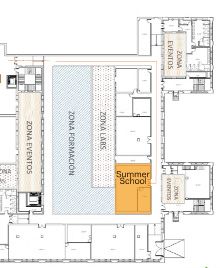
EVENT SCHEDULE
         tHURSDAY               friday                 SATURDAY
by         Lightning talks by     Lightning talks by
              participants           participants

ations     Work in group /          Work in group /
rtega         projects                 projects
d           development              development
ects

/

ak           Morning break           Morning break       Projects presenta-
                                                          tion at Museo del
                                                        Patrimonio Municipal
p/           Work in group /        Work in group /          Auditorium
                projects               projects              (11:00 am)
t             development            development

                 Lunch                   Lunch          Wrap-up and farewell

p/          Work in group /         Work in group /
               projects                projects
t            development             development

               Wrap-up                  Wrap-up
Main entrance

          Drinks and
          Coffee
  POLO
DIGITAL
  MAP
Hall

       Summer School
       Class
#DAHS
                                    LIghtnin
tuesday 30
  Alejandro Mozo Quesada
        Ana Fernández
      Borja Franco Llopis
 Cristina Vázquez Rodríguez
    Elena Paulino Montero

                   wednesday 31
                         Elisabeth Sobieczky
                       Fernando Muñoz Martín
                       Jorge Sebastián Lozano
                              José Iranzo
                             Léonie Cujé
SS19
ng talks
Friday 2
Sofía Isabel Ochoa García
Tihana Puc
Víctor Casas Moreno
María Ortiz Tello
Leticia Crespillo Marí
Thursday 1
Lukas Pilka
María Inmaculada Rodríguez Moya
Paul Melton
Qiuzi Guo
Roozbeh Seyedi#DAHSS19 PARTICIPANTS
Alejandro Mozo Quesada                    Léonie Cujé
  Universidad de Málaga               Independent Researcher

     Ana Fernández                         Lukas Pilka
Universidad de Santiago de    UMPRUM, Academy of Arts, Architecture &
       Compostela                        Design in Prague

    Borja Franco Llopis          María Inmaculada Rodríguez Moya
           UNED                          Universitat Jaume I

Cristina Vázquez Rodríguez                  Paul Melton
   Universidad de Málaga                     SUNY-FIT

  Elena Paulino Montero                     Qiuzi Guo
          UNED                         Heidelberg University

   Elisabeth Sobieczky                    Roozbeh Seyedi
Academy of Fine Arts Vienna           Independent Researcher

                                     Sofía Isabel Ochoa García
 Fernando Muñoz Martín                Independent Researcher
  Universidad de Málaga
                                            Tihana Puc
  Jorge Sebastián Lozano              Independent Researcher
  Universidad de Valencia
                                        Víctor Casas Moreno
       José Iranzo                     Universidad de Malaga
  Universidad de Málaga
DAHSS
Nuria Rodríguez Ortega
University of Málaga, Málaga
@airun72 // nro@uma.es
ACADEMIC DIRECTOR
Anthony Cascardi
University of Berkeley, California
ACADEMIC DIRECTOR
Harald Klinke
Ludwig Maximilians University, Munich
@HxxxKxxx // h.klinke@lmu.de
SPEAKERS
Harald Klinke is currently teaching Digital Art His-
tory at the LMU Munich, Germany. He studied art
history, media theory, painting, philosophy and busi-
ness informatics in Karlsruhe, Berlin, Norwich (UK)
and Göttingen, and received his PhD at the Hochs-
chule für Gestaltung in Karlsruhe.
From 2009 to 2010, he conducted research, supported
by a grant from the Deutsche Forschungsgemeins-
chaft, as a Visiting Scholar at Columbia University,
New York. He is Editor of the International Journal for
Digital Art History.
Greg Niemeyer
University of California, Berkeley
@gregniemeyer // gregniemeyer@gmail.com
SPEAKERS
Greg Niemeyer founded the Stanford University
Digital Art Center, which he directed until 2001,
when he was appointed at UC Berkeley as Assis-
tant Professor for New Media. At UC Berkeley, he
is involved in the development of the Center for
New Media, focusing on the critical analysis of
the impact of new media on human experiences.
His creative work focuses on the mediation between
humans as individuals and humans as a collective
through technological means, and emphasizes playful
responses to technology.TEAM
Justin Underhill
University of California, Berkeley
@ArtdotRip // justinunderhill@gmail.com
SPEAKERS
Justin Underhill is a Mellon Postdoctoral Fellow in
the Digital Humanities at UC Berkeley. He earned
his PhD in Art History from Berkeley, completing a
dissertation, “World Art and the Illumination of Vir-
tual Space,” that uses advanced software to reconstruct
the architectural contexts in which works of art were
displayed. Such research explores the relation between
pictures and the lighting of the space in which they
were originally viewed.
Presently, among other projects, he is developing art.
rip, a site dedicated to digital capture, forensic visuali-
zation, and the history of art.
Leonardo Impett
Bibliotheca Hertziana
SPEAKERS
Leonardo Impett is Digital Humanities Scientist at the
Bibliotheca Hertziana (Max Planck Institute for Art
History), where he is helping to establish a new Digi-
tal Humanities Lab. He is a member of the Image and
Visual Representation Laboratory at EPFL, a Visiting
Fellow at Cambridge University Digital Humanities,
and was previously Digital Humanities Fellow at Villa
I Tatti (Harvard University Center for Italian Renais-
sance Studies), and member of the Rainbow lab at the
University of Cambridge. His research focuses on the
use of computer vision for the history of art, especia-
lly involving the modelling of human gesture, texture,
and illumination.
Bárbara Romero Ferrón
University of Málaga, Málaga
bromerof@uwo.ca
ACADEMIC SECRETARYYou can also read


