OpenMP Accelerator Model for TI's Keystone DSP+ARM Devices - SC13, Denver, CO Eric Stotzer Ajay Jayaraj
←
→
Page content transcription
If your browser does not render page correctly, please read the page content below
OpenMP Accelerator Model for
TI’s Keystone DSP+ARM Devices
SC13, Denver, CO
Eric Stotzer
Ajay Jayaraj

                                1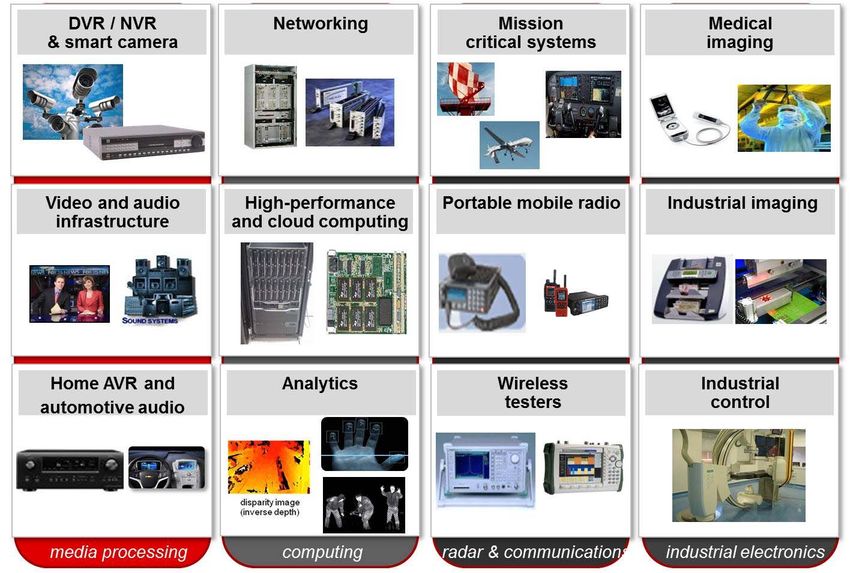
High Performance Embedded Computing

                                      2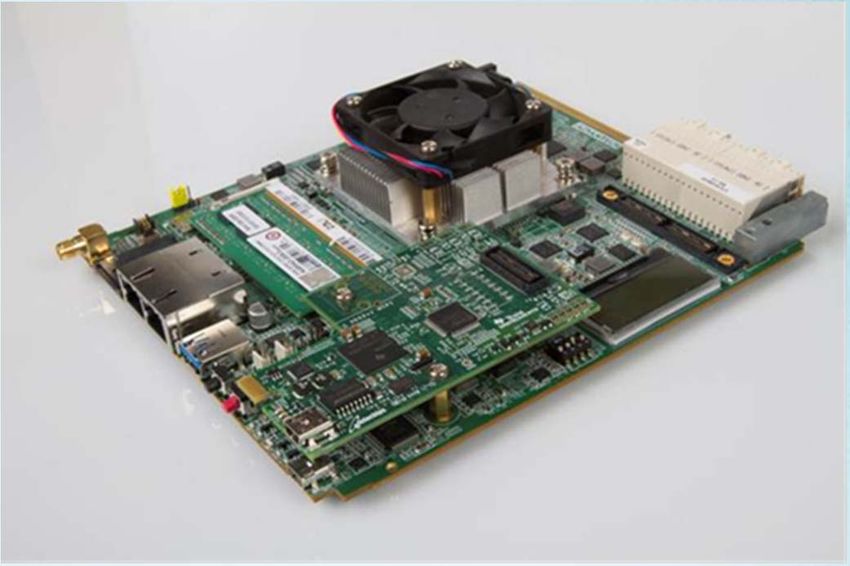
C66x Core
Architecture
•   8-way VLIW
    processor
•   8 functional units in
    two sides
     •   M: multiplication
     •   D: load/store
     •   L and S: addition and branch

•   SIMD up to 128-bit
    vectors
     •   M: 4 SP multiplies/cycle
     •   L and S: 2 SP add/cycle

•   8 MAC/cycle
     • 16 GFLOPS (SP) @ 1 Ghz

                                        3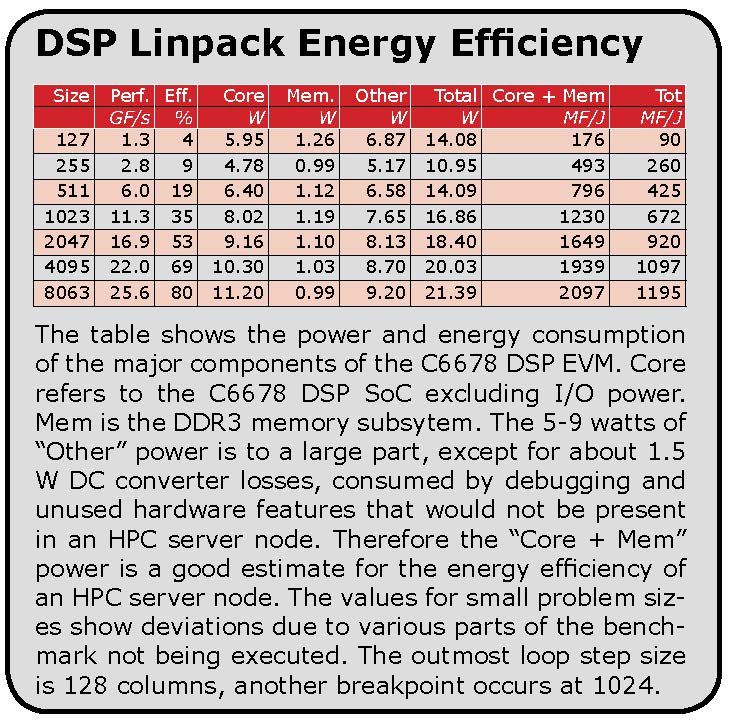
Keystone I: C6678 SoC
•   Eight 8 C66x cores
•   Each with 32k L1P, 32k
    L1D, 512k L2
•   1 to 1.25 GHz
•   320 GMACS
•   160 SP GFLOPS
•   512 KB/Core of local L2
•   4MB Multicore Shared
    Memory (MSMC)
•   Multicore Navigator (8k
    HW queues) and
    TeraNet
•   Serial-RapidIO, PCIe-II,
    Ethernet, 1xHyperlink
                               4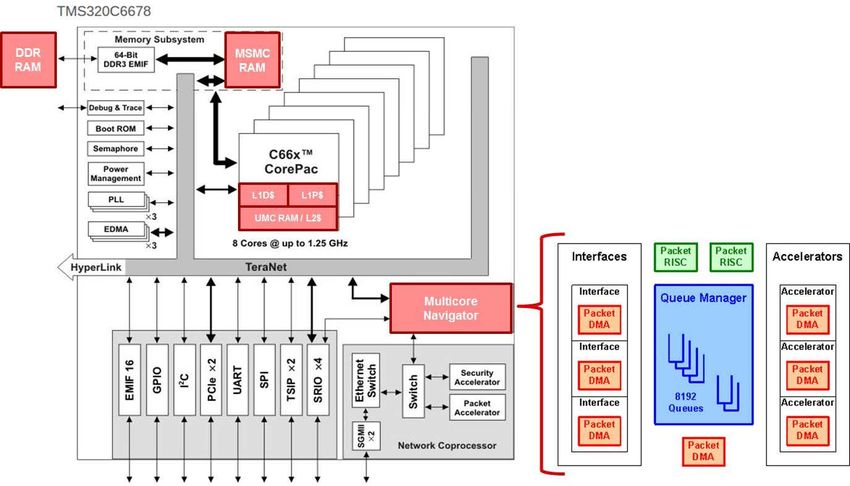
Energy Efficiency
LINPACK running on C6678 achieves 25.6 Gflops, ~2.1 Gflops/W
   PRACE First Implementation Project, Grant RI-261557, Final Report on Prototypes Evaluation. Lennart
   Johnsson, Gilbert Netzer, SNIC/KTH, 3/29/2013.

                                                                                                         5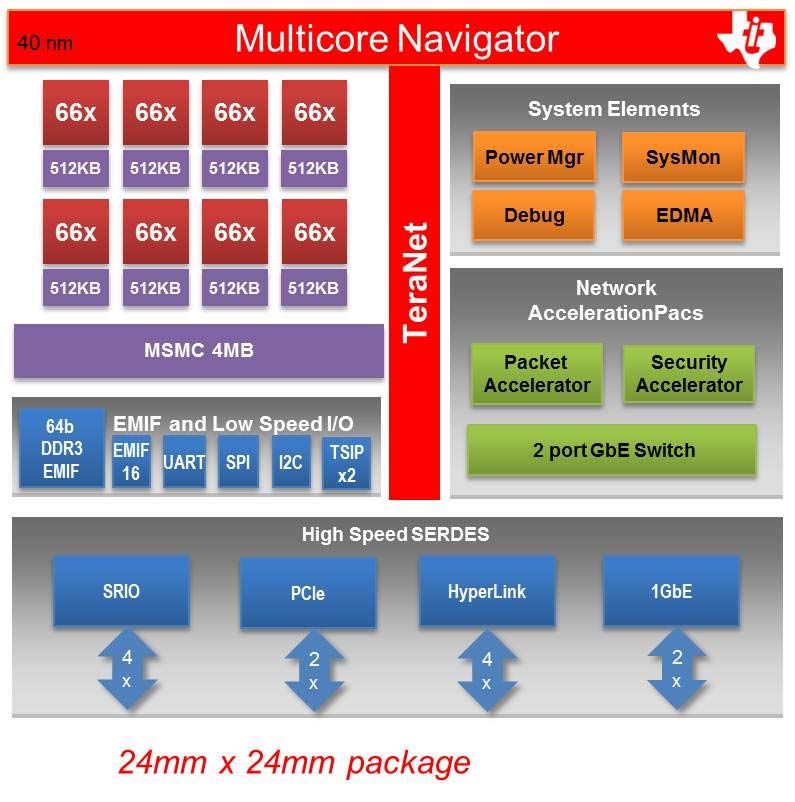
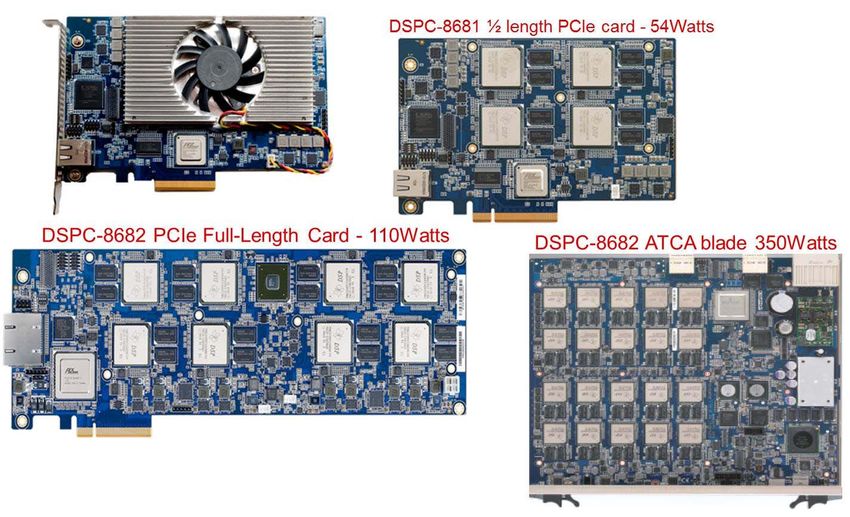
High Density COTS boards

                           6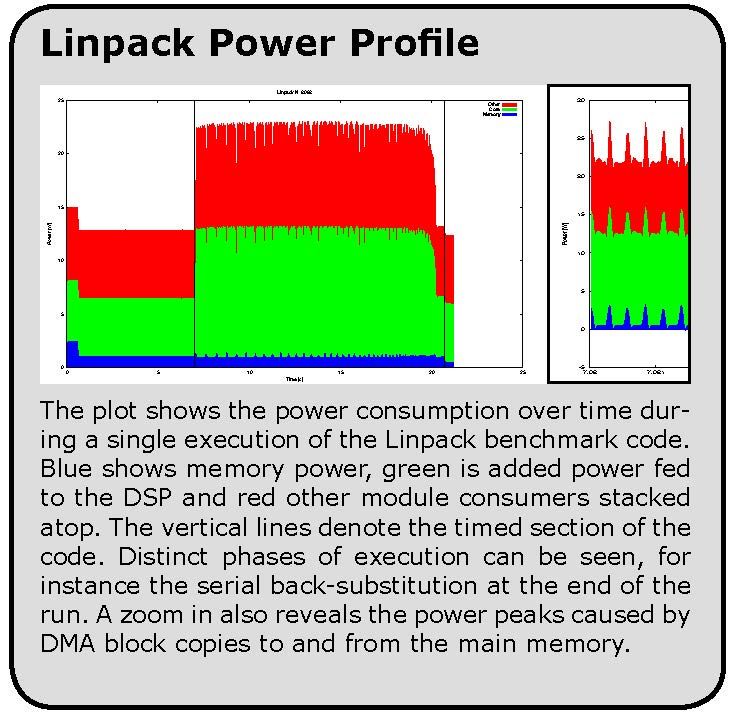
Keystone II: 66AK2H12/06 SoC
C66x Fixed or Floating Point
DSP                                                 28 nm                        Multicore Navigator
•   4x/8x 66x DSP cores up to 1.4GHz
•   2x/4x Cotex ARM A15
•   1MB of local L2 cache RAM per C66 DSP core                                                                                System Elements
•   4MB shared across all ARM                                        66x 66x 66x 66x
                                                    ARM ARM ARM ARM 66x 66x 66x 66x                                        Power Mgr       SysMon
                                                    A15 A15 A15 A15
Large on chip and off chip                                                        1MB    1MB     1MB     1MB

memory                                                         4MB               1MB    1MB     1MB    1MB                   Debug             EDMA

                                                                                                                 TeraNet
• Multicore Shared Memory Controller provides low
  latency & high bandwidth memory access
• 6MB Shared L2 on-chip                               64/72b                                                                      Network
• 2 x 72 bit DDR3, 72-bit (with ECC), 10GB total       DDR3                    MSMC 6MB                                       AccelerationPacs
  addressable, DIMM support (4 ranks total)             x2
                                                                                                                             Packet        Security
                                                                                                                           Accelerator    Accelerator
KeyStone multicore architecture                                          EMIF and I/O
and acceleration                                           16b          UART      SPI     I2C                                 5 port 1GbE Switch
                                                                                                  USB3
• Multicore Navigator, TeraNet, HyperLink                 EMIF           x2       x3       x3
• 1GbE Network coprocessor (IPv4/IPv6)
• Crypto Engine (IPSec, SRTP)
                                                                                          High Speed SERDES

                                                                                                               HyperLink
Peripherals                                                      SRIO                    PCIe                     x2
                                                                                                                                         1GbE

• 4 Port 1G Layer 2 Ethernet Switch
• 2x PCIe, 1x4 SRIO 2.1, EMIF16, USB 3.0 UARTx2,                   4                       2                        8                      4
  SPI, I2C                                                         x                       x                        x                      x
• 15-25W depending upon DSP cores, speed, temp &
  other factors

                                                                                 40mm x 40mm package

                                                                                                                                                        7
Available HPC Platforms
                  nCore BrownDwarf                                                                HP Moonshot

                                                                                      “As a partner in HP’s Moonshot ecosystem
 “The BrownDwarf Y-Class system is an incredibly important milestone in HPC           dedicated to the rapid development of new
 system development. Working in close collaboration with TI, IDT and our hardware
 partner Prodrive, we have successfully established a new class of energy efficient   Moonshot servers, we believe TI’s KeyStone
 supercomputers designed to fulfill the demands of a wide range of scientific,
 technical and commercial applications. We are very excited to be launching the
                                                                                      design will provide new capabilities across
 most capable energy efficient supercomputer available. The innovative design of      multiple disciplines to accelerate the pace of
 the BrownDwarf Y-Class system has resulted in a network fabric that far exceeds
 the latency and power efficiencies of traditional supercomputing systems based on
                                                                                      telecommunication innovations and
 x86 and Infiniband or Ethernet systems. By utilizing existing programming models     geological exploration.”
 and toolsets, the BrownDwarf Y-Class supercomputer is a disruptive force in HPC
 as it leapfrogs a number of the supercomputing incumbents.”                                 --- Paul Santeler, vice president and
        -- Ian Lintault, Managing Director, nCore HPC
                                                                                      general manager, Hyperscale Business, HP

                                                                                                                                       8
OpenMP on Multicore DSP
• API for specifying shared-memory parallelism in C, C++,
and Fortran
• Consists of compiler directives, library routines, and
environment variables
– Easy & incremental migration for existing code bases
– De facto industry standard for shared memory parallel
programming
• Portable across shared-memory architectures
• Evolving to support heterogeneous architectures, tasking
dependencies etc.
9Bare-metal OpenMP Software Stack
• Leverage HW queues from Customer Applications
Multicore Navigator Master Thread
Multicore Software Development Kit
• Thread dispatches events to Worker Thread Worker Thread
other threads via HW Worker Thread Worker Thread
queues. Worker Thread Worker Thread
• OpenMP runtime built on top OpenMP Programming Layer
of very low-level drivers
close to hardware Compiler OpenMP Environment
Directives Library Variables
• OpenMP run-time state and
user data is allocated in OpenMP Runtime layer
shared memory
TI OpenMP runtime library
Low Level Driver (LLD) APIs
Multicore Navigator HWMulticore Navigator Hardware
• 16K HW queues with
atomic access
• 2 Packet RISCs
• 1 Packet DMA engine
11OpenMP 4.0
• Released July 2013
– http://www.openmp.org/mp-documents/OpenMP4.0.0.pdf
– Example document released at SC’13
• Changes from 3.1 to 4.0 (Appendix E.1):
– Heterogeneous (accelerator) devices: 2.9
– SIMD extensions: 2.8
– Places and thread affinity: 2.5.2, 4.5
– Taskgroup and dependent tasks: 2.12.5, 2.11
– Error handling: 2.13
– User-defined reductions: 2.15
– Sequentially consistent atomics: 2.12.6
– Fortran 2003 support
12Heterogeneous device support
• target construct: creates a region of code that is executed by a target device
• Work with wide variety of devices
– GPGPUs, MIC, DSP, FPGA, etc
– A target could be a remote node of the same type as the host
Host device
#pragma omp target Target device
Main
{ Memory
/* This region of code is Map data to
executed on the default Application data Application data
target device */
{ Map data from
ARM cores code region DSP cores
executed by target
device
13Device constructs: mapping data
• Data is mapped from the host device to a target device
– It might require a copy to/from host memory to device memory
– OR it might simply be passing a pointer
• The model supports both, so the user cannot assume a copy
long a = 0x858;
long b = 0;
int X[100];
#pragma omp target data map(to:a) map(b, X)
{
/* a, b and X are mapped to the device */
b = weighted_average(X, a);
}
/* b and X are flushed back to the host */
14Data mapping: shared or distributed memory
Shared memory
Memory
Processor Processor
X Y
Cache Cache
A
A A
Distributed memory
Accelertor
Memory X Y
• The corresponding variable in the Processor
Memory Y
device data environment may share X
storage with the original variable. Cache
A
A
• Writes to the corresponding variable A
may alter the value of the original
variable.target construct and map clause
extern void init(float*, float*, int);
extern void output(float*, int);
• The target construct
maps the variables v1, v2,
void vec_mult(float *p, float *v1, float *v2, int N)
{ and p to the device data
int i;
init(v1, v2, N);
environment.
#pragma omp target map(to:v1[0:N],v2[:N]) \\ • The variable N is mapped
map(from:p[0:N])
#pragma omp parallel for
into the device data
for (i=0; iOpenMP on multicore ARM+DSP K2H
• OpenMP-ARM
– Quad A15 running SMP linux
GCC libgomp
libgomp optimized
– GCC tool chain w/ OpenMP with NRT
SMP Linux
support
– GCC libgomp runtime 66x 66x 66x 66x
ARM ARM ARM ARM 66x 66x 66x 66x
A15 A15 A15 A15
1MB 1MB 1MB 1MB
4MB 1MB 1MB 1MB 1MB
• OpenMP-DSP (C66x)
– TI C66x tool chain w/ OpenMP 64/72b
DDR3 MSMC 6MB
support x2
– Runtime based on libgomp with
optimizations leveraging
Multicore Navigator (e.g.
hardware queues)
17OpenMP on K2H
Dispatching OpenMP-DSP programs from ARM using OpenMP Accelerator Model
void foo(int *in1, int *in2, int *out1, int count)
{
#pragma omp target map (to: in1[0:count‐1], \
Host program in2[0:count‐1], count, \
with from: out1[0:count‐1])
{
OpenMP #pragma omp parallel shared(in1, in2, out1)
target directives {
int i;
#pragma omp for
for (i = 0; i < count; i++)
out1[i] = in1[i] + in2[i];
}
}
#pragma omp parallel shared(in1, in2, out1)
}
{
int i; OpenMP
#pragma omp for Region
Source to Source for (i = 0; i < count; i++)
out1[i] = in1[i] + in2[i];
lowering
}
OpenMP Accelerator
Runtime (ARM)
OpenMP Accelerator
Model Runtime (DSPs)
SMP Linux
66x 66x 66x 66x
ARM ARM ARM ARM 66x 66x 66x 66x
A15 A15 A15 A15
1MB 1MB 1MB 1MB
4MB 1MB 1MB 1MB 1MB
64/72b
DDR3 MSMC 6MB
x2
18OpenMP on K2H
Dispatch OpenMP-DSP programs from ARM using standard OpenCL APIs
OpenCL host program __kernel
void add_wrapper(__global const float *a,
program.build(devices, “add_openmp.obj"); __global const float *b,
Kernel kernel(program, “add_wrapper"); __global float *c, OpenCL
kernel.setArg(0, bufA); int size) kernel
kernel.setArg(1, bufB); { wrapper
kernel.setArg(2, bufDst); add_openmp(a, b, c, size);
kernel.setArg(3, NumElements); }
Event ev1,ev2,ev3,ev4, ev5, ev6,ev7,ev8;
CommandQueue InO_Q(context, devices[d], CL_QUEUE_PROFILING_ENABLE);
void add_openmp(float *a,
float *b,
InO_Q.enqueueWriteBuffer(bufA, CL_FALSE, 0, bufsize, srcA, NULL, &ev1);
float *c,
InO_Q.enqueueWriteBuffer(bufB, CL_FALSE, 0, bufsize, srcB, NULL, &ev2);
int size)
{ OpenMP
std::vector vec_ev5(1);
InO_Q.enqueueTask(kernel, NULL, &vec_ev5[0]);
int i; region
#pragma omp parallel for
for (i = 0; i < size; i++)
InO_Q.enqueueReadBuffer(bufDst, CL_TRUE, 0, bufsize, dst, &vec_ev5, &ev6);
c[i] = a[i] + b[i];
}
OpenCL Runtime
OpenCL Monitor +
OpenMP Runtime
SMP Linux
66x 66x 66x 66x
ARM ARM ARM ARM 66x 66x 66x 66x
A15 A15 A15 A15
1MB 1MB 1MB 1MB
4MB 1MB 1MB 1MB 1MB
64/72b
DDR3 MSMC 6MB
x2
19For more information:
• Stop by the TI Booth #3725
• Watch the 66AK2H12 EVM board tour
• Read “The case for 10G Ethernet”
• Keep up with the latest HPC happenings on the Multicore Mix blog
20You can also read


