Division of Postsecondary State Authorization Initial Authorization Training - January 2021 - TN.gov
←
→
Page content transcription
If your browser does not render page correctly, please read the page content below
Division of Postsecondary State Authorization
         Initial Authorization Training
                 January 2021
Initial Authorization Training Manual
                 Table of Contents
• Authorized Institutions Overview
• Resource Material
  • THEC Website
  • Statutes and Rules
• Annual Obligations
  • Reauthorization
  • Student Level Statistical Data (SLSD) Collection
  • Tuition Guaranty Fund
• Website and Advertising Compliance
• Student Files
• Forms and Applications
• Complaints
                                                       2
Authorized Institutions
      Overview

                          3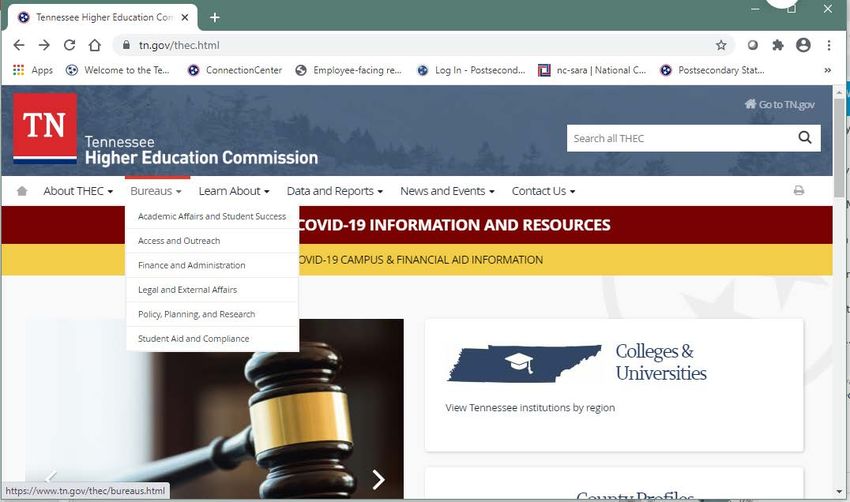
Authorized Institutions Overview

• Pursuant to the Tennessee Higher Education Authorization Act
  of 2016 (HEAA) (Tenn. Code Ann. § 49-7-2001, et seq.) the
  Tennessee Higher Education Commission (THEC) is directly
  responsible for the oversight and operation of degree and non-
  degree granting accredited and unaccredited institutions that
  offer a wide variety of academic, career, technical and trade
  programs.

• The division within THEC that staffs these functions is the
  Division of Postsecondary State Authorization (DPSA).

                                                                4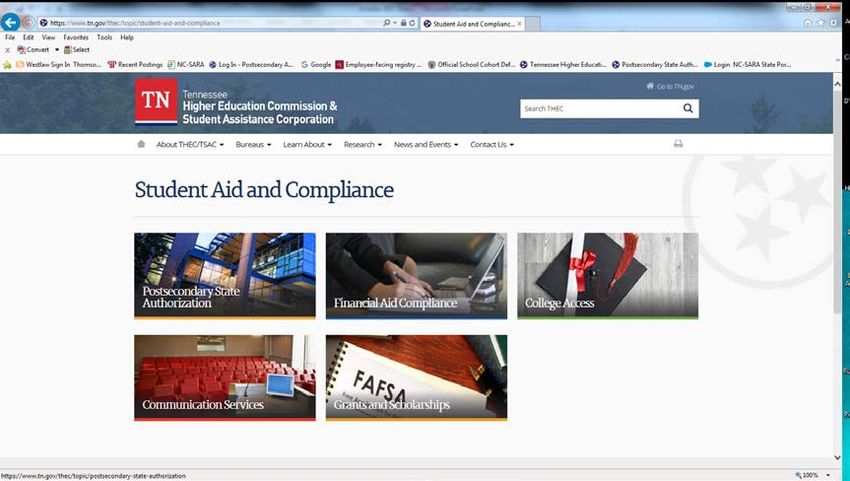
Authorized Institutions Overview

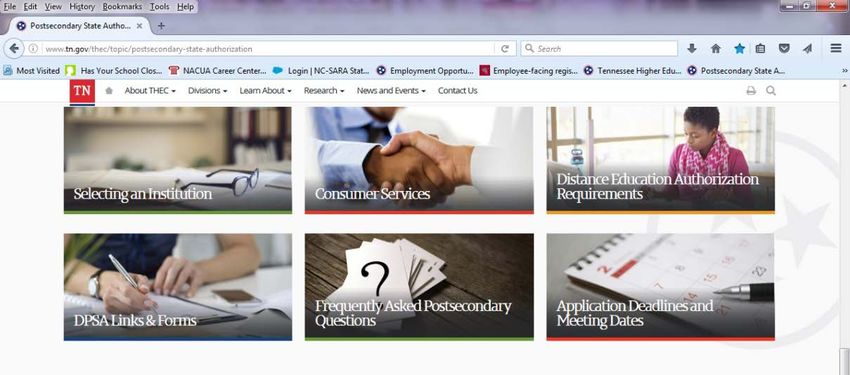
                                   5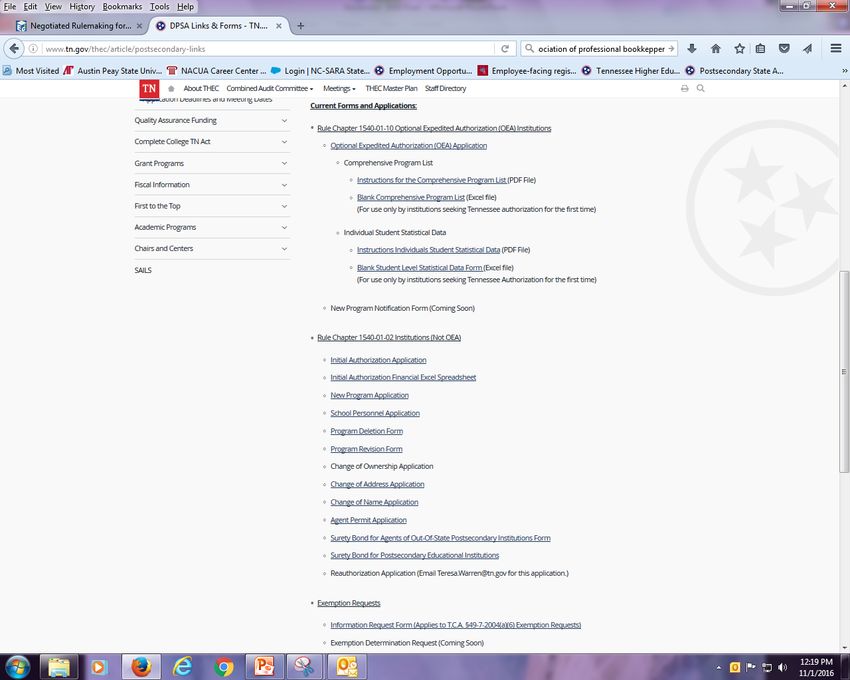
THEC Website
 tn.gov/thec

               6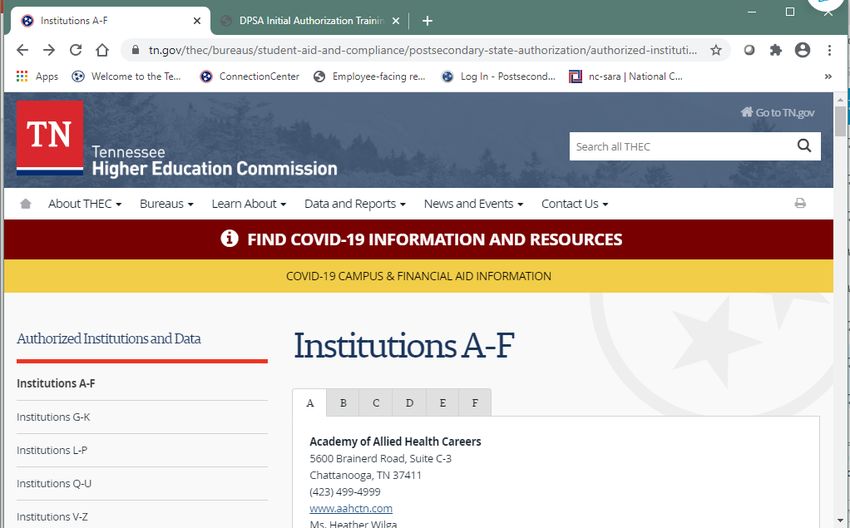
THEC Website: tn.gov/thec

                            7
THEC Website: tn.gov/thec

   Link to
Statutes and
   Rules.

                                           8
THEC Website: tn.gov/thec

                      This section is
                      applicable to
                      RA Institutions

                                        9
THEC Website: tn.gov/thec

   Link to
Statutes and
   Rules.

                                           10
THEC Website: tn.gov/thec
11Reauthorization
12Reauthorization
• Institutions are required to submit an annual reauthorization
application pursuant to Rule 1540-01-02-.07(3).
• The due date for reauthorization applications is dependent on
your authorization date. For those of you expected to be
authorized by the Commission in January 2021, your
reauthorization application will be due on the due date for the
January 2022 CPEI meeting.
• Generally, we rely on email to send updates to institutions.
Therefore, keep your email contact information up-to-date
and monitor your spam closely.
13Reauthorization
Collected Information & Data
The following information will be requested as part of
reauthorization so your institution should put in place procedures
now to ensure the information is readily available when needed.
• Licensure Passage Rates - Applies to any program leading to
employment in a field where licensure is required for
employment and there is an examination. Rules 1540-01-02-
.07(3) and .08(4)(b).
• Student enrollment documents or affirmation statements
• Listing of institutional personnel
• Total Gross Tuition Collected and Student Funding Sources -
Examples include, federal loans, in-house funding, Workforce
Investment Act monies, veterans’ benefits, scholarships
14Reauthorization
Collected Information & Data
• Updates of certain information on file, including lease documentation,
bonds, and ownership information
• Financial Statements (Income Statement and Balance Sheet) as provided
for in Rule 1540-01-02-.14
Gross Tuition Revenues of $1,000,000 or Greater
• Audited Financials Statements Prepared by a CPA in Accordance with GAAP
Gross Tuition Revenues Less Than $1,000,000 But Greater Than $100,000
• Reviewed Financials Statements Prepared by a CPA in Accordance with GAAP
Gross Tuition Revenues Equal to or Less Than $100,000
• Financials Statements on DPSA forms prepared by a CPA or Certified
Bookkeeper
15Student Level Statistical
Data (SLSD) Collection
16SLSD Collection
Collected Information & Data
• Put in place procedures now to ensure the information is
readily available when needed.
• For example, start maintaining dates for all student
withdrawals, probation, leave of absence, graduation or
any other status changes.
• Data is collected on enrolled students. "Enrollment" refers to
those students who have attended one (1) session of class,
turned in one (1) assignment, or received one (1) distance
learning lesson. Rule 1540-01-02-.03(27).
17SLSD Collection
Withdrawal and Placement Data
SLSD will be collected on an Excel spreadsheet that
includes the following information for each student:
• First Name • Date Completed
• Middle Initial • Date Withdrew
• Last Name • Special Circumstance Withdrew
• Student ID Number • Placed
• Social Security Number • Placed In-Field
• Race • Special Circumstance Non-
• Gender Placement
• Date of Birth • Name, Address, and Telephone
• Program Name Number of Employer
• Program Code • Annual Salary or Hourly Wage
• Delivery Mode
• Program Length
• Credential
• Date Started
18SLSD Collection
Withdrawal and Placement Data
Special Circumstances for Special Circumstances for Non-
Withdrawals: Placements:
•Health related situation • Health related situation
•Family emergency • Family emergency
•Death • Death
•Incarceration • Incarceration
•Full-time military service • Full-time military service
•Job relocated/transferred • Job relocated/transferred
•Transferred to a different program • Continuing education at your institution
at your institution • Continuing education at a different
institution
• Pending fulfillment of licensure
requirements
• International students - unable by law to
work
• Student could not be contacted/
Refused employment
19SLSD Collection
Common Errors
DPSA will send your institution a blank or prepopulated
spreadsheet along with instructions. You should read these
instructions carefully. Below are some common errors:
• You must provide student’s social security or unique ID
number. The social security number is preferred.
• You must provide the date of birth.
• The date completed should only be filled in when the student
completes (graduates) the corresponding program. If no
credential is awarded to the student (e.g., they failed or
withdrew) then they did not complete the program.
20SLSD Collection
Common Errors, Continued
• Do not enter a completion or withdrawal date that is later
than the end of the reporting period or earlier than the DATE
STARTED.
• The placed column must be completed if the student
completed the program.
• The placed in field column must be completed if the student
has completed the corresponding program and is marked as
“Y” for Placed.
• The name of the employer and related information must be
filled in if the student was placed or employed after
completing the corresponding program.
21SLSD Collection
Common Errors, Continued
• Failure to update materials: When you receive your first
round of data you will need to update two items:
1. Website (See discussion later in this presentation.)
2. Pre-Enrollment Checklist (See Rule 1540-01-02-.13(1)(j))
22SLSD - THEC Website: tn.gov/thec
23SLSD - THEC Website: tn.gov/thec
24Tuition Guaranty Fund
25Tuition Guaranty Fund
Rule Chapter 1710-01-02 & Tenn. Code Ann. § 49-7-2018
• The tuition guaranty fund was created by the Tennessee General Assembly
to establish a fund from which reimbursement can be made to students for
unearned tuition.
• A Board of Directors administers the fund. The Board is composed of:
• the Comptroller of the Treasury;
• the Commissioner of Finance and Administration;
• the State Treasurer;
• the Executive Director of the Tennessee Higher Education Commission
• a Member of the Committee on Postsecondary Educational
Institutions; and
• a representative of the private postsecondary education industry
named by the Chair of the Commission.
26Tuition Guaranty Fund
Rule Chapter 1710-01-02 & Tenn. Code Ann. § 49-7-2018
• The Board is authorized to take any actions necessary to administer
the fund, including promulgation of rules, regulations and bylaws.
• All institutions must pay into the Tuition Guaranty Fund for six (6)
years following authorization.
• Failure to pay Tuition Guaranty Fund assessments could result in
adverse action against your institution including a fine or, if
necessary, a recommendation to the Commission to change the
status of your institution’s authorization.
27Tuition Guaranty Fund
Rule Chapter 1710-01-02 & Tenn. Code Ann. § 49-7-2018
Institutions will receive the first of SIX notifications concerning the need to
contribute to the fund in February of the year following receipt of authorization
from THEC. Institutions must pay into the fund for the first six years of
authorization as follows:
28Website and
Advertising Compliance
29Website Compliance
Tenn. Code Ann. § 49-7-2019
WHAT ARE INSTITUTIONS REQUIRED TO POST?
• Tenn. Code Ann. § 49-7-2019 requires institutions to post the tuition costs
provided to the Commission.
WHERE SHOULD THE INFORMATION BE POSTED WITHIN THE WEBSITE?
• The tuition costs provided to the Commission should be available along with
other information on the applicable program web page.
30Website Compliance
Tenn. Code Ann. § 49-7-2019 and Rule 1540-01-02-.20(4)
1. Information related to graduation and job placement – See Tenn. Code Ann. § 49-7-2019 must be
on your website. It is recommended posting the information on the first page of the website, the
first Tennessee-specific webpage, or the webpage for each Tennessee authorized site. Commission
staff suggests the following language:
• “In order to view detailed job placement and graduation information on the programs offered
by [Name of Institution], please visit https://www.tn.gov/thec/bureaus/student-aid-and-
compliance/postsecondary-state-authorization/authorized-institutions-and-data.html.”
2. An authorization statement along with a hyperlink to the THEC’s website. See Rule 1540-01-02-
.20(4). The authorization statement must be on the institution’s home page or Tennessee specific
page.
• “[Name of Institution] is authorized for operation as a postsecondary educational institution
by the Tennessee Higher Education Commission.”
• The entire statement must be used, have the same size font, and type of print.
• The reference to the Tennessee Higher Education Commission must be a hyperlink to
www.tn.gov/thec/.
31Website Compliance
Tenn. Code Ann. § 49-7-144
WHAT ARE INSTITUTIONS REQUIRED TO POST?
• Tenn. Code Ann. § 49-7-144 requires an institution to post the transferability of
credit statement as written in paragraph (b)(2) of Tenn. Code Ann. § 49-7-144.
WHERE SHOULD THE INFORMATION BE POSTED WITHIN THE WEBSITE?
• Commission staff recommends posting this statement or a link thereto on the
first page of the website, the first Tennessee-specific webpage, or the webpage
for each Tennessee authorized site.
32Website Compliance
Next Steps – Check Your Website!
1. Authorization by the Commission ≠ Website Compliance You are responsible
for ensuring that your website is compliant with all statutes and rules at all
times.
2. Student Level Statistical Data – As mentioned previously, Tenn. Code Ann. § 49-
7-2019 requires institutions to post information related to graduation and job
placement. After you submit your first set of Student Level Statistical Data, DPSA
will provide you with statistical data report related to graduation and job
placement rates. As soon as you receive the report, your website must contain
the appropriate language and hyperlinks.
33Advertising Compliance
Rule 1540-01-02-.20(7)
Rule 1540-01-02-.20(7) states:
“All advertisements seeking prospective students must include and clearly indicate
the full and correct name of the institution, the authorized location city, and, if
out-of-state, the authorized location state.” (emphasis added)
• This rule applies to all advertisements, including billboards, radio, television, and
newspaper advertisements, and advertisements created and purchased by the
institution or its agents.
• If your agent takes out an advertisement and it does not comply with .20(7), your
institution may be fined.
34Advertising Compliance
Rule 1540-01-02-.20(9)
Rule 1540-01-02-.20(9) states:
“Other than entry level salary data available on a Tennessee or federal
government website, no dollar amount will be quoted in any advertisement as
representative or indicative of the earning potential of graduates without prior
approval by Commission Staff.”
35Advertising Compliance
Rule 1540-01-02-.20
I have simply highlighted a few Rule 1540-01-02-.20 paragraphs. The rule has 18
paragraphs in total. Review the rules thoroughly to ensure your representations,
advertisements, and solicitations are compliant.
36Forms and Applications
37Program Revisions
• An institution revises a program when it changes any element of a
program that has been approved by Tennessee Higher Education
Commission, for example, the name of the program, tuition, credit or
contact hours, other fees, length, and curriculum.
• Pursuant to Rule 1540-01-02-.07(5)(c), when an institution makes any
revision(s) to an approved program, the institution must notify the
Commission by submitting a Program Revision and Status Change
Notification to Commission Staff at least thirty (30) days prior to
implementing the revision. Moreover, “If the program revision
amounts to change of more than twenty-five percent (25%) in the last
twelve (12) months or if Commission Staff determines a significant
revision has occurred, then the institution must submit a New Program
Application prior to implementing the revision.
38Program Revisions
• However, on October 6, 2020, the Tennessee Higher Education Commission’s
Executive Director temporarily waived this rule, in part. This temporary waiver
allows an institution to revise a program without filing a Status Change
Notification to Commission Staff. The institution will notify Commission Staff of
program revision(s) during annual reauthorization.
• Change of program name or credential: An institution must notify Commission
staff at least thirty (30) days prior to the effective date of the change and must
explain the specific change and the proposed effective date.
• The institution will be required to file an Application for New Program:
• If Commission Staff determines that the institution has implemented
program revision of more than twenty-five percent (25%) in the last twelve
(12) months, or
• If Commission Staff determines a significant revision has occurred.
• Changes to delivery mode (residential, online or blended) are significant and
require an Application for New Program.
39Program Revisions
• Rule 1540-01-02-.07(5)(d) provides: “Institutions shall not
arbitrarily add a course to an existing program in which a
student would incur additional time or expense beyond the
catalog requirements at the time of enrollment, unless the
addition is in response to: demonstrated educational
necessity; a reasonable program completion period
elapsed; state approval agency requirements; U. S.
Department of Education recognized accreditor
requirements or professional licensure requirements.”
40School Personnel Applications
• Rule 1540-01-02-.07(7)(a) requires institutions to submit a School
Personnel Application for instructors and administrative personnel “no
later than ten (10) business days after the hire date.”
− Unaccredited institutions must submit applications for all
instructors and administrative personnel.
− Accredited institutions must submit applications for administrative
personnel only.
• However, on October 6 , 2020, the Tennessee Higher Education
Commission’s Executive Director temporarily waived this rule, in part.
With the exception of the institutional director, the temporary waiver
suspends the requirement for accredited and unaccredited institutions
to file an Application for School Personnel for instructors and
administrative personnel.
41School Personnel Applications
• Instructors and administrative personnel must meet the
minimum qualifications listed in Rule 1540-01-02-.16(5).
Institutions must maintain evidence of the qualifications on-
site at the institution. Institutions must submit a copy of this
evidence at any time upon receiving a request from
Commission staff.
• Administrative personnel are individuals that oversee operational
and administrative standards. This includes, but is not limited to,
financial aid administrator; director of admissions; director of
education; business officer or manager; director of student services
and the registrar.
• Support and clerical staff are not considered administrative
personnel.
42School Personnel Applications
• Institutional Directors MUST submit an Application for School Personnel to the
Commission.
• Use the Application for School Personnel available on THEC’s website.
• When completing the Application for School Personnel, complete the application
in its entirety and include the attachments requested in the application’s
checklist.
• If the institutional director will also be an instructor, list program/subject to be
taught.
• Qualifications
– Place a check mark by applicable qualifications
– Only mark the qualifications for level to be taught (i.e., instructors for
certificate level programs need only to mark certificate level qualifications)
• Submit the application with the signatures of all required persons.
• All information placed on applications is subject to verification by Commission
staff.
43Agent Permit Applications
• Rule 1540-01-02-.07(8)(a) provides: “Agents must submit an Agent Permit
Application, as provided by Commission Staff, and must receive approval and
an agent permit from Commission Staff prior to any solicitation.”
WHAT IS AN AGENT?
T.C.A. § 49-7-2003 and Rule 1540-01-02-.03(6)
Agent means any person representing a postsecondary educational institution
for payment, who solicits in any form and enrolls, or seeks to enroll, a student
for education offered by an authorized institution, or offers to award
educational credentials, for remuneration, on behalf of any such institution.
Persons owning an interest in an institution and the institution’s full-time
employees and directors shall not be considered agents under this part.
44Agents
Rule 1540-01-02-.07(8) and .16(8)
AGENT REQUIREMENTS
• All agents must:
1. receive approval and an agent permit; and
2. If the institution is out-of-state, secure an appropriate bond prior to any
solicitation.
• Agent permits must be renewed annually and the renewal application is available
on THEC’s website.
• Institutional Directors and the Institution are responsible for an Agent’s actions.
• An agent whose permit has expired must submit a New Agent Application if
submitted more that 60 days following the expiration date.
45Agents
Rule 1540-01-02-.07(8) and .16(8)
WHY IS THIS IMPORTANT?
• Any contract signed by a prospective student as a result of solicitation or
enrollment by a non-licensed agent may be unenforceable and the student
may be entitled to a refund of all moneys paid.
• The institution could be fined or the institution’s authorization status changed
to conditional or revoked.
ANSWERS TO COMMON AGENT QUESTIONS
• An institution must obtain approval for an agent prior to the individual
engaging in any agent activity.
• A full-time employee of the institution is not an agent.
• A part-time or contract employee of the institution, who the institution
compensates for enrolling or seeking to enroll students, is an agent. This
includes a person working from a remote location, who enrolls students or
makes cold calls, or as part of a recruiting firm.
46Other Required Forms
• Change of Location – Rule 1540-01-02-.07(6)
− Your institution may not conduct instruction at an unauthorized site.
Submit an Application for Change of Institutional Location at least 30
days prior to the scheduled relocation.
− DPSA must inspect the facilities and equipment.
• Institution Name Change – Rule 1540-01-02-.07(9)
• Change of Ownership – Rule 1540-01-02-.07(4)
• New Program Application – Rule 1540-01-02-.07(5)
− An institution must receive approval to offer a program prior to
advertising for or soliciting enrollment.
− For equipment heavy programs, DPSA will inspect the equipment prior
to approving the program.
• Surety Bonds for Agents and Institutions – Rule 1540-01-02-.09
47Student Files
48Student Files
Pursuant to Rule 1540-01-02-.15(5), “Institutions must maintain a file for each
student enrolled in a program or course for three (3) years after the student’s
withdrawal from or completion of the program or course of enrollment.” The
file shall contain at a minimum 1
− Documentation for the basis of admission;
− Pre-enrollment checklist executed by the student;
− Enrollment agreement executed by the student;
− Transferability of credits disclosure statement in compliance with
T.C.A. § 49-7-144;
− Documentation of all special circumstances placement and
withdrawal exceptions; and
− Account Ledger
Institutions shall retain student transcripts or certificate of completion from
your institution for the life of the institution.
1 This is not an exhaustive list. See Rule 1540-01-02-.15(5) for a complete list of requirements.
49Account Ledger/Tuition Charges
• Institutions must charge the approved tuition amount and the
account ledger should reflect that the student was charged the
approved amount.
• Rule 1540-01-02-.19(8) states:
“An institution may award a scholarship, tuition waiver, or other
similar award provided:
(a) The eligibility requirements for the offering, including terms,
conditions, application procedures, due dates, basis for selection, and
amount to be awarded, are clearly defined in writing;
(b) The institution has a form and procedure to verify eligibility; and
(c) The amount of the award is a flat dollar amount or subject to
calculation using a defined formula or scale.”
50Admission Standards
• Each institution is approved with specific admission
standards set by the institution, subject to Rule 1540-01-
02-.12.
• Admission standards must be applied as approved by
THEC.
• Do not admit students that you know or should know are
ineligible for licensure unless you get written
acknowledgement from the student.
51Admission Standards
• Students enrolling in a certificate or diploma program must possess a
high school diploma, a high school diploma equivalency, a current
Tennessee license in the field for which the training is intended,
postsecondary credit in a degree program, or a passing score on an
ability to benefit test.
• Students enrolling in an associate or bachelor degree program must
possess, at a minimum, a high school diploma, a high school diploma
equivalency, or postsecondary credit in a degree program.
• Students enrolling in a post-baccalaureate program must possess, at a
minimum, a baccalaureate degree from an institution judged to be
appropriate by the Commission.
52Student Files
• An official high school transcript, high school equivalency transcript or GED score
sheet shall be maintained in the student’s file, not a copy of the high school diploma,
or GED Certificate or HSE diploma. An official high school transcript, high school
equivalency transcript or GED score sheet must be:
− Signed by an institutional official or have an official seal.
− If a hard copy of the transcript or score sheet is scanned and stored
electronically, then it must be accompanied by documentation that verifies it
was received directly from the issuing institution/agency such as the envelope
that contained the transcript or score sheet. Please note such is not
necessary when the document itself is addressed to the receiving institution.
− If faxed or emailed the transcript or score sheet must include indicia that the
transcript or score sheet was received directly from the issuing institution or
agency such as accompanying email correspondence or fax cover sheet from
the issuing institution/agency.
• If an official postsecondary transcript is used for admission to an undergraduate
program, then the transcript must indicate that the student graduated from high
school or that the student was enrolled in and received credit in a degree program. If
used for admission to a graduate program, then the postsecondary transcript must be
official and indicate that the person holds a postsecondary degree.
53Student Files
As of January 1, 2014 the High School Equivalency Test (HiSET) is
available as an alternative option to earn the state-government issued
high school equivalency diploma. While the GED is still an option, the
State of Tennessee and the State Board of Education will not make a
distinction between the two tests when awarding the credential.
Successful test takers of either test will be issued a Tennessee High
School Equivalency Diploma (HSE).
54Student Files
55Student Files
The Student File Should Contain:
Student Passes an Ability A Copy of the Scored ATB or a Graded
to Benefit Test (ATB)1 Score Sheet1
Official GED Score Sheet or Official High
Student has a High School
School Equivalency Transcript From the
Student Equivalency
Issuing Entity
Seeks to
Enroll in a Official High School Transcript
Certificate
or Diploma Student has a High School
Diploma
Program Official Military Documentation Indicating
High School Completion
Student has Official Transcript from a Postsecondary
Postsecondary Credit in a Institution Indicating that Degree Program
Degree Program Credit Awarded
1The test should be approved by DPSA or it must be one previously approved by the U.S. Department of Education (USDOE). The institution must
notify DPSA if it intends to use a USDOE approved test.
56Student Files
The Student File Should Contain:
Official GED Score Sheet or Official High
Student has a High
School Equivalency Transcript From the
School Equivalency
Issuing Entity
Student Seeks to Official High School Transcript
Enroll in an Student has a High
Undergraduate School Diploma
Degree Program
Official Military Documentation
Indicating High School Completion
Student has Official Transcript from a Postsecondary
Postsecondary Credit in a Institution Indicating that Degree
Degree Program Program Credit Awarded
57Student Files
The Student File Should Contain:
Student Has a An Official Copy of
Baccalaureate the Transcript from
Student Seeks to
Degree or Higher the Postsecondary
Enroll in a Post-
Credential from an Institution Indicating
Baccalaureate
Institution Judged that the Student
Program
to be Appropriate Received the
by the Commission Credential
58Student Files
The Student File Should
Contain:
Verification of current
Student has a Tennessee Student Has a licensure from the issuing
Student Seeks to Tennessee licenseTennessee
in subject
An Officialmatter
Copy of the
license
Enrollin
in the field for which
the field for which the License
expert agency, such as a
the training is intended. training is intended
current screenshot from the
agency’s website.
59Complaints
60Complaints
• The investigation of complaints against institutions is one of the
most important functions performed by this agency.
• Sources of complaints:
• Students
• Parents
• Employees
• Elected Officials
• Better Business Bureau
• Other State Agencies
• DPSA is a neutral party in the complaint process. It reviews both
sides and will make a determination based on the facts presented.
• Maintain communication with DPSA throughout the process!!
61Complaint Process
When a complainant first contacts DPSA by phone, a DPSA staff
member
• Documents the call as an informal complaint
• Explains the complaint process and applicable statutes and rules
• Suggests that complainant contact the Institutional Director if the
complainant has not already done so
• Follows up with email explaining the process for initiating a
formal complaint and copy the Institutional Director if the
complainant agrees
• Opportunity for institutions to resolve the complaint
without any further involvement by DPSA
If the complainant does not submit a written complaint within 30
days of the informal complaint, the complaint is closed.
62Formal Complaint Process
When a complaint is received
in writing, it is considered
formal and will be
The institution’s response to
investigated. DPSA sends a
DPSA should fully address the
copy of the complaint to the
allegations and include all
institution along with a letter
documentation requested by
requesting a response to
DPSA.
specific allegations and
documentation to assist with
the investigation.
63Formal Complaint Process
The complainant will get an
opportunity to reply to the
institutional response. DPSA will review all
Afterwards, DPSA may information to determine if
request additional there were any violations of
information/documentation statutes, rules, or the
from both parties or institution’s internal policies.
complete a site visit as part of
the investigation process.
64Formal Complaint Process
If DPSA determines that a
Every attempt is made to violation has occurred, the
resolve the dispute between institution is given an
the parties. If no resolution is opportunity to provide
reached, DPSA will issue its substantial reasons as to why
written determinations. adverse action should not be
taken.
65Formal Complaint Process
DPSA will evaluate the
In the event that either party is
institution’s response and take
not satisfied with the
appropriate action, including
determination made by DPSA,
recommending that the Executive
the party may seek further
Director assess a fine, changing
review by the Executive Director
authorization status, or requiring
or through the Uniform
the institution to issue a refund
Administrative Procedures Act.
or take some other action.
66Common Issues in Complaints
• Fair Consumer Practices – Rule 1540-01-02-.19
– Includes violations of institutional policies
• Cancellation and Refund Policy – 1540-01-02-.17
– Inconsistency in how withdrawal or last date of attendance is recorded
• Personnel and Instructor Qualifications – 1540-01-02-.16
– Administrative personnel/instructors not approved in timely manner
– Not evaluated annually by both students and administrators as
required by Rule 1540-01-02-.16(7) or evaluations not kept on file
67Complaints
How can my institution reduce or eliminate complaints
filed with DPSA?
Adhere to DPSA’s rules and institutional policies
Document communications
Educate your staff to resolve issues internally
68Conclusion
Thank you for your attendance today. Each institution will receive an email by
close of business tomorrow. The email will include an affirmation statement,
electronic copy of the rules, and this presentation.
This statement must be completed and returned to carolyn.qualls@tn.gov by
the due date listed in the email.
Questions regarding this presentation for should be directed to
Julie.Woodruff@tn.gov or Latonya.Todd@tn.gov
69You can also read


