Draft #2: Updated 7/27/2021 - Nebraska Department of Education
←
→
Page content transcription
If your browser does not render page correctly, please read the page content below
Draft #2: Updated 7/27/2021

 FT
 RA
D

  1
Draft #2: Updated 7/27/2021

 The Nebraska State Board of Education believes that every student is entitled to
 equitable educational opportunities across all races, colors, sexes, and national
 origins. The same principle has been adopted by the United States Congress (20
 U.S.C. 1701). Additionally, the Nebraska Legislature has declared that it shall be an
 unfair or discriminatory practice for any educational institution to discriminate on the
 basis of sex in any program or activity (Neb. Rev. Stat. § 79-2, 115). Lastly, the
 Nebraska Equity Lens, approved by the Nebraska State Board of Education in 2019,
 can be utilized to help school districts/school systems consider the groups and
 individuals impacted by local health education programs.

                            FT
Introduction

School-based health education programs create a framework to help every student
acquire the health-related knowledge and skills necessary to maintain and improve
lifelong health. This includes motivating students to maintain and improve their health,
advocating for themselves and others, preventing disease and injuries, forming healthy
relationships, and avoiding or reducing health-related risk behaviors. School-based
health education programs, developed in partnership with families and communities,
 RA
teach students “health literacy” – the ability to access, understand, appraise, apply,
and advocate for health information and services in order to maintain or enhance
one's own health and the health of others (SHAPE America, 2021). This ability seeks to
ensure that all students develop a positive attitude towards a lifetime of health and
wellbeing.

In Nebraska, school districts/school systems should also consider the statutory
requirements connected to health education and seek to integrate the requirements
into local programs. Those requirements include:

   ●   Provisions for Bullying Prevention Neb. Rev. Stat. § 79-2,137
   ●   Provisions for Dating Violence Prevention Neb. Rev. Stat. §§ 79-2,138 to 79-2,142
   ●   Provisions for Fire Prevention Instruction Neb. Rev. Stat. § 79-706
   ●   Provisions for Health Education Neb. Rev. Stat. §§ 79-712 to 79-714
D

   ●   Provisions for Multicultural Education Neb. Rev. Stat. §§ 79-719 to 79-723
   ●   Provisions for Character Education Neb. Rev. Stat. §§ 79-725 to 79-727

Parent, Guardian, and Family Involvement

Parents, guardians, and families share in the responsibility of helping students learn the
health-related knowledge and skills needed to maintain and improve lifelong health. As
such, the content included in the Nebraska Health Education Standards recognizes the
rights, duties, and responsibilities of parents, guardians, and families as primary
educators. Local school districts/school systems should provide resources for parents,

                                            2
Draft #2: Updated 7/27/2021
guardians, and families so they can help their students become healthy, responsible,
and engaged while promoting inclusive health education. The partnership between
educators and families will positively contribute to students’ ability to achieve health
and wellness throughout their lives. School-based health education programs should
create opportunities to build connectedness between the school, students, and their
families. This includes making regular contact with parents/guardians in their preferred
language, providing information to parents/guardians regarding the content delivered
in the classroom, and developing strategies to involve parents, guardians, and families
in the skills and lessons students learn in health education.
Nebraska Health Education Standards
FT
The Nebraska Health Education Standards create a framework for what students should
learn, practice, and demonstrate as it relates to health education. These standards do
not prescribe particular curricula, textbooks, lessons, teaching techniques, or classroom
activities. Decisions about health education curricula, textbooks, and/or instructional
materials are made locally in consultation with parents/guardians, local school boards,
and community members, as well as teachers and school leaders. Public and
accredited non-public schools in Nebraska are required to include health education
RA
within their instructional programs for elementary, middle, and high schools, and the
instructional programs are to have written guides, frameworks, or standards for school-
based health education. When requested, local health education guides, frameworks,
or standards, along with curricula, textbooks, and/or instructional materials, should be
made available to parents/guardians and other community stakeholders.
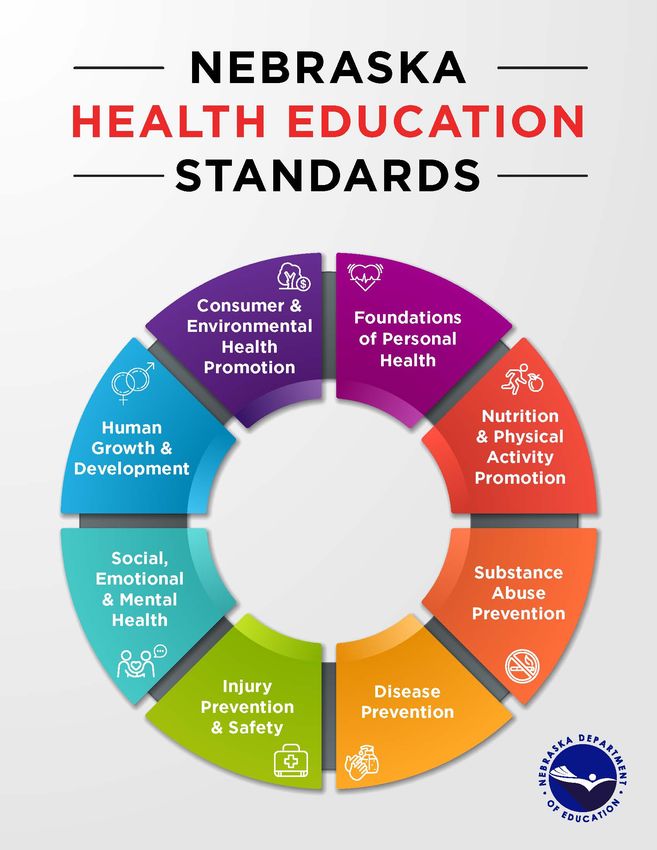
The Nebraska Health Education Standards identify eight content strands across
kindergarten through 12th grade. The eight content strands are as follows:
1. Foundations of Personal Health: Foundations of Personal Health assists students
with acquiring basic health concepts and functional knowledge and skills,
providing a foundation for promoting health-enhancing behaviors.
2. Nutrition & Physical Activity Promotion: The Nutrition & Physical Activity strand
D
promotes healthy lifestyle choices through knowledge and skills related to
properly fueling the body. Students learn the importance of movement and
dietary choices along with their effects on academics and overall health and
wellness.
3. Substance Abuse Prevention: The Substance Abuse Prevention strand provides
students with knowledge and skills to make healthy choices to avoid or reduce
their risk of substance use, misuse, and abuse.
3Draft #2: Updated 7/27/2021
4. Disease Prevention: The Disease Prevention strand promotes hygiene and safety
practices so that students learn and adopt behaviors to maintain and enhance
overall health and prevent and reduce the risk of diseases and conditions.
5. Injury Prevention & Safety: The Injury Prevention & Safety strand assists students in
understanding their role in protecting themselves and others from unintentional
danger, risk, or injury as well as recognizing and appropriately responding to
injuries or emergency situations.
6. Social, Emotional, & Mental Health: The Social, Emotional, & Mental Health strand
FT
helps students recognize the impact mental, emotional, and social wellness has
on one's overall health and the health of others.
7. Human Growth & Development: The Human Growth & Development strand
teaches students the structures and functions of human body systems and how
to recognize and manage the physical and psychological changes that occur
during development and maturation. Students learn the characteristics of
healthy relationships and develop knowledge and skills to promote body safety.
RA
8. Consumer & Environmental Health: The Consumer & Environmental Health strand
teaches students how to identify and access valid consumer products, services,
and resources for a healthy lifestyle as well as recognize how the setting around
them plays a role in overall wellbeing.
In addition to the content included in the Nebraska Health Education Standards, local
school districts/school systems should consider including sex education within health
education so students have the essential knowledge and critical skills needed to
decrease sexual risk behaviors. When determining how sex education is included in
health education programs, school districts/school systems should make decisions in
consultation with parents/guardians, local school boards, and community members,
along with teachers and school leaders. This will ensure that all stakeholders work
together and have a voice in the decision-making process and the content that is
D
delivered. Locally-determined content in sex education should be developmentally
appropriate and medically accurate. The content should be affirming and protective
in order to provide inclusive, equitable, and safe learning environments for every
student. The content should align with school, family, and community priorities and
include resources that create lines of communication between parents/guardians and
teachers so there is an understanding and knowledge of what content is being
delivered in the classroom.
4Draft #2: Updated 7/27/2021
STRAND 1: Foundations of Personal Health
Standard 1: Students will recognize the relationship between the physical, mental/emotional and social aspects of a healthy individual.
K 1 2 3 4 5 6 7 8 HS- Health 1 HS- Health 2
HE.K.1.1.a: HE.1.1.1.a: HE.2.1.1.a: HE.3.1.1.a: HE.4.1.1.a: HE.5.1.1.a: HE.6.1.1.a: HE.7.1.1.a: HE.8.1.1.a: HE.HS.1.1.a: HE.HS.2.1.a:
Explain the Identify how Identify healthy Describe how Define health Describe health Distinguish Describe how Connect Analyze the Analyze the
difference healthy behaviors healthy literacy and literacy and its between the lifestyles and healthy interrelationship interrelationship
between behaviors necessary for behaviors how it relates connection multiple habits impact lifestyles and s between the s between the
FT
healthy and affect personal the affect the to the with healthy dimensions of the multiple habits to be a dimensions of dimensions of
unhealthy health (e.g. development multiple dimensions of behaviors. health. dimensions of healthy health. health and
behaviors. brushing teeth, of the multiple dimensions of health. health. individual. their impact on
using crosswalk, dimensions of health. society.
physical health.
activity).
HE.1.1.1.b: HE.3.1.1.b: HE.4.1.1.b: HE.5.1.1.b: HE.6.1.1.b: HE.7.1.1.b: HE.8.1.1.b: HE.HS.1.1.b:
Identify the Define hygiene Identify Recognize how Analyze the Analyze the Analyze various Examine the
multiple and identify prevention prevention influence of physical, lifestyles and dimensions of
dimensions of ways to strategies strategies can media and emotional, habits and how health and the
health. practice proper related to the affect lifetime technology on mental, and they impact impact on
hygiene. dimensions of outcomes. personal and social the multiple society, family,
RA HE.3.1.1.c:
Explain the
importance of
practicing
proper
hygiene.
health.
HE.4.1.1.c:
Describe values
that promote
personal
health.
family health. importance
related to
proper hygiene
dimensions of
health.
school,
environmental
stressors and
social
determinants
on personal
health.
D
5Draft #2: Updated 7/27/2021
Standard 2: Students will exhibit knowledge for decision-making while analyzing the influences and potential outcomes of the decision.
K 1 2 3 4 5 6 7 8 HS- Health 1 HS- Health 2
HE.K.1.2.a: HE.1.1.2.a: HE.2.1.2.a: HE.3.1.2.a: HE.4.1.2.a:
HE.5.1.2.a: HE.6.1.2.a: HE.7.1.2.a: HE.8.1.2.a: HE.HS.1.2.a: HE.HS.2.2.a:
Identify Identify how Demonstrate Identify internal Provide Analyze a Examine Explain Apply the steps Apply the Demonstrate
parent/guardia family can help the steps of the and external examples of
variety of influences, influences that of the decision- decision- how to
n/trusted adults make healthy decision- factors that how a person’s
internal and personal impact making making process influence and
who can help decisions. making influence decisions can
external factors values, beliefs decision- process. in health- support others
make healthy process. decisions be positively or
that influence and perceived making (e.g. related when making
decisions. regarding negativelydecisions and norms and how peer pressure, situations. positive health-
FT
health (e.g. influenced by
behaviors (e.g. they relate to bullying, related
likes, friends, others, culture, family, health technology, choices.
family). including biases, values, behaviors. relationships,
peers. peers, media, etc.).
community
views).
HE.K.1.2.b: HE.1.1.2.b: HE.2.1.2.b: HE.3.1.2.b: HE.4.1.2.b: HE.5.1.2.b: HE.6.1.2.b: HE.8.1.2.b: HE.HS.1.2.b:
Identify how Explain how to Recognize Describe how Recognize Analyze the Predict the Evaluate Analyze how
the school can make a good, when help is choices can negative and credibility of positive and influences on peers influence
help make health-related needed in have positive positive peer health negative the decision- health-related
healthy decision and making a and negative pressure and its information, consequences making process behaviors.
decisions (e.g.
healthy food in
cafeteria, rules,
practices and
procedures).
HE.K.1.2.c:
Explain the
relationship
between a
decision and
an outcome.
RA
how all
decisions can
affect self or
others.
decision. consequences. influence on
HE.3.1.2.c:
Describe how
the media and
technology
can positively
and negatively
influence
decisions.
health
products, and
services and
promotion and how that can
risk reduction. impact one's
health-related
decisions.
HE.5.1.2.c:
Describe how
the positive
and negative
consequences
of a decision
can have short
and/or long-
of a decision.
HE.6.1.2.c:
Describe how
relevant
influences of
media and
technology
affect health-
related
(e.g. peer
pressure,
bullying,
technology,
relationships,
media, etc.).
HE.8.1.2.c:
Assess the
positive and
negative
impacts of a
decision.
HS.HS.1.2.c:
Identify
personal health-
related
decisions and
examine the
internal and
external
term effects. decisions and influences.
behaviors.
HE.5.1.2.d: HE.HS.1.2.d:
D
Demonstrate Justify when
strategies for individual or
resisting collaborative
negative peer decision-
pressure. making is
appropriate.
6Draft #2: Updated 7/27/2021
Standard 3: Students will focus on personal development and growth.
K 1 2 3 4 5 6 7 8 HS- Health 1 HS- Health 2
HE.K.1.3.a: HE.1.1.3.a: HE.2.1.3.a: HE.3.1.3.a: HE.4.1.3.a: HE.5.1.3.a: HE.6.1.3.a: HE.7.1.3.a: HE.8.1.3.a: HE.HS.1.3.a: HE.HS.2.3.a:
Demonstrate Describe Describe ways Identify Prioritize Identify the key Define SMART Explain the Formulate and Analyze the Work
effective personal health you are strategies for healthy components of goal and importance of critique health- role of cooperatively
communicatio goals and different and handling choices for self a goal (e.g. identify how each key related goals individual as an
n skills when determine who unique. pressure while being foreseeing SMART criteria component of using the key responsibility foradvocate for
expressing can assist in situations (e.g. influenced by obstacles, improve the a SMART goal. components of enhancing improving
FT
needs, wants, achieving taking a test, others. motivation, effectiveness of a SMART goal. personal personal,
and feelings. them. participating in and self- a goal. development family, and
a competitive confidence). and growth. community
activity). health.
HE.K.1.3.b: HE.2.1.3.b: HE.3.1.3.b: HE.4.1.3.b: HE.5.1.3.b: HE.6.1.3.b: HE.7.1.3.b: HE.8.1.3.b: HE.HS.1.3.b: HE.HS.2.3.b:
Define goals Discuss how to Describe Set a specific Demonstrate Implement Identify Analyze how Analyze how Analyze how
and explain handle tasks passive, and strategies to strategies to influences on influences time time
why setting and challenges aggressive, measurable reduce stress manage personal impact management management
goals is in a positive and assertive short-term, (e.g. talking to responsibilities development personal can contribute and scheduling
important. way (e.g. communicatio health-related a friend or and deadlines. and advocate development. to stress correlates with
refraining from n styles. goal and track parent/guardia for self. reduction and personal and
negative the progress. n/trusted adult, a healthier life. community
RA comments,
engaging in
positive self-
talk).
HE.3.1.3.c:
Respond
positively to
constructive
feedback.
HE.4.1.3.c:
Define positive
and negative
stress and
identify stressors
in oneself and
others.
considering
what led to
these feelings,
exercise).
HE.6.1.3.c:
Identify positive
and negative
results of stress
and
appropriate
ways of
dealing with
each.
HE.7.1.3.c:
Differentiate
between short-
and long-term
goals and
describe the
relationship
between them.
HE.8.1.3.c:
Utilize strategies
for persevering
through
challenges and
setbacks.
HE.HS.1.3.c:
Predict short-
term and long-
term benefits
and harmful
consequences
of behaviors
based on a
health
assessment
tool.
health.
HE.HS.2.3.c:
Select and
apply a health
skill to improve
personal and
community
safety and
health.
HE.3.1.3.d HE.4.1.3.d: HE.7.1.3.d: HE.8.1.3.d: HE.HS.1.3.d:
Create Identify Describe Apply Develop a plan
strategies to physical and common strategies to to attain a
D
manage emotional stressors and reduce stress. personal,
responsibilities reactions to how stress health-related
and deadlines. stress. effects one's goal that
health. addresses
strengths,
needs, and
risks.
7Draft #2: Updated 7/27/2021
HE.4.1.3.e: HE.7.1.3.e:
Discuss Practice
strategies to strategies for
manage dealing with
stressors. stress (e.g.
deep
breathing,
guided
visualization,
FT
exercise, time
management).
HE.7.1.3.f:
Describe how
time
management
might
contribute to
stress
reduction.
RA
D
8Draft #2: Updated 7/27/2021
STRAND 2: Nutrition & Physical Activity Promotion
Standard 1: Students will be able to make healthy food choices based on dietary recommendations.
K 1 2 3 4 5 6 7 8 HS- Health 1 HS- Health 2
HE.K.2.1.a: HE.1.2.1.a: HE.2.2.1.a: HE.3.2.1.a: HE.4.2.1.a: HE.5.2.1.a: HE.6.2.1.a: HE.7.2.1.a: HE.8.2.1.a: HE.HS.1.4.a: HE.HS.2.4.a:
Identify nutrient- Identify foods Classify various Identify and Associate Define a Identify the Compare and Explain the Evaluate the Develop meal
rich food from each food foods into the separate foods recommended calorie and basic nutrients contrast portion similarities and dietary plans for
choices. group. correct food that belong to food servings to describe how it and describe and serving differences recommendati various dietary
FT
groups multiple food the sizes of is used by the their functions sizes among protein, ons to recommendati
according to groups (e.g. common food body. (e.g. fat, recommended fats, and implement ons and various
dietary enchilada, items/ carbohydrates, for each stage carbohydrates healthy eating populations
recommendati pizza, Biryani, packages. protein, of regarding habits. (e.g. elderly,
ons. gumbo, vitamins, development. nutritional athletes,
Succotash, minerals and value and food chronic illness).
sandwich, water). sources.
lasagna).
HE.K.2.1.b: HE.1.2.1.b: HE.2.2.1.b: HE.3.2.1.b: HE.4.2.1.b: Set HE.5.2.1.b: HE.6.2.1.b: HE.7.2.1.b: HE.8.2.1.b: HE.HS.1.4.b:
Identify the Describe the Explain the Identify the a short-term Explore food Identify nutrient- Analyze Create a meal Evaluate the six
importance of health benefits importance of recommended goal to choose choices from rich foods nutritional plan using essential
eating of water, eating a servings for nutrient-rich different within each of information to recommended nutrients and
breakfast every
day.
HE.K.2.1.c:
Describe the
amount of
water someone
should drink in
a day.
other
RA
compared to
beverages.
HE.1.2.1.c:
Describe the
benefits of
eating nutrient-
rich snacks and
breakfast every
variety of foods
from all food
groups.
HE.2.2.1.c: Set
a goal to drink
the
recommended
amount of
water each
each food
group.
HE.3.2.1.c:
Identify what
food-borne
illness is.
foods for
snacks and
meals.
HE.4.2.1.c:
Differentiate
between
portion and
serving sizes.
cultures.
HE.5.2.1.c:
Identify
the basic food enhance food
groups and
selects
appropriate
servings for
ones age and
physical
activity levels.
HE.6.2.1.c:
Identify the
strategies that nutritional
can be used to value for
consume
recommended
choices.
HE.7.2.1.c:
Compare and
contrast the six
essential
various foods. nutrients and
their functions.
portion and
serving sizes.
HE.8.2.1.c: Set
a nutritional
goal and apply
nutritional
information to
monitor food
the impact on
individual
health.
HE.HS.1.4.c:
Compare and
contrast food
labels and
product
information.
day. day. servings of food choices.
to meet
individual
nutrient needs.
D
9Draft #2: Updated 7/27/2021
HE.1.2.1.d: HE.2.2.1.d: HE.3.2.1.d: HE.4.2.1.d: HE.5.2.1.d: HE.6.2.1.d: HE.7.2.1.d: HE.8.2.1.d:
Recognize that Demonstrate Explain the Identify food Create a daily Summarize the Develop Identify foods
family and making nutrient- benefits of with labels and menu, benefits of strategies for and beverages
culture rich snack eating fruits, locate key including eating the balancing that contain
influence food choices at vegetables, nutrition items. beverages, dietary healthy food, each of the six
choices. school and at and whole using current recommendati snacks and essential
home. grains. dietary ons of fruits, water intake, nutrients.
guidelines. vegetables along with
and water physical
FT
intake. activity.
HE.3.2.1.e: HE.4.2.1.e: HE.5.2.1.e: HE.6.2.1.e: HE.7.2.1.e: HE.8.2.1.e:
Discuss how Identify foods Illustrate how to Explain the Explain the Compare and
family, friends, that are grown keep food safe importance of relationship contrast facts
and media and produced through proper eating a between versus myths
influence food in Nebraska. food nutrient-rich access to regarding
choices. preparation breakfast every healthy foods nutrition
and storage. day. and personal practices and
food choices. products.
HE.4.2.1.f: HE.5.2.1.f: Set HE.6.2.1.f: HE.8.2.1.f:
Describe safe a goal to limit Analyze how Explain why the
RA food handling
and
preparation
practices.
HE.4.2.1.g:
Practice asking
family
members for
nutrient-rich
food options.
foods and
beverages high
in added
sugars, fat, and
sodium.
advertising and
marketing
techniques
used for food
and beverages
affect choices.
recommended
amount of food
a person needs
each day may
be different for
each food
group.
HE.8.2.1.g:
Explain how to
select healthy
foods when
dining out.
HE.8.2.1.h:
Summarize the
benefits of
limiting the
D
consumption of
fat, added
sugar, and
sodium.
10Draft #2: Updated 7/27/2021
Standard 2: Students will exhibit the knowledge to achieve and maintain a health enhancing level of physical fitness.
K 1 2 3 4 5 6 7 8 HS- Health 1 HS- Health 2
HE.K.2.2.a: HE.1.2.2.a: HE.2.2.2.a: HE.3.2.2.a: HE.4.2.2.a: HE.5.2.2.a: HE.6.2.2.a: HE.7.2.2.a: HE.8.2.2.a: HE.HS.1.5.a: HE.HS.2.5.a:
Recognize how Identify Identify Describe the Identify the Describe and Identify ways to Demonstrate Compare and Analyze the Develop an
being examples of physical concept of components of demonstrate strengthen how to find contrast amount and exercise
physically physical activities that fitness and health-related the skill-related each skill- and resting heart physical types of program with
active helps a activities that provide self- provide fitness (e.g. components of health-related rate and activities based physical safety and
person stay are personally expression and examples of cardiovascular fitness. component of calculate on the activity effectiveness
healthy. enjoyable. promotes physical endurance, fitness. target heart contributions to recommended for a specific
FT
confidence. activities to muscular rate while skill and health for teenagers outcome or
enhance endurance, being related fitness. overall health population
fitness. flexibility, body physically and for the (e.g. weight
composition, active. maintenance gain, loss or
muscular of healthy body athletes,
strength) and weight. elderly,
example disabilities).
activities of
each
HE.K.2.2.b: HE.1.2.2.b: HE.2.2.2.b: HE.3.2.2.b: HE.4.2.2.b: HE.5.2.2.b: HE.6.2.2.b: HE.7.2.2.b: HE.8.2.2.b: HE.HS.1.5.b: HE.HS.2.5.b:
Identify Identify the State the Explain the Identify the Develop a Define resting Set, monitor, Analyze and Develop an Evaluate the
examples of heart as a purpose of a importance of benefits of personal plan heart rate and and assess adjust effort to exercise community
active play
opportunities
outside of
physical
education. RA
muscle that
grows stronger
with exercise,
active play,
and physical
activity.
warm-up and
cool-down
when
performing
physical
activities.
HE.2.2.2.c:
Identify ways to
meet national
physical
activity
guidelines of 60
minutes per
warm-up and
cool-down for
vigorous
physical
activity.
HE.3.2.2.c:
Discuss the
importance of
the muscular
system on
movement.
living an active
lifestyle through
lifetime
activities.
HE.4.2.2.c:
Describe the
elements of a
physical
activity plan
(e.g. warm-up,
activity, cool-
to be physically
active.
HE.5.2.2.c:
Track progress
towards
achieving a
personal
physical
activity goal.
target heart
rate and its
relationship to
physical fitness.
HE.6.2.2.c: Set
and monitor a
self-selected
fitness goal
using different
types of
physical
progress
toward a self-
selected fitness
goal using
different types
of physical
activity.
HE.7.2.2.c:
Identify barriers
related to
maintaining a
physically
active lifestyle
and seeks
maintain target
heart rate
during various
types of
physical
activity.
HE.8.2.2.c:
Design and
implement a
fitness program
to maintain
and enhance
current physical
program with
safety and
effectiveness
for a specific
outcome.
and school
environments
for safe and
effective
physical
activity
opportunities.
day. down). activity. solutions for fitness levels.
eliminating
those barriers.
D
11Draft #2: Updated 7/27/2021
HE.2.2.2.d: Set HE.3.2.2.d: HE.5.2.2.d: HE.6.2.2.d: HE.7.2.2.d: HE.8.2.2.d:
a goal to be Explain the Discuss the role Identify each Explain the Participate in a
physically influence of weight or of the relationship variety of self-
active at least family, friends, resistance components of between self- selected
60 minutes and media training prior to the overload expression and activities with
each day. have on puberty. principles lifelong moderate to
physical (Frequency, enjoyment vigorous
activity. Intensity, Time, through intensity for a
Type {FITT}) for physical minimum of 60
FT
different types activity. minutes a day.
of physical
activity.
HE.6.2.2.e: HE.7.2.2.e: HE.8.2.2.e:
Describe the Design a warm- Identify
difference up/cool-down technical
between regimen using resistance
aerobic and dynamic and progressions
anaerobic static stretches and determine
capacity. for a self- corrections that
selected are necessary
physical for injury
RA HE.6.2.2.f:
Discuss the
importance of
proper
technique
while
performing
muscular
strength
exercises.
activity. prevention and
health
promotion.
D
12Draft #2: Updated 7/27/2021
Standard 3: Students will recognize the effects of nutritional and physical activity choices on overall health.
K 1 2 3 4 5 6 7 8 HS- Health 1 HS- Health 2
HE.K.2.3.a: HE.1.2.3.a: HE.2.2.3.a: HE.3.2.3.a: HE.4.2.3.a: HE.5.2.3.a: HE.6.2.3.a: HE.7.2.3.a: HE.8.2.3.a: HE.HS.1.6.a: HE.HS.2.6.a:
State how food Describe the Recognize the Explain how Discuss the Analyze the Define caloric Compare and Evaluate Describe the Evaluate the
gives us energy benefits of impact of physical importance of impact of food intake and contrast how personal food relationship effects of
and helps us being nutrition on activity, water hydration for choices for expenditure. food choices choices and between poor dietary
grow. physically physical and food physical physical can affect the effect on eating habits or supplement
active (e.g. activity. intake can activity. activity, youth physical physical lack of physical use, popular
FT
academics, affect a sports, and activity and activity and activity on fad diets and
social person’s health. personal performance. performance. chronic weight loss
interactions, health. diseases such products have
mental as heart on the
wellbeing, disease, community.
physical obesity,
wellbeing). cancer,
diabetes,
hypertension
and
osteoporosis.
HE.2.2.3.b: HE.3.2.3.b: HE.4.2.3.b: HE.5.2.3.b: HE.6.2.3.b: HE.7.2.3.b: HE.8.2.3.b: HE.HS.1.6.b:
Discuss how Identify foods Describe the Describe the Summarize how Identify how to Demonstrate Explore
RA physical
activity can
make one feel
better.
that are
beneficial
before and
after physical
activity.
HE.3.2.3.c:
Define nutrients
and their role
relationships
between food
intake, physical
activity, sleep,
water and
health.
HE.4.2.3.c:
Discuss the
relationship of
social benefits
gained from
participating in
physical
activity.
HE.5.2.3.c:
Identify the role
of physical
physical
activity level
affects
nutritional
needs as well
as how food
choices can
affect physical
activity and
performance.
HE.6.2.3.c:
Identify
different types
balance
caloric intake
and
expenditure.
HE.7.2.3.c:
Compare and
contrast
how to
balance
caloric intake
and
expenditure
through
nutritional and
physical
activity
choices.
HE.8.2.3.c:
Describes the
relationship
advertising
claims and
potential
health
consequences
for dietary
supplements,
popular fad
diets and
weight loss
products.
HE.HS.1.6.c:
Classify the
effects of
within the movement on activity and of physical physical between poor eating
body. the healthy eating activities and activity levels nutrition and disorders and
cardiovascular in prevention of describe how and the effects health risk research
D
and respiratory chronic each positively on nutritional factors. resources for
systems. disease. impacts health needs. seeking help
(e.g. physical, (e.g. anorexia,
mental, bulimia,
emotional, obesity).
social).
13Draft #2: Updated 7/27/2021
HE.3.2.3.d: HE.6.2.3.d: HE.7.2.3.d: HE.8.2.3.d: HE.HS.1.6.d:
Identify Recognize the Define Explain various Identify how
strategies for importance of disordered nutritional chronic
taking personal a healthy body eating and habits to conditions
responsibility for image and eating evaluate the affect food
eating healthy develop disorders. impact on choices,
foods and appropriate overall health calorie needs
being food and (e.g. eating and nutrient
physically exercise disorders, diets, needs.
FT
active. behaviors. cultural).
HE.6.2.3.e: HE.8.2.3.e:
Explain the Evaluate how
relationship physical
between the activity levels
intake of impact all
nutrients and dimensions of
metabolism. health.
HE.8.2.3.f:
Describe the
warning signs,
RA symptoms, and
consequences
of common
eating
disorders.
HE.8.2.3.g:
Locate valid
and reliable
school and
community
resources for
help and
support with
eating
disorders.
HE.8.2.3.h:
Describe the
D
relationship
between
chronic
diseases and
an individual's
nutrition and
physical
activity level.
14Draft #2: Updated 7/27/2021
STRAND 3: Substance Abuse Prevention
Standard 1: Students will understand the differences between harmful and helpful use of substances.
K 1 2 3 4 5 6 7 8 HS- Health 1 HS- Health 2
HE.K.3.1.a: HE.1.3.1.a: HE.2.3.1.a: HE.3.3.1.a: HE.4.3.1.a: HE.5.3.1.a: HE.6.3.1.a: HE.7.3.1.a: HE.8.3.1.a: HE.HS.1.7.a: HE.HS.2.7.a:
Discuss that Explain why Describe how Discuss with a Identify Explain why Summarize the Describe the Analyze the Evaluate the Demonstrate
medications only taking to use parent/guardia different types household difference progression of progression of use and how to talk with
should only be medications medications n/trusted adult of substances products are between use, substance use, substance use, potential risks a healthcare
FT
taken under under the care correctly while rules for safe (e.g. caffeine, harmful if misuse, and misuse, and misuse, and of prescription provider about
the care of a of a under the use of tobacco, intentionally abuse of a abuse and the abuse. medications, prescription
parent/guardia parent/guardia supervision of a medicines and alcohol, absorbed or substance. potential risks over-the- options,
n/trusted adult. n/trusted adult parent/guardia household medication, inhaled (e.g. associated with counter (OTC) effectiveness,
is important. n/trusted adult products. legal and bath salts, each. medications side effects,
(e.g. use illegal drugs, aerosols). and herbal or and
according to inhalants, some dietary interactions of
the label, use household supplements on medication.
only when products). health.
necessary).
HE.2.3.1.b: HE.4.3.1.b: HE.5.3.1.b: HE.6.3.1.b: HE.7.3.1.b: HE.8.3.1.b: HE.HS.1.7.b: HE.HS.2.7.b:
Identify a Describe ways Describe Evaluate when Categorize Examine the Analyze Evaluate the
RA variety of
tobacco
products.
that over the
counter and
prescription
medication
can be helpful
when used
properly or
harmful when
misused.
potential risks
associated with
inappropriate
use of over-the-
counter and
prescription
medicines.
a drug or
medication
can be helpful.
different
substances and
their effects on
overall health
(e.g. opioids,
cannabinoids,
alcohol,
amphetamines,
steroids).
different
categories of
substances
(e.g. opioids,
cannabinoids,
alcohol,
amphetamines,
steroids).
potential risks
associated with
inappropriate
use of
medicines and
drug
interactions.
impact of laws
relating to
prescription
and over-the-
counter drug
misuse and the
use of alcohol,
tobacco, and
other
substances.
D
15Draft #2: Updated 7/27/2021
HE.4.3.1.c: HE.6.3.1.c: HE.7.3.1.c: HE.8.3.1.c: HE.HS.1.7.c:
Compare and Access valid Examine the Distinguish Identify how
contrast the and reliable safe use and between prescription
difference information potential risks proper use and medications,
between about a variety of prescription abuse of over- over-the-
helpful and of substances. medications, the-counter counter (OTC)
harmful over-the- (OTC) and medications,
substances counter (OTC) prescription and herbal or
(e.g. caffeine, medications medicines. dietary
FT
tobacco, and herbal or supplements
alcohol, dietary are more
medication, supplements. addictive than
illegal drugs, others.
inhalants, some
household
products).
HE.4.3.1.d: HE.HS.1.7.d:
Access valid Distinguish
and reliable between the
sources of different
accurate categories of
RA information
about
tobacco,
alcohol and
medications.
HE.4.3.1.e:
Identify
products that
contain
alcohol.
prescription
and over-the-
counter
medications
and when you
would use
them.
D
16Draft #2: Updated 7/27/2021
Standard 2: Students will recognize positive and negative influences and effects of substance use, misuse and abuse.
K 1 2 3 4 5 6 7 8 HS- Health 1 HS- Health 2
NOT TAUGHT AT HE.1.3.2.a: HE.2.3.2.a: HE.3.3.2.a: HE.4.3.2.a: HE.5.3.2.a: HE.6.3.2.a: HE.7.3.2.a: HE.8.3.2.a: HE.HS.1.8.a: HE.HS.2.8.a:
THIS GRADE Demonstrate Demonstrate Identify family, Analyze Explain why it Identify positive Distinguish Evaluate Practice Analyze the
LEVEL an effective school and possible can be hard to and negative between the personal methods to financial,
understanding refusal skills community reasons why stop using influences of potential short- influences of resist peer political, social,
of rules for when offered rules about individuals harmful substance use, term and long- substance use, pressure with and legal
proper medicine or substance use. choose to use substances. misuse, and term effects of misuse, and regards to influences on
handling of other drugs by or not use abuse. substance use. abuse. alcohol, the use of
FT
medicines and someone other alcohol, tobacco, and alcohol,
household than a tobacco or other tobacco, and
products. parent/guardia other drugs substances, other drugs.
n/trusted adult (e.g. family, including the
(e.g. firmly external misuse of
saying no and influences, prescription
walking away). stress, anxiety, drugs.
depression).
. HE.3.3.2.b: HE.4.3.2.b: HE.5.3.2.b: HE.6.3.2.b: HE.7.3.2.b: HE.8.3.2.b: HE.HS.1.8.b: HE.HS.2.8.b:
Explain how Explain how Practice ways Identify the Apply Analyze the Predict how a Locate and
culture, family, decisions to resist potential strategies to effects of drug-free evaluate
RA peers and
media can
influence
decisions
related to
alcohol,
tobacco and
other drug use.
HE.3.3.2.c:
Demonstrate
effective
refusal skills,
about
substance use,
misuse and
abuse could
impact
relationships
with friends
and family.
HE.4.3.2.c:
Identify valid
and reliable
information
negative peer
pressure and
positively
influence
others to be
alcohol-,
tobacco- and
other drug-free.
HE.5.3.2.c:
Analyze various
strategies used
in the media
effects of
substance use.
HE.6.3.2.c:
Demonstrate
strategies to
resist the use of
resist the use of
substances that
prevent misuse
and abuse.
HE.7.3.2.c:
Examine the
reasons why
people choose
substance use
and misuse on
self, family,
peers, and
society.
HE.8.3.2.c:
Describe
situations that
could lead to
lifestyle will
support
achievement
of short- and
long- term
goals.
HE.HS.1.8.c:
Analyze the
role of family,
community,
community or
regional
resources
available to
support
individuals
impacted by
substance
abuse and
addiction.
HE.HS.2.8.c:
Examine the
influence of
culture and
including about the that substances that to use or not the use of and cultural society on
verbal and non- benefits of not encourage or can lead to use alcohol, alcohol and norms in substance use,
verbal ways to using alcohol, discourage misuse and tobacco and other drugs. deciding to use misuse and
refuse alcohol, tobacco or alcohol- and abuse. other drugs. alcohol, abuse in
D
tobacco and other drugs. tobacco- use. tobacco, and school, sports,
other drugs. other drugs. or
entertainment.
17Draft #2: Updated 7/27/2021
HE.3.3.2.d: HE.4.3.2.f: HE.5.3.2.d: HE.6.3.2.d: HE.7.3.2.d: HE.8.3.2.d: HE.HS.1.8.d: HE.HS.2.8.d:
Encourage Describe the Identify Identify healthy Define Compare and Analyze media Educate others
peers to be impact of using misinformation alternatives to addiction and contrast how and marketing about the
alcohol and substances and and alcohol, understand the media/marketi tactics used to dangers of
tobacco free. how that they manipulation tobacco, need for ng tactics promote substance use,
can be techniques nicotine, and professional positively or substance use. misuse and
addictive (e.g. used within other harmful intervention. negatively abuse.
tobacco, marketing substances influence
alcohol, tactics (e.g. physical substance use
FT
medications, regarding activity, and/or misuse.
caffeine). substance use. healthy eating,
reading,
recreation).
HE.5.3.2.e: HE.7.3.2.e: HE.8.3.2.e: HE.HS.1.8.e: HE.HS.2.8.e:
Demonstrate Analyze Demonstrate Clarify myths Advocate for
strategies a influences on strategies to regarding the self and others
person could personal resist peer scope of about the
use to leave an choices to use pressure with alcohol, dangers of
uncomfortable or not use regards to tobacco, and substance use,
situation tobacco, substance use other drug use misuse and
RA related to
alcohol-,
tobacco- and
other drug-use.
alcohol and
other drugs.
or misuse. among
adolescents.
abuse.
HE.HS.2.8.f
Analyze the
influence of
alcohol and
other drug use
on personal,
family, and
community
safety.
D
18Draft #2: Updated 7/27/2021
Standard 3: Students will identify health risks associated with substance use, misuse and abuse in relation to one's physical, mental/emotional and social
health.
K 1 2 3 4 5 6 7 8 HS- Health 1 HS- Health 2
NOT TAUGHT AT HE.1.3.3.a: HE.2.3.3.a: HE.3.3.3.a: HE.4.3.3.a: HE.5.3.3.a: HE.6.3.3.a: HE.7.3.3.a: HE.8.3.3.a: HE.HS.1.9.a: HE.HS.2.9.a:
THIS GRADE Identify the Describe the Describe the Examine the Describe the Explain the Summarize the Make a pledge Investigate Analyze how
LEVEL harmful effects short and long short and long affects to the benefits of short and long negative to be alcohol-, consequences addiction and
of tobacco term effects of term effects of brain, body abstaining from term physical, consequences tobacco- and of alcohol, dependency
smoke (first and experimenting experimenting and lungs or mental, social, of using drug-free. tobacco, and impact
FT
second hand with and/or with and/or when oxygen is discontinuing financial, and alcohol, other drug use individuals,
smoke). using tobacco, using alcohol, limited through substance use emotional tobacco and (e.g. physical, families, and
including including inhaling or misuse. effects of other drugs. mental and society.
addiction. addiction. substances substance use. emotional,
(e.g. smoking, social, legal,
vaping, financial,
inhalants, addiction).
candy).
HE.2.3.3.b: HE.3.3.3.b: HE.4.3.3.b: HE.5.3.3.b: HE.6.3.3.b: HE.7.3.3.b: HE.8.3.3.b: HE.HS.1.9.b: HE.HS.2.9.b:
Demonstrate Describe the Examine the Explain Explain how the Compare and Describe the Identify and Research the
strategies to impact of using affects to the addiction and development contrast health risks recognize the legal
avoid exposure alcohol, brain and body recovery. of the frontal potential short between warning signs consequences
RA to secondhand
smoke.
including that it
changes how a
person feels,
thinks, and
acts.
when harmful
substances are
ingested (e.g.
household
products,
medications,
alcohol, illicit
drugs).
HE.4.3.3.c:
Explain how
choosing to
refuse alcohol,
tobacco and
other
HE.5.3.3.c:
Discuss vaping
and identify
the health
hazards
associated with
lobe impacts
decision-
making and
how substance
use affects
development.
HE.6.3.3.c:
Locate school
policies and
community
laws about
alcohol,
and long term
consequences
of substance
use on all
dimensions of
health.
HE.7.3.3.c:
Evaluate how
the use of
substances can
cause illness,
injury and
substance use
and misuse.
HE.8.3.3.c:
Apply refusal
skills to
minimize
exposure
and/or
of addiction.
HE.HS.1.9.c:
Summarize the
consequences
of alcohol,
tobacco, and
other drug use
of driving under
the influence of
alcohol and
other
substances.
HE.HS.2.9.c:
Interpret school
policies and
community
laws related to
alcohol,
substances are e-cigarette tobacco and complications influences to during tobacco, and
related to (nicotine and other drug use. with growth substance use. pregnancy. illegal drug use,
accomplishing cannabinoid) and possession, and
D
personal goals. use. development. sale.
19Draft #2: Updated 7/27/2021
HE.6.3.3.d: HE.7.3.3.d: HE.8.3.3.d: HE.HS.1.9.d: HE.HS.2.9.d:
Summarize the Describe the Describe the Locate Analyze the
short and long health risks of health risks of community validity and
term effects of using weight using resources reliability of
marijuana use. loss drugs. performance- available for resources and
enhancing treatment of services
drugs. substance use, available for
misuse and substance use,
abuse. misuse and
FT
abuse as well
as prevention.
HE.7.3.3.e: HE.8.3.3.e: HE.HS.1.9.e: HE.HS.2.9.e:
Encourage Summarize the Analyze the Create
others to be relationship relationship awareness of
tobacco-, between between using substance use,
alcohol- and intravenous alcohol and misuse and
drug-free. drug use and other drugs as abuse using
transmission of well as other valid and
blood-borne health risks reliable
diseases, such (e.g. community
as HIV and unintentional resources.
RA hepatitis. injuries,
violence,
suicide, sexual
activity, and
tobacco use).
D
20Draft #2: Updated 7/27/2021
STRAND 4: Disease Prevention
Standard 1: Students will recognize what a disease is and how it is spread or acquired.
K 1 2 3 4 5 6 7 8 HS- Health 1 HS- Health 2
HE.K.4.1.a: HE.1.2.1.a HE.2.4.1.a: HE.3.4.1.a: HE.4.4.1.a: HE.5.4.1.a: HE.6.4.1.a: HE.7.4.1.a: HE.8.4.1.a: HE.HS.1.10.a: HE.HS.2.10.a:
State examples Define Describe how Explain the Define and Discuss Examine Differentiate Compare and Compare and Compare and
of a healthy diseases. health difference identify the pathogens pathogens and between contrast contrast the contrast how
(well) and behaviors between function of the (germs) and the diseases communicable communicable signs, infection can
FT
unhealthy (ill) affect the communicable immune system common types they cause. and non- , non- symptoms, and spread globally
person. spreading or (infectious) and list ways to of pathogens. communicable communicable risk factors of (pandemic)
acquiring of diseases and keep the diseases (e.g. , acute and communicable and locally
diseases. non- immune system STDs, STIs, HIV, chronic diseases. (epidemic).
communicable strong. influenza, heart diseases.
(non-infectious) disease,
diseases. cancer,
diabetes).
HE.K.4.1.b: HE.1.4.1.b: HE.2.4.1.b: HE.3.4.1.b: HE.4.4.1.b: HE.5.4.1.b: HE.6.4.1.b: HE.7.4.1.b: HE.8.4.1.b: HE.HS.1.10.b: HE.HS.2.10.b:
Explain that Classify Recognize that Identify Describe when Describe how Identify how Identify blood Research how Analyze how Utilize tools in
germs can diseases into 2 bacteria and common it is important family history, diseases affect borne health genetics and Public Health to
make one sick. categories: viruses are childhood to seek health genetics, the body pathogens and disparities and family diseases mitigate or
HE.K.4.1.c:
Identify ways
germs are
spread from
one person to
another (e.g.
RA
“can spread”
and “cannot
spread”.
types of germs. chronic
diseases or
conditions (e.g.
asthma,
allergies,
diabetes, and
epilepsy).
HE.3.4.1.c:
Describe
symptoms that
occur when a
person is sick.
care treatment
of
communicable
(infectious) and
non-
communicable
(non-infectious)
diseases.
HE.4.4.1.c:
Identify the
most common
symptoms of an
communicable
(infectious)
lifestyle
choices,
pathogens and
preventive
health care
can affect
health.
HE.5.4.1.c:
Locate valid
and reliable
information
about common
chronic health
systems.
HE.6.4.1.c:
Examine the
factors that
affect how
diseases are
spread or
methods to
prevent
disease
transmission.
HE.7.4.1.c:
Explain the
behavioral and
environmental
factors that
contribute to
environment
can increase or
decrease risk of
acquiring
disease.
can impact
your personal
health.
HE.HS.1.10.c:
Compare and
contrast
different types
of pathogens
and explain
significantly
reduce
transmission.
HE.HS.2.10.c:
Research how
historical public
health crisis
had been
approached
contact with disease (e.g. conditions ( acquired (e.g. some common how they are and determine
eyes, nose, fever, chills, e.g. asthma, genetics, family chronic different. whether or not
mouth, skin, congestion, diabetes, history, lifestyle diseases. those
D
breathing, fatigue, muscle allergies, choices, approaches
blood). aches and anaphylaxis, environment). were effective
headache). seizures). in controlling
the emerging
health threat.
21Draft #2: Updated 7/27/2021
HE.HS.1.10.d:
Assess how the
body defends
itself against
pathogens and
disease.
HE.HS.1.10.e:
Analyze
FT
treatment
options for
bacterial, viral,
fungal and
parasitic
infections.
HE.HS.1.10.f:
Analyze how
Sexually
Transmitted
Infections
spread and
RA affect the
body.
HE.HS.1.10.g:
Examine the
causes and
progression of
non-
communicable
diseases and
their treatment.
D
22Draft #2: Updated 7/27/2021
Standard 2: Students will identify ways to protect from and reduce the risk of diseases and conditions.
K 1 2 3 4 5 6 7 8 HS- Health 1 HS- Health 2
HE.K.4.2.a: HE.1.4.2.a: HE.2.4.2.a: HE.3.4.2.a: HE.4.4.2.a: HE.5.4.2.a: HE.6.4.2.a: HE.7.4.2.a: HE.8.4.2.a: HE.HS.1.11.a: HE.HS.2.11.a:
State the Describe when Describe ways Explain how Demonstrate Name Research how Associate how Analyze Hypothesize Locate and
importance of one should to prevent common how to locate alternatives to body systems risk factors and personal health how lifestyle appraise valid
hand washing, wash their communicable childhood sources of valid unhealthy work together health risk factors and choices can and reliable
coughing and hands. (infectious) and illnesses are and reliable behaviors that to reduce behaviors work health impact chronic health
sneezing non- treated (e.g. information for may cause and/or prevent together to behaviors and disease. information to
etiquette to communicable medication, disease disease. diseases and reduce and/or their support the risk
FT
prevent the (non-infectious) rest, staying prevention. conditions. prevent association reduction of
spread of diseases. home, diseases and with preventing disease
germs. hydration, seek conditions. diseases and transmission.
medical conditions.
attention).
HE.K.4.2.b: HE.1.4.2.b: HE.2.4.2.b: HE.3.4.2.b: HE.4.4.2.b: HE.5.4.2.b: HE.6.4.2.b: HE.7.4.2.b: HE.8.4.2.b: HE.HS.1.11.b: HE.HS.2.11.b:
Demonstrate Explain why State reasons Demonstrate Apply practices Describe how Assess situations Summarize how Demonstrate Analyze the Formulate ways
how to properly proper hygiene why people skills throughout and behaviors health to determine health how to access influences that to present valid
wash one's is important to visit a the day to that reduce or disparities and when it is behaviors valid and impact your and reliable
hands stay healthy healthcare reduce the prevent risk factors necessary to prevent the reliable health personal health health
(e.g. oral, provider (e.g. spread of common affect disease seek medical spread of information, with regard to information to
HE.K.4.2.c:
Demonstrate
how to properly
cover one's
cough or
RA
washing body,
clean clothes).
HE.1.4.2.c:
Demonstrate
how to properly
brush and floss
one’s teeth.
dentist, doctor,
counselor, eye
doctor).
HE.2.4.2.c:
Make a pledge
to effectively
wash hands
when
germs.
HE.3.4.2.c:
Articulate the
importance of
seeking help
and treatment
childhood
illnesses or
conditions.
HE.4.4.2.c:
Locate
professional
health services
in the
prevention
(e.g. physical
activity,
genetics,
heredity,
lifestyle
choices).
HE.5.4.2.c:
Discuss how
social
determinants
and health
advice and/or
health care.
HE.6.4.2.c:
Examine how
social
determinants
and health
communicable
diseases.
HE.7.4.2.c:
Set a personal
goal and
monitor
progress to
products and
services
regarding
diseases and
conditions.
HE.8.4.2.c:
Correlate how
health
disparities and
other factors
disease
prevention.
HE.HS.1.11.c:
Analyze the
different ways
that
communicable
engage a
community in
health
behaviors that
prevent
sickness and
promote
health.
HE.HS.2.11.c:
Analyze school
wellness
policies to see
if they promote
sneeze. appropriate for common community. disparities can disparities can prevent or increase or diseases health and
and cover communicable impact health. impact health. reduce one's decrease risk spread to prevent
one's cough or (infectious) and risk of disease for diseases others. disease.
sneeze. communicable transmission. and conditions
D
(non-infectious) (e.g. genetics,
diseases. lifestyle
choices).
23Draft #2: Updated 7/27/2021
HE.1.4.2.d: HE.2.4.2.d: HE.3.4.2.d: HE.4.4.2.d: HE.7.4.2.d: HE.8.4.2.d: HE.HS.1.11.d: HE.HS.2.11.d:
Set a goal to Cite the role of Summarize the Explain how Describe the Define Connect the Deconstruct
brush one’s physical benefits of family, culture, relationship standard various stages social
teeth twice a activity and personal health peers or media between precautions in of infection determinants of
day. healthy eating care practices can influence disease regards to and how they health and
in prevention of for disease personal health prevention and body fluids. correlate with health
chronic prevention and wellness- quality of life. immune disparities
disease. (e.g. tooth related response. within one's
brushing and decisions (e.g. community.
FT
flossing, skin vaccinations,
care and holistic healing,
bathing natural/herbal
regularly). treatments,
spirituality).
HE.1.4.2.e: HE.2.4.2.e: Seek HE.3.4.2.e: HE.8.4.2.e: HE.HS.1.11.e: HE.HS.2.11.e:
Recognize the help from a Identify Interpret how Evaluate Evaluate STD
importance of parent/guardia procedures to to avoid, personal habits and STI
never touching n/trusted adult follow when manage and that promote prevention
another when not encountering report situations resistance to tools, testing,
person's blood feeling well. another involving infection (e.g. healthcare
or other bodily person's blood exposure to sleep patterns, rights, and
RA
fluids. or other bodily
fluids.
HE.3.4.2.f:
Demonstrate
ways people
can avoid
coming in
contact with
another
person's blood
and bodily
fluids.
another
person's blood
and other
bodily fluids.
nutrition,
exercise).
HE.HS.1.11.f:
Identify and
compile
resources for
testing and
treatment of
Sexually
Transmitted
Infections (STI)
and Sexually
responsibilities.
Transmitted
Diseases (STD).
D
24Draft #2: Updated 7/27/2021
STRAND 5: Injury Prevention & Safety
Standard 1: Students will recognize and respond to an injury or emergency situation.
K 1 2 3 4 5 6 7 8 HS- Health 1 HS- Health 2
HE.K.5.1.a: HE.1.5.1.a: HE.2.5.1.a: HE.3.5.1.a: HE.4.5.1.a: HE.5.5.1.a: HE.6.5.1.a: HE.7.5.1.a: HE.8.5.1.a: HE.HS.1.12.a: HE.HS.2.12.a:
Describe a Demonstrate Explain Describe Describe the Demonstrate Assess the Explain climate- Differentiate Analyze the Examine ways
trusted adult ways to ask a protective situations that signs and how to obtain severity of an related between life- signs and to offer
and the parent/guardia factors to use could lead to symptoms of or offer injury or physical threatening symptoms of assistance to
FT
characteristics n/trusted adult when unsafe risks that someone who assistance to emergency conditions that and non-life various injuries, injury or
that make for help when approached cause injuries. is seriously ill or others in and respond affect personal threatening illnesses, and emergency
them trusted an emergency personally or on injured and harmful appropriately. safety (e.g. injuries and the emergencies to situations in the
and safe. or injury occurs. the internet by needs situations. heat appropriate be able to community.
strangers. immediate exhaustion, response. respond
medical heat stroke, accordingly.
attention. sunburn and
hypothermia).
HE.K.5.1.b: HE.1.5.1.b: HE.2.5.1.b: HE.3.5.1.b: HE.4.5.1.b: HE.5.5.1.b: HE.6.5.1.b: HE.7.5.1.b: HE.8.5.1.b: HE.HS.1.12.b:
Identify fire Demonstrate Differentiate Locate fire exits Explain and Identify Locate Interpret Develop an Speculate and
exits and how the procedure between and practice strategies a emergency emergency emergency deduce the
to safely for calling 911 situations when demonstrate procedures to person could preparedness preparedness preparedness appropriate
evacuate a
building in
multiple
situations.
RA
and when it is
appropriate to
do so.
an injury or
emergency
situation can
be handled
individually or
when
assistance is
needed from
an adult.
how to safely
evacuate a
building in
multiple
situations.
follow in case
of emergency
which may
include fire,
lockdown,
lockout,
evacuate, and
shelter-in-place
for school,
home and
community
settings.
use to call
attention to or
leave an
uncomfortable
or dangerous
situation,
including
harassment.
plans for
school.
plans for home,
school, and
community.
plan for home
and
community
(e.g.
tornadoes, fires,
storms, injuries,
accidents,
poisonings,
travel).
health service
required in
injury or
emergency
situations for
oneself or
others.
D
25Draft #2: Updated 7/27/2021
HE.K.5.1.c: HE.1.5.1.c: HE.2.5.1.c: HE.3.5.1.c: HE.4.5.1.c: HE.6.5.1.c: HE.8.5.1.c: HE.HS.1.12.c:
Demonstrate Demonstrate Demonstrate Locate the Explain the Examine the Demonstrate Demonstrate
safe practices appropriate how to safest places to importance of signs and basic first aid the proper
in regards to responses to communicate take cover telling an adult symptoms of and emergency
school safety injury and/or proper when seeking if someone is in someone who cardiopulmona care and
procedures emergency information shelter (e.g. danger. is in danger of ry resuscitation lifesaving
with a trusted situations (e.g. with a 911 tornado, hurting (CPR). procedures
adult. tornadoes, operator in an earthquake, themselves or using universal
lightening, fire, emergency lockout, others. precautions in
FT
accident, situation. lockdown). various injuries
poisoning, and
medical emergencies
emergency, (e.g. CPR, AED,
bug bites or first aid, and
stings). control of
bleeding.
HE.K.5.1.d: HE.2.5.1.d: HE.3.5.1.d: HE.8.5.1.d: HE.HS.1.12.d:
Identify injuries State when to Demonstrate Demonstrate Interpret when
and/or evacuate a how one how to help or a natural
emergency building and should react to contact the disaster could
situations (e.g. when to seek an injury or appropriate occur and how
tornadoes,
lightening, fire,
accident,
poisoning,
medical
emergency,
bug bites or
stings).
RA shelter at
home, school,
and in the
community.
emergency
and promptly
report to a
parent/guardia
n/trusted adult
or emergency
service.
emergency
resources for
different
situations (e.g.
first aid, CPR,
poison control,
911, mental
health crisis
line, animal
control, non-
emergency
line).
to respond for
personal safety.
D
26You can also read


