ECFC FAMILY HANDBOOK 2021-2022 - Quincy Public Schools
←
→
Page content transcription
If your browser does not render page correctly, please read the page content below

Page 1 of 33

ECFC FAMILY HANDBOOK
       2021-2022
Page 2 of 33

                                Table of Contents
Welcome, Vision & Mission Statements        3   Transitional Kindergarten Health Req.                19
Student Entrance Documentation Requirements 5   Illness                                              20
Staff Listing                               6   Attendance                                           20
School Day Schedules                        9   Security                                             21
Head Start Description                      9   Visits to School                                     21
Pre-School for All Description              9   Child Abuse/Neglect Reporting                        22
Early Childhood Special Education          10   Emergency Drills                                     23
Transitional Kindergarten Description      10   QPS Emergency Guide for Parents                      23
Curriculum                                 10   School Emergency Procedures                          23
Social & Emotional Learning Systems        12        • Cut-out reference cards for parents           26
Student Dress                              14   Developmental Screening Program                      27
Book Bags                                  14   Erin’s Law                                           27
Outdoor Play                               15   Transportation                                       28
School Day Cancellation/Early Dismissal    15   Family Education/Engagement                          29
Suggested Treats for Students              16   Family Support Services                              29
Party Invitations                          16   Policy Council                                       30
Phone Calls                                16   Helping Hands Day                                    30
Pets/Animals at School                     16   Parent Meetings/Workshops                            30
Confidentiality                            17   Parenting Classes                                    31
Meals at School                            17   Americans with Disabilities Act                      31
Recess/Playground                          17   Use of Medical Marijuana                             32
Parking/Student Drop-off & Pick-up         17
ECFC Health Requirements                   18
Page 3 of 33

  EARLY CHILDHOOD & FAMILY CENTER
                                        401 South 8th
                                      Quincy, IL 62301
                                       (217)228-7121
                                         www.qps.org

                 Quincy Public Schools Mission Statement:
                    EDUCATE STUDENTS AND TEACHERS TO
                            ACHIEVE PERSONAL
                               EXCELLENCE

                                            QPS VISION:
The Quincy Public School District is committed to creating a culture of excellence in education for college and
career readiness by
    • Engaging student to achieve personal excellence;
    • Building professional knowledge and excellent teaching practices through collaboration;
    • Utilizing curriculum aligned to the state standards;
    • Establishing high expectations and improving student growth; and
    • Developing active partnerships with parents and the community.

      Early Childhood & Family Center Mission Statement:
Quincy Early Childhood & Family Center is committed to creating a safe and welcoming
environment by providing developmentally appropriate experiences that promote a love for
learning while supporting and empowering students and families.
Page 4 of 33

                                WELCOME!
Dear ECFC Explorers Families,

On behalf of the staff of Early Childhood & Family Center, we welcome you to the 2021-2022 school year. The
program strives to ensure that each child will experience success each day. Our commitment is to excellence
and a positive experience for both children and their families.

We are very excited about the partnership that we have entered with you on behalf of your child. Our
program will provide opportunities for your child to enter a world of exploration through concrete learning
experiences. We know that the young child learns through play and our classrooms are designed to motivate
your child’s learning process each day. Families are an important part of our program and we encourage your
participation at the school through volunteering, observing, attending parent activities, and monthly meetings.

We look forward to an exciting year and working with you to ensure a positive educational experience for your
child.

Sincerely,

Sara Cramer
Director - Early Childhood & Family Center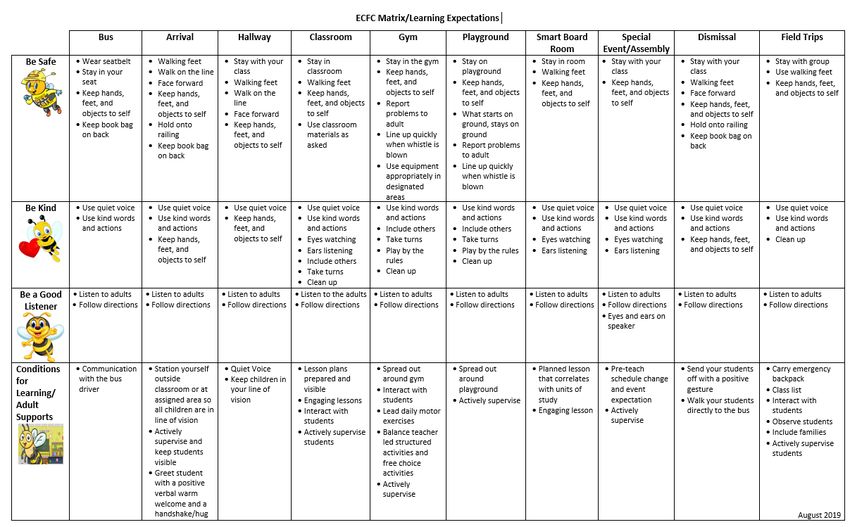
Page 5 of 33
Page 6 of 33

                           ECFC Staff 2021 – 2022

Pre-K for All Staff
Ms. Cindy Awerkamp – Teacher           Ms. Jennifer Leach – Teacher
Ms. Wanda Amador - Paraeducator        Ms. Theresa Edwards – Paraeducator
                                       Ms. Katie Huseman– Paraeducator

Ms. Jolie Lilly – Teacher              Ms. Kay Tate – Teacher
Ms. Amanda Schuering – Paraeducator    Ms. Lynne Ohnemus – Paraeducator

Ms. Amy Willimann – Teacher
Ms. Tammy Davis – Paraeducator

Head Start Staff
Ms. Catherine Bruening – Teacher      Ms. Cathy Heany – Teacher
Ms. LeAnna Johnson-Paraeducator       Ms. Cindy Carter – Paraeducator

Ms. Tami Redd – Teacher               Ms. LeighAnn Reno – Teacher
Ms. Jennifer Martin – Paraeducator    Ms. Kim Schaffer – Paraeducator
Ms. Kelly Obert – Paraeducator

Ms. Theresa Owens – Teacher           Ms. Cathy Howerter – Teacher
Ms. Donna Bichsel – Paraeducator      Ms. Lynne Hummel – Paraeducator

Ms. Dena Knipe – Teacher              – Teacher
Ms. Toni Timbrook – Paraeducator      Ms. Taelor Sheets

Mr. Christopher Sikorski – Teacher    Ms. Alexa Riutzel – Teacher
Ms. Jewel Chatten– Paraeducator       Ms. Lisa Genenbacher – Paraeducator
Ms. Beth Hammer – Paraeducator        Ms. Amber Venvertloh -Paraeducator

Ms. Beth Schutte – Teacher            Ms. Sierra Silas – Teacher
Ms. Chris Miller – Paraeducator       Ms. Stephanie Beswick – Paraeducator

Ms. Kim Stratman – Teacher            Ms. Kim Triplett – Teacher
Ms. Kim Brown – Paraeducator          Ms. Alex Coleman – Paraeducator
                                      Ms. Carissa Wedding – Paraeducator
Page 7 of 33 Special Education Staff Ms. Dee Friye – Teacher Ms. Crystal Johnson – Teacher Ms. Kathy Kerker – Paraeducator Ms. Carrie Smith – Paraeducator Ms. Rachel Peterson– Paraeducator Ms. Jennifer Gosnell – Paraeducator Ms. Kris Thomas – Paraeducator Ms. Shelbie Redd – Paraeducator Ms. Susie Saathoff Transitional Kindergarten Staff Ms. Dee Fleming – Teacher Mrs. Laura Slaughter – Teacher Ms. Crystal Heming– Paraeducator Mrs. Cheryl Meyer – Paraeducator Ms. Keri Bergman– TK Coordinator, PE, Music, Library, & Fine Arts Teacher, Interventionist, and TK Family Support Specialist Occupational & Physical Therapists Ms. Diana Bradley Ms. Jamie Mixer Ms. Robyn Sprenger Ms. Deb Talcott Ms. Janelle Wathen Speech & Language Therapist Ms. Elaina Cowick Ms. Teresa Douglas Ms. Beth Hayes Ms. Nicole Holtschlag Ms. Jennifer Seckman Social Worker & School Phycologist Ms. Kathleen Carter – Social Worker Ms. Abbie John – Psychologist Family Support Specialists Mr. Brad Bergman – FSS Coordinator Ms. Janie Reed Ms. Sherri Foley Ms. Kathy Sibbing Ms. Melissa Jansen Ms. Dana Caspermeyer Ms. Nancy Sapp Cafeteria Staff Ms. Mick Druffel Ms. Sue Frericks – Café Coordinator Ms. Kim Pickle Ms. Peggy Rowsey Ms. Cathy Sprague Ms. Linda Wellman
Page 8 of 33

Custodial Staff
Mr. Jerry Hanlin – Day Custodian         Mr. Nathan Calvert – Evening Custodian
Mr. Ron Lowe – Evening Custodian

Nursing Staff
Ms. Cyndi Ott                             Ms. Dawn Ufkes

Secretarial Staff
Ms. Julie Giese – Administrative Asst.   Ms. Sueanne Spencer– Office Secretary

Ms. Carrie Trowbridge – Office
Secretary

Security Staff
Mr. Steve Cullo                           Mr. Brian Test

Support Staff
Mr. Glenn Hogge – Enrollment              Ms. Denise Moore – Special Education
Coordinator                               Coordinator

Mr. Scott Moore – Building Manager        Ms. Sharadan Parks – Community
                                          Resource Coordinator

Ms. Katie Hoffman– Instructional Coach    Tracy Uplinger – Resource Room Para
Page 9 of 33
School Day
Head Start 4 Day Program (Monday-Thursday) Pre-K 5 Day Program (Monday-Friday)
Morning Session - 8:30 A.M. – 11:25 A.M. Morning Session - 8:30 A.M. – 11:00 A.M.
Afternoon Session -12:15 P.M. – 3:15 P.M. Afternoon Session - 12:45 P.M. – 3:15 P.M.
All day session – 8:30 A.M.-3:15 P.M. Transitional Kindergarten – 8:30 A.M. – 3:15 P.M.
• If you transport your child to school, please wait in the lobby until bus arrival times: 8:20 A.M., 12:10
P.M., & 12:35 P.M. Staff will be unavailable prior to arrival time. Children can never be left
unattended.
• If you choose to pick up your child from school you will need to do so at the following times: 10:45
AM for Pre-K morning sessions, 11:10 AM for Head Start Morning sessions, and 3:00 PM for all
afternoon and All-Day sessions. Should you not pick up your child from school, at these times your child
will be put on the bus. Changes in arrangements must be made fifteen minutes prior to dismissal time
or your child will be put on the bus.
PROGRAM
Early Childhood & Family Center is a collaboration of four programs: Head Start, Preschool for All (PreK), Early
Childhood Special Education, and Transitional Kindergarten.
HEAD START
Head Start is a federally funded program for children turning three or four years of age by September 1st of
each year. The overall goal of the Head Start program is to bring about more social competence in children of
low-income families. There are four major components in the Head Start program: education, health, parent
involvement, and social services. The educational component is designed to meet each child’s individual
needs. It also aims to meet the needs of the community served and its ethnic and cultural characteristics.
Head Start arranges for every child to receive comprehensive health care, including medical, dental, mental
health and nutrition services as needed. Parents are the most important influence on a child’s development.
An essential part of every Head Start program is the involvement of parents in parent education, program
planning, and operating activities. The social services component of Head Start represents an organized
method of assisting families to assess their needs and then providing those services that will build upon the
individual strengths of families to meet their own needs.
PRESCHOOL FOR ALL (PreK)
Pre-Kindergarten is a state funded program for children turning three or four years of age by September 1st of
each year. 3- year old students are eligible to attend Preschool for All, however the program will give 4- year
old students priority. The program meets young children at their developmental level, which allows each child
the opportunity for success and positive self-esteem. The aim of the program is to provide a developmentally
appropriate curriculum in the areas of physical, emotional, social, creative, cognitive, and language skills. This
is done through an integrated approach. Parents are the child’s first teacher. Therefore, parent involvement is
an important component of Pre-Kindergarten. Parents are encouraged to assist in the child’s classroom, onPage 10 of 33
field trips, and in any area that will benefit the children and their families. The program also offers health and
social services to provide a well-rounded educational program for children and their families.
EARLY CHILDHOOD SPECIAL EDUCATION
Early Childhood Special Education (ECSE) is a program established by federal law to serve the special needs of
children ages three through five. Once a child is found eligible, an Individualized Education Plan(IEP) is
developed by a team comprised of parents, teachers, and others involved with the child. The IEP addresses
the areas in which a child is experiencing delays by establishing long range goals and short-term objectives.
The ECSE staff plans programming based on the individual needs of the students in the class. A typical day
provides children with experiences in listening activities, structured play, fine and gross motor activities, and a
wide range of learning and language experiences. A very important part of the child’s education and
development occurs through the direct involvement of parents. Parents are encouraged to volunteer in the
classroom, participate in school activities, and attend all meetings. Parent involvement includes teachers
visiting homes and parents visiting school!
Note: Special Education Related Service Log - Illinois School Code (105 ILCS 5/14-8.02f)
(d) Local education agencies must make logs that record the delivery of related services administered under
the child's individualized education program and the minutes of each type of related service that has been
administered available to the child's parent or guardian at any time upon request of the child's parent or
guardian. For purposes of this subsection (d), related services for which a log must be made are: speech and
language services, occupational therapy services, physical therapy services, school social work services, school
counseling services, school psychology services, and school nursing services. The local education agency must
inform the child's parent or guardian within 20 school days from the beginning of the school year or upon
establishment of an individualized education program of his or her ability to request those related service logs.
TRANSITIONAL KINDERGARTEN
Transitional Kindergarten is a program which enables students to receive a year of intervention services to
help them secure their readiness skills for kindergarten. Teachers emphasize a curriculum which blends
preschool and kindergarten and is based on starting from where each student is functioning. Students attend
all day 5 days a week, having a school day that is based on the kindergarten day.
CURRICULUM/CLASSROOM
The philosophy behind our curriculum is that young children learn best by doing. Since young children learn
and retain by concrete experience, the “hands-on” approach to learning is essential. Learning is not just
repeating what someone else says; it requires active thinking and experimenting to find out how things work
and to learn firsthand about the world we live in. One of the most important educational goals of our
program is to help children become enthusiastic learners. This means encouraging children to be active and
creative explorers who are not afraid to try out their ideas and to think their own thoughts. We encourage
our children to become independent, self-confident, inquisitive learners. We’re teaching them how to learn
and helping them develop good habits and attitudes, particularly a positive sense of themselves, which will
make a difference throughout their lives.Page 11 of 33
Our Early Childhood curriculum is the Creative Curriculum, a research-based curriculum which addresses all
areas of Early Childhood development:
Personal and Social: fostering a healthy self-concept, developing self-control, approaching learning
with eagerness and curiosity, interacting easily with others, and using words to solve conflicts.
Language and Literacy: developing listening and speaking skills, encouraging a love of books and
reading related activities, encouraging written communication through drawing and pretend writing.
Mathematical thinking: promoting an interest in numbers and counting, recognizing patterns and
relationships, awareness of shapes and spatial relations, able to sort and put objects in order,
experience measurement activities and begins to construct a sense of time.
Scientific thinking: using senses to explore, encouraging curiosity to seek answers and draw
conclusions.
Social Studies: awareness of own characteristics, understanding of family and jobs that people do,
awareness of rules and leadership, sensitivity to people and their environment.
The Arts: using a variety of materials to express self, participating in music and creative dramatics,
appreciating the work of others.
Physical: developing balance and control to perform simple tasks, developing eye-hand coordination to
perform a variety of small motor skills, gain independence for self-care tasks, awareness of basic health
and safety.
Our teachers use a portfolio and progress report to document your child’s growth and development.
Information collected in these portfolios and the progress report will be shared with parents during two
scheduled home or center visits, one in November – December and the other in April - May.
Transitional Kindergarten staff is dedicated to offering children a well-balanced educational program that
covers the basics as well as other differentiated experiences. Language Arts (reading, writing, spelling,
language, speaking, and listening), Mathematics, Science, and Social Studies are basic subjects. In addition,
Physical Education, Music, Art, and Social Emotional learning are provided. We also expose students to
Environmental Education, Health, and current events. Field trips, use of community speakers, and audio-
visual aids along with educational games help make learning interesting and motivating. Technology is used as
needed to enhance each student’s education. Progress reporting will occur in October and February with a
parent teacher conference. Teachers will use a standards-based report card to share how your child is
progressing. The standards-based report card will be sent home following each quarter as outlined by QPS.
Our staff works to identify children who may benefit from special services. These services may include:
speech, language, physical and occupational therapy, vision and hearing services, and services for
developmental delays. The activities we plan for children, the way we organize the environment, select toys
and materials, plan the daily schedule and talk with children, are all designed to accomplish the goals of our
curriculum and give your individual child a successful school experience.Page 12 of 33
A CHILD’S PLAY HAS GREAT VALUE
Every part of a child’s life is interwoven with play. This is the nature of a child. On the surface, children’s play
looks simple. In fact, play touches on every aspect of development and learning. In play, children are free to
master new knowledge at their own rate and in their own way. It is the process that we value, not the child’s
end result. While children play they practice new cognitive, social, emotional, language, and physical skills.
Play is active. It is a form of learning that unites the mind and the body.
SOCIAL & EMOTIONAL LEARNING (SEL)/BEHAVIOR MANAGEMENT
Our classrooms provide an environment that is accepting and which encourages appropriate behavior in
children. Our primary goal is to teach children ways to get along with others. One way of doing this is to let
the children know what is expected of them by explaining behavior expectations, as well as modeling those
expectation. Children need to learn how to make good choices to develop responsibility and that there are
consequences to their actions. They learn to interact with other children, to listen to adults, to use toys and
materials appropriately, and to clean up after themselves.
These techniques are all a part of our ECFC Social & Emotional Learning Systems framework. This framework
is a continuum of supports and services designed to build social competence and prevent challenging
behaviors for young children. It has an emphasis on school-wide systems of support that include proactive
strategies for defining, teaching, and supporting appropriate student behaviors to create positive school
environments. Instead of using a piecemeal approach of individual behavioral management plans, a
continuum of positive behavior support for all students within a school is implemented in areas including the
classroom and non-classroom settings (such as hallways, buses, and restrooms). The following School Wide
Behavior Expectations Matrix specifically lays out the expectations we have for our students and staff
members. Copies of this matrix can also be found in your child’s classroom and throughout our building.Page 13 of 33
Page 14 of 33

All of our classrooms at ECFC also utilize the Second Step Social-Emotional Early Learning curriculum to enrich
the skills taught through our ECFC SEL Framework. Second Step SEL for Early Learning helps your youngest
learners benefit more from preschool and prepare for kindergarten. They’ll learn skills to help them pay
attention, remember directions, and begin to regulate their feelings and behavior. More information can be
found at secondstep.org or by contacting your child’s teacher.

Teaching Life Skills is a strong part of our school discipline process. This program systematically teaches those
positive behaviors, which encourage good social interactions. All of our staff work hard to build relationships
with students to ensure that we are able to effectively partner with them in that process. Some mildly
disruptive behaviors are age appropriate and expected. Simple redirection and re-teaching of our behavior
expectations is often quite effective in reducing disruptions. Examples of some consequences designed as
additional tools used to help a child who would benefit from some support are:
    • Loss of privileges
    • Moving seats
    • Natural Consequences (i.e.: student is throwing blocks-student may have to find another activity)
    • Conference with Student
Any disruptive behavior that needs more support will also include staff partnering with the student’s family.

We encourage all parents to participate in workshops and/or parenting classes teaching CONCIOUS DISCIPLINE
principles. See your Family Support Specialist for more details.

In that the Quincy Public Schools requires a safe and secure environment, any act, comment, remark, or
statement by a student either verbal, nonverbal, or written which could in any way be interpreted as a threat
to the safety of any person shall subject that student to disciplinary action. This includes all acts, comments,
statements, or remarks.

                                                     DRESS

Children should be dressed in comfortable clothes and shoes for active play. Please do not allow your child to
wear open back shoes such as sandals. TENNIS SHOES ARE BEST FOR SAFETY AND EASE IN MOTOR ACTIVITIES.
Each day, children will be involved in messy activities (such as finger painting, easel painting and water play)
and should be dressed accordingly. All children are required to leave an extra set of clothes at school (shirt,
pants, socks, and underwear).

                                                 BOOKBAGS

Each child should bring a bookbag to school every day. Bookbags should be large enough to carry notes,
school work, clothes, etc… Bookbags on wheels are unsafe for young children and are not allowed at school.

Children should not bring toys to school. We have many toys and materials for the children to use during the
school day. Any toy that could be considered weapon-like (toy guns, toy knives, etc.) will be kept until the
parent can pick it up.
Page 15 of 33
OUTSIDE PLAY
Children will play outside whenever it is possible. This is good for physical development, healthy living habits,
and to help establish lifelong habits of physical exercise. Our policy for outside play is for the children to go
outside as follows:
• 30° to 90° --- outside play, when dressed appropriately and conditions permit
• 15° to 30° --- outside play for short period, when conditions permit
• below 15° --- no outside play
• above 90° --- outside play limited or not allowed, depending on conditions
Parents should dress their children appropriate for the weather:
• Jackets for cool weather and heavier coats as temperatures get colder
• Hats and gloves/mittens in cold weather
• Lighter clothes in warmer temperatures
SCHOOL CANCELLATION AND EARLY DISMISSAL
In case of questionable weather, listen to any of the local commercial radio or TV stations listed below for
school closing information. Quincy Public Schools/ECFC will also send a Skylert message to the primary
number that you have listed in Skyward, as well as post a School Wide Announcement on SeeSaw and our
social media outlets. Please make sure you keep the school up to date with correct phone numbers and
address changes, so we can communicate effectively with you. This should be broadcast no later than 6:00
a.m. for the morning session or as soon as available for the afternoon session. If school is dismissed early
there will be no afternoon session.
KGRC (FM) 92.9 WGEM (AM) 1440
WTAD (AM) 930 KHMO (AM) 1070
WGEM (FM) 105 WGEM (TV) CH 10 (Cable 13)
WGCA (FM) 88.5 KHQA (TV) CH 7 (Cable 12)Page 16 of 33
SUGGESTED TREATS FOR ECFC STUDENTS
According to school policy, we are unable to accept homemade treats. Unfortunately, homemade treats have
the potential for harboring food borne illnesses or other contaminants. Therefore, we have developed a list of
suggestions for treats:
Fruit Roll-Ups Pudding or Jell-O Cups
Frozen Yogurt Packaged muffins
Regular Yogurt, especially with fruit Trail Mix
Pretzels Teddy Grahams
Cheese Crackers Bagels
Fish Crackers Granola Bars
Vanilla Wafers or Chocolate Wafers Fig Newtons
Angel Food Cake Fresh Vegetables, with dip
Nutri-Grain Bars Fresh Fruit
Nutritious treats help children create healthy eating habits. Since research shows that children eat too many
sweets and high calorie foods, we want to emphasize snacks which benefit the mind and body. We welcome
prepackaged snacks. However, please check with your child’s teacher before bringing in snacks. Teachers will
be able to communicate if they have any allergies in their room.
PARTY INVITATIONS
Party Invitations may be sent to school if all students in the class are invited. A list of students’ names is
available upon request. Invitations will be placed in each child’s bookbag. Due to federal law, we are unable
to share addresses and phone numbers.
PHONE CALLS
We do not interrupt instructional time with phone calls while students are in class. However, our secretaries
would be happy to take a message for you or you may send a message directly to your child’s teacher on the
SeeSaw Family app for them to call you after students have left their classroom. If you have an emergency,
the secretaries will help you.
PETS/BRINGING ANIMALS TO SCHOOL
Bringing pets/animals to school for show and tell is not permitted at this time. Many students have allergies
which could be affected by animals. Safety of students is also a concern when pets/animals are brought into
the school. Service animals will continue to be welcome. Please contact ECFC Director to make arrangements
for service animals.Page 17 of 33
CONFIDENTIALITY
All information about your child and family is strictly confidential and will not be shared with anyone not
directly involved with your child without your written consent. Only authorized Early Childhood & Family
Center personnel can review the files. Parents also have a right to review the files. Please contact the
Director if you wish to review your child’s file.
BREAKFAST/LUNCH
Transitional Kindergarten and Head Start All-Day students will receive breakfast, lunch, and a snack each day.
Head Start four-day students will receive breakfast/lunch in the AM and lunch/snack in the PM. PreK five-day
classes will receive breakfast in the AM and Lunch in the PM. The meals follow the nutritional guidelines set by
the U.S. Department of Agriculture for the National School lunch and breakfast program. If you are concerned
about meal time at ECFC, please contact Director, Sara Cramer.
Meals are free for all students attending ECFC.
RECESS/PLAYGROUND
Transitional Kindergarten students will have two recesses each day. Recesses are approximately 20 minutes in
length. Students are always under the supervision of staff when on the playground. The adults assigned to the
playground have the authority to enforce all student rules. Students will be expected to play safely and follow
the rules. Children should be dressed appropriately for all types of weather since we will be going out
whenever possible!
Notes to “Stay In” for Recess
The only time a student should stay inside at recess is if he or she has a note from the doctor.
PARKING/DROP-OFF/PICK-UP
PARKING - Posted Handicap Parking is available in the alley along the south side of the building. Other parking
is available in the Pear Tree Villa parking lot and on Kentucky street. There is limited parking on the east side
of the building in the parking lot.
DROP-OFF & PICK-UP – The designated area for picking up and dropping off students is the 8th Street
entrance, along the yellow curbed area. Pull all the way forward closest to Kentucky Street, allowing room for
others to park. It is important that we do not block the driving path in the alley, block State Street Bank
driveways, or park behind cars blocking them in.
*Please remember all areas around ECFC are designated school zones. Please drive slower than 15 miles per
hour and stay alert to families coming and going with their children.Page 18 of 33
Early Childhood & Family Center Health Requirements 2021-2022
PHYSICAL EXAMINATION: Required components of the health examination include: health history with parent
signature, diabetes screening, lead risk assessment or testing, and complete physical examination.
Children must receive a physical examination:
Prior to first entrance in Early Childhood & Family Cneter AND yearly while enrolled in ECFC.
The examinations must be completed by a MD, DO, Nurse Practitioner, or Physician’s Assistant and must be recorded on an
Illinois School Physical form. Physicals of transfer students may be accepted on another form if the information is
comparable to that required on the Illinois form and if the physical has been completed within the last year. The IHSA Pre-
participation Examination (sports physical) form is not acceptable as the school physical. THE LAW REQUIRES US TO
EXCLUDE ALL STUDENTS WHO DO NOT MEET THIS HEALTH EXAMINATION REQUIREMENT BY OCTOBER 15TH OF
THE SCHOOL YEAR. (77 Ill. Adm. Code 665)
IMMUNIZATION REQUIREMENTS: All students must present proof of having received immunizations in accordance with
the law and the rules and regulations of the Illinois Department of Public Health. Proof of immunization must be
presented to school authorities by the child’s parent or legal guardian prior to or upon entrance to the school. THE LAW
REQUIRES US TO EXCLUDE ALL STUDENTS WHO DO NOT MEET THE IMMUNIZATION REQUIREMENTS. (77 Ill. Adm. Code
665)
IMMUNIZATION REQUIREMENTS FOR PRE-K AND HEADSTART
DTP/DTaP: 4 or more doses Measles: 1 dose on/after the 1st Birthday
Polio: 3 or more doses Mumps: 1 dose on/after the 1st Birthday
Varicella (Chickenpox): 1 dose on/after 1st Birthday Rubella: 1 dose on/after the 1st Birthday
Pneumococcal: Primary series Hib: Primary series or 1 dose after 15 months of age
Hepatitis B: 3 doses (3rd dose on/after 6 months of age)
SCREENING FOR LEAD POISONING: is required to have been done at least once between the ages of six months and six
years of age. Children who have attended state approved licensed day care centers or preschools, including school district
programs, have already been screened as a requirement to attend. Screening for lead poisoning for children six years of
age and older will be at the discretion of the child’s health care provider. Lead poisoning screening is available from your
doctor and can be done at the time of the physical examination. This screening is not available at the Adams County Health
Department. THIS IS A REQUIREMENT OF THE LEAD POISONING PREVENTION ACT (410 ILCS 450) AND PUBLIC ACT
093-0104.
DENTAL EXAMINATIONS: Children must receive a dental examination: Prior to first entrance in Early Childhood
Program.
The examination must be completed by a licensed dentist and recorded on the State Dental Form. Dental examinations
that have been completed after November 15, 2020, will be accepted for the 2021-2022 school year. Please make an
appointment with your family dentist. The Adams County Dental Clinic is also available to families who meet eligibility
requirements. Contact the Adams County Dental Clinic for further information @ 223-5611 (Hours – Tuesday through
Friday 7:00am – 5:00 P.M.) (77 Ill. Adm. Code 665-410)
MEDICAL HISTORY: At the time of registration, the parent or legal guardian will be asked to complete pertinent medical
history information on the electronic registration form named “Other Health Information”. Additional information may be
required dependent on the medical history.Page 19 of 33
Transitional Kindergarten Health Requirements 2021-2022
The following requirements are according to the most recent Illinois Department of
Public Health (IDPH) and Illinois State Board of Education (ISBE) guidelines.
REQUIRED:
Physical Examination: A physical dated anytime on or after August 15, 2020, will be accepted. The exam must
be completed by a MD, DO, Nurse Practitioner, or Physician’s Assistant, must be recorded on the State of Illinois
Certificate of Child Health Examination form, and a parent must complete and sign the Health History section of
the physical for it to be accepted by the State of Illinois.
Lead Screening Documentation: Screening for lead poisoning is required to have been done at least once between
the ages of 6 months and 6 years of age. Lead poisoning screening is available from your doctor or at the
Adams County Health Department during Immunization Clinic Hours.
Immunizations: Required immunizations for kindergarten are:
Diphtheria, Tetanus, Pertussis: 4 or more doses with the last dose received on/after 4th birthday.
Polio: 4 or more doses of IPV with the last dose received on/after 4th birthday.
Measles: 2 doses - 1st dose must be on/after the 1st birthday; 2nd dose at least 28 days after the first.
Rubella: 2 doses - 1st dose must be on/after the 1st birthday; 2nd dose at least 28 days after the first.
Mumps: 2 doses - 1st dose must be on/after the 1st birthday; 2nd dose at least 28 days after the first.
Varicella (Chickenpox): 2 doses – 1st dose must be on/after the 1st birthday and the 2nd dose at least
28 days after the first.
Immunizations are available at your physician’s office at the time of the physical or at the Adams County Health
Department during immunization clinic hours – Monday through Friday, 8am -noon and 1pm – 4pm. Clinic
hours are subject to change.
Dental Examination: The exam must be completed by a licensed dentist and recorded on the State of Illinois Proof
of School Dental Examination form. Dental exams that have been completed after November 15, 2020, will be
accepted for the 2021-2022 school year.
Eye Examination: The exam must be completed by a licensed optometrist or medical doctor who performs eye
examinations and recorded on the State of Illinois Eye Examination Report form. Eye exams dated anytime on
or after August 15, 2020, will be accepted for the 2021-22 school year.
Physical & Dental Exams are required prior to the first day of school. ALL children require an annual physical & dental
exam to attend school. You can bring them with you at the time screening, registration or turn them into the school nurse.
YOUR CHILD WILL NOT BE ABLE TO ATTEND SCHOOL WITHOUT COMPLETED PHYSICAL & DENTAL EXAMS
The State of Illinois requires schools to have a copy of each child’s Certified Birth Certificate from the State & County
the child was born in. (This is not the certificate provided by the hospital).
Please supply your child’s Certified Birth Certificate prior to the start of school or at registration.Page 20 of 33
MEDICAL HISTORY
At the time of registration, the parent or legal guardian will be asked to complete pertinent
medical history information on the electronic registration form named “Other Health
Information”. Additional information may be required dependent on the medical history.
ILLNESS
Children should be kept home from school when they have any of the following:
1. Fever. A child must be fever free without the aid of fever reducing medication
for 24 hours before returning to school.
2. Vomiting within the last 24 hours.
3. Diarrhea within the last 24 hours.
4. Sore throat accompanied by white spots in the back of the throat.
5. Rash.
6. Communicable/contagious disease (chicken pox, strep throat, suspected or
confirmed COVID-19 or influenza).
A doctor’s note may be required to return to school.
PLEASE REMEMBER, NURSING STAFF IS ONSITE DAILY AND ARE HERE TO
ASSIST YOU. PLEASE FEEL FREE TO CONTACT THEM!
ATTENDANCE
Student attendance is very important in our programs, as it is in elementary and secondary
school. Attendance is recorded daily. The school must be notified by the parent/guardian
each day a child is absent or tardy. It is important for your child to be on time! If you have
not called the school by 9:00 am or 12:45 pm on the day your child is absent, school
personnel will contact you. Excessive absences or chronic tardiness will require a meeting
with school administration and could jeopardize the student’s placement in the program.
Truancy: Truancy is defined as being absent without valid cause for a school day or a
portion of a day or when a parent/guardian fails to notify the school of an absence. 4
tardies is also equal to 1 unexcused absence or truancy.
Chronic Truancy: Chronic or habitual truancy shall be defined as a student who is absent
without cause from attendance for 5% or more = 9 regular attendance days.
ECFC’s goal is to have all students in school daily. It is important that children be at school
daily as learning occurs that cannot occur when the child is home. Please let us know if you
need help or support with you child attending school daily.Page 21 of 33
SECURITY
Your child’s safety is a priority of the district. To ensure the safety of all students and staff
the following procedures are in place:
• All visitors are required to sign in and out with Security at our main entrance (8th
Street).
• All visitors are required to walk through a metal detector.
• All bags will be searched.
• Two security guards are on duty during school hours.
• All doors are kept locked.
• Handicapped accessibility is located at the main, Kentucky St. and alley entrances.
• Proper ID is required of any person picking up a child. Please notify the school if
anyone other than a parent or guardian is picking up a child.
Visits to School
Visitors to school are encouraged. Parents are encouraged to visit school and observe their
children in the classrooms. Visiting classes and seeing your child working with the group
helps you understand the school program better. It also helps your child feel that you are
sincerely interested in him/her and the work he/she is doing. It will be helpful if parents
schedule any classroom visitation with the teacher in advance. We do not allow “young”
friends or relatives of students to spend the day at school.
All visitors, including parents and siblings, are required to enter through the main entrance
with the security guard. Quincy Public Schools has implemented the Raptor Visitor
Management System. The Raptor system enhances the safety of our student(s) and staff, as
it provides us with the ability to:
1) compare each visitor to a national database of sex offenders,
2) provide other safety alerts,
3) and keep an accurate log of visitors in each school.
With this in place, no known, convicted sex offenders can enter your student’s school,
except as allowed by law. Other alerts include Orders of Protection. When entered into the
system, security guards can help to ensure that the school keeps parties separated as the
court order demands. Or, if you want to inform us about someone who is not authorized to
pick up your child, we can set an alert to warn the security guard. Finally, knowing who is in
the school and where they are located is important for each visitor’s own safety. For
instance, in the event of an evacuation, we would be better able to locate everyone and
help them to safety because we would know they were present and where to find them.Page 22 of 33
The Raptor system requires a valid state-issued, photo identification to enter each school
building. This is only required for your first visit to an individual building. Once entered into
that building’s system, you only need to provide your name to the guard on subsequent
visits.
The initial scanning only takes a couple of minutes, and each subsequent entry only takes a
few seconds. After initial scanning, simply tell the security guard your name on your next
visit. The security guard types in your name, compares you to your photo, and prints your
Visitor’s Pass. We ask that you wear the Visitor’s Pass prominently during your visit. That
enables any staff member who sees you to be confident that you successfully passed
through security. Failure to wear the Visitor’s Pass may mean that staff members will need
to escort you back to the security post to verify that you are not an intruder. Each Visitor’s
Pass is dated and is only valid for that visit. When leaving, you will need to check out at the
security post, so we know that you have gone. Do not exit the building by any other door
other than at the main entrance with Security.
The safety of your child/children is important to us, as it is to you. This requires us to
implement measures that were not in place a few years ago – certainly not in place when
we were all students! As we implement new security procedures, we must balance our
obligation to keep your child safe against the ease of access to our buildings. We try to
make access as convenient as possible. If a visitor does not activate the metal detector,
most visitors can successfully pass through security screening within a few seconds. This
system should help to speed up the process somewhat, while also enhancing security.
Visitors are expected to abide by all school rules during their time on school property. A
visitor who fails to conduct himself or herself in a manner that is appropriate will be asked
to leave and may be subject to criminal penalties for trespass and/or disruptive behavior. If
you have any questions, please contact your building’s administration or the Security Office
at 228-4084.
CHILD ABUSE AND NEGLECT REPORTING POLICY
Illinois state law mandates that any school personnel who suspect child abuse or neglect
must make a report to the Illinois Department of Children and Family Services Child Abuse
Hotline. (800-252-2873) Please call the local DCFS office if you have any questions.
(217-228-7121)Page 23 of 33
EMERGNCY DRILLS
Systematic drills are practiced by the entire school in preparation for such emergencies as a
fire, inclement weather or lock down. Students and staff have specific places to go and
specific behavior to perform once they get there. In a fire drill, students move quickly to
the nearest door and go to an assigned area away from the building. In an inclement
weather drill, students and staff are assigned to a specific “safe place” in the building and
are to go there immediately upon hearing the alarm. Once there, the students assume a
“tucked” position on their hands and knees, and the staff will have a roll call to account for
each student’s whereabouts. In a lock down drill, students and staff are alerted of danger.
Students and staff will locate themselves in the “safe place” in the building or go to the
location designated by the district should they be outside of the school building. All
students and staff will remain in the “safe place” until they are notified by the authorities
that the dangerous situation has been resolved.
QUINCY PUBLIC SCHOOLS
SCHOOL EMERGENCY GUIDE FOR PARENTS
The purpose of this guide is to provide a quick reference for parents when there is a crisis at
school, describe what parents can do to best help their children before and during the
incident, and explain the process for the safe return of your child.
3 SIMPLE STEPS YOU CAN TAKE TO PREPARE FOR A SCHOOL EMERGENCY
Communication is vital in any type of emergency. To be sure we can quickly contact you,
1 please make certain that your child’s Emergency Contact Card is accurate. Also, please
remember to update your contact information whenever it changes.
Individuals listed on the Emergency Contact Card should:
• Know you are listing them on the Emergency Contact Card and agree to accept the
responsibility of picking up your child, when necessary,
• Be readily available during the day,
• Have easily accessible transportation to pick up your child from school, and
• Have a good relationship with your child.
2 Talk with your child about the importance of listening to school staff members and
following directions during an emergency. Also, discuss the emergency training that is
provided at school, and ask them to explain their role during the various drills. If you havePage 24 of 33
any further questions about your school’s emergency procedures, please feel free to
contact the principal for details.
School Emergency Cards for Parents are located on the third page of this guide. Cut them
3 out and carry one in your wallet or purse. The School Emergency Cards for Parents have
important instructions to follow during a school emergency.
EMERGENCY OPTIONS DURING A SCHOOL EMERGENCY
Evacuation. Certain emergencies require everyone to leave the premises to keep safe.
Each school has planned for off-site evacuations. Evacuation during a fire may only require
everyone to assemble in a field away from the building, while other emergencies may
require relocating to another building. The other building may be a nearby shelter within
walking distance or it may be another school building that requires busing to reach it. The
type of crisis and the conditions outside the school will determine the response chosen.
Shelter-In-Place. Sometimes it is safer to remain inside the school building because
conditions outside are less safe. During a tornado warning, students and staff may respond
to a designated shelter/safe area of the building, if there is time to do so. During an
earthquake, the best response is usually to remain in the classroom and take cover to avoid
potentially falling debris.
Lockdown. During most violent intruder incidents, lockdown is the best response.
Lockdown keeps students and staff in an area they know is safe at the time, while keeping
violent intruders out of that area. Emergency responders will normally arrive quickly, so the
more time spent in a safe area, the better. Although our drills end rather quickly, in a real
event, students should prepare to remain quietly locked down for an extended period.
Lockout. If a potentially dangerous situation is in a school, the school may decide to
lockout. A lockout may be caused by police action in the area, a vicious dog near the
playground, or some other threatening circumstance that might endanger someone outside
the building. Our schools operate in a near-lockout mode daily, as all incoming traffic is
directed through the security entrance. In an actual lockout, any students who are outside
would be brought back into the building, and no one would be allowed to leave until the
lockout is lifted. Otherwise, it is “business as usual.”
STUDENT REUNIFICATION PROCEDURES FOLLOWING A SCHOOL EMERGENCY
After an emergency or crisis has caused one of the responses listed above, it is our goal to
reunite you with your child as soon as the situation has stabilized. Quincy Public SchoolsPage 25 of 33
created a Reunification Plan to assist in the safe return of your child to you or your
designee. School administration will implement this plan at the earliest opportunity.
What to expect. If an emergency interrupts the school day, QPS will disseminate
information as soon as possible. QPS will activate its Skylert message system with specific
information and instructions for parents, and post information on www.qps.org as soon as
possible, as well. If your child was harmed during the crisis, school personnel will personally
contact you at the earliest possible time.
In most cases, students will either remain at their school or at the evacuation site until the
regular end of the school day. The Skylert message will inform you as to their location and
the appropriate place for you to respond, if you plan to pick them up.
What you can do. Please listen to the full Skylert message and respond as requested. We
can return your student to you sooner if everyone follows the established procedures.
If you are directed to the reunification site, please follow directions regarding parking and
bring a government–issued photo ID. This also applies if one of your previously approved
contacts will pick up your child in your place. Students will not be released to anyone unless
they are on your approved list and they can prove that by presenting a government–issued
photo ID. Students will only be released to parents or guardians who have presented
acceptable identification and who are named on the student’s Emergency Form.
What you should NOT do:
➢ Please, do NOT call the school. School staff will be busy assisting students during the
emergency and preparing for reunification immediately afterwards. Calling the
school will delay them and tie up phone lines that may be needed to communicate
with emergency personnel.
➢ Please, do NOT immediately come to the school or evacuation site, unless instructed
to do so. Traffic may already be impeded by emergency vehicles and adding more
cars when no one is ready for release will only aggravate the situation. While
parents’ instinct in an emergency is to go to the school to safeguard their child,
please understand that doing so may significantly reduce the school’s ability to
respond to the situation. In addition, going to the school may interfere with police
or other emergency workers whose sole purpose is to assure the safety and well-
being of students and staff.
ENSURING SCHOOL SAFETY IS EVERYONE’S RESPONSIBILITY
Quincy Public Schools are committed to the safety of our students. Our staff works with
public safety providers to maintain a safe environment for our students, staff, and visitors.
Each summer, we meet with leaders from all local area first responder agencies to review
and improve our Crisis Management Plan. As a parent, you should feel confident knowingPage 26 of 33
that we provide emergency response training to school staff. The school’s Crisis
Management Plan is modeled from the National Incident Management System (NIMS) that
has been developed by the Department of Homeland Security.
Throughout the school year, your child will be trained in emergency procedures and will be
taught how to react, where to assemble, and what to expect in an emergency. This will be
accomplished through fire drills, severe weather drills, and lockdown drills. While it can be
unsettling to think about situations that require an emergency response, frequent review
and practice will help to reduce risk and help both staff and students prepare for an actual
event.
Following an emergency scenario practice drill, your child may wish to share their
experience with you. If so, this would be an excellent time to review the information and
procedures as a family. We created this School Emergency Guide for Parents to help you
better understand your important role in our Safe School Plans. Open communication
between home and school is critical to the safety and well-being of your child.
Please let us know if you have concerns or questions about school policies or your child’s
safety. You can learn more about this at our website (www.qps.org).
Please cut out and carry these quick reference cards with you.
QUINCY PUBLIC SCHOOLS QUINCY PUBLIC SCHOOLS
SCHOOL EMERGENCY CARD FOR SCHOOL EMERGENCY CARD FOR
PARENTS PARENTS
During an emergency, information will be During an emergency, information will be
provided in the following ways: provided in the following ways:
• Visit www.qps.org and click on Emergency • Visit www.qps.org and click on Emergency
Information. Information.
• Wait for a call from the Skylert Messaging • Wait for a call from the Skylert Messaging
System. You will receive information and System. You will receive information and
instructions on what to do during the emergency. instructions on what to do during the emergency.
• Tune into local TV and radio stations for news • Tune into local TV and radio stations for news
alerts. alerts.
• The school may call the emergency phone • The school may call the emergency phone
numbers provided on your child’s Emergency numbers provided on your child’s Emergency
Contact Form. Contact Form.Page 27 of 33
PRESCHOOL DEVELOPMENTAL SCREENING PROGRAM
All three, four, and five-year old’s residing in Quincy Public School District are eligible for
screening. Children are screened by going through a brief check of speech, language,
cognitive, social, fine motor and gross motor skills.
Screenings are scheduled throughout the year. Please call the school office to make an
appointment 217-228-7121.
ERIN’S LAW
Erin’s Law requires that all public schools in Illinois implement child-focused sexual abuse
prevention education that:
• teaches students in grades pre-K through 5th grade age-appropriate information
about how to recognize child sexual abuse and tell a trusted adult
• requires school personnel to be informed about child sexual abuse
• provides parents and guardians with information on the warning signs of child sexual
abuse, plus any needed assistance, referrals or resources to support victims and
their families
To that end, all ECFC classrooms will implement the Second Step Child Protection Unit
curriculum. In these lessons, children will learn three types of skills:
• Personal Safety. Children will learn important safety rules, such as safety with guns,
sharp tools, and fire, and when riding on wheels or in cars. They will also learn ways to
help them decide if something is safe or not.
• Touching Safety. Children will learn about safe, unsafe, and unwanted touches, and
rules about touching private body parts. They’ll also learn to say no to unsafe or
unwanted touches, and to tell a grown-up if someone breaks rules about touching
private body parts.
• Assertiveness. These lessons will also give children a chance to practice asking a
grown-up for help, telling a grown-up about an unsafe situation, and being assertive to
get out of unsafe situations.
Your child will bring home simple, fun activities called Home Links that will help you
understand what he or she is learning about safety at school and give your child
another chance to practice safety skills.
This curriculum will be taught on a rotating basis throughout our building. Your child’s
teacher will inform you when their classroom will be teaching the lessons. Sample lessons
ad more information can be found at secondstep.org.Page 28 of 33
TRANSPORTATION PROCEDURES
The Early Childhood & Family Center bus will transport all children who live in the Quincy
Public Schools District. Due to the number of children we must transport, it is extremely
important that children are ready when the bus arrives. It is the parent’s responsibility to
see the child to and from the bus. The driver or bus rider cannot go to the door. Riding the
school bus is a privilege.
BUS RULES
➢ 2021-2022 COVID-19 Procedures: ALL students riding buses will always be required
to wear a face mask while riding on the school bus.
➢ All students should be ready and waiting for the bus to arrive.
➢ Due to illness, weather, and traffic the bus may arrive 5 minutes before or after the
designated pick-up time.
➢ Parents are welcome to ride the bus with their child to participate in school
activities.
➢ To make a permanent bus change, call transportation at 217-224-5910.
➢ No temporary bus changes.
➢ It takes one busing day to make a permanent bus change.
➢ If your child is absent, call transportation at 217-224-5910 AND school at 217-228-
7121.
➢ If the bus attempts to pick up a child and is unsuccessful it will be the
parent/guardian’s responsibility to transport that child to school.
➢ After three unsuccessful attempts to pick up a child, the child is ineligible to ride the
bus until the parent/guardian has contacted the transportation department.
➢ If a parent/guardian/sitter is not at the designated drop-off, the student will be
returned to school. It is the parent/guardian’s responsibility to pick the child up.
➢ All children must be “SAFE SITTERS.” All children must wear seat belts.
➢ All children are to be “GOOD SEAT BUDDIES.”
➢ No food or drink is allowed on the bus.Page 29 of 33
FAMILY EDUCATION / ENGAGEMENT
Parents are their child’s first teacher. Therefore, family involvement is an important part of
the Early Childhood & Family Center program. Volunteers are also an important part of our
program. We encourage you to get involved in your child’s educational activities through
the following:
VOLUNTEERING IN CLASSROOMS/BUILDINGS/EVENTS
• Assist with classroom activities
• Assist with snacks and lunches
• Assist with outdoor play
• Help children with coats or boots
• Prepare and donate supplies or materials
• Interact with children at centers, dramatic play, blocks, etc.
• Parent-Child Interactions
• Open House/Curriculum Night
• Parent Meetings
• Policy Council-parent advisory board
• Health Advisory
• Special Topic Meetings
• District Parental Training Events
• Special Programs
• Parenting Classes
• Read or tell a story
• HAVE FUN AND ENJOY!
FAMILY SUPPORT SPECIALISTS
Family Support Specialists (FSS) are staff members specifically assigned to each classroom to
serve as a contact with each family. The FSS will connect with each family early in the year
to make introductions and to set up home visits. FSS are available to support families by
being a connection to the classroom and all school activities, as well as connecting families
with community resources.
Early Childhood & Family Center Family Partnership Agreement
As an ECFC family, you can take advantage of many opportunities to learn about our
services and to participate in decisions about ECFC. You will also have an opportunity to
develop new skills and to share your experiences and interests with other parents.You can also read


