Education 2030 ASSOCIATE PROFESSOR DR. MARIANI MD NOR DEAN FACULTY OF EDUCATION UNIVERSITY OF MALAYA
←
→
Page content transcription
If your browser does not render page correctly, please read the page content below
Education 2030
  National Priorities and Challenges in Education
                        2030:
              Trend and Issues in ECE

ASSOCIATE PROFESSOR DR. MARIANI MD NOR
                 DEAN
         FACULTY OF EDUCATION
         UNIVERSITY OF MALAYA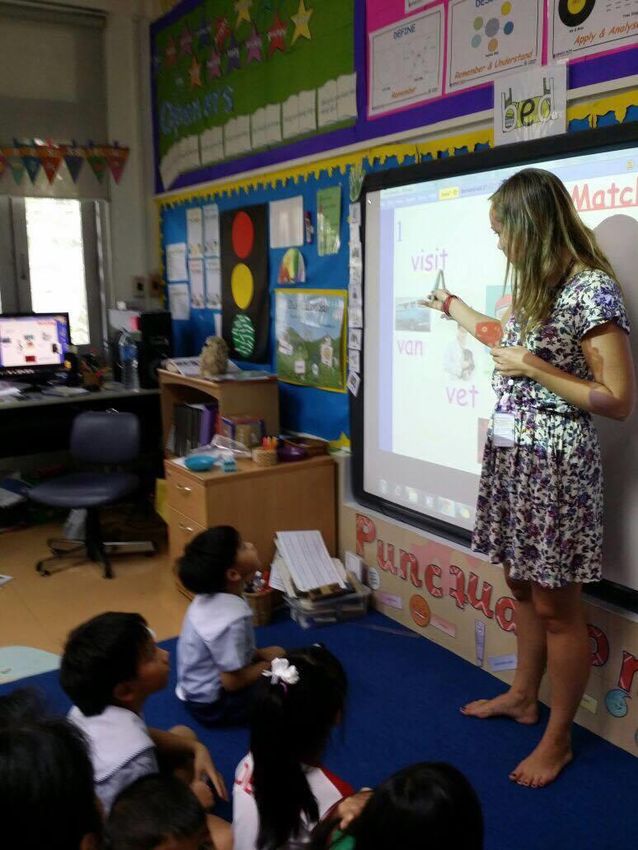
ECONOMICS OF EARLY CHILDHOOD

“On A Purely Economic Basis, It
Makes A Lot Of Sense To Invest
In The Young… Early Learning
Begets Later Learning. And
Early Success Breeds Later
Success.”
         --James J. Heckman, Ph.D.
         Nobel Prize Laureate
         Economist
QUALITY

INFRASTRUCTURE    HUMAN        STAFF      PEDAGOGY   ASSESSMENT   LEARNING
                 RESOURCE   DEVELOPMENT                           MATERIALS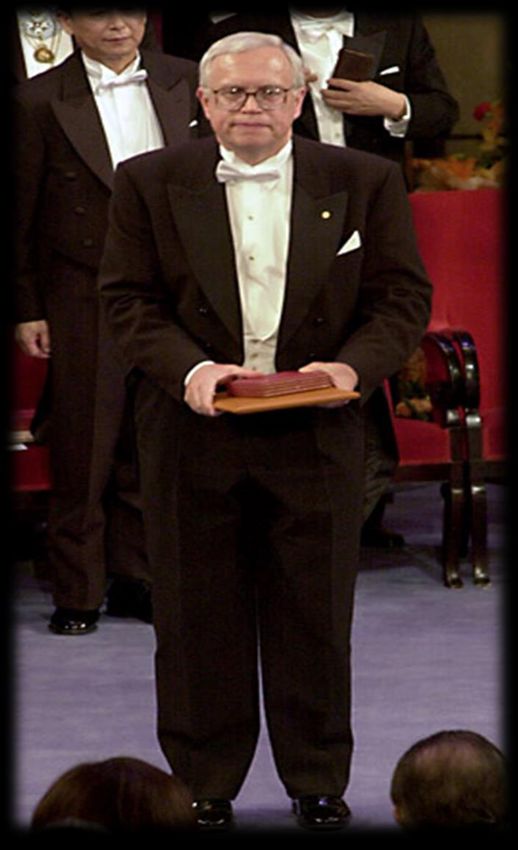
PRIORITIES
PHILOSOPHY

INSFRASTRUCUTE/
FACILITIES
HUMAN
RESOURCE
PEDAGOGICAL

ASSESSMENT
                  INNOVATION
                  TRANSFORMATION
FINANCIAL

CURRICULUM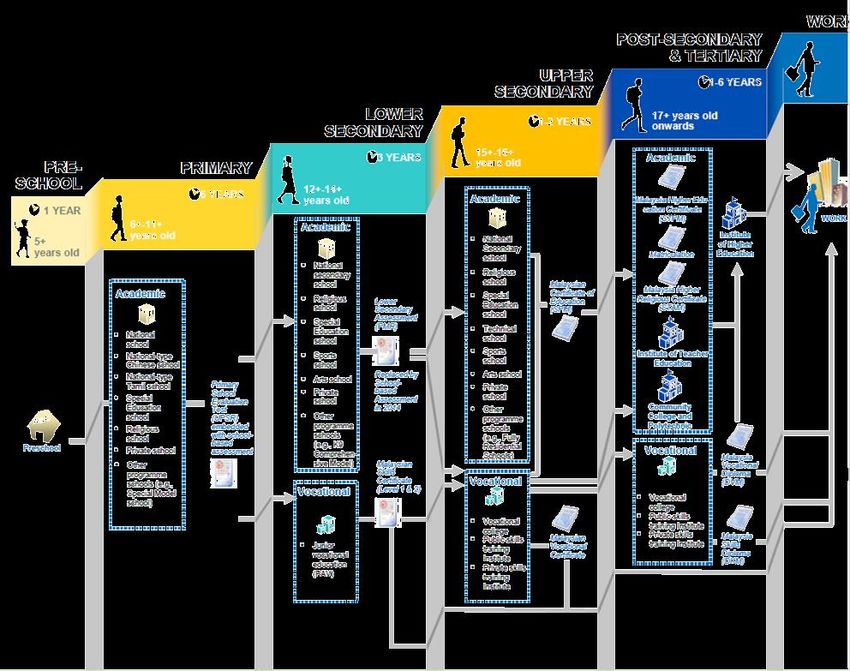
THE EDUCATION JOURNEY_MALAYSIAN CONTEXT
NATIONAL PHILOSOPHY OF EDUCATION

                         “ Education in Malaysia is an ongoing effort towards
                         further developing the potential of individuals in a
                         holistic and integrated manner, so as to produce
Before considering the   individuals who are intellectually, spiritually, emotionally,
Quality aspect,          and physically balanced and harmonious, based on a
• some brief             firm belief in and devotion to God. Such an effort is
  background on the      designed to produce Malaysian citizens who are
                         knowledgeable and competent, who possess high moral
  Malaysian Education    standards, and who are responsible and capable of
  System.                achieving high levels of personal wellbeing as well as being
                         able to contribute to the harmony and betterment of the
                         family, the society, and the nation at large.”
MALAYSIA POLICY TOWARD PRE-SCHOOL

The ministry remains committed to ensuring the structure of the
preschool phase of education will be scaled up in successive
waves, with the objective of ensuring universal preschool
enrolment and an equal head start in education for all
children.

NATIONAL STANDARD PRESCHOOL CURRICULUM
VISION /MISSION
                       Vision:
• Quality Education, Human Educated, Prosperous Nation.
                       Mission:
 • Preserving Quality Education System for Developing
    Individual Potential to Meet National Aspirations.
OBJECTIVES
To Acquire Good Health Ability To Interact With Others. Explore The Environment Using
Practices. Able To Work Independently As Basic Science Process Skills.
To Acquire Steps To Protect Well As Work As A Team. Using Basic Math Skills In
Themselves. Respect The Feelings And Rights Carrying Out Daily Tasks And
Of Others, Thus Creating Positive Solve Problems.
Fine Motor Skills And Gross
Motor Base. Relationships With Adults And Use Critical Thinking Skills,
Peers. Creative And Innovative In Their
Have Emotional Maturity.
Practicing Moral Values. Learning And Everyday Life.
Having A Positive Self-concept
Adopt The Values Of Islam In Develop Creativity And Aesthetics.
And Self-esteem.
Daily Life For Muslim Students. Appreciate The Natural Beauty
Courage To Express Their
Communicate Using Bahasa And Cultural Heritage.
Thoughts And Feelings.
Malaysia, English And The
Language Of Instruction In The
Context Of Everyday Life.BENEFITS OF PRE-SCHOOL
•Academic Achievement
Overall Academic Achievement And
School Success, Less Grade Repetition
And Special Education And Increased
High School Graduation Rates.
According To Barnett, High-quality
Preschool Programs Benefit Children
From Middle-income Families As Well As
From Low-income Families.• School Readiness "A Number Of Large-scale Studies Demonstrate That Participation In High-quality, Center-based Pre-k Programs Positively Influences All Children's Kindergarten Readiness," Says Barnett. "Positive Impacts Include Gains In Achievement Test Scores, Including Early Literacy And Math Skills, As Well As Improvements In Social And Emotional Development.“
THE DESIGN OF EARLY
CHILD CARE EDUCATION
     IN MALAYSIA
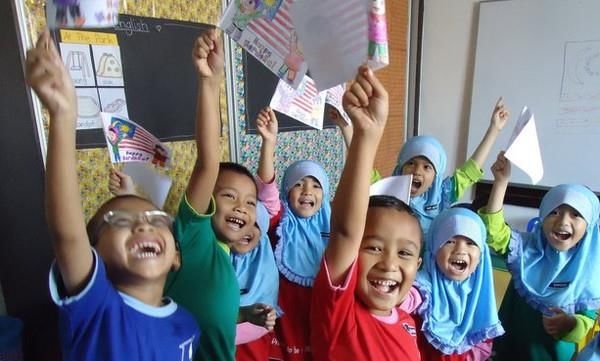
Preschool education is viewed as an
important experience for each child in
Malaysia (Ministry of Education,1998)
The Standard National Preschool Curriculum
(KSPK) was the guidelines used in most of the
government preschools including public and
private preschools in Malaysia.All preschools including
public and private
sectors are to follow all
the guidelines stated in
Standard National
Preschool Curriculum
(SNPC) issued by
Malaysia Ministry of
Education (MOE) on
2010.STANDARD NATIONAL PRESCHOOL CURRICULUM
COMMUNICATION
SPIRITUAL
ATTITUDES PHYSICAL AND
AND VALUE AESTHETIC
COMPONENT
OF
DEVELOPMENT
SCIENCE & HUMANITY
TECHNOLOGY
PERSONAL
APPEARANCETHE DESIGN OF PRESCHOOL PREMISES
PRIVATE PRESCHOOL
A teacher in a private preschool explains "Yakult
Day" using a slide show. Yakult day is the day the
children visit factory manufactured cultured milk A classroom in a private preschool equipped with
called yakult. modern technology and an appropriate classroom
Before the trip the children watch the show and environment.
the teacher explains about the health benefits of
drinking the yakult.GOVERNMENT PRESCHOOL
Public preschool Morning opening Children at reading
building in a rural area session in a public centre during free
preschool time in a public
preschoolPhysical Infrastructure
INDOOR
Smart board

That help the teacher in interacting teaching and learning process.
COMPUTER ROOM
LIBRARY

Library and Reading Corner
Indoor Playground
Indoor playground often use when rainy day or the weather
not really good to bring children outside.
Providing the indoor playground is an advantage to teacher.
Outdoor playground
Garden
OTHER INFRASTRUCTURE

                          Shoe Shelf

Walking Area
CHALLENGES IN EDUCATION
Financial
constraint
High Teacher’s
maintenance innovationTEACHER QUALIFICATION
NOSS - Qualifications for Preschool Teachers

 The four qualification levels for the childcare sector under
      National Occupational Skill Standard (NOSS):

                     Preschool Teacher (SKM Level 2)

                 Senior Preschool Teacher (SKM Level 3)

               Childcare Centre Supervisor (DKM Level 4)

                   Childcare Manager (DLKM Level 5)
Graduates of a diploma programme should be able to:
Promote child development and learning of young children
Build family and community relationships
Observe, document, and assess to support young children and families
Design, implement, and evaluate experiences that promote positive
development and learning for all children
Identify and conduct themselves professionally as members of the early
childhood professionCHALLENGES IN EDUCATION Ethnicity/ Language Race Quality Qualification
TEACHER:CHILD RATIO
RATIO OF TEACHER AND CHILDREN TASKA (NURSERY)

Child Category                       Child Age           Ratio of Teacher to Child

     Child         New born baby – I years old   1 teacher : 3 children’s

                   1-3 years old                 1 teacher : 5 children’s

                   3-4 years old                 1 teacher : 10 children’s

Special Children   New born baby – 1 years old   2 teacher : 3 children’s

                   1 – 3 years old               2 teacher : 5 children’s

                   3- 4 years old                3 teacher : 10 children’s
RATIO OF TEACHER AND CHILDREN TADIKA (PRESCHOOL) Child Child Age Ratio of Teacher to Child Category Preschool 5 – 6 years old 1 teacher : 1 Assistant teacher : 25 children’s
TEACHER’S TRAINING
Preservice or initial training refers to Professional Development in which an individual
engages prior to beginning a position. Preservice training may be required for early childhood
professionals to serve in a role.

In-service or ongoing training is Professional Development in which early childhood
professionals engage to enhance their skills and remain current regarding knowledge and
practice in the field.In-service training may be required foe early childhood professionals to
continue serving in a role.
TRAINING OF PRESCHOOL TEACHERS IN MALAYSIA

1. Trained by MOE and universities
• All teachers teaching in the preschools run by Ministry of Education
  are trained and certified with at least a diploma in teaching.
• Many of them have a degree and master degree in early childhood
  education.
• Teachers teaching in KEMAS preschool receives a 6 months training
  whereas PERPADUAN receives a 3 weeks training by their respective
  Ministries.
• Since 2013, there have been a Teacher Training Division of Ministry
  of Education to provide courses to their teachers to attain at least a
  diploma level.
2. The main agencies responsible for the training of teachers for certification are :

• Ministry of Education through the Teacher Training Division and the universities (Public
  & Private).

3. The kinds of courses provided by the Teacher Training Division through its Teacher
Training Institute are as follows:

•    Diploma in Teaching for Preschool (3 years)
•    Post Degree Course ( for conversion, 1 year)
•    Degree course (4 years)
•    In service training ( 14 weeks, 1 year )
Various public universities such as the University of Malaya, National University of Malaysia,
University Science Malaysia, Sultan Idris Teaching University and the Open University of Malaysia
produce graduates & postgraduates on preschool education too.

• Students at these universities either pursue their
  • Basic Degree or
  • Master and PhD in Preschool or Early Childhood education

The Ministry of Education also awards scholarship or study leave for some of these teachers.
Trained by NGO
One organisation conducting a systematic regular courses for private preschool teachers is the The Malaysian
Association of Kindergartens (PTM).

PTM conducts regular nine steps in-service courses on “Skills Training for preschool teachers‟ during school
holidays.

Attendance certificates are awarded to participants who have completed the courses which consists of the
following modules:

•   Socio-emotional development
•   Preschool teacher education
•   Preschool administration/management
•   Physical development
•   National Preschool Curriculum
•   Spiritual/Moral Education
•   Child Psychology
•   Language & Communication
•   Creativity and Aesthetics
•   Cognitive Development
Number of preschools teacher trained as reported by the various agencies is
given in Table.
This table shows the increment of preschool teachers being trained yearly.

                                  Number of ECCE Teachers Trained at the Particular Year
TRAINING OF CHILDCARE PROVIDERS AND CHILDCARE MINDERS Childcare providers are the owner of Childcare Centers. Childcare minders are those who take care of the children in the Childcare Centers. Both childcare providers and childcare minders are required to attend 10 days courses (the Basic Childcare course, KAAK) specified by the Ministry of Woman, Family and Community Development, MWFCD. The curriculum and training modules are provided by the Ministry. The plan is to create hierarchical level for different categories of childcare workers. An example of these levels are: • Level 1 is for Childcare minders at home • Level 2 for Childcare minders • Level 3 for Childcare providers • Level 4 for diploma • Level 5 is equivalent to degree.
CHALLENGES IN EDUCATION

     Input/ Output        Experience
        Training           Exposure
CHALLENGES IN MALAYSIA Continuity of informal education in preschool to formal education in the primary school. Incentives in teacher professionalism: salary, in- service training. Training for private practitioners and providers. Professional development for novice and expert teachers.
FUTURE PLANS
Comprehensive policies have been developed and
implemented,
There are gaps between the aspired and the
implemented.
Good governance ensures successful
implementation of policies, requires the authority
and other stakeholders to focus on the vulnerable
population including the indigenous people, children
with special needs and refugee.
Providing effective dissemination of policies,
Maintaining a sustainable mechanism of
monitoring,
Attention to coordination and integration are tasks
at hand to ensure successful implementation of
policies.WAVE 1 (2013 - 2015)
EXPANDING PRESCHOOLS RAPIDLY, INCREASING ENROLMENT IN
OTHER PHASES OF EDUCATION
Increasing Enrolment And Improving Quality In Preschools
Maintaining The Starting Point For Formal Education
Increasing Primary Enrolments
Making Secondary Education Compulsory For All
Maintaining Current Length Of Formal EducationFocus On Building On The Gains
From The Earlier Phase
WAVE 2 (2016 - 2020)
CONSOLIDATING Focus Will Be On Continuously
BENEFITS Improving Standards For
Preschool E.G. Ensuring That
100% Of All Preschool
Teachers Will Have Minimum
Diploma Qualifications, To
Raise Standards In Other ECCE
Programs Such As Childcare.WAVE 3 (2021 - 2025)
ENSURING UNIVERSAL
ACCESS
• By 2021, The Malaysian Education System Is Expected To Achieve 100%
Enrolment In Public Or Private Schools Across The Preschool, Primary,
Lower Secondary, And Upper Secondary Phases Of Education.
• Continuously Improve The Quality Of Education Based On Pilots Done In
Wave 2.GTP 2.0 ASSURING QUALITY EDUCATION.
ENHANCING PRE-SCHOOL AND EARLY CHILDCARE
The GTP 2.0 will see the initiative to improve pre-
schools enhanced. While the GTP 1.0 focused on
enrolment, the GTP 2.0 will also look to improving
the quality of pre-schools by introducing minimum Specifically, the initiative will see:
standards. The EDU NKRA will also extend the
initiative to cover early childcare as well.
The number of classes by private and public
providers increased review and revise eligibility
requirements for fee assistance and grants These initiatives will be executed immediately with
harmonise pre-school teacher qualifications the aim of achieving 92% and 10% enrolment in
expand fee assistance and grants for childcare put pre-school and childcare respectively by 2015.
in place national early childcare education (ecce)
standards, as well as professional standards for
teachersCONCLUSION
Quality targets:
This challenge to
• All preschool A need to know offer high quality
Malaysia teachers to be how other at affordable cost
education diploma holders countries have met will always remain
blueprint (minimum Universities/ the challenges of with us, whatever
2013-2025 requirement) teacher ensuring quality our living standards
emphasizes
• Primary schools training education at A and whatever
equity and
• Secondary schools cost their progress we make
access to
populations can in our education
education • Tertiary
afford. systems.THANK YOU
For more information
Contact: 603-79675000
Or email: marianin@um.edu.myYou can also read


