Eligible Training Provider Manual - Louisiana Workforce ...
←
→
Page content transcription
If your browser does not render page correctly, please read the page content below

Eligible Training Provider Manual

The total cost of publishing 100 paper copies of this public document, including first printing and
            reprints, would be $700.00 or $6.99 a copy. The Louisiana Workforce Commission, Office of
            Occupational Information Services, Research and Statistics Division, P.O. BOX 94094, Baton Rouge
            LA 70804-9094 publishes this document on its website www.laworks.net. Its purpose is to
            disseminate information pertaining to labor market developments and employment trends under the
            authority of Part 602.6, Title 20, and Chapter V. of the Code of Federal Regulations. It was printed
            in accordance with the standards for printing by state agencies established pursuant to R. S. 43:31.

               |   Equal Opportunity Employer/Program   |   Auxiliary aids and services are available upon request to individuals with disabilities • TDD# 800-259-5154

Eligible Training Provider Manual                                                     2
Table of Contents

          Introduction
                    Purpose ................................................................................................................................7

                    II. Acronyms and Definitions .............................................................................................7

                    III. References ..................................................................................................................10

                    IV. Additional Resources..................................................................................................10

          Chapter 1. The Workforce Innovation and Opportunity Act
                    1.01 Purpose of the Workforce Investment & Opportunity Act ..........................................11

                    1.02 Key Services ……………...……….............................................................................11

                    1.03 Highlight of WIOA Reforms………………………………………………………………12

                    1.04 Target Population & Eligibility Requirements ...........................................................15

          Chapter 2. Louisiana Workforce Development System
                    2.01 Louisiana Workforce Commission’s Goals.................................................................17

                    2.02 Louisiana’s Workforce Commission’s Duties …………………………….....................18

                    2.03 Workforce Investment Council ..................................................................................18

                    2.04 Occupational Forecasting Conference ........................................................................18

                    2.05 Louisiana Workforce Development Boards................................................................18

                    2.06 Individual Training Accounts......................................................................................20

                    2.07 Helping Individuals Reach Employment (HiRE) System............................................21

          Chapter 3. Training Provider Eligibility Requirements
                    3.01 Training Providers that Qualify for the ETPL …...….…………............................... 22

                    3.02 Training Programs Required to Apply for the ETPL for WIOA…………………………... 23

                    3.03 Programs not required to follow the ETPL Application Process………………….... 23

                    3.04 Initial Eligibility Requirements……………………………………………………………….24

                    3.05 Continued Eligibility Policy………………………………………………………………….. 24

Eligible Training Provider Manual                                                      3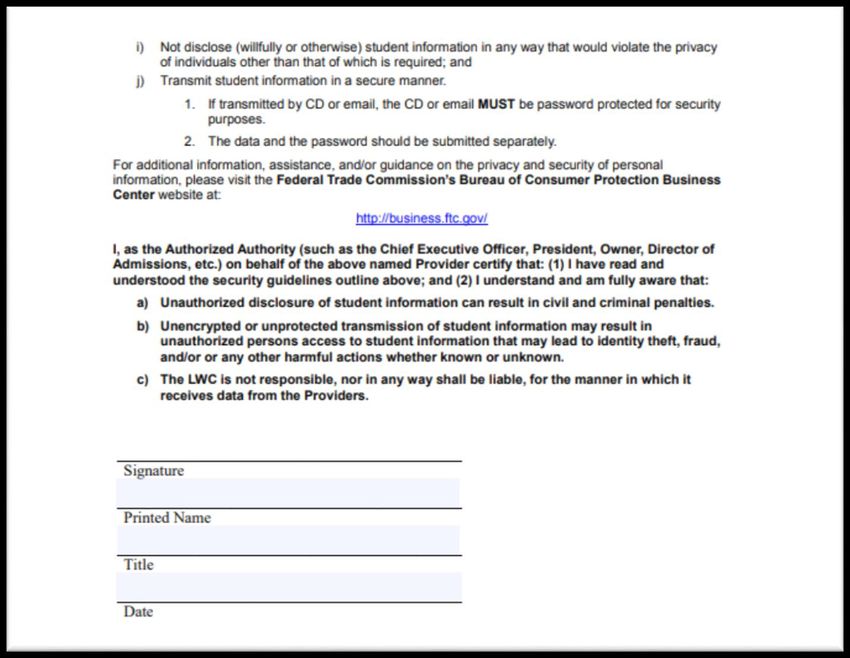
3.06 Continued Eligibility Requirements .........................................................................25

          Chapter 4. State Minimum Performance Standards
                    4.01 Minimum Performance Standards Implementation Requirements.............................26

                    4.02 Program Minimum Performance Requirements .......................................................26

                    4.03 Performance Standards and Data Collection Methodologies…………………………..27

          Chapter 5. Application and Continued Application Process
                    5.01 Initial Application/Certification Process......................................................................29

                    5.02 Continued Application/Certification Process.............................................................30

          Chapter 6. Program Review Process
                    6.01 Initial Eligibility Review Process…………………………………………………………..31

                    6.02 Continued Eligibility Review Process………………………….....................................31

                    6.03 Program Approval Process .......................................................................................31

                    6.04 Program Denial Process…………………………………………………………………..31

                    6.05 Reasons for Program Denial........................................................................................32

                    6.06 Reasons for Removal from the State’s Eligible Training Provider List …………….....32

                    6.07 Status of Students Attending a Program No Longer on the State’s ETPL……………33

                    6.08 Supplemental Data Provision ...................................................................................33

                    6.09 Supplemental Data Submission Process…………………………………………………..33

                    6.10 Appeals Process for Denied Provider Programs………………………………………..34

          Chapter 7. Student Data Requirements

                    7.01 Programs Required to Submit Student Data………………………………………… 35

                    •    Figure 7.1: Student Data Submission Requirements by Program Year…………….....35

                    7.02 Student Data Submission Requirements …………………………………………………35

                    7.03 Student Data Requirements ………………………………………………………………..35

Eligible Training Provider Manual                                              4
7.04 Student Data Spreadsheet Set-up……………………………………………………......35

                    •    Figure 7.2: LW C’s HiRE Program Outcome Codes…………………………………….. 35

                    7.05 Student Data Layout Requirements ...........................................................................35

                    7.06 Student Data Submission Methods ............................................................................37

                    7.07 Securing Student Data ……………………………………………………………………..37

          Chapter 8. HiRE System Users Guide
                    8.01 Navigating the LW C Website …………………………………………………..………....39

                    8.02 Accessing Eligible Training Provider Information ……………………………..……..…40

                    8.03 HiRE User Registration Process ……………………………………………...……….........43

                    8.04 Managing Institutional Information........................................……………..………….....46

                    8.05 Adding a Program (Part 1) – Adding an Education or Training Program ……………..47

                    8.06 Adding a Program (Part 2) – General Information………………………………………48

                    8.07 Adding a Program (Part 3) – Registered Apprenticeship …………………………………..50

                    8.08 Adding a Program (Part 4) – Additional Details ………………………………………...…51

                    8.09 Adding a Program (Part 5) – Occupation …………………………………………………52

                    8.10 Adding a Program (Part 6) – Occupational Skills………………………………………53

                    8.11 Adding a Program (Part 7) – Scheduling …………………………………………………….54

                    8.12 Adding a Program (Part 8) – Duration …………………………………………………………55

                    8.13 Adding a Program (Part 9) – Locations ……………………………………………...…56

                    8.14 Adding a Program (Part 10) – External Approvals………………………………………...56

                    8.15 Adding a Program (Part 11) – Cost Details……………………………………………...57

                    8.16 Adding a Program (Part 12) – Performance……………………………………………. 58

                    8.17 Adding a Program (Part 13) – Confirmation……………………………………………..59

                    8.18 Adding a Program (Part 14) – Review …………………..…………………….…….....60

                    8.19 Editing Provider Program Information…………………………………………………….61

                    8.20 Deactivating a Program in HiRE……………………………………………………………....63

Eligible Training Provider Manual                                           5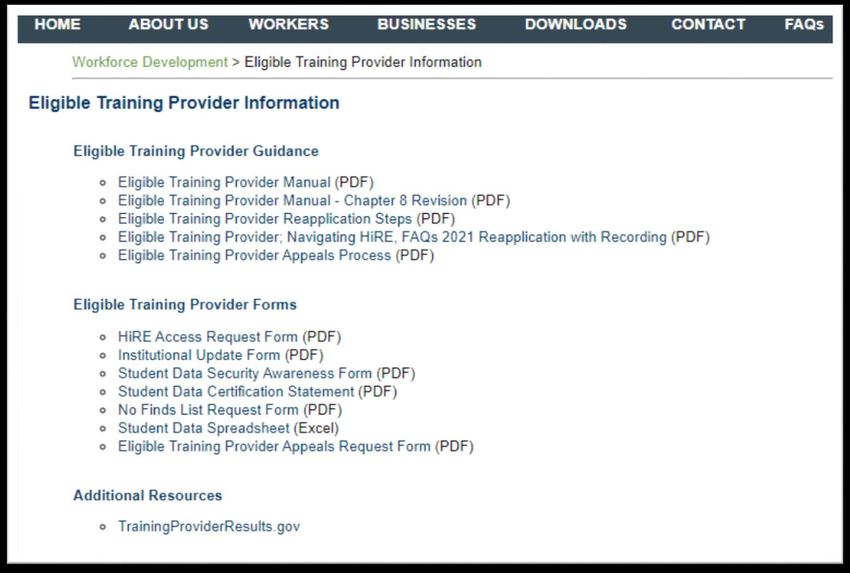
8.21 Submitting a Program for Continued Approval (Reapplication)……………………………. 64
8.22 Checking the Status of a Program…………………………………………………………….65
8.23 Recovering or Resetting a User’s Username or Password………………………………….68
8.24 Updating Contact Information in HiRE………………………………………………………...69
Appendices
Appendix 1: Eligible Training Provider Forms
Form A: Institutional Update Form………………………………………………………… 75
• Form B: HiRE Access Request Form……………………………………………………...76
• Form C: Student Data Certification Statement……………………………………………77
• Form D: “No Finds” List Request Form …………………………………………………...79
• Form E: Student Data Security Awareness Form……………………………………….. 81
Form F: Eligible Training Provider Appeals Request Form……………………………..84
Appendix 2: LWC Contact Information
• Louisiana Workforce Commission Contact Information……………………………….86
Appendix 3: Application/Reapplication Checklist
Initial Application Checklist …………………………………………………………………………88
Continued Application Checklist……………………………………………………………………89
Appendix 4: LWDA Maps
State LWDA Map & Parish Listing…………………………………………………………91
Eligible Training Provider Manual 6
Introduction
  I.       Purpose
                    The Eligible Training Provider Manual provides educational institutions with updated information about the
                    Workforce Innovation and Opportunity Act, Louisiana’s Workforce Development System, and provides the
                    necessary guidance, procedures, and requirements in becoming the Eligible Training Provider in
                    Louisiana. The Eligible Training Provider List is a list of providers and their training programs and/or
                    services that qualify for WIOA funding eligibility. Only providers’ programs, courses, or classes that meet
                    specific criteria and requirements are listed on Louisiana’s ETPL. The ETPL provides goals and
                    Louisianan’s Workforce Investment Strategies. Requirements used to determine the eligibility of
                    training/education providers and their programs are found in the Workforce Innovation and Opportunity
                    Act of 2014, the USDOL’s training and Employment Guidance Letters, Louisiana State Law, and
                    Louisiana Workforce Commission’s Office of Workforce Development.

  II. Acronyms and Definitions

                    •    American Job Centers (AJC) - designed to provide full range of assistance to job
                         seekers under one roof. The centers offer training referrals, career counselling, job
                         listing, and similar employment-related services.

                    •    Board of Regents (BOR) - the state licensing agency that determines if educational
                         providers and their programs/services need to be licensed in the state of Louisiana.

                    •    Calendar Year Quarter – a three-month period within a calendar year. These calendar
                         year quarters are used in the processing of program performance timelines.

                    •    Classification of Instructional Programs (CIP) Code – a taxonomic scheme that will
                         support the accurate tracking, assessment, and reporting of fields of study and program
                                               1
                         completions activity.

                    •    Completer- a completer is a student that completes a providers’ program and obtains
                         credential, certificate, degree, etc. from the school.

                    •    Consumer Reporting System (CRS) - the mechanism that tracks activities and
                         outcomes for various programs, including but not limited to: WIOA, Wagner-Peyser,
                         LEAP, TAA, Rapid Response, and the Veterans Program, along with employer services.

                    •    Code of Federal Regulations (CFR) - The codification of the general and permanent rules and
                         regulations published in the Federal Register by the executive departments and agencies of the
                         federal government of the United States.

            1    http://nces.ed.gov/pubs2002/cip2000/

Eligible Training Provider Manual                                 7
•    Date of Program Exit – the term program exit means a participant has not received a service funded
                         by the program or funded by a partner program for 9 consecutive calendar days, and is not scheduled
                         for future services. The exit date is the last date of service.

                    •    Eligible Training Provider (ETP) – post secondary education providers that have programs approved
                         for federal funding under the Workforce Innovation and Opportunity Act.

                    •    Enrollee - a student that started a provider’s program during the enrollee data collection period. A
                         student who is participating in a program but who started in a previous collection period is not an
                         enrollee.

                    •    Enrollee Data - data that the LWC request from providers for an ETPL program year. Enrollees include
                         only students starting a program during the specified timeframe.

                    •    Employment and Training Administration (ET A) - a division within the U.S. Department
                         of Labor that provides a variety of labor-related services, such as training and layoff
                         assistance.
                    •    Eligible Training Provider List (ETPL) - a list of provider programs and/or services
                         that have been approved by Louisiana Workforce Commission by meeting the criteria
                         outlined by WIOA Federal and State Regulations.
                    •    Exit Quarter - the calendar year quarter containing the exit date of a student from a program.
                    •    Exiter – a completer or non-completer of a program that exits a provider’s program.
                    •    Exiter Data - data that the LWC request from providers for an ETPL program year.
                         Includes completers and non-completers of all program participants who exit a program
                         during the specified timeframe.
                    •    Helping Individuals Reach Employment (HiRE) - an advanced and comprehensive
                         workforce development software system created by Geographic Solutions, Inc. in
                         coordination with the Louisiana Workforce Commission. This system integrates
                         services via the Internet for individuals, employers, training providers, workforce staff,
                         and WIOA partners.

                    •    Individual Training Account (IT A) - the primary mechanism used to pay for training
                         services for eligible students. When training services are determined appropriate,
                         they must be provided through an Individual Training Account (ITA). The training
                         must be linked to in-demand employment opportunities in the local area, planning
                         region, or in a geographic area in which the adult or dislocated worker is willing to
                         commute or relocate.

                    •    Louisiana Community and Technical College System (LCTCS) – the entity that
                         oversees all community and technical colleges in the state of Louisiana.
                    •    Louisiana Occupational Information System (LOIS) - a comprehensive labor market
                         information delivery system providing a single source of demographic, economic, and
                         labor market information for the state, Metropolitan Statistical Areas’, and parishes.
                    •    Labor Market Information (LMI) – data on job seekers, employment, unemployment, and
                         changes in industrial structure, technological changes, conditions of employment, wage
                         rates and other related statistics.
                    •    Local Workforce Development Boards (LWDB) – regional entities created by the
                         Workforce Innovation and Opportunity Act whose role is to direct federal, state and local
                         funding to workforce development programs.
                    •    LWDA - Local Workforce Development Areas are the areas throughout the state in which
                         WIOA Title I-B funds are distributed.

Eligible Training Provider Manual                                 8
•    Louisiana Workforce Commission (LWC) – Louisiana’s Department of Labor Agency responsible
                         for enforcing federal labor standards and promoting workers’ well-being

                    •    North American Industry Classification System (NAICS) - the standard used by Federal statistical
                             agencies in classifying business establishments for the purpose of collecting, analyzing, and
                         publishing statistical data related to the U.S. business economy.

                    •    Non-completer – a student that does not complete a provider’s program.

                    •    Occupational Employment Statistics (OES) – a program that manages a survey of
                         establishments conducted in cooperation with BLS to capture detailed occupational
                         employment and wages.

                    •    Occupational Forecasting Conference (OFC)- projects job growth and develops
                         information on the needs of current, new and emerging industries for the workforce
                         development planning process at the statewide and regional levels.

                    •    O*Net - the nation's primary source of occupational information. Central to the
                         project is the O*NET database, containing information on hundreds of standardized
                         and occupation-specific descriptors. The database is continually updated by
                         surveying a broad range of workers from each occupation. Information from this
                         freely available database forms the heart of O*NET Online, the interactive
                         application for exploring and searching occupations. The database also provides the
                         basis for our Career Exploration Tools, a set of valuable assessment instruments for
                         workers and students looking to find or change careers.

                         Office of Workforce Development (OWD) – Department responsible for administering federal
                         programs that create a comprehensive statewide workforce system of employment services, hiring
                         support and tax credit and labor market information to employees and workers.
                    •    Quarter After Exit - The quarter following the participant’s exit from the program.

                    •    Regional Labor Market Areas (RLMA) –an economically integrated area within which
                         individuals can reside and find employment with a reasonable distance or can readily
                         change jobs without changing their place of residence. The State is divided into 8
                         RMLAs.

                    •    Standard Occupational Classification (SOC) – a universal occupational classification system that
                         is designed to cover all occupations in which work is performed for pay or profit, reflecting the current
                         occupational structure of the United States.

                    •    State Workforce Agency (SWA)- the agency or bureau in each State that deals
                         with employment and labor issues.

                    •    Unemployment Insurance (UI) Wage Records – a record that contain the earnings
                         reported by employers (on a quarterly basis) to the state’s unemployment insurance
                         agency for each employee. Unemployment Insurance Wage Records are the
                         primary source for determining employment and earnings outcomes under the
                         Workforce Innovation and Opportunity Act.

                    •    Unsubsidized Employment - employment not financed from funds provided under a grant.
                         In the grant program the term “adequate” or “suitable” employment is also used to mean
                         placement in unsubsidized employment which pays an income adequate to accommodate
                         the participants’ minim um economic needs.

                    •    Workforce Innovation and Opportunity Act (WIOA) of 2014 - supersedes the
                         Workforce Investment Act (WIA) of 1998 and amends the Adult Education and Family
                         Literacy Act, the Wagner-Peyser Act, and the Rehabilitation Act of 1973. In general, the
Eligible Training Provider Manual                                     9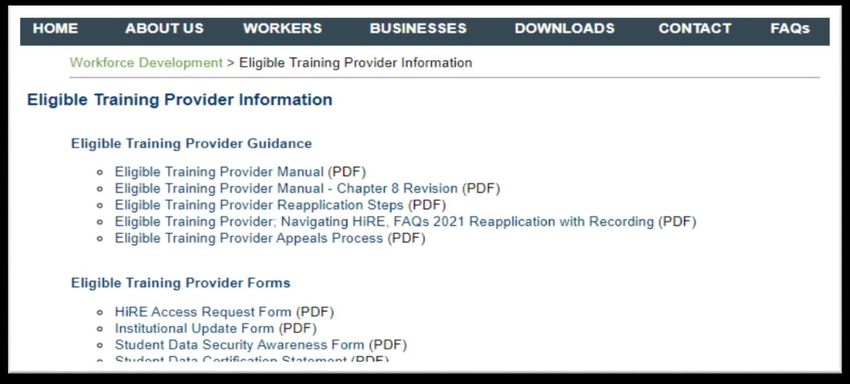
Act took effect on July 1, 2015, the first full program year after enactment, unless
                         otherwise noted.

                    •    Workforce Investment Council (WIC)- is Louisiana’s State Workforce Investment
                         Board and is the statewide body that was created with the goal to create a common
                         vision for an integrated workforce delivery system and to advise the Governor with
                         strategies to meet the needs of the state’s employers and workforce.

  IV.       References
                    •    Workforce Innovation and Opportunity Act (Public Law 113-128) Sections 107, 116, 122 and 134.
                    •    WIOA Regulations, 20 CFR 680.400 et. seq., Subpart D – Eligible Training Providers.
                    •    Training and Employment Guidance Letter WIOA No. 41-14.
                    •    Training and Employment Guidance Letter WIOA No. 41-14, Change 1.
                    •    Training and Employment Guidance Letter WIOA No. 13-16.
                    •    Training and Employment Guidance Letter WIOA No. 16-16.
                    •    Training and Employment Guidance Letter WIOA No. 16-16, Change 1.
                    •    Training and Employment Guidance Letter WIOA No. 26-16.

  V.        Additional Resources
                    •    Bureau of Labor Statistics: http://www.bls.gov/.
                    •    Career One Stop Website: http://www.servicelocator.org.
                    •    CIP Code Database: http://nces.ed.gov/ipeds/cipcode/Default.aspx?y=55
                    •    Department of Children and Family Services: http://www.dcfs.louisiana.gov/.
                    •    Labor Market Information: http://www.laworks.net/LaborMarketInfo/LMI_MainMenu.asp.
                    •    Louisiana Board of Education: http://www.doe.state.la.us/.
                    •    Louisiana Board of Regents: http://www.regents.state.la.us/.
                    •    Louisiana Community and Technical College System: http://www.lctcs.edu/.
                    •    Louisiana Economic Development: https://www.opportunitylouisiana.com/.
                    •    Louisiana State Government Website: http://louisiana.gov/.
                    •    Louisiana Workforce Commission: http://www.laworks.net/.
                    •    U.S. Department of Labor Workforce Innovation and Opportunity Act Website:
                             https://www.doleta.gov/WIOA/Overview.cfm
                    •    O*NET Resource Center – Occupational Code: http://www.onetcenter.org/.

Eligible Training Provider Manual                                10
Chapter 1. The Workforce Innovation and Opportunity Act
1.01 Purpose of the Workforce Innovation and Opportunity Act
The purpose of the Workforce Innovation and Opportunity Act is to amend and reauthorize the
Workforce Investment Act of 1998, which supports the nation's primary programs and
investments in employment services, workforce development, adult education, and vocational
rehabilitation activities and has been due for reauthorization since 2003. The bill also
reauthorizes and enhances the Adult Education and Family Literacy Act, amends the Wagner-Peyser
Act of 1933, and amends and reauthorizes certain provisions in the Rehabilitation Act of
1973.
1.02 Key Principles
WIOA is bipartisan, bicameral legislation that will improve our nation’s workforce development system
and help put Americans back to work. Now more than ever, effective education and workforce
development opportunities are critical to a stronger middle class. We need a system that prepares
workers for the 21st century workforce, while helping businesses find the skilled employees they need
to compete and create jobs in America.
WIOA creates:
A streamlined workforce development system by:
Eliminating 15 existing programs.
Applying a single set of outcome metrics to every federal workforce program under the Act.
Creating smaller, nimble, and more strategic state and local workforce development
boards.
Integrating intake, case management and reporting systems while strengthening
evaluations.
Eliminating the “sequence of services” and allowing local areas to better meet the unique
needs of individuals.
Greater value by:
Maintaining the 15% funding reservation at the state level to allow states the flexibility to
address specific needs.
Empowering local boards to tailor services to their region’s employment and workforce
needs.
Supporting access to real-world education and workforce development opportunities
through:
o On-the-job, incumbent worker, and customized training;
o Pay-for-performance contracts; and
o Sector and pathway strategies.
Better coordination by:
Aligning workforce development programs with economic development and education
initiatives.
Enabling businesses to identify in-demand skills and connect workers with the
opportunities to build those skills.
Supporting strategic planning and streamlining current governance and administration by
requiring core workforce programs to develop a single, comprehensive state plan to break
down silos, reduce administrative costs, and streamline reporting requirements. Ensuring
individuals with disabilities have the skills necessary to be successful in businesses that
provide competitive, integrated employment.
Eligible Training Provider Manual 111.03 Highlight of WIOA Reforms
Requires States to Strategically Align Workforce Development Programs:
WIOA ensures that employment and training services provided by the core programs are
coordinated and complementary so that job seekers acquire skills and credentials that
meet employers’ needs.
Promotes Accountability and Transparency:
WIOA ensures that Federal investments in employment and training programs are
evidence-based and data-driven, and accountable to participants and tax-payers.
Core programs are required to report on common performance indicators that provide key
employment information, such as how many workers entered and retained employment,
their median wages, whether they attained a credentials, and their measurable skill gains.
Core programs must measure the effectiveness of services to employers for the first time.
Performance reports for states, local areas, and eligible training providers will be publicly
available.
Programs will be evaluated by independent third parties at least every four years.
Fosters Regional Collaboration:
WIOA promotes alignment of workforce development programs with regional economic
development strategies to meet the needs of local and regional employers.
Local areas in regions will have coordinated planning and service delivery strategies.
AJC System: WIOA increases the quality and accessibility of services that job seekers and
employers receive at their local AJCs.
States will establish criteria to certify AJCs at least every three years to ensure continuous
improvement, access to services (including virtual access), and integrated service delivery
for job seekers and employers.
Key partners and services will be available at AJCs through the co-location of the Wagner-
Peyser Employment Service and the addition of the TANF program as a mandatory
partner.
The workforce system will have a common identifier so workers that need employment or
training services and employers that need qualified workers can easily find their local AJC.
The Secretary of Labor, with input from a new advisory council, other Federal agencies,
and states will develop and implement plans to improve the national workforce and labor
market information system and help job seekers make informed career choices.
States and local areas are encouraged to improve customer service and program
management by integrating intake, case management, and reporting systems.
AJC partner programs will dedicate funding for infrastructure and other shared costs.
Improves Services to Employers and Promotes Work-Based Training: WIOA contributes to
economic growth and business expansion by ensuring the workforce system is job-driven –
matching employers with skilled individuals.
Eligible Training Provider Manual 12 State and local boards will promote the use of industry and sector partnerships to address
the workforce needs of multiple employers within an industry.
State and local boards are responsible for activities to meet the workforce needs of local
and regional employers.
Local areas can use funds for demonstrated effective strategies that meet employers’
workforce needs, including incumbent worker training, Registered Apprenticeship,
transitional jobs, on-the-job training, and customized training.
Employers are incentivized to meet their workforce needs and offer opportunities for
workers to learn with increased reimbursement rates for on-the-job and customized
training.
Provides Access to High Quality training:
WIOA helps job seekers acquire industry-recognized credentials for in-demand jobs.
Training that leads to industry recognized post-secondary credentials is emphasized.
States and local areas will use career pathways to provide education and employment and
training assistance to accelerate job seekers’ educational and career advancement.
Local areas have additional procurement vehicles for training to increase customer choice
and quality, including individual training accounts, pay for performance contracts, and
direct contracts with higher education.
Enhances Workforce Services for the Unemployed and Other Job Seekers:
WIOA ensures that unemployed and other job seekers have access to high-quality
workforce services.
WIOA service categories of core and intensive services are collapsed into “career services”
and there is no required sequence of services, enabling job seekers to access training
immediately.
Local areas have flexibility to serve job seekers with greatest need by transferring up to 100
percent of funds between the Adult and Dislocated Worker programs.
Job seekers who are basic skills deficient, in addition to those who are low-income
individuals, have a priority for services from the Adult program.
Unemployment insurance claimants can receive eligibility assessments and referrals to an
array of training and education resources through the Wagner-Peyser Employment Service
program.
Improves Services to Individuals with Disabilities: WIOA increases individuals with
disabilities’ access to high quality workforce services and prepares them for competitive
integrated employment.
AJCs will provide physical and programmatic accessibility to employment and training
services for individuals with disabilities.
Youth with disabilities will receive extensive pre-employment transition services so they can
successfully obtain competitive integrated employment.
State vocational rehabilitation agencies will set aside at least 15 percent of their funding to
provide transition services to youth with disabilities.
Eligible Training Provider Manual 13 A committee will advise the Secretary of Labor on strategies to increase competitive
integrated employment for individuals with disabilities.
Vocational Rehabilitation state grant programs will engage employers to improve participant
employment outcomes.
Makes Key Investments in Serving Disconnected Youth and Other Vulnerable Populations:
WIOA prepares vulnerable youth and other job seekers for successful employment
through increasing the use of proven service models services.
Local areas must increase the percentage of youth formula funds used to serve out-of-school
youth to 75 percent from 30 percent under current law.
Local areas must spend at least 20 percent of youth formula funds on work experience
activities such as summer jobs, pre-apprenticeship, on-the-job training, and internships so
that youth can be prepared for employment.
Reinforces Connections with Registered Apprenticeship (RA):
WIOA promotes the use of RA, a proven model that provides workers with career
pathways and opportunities to earn while they learn.
RA programs are included on the eligible training provider list for the Adult and Dislocated
Worker programs as long as they remain registered, providing access to high-quality
training.
State and local boards will have representatives of RA programs as members, ensuring
that a key employer voice contributes to strategic planning activities for the workforce
system.
RA completion certificates will be recognized as a post-secondary credential, providing job
seekers with flexibility.
The Youth program may offer pre-apprenticeship training to prepare youth for RA or other
career opportunities.
Streamlines and Strengthens the Strategic Roles of Workforce Development Boards:
WIOA makes state and local boards more agile and well-positioned to meet local and
regional employers’ workforce needs.
State and local boards must coordinate and align workforce programs to provide
coordinated, complementary, and consistent services to job seekers and employers.
Business continues to contribute to strategic development and other activities by
maintaining a leadership role on the boards and forming the majority of workforce board
members.
State and local boards are more strategic and flexible as board membership is streamlined.
Eligible Training Provider Manual 141.04 Target Populations and Eligibility Requirements
Adult
To be eligible to receive WIOA services as an Adult an individual must:
Be a citizen or noncitizen authorized to work in the United States
Meet Military Selective Service registration requirements (males only)
Be 18 years of age or older
Be unemployed or employed and in need of services in order to obtain or retain
employment
Priority of Service for Adult Individualized Career and Training Services
While WIOA Adult eligibility requirements remain primarily consistent with WIA, there are some
significant changes to the service priority provisions.
WIOA requires that priority for Adult services must be given to recipients of public assistance and
other low-income individuals, and individuals who are basic skills deficient for receipt of individualized
career and training services necessary for an individual to obtain or retain employment. Previously,
under WIA, this priority applied only when Adult funds were limited. Under WIOA however, priority
access to services by members of this group applies automatically. Adults must meet basic eligibility
requirements and any service priority criteria in effect for the Board. Local policy must align with State
policy requirements.
WIOA establishes a priority of service requirement with respect to funds allocated to a local area for
"individualized" career services in addition to training services. Such "individualized" career services
may include career counseling and the development of an individual employment plan which involves
more dedicated staff time. AJC staff responsible for these funds must give priority to:
Recipients of public assistance
Other low-income individuals
Individuals who are basic skills deficient
Dislocated Worker
The WIOA Dislocated Worker program offers employment and training services for eligible workers
who are unemployed through no fault of their own or who have received an official layoff notice.
WIOA expands the definition of Dislocated Worker to include the spouse of active military who lost
employment as a result of a permanent change in duty location or is unemployed or underemployed
and experiencing difficulty in obtaining or upgrading employment.
To be eligible to receive WIOA services as a Dislocated Worker an individual must:
Be a citizen or noncitizen authorized to work in the United States
Meet Military Selective Service registration requirements (males only)
Be 18 years of age or older
Meet the definition of a Dislocated Worker defined by WIOA, meeting the criteria of one of
the following five (5) parts:
Part I- The individual:
Has been terminated or laid off, or has received a notice of termination or layoff, from
employment
Is eligible for or has exhausted entitlement to unemployment compensation; or
Has been employed for a duration sufficient to demonstrate, to the appropriate entity at a
AJC referred to in Section 121(e), attachment to the workforce, but is not eligible for
unemployment compensation due to insufficient earnings or having performed services for
an employer that were not covered under a State unemployment compensation law; and
Is unlikely to return to a previous industry or occupation.
Eligible Training Provider Manual 15Part II -The individual:
• Has been terminated or laid off, or has received a notice of termination or layoff from
employment as a result of any permanent closure of, or any substantial layoff at, a plant,
facility, or enterprise
• Is employed at a facility at which the employer has made a general announcement that
such facility will close within 180 days; or
• For purposes of eligibility to receive services other than training services described in
Section 134(c)(3), career services described in Section 134(c)(2)(A)(xii), or supportive
services, is employed at a facility at which the employer has made a general
announcement that such facility will close
Part Ill - The individual was previously self-employed (including employment as a farmer, a rancher,
or a fisherman) but is unemployed as a result of general economic conditions in the
community in which the individual resides, or because of natural disasters
Part IV- The individual is a displaced homemaker. A displaced homemaker is an individual who has
been providing unpaid services to family members in the home and who:
• Is unemployed or underemployed and experiencing difficulty finding or upgrading
employment, and
• Meets one of the following:
o Has been dependent on the income of another family member but is no longer
supported by that income; or
o Is the dependent spouse of a member of the Armed Forces on active duty and
whose family income is significantly reduced because of a deployment, a call or
order to active duty, a permanent change of station, or the service-connected
death or disability of the member
Part V -The individual:
Is the spouse of a member of the Armed Forces on active duty (as defined in Section 101
(d) (1) of Title 10, U. S. C), and who has experienced a loss of employment as a direct
result of relocation to accommodate a permanent change in duty station of such member;
or
Is the spouse of a member of the Armed Forces on active duty and who is unemployed or
underemployed and is experiencing difficulty in obtaining or upgrading employment.
Eligible Training Provider Manual 16Chapter 2. Louisiana Workforce Development System
Louisiana's stakeholders envision a workforce system that will provide pathways for all
Louisianans, including individuals who are receiving public assistance, the unemployed or
underemployed, those who are deficient in basic skills, as well as persons with disabilities,
including disabled veterans, and others who have significant barriers to employment. All will
have access to education, training and the supportive services needed to prepare for and
secure high-demand occupations that pay family-sustaining wages.
2.01 Louisiana Workforce Commission’s Goals
Goal 1: Establish Career Pathways as a model for skill, credential and degree attainment for
Louisiana citizens to secure jobs that provide opportunities for economic independence and family
stability. This goal will be accomplished by executing the following objectives:
1. Workforce development system partners will develop a shared vision and strategy for
industry sector-based career pathways for youth and adults. Career pathways must be
diverse, with multiple entry and exit points allowing individuals of varying abilities, including
low-skilled adults and youth with multiple barriers to employment, to have realistic access to
pathways.
2. Engage employers and integrate sector strategy principles to ensure multiple employers,
business associations and organized labor are partners in creating demand-driven career
pathways.
3. Increase the identification, prioritization and leverage of workforce system partner
resources to provide supportive services and reduce barriers for low-skilled youth and adults.
4. Strengthen the alignment of Jump Start, WorkReadyU and other viable initiatives as entry
and exit points in the career pathways model for in- and out-of-school youth.
5. Expand utilization of registered apprenticeship by industry sector employers to train
workers and meet occupational demands.
6. Support and grow learning opportunities for job-seekers and workers by improving
processes for transfer credits through postsecondary, apprenticeships and college
coursework.
Goal 2: Expand career services and opportunities for populations facing multiple barriers to close
the gap in educational attainment and economic advancement through career pathways and
improved career services and the expansion of bridge programs.
1.Expand and incentivize the utilization of evidenced-based workforce strategies that support
targeted populations (e.g., the long-term unemployed, individuals with disabilities, veterans,
out-of-school youth) into sector-based career pathway initiatives to achieve similar outcomes
relative to other populations.
2. Create new pathways for success by preparing very low-skill adults to take advantage of
sector-based bridge programs that link foundation skills and adult basic education.
3. Enhance and expand the delivery of integrated re-entry and employment strategies to
reduce recidivism among Louisiana’s returning citizens and meet the skill and workforce
needs of business and industry.
4. Promote the efficient alignment and utilization of supportive resources for populations
facing multiple barriers to employment at the regional and local service delivery levels.
5. Foster the improvement and expansion of employer-driven regional sector partnerships to
meet occupational demands as supported by regional labor market
information.
6. Increase the use of labor market and educational data and technology, in coordination with
local data, to inform and guide strategic workforce development decisions.
Eligible Training Provider Manual 177. Develop focused, regional workforce initiatives that blend partner resources (co-
investment) to educate and train workers for jobs within the workforce region.
8. Increase the alignment and efficacy of formula, discretionary and competitive workforce
funding in efforts to support regional and local workforce initiatives.
9. Promote meaningful, portable industry credentials supported throughout the workforce
delivery system that align to workforce demand.
10. Institute a system of accountability for the workforce development system that supports
and promotes the evaluation of the effectiveness of state and local workforce development
boards in meeting the workforce demands of business and workforce.
2.02 Louisiana Workforce Commission’s Duties
LWC, by statute, is the leader of the statewide workforce investment efforts with the authority to carry
out integration activities across all state agencies. This ensures that the impact of all activities is
aimed at meeting the needs of our customers, employers, and taxpayers. LWC, in coordination with
the WIC, provide the LWDBs, AJC’s, Training Providers, and all WIOA involved entities with guidance
and direction, based on federal requirements and regulations. In addition, LWC has been designated
as the agency responsible for the system that determines the performance outcomes of post-
secondary training programs; and is used in the Eligible Training Provider List eligibility
determinations.
2.03 Workforce Investment Council
The Louisiana WIC serves to develop a strategic plan to coordinate and integrate a workforce
development delivery system to assure efficiency and cooperation between public and private
entities by advising the Governor on the needs of Louisiana’s employers and its workforce.
Visit the Workforce Investment Council’s Webpage at www.laworks.net > Workforce Investment
Council for more information, board membership, and contact information.
2.04 Occupational Forecasting Conference
An important role of the WIC is directing the OFC. The OFC projects job growth and develops
information on the needs of current, new and emerging industries for the workforce development
planning process at the statewide and regional levels. The OFC identifies information that is
critical to the budgeting of state resources for workforce development.
The OFC provides information that allows for data-driven strategies for promoting and disseminating
the final report to the appropriate stakeholders, as determined by the OFC. A list of these projections
may be viewed at
http://www.laworks.net/LaborMarketInfo/LMI_EmploymentProjections_Revised.asp?years=20152024.
2.05 Louisiana Workforce Development Boards
LWDB Functions
Functions of local board —Consistent with Section 108, the functions of the local board shall include
the following:
(1) Local Plan—The local board, in partnership with the chief elected official for the local area
involved, shall develop and submit a local plan to the Governor.
Eligible Training Provider Manual 18(2) Workforce Research and Regional Labor Market Analysis —In order to assist in the
development and implementation of the local plan, the local board shall—
A. Carry out analyses of the economic conditions in the region, the needed knowledge and skills for
the region, the workforce in the region, and workforce development activities (including education
and training), and regularly update such information;
B. Assist the Governor in developing the statewide workforce and labor market information system
specifically in the collection, analysis, and utilization of workforce and labor market information for
the region; and
C. Conduct such other research, data collection, and analysis related to the workforce needs of the
regional economy.
(3) Convening, Brokering, Leveraging —The local board shall convene local workforce
development system stakeholders to assist in the development of the local plan under
Section 108 and in identifying non-Federal expertise and resources to leverage support for
workforce development activities.
(4) Employer Engagement —The local board shall lead efforts to engage with a diverse range
of employers and with entities in the region involved—
A. to promote business representation (particularly representatives with optimal
policymaking or hiring authority from employers whose employment opportunities
reflect existing and emerging employment opportunities in the region) on the local
board;
B. to develop effective linkages;
C. to ensure that workforce investment activities meet the needs of employers and
support economic growth in the region, and
D. to develop and implement proven or promising strategies for meeting the employment
and skill needs of workers and employers.
(5) Career Pathways Development —The local board, with representatives of secondary and
postsecondary education programs, shall lead efforts in the local area to develop and
implement career pathways within the local area by aligning the employment, training,
education, and supportive services that are needed by adults and youth, particularly
individuals with barriers to employment.
(6) Proven and Promising Practices —The local board shall lead efforts in the local area to—
A. identify and promote proven and promising strategies and initiatives for meeting the needs of
employers, and workers and jobseekers (including individuals with barriers to employment) in the
local workforce development system.
(7) Technology —The local board shall develop strategies for using technology to maximize the
accessibility and effectiveness of the local workforce development system for employers,
and workers and jobseekers.
(8) Program Oversight —The local board, in partnership with the chief elected official for the
local area, shall—
A. conduct oversight for local youth workforce investment activities, local employment
and training activities and the one-stop delivery system in the local area.
B. for workforce development activities, ensure the appropriate use, management, and
investment of funds to maximize performance outcomes.
Eligible Training Provider Manual 19(9) Negotiation of Local Performance Accountability Measures —The local board, the chief
elected official, and the Governor shall negotiate and reach agreement on local performance
accountability measures as described in Section 116(c)
(10) Selection of Operators and Providers —
A. Selection of One-Stop Operators —
B. Selection of Youth Providers —
C. Identification of Eligible Providers of Training Services —
D. Identification of Eligible Providers of Career Services —
E. Consumer Choice Requirements.—Consistent with Section 122 and paragraphs (2)
and (3) of Section 134(c), the local board shall work with the State to ensure there
are sufficient numbers and types of providers of career services and training
services (including eligible providers with expertise in assisting individuals with
disabilities and eligible providers with expertise in assisting adults in need of adult
education and literacy activities) serving the local area and providing the services
involved in a manner that maximizes consumer choice, as well as providing
opportunities that lead to competitive integrated employment for individuals with
disabilities.
(11) Coordination with Education Providers —
A. In General —The local board shall coordinate activities with education and
training providers in the local area, including providers of workforce investment
activities, providers of adult education and literacy activities under Title II,
providers of career and technical education (as defined in Section 3 of the Carl D.
Perkins Career and Technical Education Act of 2006 (20 U.S.C. 2302)) and local
agencies administering plans under Title I of the Rehabilitation Act of 1973 (29
U.S.C. 720 et seq.), other than Section 112 or part C of that Title (29 U.S.C. 732,
741).
(12) Budget and Administration —The local board shall develop a budget for the activities of
the local board in the local area, consistent with the local plan and the duties of the local
board under this Section, subject to the approval of the chief elected official.
(13) Accessibility for Individuals with Disabilities —The local board shall annually assess the
physical and programmatic accessibility, in accordance with Section 188, if applicable, and
applicable provisions of the Americans with Disabilities Act of 1990 (42 U.S.C. 12101 et seq.),
of all AJCs in the local area.
2.06 Individual Training Accounts
An individual who seeks training services and who is eligible may, in consultation with a career
planner, select an eligible provider of training services from the ETPL. Upon such selection, the AJC
involved shall, to the extent practicable, refer such individual to the eligible provider of training
services, and arrange for payment for such services through an individual training account.
Training services can be critical to the employment success of many adults and dislocated workers.
There is no sequence of service requirement for "career services" and training. This means that the
SWA or AJC staff may determine training is appropriate regardless of whether the individual has
received basic or individualized career services first. Under WIOA, training services may be provided if
the SWA or AJC staff determine, after an interview, evaluation or assessment, and career planning,
that the individual:
Eligible Training Provider Manual 20You can also read


