Employment Insurance - Premium Rate Setting Mechanism 2017 EI Commissioner's Employer Forum 30 November 2017 Michel Millette, Chief Actuary, EI ...
←
→
Page content transcription
If your browser does not render page correctly, please read the page content below
Employment Insurance – Premium Rate Setting Mechanism

2017 EI Commissioner’s Employer Forum
30 November 2017

Michel Millette, Chief Actuary, EI Premium Rate Setting
Annie St-Jacques, Actuary, OCA, OSFI
Kristen Underwood, Senior Director (acting), EI Policy, ESDC

Overview
• The seven-year rate setting is a new process where the EI premium rate is set by the
Canada Employment Insurance Commission (CEIC) based on actuarial projections.
• Dynamic procedure to set the rate every year.
The CEIC sets the premium rate based on the EI Chief Actuary’s calculations
of a seven-year break-even rate.
The EI premium rate setting mechanism and timeline are set in legislation,
with roles for the EI Chief Actuary and the Office of the Superintendent of
Financial Institutions (OSFI), the Canada Employment Insurance Commission
(CEIC) and the Ministers of ESDC and Finance.
• Set in this manner to ensure:
There are enough EI revenues to fund EI expenditures over time.
Accountability of EI revenues.
Transparency for employers.
Stability in the premium rate. 2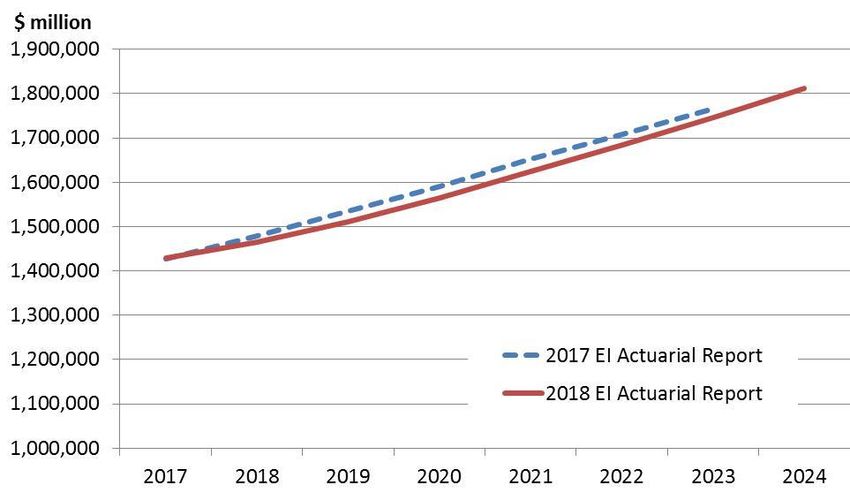
Canada Employment Insurance Commission
• The CEIC plays a key role in overseeing the EI program.
• ESDC and Service Canada carry on the administration of the EI program on behalf
of the CEIC.
• The CEIC is composed of Commissioners representative of employers, workers and
the Government.
• Judith Andrew, Commissioner for Employers
• Pierre Laliberté, Commissioner for Workers
• Louise Levonian, Deputy Minister of ESDC
• Leslie MacLean, Senior Associate Deputy Minister of ESDC and Chief Operating
Officer for Service Canada
• The Vice-Chairperson votes on decisions only if the Chairperson is unavailable
• The CEIC annually monitors and assesses the EI program, as well as has
responsibilities in:
EI policy and regulations
Financial transparency/rate-setting
EI appeals 3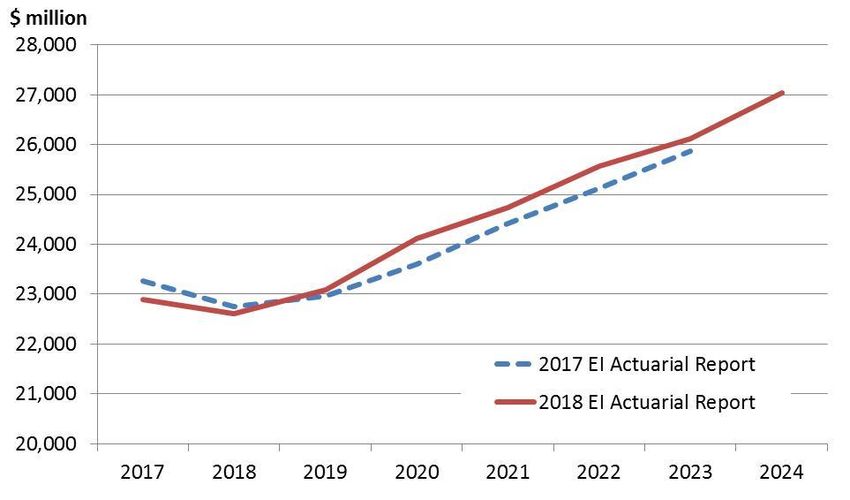
Office of the Chief Actuary
• Independent Unit within OSFI
• Mandate: conduct statutory actuarial valuations on the
Canada Pension Plan (CPP)
Old Age Security (OAS)
Federal public sector employee pension and insurance plans
• Canadian Forces • Public Service of Canada
• Federally Appointed Judges • Royal Canadian Mounted Police
• Members of Parliament
Canada Student Loans Program (CSLP)
Employment Insurance (EI) premium rate
• Tabled before Parliament by the Minister of Families, Children and
Social Development (since 2013)
4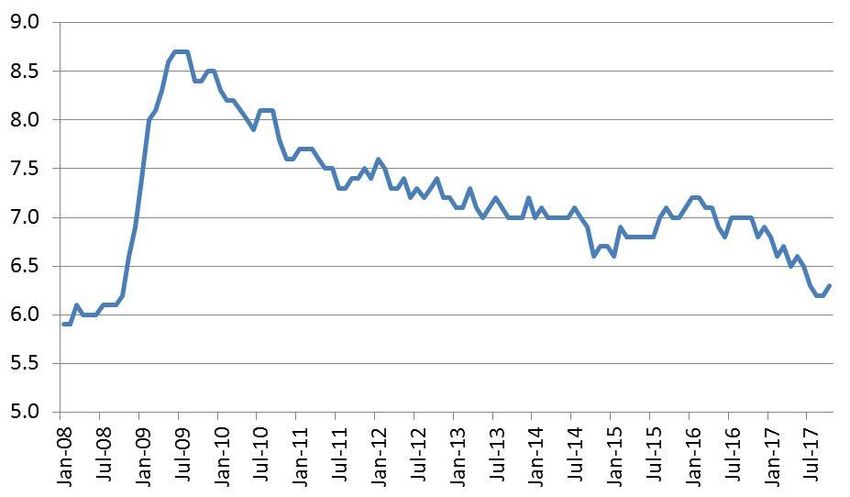
Employment Insurance – The Role of the Actuary
• The Commission shall engage the services of a Fellow of the Canadian Institute of
Actuaries (CIA) who is an employee of OSFI
• The actuary shall prepare actuarial forecasts and estimates and shall provide the
Commission with a report that sets out:
information provided by ESD and Finance
source of the data, actuarial and economic
assumptions and methodology used
calculations performed for the MIE
forecast premium rate
premium reduction for provincial plans
premium reduction for wage-loss plans
5A New Rate-Setting Methodology
• Budget 2011 launched EI consultations on “how the EI rate-setting mechanism can
be further improved to ensure more stable, predictable rates going forward”
• Key principles:
Ensure the program breaks-even over time
Avoid large cumulative surpluses or deficits
Maintain transparency in the rate-setting process
• Submissions and stakeholders suggested that it was necessary to continue to ensure
EI premiums are only used for the EI program and year-to-year fluctuations should
be limited
• In response to the consultations, a seven-year rate-setting mechanism was
introduced, to come into effect once the EI Operating Account achieved balance
6•Information provided to EI Chief Actuary by Departments
By July 21, 2017* of Finance (e.g., forecast unemployment rate) and ESDC
(e.g., program expenditures) 2018 EI Premium Rate
Setting Timeline
By August 22, 2017 •Chief Actuary’s Final Report provided to CEIC
•CEIC provides Summary Report and Actuarial Report
By August 31, 2017
to the Ministers of ESDC and Finance
•CEIC sets the premium rate, releases Summary Report
By September 14,
and makes the Actuarial Report available
2017
•Typically, Ministers of Finance and ESDC welcome the report
•Minister of ESDC shall cause Summary and
By September 29,
Actuarial Report to be laid before each House
2017**
of Parliament
= legislated date •Premium rate
January 1, 2018
becomes effective
*The legislated date is July 22, if a legislated date falls on a Saturday or Sunday
the deadline is advanced to the Friday before.
**The legislated date is “within 10 sitting days”
7The Information Used in the Actuarial Report is Coming from
Different Sources
Finance CRA
ESDC Stats Can
Methodology
and Additional
Assumptions
Developed by
the Actuary
8Maximum Insurable Earnings
$53,000
$1,800
$52,000
Maximum Employer Premium
$1,600 $51,000
Premium rate
$1,400 1.88% $50,000
Premium rate
Premium rate
MIE
1.66% $49,000
1.63%
$1,200
$48,000
$1,000
$47,000
$800
$46,000
$600 $45,000
2016 2017 2018
MIE Maximum Premium Out-of-Quebec Employer Maximum Premium Quebec Employer
The 2018 MIE is equal to $51,700
0.8% increase from the 2017 MIE of $51,300 92018 EI Seven-Year Forecast Break-Even Rate
EI Expenditures EI Revenues EIOA Balance
(2018-2024) (2018-2024) (31 Dec. 2017)
- Benefits (EI Part I) Employee Premiums Cumulative Surplus
- EBSM (Part II) TIE x (1 – PR%) x RATE at 31 Dec. 2016
- Admin. Costs
+ 2017 Expected Revenues
Employer Premiums - 2017 Expected Expenses
Premium
1.4 x TIE x RATE
Reduction for WLP
Premium Self-Employed Premiums
Reduction for PP TSEE x RATE
Year-to-year, the EI premium rate cannot change by more than 5 cents
10Historical and Projected EIOA and Premium Rates
$6.0 2.65% 2.75%
2.56%
2.43% 2.48%
$4.0 2.20%
2.08% 2.25%
EIOA cumulative balance (Billions)
1.83% 1.88%
1.78%
$2.0 1.73% 1.73%
1.66%
1.62% 1.63% 1.75%
1.56%
$0.0
1.25%
($2.0)
Projected at 0.75%
($4.0) $675M
0.25%
($6.0)
Projections
-0.25%
($8.0)
($10.0) -0.75%
2009 2010 2011 2012 2013 2014 2015 2016 2017 2018 2019 2020 2021 2022 2023 2024
EIOA End of Year Cumulative Balance Forecast Break-even rate Premium rate 7-year Forecast Break-Even Rate
11The Unemployment Rate Has An Impact on Both Sides of the
Equation
The Unemployment Rate And is Expected to Decrease Further
Has Been Trending Down… Over the Next Five Years
2017 2018 2017 Fall
Actuarial Budget Actuarial Economic
Report * 2017 Report * Statement
2016 7.0 7.0 7.0 7.0
2017 6.8 6.9 6.6 6.5
2018 6.4 6.7 6.5 6.3
2019 6.2 6.7 6.5 6.3
2020 6.2 6.6 6.5 6.4
2021 6.2 6.4 6.3 6.3
2022 6.2 6.3 6.1
Average 2017-2023 Average 2018-2024
6.3% 6.4%
12
* Unemployment Rates Assumptions used in Actuarial Reports are provided by the Department of Finance.The Recipiency Rate is an Important Element of the
Projections of EI Expenditures
Unemployed Recipiency Rate:
(U)
74% of potential claimants
are receiving EI benefits
No Insurable Insurable Not all potential claimants are
Earnings in the Earnings in the receiving EI benefits since:
Last 52 Weeks Last 52 Weeks
• They have not accumulated the
required number of insurable
hours; or
Invalid Job Valid Job
Separation Separation • They do not apply for EI benefits.
Potential
Claimants
= 56% of U 13Projected EI Expenditures and Revenues
Projections of EI Expenditures Projections of EI Earnings Base
Resulting 7-Year Forecast Break-Even Rate for 2018 1.66%
14EI 7-Year Forecast Break-Even Rate Sensitivities
With all other assumptions remaining constant, over the 2018-24 period:
Variation in Average Impact on Rate
6.4% ± 0.5% ± 0.07%
Unemployment Rate
Impact on Rate
Variation in Average 74% ± 5% ± 0.05%
Recipiency Rate
Impact on EIOA
Variation in over 7 years
1.66% ± 0.01% ± $1.1B
Premium Rate
15Maternity and Parental (MP) Rate
• Canada-Quebec Agreement : MP rate is the ratio of EI MP expenditures to the
earnings base of residents outside the province of Quebec (OQ)
• 2018 QPIP Reduction = 0.36%
EI MP Earnings
MP Rate Expen- Base
ditures (OQ)
Employer Premiums (OQ)
Employee Premiums (OQ)
Self-Employed Premiums (OQ)
16Premium Reduction for Wage-Loss Plans
2018 Rounded Employer Multiplier Employer Multiplier
Rates of Reduction (Out-of-Quebec) (Quebec)
Category 1 0.21% 1.273 1.238
Category 2 0.36% 1.182 1.122
Category 3 0.35% 1.187 1.128
Category 4 0.39% 1.167 1.103
• Multiplier calculation:
1.273 = (1.66% × 1.4 – 0.21%) / 1.66%
1.238 = (1.30% × 1.4 – 0.21%) / 1.30%
17Conclusion
• The rate for 2018 marks the second year the CEIC set the rate using the
seven-year break-even rate setting mechanism
• The announced rate for 2018 is $1.66 per $100 of insurable earnings,
and $2.32 per $100 of insurable earnings for employers
• Going forward, the rate will continue to be forecast using up-to-date
economic information and expected EI program expenditures
• This mechanism helps to keep rates low and stable and set transparently
• The Government continues to ensure that EI revenues are only used for
EI expenditures
18Employment Insurance – Premium Rate Setting Mechanism 2017 EI Commissioner’s Employer Forum 30 November 2017 Thank you
You can also read


