Engineering excellence - Australian Academy of Technology and ...
←
→
Page content transcription
If your browser does not render page correctly, please read the page content below
Australian academy of Technological sciences and engineering (ATSE)

                                                           Number 161
                                                            April 2010

                    engineering
                     excellence
COLLABORATION AND INNOVATIVE THINKING
Contributors from some of our top engineering firms
   describe ground-breaking Australian engineering
       projects and techniques – and the issues and
     options for Australian leadership in engineering
Arup
is no ordinary firm
We are an
independent firm
of designers, planners,
engineers, consultants
and technical specialists
offering a broad range
of professional services.
Through our work, we
make a positive difference
in the world.

Arup looks at every project,
big or small, with a fresh
perspective. The firm supports
and promotes in its people a
willingness to think laterally.
Often, this willingness to take
a creative approach produces
ideas and concepts that may not
have been immediately obvious,
but which deliver the best solutions.

Arup invests heavily in research
and development. It also invests in
skills networks and facilitates the
constant exchange of ideas between
its people, no matter where they are
based or what discipline they belong to.

The firm’s commitment to sustainability
is at the heart of every project. The firm
is acutely aware of the responsibility it has
in designing and influencing the built
environment, to do the best possible work
for current and future generations.

The result is solutions that work for clients and
for the people who use them and live or work in
and around them.

We shape a better world | www.arup.com
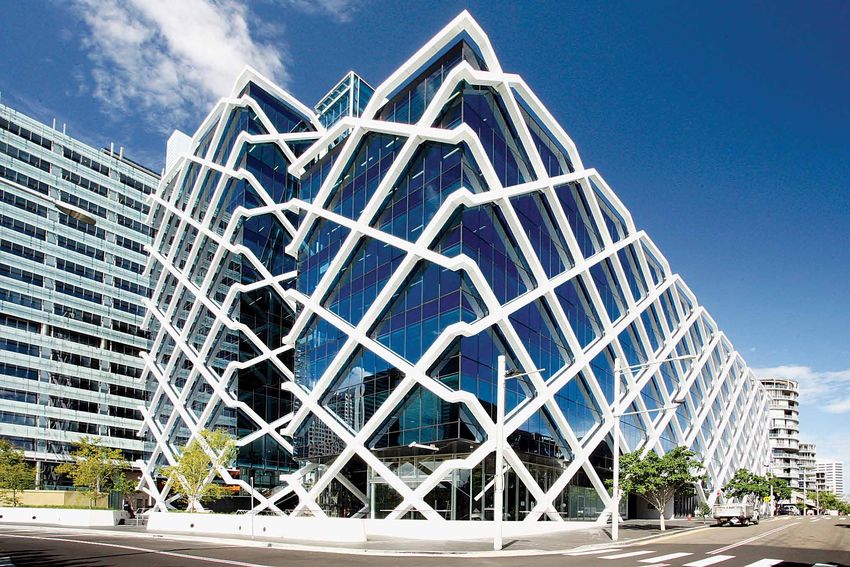
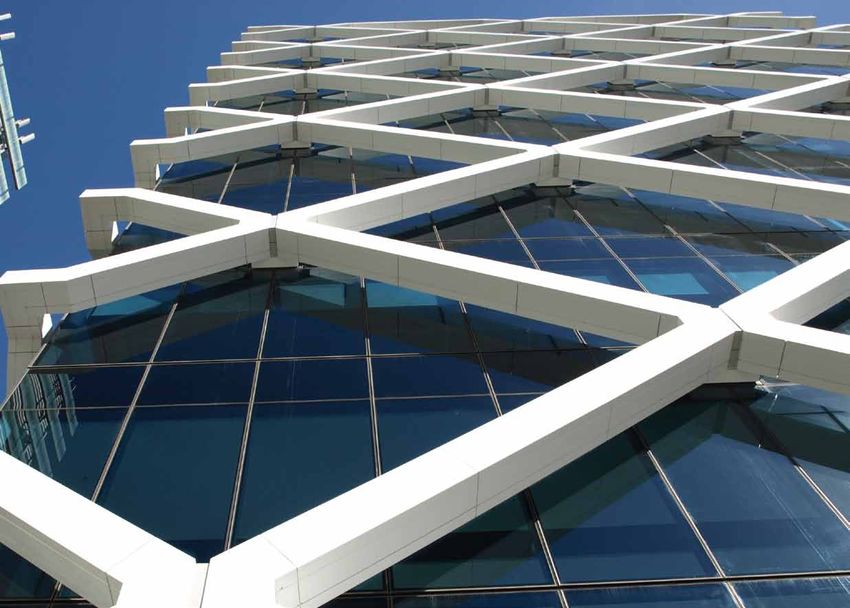
Photo: One Shelley Street – Winner, Building and Structures
category, Engineering Excellence Awards 2009 | ©Arup
contents                                   3
                                                                                                                                                                                                      Apr 10
                                                                                                                                                                                                      Focus

            5
            Modelling – engineering
            moves into the virtual
            world
            By Anthony Barry

            9
            Irrigation modernisation –
            sustainability in action
                                                                                                                    Irrigation for the 21st century – FutureFlow style (see page 9).

                                                                                                                    17	Form, function and sustainability
                                                                                                                    21	Necessity drives sustainable water
            By Paul Dougas                                                                                              solutions

            13
                                                                                                                    23 	ATSE focuses on electricity for the next
                                                                                                                         40 years
                                                                                                                    25 	ATSE hosts national energy briefing
            Engineering big bridges                                                                                 27	Front and centre at ThinkFuture 2010
            in South-East Asia                                                                                      31 	German team visits for photovoltaic talks
            By Richard Kell
                                                                                                                    34 	Teachers go back to school for science
                                                                                                                         and technology
               AUSTRALIAN ACADEMY OF TECHNOLOGICAL SCIENCES AND ENGINEERING (ATSE)

                                                                         NUMBER 161
                                                                          APRIL 2010

                                                                                                                    35	Government praises STELR and boosts
                                                                                                                        science teachers
                                                                                                                    41 	Science must be exposed
                                  ENGINEERING                                                                       46 	ATSE in Focus
                                   EXCELLENCE
              COLLABORATION AND INNOVATIVE THINKING
              Contributors from some of our top engineering firms                      Front cover: The dramatic diagrid faces of
                 describe ground-breaking Australian engineering
                     projects and techniques – and the issues and                      One Shelley Street, Sydney.
                   options for Australian leadership in engineering
                                                                                       Photo: Arup

                                                                                                                    ATSE is an independent body of eminent Australian engineers and scientists established
                                                                                                                    to promote the application of scientific and engineering knowledge to practical purposes.
                                                                                                                    ATSE Focus is produced to serve this goal.
                                                                                                                    Opinions expressed in this publication are those of the authors, and do not necessarily
                                                                                                                    reflect the views of ATSE. Material published in Focus may be reproduced provided
                                                                                                                    appropriate acknowledgement is given to the author and the Academy.

ATSE Focus is produced to stimulate discussion and                                                                  CEO: Dr Margaret Hartley
                                                                                                                    Editor: Bill Mackey
public policy initiatives on key topics of interest to the                                                          Technical Consultant: Dr Vaughan Beck FTSE
Academy and the nation. Many articles are contributed                                                               Australian Academy of Technological Sciences and Engineering (ATSE)
by ATSE Fellows with expertise in these areas. Opinion
                                                                                                                    Address: Level 1, 1 Bowen Crescent, Melbourne
pieces on topics of national interest, particularly the                                                             Postal Address: GPO Box 4055, Melbourne, Victoria 3001
Academy’s key interest areas – climate change impact,
                                                                                                                    Telephone: 03 9864 0900
water, energy and education – will be considered for                                                                Facsimile: 03 9864 0930
publication. Items between 800 and 1500 words are                                                                   Email: editor@atse.org.au
preferred. Please address comments, suggested topics                                                                ACN 008 520 394
and article for publication to editor@atse.org.au.                                                                  ABN 58 008 520 394
                                                                                                                    Print Post Publication No 341403/0025
Deadline for the receipt of copy for next edition of Focus is                                                       ISSN 1326-8708

14 May 2010.                                                                                                        Design and production: Coretext 03 9670 1168 www.coretext.com.au
Achieve
                                          international research excellence.
                                          Join us.
BC&YUNWG431 CrICos Provider Code 00126G

                                          If you want to achieve world-class results and work with researchers who are already doing just that,
                                          we invite you to join The University of Western Australia. As a member of Australia’s Group of Eight
                                          research-intensive universities, our focus is on working with the brightest and the best. We continue
                                          to attract international award-winning teachers, researchers and students whose individual reputations
                                          have helped to build ours. To explore the exciting opportunities available visit www.uwa.edu.au
engineering              5
                                                                                                              excellence
                                                                                                                                  apr 10
                                                                                                             www.atse.org.au      Focus

Modelling – engineering moves
into the virtual world
Modelling and simulation helps decision makers to envision the future they seek to create
and gives them confidence in making successful investment and commitment decisions.

                By Tony Barry
                barrya@ap.aurecongroup.com

T
        echnology is changing the face of engineering,
        management and the delivery of specialist techni-
        cal services. Advances in computing have made it
        possible to vastly extend the range and depth of
modelling and simulation applications within engineering
consultancies.
    Increasingly, global consultancy businesses are turning
to advanced simulation and modelling to deliver reduced
risk across a project lifecycle and to create optimum design
solutions for clients.
    Whether developing infrastructure or industrial, com-
mercial, environmental or community-based projects, the
capability to model multiple facets of complex projects is
saving time, money and reducing project risk.
    By incorporating various future scenarios and detailed
projections, estimates and statistics into simulations early
in the project-planning phase, clients benefit from signifi-
cantly reduced project risk.
    Modelling and simulation assists decision makers to          that are skilled in such areas as finite element modelling,    Modelling
envision the future they seek to create and gives them con-      blast and impact simulation, computational fluid dynam-        improves
fidence in making successful investment and commitment           ics for fire safety engineering, wind flow and façade mod-     freight
decisions.                                                       elling. By combining these technologically based outputs,      forecasts
                                                                 clients derive direct benefits from having more accurate       and
Testing infrastructure scenarios                                 pricing information, a smoother construction program           planning.
Engineering consultancies are increasingly being called          and improved facility management and maintenance.
upon to provide clients with ultimate confidence in their             The integration of design, analysis and documentation
project investments.                                             of projects, using 3D modelling software packages, is prov-
     One method for delivering this is by creating virtual       ing particularly useful to clients. This technology is being
environments where it is possible to test the viability of       applied in the property sector, where a single 3D represen-
building materials, resources, proposed project sites and        tation for thermal modelling, energy modelling, lighting
consumption forecasts, as well as environmental and com-         models, structural modelling and many other areas of ad-
munity impacts to design best practice project solutions.        vanced analysis is developed and presented to clients.
     Many of these technologies previously existed as indi-           On major property projects, clash detection is being
vidual systems, but at Aurecon we are pioneering 3D mod-         used to check structural designs for interference prior to
elling capabilities by integrating them into our entire busi-    construction between different design elements. By identi-
ness to create a holistic, virtual project scenario to present   fying potential structural clashes during the design phase,
to clients.                                                      costs and delays associated with discovering problems dur-
     Today’s engineering consultancies now contain teams         ing the construction process are reduced.
6      engineering
           excellence
  apr 10
  Focus    www.atse.org.au

                 Increasingly, information is embedded in the various            More importantly, strategic transport modelling and
             models, which allows equipment and materials schedules          demand forecasts assist governments to plan transport in-
             to be created automatically. This improves the service that     frastructure so it is efficient, sustainable, cost-effective and
             is provided to the clients and contractors, both during and     flexible for future expansions. Aurecon undertook freight
             after construction, once the building is occupied.              movement modelling in Melbourne for the Victorian De-
                                                                             partment of Transport that reflected freight movement
             Transport infrastructure                                        along various sections of the supply chain. The data was
             Urban personal transport systems are very complex, with         then used to strategically plan future systems to cater for
             a large number of factors influencing travellers’ choices for   Melbourne’s freight growth.
             a particular trip. An increasingly important issue for trans-       Traffic-flow modelling capabilities allow engineers,
             port agencies is the design and implementation of multi-        planners, owners/operators and governments to consoli-
             modal transport systems that ultimately provide improved        date complex data into a clear and comprehensive model
             options for travellers and enable mode choices that reduce      that considers project impacts on environment, local com-
             congestion and emissions in urban areas.                        munities, retail hubs and industry developments.
                  From light rail urban commuter lines to economically           Intricate microsimulation models provide clients with
             vital freight and mixed-use networks, diverse modelling         a valuable intellectual asset that can be used for a pleth-
             capabilities support any rail project scenario.                 ora of purposes, offering considerable cost savings across
                  Through railway network simulation software packag-        multiple projects. In New Zealand, Aurecon delivered a
             es, such as OpenTrack and TRAIN, engineers at Aurecon           dynamic simulation model to forecast traffic flow and de-
             can replicate complex rail systems to design critical infra-    mand generated by one of the country’s largest retail de-
             structure and power supply solutions.                           velopments. This provided the client with significant cost
                  This sophisticated technology incorporates track pro-      savings, as variations to designs and environmental impact
             files, speed limits, signalling configurations and timetable    were assessed prior to construction.
             information to quickly and easily identify the impacts of           For the future, emerging developments in computing,
             different design options. The effects of adding or moving       networking and data storage promise to further revolutio-
             infrastructure design components can be instantly evalu-        nise how simulation will be applied by engineers and tech-
             ated, considerably reducing timelines on design programs        nical consultants in the future.
             and associated project risks.
                  Aurecon’s unique in-house freight vehicle modelling        Wind modelling
             framework estimates heavy commercial vehicles and their         As the world embraces green energy solutions, consultants
             distribution patterns across a supply-chain network. Cli-       are turning to sophisticated modelling technology to help
             ents, both public and private, can use this information to      clients site strategically located and cost-effective wind farms.
             better understand these movements, ultimately leading to             Essential for reducing project risks and assessing feasi-
             better policy and infrastructure planning.                      bility, meteorological models analyse the physics of a par-
                                                                             ticular site’s atmosphere to predict wind speeds based on
             Designing for future requirements                               reliable simulations of actual weather events. This data al-
             Advanced modelling systems allow public and private sec-        lows in-house meteorologists and wind experts to identify
             tor clients to estimate the economic benefits of upgrading      the best locations for siting wind farms. This technology
             key import/export transport facilities through accurate         delivers financiers considerable cost savings in the pre-
             forecasts up to 25 years into the future. The framework         feasibility phase and drives investment confidence in the
             created by such modelling allows testing for road infra-        emerging energy-generation market.
             structure plans or policy changes to determine the effect            Aurecon used a ‘world first’, in-house modelling system
             on road use, congestion, and road wear and tear.                on the Castle Hill Wind Farm project in New Zealand to
                  The resultant model draws upon many multidisci-            demonstrate that initial uncertainty in wind farm develop-
             plinary techniques, including statistical analysis and mod-     ment can be significantly reduced using advanced analyti-
             elling, econometric modelling, supply-chain modelling           cal modelling techniques.
             and mapping and survey design.                                       Advanced mesoscale modelling capabilities saved the

Letters to the Editor
ATSE Focus welcomes letters from readers in response to articles. Please keep letters brief to enhance publication
prospects. Longer letters may be run as contributed articles. Please address to editor@atse.org.au
engineering                 7
                                                                                                                     excellence
                                                                                                                                              apr 10
                                                                                                                     www.atse.org.au          Focus

client substantial costs and development time and added            Anthony Barry FTSE is Chief Executive, Asia Pacific of Aurecon and has 34
significant value to the project by verifying performance          years of experience in engineering, 27 of which have been in consulting. As a civil
projections and determining the optimal turbine location           engineer, he worked on many road and highway projects, with later experience
sites. With proven accuracy and reliability, this technology       in land development, mining and airport and other transportation projects. He
is becoming a vital tool in developing future wind farms           subsequently diversified into major land and urban redevelopment projects. He
around the world.                                                  holds a Masters of Engineering Science and has served as National President of
     Drawing upon experience in every stage of wind farm           the Association of Consulting Engineers of Australia from late 2004 to 2006, and
design and development, our meteorologists and wind ex-            remained a director until November 2008.
perts turned to modelling technology for Castle Hill Wind
Farm’s initial wind resource assessment, rather than the
traditional approach of erecting short monitoring masts.            Modelling delivers better project outcomes
Measured data from masts, which have since been erected,            Freight modelling
confirm Aurecon’s original predictions and demonstrate              Aurecon has designed and developed Australia’s first freight-movement
that the confidence clients have in innovative approaches           model to improve urban freight forecasts and aid with transport planning.
to wind farm design is well placed. This wind-modelling             Initially developed for the Victorian Department of Transport, the model
technology has already been used on projects in Austra-             reflects freight movements along various sections of the supply chain and
lia, New Zealand, South Africa, Afghanistan, Morocco,               can be used to strategically plan future freight systems in Melbourne. Since its
Malta, Poland, France, Belgium and the UK.                          implementation, Aurecon has been engaged by transport agencies in Sydney,
                                                                    Brisbane, Perth and Adelaide to transform the model so that it is applicable to
Looking to the future                                               these respective cities’ freight transport networks.
As the role of engineering management and specialist technical
services consultancies expands, new technologies will play an       Eden Park Stadium
ever-increasing part in project assessment, design and delivery.    Aurecon is providing structural engineering for the redevelopment of the
    While engineers will always be called upon to design,           Eden Park Stadium in Auckland, New Zealand. The upgrade will allow the
manage and deliver complex projects, they will increas-             stadium to have a permanent seating capacity of 50,000, with an increase to
ingly turn to modelling as a powerful tool that improves            60,000 for the 2011 Rugby World Cup. By undertaking extensive wind tunnel
project quality and lifecycle performance.                          testing and computational fluid dynamics (CFD) modelling, Aurecon ensured
    As engineers respond to the challenges of creating a            natural ventilation within the covered concourse spaces. The modelling
better and more sustainable world for future generations,           enabled the firm to define structural loads on the cantilever roof and stadium
powerful modelling tools enable businesses like Aurecon             envelope, minimise the height of fume exhaust stacks, assess smoke spill and
to deliver innovative solutions that are supported by even          ensure pedestrian comfort.
deeper technical analysis. t

  Eden Park Stadium for the future.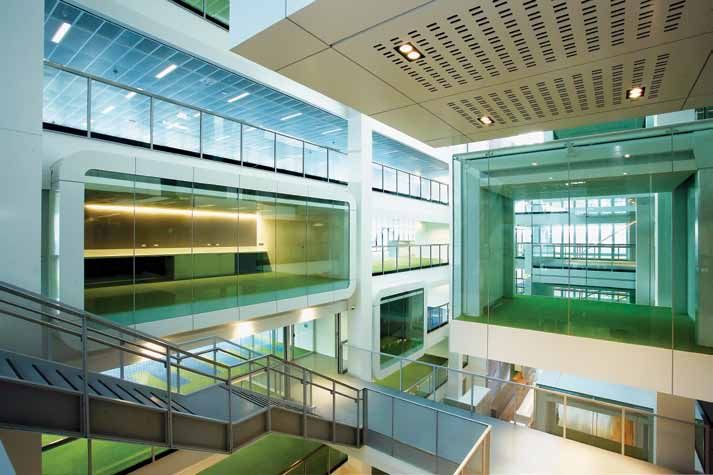
JAM USA/0593/B CRICOS PROVIDER NO 00121B
                                 Helping the world
                                        see clearly.
                                     The cornea, the eye’s window on the world, plays a vital role in ocular function
                                    by allowing the passage of light through a transparent surface. When the corneal
                                     surface is damaged, through injury or disease, this can lead to a loss of visual
                                                                                      acuity and ultimately blindness.

                                          At UniSA’s Mawson Institute, Senior Research Fellow Dr David Steele and
                                         his team are using plasma polymer coatings, films produced from organic
                                     compounds, to coat contact lenses. These polymer coatings can be tailored to
                                    provide the optimum surfaces for specific types of cells. With this new science,
                                    there is the potential to restore vision by a cell therapy technique – transplanting
                                       a new corneal surface grown in the laboratory from the patient’s own cells.
                                        This research is part of an international collaboration between the Mawson
                                      Institute, the Centre for Eye Research Australia, the Bernard O’Brien Institute
                                                                                  for Microsurgery and the L V Prasad.

                                     In an allied project to develop a complete bioengineered cornea, the Mawson
                                   Institute’s expertise in biomaterials preparation and surface engineering is again
                                  being harnessed. This bioengineered cornea, to be constructed from a polymeric
                                  scaffold incorporating cells, will play an important role in the discovery, development
                                    and selection of new ophthalmic drugs and novel ocular drug delivery systems.

                                            This research is another example of how UniSA continues to expand its
                                          reputation for outstanding collaborative achievements and ground breaking
                                                                 research, making a real difference to the way we live.
      “The international
 collaborative development                 For more information about research at UniSA visit unisa.edu.au/research
of a cell therapy to resurface
     the cornea will help
  address a major cause of
   blindness worldwide.”
  Dr David Steele, Senior
     Research Fellow.
engineering          9
                                                                                                                    excellence
                                                                                                                                      apr 10
                                                                                                                    www.atse.org.au   Focus

Irrigation modernisation –
sustainability in action
The FutureFlow project is delivering economic, social and environmental benefits well
beyond the project boundary, and will do so for the design life of the capital works.

                By Paul Dougas, with Ross Titchmarsh and David Mathlin
                pdougas@skm.com.au

T
         echnology, science and innovation are central to          100-year-old irrigation system by updating water chan-
         finding solutions to the many economic, social and        nels and delivery infrastructure, thereby making more
         environmental challenges we face today.                   water available to the environment in the Murray–Dar-
             Our clients and communities need help to ad-          ling basin; and
dress sustainability issues. With appropriate skills and an        to engage all stakeholders along the entire irrigation
                                                                 ¢
ability to foster innovation, engineers, scientists and proj-      channel without disrupting water supply during the
ect managers are in a powerful position to respond.                project.
     There is an opportunity to embed sustainability in ev-
erything we do – deliberately and by design.                      Irrigation for the 21st century – FutureFlow style.
     Embedding sustainability is easy to say and harder
to do, as it requires us to completely rethink how we ap-
proach the scoping and delivery of projects. But we are
now seeing the delivery of significant and far-reaching
benefits through major projects, with the FutureFlow Ir-
rigation Modernisation Project being a recent example.
     The FutureFlow project in the Goulburn–Murray Wa-
ter region in northern Victoria is now the world’s largest
automated irrigation water management system. It is de-
livering economic, social and environmental benefits well
beyond the project boundary, and will do so for the design
life of the capital works.
     The project was a collaboration between Goulburn–
Murray Water’s FutureFlow alliance – which included
Sinclair Knight Merz (SKM), Transfield Services Australia
and Comdain – and several suppliers, including Rubicon
Systems Australia. It built on previous research and pilot
works undertaken by Goulburn–Murray Water and fund-
ing was provided by several Federal Government programs.

Innovative thinking
Following 12 years of drought, farmers’ reliance on an out-
of-date irrigation system was threatening the productivity
of this key food-production region.
    From the outset, the project had several important and
clear sustainability objectives requiring innovative thinking:
¢  to secure efficient water suppliers to one of Australia’s
    most important agricultural regions;
¢  to stem the massive 30 per cent water loss along the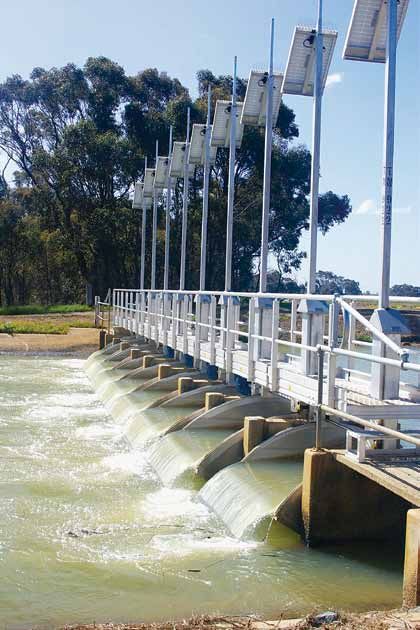
10 engineering
excellence
apr 10
Focus www.atse.org.au
Over 15 months, the $290 million project replaced ¢ r eplacing or rationalising 3500 Dethridge wheels – a
outdated irrigation infrastructure with a new integrated 100-year-old technology – with accurate electronic meters.
water-management system in record time, using innovative Many of the new electronic meters are fully automated,
approaches to project delivery. meaning they supply water to customers’ farms at the flow
More than 2000 kilometres of channels and thousands rate and times requested by the irrigators. These meters in-
of irrigation infrastructure assets were integrated into an teract with the FlumeGates to provide a fully integrated and
automated water-distribution network. efficient system and also interact with on-farm automation.
The FutureFlow consortium worked within a tight
timeline to deliver significant works. It employed a staged Radio waves
and systemic approach to ensure the project was delivered The new system includes solar-powered channel-control
efficiently, including: gates and water meters, which are integrated into a radio net-
¢ negotiating with customers to decommission work controlled by Goulburn–Murray Water’s Operations
unsustainable infrastructure and 50km of under- Support Centre. The water authority expects to have more
utilised channels; than 15,000 radio sites over its five water districts by 2012.
¢ upgrading the communication network to enable the The new system can automatically process customer
thousands of new electronic assets to communicate via orders and deliver the exact amount of water when and
radio; where it is required. Previously it could take four days for a
¢ replacing manual drop bar regulators with more than request to be delivered.
1700 automated regulating structures – FlumeGates – Because the system measures inflows and outflows in
to automate flows and provide information on channel real time, the performance of each channel can be evalu-
performance; ated and areas with high water loss identified.
¢ upgrading high-loss pools through plastic lining or The project will save more than 94 billion litres of wa-
replacing channels with pipelines; and ter each year – equivalent to approximately 17 per cent of
Excellence in delivering information
l Professionally written and produced publications
l Information products that showcase R&D at work
l Our passion is creating content that matters
Coretext specialises in developing publications for organisations devoted to knowledge-raising through science,
education, research & development. We provide communication strategies, editorial, design, production and publication
distribution for a broad range of clients and audiences.
www.swinburne.edu.au
In SItu leaChIng IROn ORe gOld ReCOveRy
fiSherieS reSearch & deVelopment corporation News
Mining gold Cast-iron future Together two
without for Australia compounds
a mine hinges on answer gold
Page 3 research recovery woes
Page 6 Page 9
MARCH – APRIL 2010
Issue 9 | March 2010
OILSEED BREEDING SUPPLEMENT CSIRO research in minerals processing and metal production February 2010
Bacteria PAGE 3 INDUSTRY POSITIONING
surface PAGE 5 SUNFLOWERS
surprise P3 PAGE 6 CANOLA
PAGE 18 SOYBEANS
Cultural pride’s PAGE 20 CROP BIOFACTORIES gOld
education
role P8
PAGE 22 BETTER OILSEEDS
CFD sheds light on the
Vaccine hope
curious workings of a gold jig
for childhood Key points
virus P18 p CFd has been used to understand how
a gold jig works
p An important finding was how the
vessel’s circular shape and central slurry
Increased break
injection point helps performance
p optimum operating parameters for
different applications were identified
Volume 18 number 1
march 2010
crop options By tIm tReadgOld
Albert einstein and Sir Isaac Newton
had their scientific explanations for gravity,
but goldminers have never really cared
how it works, just as long as gravity helps
separate gold from lighter minerals.
Some of the earliest gold processing
Knowledge
techniques – from panning, sluicing and
dry-blowing, when no water was available
– were early, simple uses of gravity.
The same force is at work in a
thoroughly modern gold-extraction
technique, which is at the heart of the
Inline Pressure Jig (IPJ) of Gekko Gekko Systems InLine Pressure Jig in operation. Photo: Gekko SyStemS
Systems, a company based in the historic
Is being
Victorian goldmining city of ballarat. a senior member of the CFD team, says modelling was the circular shape of the
While the jig is much faster and far the assignment required constructing a vessel itself and the central slurry injection
ReD prawns
HOT
more efficient than the original gravity computer model that replicated the jig’s point from which slurry disperses in all
separating techniques used by oldtimers, internal workings. directions.
Gekko was keen to better understand the “We had to incorporate into the model “As the slurry slows down there is a
science inside the device so they could all of the factors at work in the jig, from greater opportunity for the gold to drop
optimise its performance. the round shape of the vessel, the nature of out onto the ‘gold pan’.
enter CSIrO’s computational fluid the slurry being injected, the flow rate, and “Other jigs lack the circular shape
dynamics (CFD) team, which was happy the effect of a pulsing (or jigging) action and are more like long channels, so the
to take up the challenge. on the slurry,” Dr Solnordal says. flow rate across the screen where heavy
Gekko wanted to know what happens “The result is a model that explains material falls out stays constant … it’s not
inside the closed world of its IPJ in order why Gekko’s IPJ achieves high recoveries spreading out, it’s like water flowing down
Centre draws on Indigenous wisdom to provide a more detailed description to
its clients and market it more successfully.
Dr Chris Solnordal, project leader and
of both fine and coarse mineral particles.”
Dr Solnordal says one of the most
important factors revealed in the computer
a river.”
As the gold drops out of the slurry
ConTinued PAGe 2
the party
favourite
GCS_1003_p01-13.indd 1 11/02/10 12:26 PM
Science adds value to seafood
Warming waters speed rocklobster growth
comfort crucial for travelling oysters
www.coretext.com.au T 03 9670 1168 | F 03 9670 1127 | PO Box 12542, Melbourne VIC 8006, Australia | Level 2, 100 Franklin Street, Melbourne VIC 3000, Australiaengineering 11
excellence
apr 10
www.atse.org.au Focus
the volume of Sydney Harbour, or 37,600 Olympic swim- Water Innovation Award.
ming pools. Most of this saved water will be returned to The Murray–Darling is now under enormous stress
northern Victoria’s stressed rivers and wetlands via envi- as a result of past water-allocation decisions, prolonged
ronmental flows. drought, natural climate variability and emerging climate
The automated channel system will better control pass change. Exemplifying sustainability in action, this project
flows into receiving rivers and wetlands to mirror natural serves as a great role model for other applications, poten-
flow patterns. A proportion of the savings will be returned tially elsewhere in the Murray–Darling Basin.
to local irrigators to increase their water entitlements, fur- SKM has already played a role in helping determine the
ther enhancing the viability of their individual enterprises. ongoing effects that reduced rainfall and runoff will have on
available water and the resulting impact on water users in
Energy smarts the Basin. We have completed hydrologic and groundwater
The gravity irrigation system is an extremely low-energy modelling for the Murray–Darling Basin Commission and
system. The exclusive use of solar power on the irrigation investigated the impact on the various water demands for
infrastructure maintains this low energy profile. It is esti- all catchments in Victoria and the majority in NSW.
mated that 215 kilowatts of renewable power is generated Irrigation modernisation almost certainly has a further
from the solar-powered system. role to play in the economic, social and environmental sus-
The next stage is providing on-farm efficiencies, such as tainability of the Murray–Darling Basin. t
using soil moisture probes, drip irrigation and high surface
irrigation, which have the potential to raise application ef- Paul Dougas FTSE is Chief Executive Officer and Managing Director of Sinclair
ficiency from 70 to 90 per cent. Knight Merz. Ross Titchmarsh was SKM’s Project Manager on the FutureFlow
A key challenge for the project was to build an excel- Irrigation Modernisation Project and David Mathlin acted as SKM’s senior
lent relationship with the irrigation community. This was representative on the FutureFlow Alliance leadership team.
largely due to the size of the project, its complex logistics
and tight timeframe. Laying the groundwork for
Twenty full-time customer consultation officers were more efficient irrigation.
employed to meet irrigators, explain the project and help
with the commissioning and operation of their new irriga-
tion assets. More than 2500 individual irrigators and land-
owners were consulted, and the project’s final design was in-
fluenced by the individual requirements of each customer.
Independent farm designers were also employed to
provide irrigators with advice about meter size and flow
rate. The design was continually evolving and required
strong cooperation within the alliance as the construction
team implemented work in stages.
This effective consultation meant all customers agreed
to works on their property and legal powers were not re-
quired to access land.
The local area benefited from employment and, where
possible, supplies were procured in the region. Rubicon
upgraded its manufacturing plant in Shepparton to pro-
duce the automated irrigation gates required for the proj-
ect, which also provided significant local employment.
A model for the future?
A project like FutureFlow is special because it tests the
boundaries of what has been done before. And it is spe-
cial because it examines the broader community context
of which it is part.
It showcases the best of Australian engineering and re-
cently won the Australian Water Association’s prestigiousWhen science is in the headlines the
Australian Science Media Centre is there to make sure
the media get the message straight. Independent and
not-for-profit, the Centre aims to inform
public debate by encouraging scientists to better
engage with the media. With a growing database
of over 2000 experts and 500 registered journalists
you can’t afford not to know about us! To find out
more, visit our website at www.aussmc.orgengineering 13
excellence
apr 10
www.atse.org.au Focus
Engineering big bridges
in South-East Asia
The Batam-Tonton Bridge.
The iconic Anzac Bridge demonstrated the capacity of Australian engineers,
which has paid dividends in overseas work and export income.
By Richard Kell
richard.kell@cardno.com.au
B
ig bridges are complex structures that pose many Anzac Bridge it would not have been possible for Austra-
challenges for their designers and builders, who lian engineers to win overseas commissions for similar de-
must integrate their skills to achieve safe and ef- signs for overseas clients.
ficient structures. They are landmarks and form The bridge provided the impetus for the builders, Baul-
vital links within cities or regions. They must withstand derstone Hornibrook, and engineers, Cardno, to become
traffic loads and the impacts of high winds and seismic, involved in similar bridges in SE Asia and illustrates the
thermal, dynamic, material and geotechnical effects. lesson for the future that development by public authori-
Australian engineers and builders have been respon- ties of major infrastructure involving innovation and ad-
sible for many notable big bridges in South-East Asia in vanced technology has the capacity to impact favourably
recent years. Much of this success derived from the repu- on export opportunities. This is not normally considered
tations of major Australian bridges – Melbourne’s Bolte at the time of evaluating projects.
Bridge and Brisbane’s Gateway Bridge and, in particular, Australian engineering has delivered the Friendship
the cable-stayed Anzac Bridge at Glebe Island in Sydney. Bridge across the Mekong River border between Nong
The iconic Anzac Bridge demonstrated the capacity of Khai (in Thailand) and Vientiane (in Laos), the My Thuan
Australian engineers, which has paid dividends in overseas Bridge over the Mekong near Vinh Long, and the Phu
work and export income. The vision and courage that was My Bridge over the Saigon River in Ho Chi Minh City,
required to design and construct Anzac Bridge contributed Vietnam. Others have included the Batam–Tonton Bridge
significantly to Australia’s reputation amongst our Asian between Batam Island and Tonton Island, Indonesia; the
neighbours for technologically advanced bridge engineering. Steel Bridges Program (some 3500 bridges) in Indonesia;
Without the reference of a project as successful as the the Sarawak Bridges Program in Malaysia including three14 engineering
excellence
apr 10
Focus www.atse.org.au
major balanced cantilever bridges; and the Padma Bridge The Australian involvement in the Batam–Tonton
over the River Padma in Bangladesh, which will connect Bridge did not end with the proof check and detailed de-
the south-west of the country with its capital, Dhaka. sign by Cardno.
All of these bridges are landmark contributions to the Design of false-work and forms was carried out in Aus-
highway systems and the wellbeing of the people in each tralia and the Resident Engineers were also Australian.
country. Professor Harry Poulos AM FTSE, of Coffey Geotech-
Three major bridges are highlighted – all of which in- nical, provided advice of the foundations and the Bridge
volved Cardno, the Australian-based global infrastructure Branch of the NSW Roads and Traffic Authority carried
services consultancy. out the proof check of the Cardno design.
Batam–Tonton Bridge, Indonesia ASEAN Bridge, Sarawak, Malaysia
The Indonesian Government’s Batam Industrial Develop- The ASEAN Bridge over the Baram River forms part of
ment Authority (BIDA) administers the development of the North–South Trunk Road in the East Malaysian state
Batam and adjoining islands south of Singapore, including of Sarawak, linking Sarawak with Brunei.
a new road and bridges connecting the islands to establish The Baram River is Sarawak’s second-largest river and
a major manufacturing region. flows into the South China Sea, providing access to the
BIDA invited tenders for the construction of the undeveloped hinterland. It carries substantial river traffic
bridge – the first cable-stayed road bridge in Indonesia – including timber barges up to 3000 tonnes, small coastal
on a concept design prepared by the Institute of Technol- traders and many commercial passenger vessels.
ogy, Bandung (LAPI-ITP). Cardno was initially engaged The ASEAN Bridge is 11 kilometres upstream of the
by BIDA to carry out the proof check of the LAPI-ITP river’s mouth and replaced a vehicular ferry. The bridge
concept design including dynamic performance model- includes the longest main span in Sarawak, at 180m, and
ling, and was subsequently commissioned by the contrac- is also the longest bridge in Sarawak, with a total length
tor PT Pembangunan Perumbuhan (PT PP) to redesign of 1040m.
the pylons, the superstructure and abutments to better suit It is a private toll project, financed and operated by the
the contractor’s construction approach. Sarawak company Shin Yang Group, which has a 30-year
The cable-stayed bridge was designed to comply with operating concession. The construction was by Shin Yang’s
the Indonesian Bridge Design Code 1992 (based on the subsidiary, Woodville Development.
1992 Austroads Bridge Design Code) and comprises three Cardno designed the bridge with KTA (Sarawak),
spans (145.9 metres/350.0m/145.9m) with an overall leading Sarawak consulting engineers. Cardno was respon-
length of 641.8m. The bridge deck is on a vertical curve to sible for:
provide shipping clearance of 35m over the central 200m- ¢ overall concept design;
wide shipping channel. ¢ design of the 400m-long balanced cantilever river spans
The width of the bridge is 21.5m, providing two two- structure; and
lane carriageways with footways. The A-shaped pylons are ¢ inspections and assistance during construction as Chief
120m above the top of the pile cap level. Each pylon leg is Resident Engineer.
supported by a 16m-diameter pile cap on 30 cast-in-situ The bridge comprises three balanced-cantilever spans
piles of 1.5m diameter founded at 40m depth into hard of 110m, 180m and 110m over the river and T-girder ap-
siltstone. proach spans. The bridge has a summit vertical curve to
The deck consists of a reinforced concrete slab mono- achieve river clearance. The 20.5m deck comprises two
lithic with 2m-deep prestressed concrete cross-girders and carriageways with two lanes and footways each side.
edge beams. Two planes of post-tensioning stay cables The balanced cantilever section comprises a variable
support the deck from the pylons. The design allowed for depth, single-cell, post-tensioned concrete box girder, in-
replacement of a cable due to damage by corrosion or un- tegral with the main piers, segmentally constructed using
planned failure of the cable caused by freak traffic accident two 150-tonne OHT form travellers, with maximum can-
or terrorist action. tilevers of 91m.
Given the high seismic risk in the region, dynamic The approach span precast post-tensioned T-girders
analysis was critical to determine the adequacy of the py- are tied through deck link slabs across each pier to provide
lon foundations and abutments in terms of the dynamic a continuous deck with joints only at the main span.
behaviour of the bridge, prompting additional restraints in With the bridge’s close proximity to the South China
the final design. Sea, durability was recognised as an important designengineering 15
excellence
apr 10
www.atse.org.au Focus
criterion. Concrete strengths were nominated as high as
practically achievable and concrete covers increased above
minimum requirements, consistent with Australian bridge
design practice.
The pilecaps protrude above high-water level, visible
to traffic, and are shaped so that, if accidentally hit by a
barge, they prevent the barge ‘riding up’ the pilecap and
hitting the pier column. The main river pier pilecaps are
supported on 33 concrete-filled steel tube piles approxi-
mately 100m long and 1.5m in diameter, founded in a
very dense sand layer.
The ASEAN Bridge is typical of the modern balanced
cantilever bridge, with a slender parabolic profile for the
box girder superstructure. The choice of this structurally
efficient form of bridge has maximised the utilisation of
local material and labour.
Phu My Bridge, Vietnam
The Phu My Bridge, completed in October 2009, spans the
Saigon River in Ho Chi Minh City and will form part of
a new ring road currently under construction – an impor-
tant transport link from the southern Mekong delta region
to central and northern Vietnam.
The Phu My Bridge contract comprised the design
and construction of a 705m-long cable-stayed main bridge
with a clear span of 380m, and approach structures on ei-
ther side of 758m and 638m. The main span deck is 27m
wide and comprises six traffic lanes and foot/cycleways.
Clearance to river traffic is provided with 45m vertical The Phu My Bridge under construction.
clearance in a 250m-wide zone.
The bridge was constructed by BBBH Consortium, a
joint venture between Bilfinger Berger of Germany and girders linked by cross girders. Two vertical planes of stay
Baulderstone Hornibrook of Australia, the contractors cables are connected to the edge girders via precast anchor
for the Anzac Bridge in Sydney. The client, Phu My Bridge pods at 10m spacing. The deck was constructed segmen-
Corporation (PMC), is a private consortium of Vietnam- tally by balanced cantilever from each tower.
ese companies, which has a licence to operate the bridge as The project required significant planning to optimise
part of a toll road. the construction, with close collaboration between the
The main bridge design was produced in France by contractor and construction engineers (both Australian
the consultant Arcadis and the approach structures were German consortia), resulting in few problems during the
designed in Australia by Cardno, which also designed the construction process and achievement of a five-day con-
main bridge temporary works and construction engineer- struction cycle and completion in only 32 months. t
ing, together with Leonhardt, Andrä und Partner (LAP)
from Germany. Civil engineer Richard Kell AM FTSE was a director (1999–05) and chairman (until
Each pylon is founded on two groups of 14 piles, up to mid-2004) of Cardno Pty Ltd, a leading consulting engineering company listed on the
80m depth, with grouted bases, and connected by a two- ASX, with approximately 3000 staff and offices throughout Australia and overseas.
cell pilecap. The elegant 140m-high pylon towers are H- He is now a consultant to Cardno and a director of subsidiary company Cardno
shaped with two cross beams. Each tapering leg is a box sec- International Pty Ltd. He was President of the International Federation of Consulting
tion. The stay anchorages are located inside the tower box. Engineers (2003-05). He has almost 50 years’ experience working on infrastructure
The concrete deck slab is suspended from the pylons projects throughout Australia and overseas. He continues as Project Director on
by stay cables and is prestressed in both the longitudinal Cardno development assistance projects in Papua New Guinea, Indonesia and
and transverse directions. The deck has longitudinal edge Solomon Islands.Fostering, nurturing
and exciting
the inner scientist
teachers meet stelr across australia
Helping tHe teacHers Help tHeir students tHrougH stelr
• During March 370 teachers from 185 schools in all states and territories attended STELR professional
development workshops in Melbourne, Brisbane, Sydney and Perth. Teacher comments were warm and the
STELR concept was praised by Hon Richard Marles, Parliamentary Secretary for Innovation
and Industry, who opened the Melbourne workshop.
• “We need children studying science…we need them to grow up and want
to be scientists. Their work as scientists will help us deal with the challenges
of the future – the challenges of feeding the world, managing our resources,
the growth and development of our nation,” he said. “As teachers, you can
sow the seed of that enthusiasm for problem solving - show your students
that science is exciting, it is fun and it is worthwhile.”
tHe stelr program
• STELR is an exciting new curriculum program that aims to reverse the low level
of interest among students in science courses and careers.
• STELR targets students in Years 9 or 10 – and their science teachers – and will be provided
free of charge to 150 secondary schools from across Australia in 2010.
• STELR is a 6-to-10 week package involving inquiry-based activities. It engages students through investigations
into global warming, climate change and renewable energy resources.
• STELR operates within the curriculum. It is intended for delivery to all students in the year level.
2010 participating scHools receive:
• a comprehensive set of curriculum materials, including teacher and student resources;
• a class set of solar and wind laboratory equipment (yours to keep); “As sci
• on-going support throughout the year. your jo ence teacher
there i
b is so s,
s no m important ...
than yo ore
urs in o important jo
ur nati b
– Rich on tod
learn more about stelr at www.stelr.org.au ard Ma
Secret rl
es ay.”
or contact stelr project manager peter pentland ary fo , Parliame
and In r Innovatio ntary
dustry n
(03) 9864 0906 or peter.pentland@atse.org.au
The STELR Stage One Project 2009-2010 is supported
by the Australian Government.
STELR is a key initiative of the Australian Academy of Technological Sciences and Engineering (ATSE) www.atse.org.auengineering 17
excellence
apr 10
www.atse.org.au Focus
Form, function and sustainability
Sustainable materials,
alternative transport
options, recycling
facilities and the
ability to monitor
and track
environmental
performance of
the building
construction and
operation were
also fundamental.
Natural light floods the
One Shelley Street building.
By Tristram Carfrae
and John Hewitt
tristram.carfrae@arup.com.au
john.hewitt@arup.com.au
One Shelley Street at Sydney’s King Street Wharf is a striking mental performance of the building construction and opera-
combination of beauty and function. Featuring a magnificent tion were also fundamental to the environmental goals of the
external diagrid structure and internal atrium, the building building. This level of sustainability is increasingly sought.
establishes new benchmarks in environmental sustainability Comprising one level of retail and 10 levels of A-grade
and workplace functionality, achieving a 6 Star Green Star rating commercial office space, One Shelley Street required ex-
– the highest possible ‘green’ rating in Australia – from the Green pansive interlinked internal spaces to ensure connectivity
Buildings Council of Australia. between all work areas and to promote easy communica-
B
tion among the 3000 eventual occupants. Additionally, an
rookfield Multiplex’s brief for One Shelley Street indoor environment with superior air quality, occupant
was to create a premium commercial office build- comfort and abundant natural light was also a high priority.
ing with a strong architectural presence. Integral WSP Lincolne Scott and Advanced Environmental
to the competition-winning architectural design is were involved from the early concept stages to ensure the
its diagonal grid, or diagrid, structure – a steel frame run- client’s goal of a world-leading ecologically sustainable de-
ning through and on the outside of the building. velopment was realised. A comprehensive and site-specific
Conceived by architect James Fitzpatrick, the diagrid cre- environmental management plan was implemented and a
ates a distinctive visual characteristic and gives the building full-time environmental representative was employed to
its unique identity. Its 10-storey central atrium is filled with ensure compliance with set goals.
natural light and acts as the building’s hub, interconnecting In regard to energy, One Shelley Street was designed to
the floors with 26 cantilevered meeting pods and bridges. exceed the 5 star NABERS (National Australian Built En-
Paramount to the building’s success is its level of sus- vironment Rating System) benchmark by 40 per cent. This
tainability and the feasibility of its design in terms of cost. allows the potential for the development to emit a very low
Brookfield Multiplex wished to obtain the highest possible level of greenhouse gas when compared to other buildings
Green Star office design rating with emphasis on reduced of comparable size and location.
water use and minimised carbon emissions. The passive chilled beams with harbour heat rejection
Sustainable materials, alternative transport options, recy- save more than six million litres of water and 2013 tonnes
cling facilities and the ability to monitor and track environ- of carbon dioxide each year – equivalent to 2.4 Olympic18 engineering
excellence
apr 10
Focus www.atse.org.au
swimming pools of water and 50 average cars being taken facade. Stub connections cantilever inwards from the diagrid
off the road every year. in order to transfer forces back to the edge beams. A regular
To increase natural light into the building, detailed con- diagrid pattern was chosen for ease of fabrication and erec-
sideration was given to the glazing selection in combination tion, while the simple internal steelwork comprises standard
with lighting controls. An individually addressable DALI universal beams with regular penetrations for services.
lighting system with automated perimeter dimming to ad- This repetitive design allowed for a speedy construction
just for daylight penetration was included in the design. with all steel framing elements being assembled quickly. The
Indoor air pollutants were minimised by material 11-storey main frame was erected in around five months.
specification, 100 per cent fresh air with no recirculated The diagrid enables the redistribution of vertical loads
component, increased fresh air rates and optimised venti- towards strong points in the existing basement, readily
lation design. A comprehensive water and energy metering spanning across the bus ramps and minimising the base-
strategy with regular monitoring and reporting was also a ment strengthening works.
significant factor of the success of the design. In one area within the atrium, the location of the bus
Arup worked with the client and the project consul- parking in the basement prevents the placement of col-
tants to determine how best to negotiate the issues associ- umns along the line of the atrium above. The diagrid there-
ated with the construction of a commercial office build- fore spans over three grid bays (approximately 29 metres),
ing above an existing basement. Originally home to a bus to suspend this area from above. This is achieved with no
garage, the basement featured a complex column arrange- apparent additional structure.
ment, with entry and exit ramps not appropriate for the Arup worked closely with the Robert Bird Group,
new design. By placing the vertical diagrid structure out- which designed the substructure for the building at ground
side the facade, internal floor spaces are unencumbered level and below, to develop the overall analysis of the build-
by perimeter columns, maximising the flexibility of the ing and the design of the new transfer structures that link
internal floor space and helping to transfer forces to the the superstructure and the substructure. (The Robert Bird
perimeter of the existing basement. Group also provided peer review and certification for the
The diamond pattern created by the diagrid is fully tri- structural design of the building as a whole.)
angulated using the slab edge beam on the inside face of the The connection between the diagrid and concrete
Keen to be green
Recent investigations by
the Green Building Council
of Australia indicate that
large organisations are now
demanding Green Star-rated
office buildings, which not
only enhance productivity
but also strengthen brand
association and credibility.
According to a cost study
by Davis Langdon, no
significant cost differences
are identified when green
buildings are compared
with conventional buildings.
Provided the buildings with
green credentials operate the
way they are intended, this
will generate added value for
various stakeholders.
Innovative bridges,
stairs and pods.engineering 19
excellence
apr 10
www.atse.org.au Focus
ground floor structures was designed to transfer substantial The fire engineering design uses a combination of atri-
vertical and lateral loads while minimising damage to the um smoke exhaust and drop down smoke curtains to the
existing structure. This was done using welded dowel pins upper levels along the atrium edge to keep smoke off non-
on the underside of base plates. These were laid out to align fire floors, while allowing smoke from a fire floor to spill
where grout-filled core holes could be positioned in the into the atrium. The exhaust and make-up air louvres in
ground floor slabs around existing post-tensioning ducts. the atrium end walls maintain tenable conditions to allow
Beneath this level, existing and new structures pick up the for safe evacuation of the building. With smoke relief from
loads and transfer them through the basement levels. the fire floor, smoke damage is also limited.
Arup incorporated complex 3D modelling, structural The use of the atrium for smoke exhaust also removed
optimisation and documentation into the design of the di- the need for additional smoke shafts on the office floors,
agrid (such as that used on the Beijing Water Cube) to al- which once again increased the net lettable area. Arup
low rapid development and checking of design options for then rationalised the egress design, as increasing the net
optimum performance and economy. The resulting build- lettable area meant extended travel distances on the floor
ing offers large flexible floor plates, natural light, great and an increased number of people exiting.
amenities and an opportunity to create a unique and safe Sprinklers to the atrium roof were omitted and an aspi-
working environment for the tenants. rating system was used for smoke detection at the roof for
Arup also designed the steel framing for the bridges, Occupational Health and Safety and maintenance reasons.
stairs and pods within the atrium, which reach out several Glazed lifts run through the atrium, providing transparent
metres across the atrium space to create meeting rooms and connectivity to the building, which again were only per-
give open access between levels. Structurally, these needed mitted through the performance-based design.
to be light enough to avoid compromising the strength of Arup’s fire engineering team sought input from the
the floors to which they attach, while also stiff and strong firm’s computational fluid dynamics (CFD) experts global-
enough to act as an extension to the floors without undue ly and locally to incorporate best practice CFD modelling
deflection and vibration. to prove the robustness of their design. This was approved
by the NSW Fire Brigade and the Building Certifier.
Intense collaboration Arup investigated a range of fire scenarios to check the
The structural system that was developed uses a steel frame robustness of the design, including different system failure
of square hollow sections attached to the edges of the scenarios. All were successful, with the fire engineering
floors at two levels. This was augmented by diagonal braces design subject of a peer review as well as review from the
for added stiffness. Particular care was taken to check the NSW Fire Brigades and the Building Certifier. All these
design for vibrations caused by occupant foot-falls. parties approved it, attesting to the robustness of both the
In addition to the unique use of the external diagrid strategy and the analysis of the design. t
frame, another clever part of the construction is located
inside the building and hidden above the ceilings. Intense Arup, WSP Lincolne Scott and Brookfield Multiplex won one
collaboration by all parties resulted in the use of relatively of five national excellence awards at the 2009 Australian Engi-
deep 610 Universal Beam sections complete with stan- neering Excellence Awards for their work on One Shelley Street.
dardised, large, un-stiffened penetrations to accommodate
all building services passing through them. Tristram Carfrae FTSE is a Principal at Arup, based in Sydney. He believes that
These composite steel floor beams required no welding good buildings should consume fewer materials and less energy, time and money,
or painting and could therefore be delivered directly to site while providing greater amenity. He has a reputation for challenging the established
from the steel supplier, once again saving significant time way of doing things and this unique approach has produced some of the world’s most
and cost. The steel frame erection was carefully analysed exciting structures, where structural form is itself an aesthetic statement. His awards
beforehand so that all erection movements were fully un- include the 2009 MacRobert Award, The Royal Academy of Engineering; 2008 Hero
derstood and compensated for in the steelwork. of Innovation, the Warren Centre; 2006 Royal Designer for Industry, The Royal Society
A complete fire strategy relating to egress, smoke con- for the encouragement of Arts, Manufactures and Commerce; 2006 Milne Medal, the
trol, structural fire resistance and emergency services was International Association for Bridge and Structural Engineering; and 2001 Professional
also incorporated into the building’s design. The open atri- Engineer of the Year, Engineers Australia.
um set a challenge to Arup’s fire engineering team as the
Building Code of Australia (BCA) is based on fire sepa- John Hewitt is a Senior Associate of Arup, based in Sydney. He is an experienced
ration between floors to minimise fire and smoke spread structural engineer and fire safety engineer and has worked at Arup since 1983 on
throughout a building. many high-profile projects in Europe, Asia, North America and Australia.You can also read


