Environmental Impact Statement (EIS) Summary for the Public for the Proposed PNR Clark Phase 2 (Malolos Clark Railway) Project May 2018 Department ...
←
→
Page content transcription
If your browser does not render page correctly, please read the page content below
Environmental Impact Statement (EIS)
       Summary for the Public
               for the
    Proposed PNR Clark Phase 2
  (Malolos Clark Railway) Project

              May 2018

 Department of Transportation (DOTr)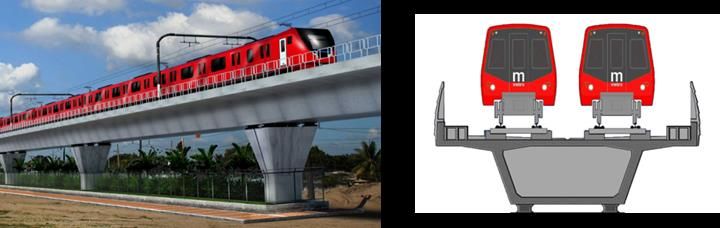
EIS Summary for the Public (ESP)
                                           PNR CLARK PHASE 2 (MALOLOS-CLARK RAILWAY) PROJECT

A. PROJECT DESCRIPTION

Project Name       Proposed PNR Clark Phase 2 (Malolos - Clark Railway) Project
Project Location   Malolos, Bulacan to Capas, Tarlac
Project Type       Railway System
Major Components   The major components of the proposed MCRP are the following:
of the Project
                   (1) MAIN RAILWAY LINE

                   The main railway line has a total length of 72.5 km from Malolos to Capas and a
                   total width of 30 m. The proposed vertical alignment are as follows:

                       a. Embankment/At Grade Section: 4.8 km

                          Figure 1: Cross-section of typical Embankment

                          Figure 2: Cross-section of typical At Grade

                       b. Elevated Section (Viaduct): 62.7 km length and 10m width

                         Figure 3: Cross-section of typical Viaduct

                       c. Tunnel/Underground Section: 5 km from Clark Station to CIA Station
                           and from Clark Station to NCC Station.

                   (2) STATIONS

                   There will be seven (7) stations along the MCRP alignment. All stations will be
                   elevated and will have a ROW width of 60 m (including the tracks) and length
                   of 180-220 m. The station layout may either be two (2) separate platforms
                   serving two (2) tracks or a single platform at the center. The platforms will be
                   8m wide.

                                              2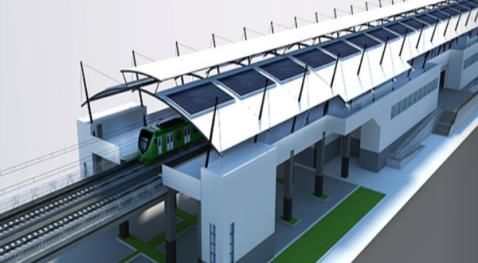
EIS Summary for the Public (ESP)
                                              PNR CLARK PHASE 2 (MALOLOS-CLARK RAILWAY) PROJECT

                                      Figure 4: Sample Design of the Station

                     (3) MAINTENANCE DEPOT

                     The depot will serve as an area for stabling, maintenance, inspection and train
                     repair. This will also function as a central command office which conducts the
                     operation control of the main line and the integrated management of electricity,
                     facilities for the crew, and the maintenance base for track, power supply system,
                     signaling, communication systems, and civil and architectural facilities.

                     (4) E&M SYSTEM

                     E&M System refers to the electrical systems, mechanical systems,
                     communication and automation systems, water services, fire detection and
                     protection systems.

                     (5) ROLLING STOCK

                     DOTr plans to operate three (3) types of train services in this project, namely, 1)
                     Commuter train, 2) Express Commuter train and 3) Airport Limited Express
                     train, which can connect CIA and the center of Manila within 1-hour.

                         a) Commuter Train - a total of 17 rolling stock (136 cars) with a capacity
                            of 2,200 passengers (seating + standing) per train set. The train’s
                            maximum speed is 120 km/hr and fully air-conditioned.
                         b) Express Commuter Train and Airport Limited Express Train – has
                            a total of 13 rolling stock (104 cars) with a capacity of 400 passenger
                            (seated) per train set. The train’s maximum speed is 160 km/hr and
                            fully air-conditioned.

                     (6) SUPPORT FACILITIES

                     The support facilities include electric power substations, administration
                     building, training center, drainage facilities and sewage treatment plant.

                     During construction phase, the following temporary support facilities will be
                     constructed: Contractor and Engineering Office, Laboratory, Labor Quarter,
                     Warehouse, Rebar, Form Fabrication Yard, Batching Plant and Segment
                     Fabrication Yard.
Project Size
Project Area         Line: Length: 72.5km, Width: 30 m
                     Station: 7 stations, Length: 180-220 m, Width: 60 m
                     Depot: Approximately 40 hectares
Project Capacity     Six (6) commuter trains having a capacity of 1,600 passengers/train
                     Eight (8) express trains having a capacity of 400 passengers/train
Project Technology   The DOTr will utilize an Electric Multiple Unit (EMU) which consist of self-
                     propelled carriages that uses electricity as the motive power.

                                                 3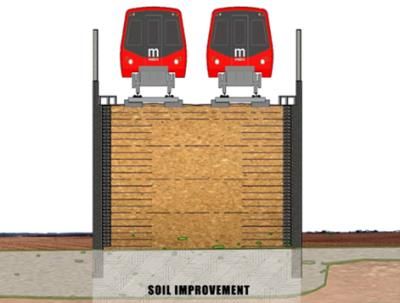
EIS Summary for the Public (ESP)
                                               PNR CLARK PHASE 2 (MALOLOS-CLARK RAILWAY) PROJECT

Project Alternative   (1) SITING

                      Alignment Alternatives:
                      i.    From Malolos to Clark:
                      Option 1: PNR ROW
                      Option 2: NLEX ROW
                      Evaluation: The PNR ROW was chosen as it is recommended with major
                      positive points such as lower costs with less construction delay factors such as
                      affected houses, land acquisition, and affected trees.

                      ii.    From Clark to NCC:
                      Option A: Existing arterial road of BCDA (Longer Distance)
                      Option B: Maximizing BCDA property (Shorter distance and more tunnels)
                      Evaluation: Considering the cost for the land acquisition and tunnelling, Option
                      A was chosen as the better route from CIA to NCC

                      Depot:
                      Option 1: 40 ha lot along Sacobia River
                      Option 2: 42 ha lot at the Northwest of Xevera Subdivision
                      Evaluation: Option 1 was chosen as the better location of the depot, as there is
                      no need of land acquisition and the site is outside the Ancestral Domain area.

                       (2) TECHNOLOGY AND DESIGN

                      Track Structure:
                      Option 1: Embankment/At Grade Structure
                      Option 2: Elevated Structure (Viaduct)
                      Option 3: Tunnel/Underground Structure
                      Evaluation: Combination of the 3 options. The elevated section (viaduct) is
                      planned at urban area for over 54.7km, whereas grade/embankment section is
                      planned for 10.5km possible underground 2.1km from Clark Station to CIA and
                      tunneling 2.0 km from CIA to NCC.

                      Rolling Stock:
                      DOTr will utilize an Electric Multiple Unit (EMU) Train for the Project, which
                      runs quieter than diesel and locomotive-drawn multiple units.
Resource              (1) FUEL
Utilization           Construction Phase: Approximately 256,100 liters/year of diesel will be used
                      for the heavy equipment, transport and service vehicles.
                      Operation Phase: Approximately 20,000 liters/year of diesel will be used for
                      the back-up generators and service vehicles.

                      (2) POWER REQUIREMENT
                      Construction Phase: Approximately 60,683,805 kWh/year will be required
                      during construction.
                      Operation Phase: Approximately 420,118,650 kWh/year will be required for
                      the train operation, which will be sourced from MERALCO.

                      (3) WATER
                      Construction Phase: Water supply during construction phase will be taken
                      from the nearest water source/ provider.
                      Operation Phase: Water supply will be sourced from the local water districts.
                      Water usage in this phase shall be minimal and limited to domestic use only at
                      the stations. Additional water will be required at the depot for washing of trains.

                                                  4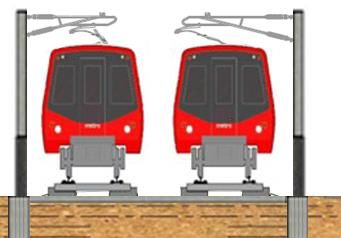
EIS Summary for the Public (ESP)
                                               PNR CLARK PHASE 2 (MALOLOS-CLARK RAILWAY) PROJECT

B. PROJECT LOCATION

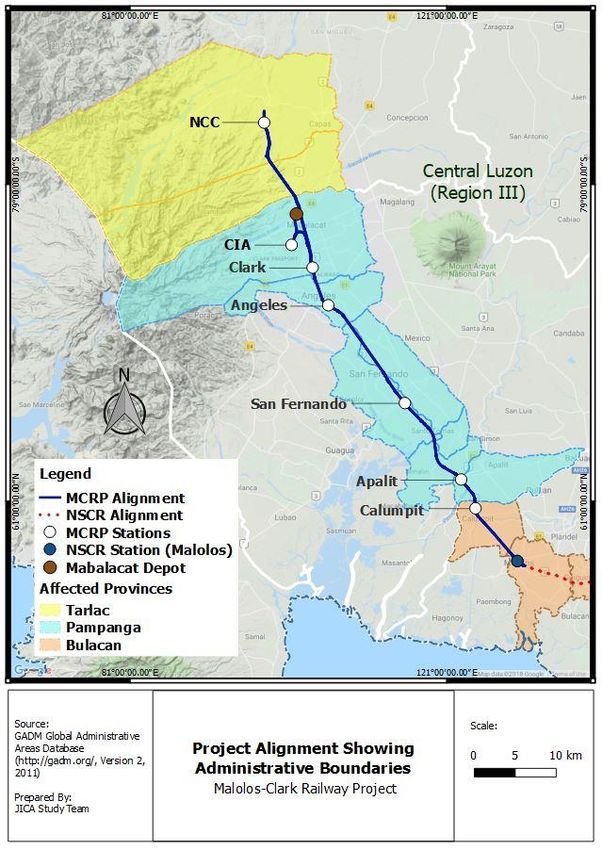
The MCRP will utilize the existing Right-of-Way (ROW) of the Philippine National Railways (PNR)
traversing the ten (10) municipalities/cities of Malolos and Calumpit in Bulacan; Apalit, Minalin, Sto.
Tomas, San Fernando, Angeles, and Mabalacat in Pampanga; and Bamban and Capas in Tarlac. The
proposed MCRP Depot will be located in a 0.4km2 (40ha) lot area along Sacobia River in Mabalacat.
The location map of the proposed MCRP is shown in Figure 5 while Table 1 shows the host LGUs.
Table 2 presents the station location.

                       Figure 5: Location Map of the Proposed MCRP

                                                  5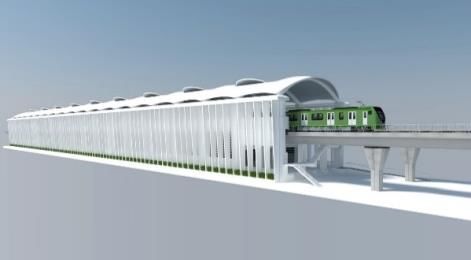
EIS Summary for the Public (ESP)
                                                      PNR CLARK PHASE 2 (MALOLOS-CLARK RAILWAY) PROJECT

                           Table 1: Host LGUs of the Proposed MCRP
             LGU                                               Host Barangays
 Malolos                  1.    Bulihan                 2.    Longos
 Calumpit                 1.    Pio Cruzcoza            4.    Iba Este            7.    Balungao
                          2.    San Marcos              5.    Palimbang           8.    Gatbuca
                          3.    Calumpang               6.    Iba O’Este
 Apalit                   1.    Capalangan              2.    Sulipan             3.    San Vicente
 Minalin                  1.    Lourdes                 3.    Sta. Maria          4.    San Pedro
                          2.    San Isidro
 Sto. Tomas               1.    Poblacion               3.    Sapa (Sto. Nino)    4.    Moras dela Paz
                          2.    San Matias
 San Fernando             1.    Baliti                  7.    Pulung Bulu         13.   Sto. Niño
                          2.    Dolores                 8.    Quebiawan           14.   Sindalan
                          3.    Lourdes                 9.    San Agustin         15.   Calutcut
                          4.    Maimpis                 10.   San Nicolas         16.   Panipuan
                          5.    Malpitic                11.   San Pedro Cutud
                          6.    Pulung Bulu             12.   Sta. Lucia
 Angeles                  1.    Agapito del Rosario     5.    Lourdes Sur         9. Santo Cristo
                          2.    Balibago                6.    Lourdes Sur East    10. Tabun
                          3.    Claro M. Recto          7.    Malabañas
                          4.    Pulungbulu              8.    Sta. Teresita
 Mabalacat                1.    San Joaquin             3.    Dolores             5.    Dau
                          2.    Lakandula               4.    Tabun               6.    Poblacion
 Bamban*                  1.    Santo Niño              2.    San Vicente
 Capas*                   1.    Aranguren               3.    Cutcut 2nd          4.    Maruglu
                          2.    Cristo Rey

                                        Table 2: Station Location
                                                                         Geographical Coordinates
            Stations                    Location
                                                                    North Latitude        East Longitude
  1        Calumpit            Calumpit, Bulacan                    14°54'45.68"N         120°45'57.57"E
  2        Apalit              Apalit, Pampanga                     14°56'39.22"N         120°44'59.05"E
  3        San Fernando        San Fernando, Pampanga               15°01'40.49"N         120°41'09.24"E
  4        Angeles             Angeles, Pampanga                    15°08'05.94"N         120°35'56.72"E
  5        Clark               Mabalacat, Pampanga                  15°10'34.33"N         120°34'52.74"E
  6        CIA                 Mabalacat, Pampanga                  15°12'03.65"N         120°33'26.91"E
  7        NCC                 Capas, Tarlac                        15°20'05.33"N         120°31'34.84"E

C. PROJECT PROPONENT

 Name of Proponent               :   Department of Transportation

 Proponent’s Address             :   DOTr Head Office, Pinatubo Street corner Osmeña Street,
                                     Clark Freeport Zone, Angeles City, Pampanga

 Authorized Signatory/           :   Atty. Timothy John R. Batan
 Representative                      Undersecretary for Railways

 Contact Details                 :   Telephone No: (02) 790-8300

                                                         6
EIS Summary for the Public (ESP)
PNR CLARK PHASE 2 (MALOLOS-CLARK RAILWAY) PROJECT
D. PROJECTED TIMEFRAME OF THE PROJECT IMPLEMENTATION
The projected timeframe of the MCRP implementation is presented Table 2. The construction will
start upon securing all the needed regulatory requirements. The project is expected to operate by the
end of 2022.
Table 3: Project Timeframe
2018 2019 2020 2021 2022
Project Phase
1Q 2Q 3Q 4Q 1Q 2Q 3Q 4Q 1Q 2Q 3Q 4Q 1Q 2Q 3Q 4Q 1Q 2Q 3Q 4Q
Pre-construction
Construction
Trial Run
Operation
E. SUMMARY OF MAJOR IMPACTS AND RESIDUAL EFFECTS
AFTER MITIGATION
Table 4 presents the summary of environmental impacts caused by the project as well as the
corresponding mitigating measures and residual impacts.
Table 4: Summary of the Environmental Impacts, Mitigating and Enhancement
Measures, and Residual Impacts
Environmental Prevention/Mitigation/ Residual Impact
Potential Impact
Component Enhancement Measures
PRE-CONSTRUCTION
LAND
Land use and Incompatibility with the DOTr will coordinate with the lot owners, LGUs, other Change in land use classification of areas
Classification existing land use relevant agencies and concerned stakeholders in utilized as part of ROW
acquiring and/or securing the ROW
Potential conflict with Coordinate with BCDA, DPWH (for depot site), and Possible acquisition of additional private
other government other relevant agencies and develop designs with lots outside BCDA
infrastructure projects compatible, non-overlapping structures
Overlap with areas Coordinate with NCIP for the conduct of FBI to None
with CADT/CADC, or determine the possible overlap with CADT/CADC and
areas occupied by update design to eliminate overlap
cultural communities
or tribes
PEOPLE
People Involuntary DOTr will implement RAP in coordination with NHA, Resettlement of project affected
Resettlement of LGUs, and concerned stakeholders and relevant persons (PAPs) (at least 7,692
project affected agencies that provide relocation site with complete households);
persons (PAPs) facilities, amenities and basic services as well as Enhanced living and livelihood
(at least 1,329 livelihood for income restoration of head-of-household conditions of resettled PAFs of ISFs
households) PAPs of ISFs and vulnerable groups. and vulnerable groups
CONSTRUCTION
LAND
Land Use and Impairment of aesthetic Maintain the construction site/ yards tidy and clean and Minimal impairment of aesthetic view
Classification view rehabilitate after construction
Provide temporary screens/ walls to minimise the visual
clutter.
Design the project facilities to harmonise with the
surrounding environments (shape, colour, size, etc.)
Geology/ Inducement of Design and construct appropriate foundation and None
Geomorphology subsidence, structures based on the combination of geotechnical,
liquefaction, landslide, geodetic and hydrologic study, and seismicity studies,
7EIS Summary for the Public (ESP)
PNR CLARK PHASE 2 (MALOLOS-CLARK RAILWAY) PROJECT
Environmental Prevention/Mitigation/ Residual Impact
Potential Impact
Component Enhancement Measures
mud/debris flow and in compliance with the National Building Code and
the Structural Code of the Philippines and internationally
accepted guideline.
Pedology Degradation of soil Prepare and implement solid waste management plan None
quality (soil and proper disposal in accordance with RA 9003,
contamination) hazardous waste disposal in accordance with RA 6969.
Terrestrial Loss of flora and fauna Prior to any clearing activity, conduct 100% inventory of Minimal loss of flora and fauna within
Ecology within ROW and Depot the affected trees along the alignment and secure tree ROW and Depot site
site cutting permit in compliance with DENR Memorandum
Order No. 2012-02.
Minimize vegetation clearing to areas to be developed Buffer zones to be created will serve as
only and implement the tree and vegetation management favourable habitat for nurturing wildlife
plan as part of the construction plan
Areas not part of the development within the ROW,
around the stations and depot will be prioritized for
replanting activity to create buffer zone to improve
wildlife habitat.
WATER
Hydrology Inducement of flooding Design and install drainage to accommodate the surface Improved drainage system in areas
water runoff from the project and avoid any flooding in along the MCRP alignment
the area caused by the project.
Regular inspection and prompt maintenance of the
drainage system, all installed structures and facilities and
improve/ enhance capacity when possible.
Water Quality Degradation of surface Install wastewater treatment, portable sanitary facilities Minimal surface water quality
water quality at construction sites/yards degradation
Install temporary erosion ponds or silt traps around the
major work areas.
Plan and implement construction activities in
consideration to the water course, embankment, and
wet/dry season.
AIR
Air Quality Degradation of air Adjust construction activities in consideration to weather Minimal degradation of air quality
quality system, identifying periods of high winds and drought
that aggravated dust transport.
Control vehicle movement maintaining the speed limit
within the construction site toEIS Summary for the Public (ESP)
PNR CLARK PHASE 2 (MALOLOS-CLARK RAILWAY) PROJECT
Environmental Prevention/Mitigation/ Residual Impact
Potential Impact
Component Enhancement Measures
measures. In case of any changes, prompt update on the
diverted routes to the concerned communities and LGUs,
Assign traffic guide to provide assistance to the road
users.
In-migration Plan and implement construction schedule to shorten None
(Proliferation of time between the pre-construction and construction as
Informal Settler) much as possible.
Install fencing and guarding of the proposed project to
restrict the public from entering the ROW.
Cultural/Lifestyle Conduct FBI at the proposed depot area in accordance Minimal lifestyle change of IPs
Change of Indigenous to the NCIP AO No. 3, 2012. If section of the depot site
Peoples is within an Ancestral Domain, additional measures will
be implemented in close coordination with the NCIP and
LGUs.
Ensure resolution of indigenous community (if any) in
coordination with NCIP and LGU.
Impacts on /Cultural Conduct literature review and site validation of the Damage on some infrastructure might
Historical resources potential historic structures in coordination with PNR and still occur
NHCP
Perform measured survey of the identified historic
structures including its foundation and building condition.
Threat to public health Formulation and implementation of IEC Plan to inform Accidents may still occur, but the safety
and safety the affected LGU and local communities and the general and health guidelines in place will
public about 1) the project, project activities, duration, significantly lower the exposure of
possible project impacts and incorporate their comments workers and commuters to occupational
and inputs in the design, 2) the potential impact of and construction hazards, respectively.
project activities to air quality, noise, vibration, and
climate change and mitigation, and safety aspects like
areas that are restricted for the public, and 3) the
Grievance Redress Mechanism to handle complaint/s if
any.
Plan for construction sites and access route in
consideration to health and safety of local communities
Install fencing of the construction site, provision of
signage and posters, and guarding of the access point to
ensure that the public is prevented from entering unsafe
areas.
Generation of Prioritize in hiring local qualified residents in coordination Increased number of employed local
Livelihood with the LGUs and employ workers in consideration to residents with consideration to gender
Opportunities and gender equality and to vulnerable group equality and vulnerable group
improvement of Safety
Traffic Congestion Conduct Traffic Impact Assessment (TIA) and based on Minimal traffic congestion may still
the results of TIA, prepare and implement Traffic occur;
Management Plan (TMP), coordinate to the concerned Inconvenience to commuters. The
LGUs and transport operator/s and get their inputs and residual impacts will be confined to
approval construction phase only.
Schedule transport of heavy structures during period
when there are fewer vehicles on the road and posting of
appropriate traffic signage and warnings.
Disseminate information to the general public, host
barangays and LGUs on the potential impact of the
project to the existing access and provide mitigating
measures.
OPERATION
LAND
Land Use and Impairment of visual Maintain tree planting to minimise the visual impact of Trees planted along the alignment may
Classification aesthetic the project create a positive visual impact
Geology/ Inducement of Conduct proper inspection and prompt maintenance None
Geomorphology subsidence, checks to every single installed structure and facility and
Liquefaction, Landslide, improve/ enhance capacity when possible
Mud/Debris Flow, etc. Conduct inspection in the event of natural hazard
occurrence to assess damage of structures
Regular Coordination with the PHIVOLCS for earthquake
and volcanic events to adjust the train schedule as
necessary.
9EIS Summary for the Public (ESP)
PNR CLARK PHASE 2 (MALOLOS-CLARK RAILWAY) PROJECT
Environmental Prevention/Mitigation/ Residual Impact
Potential Impact
Component Enhancement Measures
Pedology (Soil Degradation of soil Strict implementation of solid waste management plan None
Quality) quality (soil and proper disposal by an accredited contractor in
contamination) accordance with RA 9003, hazardous waste disposal in
accordance with RA 6969.
Terrestrial Loss of Habitat Minimize the noise, vibration, illumination, and vehicular Minimal disturbance to flora and fauna
Ecology Threat to Existence movement which can disturb significant fauna area near bio-diversity areas
and/or Loss of (alignment sections in Malolos to Sto. Tomas, which are
Important Local under Manila Bay Biodiversity Area).
Species
Hindrance to Wildlife
Access
WATER
Groundwater Deterioration of nearby Each commuter station and depot will have a sewage None
and Freshwater groundwater and treatment plant (STP) and a separate treatment facility
Quality surface water due to for non-sewage waste waters such as from sinks, and
discharge of untreated washings to meet the applicable effluent standards.
wastewater in stations Handling of potential contaminants during operation
and depot phase shall be compliant with RA 6969.
AIR
Acoustic Noise Increase in ambient Optimize the number of train operation at night time to Minimal increase in ambient noise
noise level reduce generated noise levels confined to areas adjacent to
Provision of effective height of noise barriers on each alignment
side of the track especially on areas with sensitive
receptors such as school, hospital, residential area
Provision of noise control device such as muffler to all
stationary sources (i.e. generator set)
Regular inspection and proper maintenance of trains and
tracks to reduce operational noise
Ground Increase in ground Regular inspection, proper maintenance and Minimal increase in vibration levels
Vibration vibration level reconditioning of trains and tracks such as rail grinding,
slip-slide detectors and maintenance or replacement of
suspension system, brakes and wheels
PEOPLE
People Generation of Coordinate closely with the host LGUs, specifically at the Higher employment rates in the host
estimated 1,400 job barangay level regarding hiring of regular workers to cities
positions; opportunities ensure that the workers being considered are legitimate
for business residents in the area in consideration to gender equality.
Influx of ISFs Install fencing and provide guards to prevent the None
settlement of ISFs along the ROW
Threat to public health Provide security guards in all stations to direct Accidents may still occur, but the safety
and safety passengers on the safe zone and health guidelines in place will
Provide sanitary facilities or utilities in all stations and significantly lower the exposure of
depot. workers and commuters to occupational
Implement the Occupational Health and Safety and operational hazards, respectively.
Management Plan.
Provide appropriate PPE to all personnel undertaking
maintenance work.
Traffic Congestion in Establish a TOD Committee, which compose of the Minimal traffic build-up may still occur in
the areas adjacent to Traffic Management of LGUs, Planning Office, PNR, areas adjacent to the proposed stations
the proposed stations DPWH, and DOTr
Plan and implement TOD in consideration to the loading
and unloading area and the circulation of the traffic as
well as the integration of transport facility within the
station.
Change in lifestyle Promote benefit of reduced travel time using MCRP Increased number of commuters using
mass transit over other modes of transportation the MCRP for transportation
Maintenance of facilities such as air conditions in trains Increased leisure time and reduced
to provide comfort to commuters strain of commuters
Increased job satisfaction due to
shorter travel time
10EIS Summary for the Public (ESP)
PNR CLARK PHASE 2 (MALOLOS-CLARK RAILWAY) PROJECT
F. IDENTIFIED STAKEHOLDERS
The following are the identified stakeholders of the proposed MCRP:
LGUs of the host cities/municipalities and of host barangays as identified in Table 1.
Residents living at the PNR ROW and its vicinity
Sectoral Representatives (Education, Health, Livelihood, Religious, Business, Senior
Citizens, Women) at the host LGUs
Non-Government Organizations at the host LGUs
Philippine National Railway (PNR)
Social Housing Finance Corporation (SHFC)
Presidential Commission for the Urban Poor (PCUP)
Housing and Urban Development Coordinating Council (HUDCC)
National Commission for Culture and the Arts (NCCA)
National Housing Authority (NHA)
Department of Public Works and Highways (DPWH)
National Commission on Indigenous Peoples (NCIP) Region 3
EMB-DENR Region 3
Department of Social Welfare and Development (DSWD) Region 3
Philippine Institute of Volcanology and Seismology (PHIVOLCS) Region 3
Public Utility organizations at the host LGUs (TODA/Jeepney drivers)
G. STATEMENT OF COMMITMENT AND CAPABILITY TO
IMPLEMENT NECESSARY MEASURES TO PREVENT NEGATIVE
IMPACTS
The DOTr, as the Implementing Agency, commits to provide overall policy and guidance with
regards to implementation of the Project. DOTr shall ensure that all necessary mitigating measures
including budgets and agreements with other concerned national and local government agencies are
included in all contracts to prevent and/or minimize the negative impacts of the project and enhance
the positive impacts.
H. INFORMATION WHERE TO GET COPY OF THE EISR
The draft Environmental Impact Statement Report (EISR) and this ESP will be posted in the EMB
website (www.emb.gov.ph) at least 20 days before the public hearing. After the review process, the
final EISR of the proposed MCRP will be available at the following:
Provincial Government of Bulacan Municipal Government of Minalin Provincial Government of Tarlac
Bulacan Provincial Capitol Minalin Municipal Hall Tarlac Provincial Capitol
MacArthur Highway, Malolos City, Poblacion, Minalin, Pampanga Capitol Site Street, Tarlac City, Tarlac
Bulacan Contact No. (045) 301-6046 Contact No. +63(45)9824909
Contact No. +63(44)7911604
City Government of Malolos Municipal Government of Sto. Tomas Municipal Government of Bamban
Malolos Municipal Building, Sto. Tomas Municipal Hall, Bamban Municipal Hall
Pariancillo Street, Malolos City, Bulacan Magsaysay Street, Santo Tomas, Brgy. Anupul, Bamban, Tarlac
Contact No. +63(44) 796-2793 Pampanga Contact No. (045) 925 0050
Contact No. +63(45)4097594
11EIS Summary for the Public (ESP)
PNR CLARK PHASE 2 (MALOLOS-CLARK RAILWAY) PROJECT
Municipal Government of Calumpit City Government of San Fernando Municipal Government of Bamban
Calumpit Municipal Hall New Municipal Hall Building, Bamban Municipal Hall
Poblacion, Calumpit, Bulacan 3003 A Consunji Street, San Fernando City, Brgy. Anupul, Bamban, Tarlac
Contact No. +63(44)9130268 Pampanga Contact No. (045) 925 0050
Contact No. +63(45)9616601
Provincial Government of Pampanga City Government of Angeles Municipal Government of Capas
Capitol Boulevard, Capitol Compound, Angeles City Hall Capas Municipal Hall
San Fernando City, Pampanga Angeles City, Pampanga Sto. Domingo 2nd, Capas, Tarlac
Contact No. +63(45)4353966 Contact No. (045) 892-1211 Contact No. (045) 925 0154
Municipal Government of Apalit City Government of Mabalacat Environmental Management Bureau
Apalit Municipal Hall Mabalacat City Hall DENR Compound, Visayas Ave,
San Juan , Apalit, Pampanga 2016 Delfin Drive, Mabalacat, Pampanga Diliman,
Contact No. +63(45)6520108 Contact No. (045) 893 0676 Quezon City, 1116 Metro Manila
Contact No: (02)920-2240
For more information about the proposed MCRP, the following people may be contacted:
Proponent: EIA Preparer:
Ms. Christina Quinalayo Engr. Ledicia T. dela Cruz
Environmental and Social Considerations Officer Managing Director
Department of Transportation Geosphere Technologies, Inc.
DOTr Head Office, Pinatubo Street corner Osmeña Street, 19D Eisenhower Tower, Eisenhower St.,
Clark Freeport Zone, Angeles City, Pampanga Greenhills, San Juan City
Telephone No: (02)790-8300 Tel: (02) 724-5665/67
E-mail: gti0722@geospheretech.com
12You can also read


