Communication Strategy - for the period 2014 to 2020 - approved by the - Interreg Baltic Sea Region
←
→
Page content transcription
If your browser does not render page correctly, please read the page content below
Communication
     Strategy
            for the period 2014 to 2020

                                                   version 2
    presented to the Monitoring Committee on 14 June 2016
          edited by the Managing Authority/Joint Secretariat
                                    Rostock, Germany, 2016
Communication strategy of Interreg Baltic Sea Region, a transnational European
Territorial Cooperation Programme, for the period 2014 to 2020, part-financed by
the European Regional Development Fund (ERDF).

Published by the Programme’s Managing Authority/Joint Secretariat in Rostock,
Germany. The Managing Authority/Joint Secretariat is hosted by Investitionsbank
Schleswig-Holstein (IB.SH).

Electronic document, available for download at interreg-baltic.eu.
Communication Strategy

Table of contents
About this document .........................................................................................................................4
1. Introduction..................................................................................................................................5
       Legal background .......................................................................................................................5
       Communication strategy development .....................................................................................6
2. Communication fields...................................................................................................................9
       Attracting relevant partners (field A)........................................................................................9
       Supporting projects (field B) ......................................................................................................9
       Making achievements visible (field C) .................................................................................... 10
       Facilitating cooperation in administration (field D) ................................................................ 10
3. Responsibilities & budgets ........................................................................................................ 11
       Managing Authority/ Joint Secretariat ................................................................................... 11
       Monitoring Committee, sub-committees and contact points ................................................ 12
       Projects ................................................................................................................................... 12
4. Implementation ......................................................................................................................... 13
       4.1 Activity planning ............................................................................................................... 13
       4.2 Evaluating and reporting .................................................................................................. 14
       4.3 Messages of the Baltic Sea Region Programme ............................................................... 15

Table of annexes
Annex 1: Strategic partners (running list)
Annex 2: flowchart for “Attracting applicants” (field A)
Annex 3: flowchart for “Supporting projects” (field B)
Annex 4: flowchart for “Making achievements visible” (field C)
Annex 5: flowchart for “Facilitating cooperation in administration” (field D)

                                                                                                                                                    3
Communication Strategy
About this document
The Communication Strategy describes how the transnational cooperation Programme
Interreg Baltic Sea Region will approach communication during the EU funding period
2014 to 2020.
This document will assist the Monitoring Committee (MC), the Managing Authority/ Joint
Secretariat (MA/JS) and, specifically, the project owners in taking a coherent approach
towards communication.
Interreg in general, and the project achievements in particular, need to be
communicated in a consistent manner. The Communication Strategy describes the main
aims of communication and assigns responsibilities for achieving these aims. It explains
how the different stakeholders of Interreg Baltic Sea Region can connect activities
towards common communication objectives.
In Chapter 1, the general understanding of communication in Interreg Baltic Sea Region
is addressed. Chapter 2 provides information about communication aims, target
audiences, key messages, communication tactics as well as indicative activities at
Programme level. The main responsibilities and resources for communication of the
MA/JS, the MC and the projects are listed in chapter 3. Chapter 4 sets out how this
communication strategy will help adapt communication activities to changing needs and
evolving technical possibilities.
Managing Authority/ Joint Secretariat
4Communication Strategy
1. Introduction
Communication has gained a vital role in transnational cooperation programmes
throughout the past years. Effective communication is the basis of cooperation. In
addition, it is a prerequisite for the Programme to deliver meaningful results not only to
project partners but also to audiences outside the project communities. Communication
is thus an integral part of the working procedures at all levels throughout the project and
Programme cycles. Communication takes place, for example, between project partners,
between project partners and their audiences outside the project community, between
projects and the Programme, between the different Programme bodies.
Interreg Baltic Sea Region is designed to bring forward change by increasing
institutional capacities to tackle challenges in the region jointly. Thereby, the Programme
shall push for progress in implementing the joint macro-regional EU Strategy for the
Baltic Sea Region and to succeed in achieving the Europe 2020 goals. This
communication strategy is designed to support the delivery of tangible results to
audiences beyond the project communities and to demonstrate the benefits of the
European Union for its citizens. To this end, all those involved in Programme or project
work need to communicate in a strategic manner, i.e. there is a need to target
communication towards specific aims.
Legal background
According to article 115 of the Regulation 1303/2013 of the European Parliament and of
the Council, the Managing Authority is responsible for drawing up a communication
strategy covering a number of activities specified in annex XII of the same document.
Article 116 requires that the communication strategy shall be submitted to the
Monitoring Committee for approval no later than six months after the adoption of the
Cooperation Programme. In addition, the European Commission has issued
Implementing Regulation (EU) No 821/2014 laying down rules for the technical
characteristics of information and communication measures of the Programme in article
3 and 4 as well as annex II.
5Communication Strategy
Communication strategy development
The communication strategy was drafted in several steps by the MA/JS based on
experience gathered during two preceding periods (table 1). The Baltic Sea Region
Programme (ongoing at the time of drafting) was evaluated and needs for changes in the
approach to communication assessed. The results were discussed with members of the
Joint Programming Committee for Interreg Baltic Sea Region as well as MA/JS staff and
other Programme stakeholders. Major principles of the communication strategy
development were discussed and elaborated jointly in the INTERACT group of
transnational Interreg Programmes’ communication officers since end of 2012.
As a result of the assessments, four fields of Programme implementation were identified
where communication plays a major role. During spring 2016 the strategy was developed
to also include updated overarching messaging for the Programme as well as for the
communication fields.
Communication fields identified:
A. Attracting relevant partners
B. Supporting projects
C. Making achievements visible
D. Facilitating cooperation in administration
table 1: Steps of Communication Strategy development
Development step Time
Evaluation of MA/JS communication & support measures in 2007-2013 December 2012 -
among project partners in ongoing projects (online survey) February 2013
Evaluation of projects in 2007-2013 in terms of size, partner types and July 2013 –
geographical coverage & Programme communication with applicants/projects August 2013
presented to and discussed with the Programming Task Force
Assessment of needs concerning Programme/project communication September 2013
(targeted interviews)
selected members of the Monitoring Committee and project partners of the Baltic
Sea Region Programme 2007-2013
Definition of aims & target groups (MA/JS internal workshop) September 2013
presented to and discussed with Joint Programming Committee
Definition of tactics and indicative activities (MA/JS internal workshops) May –
September 2014
First draft of the Communication Strategy February 2015
presented to and discussed with Joint Programming Committee
6Communication Strategy
Approval of the Communication Strategy 28 April 2015
by the Monitoring Committee
Revision of the Communication Strategy with emphasis on messaging January-May 2016
Presentation of the Communication Strategy, version 2 14 June 2016
to the Monitoring Committee
Communication strategy methodology
In order to target programme communication, and to frame the communication
strategy, a systematic approach was followed for each communication field (figure 1).
In total, 12 communication aims were identified („What does the Programme want to
achieve with communication?“). For each aim, those target audiences that are relevant
for achieving the respective aim were derived („Whom does the Programme have to
communicate with in order to achieve the aim?“). Each target group is reached with
specific messages. These are based on the messages developed for the different
communication fields.
For each target audience, tactics for communication were selected („How does the
Programme want to interact with the different target audiences in order to achieve the
aim?“). Tactics refer to different types of interaction between those active in Programme
communication and the target audiences. They are an important element of
communication strategy planning, as they allow the planner to verify if certain activities
are likely to achieve the aim or not.
And finally, a number of indicative activities for each tactics were listed. The activities
are deliberately indicative, because recent periods have taught us to be flexible in
developing new communication activities. Flexibility may be needed in order to achieve
the aims, e.g. as a result of an intermediary evaluation, in response to changing political
objectives outside the Programme’s scope, or due to technical advances (e.g. social
media, mobile devices etc.).
7Communication Strategy
figure 1: Joint approach to framing a communication strategy.
8Communication Strategy
2. Communication fields
The communication strategy was framed for each of the four fields in which
communication plays a major role (see chapter 1.2). The strategy comprises aims, target
audiences relevant to achieving these aims and tactics, specifying the types of
interaction between the MA/JS and the target audiences. In chapter 3.1 to 3.4 a
summary description is provided. The complete communication field overviews can be
found in annexes 2-5.
Attracting relevant partners (field A)
In communication field A, one aim is to enable EU, pan-Baltic & national multipliers to
inform their audiences about the Programme (A1). In order to achieve this aim, the
MA/JS will target different multipliers - in particular strategic partners (annex 1). Three
consecutive aims were set towards potential applicants: The MA/JS strive to raise
awareness among potential applicants about the Programme as a funding source (A2), to
engage them into project development (A3) and to make them aware of rules and
requirements for projects (A4). The MA/JS will target potential applicants on the one
hand through one-way information in easy language, and on the other by providing
contact opportunities. Annex 2 provides an overview of the strategy for communication
field A.
Supporting projects (field B)
Communication field B prepares the grounds for good project management and
communication, taking into account the lead partner principle and the projects’
management structures. The MA/JS’s aim is to make project applicants aware that they
have to identify and communicate with decision makers in their fields (B1). This shall be
achieved by pro-actively contributing to project development and implementation. The
MA/JS aim at making sure that lead partners and project partners have the capacity to
communicate with their projects’ target audiences (B2). Capacities cover human
resources as well as know-how. Next to pro-active contributions to project development
and implementation, the MA/JS will establish close relations with communication
managers of projects. Making lead partners understand and apply the rules and
requirements of the Programme (B3) shall be pursued by providing information to lead
partners which is easy to understand and by providing opportunities for dialogue. Such
easy to understand information shall be prepared in a way so that it can be readily
passed on to project partners. Furthermore, the MA/JS aim at making not only lead
partners but also project partners aware of the role of the MA/JS (B4) , i.e. aware of the
services the MA/JS do and do not provide to project applicants and partners and the
functions they do and do not carry out within the Programme structure. To this end, the
MA/JS will enable and encourage lead partners to inform their project partners about
the MA/JS role. Furthermore, existing opportunities shall be used when possible to get
into direct contact with project partners. Annex 3 provides an overview of the strategy
for communication field B.
9Communication Strategy
Making achievements visible (field C)
Communication field C was drawn up to assure that the Programme’s results and impact
will efficiently be taken up within the cooperation area and beyond.
One aim is to make thematic experts in the region aware of the Programme results and
achievements (C1). This can primarily be achieved by projects communicating with their
respective thematic target audiences. To this end, the MA/JS will support to project
communication including technical infrastructure and corporate branding items. Another
aim is directed towards national, pan-Baltic and EU decision makers. It is the
Programme’s aim to make these target groups aware of Programme results and
achievements (C2). When carrying out communication activities in this field, cooperation
with designated stakeholders of macro-regional cooperation will be important. For
example the Monitoring Committee and national sub-committees, the Priority Area
Coordinators and Horizontal Action Leaders of the EU Strategy for the Baltic Sea Region
as well as other transnational Interreg Programmes can serve as partners when planning
and implementing specific measures. In this communication field, creating project stories
will play a crucial role to highlight the achievements of the Programme as part of the EU
cohesion policy. Annex 4 provides an overview of the strategy for communication field C.
Facilitating cooperation in administration (field D)
As a number of bodies are directly or indirectly involved in the Programme’s
administration, the MA/JS have set four specific aims to facilitate efficient cooperation
among them. One aim is to make auditors and controllers aware of the Programme
scope and rules as well as their roles (D1). The MA/JS will target auditors and controllers
both through providing key information in writing, and through creating opportunities
for dialogue. As EUSBSR stakeholders will play an important role in the Programme’s
funding priority 4, the MA/JS aim at making them aware of the scope of priority 4, their
roles and relevant Programme rules (D2). The MA/JS will target auditors and controllers
by providing easy to understand information, engaging closely with them as well as
informing them about Programme activities. In order to achieve more harmonisation
among programmes, the MA/JS strive to inform other Interreg programmes and
INTERACT about the Programme’s approaches towards Programme implementation
(D3). To this end, the MA/JS will participate in networking and get engaged in joint
activities. Furthermore, organisations/authorities hosting the Programme’s managing
bodies are to be made aware of the Programme and the usefulness of its achievements
(D4). This will be pursued by providing face-to-face information and by frequent dialogue
on the management level of the organisations involved.
Annex 5 provides an overview of the strategy for communication field D.
10Communication Strategy
3. Responsibilities & budgets
Programme communication is a shared responsibility of the MA/JS, the MC, and the
projects. The Programme provides the administrative structures and support measures
for successful projects and establishes favourable conditions for good project
communication. In particular, the Programme supports communication activities of the
projects at transnational level. The MC serves as the steering and decision making body,
not only for the decision on project approval, but also for the communication strategy.
The projects - dealing with specific thematic issues and target audiences – carry out
communication activities within thematic expert communities.
Managing Authority/ Joint Secretariat
The MA/JS will coordinate the implementation of the communication strategy. MA/JS
will make sure that requirements for information and communication activities, as
defined by the EU legal framework will be met1. The MA/JS will report annually to the
Monitoring Committee on the status of implementation.
Key activities of the MA/JS:
establish and maintain a website operated in English language under the domain
www.interreg-baltic.eu.
frequently provide news on transnational Programme topics in English language
participate regularly in conferences, workshops and other relevant events at
international level
run seminars and provide advisory services for project applicants;
provide targeted seminars to support project implementation at different stages
(e.g. lead partner seminar, financial seminar, communication seminar, finalising
project seminar)
provide communication training, templates and technical tools to projects
including guidance on the use of EU visibility requirements and on media work.
MA/JS human resources and budget for communication
Communication activities of the MA/JS will be financed by the Technical Assistance (TA)
budget of the Programme. TA includes a budget line for marketing and events as well as
two staff positions (communication officers). The TA budget is subject to annual reviews.
1
Commission Implementing Regulation EU No 821/2014
11Communication Strategy
Monitoring Committee, sub-committees and contact points
The Monitoring Committee will oversee communication activities. Its responsibility is to
assess and approve the communication strategy within the first six months after
approval of the Programme. Annually, the Monitoring Committee will assess and
approve the annual activity work plan including communication activities. Additionally,
the Monitoring Committee will contribute to achieving the communication aims. The
Programme countries have established national sub-committees, some have in addition
set up regional/ national contact points. Resources and responsibilities are divided
differently in each Programme country.
Monitoring Committee and sub-committee members as well as contact points can
contribute to all communication aims, in particular:
A1: Multipliers know the Programme and have tools to inform their audiences
A2: Raise awareness: potential applicants know the Programme as funding source
A3: Increase knowledge & engage: potential applicants know how, when, where and
with whom to apply for what.
C2: Relevant decision makers are aware of and know Programme results and
achievements and consider the Programme as useful and efficient.
D4: Organisations hosting the managing bodies are aware of the Programme and the
usefulness of its achievements.
Details concerning the communication aims can be found in annexes 2 to 5.
Projects
Communication plays a key role for projects in achieving their defined objectives, e.g. in
relation to identifying end-users and decision makers, to involving them in the
development of outputs and to implementing outcomes in working routines or
organisational structures. Projects are expected to contribute in particular to
communication aims C1 (“Thematic experts in the region are aware of the Programme
results and achievements”) and C2 (“Relevant decision makers are aware of and know
Programme results and achievements”). To this end, the MA/JS expect projects to follow
the rules and regulations related to communication as explained in the Programme
Manual2, to make use of guidance and support measures offered by the MA/JS, as well
as to provide content to the MA/JS in a pro-active manner.
Human resources and budgets of projects
Every project will define the human resources and the budget for communication
activities individually as part of the project application. Every project is expected to
employ one communication manager. The communication manager will be the primary
contact for the MA/JS in communication related matters.
2
In particular chapters D.1.5, F.1.10 and G.2.2 of the Interreg Baltic Sea Region Programme Manual for
priorities 1-3, for download at www.interreg-baltic.eu/about-the-programme/main-documents.html
12Communication Strategy
4. Implementation
The MA/JS will use the communication strategy to prioritise communication aims
according to project and programme cycles, to plan and implement MA/JS
communication activities, and to evaluate in how far the MA/JS have reached the
communication aims of the Programme, and to report to the Monitoring Committee.
4.1 Activity planning
When planning communication activities throughout the Programme implementation,
the MA/JS will prioritise communication aims according to the respective phase of the
Programme cycle. The different phases, require the MA/JS to implement the various
communication activities at different levels of intensity.
The project cycle consists of several phases (see Programme Manual, chapter F2)
including project generation, contracting and project implementation. During the second
half of the project implementation phase, the projects will start to deliver outputs. The
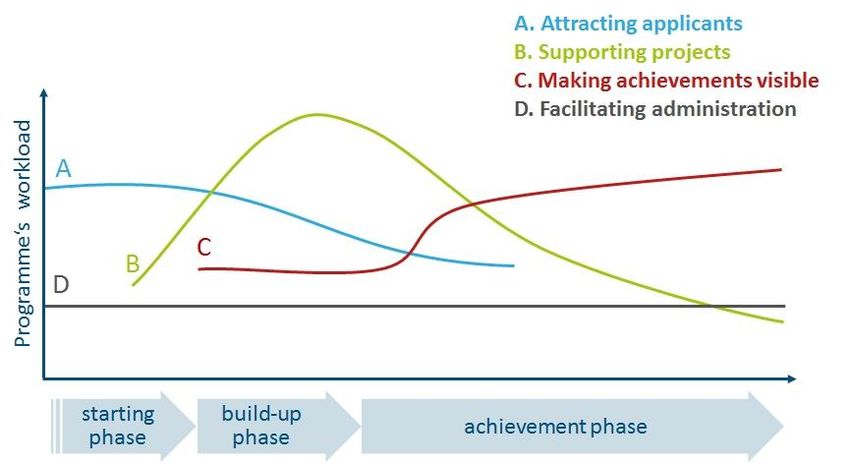
Programme cycle (see figure 2) consists of a starting phase (no projects running yet), a
build-up phase (an increasing number of projects running in parallel, but no outputs yet)
and an achievement phase (increasing number of project outputs, decreasing number of
projects running in parallel). The Programme cycle results from a number of overlapping
project cycles.
figure 2: Expected workload related to communication activities throughout the Programme
cycle – schematic representation. A) During the Programme starting phase, the activity level to
attract applicants will be high, It will continue with decreasing intensity until the last call for
projects. B) Activities to support projects will commence towards the end of the Programme’s
starting phase. They will increase until the end of the build-up phase, when the majority of
funds will have been allocated to projects, and a large number of projects will be running in
13Communication Strategy
parallel. Afterwards, support activities will continuously decrease, when more and more
projects will be ending. C) Activities to make achievements visible will start as soon as the first
projects will enter the implementation phase. They will increase once projects will have
produced the first outputs, communicated this to the MA/JS. At this point the MA/JS will be
able to use the content input from projects for communication activities (achievement phase).
D) Activities to facilitate cooperation on project administration will be continuous.
The MA/JS will use the communication strategy to plan and implement individual
activities. Based on the communication strategy, the MA/JS will present an annual
activity work plan to the MC, including the planned communication activities. Depending
on the Programme and project phases, the MA/JS will prioritise the implementation
fields and communication aims and propose a suitable set of communication activities
for each annual work plan to the MC.
4.2 Evaluating and reporting
The MA/JS will evaluate the communication measures in terms of visibility and
awareness of policy, Programme and operations on different levels. The procedures for
the evaluations of the success of communication measures will be elaborated in detail in
the evaluation plan.
Communication measures will be assessed annually as part of the internal operational
evaluation. Key elements of communication will be evaluated as part of the Annual
Implementation Report (see table 2). Results of this evaluation will be presented to the
Monitoring Committee. Furthermore, selected communication aspects will be evaluated
as part of the external Programme evaluations to be carried out. Infrequent feedback
surveys and needs assessments among target audiences are part of the day-to-day
implementation of the communication strategy.
table 2: List of output indicators for Technical Assistance relevant to evaluating communication
activities (from the Cooperation Programme document, http://www.interreg-baltic.eu/about-
the-programme.html)
Indicator Unit Target value
(2023)
TA01 Number of (potential) applicants advised Number 260
TA02 Number of applications received and assessed Number 630
TA04 Number of news items to be published on the Programme’s website Number 168
TA05 Number of own events carried out Number 14
TA06 Number of participants at Programme events Number 1580
TA07 Number of other events attended by MA/JS staff Number 700
14Communication Strategy
4.3 Messages of the Baltic Sea Region Programme
Messaging describes how we talk about who we are and why we exist as an organization.
It communicates key points we consistently make when we reach out to your audience.
And they always tie back to our brand. Different messages have been developed for the
different communication fields, as well as overarching Programme messages. As we
reach out to specific audiences we have standard language ready to tailor to our
purpose. The messages connect the dots between what we do and how it relates to our
audience. The messages developed are intended to be used in both oral and written
communications, on- and off line, in front of audiences and in smaller meetings.
Programme messages
What is the Programme?
Interreg Baltic Sea Region is an EU funding Programme that stimulates cooperation
around the Baltic Sea. Developing the Baltic Sea Region is at the core of the Programme.
What does the Programme do?
Interreg Baltic Sea Region funds cooperation to create change for a better region.
Where is it based (Programme area)?
Countries around the Baltic Sea work together to find joint solutions to common
challenges.
What does the Programme hope to achieve?
Developing the region through a culture of cooperation is at the heart of Interreg Baltic
Sea Region.
What does the Programme contribute to?
Common needs and common solutions drive Interreg Baltic Sea Region.
Extra:
Interreg Baltic Sea Region believes in an integrated and prosperous Europe for all.
List of field messages
A: Attracting relevant partners
Interreg Baltic Sea Region funds cooperation to support you in finding solutions that
meet your needs
B: Supporting projects
Interreg Baltic Sea Region is your counterpart in developing your project
and reaching your goals
C: Making achievements visible
Interreg Baltic Sea Region opens your eyes to common solutions
D: Facilitating cooperation in administration
Interreg Baltic Sea Region works in a supportive, cooperative and reliable manner
15Communication Strategy
Annex 1: Strategic partners (running list)
Name Type Description Website
CBSS - Council of transnational Inter.governmental organisation of the Ministries of
foreign Affairs of the BSR
www.cbss.org
Baltic Sea States political body
HELCOM is the governing body of the Convention on the
HELCOM - Helsinki transnational Protection of the Marine Environment of the Baltic Sea
Area. HELCOM protects the marine environment through
helcom.fi
Commission political body
intergovernmental cooperation.
The Nordic Council is the official inter-parliamentary body
Nordic Council and transnational in the Nordic Region. The members of the Council are
members of the national parliaments, who are nominated
www.norden.org
Council of Ministers political body
by the party groups.
VASAB is an intergovernmental multilateral co-operation
VASAB 2010 - Vision of the BSR in spatial planning and development. VASAB
transnational prepares policy options and provides a forum for exchange
and Strategies (part of CBSS): e.g. Promote co-operation projects; Co-
www.vasab.org
political body
around the Baltic Sea operate with other cross-BSR initiatives; Promote a
dialogue with sector institutions.
Thematic The goal of EWTCA is to develop the cooperation between
East West Transport transport and logistics companies, intermodal transport www.ewtcassoci
network, pot. operators, consignors and consignees, authorities and
Corridor Association ation.net
Applicant academic institutions to establish multifaceted trade flows
Submariner Network SUBMARINER Network brings together public and private
Thematic
- Sustainable Use of actors from the BSR in order to further promote and www.submariner
Network, pot. realise activities necessary for using marine resources
Baltic Marine -network.eu
Applicant innovatively and sustainably. organised as non-profit EEIG.
Resources
Aims to assist actors from the public sector, and their
Thematic advisers, working on energy efficiency and renewable
ManagEnergy www.managener
Network, EU- energy actions at the local and regional levels, e.g. through
Initiative its targeted capacity building and networking events, and gy.net
wide
online resources and promotion.
This site is designed to help you find out about European
ESFRI - European Research & Innovation. Whether you are a researcher or a ec.europa.eu/res
Strategy Forum on Thematic teacher, in business or in politics, there is something for
you here. You can read about the latest political decisions,
earch/infrastruct
Research network
or the latest advances in research. Funding information is ures
Infrastructures
provided as well.
The Observatory is primarily aimed at policy makers,
government officials, cluster management staff, academics
European Cluster Thematic www.clusterobse
and researchers. However, everyone is welcome to
Observatory network register, for example journalists, consultants, business rvatory.eu
sector representatives, and students.
The S3 Platform assists EU countries and regions to
S3 - Smart develop, implement and review their Research and
Thematic Innovation Strategies for Smart Specialisation (RIS3) by s3platform.jrc.ec.
Specialisation providing information, methodologies, expertise and
network europa.eu
Platform S3 advice to national and regional policy makers, as well as
promote mutual learning, trans-national co-operation.
The Baltic Sea Parliamentary Conference (BSPC) is a forum
BSPC – Baltic Sea for political dialogue between parliamentarians from the
Stakeholder
Parliamentary Baltic Sea Region. BSPC gathers parliamentarians from 11 www.bspc.net
network national parliaments, 11 regional parliaments and 5
Conference
parliamentary organizations around the Baltic Sea. BSPC
16Communication Strategy
aims at raising awareness and opinion on issues of current
political interest and relevance for the Baltic Sea Region. It
promotes and drives various initiatives and efforts to
support a sustainable environmental, social and economic
development of the Baltic Sea Region.
Stakeholder UBC is a voluntary, proactive network mobilizing the
UBC - Union of the shared potential of its member cities for democratic,
network, pot. economic, social, cultural and environmentally sustainable
www.ubc.net
Baltic cities
Applicant development of the Baltic Sea Region.
BSSSC is a political network for decentralised authorities
BSSSC - Baltic Sea Stakeholder (subregions) in the Baltic Sea Region. The BSSSC co-
States Subregional network, operates closely with other key Baltic Sea Region and www.bsssc.com
Co-operation interest group European organisations and institutions. It is the interest
representation of the regions.
The Baltic Sea Commission (BSC) is one of the six
Geographical Commissions that make up the backbone of
Stakeholder the Conference of Peripheral Maritime Regions of Europe
BSC-CPMR - Baltic (CPMR). BSC brings together around 25 Regions from six www.balticseaco
network, States from the European Union and beyond. The BSR
Sea Commission mmission.eu/
interest group actively contributes to the the preparation of the CPMR
policy positions, whilst at the same time acting as a think
tank and as a lobby for the regions around the Baltic Sea.
The Covenant of Mayors is the mainstream European
Stakeholder movement involving local and regional authorities,
www.covenantof
Covenant of Mayors Network, EU- voluntarily committing to increasing energy efficiency and
use of renewable energy sources on their territories. It was mayors.eu
wide
launched by COM.
Network BDF is the leading think-tank and network for high level
decision-makers from business, politics, academia and
BDF - Baltic (thematic www.bdforum.or
media in the Baltic Sea Region. It brings together actors
Development Forum &stakeholder), from diverse sectors and from across the BSR, ensuring g
pot. Applicant better cooperation, coordination and coherence.
BCCA - Baltic Sea The BCCA promotes trade and business relationships
Interest group,
Chamber of across the Baltic Sea Region through action such as trade
stakeholder faires and conferences, through networks but also through
www.bcca.eu
Commerce
Network information and analysis.
Association
Northern Dimension
Funding
Partnership on Trans-governmental structure within Northern Dimension
Programme; Policy, establishedin 2011
www.ndptl.org
Transport and
political body
Logistics
BONUS EEIG - Science
Funding www.bonusporta
for a better future of Funding Programme for science in the BSR
Programme l.org
the Baltic Sea Region
NDEP - Northern The NDEP framework enables the creation of financing
Dimension Funding structures that combine loans, grants and local budget
funding which can be used for priority environmental
ndep.org
Environmental Programme
investments.
Partnership
Organised annually in October. To enhance balanced and
“Strategic Planning in sustainable development of the regions and cities of Russia
the Regions and Event by improving the system of territorial strategic planning,
Cities of Russia” supporting coordination and public dialog, creating and
promoting standards of planning.
annual international agri-environmental conference for
GABBS - Greener networking and exchange of knowledge concerning clear
agriculture for a Event water and agriculture; attracts science, business and public
bluer Baltic Sea authorities; organised by different organisations, since
2009
17Communication Strategy
“Interreg Baltic Sea Region funds cooperation to
Annex 2: flowchart for “Attracting applicants” (field A) support you in finding solutions that meet your needs”
interreg-baltic.euCommunication Strategy
“Interreg Baltic Sea Region is your counterpart in
Annex 3: flowchart for “Supporting projects” (field B) developing your project and reaching your goals”
interreg-baltic.euCommunication Strategy
“Interreg Baltic Sea Region opens your eyes to
Annex 4: flowchart for “Making achievements visible” (field C) common solutions”
interreg-baltic.euCommunication Strategy
“Interreg Baltic Sea Region works in
Annex 5: flowchart for “Facilitating cooperation in administration” (field D) a supportive, cooperative and
reliable manner”
interreg-baltic.euYou can also read


