Epilepsy Treatment Update for Patients Suffering From Seizure Clusters - Tuesday, December 3, 2019 National Harbor, MD - amsus
←
→
Page content transcription
If your browser does not render page correctly, please read the page content below
Epilepsy Treatment Update
for Patients Suffering
From Seizure Clusters

Tuesday, December 3, 2019
National Harbor, MD

                      US-P-NZ-SC-1900152 12/19
!       Disclaimer

•       The speaker today is being compensated by UCB, the sponsor of this presentation
•       The use of products in any way other than that specified by the FDA approved US Prescribing
        Information is off-label and cannot be recommended by UCB
•       Disclosures: research grants from Lundbeck, Eisai; advisory boards and consulting for Abbot,
        Alliance, Aquestive, Eisai, Lundbeck, SK Life Sciences, UCB Pharma; speaker bureau for
        Aquestive, Eisai, Sunovion, UCB Pharma

                                                                                                  2
What Is a Seizure Cluster?

  •          Seizure clusters can be broadly                                                                                         Various Alternative Names for Seizure Clusters5
             defined as acute episodes of
             consecutive seizures that occur with                                                                                                                                                         Acute
                                                                                                                                            Recurrent
                                                                                                                                                                              Flurries                   Repetitive
             short interictal periods and may be                                                                                            Seizures
                                                                                                                                                                                                         Seizures
             distinguishable from a patient’s typical
             seizure pattern or frequency1-4

  •          No consensus definition of seizure                                                                                              Cyclical                      Crescendo                      Serial
             clusters currently exists1                                                                                                      Seizures                       Seizures                     Seizures

Sources: 1. Haut SR. Curr Opin Neurol. 2015;28:143-150. 2. Mitchell WG. Epilepsia. 2996;37:S74-S80. 3. Haut SR. Epilepsy Behav. 2006;8:50-55. 4. Dreifuss FE, et al. N Engl J Med. 1998;338:1869-1875.                5
5. Jafarpour S, et al. Seizure. 2019;68:9-15.
Burden of Seizure Clusters
Impact of Seizure Clusters on Patients’ and Their Caregivers’ Lives
Percent of Respondents, %
Patients (N=259) Caregivers (N=263)
Driving Driving
69%
Extracurricular Extracurricular
Overall mood Overall mood
activities 69% activities
58% 55%
41% 10%
59% 52% 48%
69%
Travel Work Travel 34% Work
67%
Independence Independence
Seizure clusters represent substantial burdens to patients’ their caregivers’ lives
Source: Penovich PE, et al. Neurologist. 2017;22:207-214. 6Gaps in Communication About Seizure Clusters
Healthcare Professional Community Member
• 12-hour period for children • Can range from daily to once a year
Time frame
• 24-hour period for adults
• Over a relatively short period of time, usually
Duration • Ranges from a few days to a few weeks
less than 24 hours
Frequency • Multiple seizures, usually 3 or more • No specific number of seizures
Note: Based on qualitative reviews and analyses of the medical literature (Healthcare Professional) and of the Epilepsy Foundation
website (Community Member). This theme refers to the understanding or the definition of seizure clusters as understood by healthcare professionals
or epilepsy community members.
Source: Buelow JM, et al. Epilepsy Behav. 2016;57:16-22. 7Average Seizure Cluster Duration
Compared With Isolated Seizures
Seizure Duration Based on Position Within a Cluster Compared With Isolated (Non-Cluster) Seizuresa
Mean (SD) Seizure Duration, Seconds Intracluster vs Terminal
Seizure Cluster Mean Number of
Intracluster Terminal Isolated Seizure Duration
Definition Seizures/Cluster
Seizures Seizures Seizures P Valueb
2 or more seizures
2.8 71 (78) 84 (68) 90 (92) 0.014
within 2 hours
2 or more seizures
3.2 78 (72) 95 (98) 86 (92) 0.011
within 4 hours
2 or more seizures
3.8 82 (81) 83 (69) 91 (108) 0.294
within 8 hours
a Data based on EEG findings from 996 seizures among 92 patients.
b There were no statistically significant differences between mean terminal seizure duration and mean isolated seizure duration.
Abbreviations: EEG, electroencephalogram. 8
Source: Ferastraoaru V, et al. Epilepsia. 2016;57:889-895.Seizure Clusters May Involve the Failure of
Inhibitory Mechanisms
Mechanisms Reported to Be Involved in Seizure Termination1
Seizure onset zone
Substantia nigra pars reticulata
Single Neurons Local Network of Neurons Remote Brain Regions
Transmembrane ion gradients Gap junction decoupling GABAergic synaptic inhibition
Energy failure (eg, ATP or glucose loss) Changes in neuromodulator levels
GABAergic synaptic inhibition
Binding of benzodiazepines to the GABA receptor is believed to potentiate GABAergic inhibition 2
Abbreviations: ATP, adenosine triphosphate; GABA, γ-aminobutyric acid. 9
Sources: 1. Lado FA, Moshé SL. Epilepsia. 2008;49:1651-1664. 2. Riss J, et al. Acta Neurol Scand. 2008;118:69-86.Seizure Clusters and Hospitalizations
Seizure-Related Hospitalizations Among Patients With Epilepsy (non-SE)
Patients, %
0% 25% 50% 75% 100%
Seizure clustering
73%
(N=41)
P=0.006
Nonclustering
59%
(N=100)
Note: Seizure cluster defined as 3 or more seizures in 24-hour period.
Abbreviation: SE, status epilepticus. 10
Source: Haut SR, et al. Epilepsia. 2005;46:146-149.Seizure Clusters and Status Epilepticus
History of Convulsive Status Epilepticus Among Patients
With and Without Seizure Clusters
100% Seizure clustering Nonclustering
75%
Patients, %
P=0.03 PSeizure Clusters and Mortality
Survival With and Without Seizure Clusters
100 –
Cumulative Proportion Surviving, %
90 –
80 –
70 – Patients with seizure clusters have a
60 –
~3.5-fold greater risk of death*
50 –
40 – compared to patients without clusters
30 –
20 – *95% CI, 1.25-9.78
No Seizure Clusters (N=94)
10 – Seizure Clusters During Treatment (N=12)
0–
0 5 10 15 20 25 30 35 40 45
Years After Onset of Epilepsy
Abbreviation: CI, confidence interval. 12
Source: Sillanpää M, Schmidt D. Brain. 2008;131:938-944.Risk Factors for Experiencing Seizure Clusters
Prevalence of Select Risk Factors Among Patients Aged 16 Years or Older With and Without Seizure Clusters
Patients With Risk Factor, %
Risk Factor
0% 25% 50% 75% 100%
History of…
70.6%
Complex partial seizure 48.5%
51.0%
Simple partial seizure 43.4%
15.4%
Status epilepticus 5.8%
10.5%
Febrile seizures 7.9%
10.5%
Nocturnal seizure 7.1%
8.7%
Tonic seizure 2.0%
7.8%
Drop seizure 1.9%
Note: All P valuesSeizure Emergency Action Plans
Clinician Recommendations and Patient
In a survey of 259 patients with epilepsy…
Responses to Seizure Clusters
-100% -50%
Patients (N=259), % 0% Clinicians
50%(N=339),100%
%
30%
Rescue medication 20% 79%
Have a seizure
emergency plan Call doctor's office 20% 67%
Visit ER 24% 61%
Stay calm 34% 50%
Extra/increased dose of AED 11% 28%
VNS 10% 21%
Visit urgent care 7% 12%
70%
Do not have a Other 5% 2%
seizure emergency plan Patients
Patient
Typically nothing 27% 1% Physician
Clinicians
Most patients with seizure clusters report that they do not have a seizure emergency plan
Abbreviations: AED, antiepileptic drug; ER, emergency room, VNS, vagus nerve stimulator. 14
Source: Penovich PE, et al. Neurologist. 2017;22:207-214.Use of Various Benzodiazepines
as Rescue Medication
Prescriptions for Rescue Medications Among Rescue Medication Use for Patients With Seizure Clusters (N=612)
Patients With Seizure Clusters (N=612)
2.1% 40%
10.8%
3+ prescriptions
2 prescriptions
30% 28.9%
Patients, %
20%
30.6%
1 prescription 10% 7.8%
56.5% 7.0% 6.9%
5.4%
No prescription
n=177 n=48 n=43 n=42 n=33
0%
Lorazepam Diazepam Diazepam Midazolam Clonazepam
(oral) (rectal) (oral) (intranasal) (oral)
Less than half (43.5%) of patients who experienced seizure clusters had a prescription for a rescue medication
Source: Chen B, et al. Epilepsy Res. 2017;133:98-102. 15Pharmacokinetics of Benzodiazepines
Tmax (hours) Elimination Half-lifea (hours)
0 1 2 3 4 5 6 7 8 9 10 11 12
Clorazepate (IM) 2.7-11b
>24
Clorazepate (PO) 0.5-2b
Clonazepam (PO) 1-4 19-60
Clobazam (PO) 1.3-1.7 10-30
Diazepam (PO) 0.5-1.5
Diazepam (IM) 0.5-1.0 21-70
Diazepam (R) 0.17-0.75
Midazolam (PO) 0.5-0.97
Midazolam (IM) 0.24-0.51 1-4
c
Midazolam (IN) 0.15-0.32
Lorazepam (PO) 2.4
Lorazepam (SL) 2.3 7-26
Lorazepam (IM) 1.2
a Inhealthy subjects.
bT
max for N-desmethyldiazepam after administration of clorazepate.
c Compounded intranasal midazolam.2
Abbreviations: IM, intramuscular; IN, intranasal; PO, oral; R, rectal; SL, sublingual. 16
Sources: 1. Riss J, et al. Acta Neurol Scand. 2008;118:69-86. 2. Knoester PD, et al. Br J Clin Pharmacol. 2002;53:501-507.NAYZILAM® (midazolam) nasal spray, CIV
Product Overview
Please see Important Safety Information, including the Boxed Warning for concomitant use with opioids, included
in this presentation.
Please refer to full Prescribing Information provided by the UCB Representative and visit www.NAYZILAM.com
NAYZILAM® is a registered trademark of the UCB Group of Companies.
All other trademarks are the property of their respective owners.
©2019 UCB, Inc., Smyrna, GA 30080. All rights reserved. 17
US-P-NZ-SC-1900152 12/19NAYZILAM® Is the First and Only Nasal Spray
Indicated to Treat Seizure Clusters
NAYZILAM is a benzodiazepine indicated for the acute treatment of intermittent, stereotypic episodes of frequent
seizure activity (ie, seizure clusters, acute repetitive seizures) that are distinct from a patient’s usual seizure pattern in
patients with epilepsy 12 years of age and older.
WARNING: RISKS FROM CONCOMITANT USE WITH OPIOIDS
Concomitant use of benzodiazepines and opioids may result in
profound sedation, respiratory depression, coma, and death
[see Warnings and Precautions (5.1), Drug Interactions (7.2)].
Reserve concomitant prescribing of these drugs for use in patients
for whom alternative treatment options are inadequate.
Limit dosages and durations to the minimum required.
Follow patients for signs and symptoms of respiratory depression
and sedation.
Please see additional Important Safety Information within this presentation.
Source: NAYZILAM [prescribing information]. Smyrna, GA: UCB Inc. Please refer to full Prescribing Information provided by the UCB Representative and visit www.NAYZILAM.com.
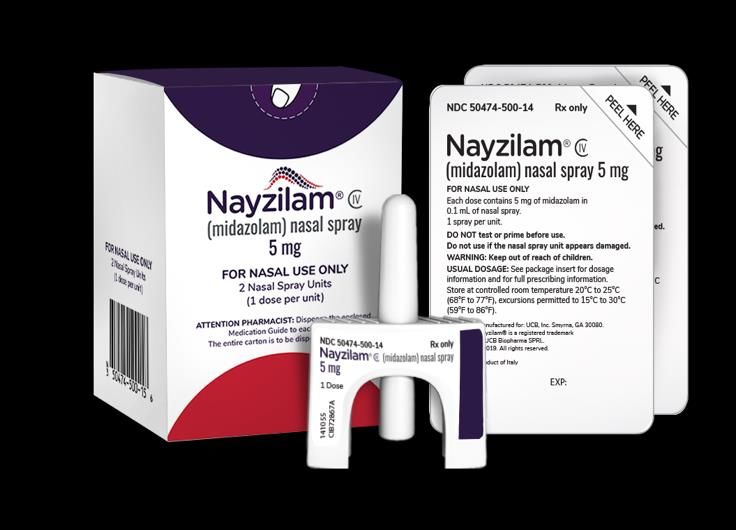
18NAYZILAM® Is Now Available Single-use nasal spray supplied in
boxes of 2 blister pack units
NAYZILAM is a midazolam formulation
designed for nasal delivery
NAYZILAM can be administered
by a non–healthcare professional
Image is for illustrative
purposes only.
NAYZILAM is contraindicated in patients with acute narrow-angle glaucoma. Concomitant use
of benzodiazepines, including NAYZILAM, and opioids may result in profound sedation,
respiratory depression, coma, and death. NAYZILAM may cause increased CNS-depressant
effect when used with alcohol or other CNS depressants. Concomitant use with moderate or
strong CYP3A4 inhibitors may result in prolonged sedation due to a decrease in plasma
clearance of midazolam. Antiepileptic drugs, including NAYZILAM, increase the risk of suicidal
ideation and behavior. Midazolam is associated with a high incidence of partial or complete
impairment of recall for the next several hours.
Source: NAYZILAM [prescribing information]. Smyrna, GA: UCB Inc.
Please see additional Important Safety Information within this presentation.
Please refer to full Prescribing Information provided by the UCB Representative and visit www.NAYZILAM.com. 19NAYZILAM Pharmacokinetics
Key Pharmacokinetic Parameters Mean Plasma Concentration After 2 Doses of Intranasal Midazolam
in Healthy Adults1 Administered 10 Minutes Apart in Patients With Epilepsy2,a,b
Absorption
• Median Tmax 17.3 minutes Detected in plasma by 5 minutes post dose
Mean (±SD) NAYZILAM Plasma
• Mean absolute bioavailability ~44%
Concentration (ng/mL)
Distribution
• Total volume of distribution ~226.5 L
• ~97% protein bound
Metabolism
• Primarily liver and intestinal CYP3A4
Elimination
Hours Post Dose
• Half-life 2.1 hours to 6.2 hours
aMean plasma concentration was estimated from the Pharmacokinetic Analysis Population: All subjects who received both test doses in the ARTEMIS I clinical trial, with
sufficient plasma concentration data to accurately estimate pharmacokinetic parameters (n=235).2
bThe formulation of intranasal midazolam used in this study was different from the final formulation of NAYZILAM.
Sources: 1. NAYZILAM [prescribing information]. Smyrna, GA: UCB Inc. 2. Data on file. UCB Inc.
Please see additional Important Safety Information within this presentation.
Please refer to full Prescribing Information provided by the UCB Representative and visit www.NAYZILAM.com. 20NAYZILAM® (midazolam) Nasal Spray, CIV
Important Safety Information
CONTRAINDICATIONS
NAYZILAM is contraindicated in patients with acute narrow-angle glaucoma.
RISKS FROM CONCOMITANT USE WITH OPIOIDS
Concomitant use of benzodiazepines, including NAYZILAM, and opioids may result in profound sedation,
respiratory depression, coma, and death.
• Reserve concomitant prescribing of these drugs for use in patients for whom alternative treatment
options are inadequate.
• Limit dosages and durations to the minimum required.
• Follow patients for signs and symptoms of respiratory depression and sedation.
RISKS OF CARDIORESPIRATORY ADVERSE REACTIONS
Serious cardiorespiratory adverse reactions have occurred after administration of midazolam. Warn patients and
caregivers about the risks of respiratory depression, cardiac, and respiratory arrest.
Respiratory depression was observed with the administration of NAYZILAM during clinical trials. Cardiac or respiratory
arrest caused by NAYZILAM was not reported during clinical trials.
Source: NAYZILAM [prescribing information]. Smyrna, GA: UCB Inc.
Please see additional Important Safety Information within this presentation.
Please refer to full Prescribing Information provided by the UCB Representative and visit www.NAYZILAM.com. 21NAYZILAM® (midazolam) Nasal Spray, CIV
Important Safety Information (cont’d)
CENTRAL NERVOUS SYSTEM DEPRESSION FROM CONCOMITANT USE WITH OTHER CENTRAL NERVOUS
SYSTEM DEPRESSANTS, OR MODERATE OR STRONG CYP3A4 INHIBITORS
Drug products containing midazolam, including NAYZILAM, have a central nervous system (CNS) depressant effect.
Risks from Concomitant Use with Other CNS Depressants
NAYZILAM may cause an increased CNS-depressant effect when used with alcohol or other CNS depressants
(eg, opioids). Warn patients and caregivers that the use of NAYZILAM in combination with alcohol or other CNS
depressant drugs may increase the risk of hypoventilation, airway obstruction, desaturation, or apnea and may
contribute to profound and/or prolonged drug effect.
Risks from Concomitant Use with Moderate or Strong CYP3A4 Inhibitors
Concomitant use of NAYZILAM with moderate or strong CYP3A4 enzyme inhibitors may result in prolonged sedation
because of a decrease in plasma clearance of midazolam. Caution patients against engaging in hazardous
occupations requiring mental alertness, such as operating machinery, driving a motor vehicle or riding a bicycle until
they have completely returned to their level of baseline functioning.
Source: NAYZILAM [prescribing information]. Smyrna, GA: UCB Inc.
Please see additional Important Safety Information within this presentation.
Please refer to full Prescribing Information provided by the UCB Representative and visit www.NAYZILAM.com. 22NAYZILAM® (midazolam) Nasal Spray, CIV
Important Safety Information (cont’d)
SUICIDAL BEHAVIOR AND IDEATION
Antiepileptic drugs (AEDs), including NAYZILAM, increase the risk of suicidal thoughts or behavior in patients taking
these drugs for any indication. Monitor patients treated with NAYZILAM for the emergence or worsening of
depression, suicidal thoughts or behavior, and/or any unusual changes in mood or behavior. Advise patients and
caregivers to be alert for these behavioral changes and to immediately report them to the healthcare provider.
IMPAIRED COGNITIVE FUNCTION
Midazolam, including NAYZILAM, is associated with a high incidence of partial or complete impairment of recall for
several hours following an administered dose. Counsel patients on when they can engage in activities requiring
complete mental alertness, operate hazardous machinery, or drive a motor vehicle after taking NAYZILAM.
GLAUCOMA
Benzodiazepines, including NAYZILAM, can increase intraocular pressure in patients with glaucoma. NAYZILAM may
be used in patients with open-angle glaucoma only if they are receiving appropriate therapy. NAYZILAM is
contraindicated in patients with narrow-angle glaucoma.
Source: NAYZILAM [prescribing information]. Smyrna, GA: UCB Inc.
Please see additional Important Safety Information within this presentation.
Please refer to full Prescribing Information provided by the UCB Representative and visit www.NAYZILAM.com. 23NAYZILAM® (midazolam) Nasal Spray, CIV
Important Safety Information (cont’d)
ADVERSE REACTIONS
In the randomized, double-blind, placebo-controlled trial, the most common adverse reactions (≥5% in any NAYZILAM
treatment group) were somnolence, headache, nasal discomfort, throat irritation, and rhinorrhea.
NAYZILAM is a Schedule IV controlled substance.
Source: NAYZILAM [prescribing information]. Smyrna, GA: UCB Inc.
Please see additional Important Safety Information within this presentation.
Please refer to full Prescribing Information provided by the UCB Representative and visit www.NAYZILAM.com. 24ARTEMIS I: NAYZILAM for the Acute Treatment
of Seizure Clusters in Patients ≥12 Years of Age1,2
ARTEMIS I Study Design: Comparative Phase1,2
1st 2nd
Dose Dose
5 mg NAYZILAM
(double-blind)
n=134 If seizure cluster did not
stop within 10 minutes
Treatment
Groups Or another seizure 5 mg NAYZILAM
Randomized 2:1 occurred within 6 hours (open-label)
Placebo And no sign of
(double-blind) respiratory depressiona
n=67
• Tolerability was assessed in the Test Phase in which 292 patients received two 5 mg doses of NAYZILAM separated by 10 minutes
in the absence of a seizure: patients who met predefined criteria continued on to the Comparative Phase2
aThe patient did not haveARTEMIS I Efficacy Endpoints
Primary Endpoint1 Key Secondary and Exploratory Endpoints1
Treatment success with second dose
No recurrence of seizures (open‐label)
within 6 hours of initial
blinded study drug dose
Time to next seizure occurring
Treatment >10 minutes after drug administration
Success = +
Return to baseline functionality within
Seizure termination within 24 hours of drug administrationa
10 minutes after initial
blinded study drug dose
aReturn to baseline functionality: time when subject was able to return to what he/she was doing prior to the seizure cluster.2
Sources: 1. Detyniecki K, et al. Epilepsia. 2019;60:1797-1808. 2. Data on File. UCB Inc.
Please see additional Important Safety Information within this presentation.
Please refer to full Prescribing Information provided by the UCB Representative and visit www.NAYZILAM.com. 26ARTEMIS I Baseline Characteristics
and Inclusion Criteria
Patient Population Size1 Number of AEDs3
Safety Population: N=292ARTEMIS I Baseline Characteristics:
Seizure Cluster History
Seizure Characteristics Cluster Seizure Typesa
Complex partial
NAYZILAM® Placebo
Secondary
Typical cluster duration (min) n=129 n=63 generalized
Median 65.00 60.00 Simple partial
Range 2.5-4320.0 8.5-2880.0
Primary GTC
Seizures per cluster episode n=134 n=67
Median 5.2 6.0 Tonic
Range 2-200 2-170
Absence
Episodes in year before visit n=134 n=67 NAYZILAM 5 mg (n=134)
Myoclonic Placebo (n=67)
Median 18 15
Range 3-999 4-600 Atonic
Years since clusters onset n=133 n=63
Other
Median 5.0 5.0
Range 0.3-48.0 0.5-32.0 0 20 40 60 80 100
Percent of Patients, %
aPatients may have reported >1 seizure type.
Patients enrolled in ARTEMIS I had several different seizure types, with a median cluster duration of 65 minutes
Abbreviation: GTC, generalized tonic-clonic.
Source: Detyniecki K, et al. Epilepsia. 2019;60:1797-1808.
Please see additional Important Safety Information within this presentation.
Please refer to full Prescribing Information provided by the UCB Representative and visit www.NAYZILAM.com. 28More Than 50% of Patients Achieved
Treatment Success With a Single Dose1
Treatment Response With a Single Dose of NAYZILAM®1,2
100 NAYZILAM 5 mg
P=0.110
90 Placebo
80
81% P=0.007
Percent of Patients
70 P=0.011
70%
60
58%
50 54%
40
30 37%
34%
20
10
n=108 n=47 n=78 n=25 n=72 n=23
0
Seizure Termination No Recurrence Treatment70% of Patients Achieved Treatment Success
With Any Dose2
First Dose (blind)1,2 Second dose (open label)2,3
5 mg NAYZILAM 5 mg NAYZILAM
54% 55%
Treatment Success
n=72/134
Treatment Success
n=23/42
70%
Randomized
Treatment First dose (blind)1,2 Second dose (open label)2,3
Groups Placebo 5 mg NAYZILAM
Overall Treatment Success2
34% 66% in 122/175a patients
treated with NAYZILAM
Treatment Success Treatment Success
n=23/67 n=27/41
Respiratory depression was observed with the administration of NAYZILAM during clinical trials. Cardiac or respiratory
arrest caused by NAYZILAM was not reported during clinical trials.1
aOne hundred seventy-five patients were treated with NAYZILAM: 134 patients in the NAYZILAM arm and 41 patients in the placebo arm.2
Sources: 1. NAYZILAM [prescribing information]. Smyrna, GA: UCB Inc. 2. Data on file. UCB Inc. 3. Detyniecki K, et al. Epilepsia. 2019;60:1797-1808.
Please see additional Important Safety Information within this presentation.
Please refer to full Prescribing Information provided by the UCB Representative and visit www.NAYZILAM.com. 30NAYZILAM-treated Patients Had a Greater Probability
of No Seizure Recurrence for 24 Hours Post-dose
Probability of Experiencing No Seizures Over the 24‐hour Observation Period
Beginning 10 Minutes After Drug Administration1,2
Probability of no Seizures
NAYZILAM: 58%
21% difference
P=0.0124
Placebo: 37%
NAYZILAM
Censored NAYZILAMa
Placebo
Censored Placeboa
Time After Administration of Double-Blind Trial Drug (Hours)
Antiepileptic drugs (AEDs), including NAYZILAM, increase the risk of suicidal thoughts or behavior in patients taking these drugs
for any indication.1
aPatients
who did not have another seizure before the end of the 24‐hour observation period, and who had not been administered the second dose of trial drug, were
censored at the end of the observation period. Those administered the second dose of trial drug who did not have a seizure before the administration of the second
dose were censored at the time of the second dose.2
Sources: 1. NAYZILAM [prescribing information]. Smyrna, GA: UCB Inc. 2. Detyniecki K, et al. Epilepsia. 2019;60:1797-1808.
Please see additional Important Safety Information within this presentation.
Please refer to full Prescribing Information provided by the UCB Representative and visit www.NAYZILAM.com. 31With NAYZILAM®, More Patients Returned to Baseline
Functionality Within 24 Hours vs Placebo
Return to Baseline Functionality Within 24 Hours1 Median Time to Return to Full
100
Baseline Functionality2,a
90
80
Percent of Patients, %
70
72.4
60
29.1% difference
50 PNAYZILAM® Adverse Event Profile (≥ 2% of NAYZILAM
Patients and Greater Than Placebo)
NAYZILAMb
• The most common adverse
Body System/ Placebo + Any NAYZILAM reactions (≥5% in any NAYZILAM
Placebo NAYZILAM NAYZILAM
Adverse Reactiona NAYZILAM 5 Treatment treatment group) were somnolence,
5 mg 5 mg + 5 mg headache, nasal discomfort, throat
mg Group
irritation, and rhinorrhea1
N=26 N=91 N=41 N=43 N=175
% % % % % • Most adverse reactions were mild
Nervous System or moderate in intensity2
Somnolence 4 10 10 9 10 • At least one adverse event related
Headache 0 7 0 2 4 to acute central respiratory
Dysarthria 0 2 2 2 2 depression was reported
Application Site in 10 (3.4%) patients2
Nasal Discomfort 8 5 7 16 9
Throat Irritation 0 2 2 7 3 • NAYZILAM was well tolerated.
Rhinorrhea 0 3 0 5 3
• No patients discontinued during
Product Taste Abnormal 0 4 0 0 2
the comparative phase
Eye Disorders
of the Phase 3 study of NAYZILAM2
Lacrimation Increased 0 1 2 2 2
aAdverse reactions that occurred within 2 days after NAYZILAM administration are included. bPatients were permitted to take a second, open-label dose of NAYZILAM 5 mg
between 10 minutes and 6 hours following the initial blinded dose of NAYZILAM 5 mg or placebo if they experienced seizure recurrence or an incomplete resolution of the
episode. The Placebo + NAYZILAM 5 mg and NAYZILAM 5 mg + 5 mg columns represent patients who received a second dose of NAYZILAM 5 mg after receiving a
blinded initial dose of placebo or NAYZILAM 5 mg.
TEAE, treatment‐emergent adverse event.
Sources: 1. NAYZILAM [prescribing information]. Smyrna, GA: UCB Inc. 2. Detyniecki K, et al. Epilepsia. 2019;60:1797-1808.
Please see additional Important Safety Information within this presentation.
Please refer to full Prescribing Information provided by the UCB Representative and visit www.NAYZILAM.com. 33NAYZILAM® Dosing
Maximum Dosage &
Dosing Treatment Frequency
1st Dose Administer one spray (5 mg) Do not use more than 2 doses
into one nostril of NAYZILAM to treat a single episode
2nd Dose Administer one spray (5 mg) into Treat no more than 1 episode every
(if needed) opposite nostril after 10 minutesa 3 days or 5 episodes per month
Image is for illustrative
purposes only.
• For patients at increased risk of respiratory depression from benzodiazepines, administration under healthcare professional
supervision should be considered prior to treatment; this administration may be performed in the absence of a seizure episode.1
• Benzodiazepines, including NAYZILAM, can increase intraocular pressure in patients with glaucoma. NAYZILAM may be used in
patients with open-angle glaucoma only if they are receiving appropriate therapy. NAYZILAM is contraindicated in patients with
narrow-angle glaucoma.1
• Concomitant use of NAYZILAM with moderate or strong CYP3A4 enzyme inhibitors may result in prolonged sedation. 1
aIf
the patient has not responded to the initial dose. Do not administer if the patient has trouble breathing or if there is excessive sedation uncharacteristic of the patient
during a seizure cluster episode.
Source: NAYZILAM [prescribing information]. Smyrna, GA: UCB Inc.
Please see additional Important Safety Information within this presentation.
Please refer to full Prescribing Information provided by the UCB Representative and visit www.NAYZILAM.com. 34NAYZILAM® Treats Seizure Clusters
in the Outpatient Setting
• Can be administered by any non–healthcare professional
• No priming or assembly necessary
• Can be administered in an outpatient setting
• May be administered to a patient during or after a seizure within a cluster
• Requires no active inhalation; patient may be unconscious
Source: NAYZILAM [prescribing information]. Smyrna, GA: UCB Inc.
Please see additional Important Safety Information within this presentation.
Please refer to full Prescribing Information provided by the UCB Representative and visit www.NAYZILAM.com. 35Administering NAYZILAM®
Prior to treatment, the healthcare professional should instruct the individual administering on how to identify seizure
clusters and use the product appropriately
1. HOLD 2. PLACE 3. PRESS
Hold the nasal spray unit with Place the tip of the nozzle into Press the plunger firmly.
your thumb on the plunger and one nostril until your fingers are
your middle and index fingers on against the bottom of the
each side of the nozzle. patient’s nose.
Do not press the plunger yet.
Please see the full instructions for use in the Prescribing Information and discuss with the patient and their caregiver.
Source: NAYZILAM [prescribing information]. Smyrna, GA: UCB Inc.
Please see additional Important Safety Information within this presentation.
Please refer to full Prescribing Information provided by the UCB Representative and visit www.NAYZILAM.com. 36NAYZILAM® for the Treatment of Seizure Clusters
10 MINUTES TO STOP SEIZURE CLUSTERS1 90 MINUTES TO GET PATIENTS BACK TO BASELINE FUNCTION2
• In 81% of patients, NAYZILAM terminated seizure cluster activity • For all seizure clusters treated with NAYZILAM,
within 10 minutesa,b the median time to return to full baseline functionalityc after trial drug
administration was ~90 minutes2,d
No seizure recurrence for up to 6 hours1
• Midazolam, including NAYZILAM, is associated with a high incidence
• 58% of patients had no seizure recurrence between
of partial or complete impairment of recall for several hours following
10 minutes and up to 6 hours after drug administrationa
an administered dose.1
Treatment Success
• First dose 54%1 24 HOURS OF NO SEIZURE RECURRENCE
• All doses 70%2 IN MAJORITY OF PATIENTS1
• Serious cardiorespiratory adverse reactions have occurred after • Treatment with NAYZILAM significantly prolonged the time
administration of midazolam. Warn patients and caregivers about to the next seizure within 24 hours after double-blind study drug
the risks of respiratory depression, cardiac and respiratory arrest. 1 administration compared with placebo (P=0.012).3
• Respiratory depression was observed with the administration of • In the randomized, double-blind, placebo-controlled trial,
NAYZILAM during clinical trials. Cardiac or respiratory arrest the most common adverse reactions (≥5% in any NAYZILAM
caused by NAYZILAM was not reported during clinical trials.1 treatment group) were somnolence, headache, nasal discomfort,
throat irritation, and rhinorrhea.1
Important Safety Information1
RISKS FROM CONCOMITANT USE WITH OPIOIDS
Concomitant use of benzodiazepines, including NAYZILAM, and opioids may result in profound sedation, respiratory depression, coma, and death.
• Reserve concomitant prescribing of these drugs for use in patients for whom alternative treatment options are inadequate.
• Limit dosages and durations to the minimum required.
• Follow patients for signs and symptoms of respiratory depression and sedation.
aBaseline duration of seizure clusters in NAYZILAM arm was a median of 65 minutes (2.5-4320.0 minutes).3 bPrimary endpoint of treatment success included 2 components: the
termination of seizures within 10 minutes after the double-blind (first) dose and no recurrence of seizures between 10 minutes and 6 hours (double-blind observation period).1
CExploratory endpoint: time to return to full baseline functionality as determined by the caregiver. 3 dRange: 1.1-2.0 hours.2
Sources: 1. NAYZILAM [prescribing information]. Smyrna, GA: UCB Inc. 2. Data on file. UCB Inc. 3. Detyniecki K, et al. Epilepsia. 2019;60:1797-1808.
Please see additional Important Safety Information within this presentation.
Please refer to full Prescribing Information provided by the UCB Representative and visit www.NAYZILAM.com. 37Thank you!
You can also read


