Eroding Transparency US counterterrorism actions in Yemen under President Donald Trump - Airwars
←
→
Page content transcription
If your browser does not render page correctly, please read the page content below
Eroding Transparency US counterterrorism actions in Yemen under President Donald Trump
2

              Published by Airwars, October 2020. Airwars is a collaborative, not-for-
              profit organisation focused on reducing battlefield civilian casualties. We
              track, document and archive airpower-dominated military actions, and
              local reports of civilian harm in conflict zones. Presently covering Iraq, Syria,
              and Libya - as well as US counterterrorism actions in Somalia, Yemen and
              Pakistan - we provide a vital counter-narrative to the dominant military
              assertion that civilian deaths are low in modern warfare. Airwars contributes
              to truth-seeking and accountability through our pioneering work collecting,
              assessing, and archiving accounts from local journalists, citizens, and state
              and non-state actors - and leveraging that information for change.

              Airwars

              Goldsmiths, University of London
              London SE14 6NW United Kingdom
              +44 (0) 207 896 2076
airwars.org

              Airwars EU office

              Janskerkhof 2-3a, 3512 BK Utrecht, The Netherlands
              +31 (030) 253 6660

              info@airwars.org
              https://airwars.org/
              Twitter: @airwars

              Photographs remain the copyright of the original owners unless otherwise
              stated.

              © Airwars. All rights reserved. No part of this report may be reproduced in any
              form or by any electronicor mechanical means, including information storage
              and retrieval systems, without written permission from Airwars. All report
              citations to be credited to Airwars.

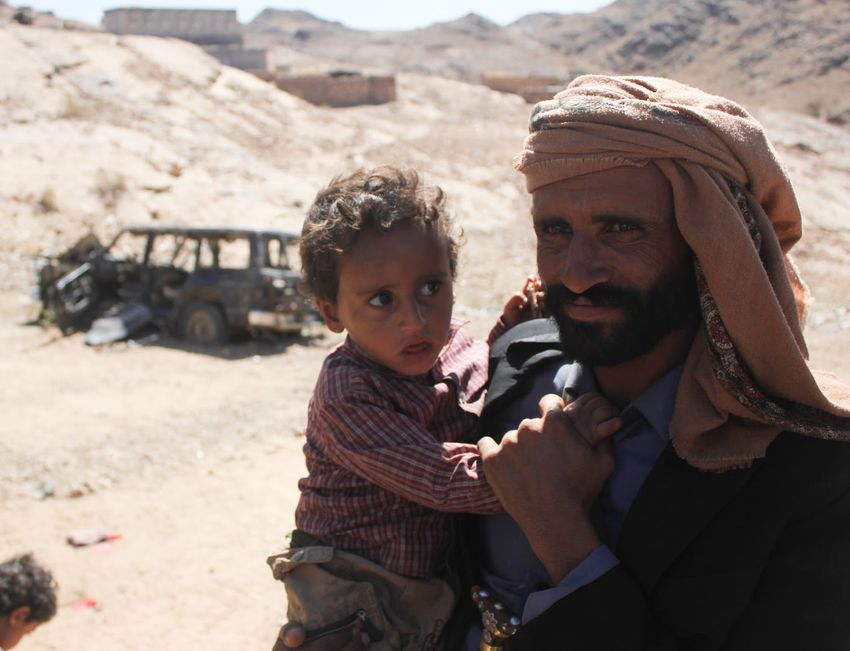
              Cover photograph: Mabkhout Ali al Ameri with his 18-month old son
              Mohammed, shortly after a botched US raid on al Ghayil in January 2017 had
              killed at least 20 villagers, including Mohammed’s mother Fatim Saleh Mohsen.
              © Iona Craig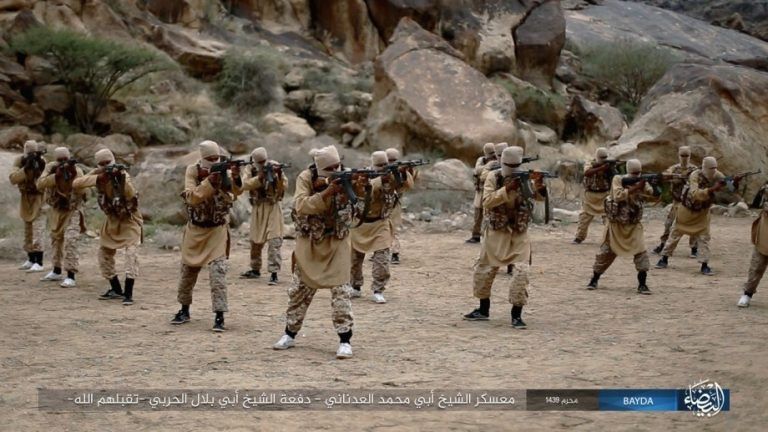
3

Eroding Transparency:

Key findings											                                                       4

US actions in Yemen: an evolving conflict 						                              6
      Holding the US better to account							                                 9

The shape of Donald Trump’s war in Yemen						                                10

The civilian cost of recent US actions in Yemen						                         14
      CENTCOM and civilian harm accountability					                           19

An effective counterterrorism approach?							                                21
      US campaign in Yemen may undermine local attempts to control militants 26
      Tracking covert and clandestine US actions in Yemen				                 28

Conclusion: An end to US actions in Yemen - or a return to the beginning?		   30

                                                                                   airwars.org
Appendix: Transforming understanding of US campaigns in Yemen			33
      Why Airwars casualty estimates differ from others				                   36
      The Airwars methodology								                                         37

About this report										                                                   38
4

              Key findings
              •    A total of 230 alleged and declared US kinetic actions took place in Yemen during
                   Donald Trump’s presidency (2017-2020) according to Airwars monitoring. Of
                   these, 181 US actions were officially declared. This likely marked the most intensive
                   period of strikes in that country by any US president since 2001. However, this
                   high tally disguises significant variations between individual years.

              •    The year 2017 saw the heaviest period of US actions in Yemen during the Trump
                   administration, with 133 officially declared US airstrikes and ground actions. This
                   spike in activity coincided with the administration labeling three provinces as
                   ‘areas of active hostilities’, making it easier for US Central Command to conduct
                   attacks.

              •    Since this early peak, US activity in Yemen has declined significantly. Only 21
                   declared or likely US actions took place in Yemen during 2019; while this year to
                   October 2020, only 15 claimed US strikes had been tracked, the lowest levels of
                   reported US activity in Yemen since 2011.

              •    Forty one of the 230 alleged and declared US actions in Yemen during Donald
                   Trump’s presidency were found by Airwars to have associated allegations of
                   civilian harm. Of these, 25 reported US actions were assessed by Airwars to have
airwars.org

                   likely resulted in civilian harm, reportedly leading to the deaths of between 86
                   and 154 civilians, including at least 28 children and 13 women. 1

              •    Attributing civilian harm in Yemen remains a challenge, due both to parallel
                   CENTCOM and CIA campaigns, as well as to a broader civil war involving multiple
                   local and foreign actors. Even so, at least 63 civilians were confirmed or reported
                   by multiple Yemeni and English sources to have been killed across 20 strikes and
                   ground actions that have been officially confirmed by the US military. At least 23
                   more civilians likely died in what appear to have been undeclared US actions in
                   Yemen, some possibly conducted by the CIA.

              •    At least 40 per cent of the total minimum likely civilian deaths estimated by
                   Airwars resulted from confirmed or alleged US ground raids in Yemen, though
                   these only accounted for between 1.5 and 3 per cent of all declared and likely US
                   actions tracked by Airwars.

              •    As the US command responsible for military strikes in Yemen, CENTCOM has an
                   obligation both to track and report on civilian harm from its actions. It appears
                   to be failing on both counts. Recent claims to Congress that there were no known
                   civilian harm claims relating to US actions in Yemen during 2019 were, for
                   example, incorrect. Senior officials informed Airwars that CENTCOM presently
                   has no formally constituted civilian casualty cell to cover Yemen allegations. And
                   despite Airwars providing CENTCOM with its complete civilian harm findings on
                   Yemen during the Trump presidency nine weeks prior to this report’s publication,
                   officials unfortunately failed to provide any event responses.

              1 Based on alleged or declared US actions with “fair” or “confirmed” reporting of civilian harm, according to the Airwars
              methodology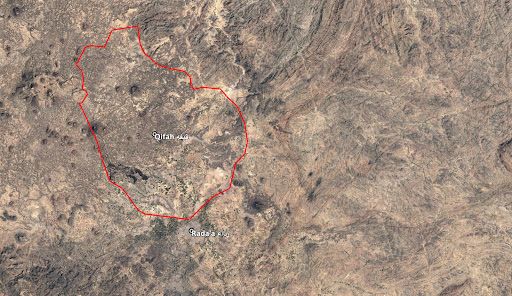
5
• From mid 2019 onwards, covert and clandestine actions in Yemen appear to have
dominated US engagements, Airwars research shows - with troubling implica-
tions for civilian harm accountability. While the last CENTCOM-declared US
military action in Yemen was on June 24th 2019, some 30 US strikes have
reportedly taken place there since. Three of those attacks have in fact been
declared by US officials, while a further fifteen events were assessed by Airwars
to be likely US strikes.
• This report also notes the degree to which small Yemeni communities have often
borne the brunt of US engagements. Almost a fifth of US actions under President
Trump targeted a relatively small area to the north of Rada’a ( ) ُم ِديْ ِريَّة َردَاع, in
Bayda ( ) البيضاءgovernorate, for example. In addition, our findings point to a US
campaign that appears often to misunderstand both complex Yemen tribal
realities, and local relations with extremist groups, potentially proving a hindrance
for local efforts to defeat Al-Qaeda in the Arabian Peninsula (AQAP) and Islamic
State in Yemen (IS-Y).
• Unsurprisingly, given the weight of action in the initial period of the Trump
presidency, fatalities among persons directly involved in hostilities primarily
occurred in 2017 - with 60 per cent of the total tracked by Airwars killed in likely
or declared actions during that year. Just under 90 per cent of the US actions
tracked by Airwars were known or suspected to have targeted AQAP. Compara-
tively, just over five per cent of strikes targeted so-called Islamic State. These
actions occurred almost entirely in October and November 2017.
airwars.org
6
US actions in Yemen: an evolving
conflict
Since the first known US drone strike was conducted in Yemen in 2002, two US
campaigns have been ongoing in the nation, conducted in parallel by the US military
and by the Central Intelligence Agency. The primary targets of this counterterrorism
campaign have been Al-Qaeda in the Arabian Peninsula (AQAP) and more recently,
Islamic State in Yemen (IS-Y).
This new Airwars dataset and analysis, published on the eve of the 2020 presidential
election, sheds fresh light on the most recent period of US direct action in Yemen,
the term in office of President Donald Trump - a period in which the Executive has
sought to portray itself as reducing US military involvement abroad; but has also
significantly reduced both the restrictions imposed on, and transparency for, direct
action in Yemen and elsewhere.
For almost two decades, scrutiny of US counterterrorism actions in Yemen has been
impeded by secrecy, particularly where civilian harm is reported. A CIA targeted as-
sassination in 2002 - of five Al-Qaeda linked suspects in the USS Cole terror attack
- was the only known kinetic intervention by George W. Bush in Yemen during his
presidency. However the means of that attack - a targeted precision airstrike involving
remotely piloted armed drones, overseen not by the US military but by a covert
civilian intelligence agency - ushered in a defining and controversial theme of the
‘War on Terror’ which persists to today.
airwars.org
Barack Obama expanded that war to substantively include Yemen, as Al-Qaeda in
the Arabian Peninsula began plotting and conducting extraterritorial attacks. Strikes
were conducted by both US Central Command (CENTCOM) and by the CIA. Yet the
Obama administration’s first major intervention in Yemen in December 2009 resulted
in a mass casualty event, when a cruise missile strike killed an estimated 47 civilians,
including at least 22 children and 12 women, during an attack on an alleged AQAP
training camp on the edge of Al-Majala village ()املعجلة, in Abyan governorate.
The deaths of those civilians - and hundreds more reportedly killed in covert and
clandestine US drone strikes in Yemen, Somalia and Pakistan - were never individu-
ally admitted by the Obama administration. However during Obama’s later presidency,
some accountability improvements were seen. In late 2013, a requirement was
introduced that strikes should not be conducted in areas outside of active hostilities
unless there was a near certainty of no civilian casualties.2 This led to a marked fall in
locally reported civilian deaths in Yemen and elsewhere from US actions.
In July 2016, Presidential Executive Order 13732 required the Director of National
Intelligence (DNI) to publish an annual unclassified summary of the number of US
strikes conducted against terrorist targets outside areas of active hostilities, “as well
as assessments of combatant and non-combatant deaths resulting from those
strikes.”3 At the same time, the Obama administration conceded the deaths of
between 64 and 116 civilians during US counterterrorism actions in Yemen, Somalia,
Pakistan and Libya between 2009 and 2015 - though it failed to identify which
specific events or countries those casualties had occurred in.4
2 ‘Remarks by the President at the United States Military Academy Commencement Ceremony’, White House, May 28th 2014,
archived at https://obamawhitehouse.archives.gov/the-press-office/2014/05/28/remarks-president-united-states-military-acade-
my-commencement-ceremony
3 ‘Executive Order -- United States Policy on Pre- and Post-Strike Measures to Address Civilian Casualties in U.S. Operations
Involving the Use of Force’, White House, July 1st 2016, archived at https://obamawhitehouse.archives.gov/the-press-of-
fice/2016/07/01/executive-order-united-states-policy-pre-and-post-strike-measures
4 ‘FACT SHEET: Executive Order on the US Policy on Pre & Post-Strike Measures to Address Civilian Casualties in the US Operations
Involving the Use of Force & the DNI Release of Aggregate Data on Strike Outside Area of Active Hostilities’, White House, July 1st
2016, archived at https://obamawhitehouse.archives.gov/the-press-office/2016/07/01/fact-sheet-executive-order-us-policy-pre-
post-strike-measures-address7
While these moves towards greater transparency and public accountability for
civilian harm during Obama’s second term were generally welcomed by critics, there
were also concerns at how durable these changes might prove.5 So it has transpired
with the Trump administration, which can best be characterised overall as having
rolled back transparency and accountability for US actions in Yemen to pre-2013
levels.
Just as Obama had done years earlier, Donald Trump began his own Yemen interven-
tion with a disastrous attack that led to significant civilian harm - when at least
twenty civilians, including eleven children and six women, died on January 29th 2017
in the village of al Ghayil ( )الغيلin Bayda ( )البيضاءgovernorate. A US Navy SEAL also
died during the operation.
US Central Command publicly conceded likely civilian harm within 72 hours of the
attack, noting in a February 1st press release that “A team designated by the
operational task force commander has concluded regrettably that civilian non-com-
batants were likely killed in the midst of a firefight during a raid in Yemen Jan. 29.
Casualties may include children.”6 This marked the first ever public concession of
civilian harm in a specific US action in Yemen since 2002. Just twelve days into his
presidency, it also represented the high water mark of public accountability for US
actions in Yemen under Donald Trump.
The Director of National Intelligence had published his 2016 report into US strikes
and reported civilian harm in theatres such as Yemen just hours before Donald
Trump’s inauguration. This had claimed just one civilian death among 53 counterter-
airwars.org
rorism strikes in 2016 in areas outside active hostilities. According to Obama’s
Executive Order 13732, the DNI’s annual report into 2017 actions was due no later
than May 1st 2018. That report was never published. Yet 2017 had seen record
numbers both of US strikes and of locally reported civilian harm in Yemen, as Airwars’
new data shows. In the first weeks of the Trump presidency, three provinces of Yemen
had in fact been flagged by the US as ‘areas of active hostilities’, enabling the US
military to undertake strikes on their own authority, without undergoing a lengthy
process of securing executive approval. This meant that these actions would anyway
likely have fallen outside any reporting obligations of the DNI.
Bipartisan efforts by Congress had nevertheless led to another avenue for Yemen
accountability - the National Defense Authorization Act 2018 (NDAA 2018). This now
required the Pentagon “to submit to the congressional defense committees, by May
1 each year, a report on civilian casualties caused as a result of United States military
operations during the preceding year.”7 The first such report covering 2017 conceded
that “that there were credible reports of civilian casualties caused by U.S. military
actions in Yemen against AQAP and ISIS during 2017.”
5 ‘Obama’s Targeted Killing Program and the Need for Transparency’, Molly Wooldridge, Human Rights First, July 8th 2016, available
at https://www.humanrightsfirst.org/blog/obama-s-targeted-killing-program-and-need-transparency
6 ‘U.S. Central Command statement on Yemen raid’, US Central Command, February 1st 2017, available at https://www.centcom.
mil/MEDIA/PRESS-RELEASES/Press-Release-View/Article/1068267/us-central-command-statement-on-yemen-raid/
7 ‘H.R.2810 - National Defense Authorization Act for Fiscal Year 2018’, US Congress, available at https://www.congress.gov/
bill/115th-congress/house-bill/2810/text8
On March 6th 2019, President Trump formally stripped from Obama’s original
executive order the obligation upon the DNI to report annually on civilian harm
from US actions in areas outside active hostilities.8 That revocation referenced
both Congress’s NDAA 2018 requirement for the Pentagon to submit annual
reports on civilian harm from US military actions, as well as NDAA 2019 which had
placed further Congressional reporting obligations upon the Pentagon.9
These annual reports from the Department of Defense have, then, provided what
little accountability there has been for Trump administration military actions in
Yemen - though none at all for the parallel and continuing CIA campaign.
According to the DoD report covering 2018 and published the following year,
“U.S. forces conducted 36 airstrikes against AQAP and ISIS operatives and facilities
in Yemen and supported United Arab Emirates and Yemen-led efforts to clear
AQAP from Shabwah Governorate. DoD has no credible reports of civilian
casualties resulting from U.S. military actions in Yemen during 2018.”10 Yet
according to Yemenis themselves, there were 15 alleged US civilian casualty events
during that year - 11 of them assessed by Airwars as likely to have killed or injured
non combatants.
In its latest report to Congress, DoD declined to reveal how many strikes it had
conducted in Yemen during 2019, noting only that “U.S. forces conducted coun-
terterrorism airstrikes in Yemen. The strikes targeted AQAP and ISIS operatives in
a continuing effort to disrupt and degrade terrorist threat threats in Yemen.” The
report also asserted that “USCENTCOM has not receive [sic] any reports from IOs
airwars.org
or NGOs regarding potential civilian casualties caused by U.S. military action in
Yemen in 2019.”11
In fact as Airwars demonstrates, there were three locally reported civilian harm
claims against US actions in Yemen during 2019. Two of those strikes, both
assessed by Airwars to include fair reporting of civilian harm, were declared by
CENTCOM. A third reported action was alleged by one source to have involved
civilian harm. Central Command told New America that this reported strike was
under investigation, despite continuing to publicly deny any US military actions
since June 2019.12 The failure of CENTCOM to itself identify these local casualty
claims - despite being the best resourced US military command, and with a
mandated obligation to track civilian harm from its own actions - points to the
ongoing necessity of external monitoring and investigation of US counterterror-
ism actions.
8 ‘Trump Revokes Obama-Era Rule on Disclosing Civilian Casualties From U.S. Airstrikes Outside War Zones’, Charlie Savage,
New York Times, March 6th 2019, at https://www.nytimes.com/2019/03/06/us/politics/trump-civilian-casualties-rule-revoked.
html
9 ‘Executive Order on Revocation of Reporting Requirements’, President Donald Trump, the White House, March 6th 2019, at
https://www.whitehouse.gov/presidential-actions/executive-order-revocation-reporting-requirement/
10 Annual Report on Civilian Casualties in Connection With United States Military Operations’, Department of Defense, May 2nd
2019, at https://media.defense.gov/2019/May/02/2002126767/-1/-1/1/ANNUAL-REPORT-CIVILIAN-CASUALTIES-IN-CONNEC-
TION-WITH-US-MILITARY-OPERATIONS.PDF
11 ‘Annual Report on Civilian Casualties In Connection With United States Military Operations in 2019’, Department of Defense,
May 6th 2020, at https://media.defense.gov/2020/May/06/2002295555/-1/-1/1/SEC-1057-CIVILIAN-CASUALTIES-MAY-1-2020.
PDF
12 @NewAmericaISP, Twitter, January 3rd 2020, at https://twitter.com/NewAmericaISP/status/12131303670892339209
Holding the US better to account
Beginning in 2011, the Bureau of Investigative Journalism had tracked all Eng-
lish-language media reporting of reported US airstrikes and associated civilian
harm in Yemen, providing a critical, transparent and award-winning counter
narrative to US claims of no or low civilian harm in its covert drone wars. The long
running project was finally retired in Spring 2020.
Airwars has now taken on this important project. Building on the Bureau of Inves-
tigative Journalism’s extensive original database, Airwars has utilised its own
unique Open Source methodology to construct a new dataset, combining rich
hyperlocal sources, primarily in Arabic, with international coverage and official US
reporting to identify confirmed and possible US actions. Airwars has also
permanently preserved the Bureau’s own invaluable archive covering US actions
in Yemen, Somalia and Pakistan from 2002 to 2019.13
Through this revised methodological process, Airwars is able to reveal that there
have been at least 230 discrete alleged or confirmed US direct actions conducted
in Yemen since Donald Trump’s inauguration on January 20th 2017, some 196 of
which have been assessed either as likely; or as corresponding to an officially
declared US action. Overall, this represents two-thirds more alleged or confirmed
US strikes under Trump than the 138 total confirmed or possible US actions in
Yemen tracked by the Bureau during Barack Obama’s second term.
airwars.org
Airwars has applied in-depth open source research techniques to each of these
events, gathering together and publicly archiving all known reports and claims,
and resulting in a public database including over 4,000 sources and over 400
unique images, associated with specific events.14 Furthermore, our in-house
geolocation
battlefield in November team
2002 in Marib province, has
killing five enabled
The United States conducted its first targeted assassination by drone outside the hot
reported us to comprehensively
members of Al Qaeda. map alleged anddata,confirmed
Overall, more than 500 US airstrikes have been locally claimed in Yemen since 2009, resulting
in several hundred locally documented civilian deaths. Airwars’ Yemen which
US actions.
However US counterterrorism operations Of
did not the
begin in reported
earnest until 2009,
founding of Al Qaeda in the Arabian Peninsula (AQAP). The Obama Administration’s
and
prompted confirmed
by the strikes
incorporates earlier tracked
monitoring by
work by the Bureau ofAirwars, over
Investigative Journalism, 60 per
presently
focuses on US actions from 2017 onwards under President Donald Trump – and will shortly be
cent
controversial campaign have
– which now
saw airstrikes by bothbeen geolocated
the US military and the CIA – managedtoexpanded
at or below
to include the
all known US strikesvillage-level
in Yemen since 2002. Reviews ofof precision,
reported US
enabling far more accurate mapping of the parallel US military and CIA
to suppress but not destroy AQAP, which continued to mount ambitious extraterritorial acts of counterterrorism actions along with any associated civilian harm claims can be accessed
terrorism. US counterterrorism strikes were expanded in October 2017 to include the local ISIS either via our interactive mapping and timeline, or via the ‘US Strikes & Civilian Casualties’ tab
franchise. campaigns.15 above.
1 incident in 2002
Dec 2009
US Forces in Yemen: Trump
20 Jan 2017 22 Oct 2020
New interactive
This map shows all strike locations tracked by Airwars, colour coded
by the targeted belligerent.
mapping by
Civilian Fatalities Militant Fatalities
Airwars enables
Strike Locations Strike Target reported US
�
strikes to be
Legend: Al Qaeda in the Arabian Peninsula (AQAP)
�
�
ISIS - Yemen Other Unknown interrogated in
Administrative Boundaries, via OCHA several ways.
��
�
Click to interact
�
� �
��
�
��
��
��
�
13 ‘Bureau of Investigative Journalism - The Covert Drone Wars Archive’, Airwars, at https://airwars.org/archives/bij-drone-war
10 10 7
14 https://airwars.org/civilian-casualties/?belligerent=us-forces&country=yemen
US
15years Forces
months in Yemen: Trump
https://airwars.org/conflict/us-forces-in-yemen/
days
181 41
Conflicts News & Investigations Reports About اﻟﻨﺰاﻋﺎت اﻟﺤﺮوب اﻟﺠﻮﻳﺔ
Declared US actions in Yemen since January 20, 2017 Alleged civilian casualty incidents assessed since
Length of Campaign January 20, 2017
since December, 2009
Airwars estimate of civilian deaths US Forces estimate of civilian deaths10
The shape of Donald Trump’s war
in Yemen
Airwars analysis demonstrates that the first year of the Trump presidency likely
featured the most intensive US activity in Yemen of any year since 2009 - but that
strike levels have since rapidly declined.
Of a total of 230 discrete events in Yemen tracked by Airwars between January 20th
2017 and October 20th 2020, 196 were assessed to correspond either to officially
declared US actions; or included sufficient reporting to be assessed as likely. Just
under three quarters (144) of these tracked actions under Donald Trump occurred
prior to the end of March 2018.
Declared and Likely US Actions in Yemen, 2017-2020
Figure (1)
Airwars analysis indicates that over a fifth of declared and likely US actions in Yemen during the period occurred in
March 2017 alone. After the first year of the Trump presidency, the number of tracked actions declined
The graphic,
considerably. showing all likely
and declared US
actions tracked
40
by Airwars since
Donald Trump’s
airwars.org
inauguration,
highlights the
broadly observed
contours of the
30 recent US
campaign in
Yemen.
20
10
2017 Apr Jul Oct 2018 Apr Jul Oct 2019 Apr Jul Oct 2020 Apr Jul
All US actions assessed as "likely" or "declared" tracked by Airwars since January 20th 2017.
Chart: Airwars • Source: Airwars • Created with Datawrapper
When compared with available data on strikes in Yemen during the Obama admin-
istration, it appears that this initial 2017 spike in activity also constituted a distinct
departure from Obama-era policy.11
Figure (2), below, displays Airwars’ 2017-2020 record of all alleged and confirmed US
actions in Yemen alongside the Bureau of Investigative Journalism’s similar data for
the Obama presidency. While this can only constitute an indicative and provisional
comparison, given methodological variance between the Bureau of Investigative
Journalism and Airwars datasets, the record indicates an immediate and considera-
ble increase in direct military action at the start of the Trump presidency - followed
by a sharp decline in actions to levels last seen a decade ago.
Alleged and Confirmed US Actions in Yemen, 2009-2020 Figure (2)
A provisional comparison between the BIJ's record of possible and confirmed US actions under Obama and Airwars' The chart shows
new analysis indicates that the first year of the Trump presidency saw significantly higher levels of US activity than all alleged and
observed in prior periods. declared US
actions in Yemen
120 tracked by
Airwars from
2017-2020,
presented
100 alongside the
Bureau of
Investigative
80 Journalism’s
historical record
of “possible” and
“confirmed” US
60
actions under
Obama.
40
airwars.org
20
2009 2010 2011 2012 2013 2014 2015 2016 2017 2018 2019 2020
All alleged or confirmed actions tracked by Airwars since January 20th 2017, alongside the Bureau of Investigative Journalism's record of
"possible" and "confirmed" US actions since 2009. Indicative comparison only, given variance in methodology between BIJ and Airwars.
2017 excludes one "confirmed" Obama strike tracked by BIJ.
Chart: Airwars • Source: Airwars/BIJ • Created with Datawrapper
A limited comparison of officially declared US actions supports the understanding
that US military strikes in Yemen increased precipitously in the first year of the Trump
presidency. A total of 133 actions were declared by US Central Command to have
taken place during 201716, compared with 150 “confirmed” strikes tracked by the
Bureau under the full presidencies of George W. Bush and Barack Obama between
2002 and 2017. This comparison, it must be noted, does not broadly account for the
parallel CIA campaign in Yemen, given that strikes conducted by that agency are
only very rarely officially confirmed, either intentionally or accidentally.
Airwars data, therefore, indicates that 2017 was a unique period of intensive US
action in Yemen within the period of the Trump presidency, but also likely constituted
a considerable increase in strike numbers compared to those seen under Obama.
What drove this? There is some evidence to suggest that Trump may have inherited
an already expanding campaign from Obama, leading towards the increased activity
observed in 2017. “Confirmed” US actions tracked by the Bureau in 2016, for example,
were by now 110 per cent greater than those tracked in 2014. According to the
Bureau’s own data, 2016 had in fact marked the highest number of “confirmed” US
strikes in Yemen under Obama.
16 This includes 131 airstrikes as well as two confirmed US ground operations. ‘US conducted a record 131 airstrikes in Yemen last
year’, Bill Roggio and Alexandra Gutowski, Long War Journal, February 7th 2018, at https://www.longwarjournal.org/
archives/2018/02/us-conducted-a-record-131-airstrikes-in-yemen-last-year.php12
This followed the ongoing resurgence of militant jihadist groups such as Al-Qaeda
in the Arabian Peninsula (AQAP) and the local emergence of so-called Islamic State,
following the security and governance vacuum that emerged as a result of the
outbreak of civil war in Yemen during 2014 and the Saudi-led coalition intervention
in Yemen the following year. The beginning of that conflict saw AQAP grow further
in size by staging jailbreaks; seizing military hardware and conducting bank robberies.
From 2015 to 2016, AQAP was also able to hold considerable territory in and around
the port city of Mukalla. By October 2016, analyst Michael Horton wrote in Terrorism
Monitor that the “future for AQAP has rarely looked brighter”, owing to their ex-
ploitation of fractious circumstances in Yemen at the time, and that it was “an organ-
ization that is larger, more formidable and better armed than it has ever been”.17 It is,
then, possible that the observed increase had less to do with the incoming Trump
administration, and more with ongoing US responses to AQAP’s growing capacity in
Yemen.
The potential dynamics of an inherited campaign, however, may be insufficient to
account for the observed scale of the increase. Airwars data shows that the initial
period of Trump’s presidency saw an immediately higher tempo of US action, rather
than the more gradual increase in activity one might expect to see if US counterter-
rorism efforts were simply responding to changing circumstances on the ground. It
is instead likely that the break in policy indicated by the provisional Obama-Trump
comparison owes more to a considerable loosening of the rules of engagement for
US counterterrorism operations that took place in early 2017.
In the first weeks of the Trump presidency, three provinces of Yemen were declared
“areas of active hostilities”, enabling the US military to undertake strikes, on their
own authority, without undergoing a lengthy process of securing executive approval.18
airwars.org
Previously a drone strike would only be authorised under four conditions, as
summarised by The Economist. Firstly, strikes outside of war zones could only be
conducted if there was near certainty that civilians would not be harmed. Secondly,
that the target had been identified with near certainty. Thirdly, the strike had to
occur within the parameters of a clear chain-of-command accountability - thus
signalling the shift of drone strike responsibility away from the CIA to CENTCOM.
Finally, any strike had to advance American strategic interests.19 The loosening of
these rules meant that the US military could now move more swiftly to authorise and
conduct drone strikes, with fewer safeguards against the possibility of civilian
casualties.20
Luke Hartig, previously Senior Director for Counterterrorism at the National Security
Council (NSC) during the Obama administration, told Airwars that the observed
2017 increase in intensity - in particular the Yakla raid - may have derived from a
desire to increase operations amongst military staff, combined with the more
permissive attitude of the incoming administration. “Clearly, and this had been
reported, before Trump took office there was a desire to do more from the military,
and they put forward a general concept of operations to allow for a greater degree
of advice and assistance to partners on the ground... It seems what happened was
that the Trump administration was keen to take the gloves off, as it were, to be what
they perceived was tougher on terrorism, and this was one of the first ready-made
concepts of operation available”.21
17 ‘AQAP in Southern Yemen: Learning, Adapting and Growing’, Michael Horton, Terrorism Monitor Volume: 14 Issue: 20, October
14th 2016, at https://jamestown.org/program/aqap-southern-yemen-learning-adapting-growing/
18 ‘Accelerating Yemen campaign, U.S. conducts flurry of strikes targeting al-Qaeda’, Missy Ryan, Thomas Gibbons-Neff and Ali
al-Mujahed, The Washington Post, March 2nd 2017, at https://www.washingtonpost.com/world/national-security/accelerating-yem-
en-campaign-us-conducts-flurry-of-strikes-targeting-al-qaeda/2017/03/02/8a9af8cc-ff91-11e6-99b4-9e613afeb09f_story.html?utm_
term=.267cc3908794
19 ‘The president is making it easier to order lethal drone strikes’, The Economist, March 18th 2017, at https://www.economist.com/
united-states/2017/03/18/the-president-is-making-it-easier-to-order-lethal-drone-strikes
20 ‘Trump Gives Military New Freedom. But With That Comes Danger’, Helene Cooper, The New York Times, April 5th 2017, at https://
www.nytimes.com/2017/04/05/us/politics/rules-of-engagement-military-force-mattis.html
21 Interview with Airwars researcher, October 20th 202013
This initial dismantling of Obama-era rules of engagement may account for the
immediately observed increase in strike activity during early 2017. Replacement
strike guidance, reportedly not agreed until September 2017, reintroduced the
requirement of “near certainty” of no civilian harm, but also expanded legitimate
targets to include non-High Value Target strikes against rank-and-file militants; and
reportedly relaxed the requirement for high-level oversight of strikes and raids.22
One (perhaps unexpected) outcome of the designation of parts of Yemen as areas of
active hostilities was to ensure at least some level of accountability for civilian harm
from US military actions. In March 2019, President Trump rescinded a recently-intro-
duced obligation upon the Director of National Intelligence to report annually on US
strikes and associated civilian harm in areas outside active hostilities.23 However, the
National Defense Authorisation Acts of 2018 and 2019, each passed with bipartisan
support, separately required the Pentagon to report annually to Congress on civilian
harm in areas of active hostility. Yemen has therefore been included in the three
annual reports published by DoD so far, covering the years 201724, 201825 and 201926
- though with civilian harm conceded only for 2017.
Despite the initial intensity of US actions in Yemen under Trump, this did not
persist beyond the first year of the presidential term.
The precipitous drop in declared or likely US actions in Yemen since early 2018,
compared with the 2017 period, is highlighted in Figure (1) above. Though 2018
strikes still accounted for a quarter of Trump actions tracked by Airwars, that annual
airwars.org
tally still fell below the total observed in March 2017 alone.
Only 21 declared or likely US actions in Yemen under President Trump took place in
2019, ten per cent of the total for his administration tracked by Airwars. And just 11
declared or likely US actions (five per cent) were monitored from January 1st to
October 20th 2020 - marking the lowest recent levels of US intervention in Yemen
since 2010. This sharp decline is discussed later in the report.
22 ‘Trump Poised to Drop Some Limits on Drone Strikes and Commando Raids’, Charlie Savage and Eric Schmitt, New York Times,
September 21st 2017, at https://www.nytimes.com/2017/09/21/us/politics/trump-drone-strikes-commando-raids-rules.html
23 ‘Trump ends requirement that CIA report drone strike casualties’, France 24, March 7th 2019, available at https://www.france24.
com/en/20190307-trump-ends-requirement-cia-report-drone-strike-casualties
24 ‘Annual Report on Civilian Casualties in Connection With United States Military Operations’, Department of Defense, May 22nd
2018, at https://fas.org/man/eprint/civcas2018.pdf
25 ‘Annual Report on Civilian Casualties in Connection With United States Military Operations’, Department of Defense, May 2nd
2019, at https://media.defense.gov/2019/May/02/2002126767/-1/-1/1/ANNUAL-REPORT-CIVILIAN-CASUALTIES-IN-CONNEC-
TION-WITH-US-MILITARY-OPERATIONS.PDF
26 ‘Annual Report on Civilian Casualties In Connection With United States Military Operations in 2019’, Department of Defense, May
6th 2020, at https://media.defense.gov/2020/May/06/2002295555/-1/-1/1/SEC-1057-CIVILIAN-CASUALTIES-MAY-1-2020.PDF14
The civilian cost of recent US
actions in Yemen
In total, to October 20th 2020 Airwars had tracked a total of 41 alleged or confirmed
US actions in Yemen during the Trump administration (2017-2020) that were reported
to have resulted in civilian harm, drawn from our unique combination of hyperlocal
and global all-source reporting.
Up to 194 non combatant deaths were locally claimed from these 41 actions. Airwars
presently assesses that at least 86 civilians likely died based on available public
evidence, including at least 28 children and 13 women, in some 25 declared or
claimed US actions. At least 63 of those reported civilian deaths resulted from twenty
actions that US Central Command has itself publicly declared. At least 23 more
civilians likely died in five actions in Yemen which were possibly, or known to have
been, conducted either by the CIA or in undeclared clandestine US military actions.
The year 2017 marked the worst year for reported civilian fatalities in Yemen from US
actions since concerted military and CIA strikes began in 2009. However, civilian
casualty claims from US actions in Yemen are presently at relatively low levels.
The US military in the form of US Central Command has conceded a minimum of
four and a maximum of twelve civilian deaths from its actions in Yemen during the
Trump years, all from a single event in late January 2017. For that same incident, the
airwars.org
public record indicates that at least 20 and as many as 56 non combatants in fact
died.27 This casualty admission by CENTCOM, just twelve days into the Trump
presidency, represented the high water mark of US accountability for civilian harm in
Yemen during Donald Trump’s time in office.
Minimum Reported Civilian Non-Combatant Deaths, 2017-2020 Figure (3)
In total, Airwars has assessed 25 distinct US actions to have associated confirmed or fair allegations of civilian harm, resulting in a
The chart shows
minimum of 86 alleged civilian deaths. Since January 21st 2019, Airwars has tracked no allegations of civilian harm that were
the annualised
assessed as "fair" under the Airwars methodology.
minimum
number of
Confirmed Fair Weak/Contested
reported civilian
deaths tracked
by Airwars since
January 20th
2017, broken
60 down by
assessed level of
reporting.
Number of
confirmed
40 fatalities reflects
Airwars’ event
tally rather than
CENTCOM’s.
20
2017 2018 2019 2020
Minimum number of reported civilian deaths deriving from alleged US actions, separated by assessed level of reporting, since January 20th 2017. In the single
US-confirmed case of civilian harm, Airwars assessed that a minimum of 20 civilian were killed, though the US itself officially conceded only 4 to 12 civilian
deaths.
Chart: Airwars • Source: Airwars • Created with Datawrapper
27 Airwars event USYEMTr006-C, at https://airwars.org/civilian-casualties/usyemtr006-c-january-29-2017/15
Civilian harm in Yemen owing to alleged or confirmed US actions, as tracked by
Airwars, primarily occurred during the first two years of the Trump presidency,
as figure (3), above, indicates.
Some 93 per cent of the minimum likely civilian deaths (80 fatalities) tracked by
Airwars arose from reported US actions in Yemen between January 2017 and April
2018; and 56 of the 86 minimum civilian deaths estimated by Airwars occurred in
2017 alone.
Since January 21st 2019, Airwars has tracked no new allegations of civilian harm
resulting from US actions that have been assessed by it as fair based on local
reporting. Broadly, as one might expect, periods of increased declared and alleged
US activity usually coincided with periods of greater alleged civilian harm.
Alleged and declared US actions in the first year of the Trump presidency were con-
siderably more deadly to civilians than prior years, provisional comparison with the
Bureau of Investigative Journalism’s own data indicates. For 2017, across 21 reported
or declared US actions, Airwars monitored allegations of at least 76 civilian fatalities,
the same minimum number of civilians tracked by the Bureau as reportedly having
been killed in the prior five years combined. Again, this can only constitute an
indicative comparison given methodological variance between the Bureau and
Airwars datasets.
airwars.org
Minimum Alleged and Confirmed Civilian Deaths in Yemen, 2009-2020
A provisional comparison with the BIJ's record of minimum possible and confirmed civilian deaths resulting from US
actions under Obama and Airwars' new analysis indicates that the first year of the Trump presidency was
considerably more deadly to non-combatants than prior periods.
Figure (4)
The chart shows
an annualised
tally of all
60 minimum alleged
and confirmed
civilian fatalities
tracked by
Airwars during
the Trump
40 presidency,
presented
alongside the
Bureau of
Investigative
Journalism’s tally
20 of all minimum
possible and
confirmed
civilian deaths
during the
Obama
presidency
2009 2010 2011 2012 2013 2014 2015 2016 2017 2018 2019 2020
All alleged or confirmed minimum civilian deaths tracked by Airwars since January 20th 2017, alongside the Bureau of Investigative
Journalism's record of minimum "possible" and "confirmed" civilian deaths owing to US actions since 2009. Indicative comparison only,
given variance in methodology between BIJ and Airwars.
Chart: Airwars • Source: Airwars/BIJ • Created with Datawrapper16
Airwars data also demonstrates the considerable civilian harm risks of US
ground actions in Yemen. Alleged or confirmed US ground actions, though
accounting only for between 1.5 and 3 per cent of tracked US actions assessed
as declared or likely, were responsible for at least 40 per cent of the minimum
confirmed or fair civilian harm tracked by Airwars.
Two cases of declared US ground actions - a January 2017 raid in Yakla ( ) يكالin
Bayda ( ;) البيضاءand a May 2017 raid in al-Adhlan ( ) العذالنin Marib ( ) مارب- resulted
in at least 25 civilian deaths, Airwars conservatively estimates. An additional
undeclared but widely reported March 2017 US ground raid, in Wadi Yashbum
( ) وادي يشبمin Shabwa Governorate ( ) شبوة, resulted in the alleged deaths of at least
additional 10 civilians.
Civilian harm in these cases appeared to derive primarily from the use of airpower
when ground forces came under fire, again highlighting the documented tendency
of close air support for “Troops In Contact” to be particularly deadly for non-com-
batants.28 In Yakla ( ) يكال, an anonymous local resident told Reuters that “gunmen
opened fire at the U.S. soldiers who left the area, and the helicopters bombed the
gunmen and a number of homes and led to a large number of casualties.29 Eight-
year-old Nawar al-Awlaki - the young daughter of US citizen and AQAP supporter
Anwar al Awlaki, who had himself been killed by the CIA several years earlier -
reportedly died as a result of helicopter gunfire while hiding in a house. Later
reporting suggested that 25 US military aircraft were deployed in various capacities
during the raid.30
During the al-Adhlan ( )العذالنraid in May 2017, local residents asserted that
helicopters had also fired on and killed people as they fled. One resident later told
airwars.org
The Intercept that as helicopters fired on buildings, “my little brother Abdullah ran
for his life with the other women and children. They killed him as he was running”.31
It was confirmed by CENTCOM that an AC-130 gunship had also participated in that
raid. One local-language news source claimed that almost 60 missiles fell on the
village during the event.32
The recorded lethality for civilians of US ground actions in Yemen since 2017 has
contrasted with their apparent inefficacy. Though CENTCOM publicly claimed that
the January 2017 Yakla ( )يكالraid was a “site exploitation mission”, intended to extract
valuable intelligence, later reporting by NBC asserted that the mission had been to
“kill-or-capture” AQAP leadership,33 possibly including AQAP leader Qassim al-Raymi.
US Central Command initially reported that fourteen AQAP militants were killed
during the raid, including “two longstanding AQAP operational planners and
weapons experts”, Sultan al-Dhahab and Abd-al-Ra’uf al-Dhahab.34 However,
ongoing reporting cast considerable doubt on their ties to the extremist group. At
least eleven named children reportedly died in the Yakla ( )يكالraid.
28 See for example ‘“Troops in Contact”: Airstrikes and Civilian Deaths in Afghanistan’, Human Rights Watch, September 2008, at
https://www.hrw.org/sites/default/files/reports/afghanistan0908web_0.pdf
29 ‘Commando dies in U.S. raid in Yemen, first military op OK’d by Trump’, Mohammed Ghobari and Phil Stewart, Reuters, January
29th 2017, at https://www.reuters.com/article/us-usa-yemen-qaeda-idUSKBN15D08J
30 ‘MC-130 Crew Receives Distinguished Flying Crosses for Role in 2017 Yemen Operation’, Brian W. Everstine, Air Force Magazine,
January 23rd 2019, at https://www.airforcemag.com/mc-130-crew-receives-distinguished-flying-crosses-for-role-in-2017-yemen-op-
eration/
31 ‘Villagers Say Yemeni Child Was Shot As He Tried To Flee Navy Seal Raid’, Iona Craig, The Intercept, May 28th 2017, at https://
theintercept.com/2017/05/28/villagers-say-yemeni-child-was-shot-as-he-tried-to-flee-navy-seal-raid/ ; ‘Pentagon Spokesman
Describes U.S. Raid in Yemen’, Terri Moon Cronk, US Central Command, May 23rd 2017, at https://www.centcom.mil/MEDIA/
NEWS-ARTICLES/News-Article-View/Article/1191797/pentagon-spokesman-describes-us-raid-in-yemen/
32 ‘ لتقي برأم لازنإ | ريرقت5 زوجعو لفط مهنيب نييندم... [ دعوتت »لذاوعلا«وReport: Ma’reb landing kills 5 civilians including a child
and an elderly person.]’, Abdullah Al-Sharif, Al-Arabi, May 23rd 2017, at https://www.al-arabi.com/Movement/12942/قورش%20
يدامرلا%20»يبرعلا«ـل:%20مالسلا%20ةرطف%20برحلاو%20تفقوأ%20طاشنلا%20يفاقثلا
33 ‘How the Trump Team’s First Military Raid in Yemen Went Wrong’, Cynthia McFadden, William M. Arkin and Tim Uehlinger, NBC
News, October 1st 2017, at https://www.nbcnews.com/news/us-news/how-trump-team-s-first-military-raid-went-wrong-n806246
34 ‘U.S. Central Command releases video retrieved during weekend raid in Yemen’, US Central Command, February 3rd 2017, at
http://www.centcom.mil/MEDIA/PRESS-RELEASES/Press-Release-View/Article/1070450/us-central-command-releases-video-re-
trieved-during-weekend-raid-in-yemen/17
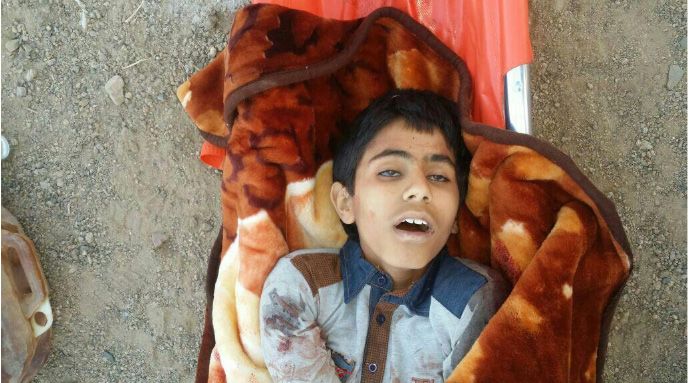
A reported
child casualty
of the
January 29th
2017 US raid
on al Ghayil
(Image via @
doamuslims)
Since the May 2017 action, there have been no declared or well-reported allegations
of US ground raids in Yemen, possibly as a result of their poor recent track record
and high reported civilian death toll.
Airwars’ new dataset and mapping also exposes the degree to which small
airwars.org
Yemeni communities have borne the brunt of the parallel CENTCOM and CIA
campaigns in Yemen.
The area north of Rada’a ( ) رداعcity in Bayda governorate ( ) البيضاء, roughly 25km
in radius and including the Qayfa ( ) قيفة, Wald Rabi () ولد الربيع, and Quraisha () القريشية
districts, has been the site of almost a fifth of the total likely and declared US actions
during the Trump presidency, Airwars research shows.
Between them, these actions reportedly killed at least 126 persons alleged to be
directly participating in hostilities. The weight of US actions in the area is perhaps
unsurprising, given the long-term presence of both AQAP and IS-Y in the near region.
It was here for example that so-called Islamic State established training camps in
2017, while Al-Qaeda in Yemen has maintained complex relations with tribal networks
in the area.35
Yet the civilian death toll in this region has also been considerable. US actions in the
northern vicinity of Rada’a ( ) رداعcity accounted for 44 per cent of the minimum fair
and confirmed civilian deaths (387) tracked by Airwars. All but one were reportedly
killed by US actions in the first year of the Trump presidency alone.
35 See for example ‘Our Common Enemy: Ambiguous Ties Between al-Qaeda and Yemen’s Tribes’, Nadwa Al-Dawsari, Carnegie
Middle East Center, January 11th 2018, at https://carnegie-mec.org/2018/01/11/our-common-enemy-ambiguous-ties-between-al-
qaeda-and-yemen-s-tribes-pub-7522518
Figure (5)
The mapping
shows all
declared and
alleged US
actions tracked
by Airwars
2017-2020 that
were
geolocated to
the area north
of Rada’a.
Of the alleged civilian deaths in the area, at least seventeen were reportedly children,
nine were said by local sources to be women, and nine were described as adult male
civilians. Twelve declared or likely US actions tracked by Airwars reportedly took
place in the village cluster of Yakla ( )يكالalone, including the January 2017 ground
airwars.org
raid, which between them account for the fair or confirmed reported deaths of at
least 25 civilians.
Other areas also witnessed mass civilian casualties resulting from alleged US actions.
During the first week of March 2017, US actions targeted areas in the Shabwa ( ) شبوة
Governorate, specifically the Wadi Yashbum ( ) وادي يشبمarea in the Saeed ( ) صعيد
district. The night of March 2nd-3rd in Wadi Yashbum ( ) وادي يشبمsaw some of the
most intense periods of reported US airstrikes in the country. According to multiple
sources, between 10 and 30 US airstrikes hit Wadi Yashbum from late on March 2nd
until dawn on March 3rd. The principal target of the strikes appears to have been
Saad Atef al-Ateeqi al-Awlaki, a senior AQAP leader in Shabwa. However according
to local and international media outlets, a number of civilians, including women and
children were killed and wounded. Local reports specified that members of the Atef
family were killed during the overnight operation in Wadi Yashbum ( ;) وادي يشبمas
well as members of other families such as the Belaid al-Salmis. Based on local sources,
Airwars estimates that between 10 and 14 civilians were killed in the attacks.
Local testimonies often paint a vivid picture of destruction as a result of US airstrikes.
Residents told Almasdar Online that the overnight airstrikes on Wadi Yashbum
( )وادي يشبمhad “destroyed three houses, a block factory, a gas station, and a weapons
depot”. An anonymous local resident also described to Middle East Eye the fear felt
locally as a result of the strikes, saying that a number of families had fled the area.
36
Other reports from local Facebook sources such as Ween Al Enfigar Alaan also
appeared to corroborate this, claiming that neighbouring villages had been
abandoned during the attack, with residents fleeing in “severe terror”.37
36 ‘US troops raid Yemen villages in hunt for al-Qaeda leader’, MEE, March 5th 2017, https://www.middleeasteye.net/news/
us-troops-raid-yemen-villages-hunt-al-qaeda-leader
37 Ween Al Enfigar Alaan, Facebook, March 2nd 2020 at https://www.facebook.com/WeenAlEnfigarAlaan/posts/169452845750727119
CENTCOM and civilian harm accountability
Despite a considerable number of reported civilian harm events from US actions in
Yemen under Donald Trump, the US has only officially admitted to between four and
twelve of the minimum 86 civilian deaths conservatively estimated by Airwars. Those
admitted fatalities all occurred in a single confirmed US military ground and air
action, the Yakla ( )يكالraid, just nine days into the presidency. Airwars’ own all-source
assessment, which references several on the ground studies by investigators as well
as hyperlocal reports from the time, resulted in a minimum assessed civilian death
toll of 20 at Yakla ( )يكال, significantly greater than that admitted by the US military.
Since February 2017, both the Department of Defense and CENTCOM have consist-
ently denied civilian casualties from US military actions in Yemen. In its 2018 and
2019 annual civilian casualty reports to Congress, issued in April 2019 and May 2020
respectively, the DoD stated that it had assessed “no credible reports of civilian
casualties resulting from US military actions in Yemen” for the years in question.
Yet in the two years covered by those DoD reports to Congress, Airwars itself has
tracked no less than thirteen alleged or confirmed US actions with sufficient all-source
reporting of civilian harm to be assessed as likely having resulted in at least 30
civilian deaths. All but one of the actions were publicly declared by the US military.
The latter DoD report to Congress report also asserted that the US military had not
received “any reports from IOs or NGOs regarding potential civilian casualties caused
by U.S. military action in Yemen in 2019”, despite the considerable work done by
Yemeni and global human rights organisations, such as Mwatana for Human Rights,
airwars.org
in drawing attention to credible reporting of civilian harm.
In response to the most recent DoD report, Mwatana pointed to a January 21st 2019
US drone strike which reportedly killed Saleh Ahmed Mohammed al-Qaisi, an elderly
housepainter or construction worker, in Bayda () البيضاء. US Central Command told
New America that a strike had been conducted in Bayda ( ) البيضاءon that day. Since
there were no other known reports of a US action in Yemen on that day, Airwars has
surmised that the strike in Ja’ar ( ) جعارwas this declared action.38
Why then is CENTCOM failing both to identify - and if necessary concede - civilian
harm from its own actions in Yemen?
As the largest US military command, CENTCOM is simultaneously focused on several
conflict theatres at present. Civilian harm assessments for Afghanistan, and for Iraq
and Syria, have been devolved by CENTCOM to their relevant combatant commands.
More than 2,000 event assessments relating to alleged civilian harm have for example
been conducted by Combined Joint Task Force - Inherent Resolve, leading to the
admission of almost 1,400 non combatant deaths in Iraq and Syria since 2014. A
majority of those CJTF-OIR assessments - and a majority of recently conceded civilian
deaths - were triggered by Airwars referrals, resulting in turn from its identification
of local-language reporting.
For Yemen, allegations of civilian harm from US actions are still assessed by CENTCOM
itself. However senior officials conceded to Airwars in mid 2020 that there is at
present no formally constituted civilian casualty assessment cell at Tampa, and that
civilian casualty claims for Yemen are reviewed on an ad hoc basis.
38 ‘U.S. Fails to Acknowledge Killing Yemeni Civilians’, Abdulrasheed al-Faqih and Kristine Beckerle, Mwatana For Human Rights, May
18th 2020, at https://mwatana.org/en/us-fails-to-acknowledge-killing-yemeni-civilians/20
Ahead of publication of this report, Airwars presented CENTCOM on August 24th
2020 with its complete findings on recently claimed civilian harm from US actions in
Yemen. This included more than 1,000 pages of archived source materials, in both
English and Arabic, relating to all 41 declared and alleged US actions which had led
to local claims of civilian harm in Yemen under President Trump to that date. Detailed
geolocational findings were also presented. Despite several assurances that officials
would “provide you with the results of CENTCOM’s findings regarding these claims
as soon as possible”, no response to those 41 Yemen allegations had been made by
Tampa as of October 20th 2020.
The failure of CENTCOM properly to respond to such good faith engagements by
external NGOs is troubling - particularly given the command’s own apparent inability
to track recent public claims of civilian harm from US actions in Yemen.
In a Department of Defense Memorandum issued in February 2020, as part of an
ongoing Pentagon review of civilian harm mitigation policies, Deputy Under Secretary
of Defense Dr James Anderson noted that “It is unrealistic to expect that civilian
harm can be entirely eliminated in armed conflict. Nonetheless, we must anticipate
its likelihood in advance of conflict and appropriately support efforts to reduce such
harm, acknowledge responsibility for U.S. actions, and continuously learn from our
experience so that further improvements can be identified and implemented.”39
The present failure of CENTCOM adequately to identify, review and where necessary
acknowledge civilian harm claims from its actions in Yemen appears to be markedly
at odds with current Pentagon policies, and should be addressed as a matter of
airwars.org
urgency.
39 ‘Memorandum: Development of a DoD Instruction on Minimizing and Responding to Civilian Harm in Military Operations’,
Deputy Under Secretary of Defense James H. Anderson, Department of Defense, February 20th 2020, at https://media.defense.
gov/2020/Feb/20/2002252367/-1/-1/1/DEVELOPMENT-OF-A-DOD-INSTRUCTION-ON-MINIMIZING-AND-RESPONDING-TO-CIVIL-
IAN-HARM-IN-MILITARY-OPERATIONS.PDFYou can also read


