EU Settlement Scheme - Fresh Produce Consortium
←
→
Page content transcription
If your browser does not render page correctly, please read the page content below

EU Settlement Scheme
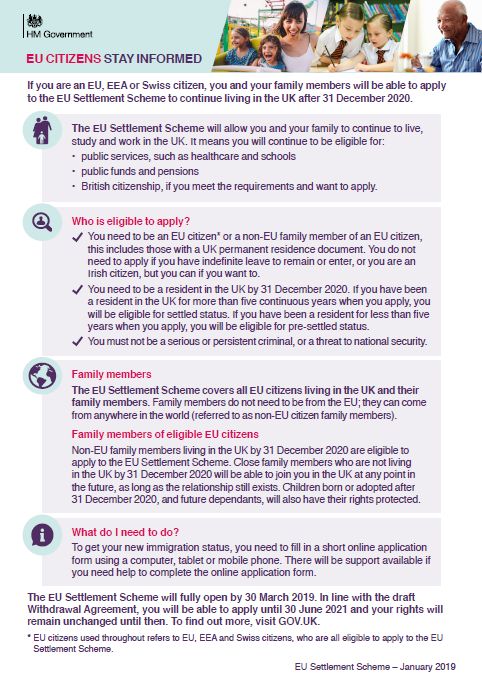
Agreement reached with the EU In December 2017 and March 2018, the UK government reached agreements with the European Union on citizens’ rights, now reflected in the Withdrawal Agreement The Withdrawal Agreement protects the rights of EU citizens living in the UK by the end of the Implementation Period, and enables them to continue to live their lives as now. It also covers their family members. There are separate arrangements that have been agreed for EEA and EFTA citizens in the UK. They can also apply to the EU Settlement Scheme
Applying No deal to the Settlement Scheme In a no deal scenario, EU, EEA and EFTA citizens and their family members resident in the UK by 29 March 2019 will be able to stay. They will still need to apply to the EU Settlement Scheme. We are engaging with EU counterparts to urge them to make the same commitment to protect the rights of UK nationals in the EU We have published 106 specific technical notices to help businesses, citizens and consumers to prepare for March 2019 in the event of a no-deal scenario. These are available in one place on gov.uk On 28 January, the Home Secretary set out that in a no deal scenario, there will be a transition period until the new skills-based immigration system is introduced at the start of 2021. During this period, EEA citizens arriving in the UK can visit for three months visa-free. EEA citizens who wish to stay in the UK for longer than three months will need to make an application for European Temporary Leave to Remain
Applying to the
Applying to the Settlement
EU Settlement Scheme
Scheme
EU citizens and their family members in the UK will need to apply to secure their rights through
a simple digital system to get their status
The application process is quick and user-friendly. The Home Office worked closely with
representatives of EU citizens on its design and development
A dedicated and proactive contact centre and casework team is in place to support citizens
We are looking for reasons to grant, not to refuseApplying to the
Applying to the Settlement
EU Settlement Scheme
Scheme
To obtain settled status EU citizens and their family members will generally need simply to have
lived continuously in the UK for five years. Those with less than five years’ residence will be
granted pre-settled status until they accumulate their five years
On 21 January, the Prime Minister announced that applications will be free. Any Scheme application
fees paid in the test phases of the EU Settlement Scheme will be refunded
We check the employment and benefits records the Government holds to establish the period of
residence, meaning most applicants won’t need to do anything to prove their residence. Where
there are gaps, a wide variety of documents can be photographed and uploaded as evidence
Irish citizens do not need to apply to the EU Settlement Scheme to protect their status and rights.
They are covered by Common Travel Area (CTA) arrangementsApplying to the
Applying to the Settlement
EU Settlement Scheme
Scheme
Most applicants will only need to prove their identity, demonstrate their residence in UK and
declare any criminal convictions
The application form is accessible through phones, tablets and computers and we will provide
support for those that need it. Identity can be verified remotely via an android app, or via a quick
postal route
We tested the application process through a series of pilots with the higher education and health
and social care sectors. We also tested the application process with some vulnerable individuals
being supported by a small number of local authorities and civil society organisations
The Scheme is being implemented on a phased basis and will be fully open by 30 March 2019Applying to the Settlement Scheme Frontier workers The rights of EU citizens who currently live outside the UK but travel regularly to and from the UK for work or self-employment – ‘frontier workers’ – are protected by the Withdrawal Agreement. Individuals will be able to continue to travel to the UK for work or self-employment in future Many frontier workers will spend enough time in the UK to qualify for status under the EU Settlement Scheme Otherwise they will be required to obtain a document to evidence their right to enter the UK and work as a frontier worker We will be setting out further details on how frontier workers will be able to apply for such a document in due course. In the meantime, there will be no change to their rights and they can continue to frontier work into the UK
Applying
Private Beta to the Settlement Scheme
2 (PB2)
Following a successful initial Private Beta 1 (PB1), a second, expanded private beta (PB2) was
launched on 1 November 2018 and ended 21 December 2018
PB2 has tested the online application process as an integrated, end-to-end process
PB2 has been successful, with 29,987 applications submitted from 1 November to 21 December
2018
It has been available, on a voluntary basis, to staff in the higher education, health and social care
sectors across the UK
PB2 has also been available to some vulnerable individuals, being supported by a small
number of local authorities and community groups, in order to test the operations of the scheme
for those with support needs
We published a full report on PB2 on 21 January 2019. Findings from this phase have been
positiveApplying to PB2 Key stats from the Settlement Scheme 29,987 applications By 14 January 27,211 decisions had been made, 70% granted settled status and 30% granted pre-settled status. No cases refused 69% of decided cases were processed in three working days, 81% processed within a week 1,330 completed feedback, 77% stated it was easy or fairly easy 90% of users successfully proved their ID using the app Over 500 different devices used 84% proved residence through the interface to HMRC/DWP and did not have to send any further information
Applying
PB2 lessonsto the Settlement
learned & next steps Scheme
We have learned lessons which have enabled further improvements to be made
Updated communications and guidance material to help
Improved functionality in respect of how an applicant verifies their email address
An increase in the size of files an applicant can upload
Introducing technical safeguards against any disruption in the automated checks of HMRC or DWP data
Updates to the case working system
In light of the successful testing during the private beta phases, we have proceeded with the start of the wider
public implementation of the EU Settlement Scheme from 21 January 2019
The Scheme is available to resident EU citizens (and their EU citizen family members) with a valid
biometric passport, and to their non-EU citizen family members holding a valid biometric residence
card, so that they can prove their identify remotely using the identity verification app
We currently anticipate that the further implementation of the EU Settlement Scheme will be secured through
further Immigration Rules changes to be laid before Parliament in early March 2019, so that the Scheme will be
fully open by 30 March 2019EUEU Settlement
Settlement Scheme
Scheme Timeline
timelineCommunications and Engagement
Targeted national campaign: Educate –
prepare – deliver – sustain
Multi-channel engagement is underway to
reach the estimated 3.4m EU citizens living
in the UK
Direct email contact with 300,000+
subscribers to EU citizens’ updates
Stakeholder engagement including through
communities, employers and local
authorities
12The role of employers and sector bodies
The Government is communicating with EU citizens about the EU Settlement Scheme through the four key channels, below:
Employers Community groups Local authorities Direct marketing
Why are we focusing on employers?
● More than two thirds of all EU citizens in the UK are currently working here
● Employers are often a trusted source of information
● Some businesses are already preparing for the potential impact of the UK’s exit from the EU. Their workforces are a key part
of this
What the EU Settlement Scheme means for employers?
● Employers have a duty not to discriminate against EU citizens in light of the UK’s decision to leave the EU as both a
prospective and current employer
● Current ‘right to work’ checks (e.g. EU passport and / or national ID card) apply until the end of 2020. There will be no change
to the rights and status of EU citizens living in the UK until 2021
● There is no legal obligation for them to communicate the EU Settlement Scheme, however they may wish to signpost the
information the Government is providing
● They do not have to interpret information provided by the Government and they must be careful not to provide immigration
adviceHow can employers and sector bodies help?
The Government has produced an employer toolkit on the EU Settlement Scheme, which is a suite of materials for EU citizen employees which explain
what the Scheme is and how it works. The toolkit materials are available for any employer to download from GOV.UK. They do not need to be interpreted,
and we simply ask that you download and cascade them to your EU citizen employees through your most appropriate channels
EU Settlement Scheme
Toolkit introduction pack Videos / animations Leaflets Posters Factsheet
briefing pack
Overview of the Key information about the Informative videos Leaflets focusing on Posters providing key Factsheet providing an
employers’ role, toolkit EU Settlement Scheme including an application awareness, eligibility information and overview of the EU
contents and how to use including support outline animation and and more timelines Settlement Scheme
it, including a practical available videos of EU citizens'
delivery plan stories
Materials to support
employers Materials to share with EU Citizens
The toolkit is being evolved to include digital and social media assetsApplying to the Settlement
European Temporary Scheme
Leave to Remain
EEA citizens arriving in the UK can visit for three months visa-free. They can continue to enter
the UK using a valid passport or identity card. EEA citizens who wish to stay in the UK for
longer than three months will need to make an application for European Temporary Leave to
Remain
Subject to identity, criminality and security checks, European Temporary Leave to Remain will
be granted for 36 months. This permission to stay for 36 months cannot be extended. Those
who wish to stay for longer will need to apply and qualify under the terms of the new skills-
based immigration system, which will begin from 1 January 2021
Employers already conduct Right to Work checks on EEA citizens and that will not change.
They do not have to differentiate between those who are resident in the UK before exit and
those who arrive afterwards. Until the new skills-based immigration system is introduced, EEA
citizens will be able to evidence their right to work in the UK by using a passport or national
identity card, as nowApplying to the Settlement
European Temporary Scheme
Leave to Remain
EEA citizens who arrive during the transition period may be accompanied by close family
members (their spouse, partner or dependent children under 18) from outside the European
Economic Area (EEA), who will require a family permit before coming to the UK. They may
enter for up to three months and may then apply as a dependant of an EEA citizen to stay in
the UK for up to three years
The details of benefits entitlements and NHS charging arrangements for EEA citizens during
the transition period will be announced in due course
These arrangements will also apply to citizens of Switzerland arriving after exit in a no deal
scenario.Future skills-based immigration system
On 17 December, the Government published a White Paper on the UK’s future skills-based
immigration system
The future skills-based immigration system is based on three key principles:
Free movement is ending. Everyone other than British citizens and Irish citizens will need
permission to come and stay in the UK
There will be a single immigration system encompassing all nationalities. For workers the
emphasis will be on talent and skills, not nationality
The future system will work for all parts of the UK. We are undertaking a 12-month period of
engagement with sectors and businesses across all regions and administrations
17You can also read


