STATUS & PLANS - AREA A & B - ERUM DATA IDT COLLABORATION MEETING 2021 - MANUEL GIFFELS & KILIAN SCHWARZ & CHRISTIAN ZEITNITZ, 10.05.2021 - INDICO
←
→
Page content transcription
If your browser does not render page correctly, please read the page content below
Status & Plans - Area A & B
ErUM Data IDT Collaboration Meeting 2021

Manuel Giffels & Kilian Schwarz & Christian Zeitnitz, 10.05.2021
TOPICS OF AREA A
Development of Technologies to Enable Utilization of Heterogeneous Computing Resources

           AP 1) Werkzeuge zur Einbindung              AP 2) Effiziente Nutzung

              • Scheduling von Cloud - Jobs               • Steigerung der Effizienz von daten-
              • Container - Technologien                    intensiven Anwendungen auf hetero-
                                                            genen Ressourcen mittels on the fly“
              • Checkpointing                                                         ”
                                                            Datencaches
              • Zugang zu Experiment-Datenbanken

           AP 3) Workflow Steuerung

              • Identifikation und Steuerung
              • In - Pilot Job Monitoring
              • Accounting
              • Optimierung durch data - mining

          Tabelle 1: Arbeitspakete des Themenbereichs Entwicklung
                                                      2           von Technologien zur Nutzung von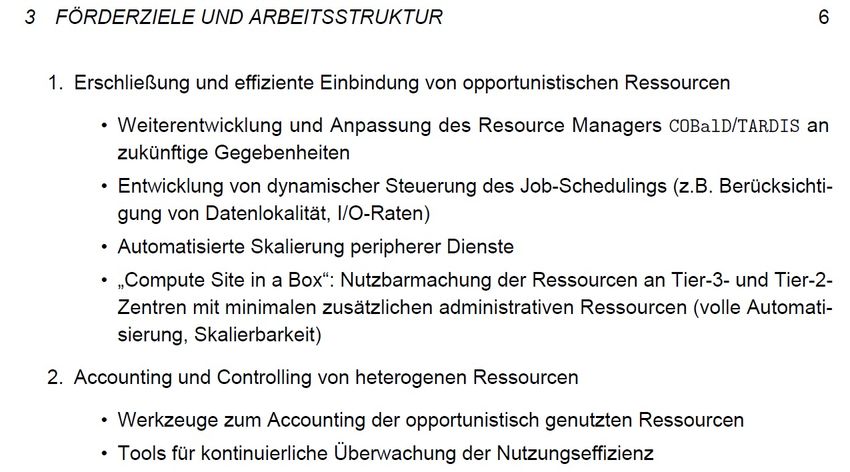
STATUS & PLANS
Anything related to compute resources
Federated Infrastructure
• Experiment-agnostic single point of entry to plethora of
                                                                                                      B      Tie 3   B   HPC
                                                                                                          (BAF)      (BONNA)

    resources (HPCs, Tier-3s and Clouds)
                                                                                                                      KIT HPC
•   Dynamic, on demand provisioning and transparent
                                                                                                    HTC d
                                                                                                                     (F HLR2)

    integration of heterogeneous resources with COBalD/
                                                                               HTC     d -CE
                                                                 G idKa    c   d-h c   d -ce-1-ki     OBS
    TARDIS                                                                Si g e P i       fE
                                                                                                                     KIT HPC
                                                                                                                     (H eKa)

•   Stable operation since ~ 2 years
                                                                                                      LMU M ich      KIT Tie 3

•   Toped the 8000-cores mark for the first time                                                       O e S ack     (TO AS)

•   First GPUs integrated (32 NVidia V100, TOpAS)
•   Fruitful collaboration (U Bonn, U Freiburg, KIT, LMU,
    RWTH Aachen, U Wuppertal joint recently)                         ∑ 7.8 million core hours
Next: Integration of the LMU C2PAP cluster

    8000 Kerne
                                                   Bonna
                    TOpAS               BAF
           LRZ
                                        HoreKa
                                         FH2
                                                             4
Lightweight Site Operation & Transparent Extension of a Tier-2
Lightweight Site Operation

• Remote CE for RWTH operated at GridKa (as one of many)
                                                                   HTC      d     CE
                                                               g d-ce-1-        .g d a.de

                                                                           GSI

• No need for local CE any more
• Simplifies contribution of compute power for smaller sites         IE           2

First Transparent Extension of a Tier-2 Site in Germany

• RWTH HPC Cluster CLAIX dynamically integrated in
  Aachen Tier 2 site using COBalD/TARDIS

• Doubled the CPU capacity of the RWTH Aachen CMS
  Tier-2 for a week

• Until submission was blocked by HPC team after using
  ~7 times the monthly quota assigned to the project

• Initial grant over 2 million core hours       5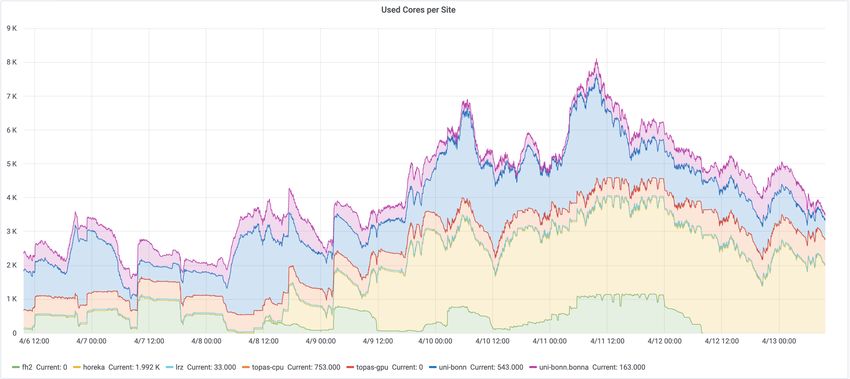
OPERATIONAL IMPROVEMENTS
●
    Bonna HPC cluster:
     –   /scratch moved to dedicated 2 TB SSD (used to be on to ship drone logs to COBalD/TARDIS node (to simplify debugging, see next
    slides)
●
    Added switches to ensure drones are pinned to VOs and only one job at a >me per drone (to
    simplify debugging, see next slides)

                         O. Freyermuth, P. Wienemann: COBalD/TARDIS
                                                             6      Opera>onal Experience at U Bonn   2
t i ng
                                                                                                                  Hu n
                                                                                                            B u g
                                                                                                         nd
                               OPERATIONAL IMPROVEMENTS                                                 a

  • Observed   problematic failure rate of  ATLAS   jobs in DE-TARDIS Panda queue (up to 50%)
●
    Bonna HPC cluster:
    •– Requested memory is strictly enforced on most opportunistic resources
         /scratch
       (not        moved
            the case      to dedicated
                     in WLCG   [soft limits])2 TB SSD (used to be on
      Added   starts and accepts
                     to ship     payload
                             drone logs to COBalD/TARDIS node (to simplify debugging, see next
      slides)
      • Drone removed from batch system before it is visible to TARDIS
●
    • Challenging/time
      Added switches consuming
                       to ensure drones
                                 to debugare pinned to VOs and only one job at a >me per drone (to
      simplify debugging, see next slides)
           Annotation by M. Giffels:
           Major improvements   of the entire
                           O. Freyermuth,        infrastructure
                                          P. Wienemann:            could
                                                        COBalD/TARDIS      be archived
                                                                      Opera>onal Experience atwith the help of U Bonn
                                                                                               U Bonn                     2
PRESENT STATUS
●
    AEer a lot of bug hun>ng situa>on looks promising
●
    Most issues were not caused by the COBalD/TARDIS layer.
●
    Opera>on of COBalD/TARDIS itself very smooth and low-maintenance
●
    Opportunis>c usage harmonizes well with local usage

                    O. Freyermuth, P. Wienemann: COBalD/TARDIS
                                                        8      Opera>onal Experience at U Bonn   8
Activities Wuppertal
• First steps into using COBalD/TARDIS together with the „Pleiades“ cluster in
  Wuppertal

• Complicated by very late installation of a new cluster in May/June
• New batch system (SLURM)
• Plan to integrate part of the cluster, at least for a testing period, into the
  system by the end of the summer
  First pull request already arrived:

                                           9
Status report Freiburg
Monitoring & Accounting of opportunistic resources

       Monitoring
        I Collecting data from various sources in multiple datastores
        I Started working on a monitoring puppet module will allow for the
          deployment of a monitoring setup for sites running COBalD/TARDIS

       Accounting
        I Implemented a prototype of an accounting system for opportunistic
           resources
        I Next step will be to evaluate it on our local setup to transfer
           fairshares from one batch system to the other
        I More details: session Area A+B: 09:40 talk by Stefan Kroboth
                                         10
 Uni Freiburg | 10.05.2021                                                    1
11
Report of Topic Area A/B
Storage/Container

               Kilian Schwarz
               Manuel Giffels
              Christian Zeitnitz
Area A/B -Storage/Container
●
With contributions from
– Frankfurt/GSI
– Freiburg
– KIT
– München
– WuppertalArea A/B – Storage/Container
Frankfurt/GSI
●
Singularity container for Grid environment running in production at GSI and tested in
Frankfurt
– Container image management in production
●
Production ready XrootD based dynamic disk caching system DCOTF developed &
provided
●
Detailed scaling & performance measurements of DCOTF and XCache
– DCOTF and Xcache DCA have similar performance
– For Xcache there are bottlenecks
– Containerisation does not affect the performance
●
Simplified installation methods including documentation
for DCOTF and container system
●
Support provided for setting up similar Caching
systems at KIT and FreiburgOpen issues
planned to be
addressed in
close
collaboration with
GSI/Frankfurt
Can be used for experiment
Overarching comparison of
Caching solutionsArea A/B – Storage/Container
KIT
●
Setup of dynamic disk caching systems at KIT and
Freiburg in collaboration with Freiburg and Frankfurt/GSIArea A/B – Storage/Container München
Area A/B – Storage/Container
  Wuppertal
• Standalone container (no network access needed) integrated into ATLAS production
  environment
• Monitoring and Job-Reports for containerized user jobs
  • Idea
     •   Containerized job (Docker and Sigularity)
     •   Start service after the payload has finished
     •   Aggregate informations from log files
     •   Generate job report with important information about Warnings, Errors and statistics
     •   Ship the aggregated data and job report to the user
     •   Easy configuration for different job types
  • Allows to pin-point poblems quickly
  • Used software packages
     • Fluentd and Elasticsearch
• Prototype implementation for ATLAS jobs, but the frameworks has NO dependence on ATLAS
  software!
  • Substantial problems in Singularity to handle services
• Log-Analysis-Framework available at
  https://github.com/erum-data-idt/LogAnalysisFramework
From IDT-UM to Fidium
Christian Zeitnitz, Manuel Giffels, Kilian Schwarz
Bergische Universität WuppertalIDT-UM – Task Area A+B
• Well addressed topics
o Utilization of different resources via COBalD/TARDIS for productions jobs of the
experiments
o Data caching solutions
o Containerization of production jobs
o Monitoring (system and job wise)
• Very limited or no progress (or not funded)
o Handle complex resource requirements
- Data locality, MPI, GPUs
o Accounting and controlling
o Simplified integration of resources (“Site in a box”)
o Failure tolerance of jobs/Checkpointing
10.05.2021 From IDT-UM to FidiumWhat is needed for the LHC/FAIR Computing in 2025?
• Expect to enter the „Exabyte“ era
o LHC Run 4
o FAIR experiments
o Large scale Astroparticle and Astronomy experiments
• Required resources not absolutely clear
o Simple scaling for LHC: Factor 60 increase wrt. 2016
o Technology progress and efficiency increase (hardware and software)
hopefully leads to a decrease (~factor 6-10 ?)
• Complexity of workflows will increase
o Need solutions across experiments
• Complexity of resource requirements will increase
o Specialized hardware requirements (CPU, MPI, GPU, FPGA …)
10.05.2021 From IDT-UM to FidiumSolutions for HL-LHC/FAIR Computing in 2025
• How to handle increase in hardware resources?
o Concentrate (most) mass storage at larger computing centers ( e.g. Helmholtz-centers)
o Use all available resources – heterogeneous resources (dedicated, Cloud, HPC …)
• Need operational concept and software for different workflows across
experiments
o Often not possible to control the system/network environment
- Further development of containerization needed
o Complex resource management and accounting
o High efficiency required – need fault tolerant solutions
• Adjustment of the software of the experiments needed!
• We have some very good projects and the know-how in IDT-UM
o COBalD/TARDIS, Data caching, Containerization, Monitoring
10.05.2021 From IDT-UM to FidiumRequired developments
• Current software is NOT ready for HL-LHC/FAIR!
• Resource Management
oCritical: never really worked in the past!
oFurther development of COBalD/TARDIS
oComplex requirements: MPI, GPU, FPGA …
• Simple integration of available resources
• Data and Workflow management
oContext: data-lakes, data caching
• Accounting
oComplex and difficult in a heterogeneous environment
10.05.2021 From IDT-UM to FidiumRequired developments (2)
• Fault tolerance of the whole software infrastructure
oCheckpointing
• Monitoring
oRequired for Resource management and accounting
oNeed special job monitoring for the users
- Complexity of the computing environment makes the error analysis much more
difficult
• Adaptation of the software of the experiments
• Internationalization of the developed software
oGet the software into production at the experiments
10.05.2021 From IDT-UM to Fidium020
ct 2
o f O
en d
BF
BM
t h e
d to
i tte
u b m
S
10.05.2021 From IDT-UM to FidiumProject FIDIUM – required to be ready in 2025 Covers the required developments – three different topic area • TA I: Development of Tools for the Integration of heterogeneous Resources 10.05.2021 From IDT-UM to Fidium
Project FIDIUM (2)
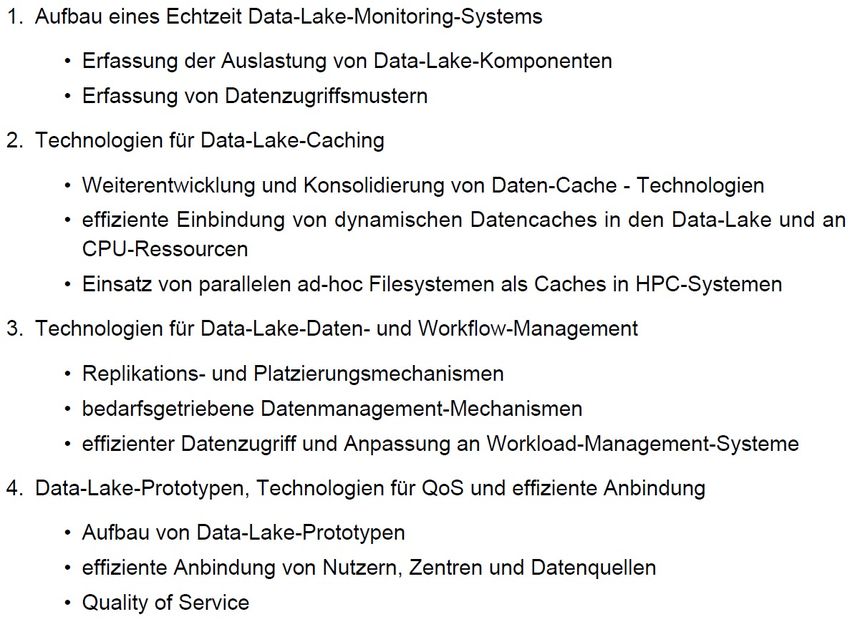
• TA II: Data-Lakes, Distributed Data, Caching

10.05.2021                          From IDT-UM to Fidium
Project FIDIUM (3)
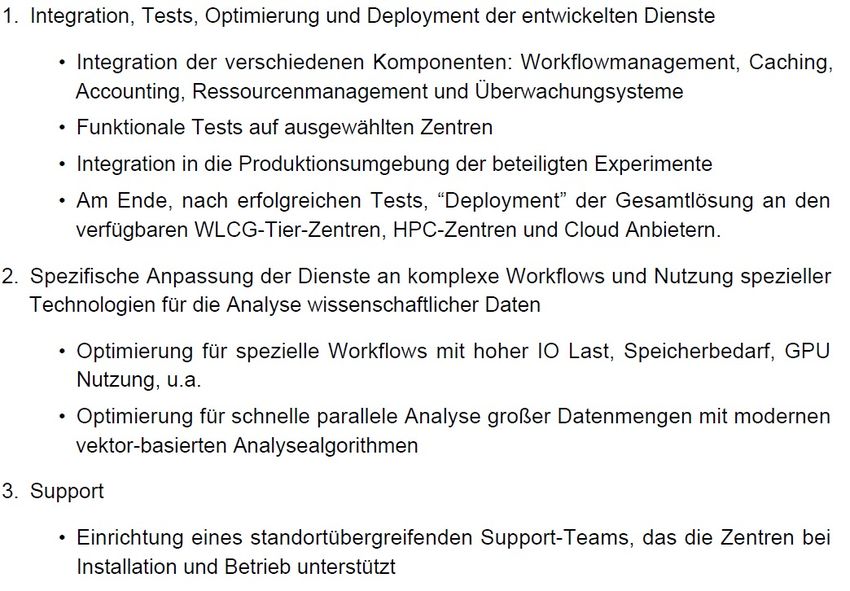
• TA III: Adjustments, Tests and Optimisation of the production and analysis
  environment

10.05.2021                         From IDT-UM to Fidium
Final remarks
• Very good results from IDT-UM, BUT we are not there yet!
• Very successful collaboration across the experiments and
  communities
• Need to keep-up the momentum with the existing know-how

             Lets hope, that FIDIUM will be funded!

10.05.2021                        From IDT-UM to Fidium
You can also read


