European Construction Sector Observatory - Ireland Policy measure fact sheet - Europa EU
←
→
Page content transcription
If your browser does not render page correctly, please read the page content below

European Construction
Sector Observatory
Policy measure fact sheet

Ireland
Home Renovation Incentive (HRI)
Thematic Objectives 1

February 2018
Policy Measure Fact Sheet - Ireland

                                               In a nutshell

                                                                         A large proportion of Irish homes are owner-occupied, as shown
    Implementing body:           Office of the Revenue Commis-           in Figure 1, with a roughly equal split between homes that are
                                 sioners (Revenue) – Irish Tax
                                 and Customs                             mortgaged and homes that are mortgage-free (owned outright).
                                                                         This implies that there is a sizeable share of Irish householders
                                                                         that could potentially leverage the value of their properties to
    Key features &               Tax relief scheme that applies a
                                                                         access funding and invest in home renovation measures. There
    objectives:                  tax credit of 13.5% to the total
                                 cost of repair, renovation and          is also significant potential for renovation measures in the rental
                                 improvements to main homes
                                                                         sector, as it accounts for almost one third of Irish householders.
                                 and rental properties, provid-
                                 ing a minimum cost threshold
                                 is met. The tax credit equates          Figure 1: Ownership of Irish housing stock
                                 to a return of the Value Added
                                 Tax (VAT) paid to complete eli-
                                 gible types of work.

    Implementation date:         25 Oct 2013 – 31 Dec 2018

    Targeted beneficiaries:      Homeowners (since 2013),
                                 rental property owners (since
                                 2014) and local authority ten-
                                 ants (since 2017).
                                                                         Source: National Renovation Strategy for Ireland, 20143

    Targeted sub-sectors:        Residential sector (repair, reno-          Tax relief schemes have been used in Ireland
                                 vation and improvements).
                                                                            to encourage both homeowner investment
                                                                            in building renovations and construction
    Budget (EUR):                74.9 million (Value of HRI Tax             sector growth over recent decades with
                                 Credits claimed by end of 2017)
                                                                            mixed results.
                                                                         They were first introduced in the 1980s to encourage the reno-
                                                                         vation and construction of residential buildings in declining
There are just over 2 million homes (houses and apartments)              urban areas, and they were later extended to non-urban areas.
in Ireland, of which nearly 1.7 million are listed as occupied,
according to the latest census (2016) carried out by the Central         Schemes such as Section 23 and the Rural Renewal Scheme
Statistics Office (CSO)1. These figures are a modest increase on         were successful but also created problems. The Section 23
the figures recorded by the CSO in 2011 (1.99 million homes              scheme, for example, was introduced as a stimulus to boost
and 1.65 million occupied). According to the National Reno-              the construction sector in the 1980s. It is broadly considered
vation Strategy for Ireland (2014), Irish homes are relatively           to have been a very successful tax relief measure that helped
energy efficient compared to many EU countries, with an                  to significantly improve the quality of rental properties and
average efficiency score equivalent to a D rating on the Building        previously run-down areas in cities and towns. However, it is
Energy Rating (BER) scale. Roughly half of Irish homes were              also considered to have outlasted its usefulness and to have
constructed prior to the introduction of building regulations            contributed to the over-inflation of the housing market and the
in 1979 and subsequent energy efficiency regulations and are             use of energy inefficient and outdated technologies4. The final
therefore in need of upgrading to meet modern quality and effi-          date for carrying out construction, renovation and conversion
ciency standards2.                                                       work, on which expenditure could qualify for Section 23 tax
                                                                         relief was 31 July 20085.

                                                                     2
                                Home Renovation Incentive (HRI) // Thematic Objectives 1
Policy Measure Fact Sheet - Ireland
The Home Renovation Incentive (HRI) scheme was launched
in October 2013 as a more targeted and time-limited tax relief
The Home Renovation Incentive (HRI)
scheme. It provides homeowners, landlords and (more recently)
local authority tenants with the option to claim tax relief on scheme was launched in October 2013 as
repair, renovation and improvement work that they have a more targeted and time-limited tax relief
completed on their main home or rental property. Claimants scheme. It provides homeowners, land-
must meet certain criteria to be eligible to receive the HRI Tax
lords and (more recently) local authority
Credit, which is payable over a two-year period.
tenants with the option to claim tax relief
The HRI has proven to be very successful to date, in just over on repair, renovation and improvement
4 years of operation. It has registered in excess of 107,000 HRI work that they have completed on their
Tax Credit applications for renovation works on over 70,000
main home or rental property.
properties. The total cost of HRI registered work amounts to
EUR 1.74 billion, including a current total of EUR 74.9 million in
claimed tax credits, to the benefit of construction sector busi-
ness and employment. Stakeholders are strongly supportive of
the HRI scheme and would like to see it better publicised and
with a broader scope in order to attract and benefit a larger
number of potential applicants.
3
Home Renovation Incentive (HRI) // Thematic Objectives 1Policy Measure Fact Sheet - Ireland
1
General description
The Home Renovation Incentive (HRI)6 is an The HRI Tax Credit requires applicants to spend a total cost of
at least EUR 4,405 on each qualifying property, exclusive of VAT
income tax relief scheme that enables home- (13.5%). The total cost may cover one or multiple types of quali-
owners, landlords and local authority tenants fying works and may be carried out by one or multiple HRI qual-
to claim an HRI Tax Credit of 13.5% of the ifying contractors. There is no limit to the total cost an applicant
may wish to incur; however, where the total cost of the work
total cost of repairs, renovations or improve- exceeds EUR 30,000, the HRI Tax Credit shall be limited to a
ments to their home. maximum of EUR 4,050. Table 2 provides some examples of
HRI calculations.
To qualify for the credit, applicants must have paid Value Added
Tax (VAT) at 13.5% on specific types of work on specific types of Table 2: Examples of HRI Tax Credit calculations
property. Table 1 provides examples of the types of works and
properties that are eligible for HRI tax relief. HRI Calculation A B C
Table 1: Examples of qualifying works and types of properties Total renovation cost: 11,000 32,000 43,000
Examples of qualifying works Types of properties
Less non-applicable 1,000 2,000 3,000
costs (e.g. new kitchen
• Painting, decorating & tiling; • Main home;
appliances):
• Plastering, plumbing & • Private rental property
rewiring; • Local authority (social)
• Bathroom upgrades; rental property. Total eligible cost: 10,000 30,000 40,000
• Fitted kitchens;
• Window replacement;
• Extensions & attic conver- HRI Tax Credit: 1,350 4,050 4,050
sions;
• Garages, driveways & land- Net cost to claimant:
scaping; Total cost: 11,000 32,000 43,000
•Septic tank repair or replace- Less HRI Tax Credit: 1,350 4,050 4,050
Net cost: 10,000 27,950 38,950
ment.
Source: Home Renovation Incentive (HRI) Scheme7 Source: Office of the Revenue Commissioners, HRI8
Applicants are not able to claim tax relief on goods and services Applicants can claim HRI tax relief on qualifying work that has
for which the 23% VAT rate is applicable. Examples are carpets, been completed and paid for from particular dates, depending
furniture, appliances and services such as architect’s fees. on the type of applicant:
• Homeowners: from 25 October 2013;
To be eligible for HRI, applicants must: • Landlords: from 15 October 2014;
• Pay tax through the ‘Pay As You Earn’ (PAYE) or self-assess- • Local authority tenants: from 1 January 2017.
ment schemes;
• Be up-to-date with their Local Property Tax (LPT) payments; Work completed and paid after 31 December 2018 will not be
• Use HRI qualifying contractors to carry out the work to their eligible for a claim, as this is the closing date of the HRI scheme.
property. One exception to the rule is where planning permission is
required. In this case, provided that the planning permission is
An HRI qualifying contractor is a contractor that is: in place, a claim can be made on work that has been completed
• VAT (Value Added Tax) registered; and paid for by 31 March 2019.
• RCT (Relevant Contracts Tax) registered;
• ROS (Revenue Online Service) registered; Homeowners and landlords can claim the HRI Tax Credit on the
• Tax compliant. Revenue Online Service (ROS) website. The HRI is an online only
4
Home Renovation Incentive (HRI) // Thematic Objectives 1Policy Measure Fact Sheet - Ireland
scheme. Local authority tenants that wish to claim the HRI Tax 3. Payment notification – the homeowner pays the
Credit are required to contact their Revenue office9. contractor for the work carried out, the contractor then
The HRI Tax Credit process involves four key stages: enters the payment details into the HRI online system, and
1. In advance of works notification – the homeowner must the homeowner then checks that the payment details are
check that the planned work is eligible and their chosen recorded in the system;
contractor is tax compliant (e.g. VAT, RCT, etc.), and must 4. Making the claim – the homeowner claims the tax credit
give the contractor the LPT Property ID for the main home; on the HRI online system, after which the tax credit is applied
2. Works notification – the contractor must input the work and spread over the following two years in equal amounts
details into the online HRI system and the homeowner must – e.g. a tax credit of EUR 4,050 that is claimed in 2014 is
log-in to the online system to check that the contractor qual- returned over two years: EUR 2,025 in 2015 and 201610.
ifies;
5
Home Renovation Incentive (HRI) // Thematic Objectives 1Policy Measure Fact Sheet - Ireland
2
Achieved or expected results
In December 2017, the Office of the Revenue Commissioners Table 4 provides a breakdown of the number of HRI eligible
published a set of statistics on the results of the HRI scheme works and the number of properties registering works under the
between 2013 and 2017, as shown in Table 3. By the end of 2017, HRI scheme. The number of HRI eligible works completed per
over 107,000 works have been completed on over 70,000 prop- year has exceeded the number of properties registered under
erties at a total estimated cost of just under EUR 1.74 billion. the HRI scheme, indicating that more than one type of works
The average value of works is just over EUR 16,000. Revenue has been completed on some properties. The low numbers
also reports that the sum total of HRI Tax Credits available to expressed for 2013 is due to the programme being launched
be claimed by those that have carried out eligible works under in the fourth quarter of that year. The peak years thus far for
the HRI scheme is EUR 122.04 million. However, that total is both works and properties registered have been 2014 to 2016,
not reflective of the actual total cost to date to the Exchequer, although there has also been strong performance in 2017.
because not all credits have yet been claimed. Currently, the
total cost of HRI Tax Credits claimed stands at EUR 79.4 million. Table 4: Number of HRI works & properties registered
The tax credits have been claimed by just under 40,000 bene-
Year No of works Totals
ficiaries, which implies that many have made claims for multiple
works (almost 3 on average) on different properties (almost 2 2013 3,577 2,975
on average).
2014 23,803 17,169
2015 30,629 19,643
By the end of 2017, over 107,000 works 2016 29,438 18,498
have been completed on over 70,000
2017 19,939 12,467
properties at a total estimated cost of just
Total 107,386 70,752
under EUR 1.74 billion.
Monthly Average 2,106 1,387
Annual Average 25,272 16,644
Table 3: Results of the HRI scheme 2013–2017
Source: Home Renovation Incentive (HRI) Statistics 2013-201712
Description Totals
Table 5 provides a breakdown of the main types of HRI eligible
Number of works: 107,386
work carried out between 2013 and 2017, based on their esti-
Number of properties: 70,752 mated value and the total number of works completed.
Just over 60% of the total works completed
Total estimated value of works (Bn EUR): 1.74
by value by the end of 2017 involved home
Average value of works (EUR): 16,187 extensions and general repairs and renova-
Total number of contractors: 10,999 tions.
Home extensions have been the most expensive in terms of
Maximum credit to be claimed (M EUR): 122.04
value, but represent less than 10% of the number of works
completed. By way of contrast, window replacements and
Number of credit claimants: 39,776
kitchen renovations each represent about 10% of the total
Value of credits claimed (M EUR): 74.9
works completed by value, and yet they account for about 23%
(window replacements) and 18% (kitchen renovations) of the
total number of works completed.
Source: Home Renovation Incentive (HRI) Statistics 2013-201711
6
Home Renovation Incentive (HRI) // Thematic Objectives 1Policy Measure Fact Sheet - Ireland
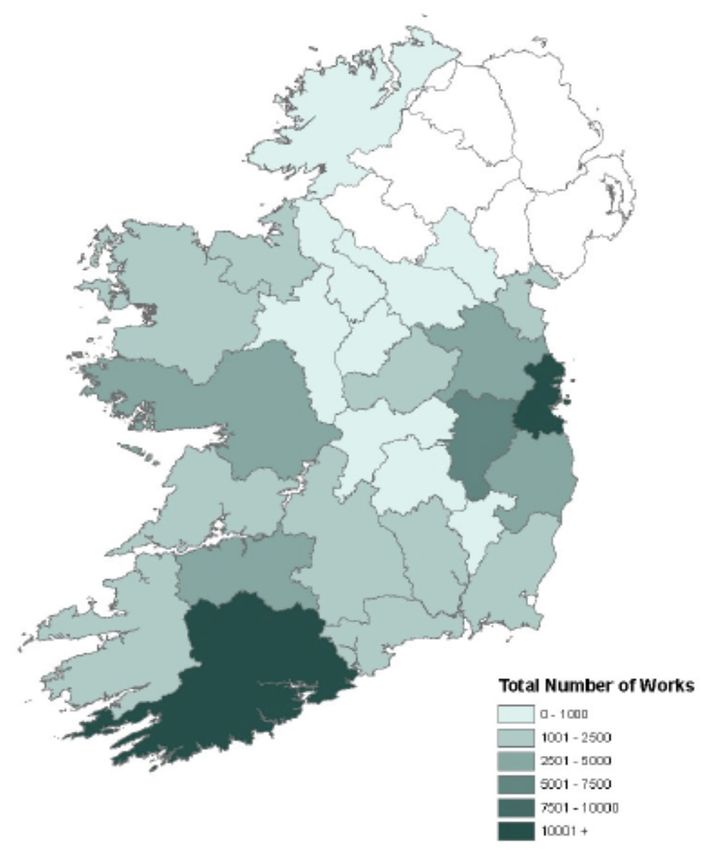
Table 5: Types of HRI works completed 2013–2017 Figure 2: Total number of HRI works by county 2013–2017
Works Description % Total Works % Total Works
by Value by Number
Home extension 34.80 8.85
General repairs & 25.36 13.65
renovations
Window replacement 10.75 23.02
Kitchen renovations 9.89 17.90
Other works 3.34 6.17
(unspecified)
Source: Home Renovation Incentive (HRI) Statistics 2013-201713
Figure 2 gives an indication of the geographical distribution
of the number of works completed by county under the HRI
scheme.
Dublin and the broad Dublin region account for almost half of
the total number of works completed under the HRI scheme
and properties impacted, and over half of the total estimated
value of those works. The other most significant region is Cork,
Source: Home Renovation Incentive (HRI) Statistics 2013-201714
which accounts for nearly 10% of works completed and prop-
erties affected, and nearly 8% of the total estimated value of
works.
7
Home Renovation Incentive (HRI) // Thematic Objectives 1Policy Measure Fact Sheet - Ireland
3
Perspectives and lessons learned
From a government perspective, the However, the HAI has also identified areas for improvement that
Ministry of Finance considers the HRI to could make the scheme more successful in terms of appeal and
uptake, and by extension achieve a greater impact on housing
have been very successful, in terms of the
quality and construction sector business opportunities. HAI
number of works (107,386) and properties recommends:
(70,752) registered on the HRI online system, • Lowering the minimum HRI qualifying spend per appli-
cation from EUR 4,405 to EUR 3,000 (-33%) to encourage
and the overall value of work that the HRI
more people (homeowners, landlords and tenants) to invest
measure has helped to generate for the in home improvements;
construction sector (EUR 1.74 billion) in just • Increasing the total project cost ceiling from which the HRI
Tax Credit is calculated, from EUR 30,000 to EUR 36,000.
over 4 years since its introduction and with
This increase would increase the maximum tax credit (13.5%)
the involvement of thousands of contrac- from EUR 4,050 to EUR 4,860;
tors. • Making the HRI Tax Credit claimable in the same year that
qualifying work is completed, and 100% crediting of the
The Minister of Finance says that the HRI is “generating employ- claim in the following tax year, rather than over two years18.
ment in the tax compliant construction sector and increasing
sales in building supplies, hardware and related businesses”15. The HAI has also identified through its own research that a fifth
of Irish homeowners planned to carry out repairs and renova-
The success of the measure is also evidenced by the fact that tions in 2017, although only 15% of those were intending to make
it was opened up to rental property owners (landlords) in 2014 an investment that would meet or surpass the minimum cost
and then to local authority tenants in 2017. The aim has been threshold (EUR 4,050) to qualify for an HRI Tax Credit.
to support tax compliant operators in the rental and construc-
tion sectors and provide an incentive for improvements to the The HAI perceives a lack of awareness among homeowners
quality of rental housing16. However, the Ministry of Finance has about the HRI scheme and takes the view that there is consid-
noted in the 2018 Budget that rental properties make up only erable scope to improve public awareness. It has also made
2.4% of the total number of HRI registered properties to date. In a recommendation to its members – retailers and builders
the final year of the measure, there is therefore room to improve merchants – that there is an opportunity to gain a competitive
the appeal of the measure to the rental sector17. advantage by making their customers aware of the scheme –
both end users and contractors – and by helping them to access
its benefits19.
From an industry perspective, the Hard-
ware Association Ireland (HAI) – the national
body for hardware and DIY (Do It Yourself)
retailers and builders merchants – is a strong
supporter of the HRI scheme and has advo-
cated its extension over recent years.
8
Home Renovation Incentive (HRI) // Thematic Objectives 1Policy Measure Fact Sheet - Ireland
Endnotes
1 Central Statistics Office, Census of Population 2016 – Profile 1 Housing in Ireland:
http://www.cso.ie/en/releasesandpublications/ep/p-cp1hii/cp1hii/hs/
2 Department of Communications, Energy and Natural Resources, Better Buildings: A National Renovation Strategy for Ireland, 2014:
https://ec.europa.eu/energy/sites/ener/files/documents/2014_article4_en_ireland.pdf
3 Ibid
4 According to a range of different stakeholders, including:
Frank Coles, Construct Ireland (Irish Green Building Magazine), Passive House Plus:
https://passivehouseplus.ie/articles/obstacles-to-sustainable-building/tax-incentives
Speech by Joan Collins, an Irish independent Member of Parliament, during a parliamentary debate of the Finance Bill 2012 (Second Stage)
on 15 February 2012
https://www.kildarestreet.com/debates/?id=2012-02-15.437.0
Dermot O’Leary, Chief Economist at Goodbody (wealth/asset management and corporate finance house), Irish Times article, 14 August 2015:
https://www.irishtimes.com/business/economy/tax-breaks-for-construction-industry-must-be-considered-1.2316339
Norris M, Gkartzios M, Coates D, Property-Led Urban, Town and Rural Regeneration in Ireland: Positive and Perverse Outcomes in Different
Spatial and Socio-Economic Contexts, 26 December 2014 (Page 5):
http://eprint.ncl.ac.uk/file_store/production/192863/3121C308-A3F9-4344-8B33-2FAFE5BAAA33.pdf
5 Ministry of Finance, Written response to a Irish parliamentary question on plans to reintroduce a tax incentive scheme similar to the Section
23 scheme, KildareStreet (searchable archive of questions raised in the Irish Parliament, Senate and committees), 6 February 2018:
https://www.kildarestreet.com/wrans/?id=2018-02-06a.256
6 Home Renovation Incentive (HRI) Scheme:
https://www.revenue.ie/en/property/home-renovation-incentive/hri-for-homeowners-and-landlords/index.aspx
7 Ibid
8 Office of the Revenue Commissioners, Home Renovation Incentive (HRI):
https://www.revenue.ie/en/tax-professionals/tdm/income-tax-capital-gains-tax-corporation-tax/part-15/15-01-43.pdf
9 Revenue office search facility: https://www.revenue.ie/en/contact-us/index.aspx
10 Association of Landscape Contractors of Ireland, A Guide to the Home Renovation Incentive Scheme: http://www.thomasjcrummy.com/
assets/ALCI%20Guide%20to%20the%20Home%20Renovation%20Incentive%20scheme%20REV%20(TJC).pdf
11 Home Renovation Incentive (HRI) Statistics 2013-2017:
https://www.revenue.ie/en/corporate/documents/statistics/tax-expenditures/hri-stats.pdf
12 Home Renovation Incentive (HRI) Statistics 2013-2017:
https://www.revenue.ie/en/corporate/documents/statistics/tax-expenditures/hri-stats.pdf
13 Ibid
14 Ibid
15 Irish Independent, Minister for Finance, Michael Noonan, Full Budget 2015 Speech:
https://www.independent.ie/business/budget/read-minister-for-finance-michael-noonans-full-budget-2015-speech-30663415.html
16 Ibid
17 Department of Finance, Report of the Working Group on the Tax and Fiscal Treatment of Rental Accommodation Providers (page 66), Sept
2017: http://www.budget.gov.ie/Budgets/2018/Documents/Report_of_the_Working_Group_on_the_Tax_and_Fiscal_Treatment_of_Landlords.pdf
18 Hardware Association Ireland (HAI), The Hardware Journal (July/August 2015, pages 13-14), HAI Campaign for the Extension of the Home
Renovation Incentive (HRI) Scheme: http://thehardwarejournal.ie/wp-content/uploads/2017/06/The-Hardware-Journal-July-August-2015.pdf
19 Hardware Association Ireland (HAI), Home Renovation Incentive Scheme Guide for Hardware Retailers and Builders Merchants, 2017:
https://hardwareassociation.ie/wp-content/uploads/2017/02/HRI-scheme-booklet-final.pdf
9
Home Renovation Incentive (HRI) // Thematic Objectives 1You can also read


