EVERY SEED COUNTS TEACHER'S GUIDE PREKINDERGARTEN SCIENCE UNIT - 1 800 698 4438 EARTHSBIRTHDAY.ORG - CELEBRATE PLANET EARTH
←
→
Page content transcription
If your browser does not render page correctly, please read the page content below
EVERY SEED

                                            SUNFLOWER LAB
  COUNTS
      Teacher’s Guide
PreKindergarten Science Unit

                        1 800 698 4438
                       EarthsBirthday.org
SUNFLOWER LAB
Acknowledgements

 Every Seed Counts is offered to New Mexico classrooms
 through support from PNM, the state’s largest electricity
 provider.

 Earth’s Birthday Project cultivates hope for the future by inspiring
 wonder, learning & care of the natural world in children, teachers
 & parents.

 Since 1989, more than 15 million children have delighted
 in raising butter flies, learning about the natural world &
 supporting conservation. Our work empowers students to initiate
 environmentally responsible actions in school & at home.

 1 800 698 4438                                   EarthsBirthday.org
SUNFLOWER LAB
Contents

     Overview and Calendar						4

     Caring for Sprouts, Caring for the Earth			   5

     Pre/Post Assessments						6-8

     What We Know About Seeds & Sprouts			         9

     Every Seed Counts—Read Aloud Storybook		      10

     A Growing Dance							11

     Planting Sunflower Seed Cups				              12-13

     Looking & Growing Day-by-Day				              14-16

     Three Flower Songs						17

     Sunflower Word Wall						18-36

     Sunflower Counting Mats 1-20		       		       37-57

     Is It a Plant? Or Not a Plant? Handout			     58

     What Are the Parts of a Plant? Handout			     59

     What Does a Seed Need? Mini-book			           60-61

     Handprint Sunflower Art					62

     Post Assessment							63

     Celebrate the Earth!						64

     The Sunflower Challenge—take-home project		   65-67
                                                           3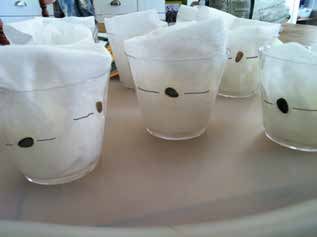
SUNFLOWER LAB
Overview
                                                                                                    Teacher’s Guide
    Every Seed Counts builds experiences and skills for growing plants and
    understanding a plant’s needs for pre-kindergarten classrooms.

    The lab includes Pre and Post Assessments along with 12 activities for learning
    and integration. Based on your students’ skills, use the Sunflower Lab in the
    ways that you think are best. Please see the Calendar below as a suggested
    sequence.

                                                   Day 1                     Day 2                   Day 3                   Day 4
                                                   Pre Assessment            What We Know &          Read Aloud
                                                                             What We Learned         Every Seed Counts

Day 5    Day 6                Day 7                Day 8                     Day 9                   Day 10                  Day 11
         Planting Sunflower   Looking & Learning   Sunflower Songs           A Growing Dance         Word Wall
         Seed Cups            Day-by-Day

Day 12   Day 13               Day 14               Day 15                    Day 16                  Day 17                  Day 18
         Counting Mats                             Is It a Plant? Or Not a                           What Are the Parts of
                                                   Plant?                                            a Plant?

Day 19   Day 20               Day 21               Day 22                    Day 23                  Day 24
         What Does a Seed     Handprint Art        Post Assessment           Celebrate the Earth!    The Sunflower
         Need?                                                                                       Challenge

                                                                                                                                 4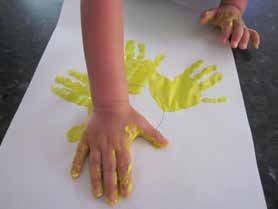
SUNFLOWER LAB
Caring for Sprouts,
Caring for the Earth
Young children understand what it means to be a good friend. Talk with them
about being a good friend. Write their suggestions on the board. How do you
treat good friends? Can plants, trees and animals be our friends? Is the Earth that
gives us so much - air, water, food, beauty - our friend? How might they like to be
treated? What can we do to help them?

Caring for living things in the classroom is a wonderful opportunity to learn that:

      • all living things have needs
      • they can understand the needs of other living things
      • they can help with the needs of others

1 - All living things have needs.
Every child understands their own need for food, shelter and care. And every
living thing has these needs. We are all connected.

2 - Students can understand the needs of other living things.
Caring for living things teaches your students that we all have unique needs. Not
everyone’s needs are the same. What is good for a child might not be good for a
plant. The care of a seedling is different than the care of an insect.

3 - They can help with the needs of others.
Students want to interact and be involved with the living things around them.
Checking to see if plants need water or if the caterpillars are becoming chrysalises
builds a child’s confidence and understanding. They learn about responding to
what is needed and offering to help.

Teaching Students How to Care for Seedlings
Sprouting seeds in your classroom is a great way to teach children about the needs
of plants that we depend on for food. Day by day, they observe how the seedlings
grow and change. They can see if the plants need water or less light. It is practical
experience in understanding the needs of others and learning how to help.

Sending a packet of seeds home at the end of the school year gives the children
an opportunity to share what they learned with their families by caring for their
plants until they bloom glorious flowers. Being responsible to help their plants
thrive is a good ‘job’ even for young children.
                                                                                        5
SUNFLOWER LAB
Pre/Post Assessments
Overview
The activities begin with an individual assessment to effectively establish a
baseline of students’ understanding, help you decide what to emphasize and
what needs to be adapted for your classroom. A pre-assessment provides a
way to evaluate the children’s growth at the end of the unit.
Materials
• Assessment Record (each sheet holds 15 names)
• handout for each student
• pencils/markers
Adapt the assessment, based on your students skill level.
1 Using a laptop or color print-out with a small group, or projected
on the white board for the entire class, show the handout and focus the
students’ attention on the parts of a plant.
• Tell the students that they will be identifying the parts of a plant by drawing
a line from each word to the correct part on the illustration.
• Use the first word that you point out as a demonstration - SEEDS.
• Point to the word SEEDS and say it out loud. Ask the students to look at the
illustration and identify the SEEDS. Point out the SEEDS on the illustration
and then draw a line from the word to that part of the plant.
• Next point out and say the word LEAF. Ask the students to identify a LEAF
on the illustration and draw a line from the word to that part.
• Repeat with the words - ROOT, FLOWER and STEM.
2 On the handout, focus their attention on what a plant needs to grow.
• Plants need SOIL, WATER, SUN and AIR to grow.
• Point to AIR and say it out loud. Ask Does a plant need AIR to grow? If it
does need AIR, draw a circle around the illustration and word.
• Repeat with the words - SOIL, SUN, SHOVEL, FORK, WATER.
6SUNFLOWER LAB
Assessment Record
Observing the Features
Student Name Needs of Living Things
of Living Things
Ability to identify a plant and Ability to describe what
the parts of a plant a plant needs to grow
Pre Post Pre Post
7SUNFLOWER LAB Name ___________________________
Parts of a Plant Date ___________________________
Draw an line from each word to a part of the plant.
SEEDS FLOWER
LEAF STEM
ROOT
What Does a Plant Need?
Circle the things a plant needs.
AIR SOIL SUN
SHOVEL FORK WATER
8SUNFLOWER LAB
What We Know about Seeds & Sprouts
Overview
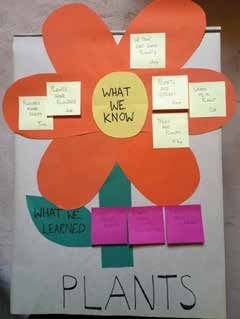
Children discuss What We Know about seeds and sprouts. The teacher records information for
display throughout the unit, including space to record What We’ve Learned during the unit.
What We Know
Example of the diagram on the right
Time
30 minutes
Materials
construction paper, post-it notes, color markers,
bulletin board
Step One
Explain to students that you’ll be sprouting seeds in
your classroom and learning all about them. Explain that
this activity gives students a chance to talk about what
they alreeady know about plants, seeds and sprouts.
Step Two
Ask the class to tell you - one at a time - what they know about seeds and plants. Write the
answers on a post-it note with the student’s name.
Talk about the responses. Encourage the students to look for relationships between the
responses and to group them in appropriate categories on a petal – i.e. food, growing, parts
of a plant, etc.
Step Three
Explain that as the class makes observations, you will write down What We Learned on the
diagram.
9SUNFLOWER LAB
EVERY SEED COUNTS
Read Aloud
Reading the story Every Seed Counts aloud with your class is a wonderful
way for your students to learn about the cycle of a plant’s life and to
build close observation skills. Reading the story several times with your
students will provide greater vocabulary gains. The vocabulary will also be
repeated and reinforced by Planting Seeds & Growing Sprouts, singing the
songs included here, as well as the other handouts and activities in the
Sunflower Lab.
Here are a few ideas to enliven multiple readings of Every Seed Counts:
• Call & Response - you read a line and the children repeat it back to you.
• Close Observation - point out details in the illustrations as you read
and during other readings, ask students to describe details in the
illustrations.
• Relate to Seeds & Sprouts - as your sprouts grow, relate events in the
story to the children’s observations of the seed cups.
10SUNFLOWER LAB
Growing Seed Dance
Materials: Instrumental music and audio system
Simple Instructions: Guide students through an improvisational dance. Have students
sit on the floor in a circle and ask them to imagine growing plants—how roots appear,
then stems and leaves, then flowers. Show them how to curl up as seeds, then uncurl
and stand like a growing shoot, and then spread arms and open hands as their flowers
bloom. Lead them through the process several times. Then let them try it on their own
with music.
After dancers have mastered the basic motions, ask if one or two would like to be
gardeners. Show them how to “cover” seeds with soil, using imaginary shovels, and
“sprinkle” them with water, using imaginary watering cans. Ask another child to dance
the part of the sun, rising in the morning, moving slowly across the sky, beaming
(smiling) and sending light to the growing seeds (moving arms in circles). A few others
could be rain, coming suddenly to moisten the soil with imaginary drops shaken from
their fingertips, moving slowly away as sprouts begin to grow, and lingering on the
distant horizon (at the boundary of your dance area).
Use your dance often as a wake-up exercise or a break from study, allowing students
to rotate through the different parts. Be sure to try it out in the schoolyard where the
children can get really big!
11SUNFLOWER LAB
Planting Sunflower Seed Cups
Overview
The students plant sunflower seed cups. Each child prepares one 9-oz plastic
cup with paper towels and “plants” approx. four seeds, so that sprouting and
growth can be observed in detail.
Suggested Time
One 30-minute session
Materials
20-25 8-oz plastic cups, one for each child
paper towels - 2 per cup
2 packets of sunflower seeds for planting
masking tape for name label
1 Sharpie or permanent marker
Easy Instructions for Sprouting Seeds
• Following as the teacher demonstrates, each child will make a seed cup.
• Everyone starts by washing their hands.
• Fold one paper towel in half and use it to line a plastic cup.
• Wad up the other towel and stuff it into the cup to hold the liner in place.
• Each student receives 4 sunflower seeds. With your fingers, slide one seed
between the paper liner and the side of the cup.
• Put four seeds in one cup. Seeds should be near the middle or approx. an
inch from the top of the cup. If one slides to the bottom, add another seed
near the middle.
• Put water into the cup a little at a time, so that the paper towels are evenly
moist with only a little extra water at the bottom of the cup. The paper
towels will wick moisture up to the seeds.
• Mark a horizontal line beside each seed with a marker to show the middle of
the seed. This will help students observe growth below and above the line.
• On a piece for masking tape, write the student’s name and tape it
vertically on the cup.
• Everyone finishes by washing their hands.
12SUNFLOWER LAB
Planting Sunflower Seed Cups
Tips
The teacher will want to have 2-3 replacement cups, just in case.
A little mold may grow on the paper towels; this is usually not a problem.
Keep the cups in a well-lit area with indirect sunlight. Choose a location
with a consistent, warm temperature. Be careful of window sills – cold
temperatures can freeze the sprouts; direct sunlight can dry them out.
IMPORTANT
Check that the paper towels are moist at the beginning and end of each
day. They dry out quickly at any time of year. Over the weekend, cover the
sprouts loosely with plastic wrap or moist paper towels.
What do you do with the sprouts after we are done studying them?
After approximately two weeks, the sprouts get leggy and no longer thrive.
Sunflower sprouts do not transplant well.
Here are a few ideas:
The sprouts can be fed to animals at your school like hamsters or rabbits.
Add them to a compost pile or bury them to decay in the ground.
13SUNFLOWER LAB
Looking & Learning Day-by-Day
Observing the growth of the sprouts every day is an excellent opportunity
to build a variety of science literacy skills like looking closely, focus, a wider
vocabulary and verbal expression.
• Each student should have their seed cup, a Looking & Learning Day-by-Day
handout and the Looking & Learning Cut-outs.
• As a class, ask the students to look closely at each seed. One at a time, have
several students describe aloud one detail that they see. Write key words on
the whiteboard.
• Explain that the class is using the Looking & Learning Day-by-Day handout
to record and learn about how sprouts grow. On Cut-outs, have the students
choose a picture that looks the most like their seeds. Cut it out and paste it on
Day 1 of the handout.
• Every day take a few minutes to observe the sprouts, select a picture and
paste it on Looking & Learning Day-by-Day.
• Every 3-4 days, take a little more time for a class discussion and writing key
words on the whiteboard. Can you see more details as the sprouts grow bigger?
• Ask the students to describe colors, shapes, size and what it might be similar
to. Encourage them to use vocabulary from Every Seed Counts.
Timeline for Sprouts
DAY 1 Prepare seed cups, plant the seeds.
DAY 2-5 Root tips sprout from the seeds.
DAY 6-10 Secondary roots appear. Stems grow to and above cup rim.
DAY 11-15 Cotyledons (cot-I-lee-dun), sometimes called “seed leaves,”
come out of the shells. These are the first two leaves that you will see. Some
sprouts will also develop two or more additional leaves, depending on how
long they are allowed to grow.
14SUNFLOWER LAB Name ___________________________ Looking & Learning Day-by-Day Date ___________________________ Each day look closely at your sprouts. Paste a picture that looks most like your sprout on each day. Day 1 Day 2 Day 3 Day 4 Day 5 Day 6 Day 7 Day 8 Day 9 Day 10 Day 11 Day 12 Day 13 Day 14
SUNFLOWER LAB                 Name __________________________

Looking & Learning Cut-outs
SUNFLOWER LAB
Three Flower Songs

This Little Seed                        Sunflower Song
Sing to the tune of “This Old Man,      Sing to “I’m a Little Teapot”
He Played One”
Lyrics ©2000 Cricket DeNamur,           I’m a little sunflower,
a naturalist for the Cincinnati Parks
                                        I’m so small.
                                        Soil, sun and water
This little seed tiny and small,        Make me tall.
It is the tiniest seed of all.          When I get all grown up
But with sun and soil and the rain      You will see
falling down,                           That I’m as big as I can be!
It will grow up through the ground.

This little plant small and green,      Flower Song
It is the smallest plant I’ve seen.     Sing to “Sing a Song of Sixpence”
But with sun and soil and the rain
falling down,                           Sing a song of flowers,
It will grow up big and strong.               flowers all around,
                                        Flowers that are growing,
This green plant grew so tall,                growing in the ground
It had the prettiest flower of all.     Flowers of each color
And with sun and soil and the rain            make a pretty view,
falling down,                           Red and orange and yellow
The bees were buzzing all around.             And blue and purple, too.

This little flower started to nod,
It grew seeds within its pod.
So with sun and wind and the rain
falling down,
Its seeds flew onto the ground.

                                                                            17
SUNFLOWER LAB
Sunflower Word Wall
The Word Wall includes 18 words from Every Seed Counts.
It is a set of domain-specific words that are all related to plants.
Introduce the word wall and utilize throughout.
Here are ideas for using the Word Wall:
• Tracing - have your students trace the letters of each word with a
finger. The students can say the letter out loud or silently. Pronounce
the whole word at the end.
• Act It Out - as you go through the words, act out the meaning with your
hands or your whole body. Especially good for kinesthetic learners.
• Relate to Seeds & Sprouts - as your sprouts grow, encourage the children
to use these vocabulary words to describe what they see.
18air
bee
bud
cycle
flower
leaves
nectar
petals
plant
pollen
rain
root
seed
soil
sprouts
stem
sun
sunflower
SUNFLOWER LAB
Sunflower Counting Mats 1-10

 Sunflower Counting Mats help children learn and count numbers 1-10 and
 develop motor skills by working with playdough or modeling clay.

 Print out one set of the counting mats and slide them into page protectors or
 laminate them for your math center.

 For counting put one seed in each box. Use small balls of playdough,
 sunflower seeds, big buttons or paper clips as counting pieces.

 Make playdough snakes and shape them into the large numbers.

                                                                                 37
1 one
2
two
3
three
4
four
5
five
6
six
7
seven
8
eight
9
nine
10
ten
11
eleven
12
twelve
13
thirteen
14
fourteen
15
fifteen
16
sixteen
17
seventeen
18
eighteen
19
nineteen
20
twenty
SUNFLOWER LAB
Is It a Plant                           Name __________________________
Or Not a Plant?
               Circle the the things that are plants.
         Mark an X through the things that are not plants.
SUNFLOWER LAB
What Is a Plant? Name __________________________
Match the words on this page to the correct parts of a plant.
Write the correct letter inside each circle.
A. leaves B. roots C. stem
D. flower E. seed F. sproutSUNFLOWER LAB
What Does a Seed Need?
Mini-Book
1. Print out the following page, one for each child.
2. In a small group, following your demonstration, have the students fold the
page.
3. First, fold the page in half, bringing the top down to the bottom with the
images showing on the outside.
4. Next, fold it in half again.
The front cover of the mini-book says, “What Does a Seed Need?”
5. In your small group, read the book together. Relate each word to each
image. The students can repeat the story with you. Count the drops of rain.
How many leaves does the sprout have? How many stripes does the seed
have? Let the children tell a story that expands on the mini-book.
Have the students practice the story, so they can “read” their mini-book to
their families.
6. Color your mini-book.
60sunlight soil,
water,
has
When a seed
and air, What Does
a Seed Need?
it
sprouts.
Name __________________________SUNFLOWER LAB
Handprint Sunflower Art
Materials
• Yellow Paint
• Green Paint
• Sheet of Paper
• Glue
• Brown or Black Crayons
Pour yellow paint onto a plate, so the
children can completely cover their hands
in paint. Alternately, you can paint the hand with a wide paintbrush.
Near the top of the paper, trace the outline of a circle using bowl or lid,
approximately 3-4 inches in diameter. Make 4-6 hand prints around the circle.
Have the fingers pointing out to the edge of the paper.
Then add a sunflower stem and leaves using fingers dipped in green paint. Add
green grass to the bottom of the paper.
Leave the paint to dry.
Cut a big circle from white paper to be the center of the sunflower. With brown
and black crayons, completely crosshatch the circle. Glue the circle to the center
of the flower.
62SUNFLOWER LAB
Post Assessment
Repeat the assessment with your students and compare the pre assessment
and post assessment for each student on the rubric.
63SUNFLOWER LAB
Celebrate the Earth!
Each school celebrates the Earth’s Birthday a little differently, bringing their own
unique ideas and interests to the event. Get creative!
Many schools choose a day close to the end of the school year, when the weather’s
warm, to celebrate by planting seeds, releasing butterflies and demonstrating ways
to care for our home planet.
Your celebration is a special gift from the children to the Earth!
Here are some activities for your classrooms to share:
• Sharing a song that students learned in the Sunflower Lab
• Planting seeds in a school garden
• Creating an art project from recycled materials
• Releasing Painted Lady butterflies
• Students draw pictures of their favorite animal
• Students reporting on ways to care for the earth like saving water,
feeding birds, growing vegetables and more
At the close of your celebration, please remember to take the Earth’s Birthday
Pledge!
No job is too big,
No action too small
For the care of the Earth
Is the task of us all!
64SUNFLOWER LAB
The Sunflower Challenge
Summer Take-Home
Overview
At the end of the school year, the students can take home a packet of sunflower
seeds to plant in their yard or in a pot. Planting instructions are included.
By reinforcing the sunflower experience, the students’ science literacy will
be reinforced over the summer. They will be able to share the experience
of planting and caring for the plant with their families, as well as enjoy the
beauty of sunflowers in late summer.
Each student will also take home a copy of Every Seed Counts to be read aloud
several times. Every Seed Counts tells the story of the sunflower life cycle in
words and pictures.
Each child receives:
• packet of sunflower seeds
• planting instructions
• one copy of Every Seed Counts
65The GROW A SMALL ONE, GROW A TALL ONE.
GROWING SUNFLOWERS IS EASY AND FUN!
Starting seeds and caring for plants as they sprout, grow and
flower is great hands-on learning experience. In the
classroom and at home, students will learn about the
lifecycle of plants and then test themselves by
participating in the
Sunflower C hallenge.
I. Learn about the lifecycle of plants.
Read Every Seed Counts with your class. Discuss the lifecycle
of the sunflower, from seed to blooming plant and back to seed again.
Can your students act out or draw the different stages of the sunflower
plant? Try making a list of everything a seed needs to grow into a
mature plant. Make copies of the counting activity
at the back of the bookand see if your
students can count the petals
of the sunflower!
2. Sprout sunflower seeds in your classroom.
There's so much to learn about seeds. Open one or two packets for use by
the classroom. Have students observe, describe and/or draw the sunflower
seeds. Can your students predict what will happen when you plant the seeds?
Let's see if they're right. Using seeds from the opened packets, start sprouting
your sunflowers.
Gather seed containers. You can use small paper cups, egg cartons, seed trays,
seed plugs or small “cups” made from folded newspaper.
Fill each one about 2/3 full with potting soil or seed starting mix. Place a seed in each cup. Push the seed down
into the soil about 1/2 an inch and cover over. If you are using clear, plastic cups, place the seed at the side of the
cup and push it down along the inside surface. You’ll be able to watch roots and leaves develop right through the cup.
Keep your seeds moist. Water them by using a spray bottle, mister or a watering can with a diffuser spout. A
direct pour of water from a cup or can will cause the seed and soil to move around. Give them enough water to
keep the soil moist but not so much that there is water standing at the bottom of the container.
Place seed containers in a safe location where they can receive lots of light but won’t be moved or knocked over
very easily. Depending on the classroom temperature, your sunflowers should germinate (start to grow)and show
their first leaves in just 3-10 days. Keep them happy, healthy and growing in your classroom until after the last
frost date in your area. Then transplant them to a new home in the ground or a pot outside, where they can grow
to their full height. Sunflowers do best in a sunny location, when temperatures are warm and days are long.
3. Take the Sunflower C hallenge!
We challenge your students to use what they've
learned about plants. Can they grow their own
Find word puzzles,
sunflowers from tiny seeds all the way to blooming
easy experiments plants? Send home a seed packet and A Note to
and many more Families (on reverse side of this sheet) with each
free, downloadable child. Students that send in a picture of themselves
sunflower-related with their home-grown sunflowers will receive a
activities at our website prize from our treasure trove of Earth-friendly gifts.
66can your
EarthsBirthday.org How many Sunflower Challenge champions
classroom can generate?Grow a small one, grow a tall one.
Growing sunflowers is
easy and fun.
Your child’s class has been participating in
the Earth Birthday Project’s Sunflower C hallenge ! The challenge gives students
a hands-on learning experience with the wonder of growing plants. Everything starts with
the class reading of Every Seed C ounts, a book about a sunflower’s lifecycle from seed to
bloom and back to seed again. Students learn what a plant needs to grow and how plants
provide food for people and animals. Next, students sprout sunflower seedlings in their
classroom. Now it's time to put all that wonderful learning into meeting our challenge: Can
your child grow his or her own sunflower from a seed to a blooming plant at home? If the
answer is “Yes!”, simply send us a picture of your child with the grown sunflowers and we’ll
send back a prize from our treasure trove of Earth-friendly gifts!
Here's how to take the Sunflower C hallenge :
Open the packet of sunflower seeds. Before you plant the seeds, take a close look at them
with your child. You might want to count their strips or arrange them in order from smallest
to largest. What can your child tell you about growing sunflower seeds? Find lots of free,
sunflower-related activities you can do at home on our website, EarthsBirthday.org.
Plant sunflower seeds at home in your yard or in a big flower pot. Your child's classroom has
already learned how to start seeds. Ask him/her how to do it!
Care for sunflower plants as they sprout and grow. Remember that plants need sunlight,
water and good soil for taking in nutrients.
When your sunflowers are blooming, take a picture of your child with the flowers he/she
has grown from tiny seeds. Send the photo, along with name and mailing address to Earths
Birthday Project, PO Box 1536, Santa Fe, NM 87504 or email a digital photo to
info@earthsbirthday.org. (Please note that we cannot return photographs.)
Two to four weeks later, check your mailbox. Earth’s Birthday Project will mail a special
surprise to everyone who sends in a photo. It’s our way of saying “Thank you!” for growing
and caring for these beautiful flowers and "Great job!" for
successfully growing your sunflower from
seed to bloom.
Earth’s Birthday Project
Inspiring wonder, learning and care for our Earth Take the Sunflower
PO Box 1536 Santa Fe, NM 87504
EarthsBirthday.org info@EarthsBirthday.org
Toll Free: 800.698.4438 C hallenge! 67You can also read


