Failure Rates During Reuse of Disposable N95 Masks in Clinical Practice in the Emergency Department
←
→
Page content transcription
If your browser does not render page correctly, please read the page content below
Original Research

       Failure Rates During Reuse of Disposable N95 Masks in
           Clinical Practice in the Emergency Department
Ronald Check, MD                              St. Luke’s University Health Network, Department of Emergency Medicine,
Brian Kelly, DO                               Bethlehem, Pennsylvania
Kathleen McMahon, DO
Vamsi Balakrishnan, MD
Leah Rivard, MD
Johnathan Pester, DO
Donald Jeanmonod, MD
Rebecca K. Jeanmonod, MD

Section Editor: R. Wilkerson, MD
Submission history: Submitted September 21, 2020; Revision received January 19, 2021; Accepted January 19, 2021
Electronically published April 19, 2021
Full text available through open access at http://escholarship.org/uc/uciem_westjem
DOI: 10.5811/westjem.2021.1.49960

        Introduction: The coronavirus 2019 pandemic caused a shortage of disposable N95 respirators,
        prompting healthcare entities to extend the use of these masks beyond their intended single-use
        manufacturer recommendation with a paucity of supporting research.

        Methods: We performed a prospective cohort study of ED healthcare workers (HCW) (“subjects”)
        required to use respirators at an academic, Level I trauma center. Subjects had been previously
        fit tested and assigned an appropriately sized N95 mask per hospital protocol. Per study protocol,
        subjects were fit tested periodically throughout their shifts and on multiple shifts over the eight-week
        study period. Data points collected included the age of the mask, subjective assessment of mask
        seal quality, and fit test results. We analyzed the data using Fisher’s exact test, and calculated odds
        ratios (OR) to determine the failure rate of disposable N95 masks following reuse.

        Results: A total of 130 HCWs underwent fit testing and 127 were included for analysis. Mask failure
        rate climbed after day 2 of use, with 33.3% of masks failing at day 3, 42.9% at day 4, and 50% at ≥
        day 5. Categorizing the masks into those being used for two or fewer days vs those in use for three
        or more, failure was more common on day 3 of use or older compared to those in the first two days
        of use (41.8% vs 8.3%, P < 0.0001) with an OR of failure with an older mask of 7.9 (confidence
        interval [CI], 2.8-22.3). The healthcare workers’ assessment of poor seal was 33.3% sensitive (CI,
        18.6-51.9) and 95.7% specific (CI, 88.8-98.6) for fit test failure.

        Conclusion: Disposable N95 masks have significant failure rates following reuse in clinical practice.
        Healthcare personnel also performed poorly in assessing the integrity of the seal of their disposable
        respirators. [West J Emerg Med. 2021;22(3)547–551.]

INTRODUCTION                                                        use.1 Initially used in industrial and manufacturing workplaces,
     In 1970 the United States Congress created the                 disposable respirator masks were introduced in the healthcare
Occupational Safety and Health Administration (OSHA) to set         setting to protect workers against airborne diseases. The
forth regulations for workplace safety, as well as the National     tuberculosis outbreak of 1991 acted as a catalyst to prompt
Institute for Occupational Safety and Health (NIOSH) to certify     the US Centers for Disease Control and Prevention (CDC) to
protective equipment and develop recommendations on its             release guidelines for their use in healthcare facilities.2

Volume 22, no. 3: May 2021                                        547                        Western Journal of Emergency Medicine
Failure Rates with Disposable N95 Masks Check et al.
Disposable respirator masks approved by NIOSH are
designed as single- or limited-use respirators that an individual Population Health Research Capsule
can mold to one’s face to ensure a proper seal and are intended
for a single patient encounter. The NIOSH-certified N95 What do we already know about this issue?
filtering facepiece respirator (FFR) is the most common The COVID-19 (coronavirus disease 2019)
disposable respirator used in the healthcare environment and pandemic caused a worldwide shortage of
is designed to fit securely on the operator’s face with the mask disposable N95 respirators, prompting healthcare
material meeting a minimum requirement of filtering 95% or workers to reuse these masks beyond their
greater of a standard test aerosol.3 intended single use.
The coronavirus 2019 pandemic quickly caused
worldwide shortages in FFRs and other personal protective What was the research question?
equipment (PPE).4 Supply chains and manufacturing have What is the failure rate of disposable N95 respirators
been hampered while demand has increased, and this following reuse in the emergency department?
imbalance in supply and demand will likely continue for some
time. With critical shortages, it is neither economically nor What was the major finding of the study?
logistically feasible to use disposable FFRs solely in their N95 respirators have significant failure rates
intended single-use capacity. Therefore, the CDC responded following reuse, specifically after two days of use.
by publishing guidelines for healthcare entities to implement
protocols for extended use of respirators (donning for multiple How does this improve population health?
patient encounters without doffing), as well as limited reuse Knowing that N95 respirators fail to provide
protocols (donning and doffing multiple times with the same adequate protection following reuse, healthcare
mask for an extended period of time) to extend the lifetime of systems can alter their masking policies to protect
their supplies.5 healthcare workers.
Although this practice would stretch supplies for a
longer period of time, there is a concern that extending the
clinical use of disposable FFRs beyond their intended design
could result in the reduction of protective effectiveness. The
effectiveness of FFRs could be reduced by degradation of the nurses, medical technicians, and radiology technicians who
filter medium itself or by loss of tight seal to the face such had already been fit tested by the study site and assigned an
that not all inhaled air travels through the mask filter.6 Studies appropriately sized N95 FFR as per OSHA mandate. During
supporting mask reuse and extended use have been largely the study period, HCWs at the study site were required to
performed through simulated scenarios, with only one study to wear N95 FFRs for the duration of their clinical shifts. We
date addressing concerns of mask performance reliability with excluded HCWs who had failed institutional fit testing and
reuse and extended use.7-9 were relegated to use a powered air-purifying respirator hood.
We also excluded HCWs for whom no mask was available at
Objectives the time of enrollment due to supply shortages, HCWs who
Our objectives were twofold: to determine the failure declined participation, and those who provided their own PPE.
rate of disposable N95 FFRs reused over multiple days in
the emergency department (ED), and to evaluate whether Study Protocol and Measurements
healthcare workers (HCW) were able to recognize the The HCWs wore a variety of N95 FFRs supplied by the
functional performance of their masks. hospital. These FFRs were either purchased by the hospital
or donated to the hospital by outside organizations and then
MATERIALS AND METHODS approved for clinical use after assessment by hospital resource
Study Design management. Mask types included 3M 1860, 3M 8210, 3M
This was an anonymous, cross-sectional, convenience study Aura 1870 (3M Company, Saint Paul, MN), Kimberly-Clark
of HCWs who were required to reuse disposable N95 FFRs 46727 (Kimberly-Clark Corporation, Irving, TX), Milwaukee
during clinical duties in the ED. The study was reviewed by 50-73-4010 (Milwaukee Electric Tool, Brookfield WI), and
the institutional review board and found to be exempt. Honeywell H801 (Honeywell International, Inc, Charlotte, NC).
Prior to testing, HCWs recorded their impressions of
Study Setting and Population the adequacy of their mask fit (adequate or inadequate) and
The study was conducted from April 1–June 15, 2020 total number of shifts during which their masks were worn.
at a community-based Level I trauma center with an annual They subsequently underwent qualitative fit testing using
census of 55,000. Study subjects (hereafter referred to as a standardized hood and 3M FT-32 bitter testing solution
HCWs) were physicians (both residents and attendings), (Bitrex). The HCWs performed standard maneuvers during fit
Western Journal of Emergency Medicine 548 Volume 22, no. 3: May 2021Check et al. Failure Rates with Disposable N95 Masks
testing, including breathing with their mouths open, rotating
their heads side to side, tilting their heads up and down, and
speaking. The fit test was performed by investigators who
completed standardized OSHA training in fit-test performance.
If the HCW tasted the bitter aerosolized solution during
testing, he or she was considered to have failed the test and his
or her mask was discarded and replaced with a new mask.
The results of fit testing were recorded on a standardized
data collection sheet. Specific HCW role and further
demographic data were not recorded. Some HCWs were tested
once, while others were enrolled more than once with each
new mask that they used. The number of times a HCW was
enrolled was not recorded. Because of the large and changing
variety of mask types approved by the hospital and used in
clinical practice due to limited supplies, specific mask type Figure 1. Flow diagram of study subjects demonstrating mask
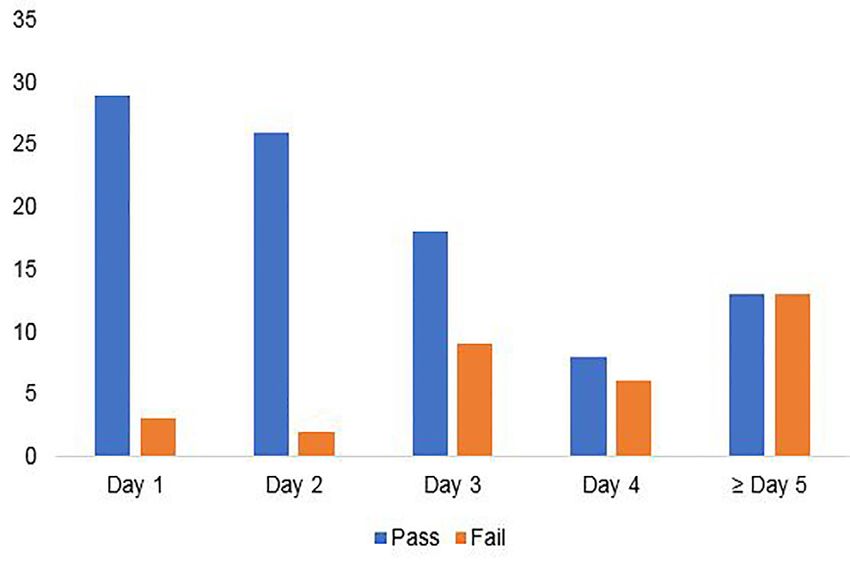
was not recorded for subgroup analysis, as any particular mask distribution based on day of use as well as “pass” and “fail” rates.
design was unlikely to be used frequently enough to draw
statically relevant conclusions.
went on to fail their fit tests. Twenty-two HCWs who felt their
Data Analysis and Handling masks had adequate seals failed their fit tests. HCW assessment
The HCW’s impression of adequacy of mask fit of poor seal was 33.3% sensitive (95% CI, 18.6-51.9) and
and results of fit testing were recorded in a standardized 95.7% specific (95% CI, 88.8-98.6) for fit test failure, with a
spreadsheet by a single investigator. We analyzed data using positive predictive value of 73.3% (95% CI, 44.8-91.1), and a
descriptive statistics. Data for rate of mask failure as a negative predictive value of 80.4% (95% CI, 71.6-87.0).
factor of number of shifts worn was analyzed using Fisher’s
exact test. We analyzed data regarding HCW accuracy in DISCUSSION
prediction of mask failure using chi square, with sensitivity In this study of mask failure rates in HCWs in clinical
and specificity analyses. All data was analyzed using MedCalc practice in an ED, mask failure rate climbed after day 2 of use
statistical software (MedCalc Software, Ostend, Belgium) and with 41.8% of masks failing on day 3 of use or older. These
VassarStats.net, (a statistical computation website developed results are consistent with the limited number of prior studies that
by Richard Lowry at Vassar College, Poughkeepsie, NY). examined the effect of multiple donning and doffing in extended
use and reuse scenarios in simulated or laboratory scenarios.
RESULTS, Bergman et al evaluated multiple N95 models and their fit over
A total of 130 HCWs underwent fit testing for the 20 consecutive donning and doffing episodes in a laboratory
purposes of the study protocol. Two HCWs enrolled who setting to simulate a single 10-hour shift of a HCW.7 Their
had not been previously fit tested by the institution, and one findings suggested that HCWs were able to don masks five times
HCW was wearing a mask that was not sized appropriately with consistent passing, but beyond this number, there was a rise
because of lack of supply of the previously tested mask. These
three HCW were excluded from further analysis. Twenty-five
percent of HCWs were on their first day of mask usage (n =
32), 22% were on their second day of mask usage (n=28),
21% were on their third day of mask usage (n = 27), 11%
were on their fourth day of mask usage (n = 14), and 20%
were on their fifth day or greater of mask usage (n = 26). The
failure rate of masks was similar on the first and second day
of usage at 9.4% and 7.1%, respectively (P = 1). Mask failure
rate climbed after day 2 of use, with 33.3% of masks failing
at day 3, 42.9% at day 4, and 50% at ≥ day 5 (Figure 1). Mask
failure was more common in masks on day 3 of use or older
compared to those in the first two days of use (41.8% vs 8.3%,
P < 0.0001), with an odds ratio of failure of 7.9 (confidence
interval [CI], 2.8-22.3)(Figure 2).
Fifteen HCWs felt that the seals on their masks were Figure 2. Graphical analysis of mask failure rates as a function of
inadequate at the time of fit testing. Of these, 11 subsequently mask age, demonstrating a drop-off in mask pass rates beyond day 2.
Volume 22, no. 3: May 2021 549 Western Journal of Emergency MedicineFailure Rates with Disposable N95 Masks Check et al.
in failure rate.7 In spite of this, they noted that approximately 60% been discarded that were still working appropriately, thereby
of FFRs had an adequate fit at the 20th donning.7 wasting masks. Conversely, we would have missed a number
Vuma et al evaluated fit factors of subjects undergoing of failures, potentially placing HCWs at risk.
six consecutive donning and doffing episodes.8 They found Although exact infection rate in our department is
that 52% of subjects passed all six fit tests.8 However, half of not known, we are aware of only two documented cases
those who failed returned to passing the fit test at some point.8 of infection in ED HCWs over the testing period. This is
Sixteen percent of the subjects in their study failed persistently substantially lower than expected given our high mask
after the third fit test.8 In a more recent study, Degesys et al failure rates. We speculate that this may be secondary to
evaluated mask failure rates among HCWs in an ED over the our universal masking policy of all patients. In addition, the
course of three days.9 They found a failure rate of 38.2% with minimal infectious dose of COVID-19 remains unknown. It
fit test failures associated with increased number of shifts that may be possible that even ill-fitting N95 masks offer enough
masks were worn, especially after day 2.9 We did not record protection to prevent infection. Secondly, the current estimates
total numbers of donning and doffing actions, but we believe of asymptomatic infections are in the range of 40-45% with
it can be assumed that the number increases with the total individual studies documenting asymptomatic cases between
number of shifts in which they are worn. 6.3- 96%.12 As our facility does not currently have universal
It is important to note that both Bergman et al7 and Vuma testing policies in place for HCWs, it is plausible that we have
et al used quantitative fit testing during their studies, rather
8
had more infections than reported. Additionally, it is possible
than qualitative testing, as was used in our study. In a study that “failed” masks intermittently had adequate fit, as one
comparing Bitrex qualitative testing vs quantitative fit testing study has shown that 50% of failed masks returned to fit later
as the gold standard, the sensitivity and specificity of the on in the study on re-testing.7 Therefore, some failed masks
Bitrex fit test was found to be 14% and 86%, respectively.10 might have provided adequate seal prior to testing, and the
This data indicates that the qualitative test is useful in seal was only broken during provocative testing occurring
identifying mask failures, but may result in identified failures during testing, but not during clinical duties.
at concentrations deemed acceptable by the quantitative
method. These results may contribute to the slightly higher LIMITATIONS
failure rates found both in our study and the study performed Our study is limited by its anonymous design, which
by Degesys et al, as compared to the studies using the precludes our ability to determine whether failures were
quantitative method.9 Regardless of methods tested, studies more common among different types of HCWs (for example,
demonstrate increased mask failure rates after prolonged use nurses as compared to technicians). Additionally, because
and re-use. of the variety of masks approved by and used through
We did not assess whether our masks failed from loss hospital resource management, we did not record whether
of facial seal vs failure of the filter medium itself. A study a specific disposable mask was more likely to fail than
performed by Grinshpun et al demonstrated that for N95 another. Anecdotally, there were failures in all groups, but the
masks, the total particle penetration was between 2.5-5.5% numbers of each mask were too low to draw conclusions for
depending on particle size, of which the majority was due to significance between the groups. We relied upon self-report
face seal leakage andCheck et al. Failure Rates with Disposable N95 Masks
HCWs as to the storage and care of their masks between uses. Healthcare facilities. 1994. Available at: https://www.cdc.gov/mmwr/
Finally, our study was performed at a single institution, and may PDF/rr/rr4313.pdf. Accessed September 20, 2020.
not be generalizable to all settings. 3. Centers for Disease Control and Prevention (CDC). Respiratory
Protective Devices, Code of Federal Regulations Title 42, Part 84.
CONCLUSION 1997. Available at https://www.cdc.gov/niosh/npptl/topics/respirators/
Reuse of disposable filtering facepiece respirators pt84abs2.html. Accessed September 20, 2020.
beyond two days in actual clinical practice has a high rate 4. Tabah A, Ramanan M, Laupland KB, et al. Personal protective
of fit failure. This suggests increased risk of aerosolized equipment and intensive care unit healthcare worker safety in the
infectious disease transmission with reuse of masks. This COVID-19 era (PPE-SAFE): an international survey. J Crit Care.
risk might be mitigated with frequent fit testing. Healthcare 2020;59:70-5.
workers perform poorly in recognizing the integrity of their 5. Centers for Disease Control and Prevention (CDC). Recommended
own mask seals. Therefore, self-assessment does not appear Guidance for Extended Use and Limited Reuse of N95
adequate to determine fit.
Filtering Facepiece Respirators in Healthcare Settings. 2020.
Available at https://www.cdc.gov/niosh/topics/hcwcontrols/
recommendedguidanceextuse.html. Accessed September 20, 2020.
Address for Correspondence: Rebecca Jeanmonod, MD, St. 6. Fisher EM and Shaffer RE. Considerations for recommending
Luke’s University Health Network, Department of Emergency extended use and limited reuse of filtering facepiece respirators in
Medicine, 801 Ostrum St. Bethlehem, PA 18015. Email: rebecca. healthcare settings. J Occup Environ Hyg. 2014;11(8): 115-28.
jeanmonod@sluhn.org. 7. Bergman MS, Viscusi DJ, Zhuang Z, et al. Impact of multiple
consecutive donnings on filtering facepiece respirator fit. Am J Infect
Conflicts of Interest: By the WestJEM article submission
agreement, all authors are required to disclose all affiliations, Control. 2012;40:375-80
funding sources and financial or management relationships that 8. Vuma CD, Manganyi J, Wilson K, et al. The effect of fit of multiple
could be perceived as potential sources of bias. No author has consecutive donning and doffing of N95 filtering facepiece
professional or financial relationships with any companies that are
respirators. Ann Work Expo Health. 2019;63(8):930-6.
relevant to this study. There are no conflicts of interest or sources
of funding to declare. 9. Degesys NF, Wang RC, Kwan E, et al. Correlation between N95
extended use and reuse and fit failure in an emergency department.
Copyright: © 2021 Check et al. This is an open access article JAMA. 2020;324(1):64-6.
distributed in accordance with the terms of the Creative Commons 10. Clapham SJ, Stephenson DJ, Wallace DO, et al. Comparison of N95
Attribution (CC BY 4.0) License. See: http://creativecommons.org/
disposable filtering facepiece fits using Bitrex qualitative and TSI
licenses/by/4.0/
Portacount quantitative fit testing. Int J Occup Environ Health. 2000;
6(1): 50-4.
11. Grinshpun SA, Haruta H, Eninger RM, et al. Performance of an N95
REFERENCES filtering facepiece particulate respirator and a surgical mask during
1. Cohen HJ and Birkner, JS. Respiratory protection. Clin in Chest Med. human breathing: two pathways for particle penetration. J Occup
2012; 33(4): 783–93 Environ Hyg. 2009;6:593-603.
2. Centers for Disease Control and Prevention (CDC). Guidelines for 12. Oran DP, Topal EJ. Prevalence of asymptomatic SARS-CoV-2
Preventing the Transmission of Mycobacterium Tuberculosis in infection. Ann Intern Med. 2020:M20-3012.
Volume 22, no. 3: May 2021 551 Western Journal of Emergency MedicineYou can also read


