Field Guide to Invasive Species in Ireland
←
→
Page content transcription
If your browser does not render page correctly, please read the page content below
Field Guide to Invasive Species in Ireland

                               2 nd Edition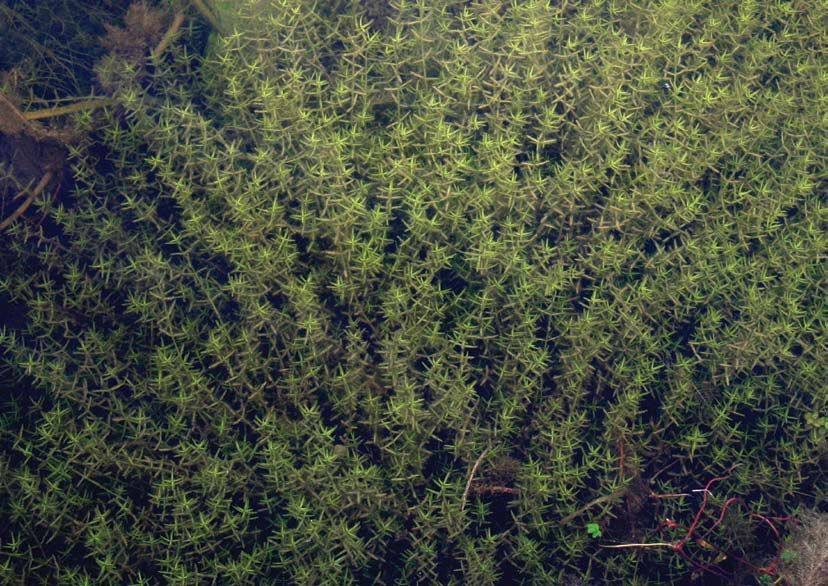
Contents

1. Introduction                                     15. Chub (Leuciscus cephalus)
2. How you can help                                 16. Zebra mussel (Dreissena polymorpha)
3. Nuttall’s Pondweed (Elodea nuttallii)            17. Chinese mitten crab (Eriocheir sinensis)
4. New Zealand Pigmyweed (Crassula helmsii)         18. Giant Rhubarb (Gunnera tinctoria)
5. Parrots Feather (Myriophyllum aquaticum)         19. Hottentot Fig (Carpobrotus edulis)
6. Curly Leaved waterweed (Lagarosiphon major)      20. Ruddy Duck (Oxyura jamaicensis)
7. Fringed waterlily (Nymphoides peltata)           21. Common cord grass (Spartina anglica)
8. Water fern (Azolla filiculoides)                 22. Wire weed (Sargassum muticum)
9. Floating Pennywort (Hydrocotyle ranunculoides)   23. Didemnum vexillum
10. Himalayan Balsam (Impatiens glandulifera)       24. The Bloody-red Shrimp (Hemimysis anomala)
11. Grey Squirrel (Sciurus carolinensis)            25. Muntjac Deer (Muntiacus reevesi)
12. Japanese Knotweed (Fallopia japonica)           26. Leathery Sea Squirt (Styela clava)
13. Giant hogweed (Heracleum mantegazzianum)        27. Slipper Limpet (Crepidula fornicate)
14. Dace (Leuciscus leuciscus)                      28. Water Primrose (Ludwigia spp.)
                                                    29. Project funders and supporters
                                                    30. Acknowledgements / credits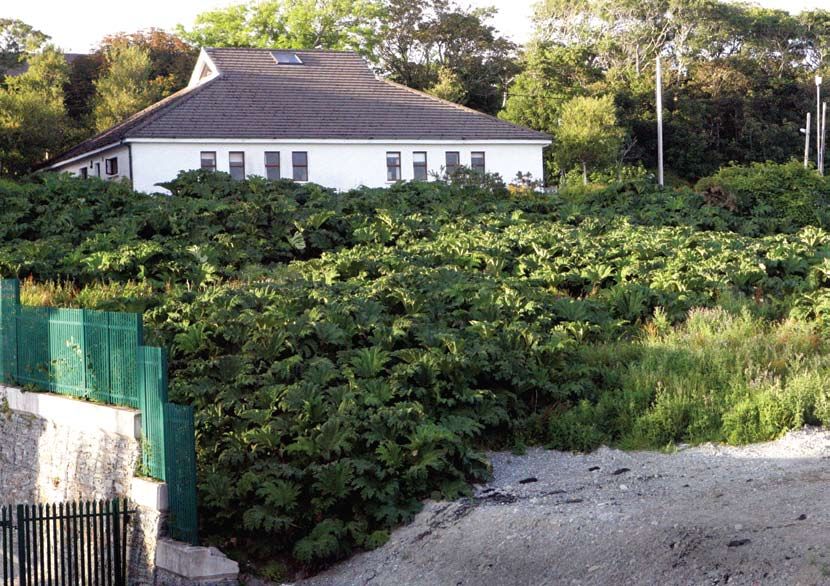
Introduction

Non-native species are species that have been introduced, either intentionally or unintentionally, outside their
natural range. Many of these non-native species live in harmony with our native species causing no adverse impacts.
A few non-native species though become what is known as ‘invasive’ as they thrive in our habitats and out-compete
our native flora and fauna. These invasive non-native species or invasive alien species, as they are also referred to as,
are widely recognised as one of the greatest threats to our native biodiversity, second only to that caused by habitat
destruction. They not only have negative environmental impacts but they can also adversely impact on recreational
activities such as walking, boating, fishing, swimming and various other water-based leisure pursuits. They can also
have serious associated economic costs.

Once an invasive species has established within a habitat its spread can be rapid, out-competing native species.
The spread of most invasive plant species is by plant fragments or seed, while invertebrates or mammals can move
independently within aquatic or terrestrial habitats or hitch rides on the hulls of boats or on equipment. To minimise
the risk of spreading or introducing non-native invasive species please rigorously follow the following guidelines.

                                                                                    Inspect > Remove > Dispose >Report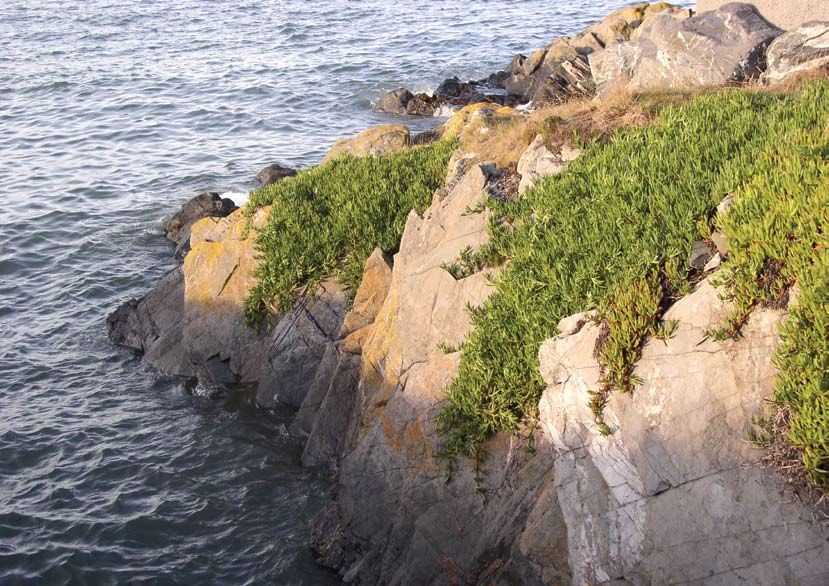
How you can help

How you can help:

Inspect: all equipment that has been in a waterbody (boats, trailers, engines, outboards, dredgers, weed cutting or
harvesting boats, cruisers or even clothing) or terrestrial site for attached vegetation, contaminated soil or obvious
animal life before moving to another waterway, catchment or site.

Remove: any adhering plant, soil or animal material from your equipment before relocating to another watercourse,
section of waterway or site. Ensure that all water is drained from your boat and equipment before transportation to
another site and all soil is removed from machinery, as this may contain seed or plant fragments.

Clean: power hose all equipment. Use hot water (>60 degrees centigrade) where possible.

Dispose: of all plant material and animal material appropriately. This material should be contained in sealed bags or
containers prior to removal. Do not throw them back into the water or leave them lying at the waters edge.

Report: Report any sightings of an invasive species on the www.invasivespeciesireland.com website in the
‘Alienwatch’ section.

                                                                                      Inspect > Remove > Dispose >Report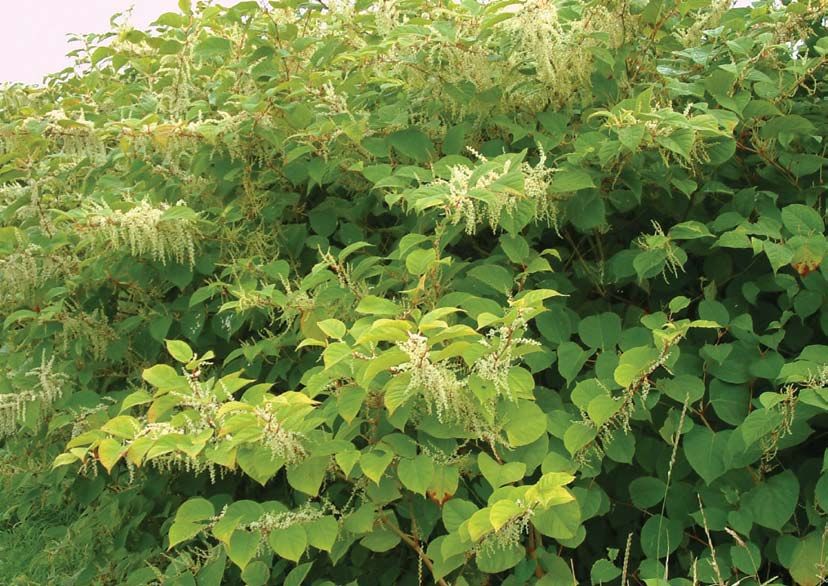
Nuttall’s pondweed - Elodea nuttallii

Nuttall’s water-weed is similar to the Canadian
pondweed (Elodea canadensis) and, like it, is an
invasive species originating from North America. The
first reports in Ireland were in the mid-1980s. It is a
perennial submerged plant, growing in still and slow
flowing water and it thrives in eutrophic waters. It is a
freshwater plant but it is tolerant of moderately saline

                                                            leave n re
water.

                                                                ofte
                                                                 s in
Over the past twenty years it has spread rapidly, by                wh
                                                                 cu orls of 3
vegetative means only. Where it establishes it can                 rved
form exceptionally dense monocultures, excluding
native species. It can occupy the water colum from
bed to surface. As a consequence, biodiversity
suffers immensely following its introduction. It also
interferes with any form of amenity usage of the
infested waterbody.

One Small Fragment can infest an entire waterbody                  Inspect > Remove > Dispose > Report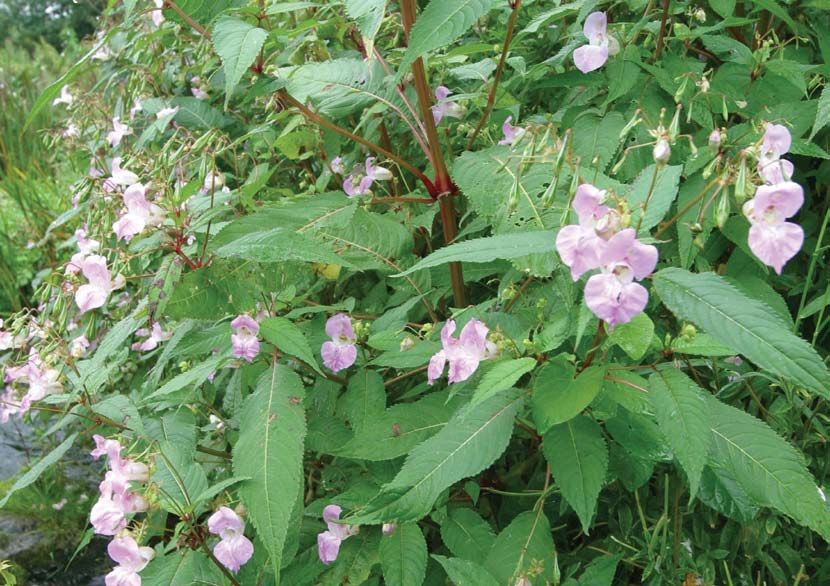
Photos by Joe Caffrey (CFB)
New Zealand pigmyweed - Crassula helmsii

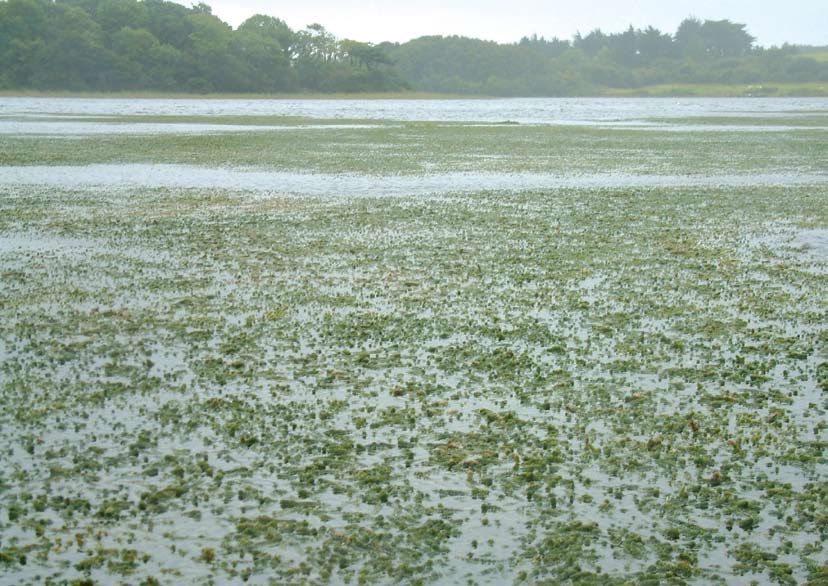
Also known as Australian swamp stonecrop. It is an
aquatic or semi-aquatic species. The first record of this
species in Ireland was in 1984 from an artificial pond
in Gosford Forest Park, County Armagh. It has spread
very rapidly in watercourses in Britain and has the
potential to do so likewise here.

It forms dense submerged and emergent stands in
ponds, small lakes and canals. The plant grows on
the muddy margins of ponds where it forms dense
carpets with up to 100% cover, or semi-submerged in
deeper water, or totally submerged with elongated
stems. It does not die back in winter. In suitable
aquatic habitats the biomass produced is sufficient
to eliminate native plants and creates inhospitable
conditions for macroinvertebrates and fish.

One Small Fragment can infest an entire waterbody                   Inspect > Remove > Dispose > Report
Photos by Joe Caffrey (CFB)
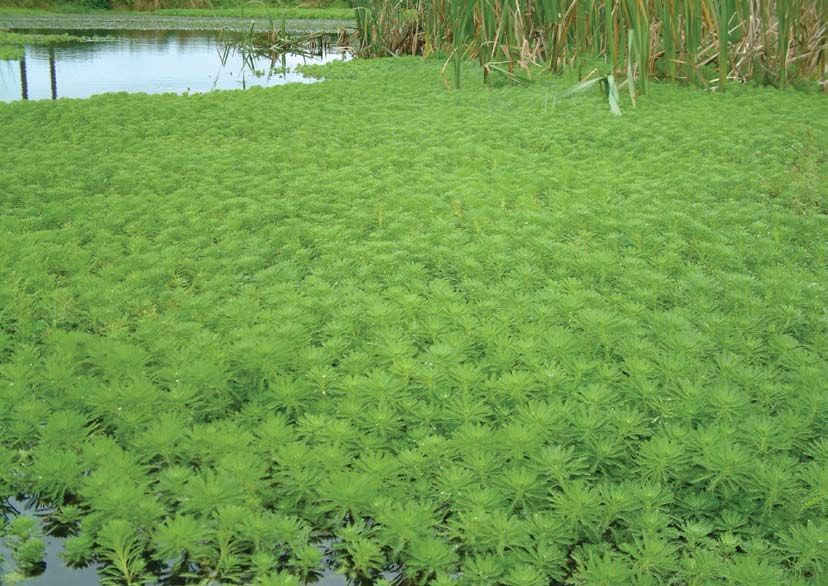
Parrot’s feather - Myriophyllum aquaticum

This species is native to the Amazon Basin in South
America. It was first recorded in Ireland in 1990. It is
a perennial plant that grows submerged but it also
produces emergent, feathery shoots. It grows vigorously
in static or slow flowing habitats. Following introduction
to a suitable freshwater habitat it rapidly spreads within
the waterbody, damaging the natural ecosystem and
impairing recreational activities.

One Small Fragment can infest an entire waterbody                   Inspect > Remove > Dispose > Report
Photos by Joe Caffrey (CFB)
Curly leaved waterweed - Lagarosiphon major

Lagarosiphon major grows in water up to 5 metres deep.

                                                                    leaves
It is commonly sold as an oxygenating plant. In Ireland
it has had a serious impact on Lough Corrib where it
                                                                        sp

                                                                      in
has grown with such vigour it has already excluded                         iral           n
                                                                                arrangeme

                                                                                        t
                                                                    (N
the native flora from the bays in which it is established.             Tw

                                                                     O
                                                                          horled)
It restricts angling, boating and other water based
activities. It spreads by fragmentation. Plant fragments
                                                                                              ro
can easily be spread from one waterbody to another on                                           wn

                                                                                              c
the hull of boats, trailers, outboard motors or angling
equipment.

                                                                                                     sub             a   nt
                                                                                                        m   erged pl

One Small Fragment can infest an entire waterbody                        Inspect > Remove > Dispose > Report
Photos by Joe Caffrey (CFB)
Fringed waterlily - Nymphoides peltata

This small yellow flowered waterlily is locally established
in lakes and ponds in Ireland. It thrives in shallow ( Remove > Dispose > Report
Photos by Joe Caffrey (CFB)
Water fern - Azolla filliculoides

This is a small free floating water fern that grows and
thrives in canals, ponds and sheltered aquatic habitats.
In suitable waterbodies it can carpet the water surface in
considerable areas. By excluding light it elimates native
submerged flora. It also prevents diffusion of oxygen
from the air to the water, which can result in low oxygen
conditions leading to fish kills. It can have serious health
and safety implications as it may be mistaken for solid
ground. It can also interfere with recreational water
based activities. In late autumn/winter it can turn red
in colour.

One Small Fragment can infest an entire waterbody              Inspect > Remove > Dispose > Report
Photos by Joe Caffrey (CFB)
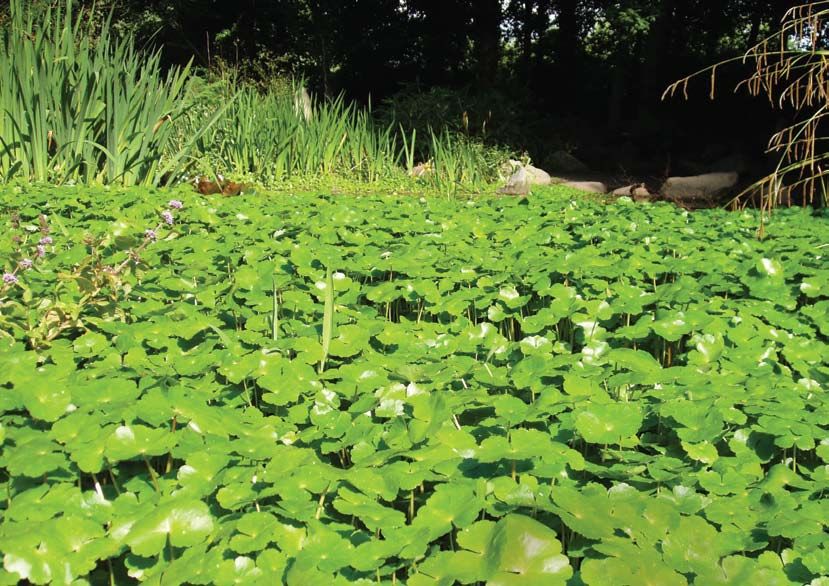
Floating pennywort - Hydrocotyle ranunculoides

Native to North America this weed was first brought
into Ireland as a plant for tropical aquariums and
ponds, but it has since escaped into the wild. It is a
floating or creeping, mat-forming perennial plant. It
thrives in shallow still flowing waterbodies, rooting in
water less than 1 metre in depth.

It resembles a larger, more robust, version of the
native Irish Marsh Pennywort. The leaves are typically
2 to 8cm in diameter and are kidney shaped, with a
distinctive ‘V’ indentation into the centre of the leaf
being the main distinguishing feature from the native
Irish Marsh Pennywort. It forms thick dense mats
across a waterbodies surface effectively blocking out
any light to native vegetation below. It also increases
the risk of flooding. In angling waters it obstructs free
casting, makes it difficult for fish to be safely landed
and also restricts boat movement.

One Small Fragment can infest an entire waterbody                       Inspect > Remove > Dispose > Report
Photos by John Early (NIEA) and Jonathan Newman (CEH)
Himalayan balsam - Impatiens glandulifera

Introduced to the wild by escaping from gardens
this plant is rapidly colonising river banks and
other areas of damp ground. It is an annual plant
which can grow up to 3 metres in height with
purplish – pink to pale pink flowers in June-August.
When the seed pods are mature they will explode
scattering the seeds up to 7 metres from the parent
plant. In many cases these seeds are then spread
downstream in rivers and streams.
                                                                 stems
It grows in dense stands along the banks of
rivers and streams effectively blocking out and
                                                                             xa

                                                                           he
suppressing any native vegetation. When it dies                                   go
                                                                                    na l
back in autumn it leaves the banks bare and                                                stems
exposed, increasing erosion during the winter
months. This can result in bank collapse and
increased sediment deposit into the waterway
affecting fish spawning and the river ecosystem.
                                                                                                   alte             es
                                                                                                          rnate leav

                                                              Inspect > Remove > Dispose > Report
Photos by Joe Caffrey (CFB)
Grey Squirrel - Sciurus carolinensis

The grey squirrel is a serious threat to our native red
squirrel. It is larger than the red squirrel and will out-
compete it for food and habitat. The grey squirrel can
carry and spread a virus to which they are immune, but
it can be potentially fatal to the red squirrel (Parapox
virus). Grey squirrels can also damage woodlands by
stripping the bark off trees, which can lead to their death.
Within 15 years of grey squirrels being introduced to a
woodland, red squirrels can disappear from the area, as
has been the case in many of Ireland’s forests.

                                                               Inspect > Remove > Dispose > Report
Photos by Tom Ennis
Japanese Knotweed - Fallopia japonica

Japanese knotweed was first introduced into Ireland
as an ornamental plant. It has since infested a wide
range of habitats, including the banks of rivers. It can
grow up to 3 metres in height and forms very dense
monocultures along river corridors. The rhizomes
(roots) are very extensive growing up to 3 metres in         ea                 in
                                                           zig ves arranged

                                                           L
depth and up to 7 metres laterally from the parent
                                                               - za g        i on
plant.                                                                format          ea
                                                                                                           af

                                                                                     H
                                                                                           rt sh
                                                                                                   aped l e
Japanese knotweed is spread entirely via the
movement of soil material contaminated with the

                                                                                                            Cre t
rhizome or via plant material, as only female plants                                                                 m

                                                                                                               a
                                                                                                                o      fl
occur in Ireland. Spread is rapid and results in the                                                                lat ower mid
                                                                                                                       e Ju
exclusion of native species that function to maintain                                                                       ly
bankside stability along rivers. In the winter when it
dies back it results in the banks being left bare and
vulnerable to erosion.                                                                                                         on
                                                                                                                                  g            low

                                                                                                                                               ,
                                                                                                                               l
                                                                                                                               red (to 3m), hol s
                                                                                                                                   -fleck stem
                                                                                                                                         ed
One Small Fragment can infest a new site.                                            Inspect > Remove > Dispose > Report
Photos by Joe Caffrey (INVAS)
Giant hogweed - Heracleum mantegazzianum

This plant was introduced as an ornamental garden                                                                          HUMAN
plant from south west Asia in the 19th century. It                                                                         HEALTH
is common along river banks, wasteland and road                                                                            HAZARD
sides. It bears a close resemblance to hogweed and
cow parsley, but is distinctive due to its size (often
3-5 metres tall). Its leaves can grow up to 1.5 metres

                                                                            complex
in width. It flowers between June and September           w

                                                         flo
                                                           ers
producing several thousand seeds per plant.                      in umbel
                                                                                  av

                                                                               le
It produces a sap which is hazardous to humans,                                     es (               e
                                                                                           to 1.5m wid

                                                                                                     )
particularly in the presence of direct sunlight.
Serious infestations can lead to the closure of public
footpaths and recreational areas. The large leaves                                                         d,

                                                                                                       re
                                                                                                              hairy
create sufficient shade to suppress native vegetation.                                                              stem
On river banks and slopes during the winter when
it dies back it leaves the soil exposed and more
vulnerable to erosion.

                                                                                                                            large seeds

Can lead to an entire area being infested                                         Inspect > Remove > Dispose > Report
Photos by Joe Caffrey (CFB)
Dace - Leuciscus leuciscus

                                                          inferior mout
Dace was introduced to the Blackwater in Munster in
1889. It was not recorded in any other catchment until -
                                                            top

                                                                h
                                                                             n

                                                                           g
the late 1970s. In southern Ireland they are spreading          lip protrudi
rapidly in waters, to which they have been introduced.
Dace competes for habitat, food and spawning                                       do r
                                                                                          sal fin
substrates with native fish species. The dace is similar in
appearance to roach, but is distinguished by its yellow
(not red) eyes and the slimmer silver/green body.                                                        ana
                                                                                                               l fin

                                                                                                                                      fin
                                                                                                                       ee               l
                                                                                                                         p fork in cauda

                                                                                                                       d
                                                                                 Inspect > Remove > Dispose > Report
Photos by Paul Mc Loone (CFB)
Chub - Leuciscus cephalus

                                                          inferior mout
Chub is a cyprinid fish that is widespread
throughout central and southern Europe. It is
indigenous to England. Until 2004, it had not been
formally recorded in Ireland. It is a species that                   - to

                                                                h
                                                                                           in

                                                                                          g
                                                                            p lip
inhabits rivers with a moderate flow, but can also                                  protrud
be found in lakes. It was most likely intentionally                                              rsa

                                                                                                do
introduced into Ireland. Chub feed on aquatic plants                                                 l fin
and invertebrates when young but, as they mature
they feed more selectively on larger prey, including
young fish. Their spread and proliferation could result                                                           al

                                                                                                                an
                                                                                                                       fin
in an imbalance among our native fish communities.

                                                                                                                             dee
                                                                                                                                fo

                                                                                                                                p
                                                                                                                                   rk   in caudal fin

                                                                                                 Inspect > Remove > Dispose > Report
Photos by John Coyne (CFB)
Zebra mussel - Dreissena polymorpha

This small, but prolific, mussel was introduced into the
Shannon Estuary in the 1990s by the movement of
boats. Zebra mussels live in freshwater and in the
upper reaches of tidal estuaries. They have spread
from the Shannon Estuary, principally via recreational
water use into unconnected water bodies, such
as Lough Neagh. Their arrival in Lough Erne led to
significant changes in native fish communities and
changes in aquatic plant growth.

They are filter feeders and remove much of the
plankton that juvenile fish depend upon and mask the
water bodies natural response to eutrophication. They
can result in toxic algal blooms which impact on
drinking water. They DO NOT JUST mAKE THE wATER
CLEANER! They attach to any hard surface, such as

                                                                                     rarel
boats, buoys and water intake pipes, where they form

                                                                                                             h
very dense clusters. As such, they can cause problems

                                                                                           ye

                                                                                                           gt
                                                                                           ce                  en
                                                                                              ed   30mm in l

                                                                                             x
by blocking out-pipes and clogging cooling systems.
                                                              Inspect > Remove > Dispose > Report
Photos by Joe Caffrey (CFB) and NIEA
Chinese mitten crab - Eriocheir sinenisis

This crab is recognisable by the hair-like covering
(mitten) on its distinctive white-tipped claws. It
is native to China and was most likely introduced
via ballast water. Ireland does not have any native
freshwater crabs. It was first recorded in Ireland
(Waterford estuary) in 2005 and has subsequently
been recorded from the lower reaches of the River
Suir and Barrow. As the crab migrates upstream
it burrows into the banks to live. It feeds on
invertebrates and fish. Where present in large
numbers they can impact on native fish populations
and cause subsidence of river banks. It is also known
to carry a parasite in cases, known as a lung fluke,
which can be harmful to humans if ate.

                                                              Inspect > Remove > Dispose > Report
Photos by Alan Cullagh (SRFB)
Giant Rhubarb - Gunnera tinctoria

Giant rhubarb is a large plant resembling the
common rhubarb that dies back at the end of the
growing season (Autumn). It can be found on boggy
ground, damp pastures, in ditches, on roadsides,
by streams, river banks and on cliff faces. It has
large umbrella sized leaves growing to around 2m
in height. Once established, giant rhubarb is highly
invasive and grows in dense clumps that shade out
native flora.

                                                       Inspect > Remove > Dispose > Report
Photos by Joe Caffrey (CFB) and John Early (NIEA)
Hottentot Fig - Carpobrotus edulis

Hottentot fig is an introduced species, native to
South Africa. It grows quickly, forming dense mats
that can carpet cliff slopes, shading out other native
species. It easily spreads by seed (hundreds per fruit)
and from segmentation (any shoot segment can
produce roots). Its succulent foliage, bright pink or
yellow flowers, and resistance to some harsh coastal
climatic conditions (salt) have made it well adapted
for life on the coast in Ireland.

                                                          Inspect > Remove > Dispose > Report
Photos by Richard Weyl (NIEA)
Ruddy Duck - Oxyura jamaicensis

The ruddy duck is an introduced species from North
America. It threatens it’s close relative, the white-
headed duck (Oxyura leucocephala). Male ruddy
ducks out-compete male white-headed ducks and
mate with the females producing hybrids. Where
pairs of ruddy ducks occur with white-headed ducks
they are more aggressive and can out-compete for
nesting space and food. Interbreeding may result in
the eventual extinction of the white-headed duck.

                                                                                      wintering

                                                        Inspect > Remove > Dispose > Report
Photos by Tom Ennis
Common cord grass - Spartina anglica

Common cord-grass is a robust grass with shoots
that can reach 1.3m, it is spread both vegetatively
and by seed. This grass colonises sheltered mud
flats at a tidal level below the normal salt marsh
vegetation, producing dense monoswards. These
swards slow the movement of water and increase
the rate of silt deposition, raising the general level
of the marsh and blocking out other species from
establishing, therefore reducing biodiversity. By
forming the dense monoswards on mudflats it
reduces the food resources available for wildfowl
and wading birds, notably eel-grass beds and
invertebrates.

                                                             Inspect > Remove > Dispose > Report
Photos by Mark Hammond and Paul Corbett (NIEA)
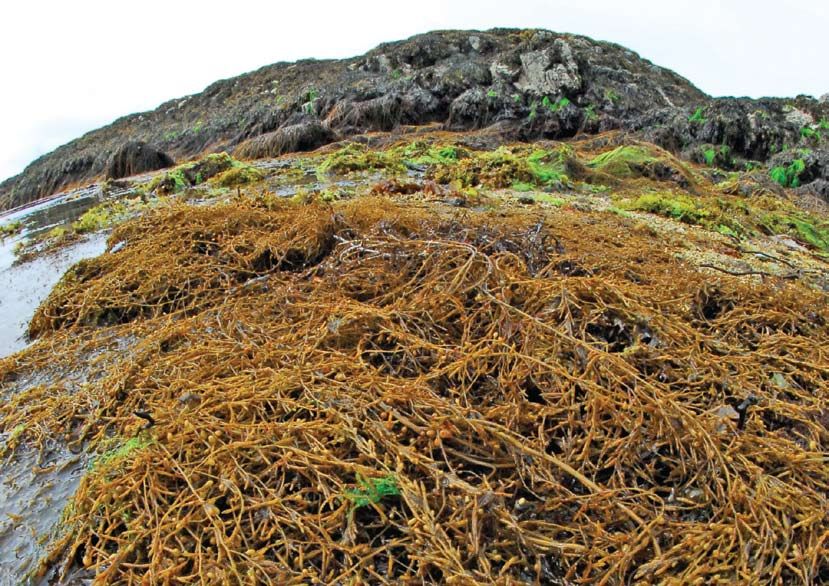
Wire weed - Sargassum muticum

This large brown alga is present at several locations
around the coast of Ireland. It is believed that this
species arrived with oyster spat introduced for
commercial purposes. It is known to occur from the
intertidal to the subtidal range of substrates including
hard rock face and Eel grass beds, where it can form
dense stands excluding other species. It can grow up
to 16 m in length, forming dense floating mats on the
sea surface, growing at a rate of up to 10 cm per day.
It reproduces both sexually and via floating fragments.

Dense stands of Wire weed can reduce the available
light for understory species, dampen water flow,
increase sedimentation rates and reduce ambient
nutrient concentrations available for native species.
Due to its prolific growth it has become a great
nuisance, drifting and clogging marinas, clogging the
intake pipes of boats and drifting ashore covering areas
of Eel grass, which are an internationally important bird
feeding habitat.

                                                            Inspect > Remove > Dispose > Report
©M.D. Guiry/www.algaebase.org
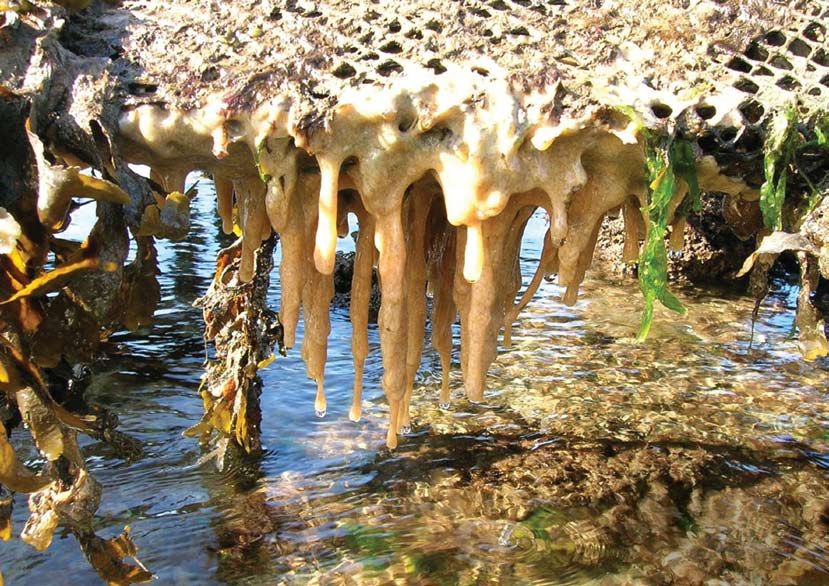
Didemnum vexillum

Didemnum vexillum is a colonial sea squirt that grows
in two forms: 1) long candle wax like colonies that
hang from any hard surface such as docks, lines and
ship hulls; 2) undulating mats that cover and encrust
rocky seabeds. This organism can spread by larvae
and fragmentation but is mainly transported on boat
hulls, fishing equipment and ballast water.
Colonisation threatens the aquaculture and fishing
industries by interfering with fish egg laying grounds
and also smothering bivalves such as mussels, scallops
and oysters, other impacts include smothering
seaweeds and sponges.

                                                         Inspect > Remove > Dispose > Report
Photos by Julia Nunn
The Bloody-red Shrimp - Hemimysis anomala

The “bloody-red shrimp” is a recent aquatic invader to
Ireland. It is a small, shrimp-like crustacean native to the
Black Sea, the Azov Sea and the eastern Caspian Sea.
They are free-swimming and have eight pairs of legs,
rather than the five typically found on larger shrimps
and other decapods. It has directly eliminated many
important macroinvertebrate species from fresh and
brackish waters in Holland. whilst not yet present in
Northern Ireland, it is highly likely to invade via the
same route as zebra mussels and rapidly establish
in the Erne system with the potential to spread to
unconnected waterbodies. In large numbers they
can form a distinctive red ‘bloom’ in the water, usually
around marinas and jetties.

They are likely to severely impact freshwater food webs
due to a large capacity for predation, which may well
pose a significant threat to other macroinvertebrates
and fish communities such as eel, pollan, lamprey,
Arctic char, brown trout and Atlantic salmon.
                                                                          Inspect > Remove > Dispose > Report
Photos by Kevin Gallagher (QUB)
Muntjac Deer - Muntiacus reevesi

Muntjac deer are a highly invasive species causing
extensive ecological and economic damage to forestry,
crops, biodiversity, species of conservation concern
and humans directly.

                                                       Small and
They originate from South East Asia and are small,
roughly around the size of a fox. Adult Muntjac
stand approximately 45 cm in height. Males (bucks)       un

                                                                       s
                                                            bra
                                                               nched antl

                                                                      er
are marginally larger than females (does). During the
summer months the Muntjac’s coat is a reddy-brown
colour with very pale, often white, hair under the chin,
throat, belly and tail.

                                                                                         Orb
mating can occur at any time of the year. The first record                                  al

                                                                                            i
                                                                                                 gla

                                                                                          t
of this species in Ireland occurred during 2007 when                                                   nd.
an adult buck was shot in the wild in Co. wicklow.
Anecdotal reports of their presence in Northern Ireland
have been increasing in frequency and in June 2009 a

                                                                                                             Elo
confirmed sighting occurred when a young buck was                                                               ga

                                                                                                                              th
                                                                                                                                e

                                                                                                                 n
                                                                                                                  ted
killed by vehicle collision in Co. Down. A small poulation                                                            canine te
exists on the Ards Peninsula.
                                                                            Inspect > Remove > Dispose > Report
Photos by Steven McDowell (NIEA) and Trevor Bantham (Forestry Commission)
Leathery Sea Squirt - Styela clava

The Leathery Sea Squirt is a competitor for food with
other species and is documented as a major fouling
pest on ships’ hulls and oyster beds. It is found in
shallow water on hard surfaces and disperses via
planktonic eggs and larvae.

Leathery sea squirts have a long club-shaped body,
tapering to a slender and tough stalk. The overall
height of the sea squirt can reach 12 cm with a stalk
1/3 of their total length. The surface of the sea squirt
can be leathery in appearance, hence their common
name, with folds and swellings. The siphons at their
top (anterior) end are positioned closely together.
Circumstantial evidence suggests it was first
transported to the UK on the hulls of warships following
the end of the Korean War in 1951. It has since become
widely distributed, locations include Cork, Lough Swilly
and Fenit Harbours in Ireland. The first sighting
in Northern Ireland was in 2008 at Larne Lough.

                                                           Inspect > Remove > Dispose > Report
Photos by Keith Hiscock
Slipper Limpet - Crepidula fornicate

The slipper limpet competes with native bivalve
molluscs for both space and food, reproducing very
rapidly and consequently blanketing whole areas of
the sea floor. Slipper limpets are commonly found in
curved chains of up to 12 animals. It is a serious threat
to the oyster industry due to it forming very high
densities (several thousand individuals per m2).

The slipper limpet is a native of the east coast of North
America but has spread to much of northern Europe. It
has also been introduced to Ireland accidentally along
with imported oyster spat and was discovered recently
in Belfast Lough. Its main pathway of movement is
believed to be via the oyster trade but it can also be
moved by attachment to boat hulls.

                                                              Inspect > Remove > Dispose > Report
Photos by Keith Hiscock
Water Primrose - Ludwigia spp .

Water Primrose is native to South America and some
US states. To date it has not been recorded in the wild
in Ireland, it has however been recorded in a garden
pond in Co.Clare in 2009. It is a vigorous aquatic
plant with bright yellow, showy flowers and willow-
like leaves. This species has become highly invasive
and caused significant economic and environmental
damage in many parts of the world including France
and is now the subject of control measures in Britain.

The roots and stems grow horizontally from the water’s
edge. The species can also grow from very small
fragments vegetatively allowing new infestations to
become established easily.

                                                          Inspect > Remove > Dispose > Report
Photos by Joseph Ditomaso & IFAS Center for Aquatic Invasive Plants
This project was Joint funded by: Project partnership:
The Invasive Species in Ireland Project has
been supported by:
Aknowledgements

Nutall’s Pondweed (Elodea nutallii) 			                                  Joe Caffrey INVAS
New Zealand Pigmyweed (Crassula helmsii)		                               Joe Caffrey INVAS
Parrots Feather (Myriophyllum aquaticum)			                              Joe Caffrey INVAS
Curly Leaved waterweed (Lagarosiphon major)		                            Joe Caffrey INVAS
Fringed waterlily (Nymphoides peltata)			                                Joe Caffrey INVAS
Water fern (Azolla filiculoides)				                                     Joe Caffrey INVAS
Floating Pennywort (Hydrocotyle ranunculoides)   John Early NIEA & Jonathan Newman CEH
Himalayan Balsam (Impatiens glandulifera)		                              Joe Caffrey INVAS
Grey Squirrel (Sciurus carolinensis)			                                          Tom Ennis
Japanese Knotweed ( Fallopia japonica)					                              Joe Caffrey INVAS
Giant hogweed (Heracleum mantegazzianum)				                             Joe Caffrey INVAS
Dace (Leuciscus leuciscus)					                                           Paul mcLoone IFI
Chub (Leuciscus cephalus)					                                              John Coyne IFI
Zebra mussel (Dreissena polymorpha)			                            Joe Caffrey INVAS & NIEA
Aknowledgements

Chinese mitten crab (Eriocheir sinensis)			                                                 Alan Cullagh SRFB
Giant Rhubarb (Gunnera tinctoria)			                                      Joe Caffrey INVAS & John Early NIEA
Hottentot Fig (Carpobrotus edulis)				                                                     Richard weyl NIEA
Ruddy Duck (Oxyura jamaicensis)				                                                                 Tom Ennis
Common cord grass (Spartina anglica)			                                  Paul Corbett & mark Hammond NIEA
Wire weed (Sargassum muticum)                                                 Prof mike D. Guiry NUI GALwAY
Didemnum vexillum.                                                               Julia Nunn ULSTER mUSEUm
Red Bloody Shrimp (Hemimysis anomala)                                                    Kevin Gallagher QUB
Muntjac Deer (Muntiacus reevesi)              Steven mcDowell NIEA & Trevor Bantham FORESTRY COmmISSION
Leathery Sea Squirt (Styela clava) 		                                                           Keith Hiscock
Slipper Limpet (Crepidula fornicate) 			                                                        Keith Hiscock
Water Primrose (Ludwigia spp.)                       Joseph Ditomaso & IFAS Center for Aquatic Invasive Plants
The second edition of this information booklet was produced in October
2009 by John Early (NIEA), Steven mcDowell (NIEA), Claire Toomath
(NIEA), Bernard Fitzsimons (NIEA), Kieran meenan (NIEA) and John Kelly
(EnviroCentre) with special thanks to Joe Caffrey and Dan O’Callaghan
of the Central Fisheries Board for all their help and input into the design,
photography and text of the booklet.
It was further updated in May 2018 by Rose Muir NIEA

For more information on any of the species in this booklet or to report
any sightings of a non-native invasive species
please visit www.invasivespeciesireland.com

This booklet should be cited as:

Early J, mcDowell S, Caffrey J, O’Callaghan D, meenan K, Toomath
C, Fitzsimons B, Kelly J (2009) & Muir R A (2018).
Field Guide to Invasive Species in Ireland. 2nd Edition. NIEA
You can also read


