First driverless vehicles for public launched in Singapore
←
→
Page content transcription
If your browser does not render page correctly, please read the page content below
First driverless vehicles for public launched
in Singapore
21 October 2014, by Pauline Teo

                                                        From this website, commuters can monitor the
                                                        locations of the vehicles. The buggies will also
                                                        feature vehicle-to-vehicle communications that will
                                                        allow each vehicle to know where the other vehicle
                                                        is. This allows the buggies to know if there is a
                                                        possibility of overlapping paths, and for each buggy
                                                        to intelligently determine how best to move so as to
                                                        improve the overall efficiency of the fleet.

                                                          The driverless buggy trial is part of the Smart and
                                                          Connected JLD Pilots and Trials initiative, which
                                                          was launched by the Infocomm Development
                                                          Authority of Singapore (IDA), in collaboration with
                                                          URA, EDB and other government agencies such as
                                                          BCA, HDB, JTC, LTA, NEA, NLB, NParks and SLA.
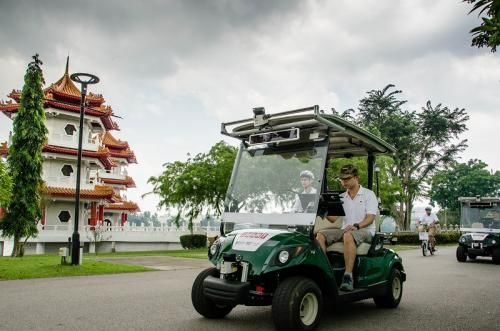
For greater safety, the steering wheel has been removed LTA and its partners will use the trial results to
and replaced with an in-vehicle touchscreen for alternate better understand the potential opportunities and
selection of destination, and researchers will shadow the challenges that autonomous vehicle (AV)
two driverless buggies on electric bicycles. Credit:      technology has for Singapore, and how it can be
SMART
                                                          shaped to suit our needs. The trial also aims to
                                                          generate awareness of AVs, as well as to help
                                                          refine the comfort and other aspects of the vehicle
                                                          based on public feedback.
For the first time, two SMART-NUS enhanced
driverless buggies to ferry passengers, free-of-
                                                          Dubbed DJ (Driverless Jockey) and BX (Buggy
charge, around Chinese and Japanese Gardens,
                                                          Xtreme), these two golf buggies which have been
as part of the Smart and Connected Jurong Lake
                                                          fitted with no more than $30,000 worth of
District (JLD) Pilots and Trials initiative.
                                                          technology, are set to ferry up to 3 passengers per
                                                          trip. Travelling up to a driverless speed of 10km/h,
Fancy a stroll in the Chinese and Japanese
                                                          DJ and BX will ply the footpaths (see Factsheet) of
Gardens? Why not up the ante, book a ride online
                                                          the 26.5ha gardens (size of 26 football pitches)
and take a driverless buggy ride through the
                                                          from 8am to 2pm from Thursday to Saturday,
gardens? Making this a reality are researchers and
                                                          starting
engineers from the Singapore-MIT Alliance for
                                                          23 Oct to 1 Nov 2014. Details of extension will be
Research and Technology (SMART), and the
                                                          updated on the booking website. The SMART-NUS
National University of Singapore (NUS), as
                                                          team targets to fulfil 100 trips within this period and
Singapore builds up to be the world's first Smart
                                                          will consolidate feedback to improve the driverless
Nation.
                                                          mobility experience. Passengers have to complete
                                                          a short online survey on the onboard computer
This is the first time, not one, but two driverless
                                                          before and after the trip.
vehicles are being deployed, free-of-charge for
public use. Visitors can obtain Mobility-on-Demand
                                                          SMART Project Lead, Dr James Fu said:
(MoD) by booking any of these vehicles via the
                                                          "Operationally, these autonomous buggies will be
online booking website - www.smartnusav.com.
                                                          closely monitored by the team throughout the whole

                                                                                                         1/4
deployment. Our researchers will shadow the              About SMART Research
movements of the buggies on electric bicycles. This
is to provide an additional level of safety as well as   To allow a fleet of autonomous vehicles to provide
to provide passengers with further elaboration on        Mobility-on-Demand (MoD) which will complement
our research work should any queries arise. This         the existing transportation system, so as to reduce
public deployment is very useful to our continued        the overall commuting time by solving the "first and
research work as we will not only be gaining             last mile" problem. This solution will thus reduce the
invaluable feedback from the public but to also          traveling time from the starting location (e.g.
further identify any other limitations of our system     commuter's house) to the start of the transportation
through the prolonged deployment."                       network (e.g. MRT station) and reduce the traveling
                                                         time from the end of the transportation network to
NUS collaborator from the Department of                  the final destination (e.g. commuter's workplace).
Mechanical Engineering, Associate Prof Marcelo
Ang said: "Having tested the SMART-NUS buggies           Our research integrates existing technologies with
at the NUS campus for close to four years, we are        fresh methodologies to allow driverless vehicles to
confident that these buggies will provide the public     intelligently provide MoD, with the goal of making
a safe and comfortable journey within the park.          this future transportation paradigm a reality. A fleet
Mobility should be available to all - the elderly,       of driverless golf buggies is used to demonstrate
young, or the disabled. We hope that the public will     the MoD system.
see the usefulness of these vehicles as a possible
solution to the 'first-and-last mile' problem, and be The SMART autonomous vehicle is a collaborative
comfortable with the idea that such driverless cars   project between the Singapore-MIT Alliance for
can co-exist with pedestrian traffic."                Research and Technology (SMART) and the
                                                      National University of Singapore (NUS); and the
MIT Lead Investigator, Prof Emilio Frazzoli said: "It golf buggy has been running driverlessly on the
is very impressive to see the pace in which           NUS campus since 2011.
Singapore is exploring how self-driving vehicles can
be used for urban mobility. At the moment, few        Purpose of Deployment at the Gardens
countries are taking the bold step to consider self-
driving vehicles into its eco-system."                This project involves the deployment of two
                                                      driverless autonomous golf buggies at the Jurong
With the advancement of autonomous technology, Gardens in Singapore. Through an online booking
driverless vehicles may soon be a reality in          system these golf buggies will provide visitors to
enhancing the lives of Singaporeans. This trial       the gardens with MoD. The purpose of this project
hopes to be a precursor to a new paradigm shift in is to:
how we understand transportation, and more
specifically, how a disruptive mode of transportation
can be a direct positive impact to the people in            1. Showcase a new concept of transportation
Singapore.                                                  2. Showcase how autonomous vehicles can
                                                               co-exist with pedestrians
Moving forward, the research team aims to further           3. Increase public awareness and gain public
improve how the vehicle's path interacts with                  acceptance of this technology.
pedestrian predicted intentions, how the vehicle is
able to convey its own intentions to pedestrians,     Mobility-on-Demand (MoD)
and how multiple vehicles can be used more
efficiently. The research is funded by the National
Research Foundation, Prime Minister's Office,               1. Fleet of lightweight Electric Vehicles
Singapore under its Campus for Research                     2. Strategically distributed charging stations
Excellence And Technological Enterprise                        throughout city
(CREATE) programme.                                         3. Providing mobility anytime, and anywhere

                                                                                                        2/4
Advantages of MoD Golf Cart Specifications
1. Does not require fixed infrastructure 1. Names: DJ (Driverless Jockey), BX (Buggy
2. Fewer vehicles meeting the needs of many Xtreme)
3. Solution to peak hour periods 2. 2.395m (Length) x 1.2m (Width) x 1.8m
4. Personalized mobility whenever and (Height)
wherever you need it 3. Weight: ~500kg
5. Vehicles are better utilized 4. Current max. autonomous speed in the
gardens: 10 km/h
Autonomous Vehicles 5. Vehicle localization using laser sensors,
and not dependent on GPS
6. Vehicle works well in poor lighting as well
1. Safety - Traffic accidents are the leading as indoors
cause of death in the 20-30 year old range. 7. Obstacle detection using laser sensors
Most accidents occur due to human errors. 8. Real-time path planner
Automation provides the vehicle with: 9. Dynamic safety zone
2. Quicker reaction time
3. Shorter braking time Enhanced Specifications (New)
4. Wider field of view
5. Not distracted
6. Not affected by fatigue 1. Steering wheel removed for increased
7. Non-aggressive behavior safety
8. Bad behaviors can be easily corrected 2. Online booking system
3. In-vehicle touchscreen for alternate
Accessibility - Provide mobility to people who selection of destination
cannot, should not, or prefer not to drive (elderly, 4. Vehicle-to-vehicle communication
youth and disabled). 5. Fleet management system
Productivity - "Commodity" driving is a chore that
absorbs a large fraction of people's time, which Provided by ResearchSEA
could be better used.
Efficiency/Throughput - Automated vehicles can
cooperate to minimize the effects of congestion.
Routes can also be planned to minimise energy
wastage, i.e., unecssary braking/acceleration.
Environment - Automated driving can reduce
emissions by 20-50%, and efficiently interface with
smart power grids.
Better User Experience
Routes can be planned to make the ride
smoother
Users can be doing other things and not
worry about road conditions
Possible location aware services
3/4APA citation: First driverless vehicles for public launched in Singapore (2014, October 21) retrieved 28
August 2021 from https://phys.org/news/2014-10-driverless-vehicles-singapore.html
This document is subject to copyright. Apart from any fair dealing for the purpose of private study or research, no
part may be reproduced without the written permission. The content is provided for information purposes only.
4/4
Powered by TCPDF (www.tcpdf.org)You can also read


