Tips for an Individual fellowships Marie Sklodowska-Curie - UPF
←
→
Page content transcription
If your browser does not render page correctly, please read the page content below
Tips for an Individual fellowships
    Marie Sklodowska-Curie
             Horizon 2020

                          Judit Chamorro-Servent, PhD
                         MSCA-IF researcher at PhySense group
                Departament of Information and Communication Technologies
                        Universitat Pompeu Fabra, Barcelona, Spain
                                 judit.chamorro@upf.edu
Resources to support your MSCA-IF proposal

Link 1: https://euraxess.ec.europa.eu/worldwide/south-korea/resources-support-
your-preparation-msca-if-grant-proposal

                                    Link 2: How to write a competitive MSCA-IF proposal
                                    https://cdn4.euraxess.org/sites/default/files/d
                                    omains/japan/how_to_write_a_competetive_
                                    msca-if_proposal.pdf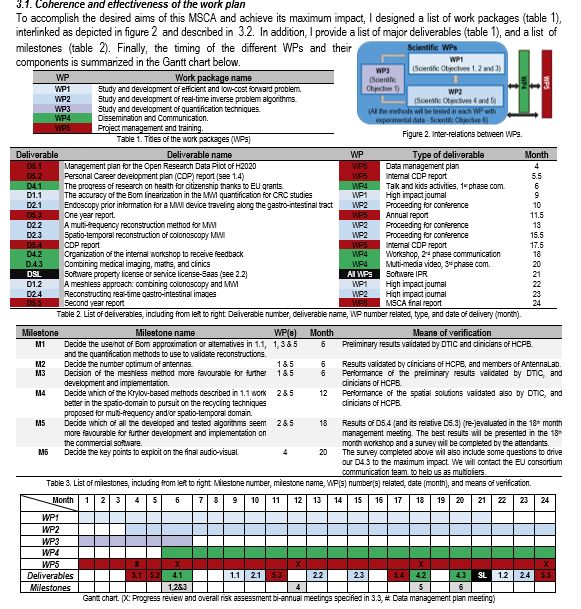
MSCA-IF proposal B-core part

                          Space is missing in part B-1 (10 pages)
                          Take advantage of the space of part B-2

                                             Do not repeat things.
                                             Complement them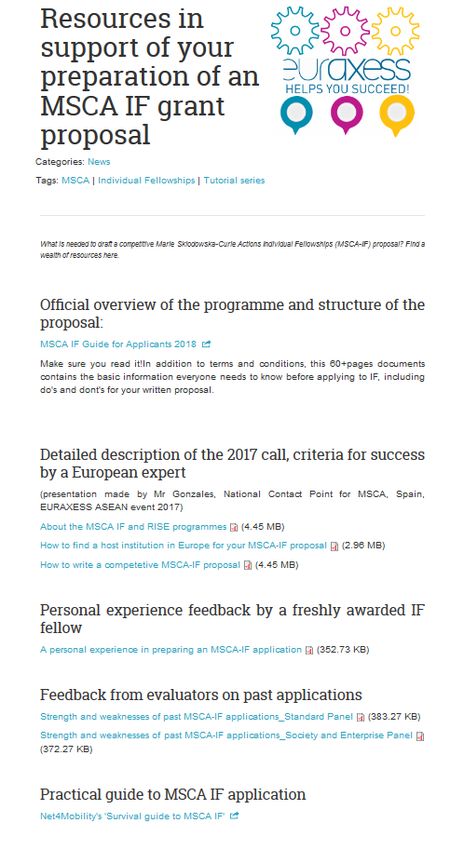
Make the evaluator remember your grant ACRONYM (Easy to remember by the evaluators, short and easy to pronounce) http://acronymcreator.net/ or http://acronymify.com/ ABSTRACT This is a summary of your proposal, NOT only your project. Why are you doing this research? What problem are you trying to solve? Is it a European priority? Why now? What is considered cutting-edge now in your field? Why you? Will the project further develop you to the point of addressing the objectives of MSCA-IF grants? Outline that you will achieve the key goals of these grants. Example: This project will be completed in a leading multi-disciplinary research group. The applicant brings mathematical and bioengineering skills that will facilitate research in the group and the transfer of ideas. The proposed work will expand her applicant’s experience, research competencies and professional networks, enhancing the development of her career as an independent researcher. An image/diagram tells more than several words (help the evaluator to find your proposal in the middle of a lot of proposals) My career path is depicted on the right side (the dark grey boxes include my previous and current positions, and the light grey boxes my next and future steps aims).

Organize your time and make the review easier
1. Try to get the maximum space: Change to Arial (Narrow) 11 at the end and be
2. Try to get a first draft soon: end July/beginning August. At this stage you will have:
3. Use a checking list: UPF checking list+ some own evaluation criterion checking list
(key subsection points and strengths and weaknesses from page 20 to 37 on survivor’s guide)
4. Take (a week) holiday in August where you do not touch nothing.
5. Came back to your draft + checking lists -> You will reorganize the puzzle yourself.
6. Try to ask someone that does not know about the subject to do the same: to read the
second draft with the checking lists to identify what is missing. End your puzzle by the
end of August
Make easier the
evaluator’s work.
Remark subsections
and important
information.First: Plan it (Number of pages & key points)
1. Part B1 (10 pages). Keep in mind the objectives of MSCA-IF grants while writing:
Survivor’s guide
Excellence (50% - 5.2 pages) :
The excellence from your project (novelty), from your host, from your supervisor, from you (If needed you can
cite part B2-sections 4 and 5 to complement information).
The inter-multidisciplinarity of your team and project
The gender aspects from the project but also from your team
The two-way transfer (remember that mobility and training to achieve your independence as researcher are
key parts)
Impact (30% - 1.9 pages):
Your career plan is very important here (how this grant and the host will help you to achieve your career goals)
The dissemination and communication: target to whom/how many/what do you bring to the EU (identify a
h2020 objective that your project can cover), timeline of your project (why now).
Implementation (20% - 2.9 pages):
Work plan (well identify the workpackages, the milestones and the deliverables)
Management
Management risks
Infrastructure of host (If needed you can cite part B2-section 5 to complement information).First: Plan it (identify the key points)
2. Part B-2. Section 4 - CV (5 pages): Do not be modest (ask someone to help you with it )
Summary, h-index. And if you have: research id, link to your webpage (or your UPF repository)
Education
Current and previous positions (outline the country, the main focus, your participation in competitive R+D+I
projects and the independent thinking and leadership qualities)
Fellowships and Awards
Mobility (remember there is a mobility rule)
Supervision of graduated students
Patents and/or participation in industrial innovation
Reviewer of R&D projects and articles
If you have non-institutional responsibilities, you work/ed as voluntary of some association. Whatever that may
add you a value/quality: responsibility, organization, leadership.
Peer-reviewed journal publications (include citations and SJR). You can add the journal publications submitted
(in case of patents/industrial exploitation that delayed your publications explain it). Outline if the publication
was highlighted by the journal
International and European peer-reviewed conference proceedings and abstracts (including citations)
Contribution at workshops and seminars (outline if you have been invited)
(IN THE GUIDE of APPLICANTS THERE IS A TEMPLATE FOR THE RESEARCHERS WITHOUT A DOCTORATE at the call
deadline. They must show a full-time equivalent research experience in the CV-4 years)First: Plan it (identify the key points)
3. Part B-2. Section 5- Capacity of the Participating Organisations (1 pages):
Tables allow you smallest font
size (8 points)
Complement Part B-1. Section 3.4
Remark the ones where your
supervisor participate/d.
Complement Part B-1. Section 1.3:Evaluation
Look to strengths and
weakness from lasts
years (Pages 20-37
from survivor’s guide)Una universitat urbana
PART B1 SECTION 1 - EXCELLENCESection 1-Excellence
In my case 5.2 pages
(3 pages)
(0.7 pages)
(0.7 pages)
(0.7 pages)
Use bold font/remark the most important – make the evaluation easier
1.1. Good state-of-the art, cite the references with most impact, specific objectives, research
methodology, remark the novelty/originality/innovation, the gender aspects, the
inter/multidisciplinary aspects and the most important points of impact on your career
advancement and new networks for the host that you could bring
1.2. Show the two-way transfer knowledge (specially important if you are already working
with the team), link your training with section 1.4 and 2.1 (what do you need?), do not forget
explain what do you bring? The planned activities will bring you to achieve
maturity/independence.
1.3. Quality of the supervisor and team. Qualifications and experience of the supervisor and
hosting arrangements(remember to exploit also PartB2-section 5)
1.4. What do you bring new and how MSCA will help you to develop your CDP (which CDP?)Strengths
Strengths and Weaknesses (other applications)
Una universitat urbana

      PART B1 SECTION 2 - IMPACT
Section 2 - Impact
In my case 1.9 pages
(0.7 pages)
(0.5 pages)
(0.7 pages)
2.1. Why the targeted scientific and complementary skills from 1.2 are relevant for an
independent position? Will you achieve an expansion of the network/broader range of
expertise? Why is timely crucial now? Will it enable transfer your skills? What about your
career prospects
• Impact to EU:This project will also timely contribute to the sustainability of public financing of health care
of middle and elder people, following one of the objectives of the H2020 program.
2.2. Dissemination : international conferences/high-impact journals, workshops – be
specific. Outline open access –target audiences/who? Which journals? Why? Be specific
Exploitation and IPRs (if relevant): patent/software protection license/other
2.3. Communication-be specific. Link the strategy communication plan with your
projects objectives: who, how many people you need to reach, by when, which kind of
social media your audience is using (you can do adjustments- this is your learning process)Communication The EU logo for
H2020 projects
• (NOT only scientifically dissemination) – Grant agreement!! – Communication is
mandatory in EU grants
• Specific communication plan (DO NOT make it general).
• Example: (three phases/different targeted audience)
- Starting phase –focus on creating expectation and on general promotion (who/how many).
- Once the project will start to generate results we will launch the intermediate phase. This phase
consists in a specific promotion to the academic community and industry (how)
- The final phase has the aim of capitalize in results – contact someone/some organization/EU
commission communication team to ask support as multiplier/to arrive to more audience.
• Links that may help you:
http://ec.europa.eu/research/participants/data/ref/h2020/other/grants_manual/amga/soc-med-guide_en.pdf
https://www.iprhelpdesk.eu/sites/default/files/EU-IPR-Brochure-Boosting-Impact-C-D-E_0.pdf
http://www.streamdis.eu/commsworkout2/
https://ec.europa.eu/easme/en/communication-toolkitStrengths and weakness
Strengths and weaknesses (other applications)

                                          resubmissions
Una universitat urbana PART B1 SECTION 3 - IMPLEMENTATION
Section 3 - Implementation

                                                                                                 In my case 2.9 pages
                                                                                                 (0.8 pages)
                                                                                                 (0.6 pages)
                                                                                                 (0.75 pages)
                                                                                                 (0.75 pages)
Tables allow font size (8 points)            3.2 Explain why do you need X months? How are the WPs, milestones
Colors/designs may help the review process   and deliverables distributed? How will you validate your methods?
3.1                                          How will be the contact and work with the supervisor and other team
                                             members? How frequently?

                                             3.3. Organization and management structure. Example:
                                             Fourfold: financial and administrative management, monitoring progress,
                                             quality management, legal matters.
                                             Research and/or administrative risks and contingency plan.

                                             Identify risks
                                             in a table

                                             Example: This is an ambitious project, however, it consists of self-contained
                                             but interlinked modular objectives.
                                             3.4. Complement infrastructure of partB2-section 5
                                             Outline good points: UPF has the International Campus Excellence seal
                                             from the Spanish Ministry of Education and Science, the European Charter
                                             for Researchers and the Human Resources Excellence in Research
                                             awarded by the EU Commission (see 1.3), partly thanks to …
Strengths and weakness
Strengths and weakness (other applications)
Good luck!

         This project has received funding from the
         European Union’s Horizon 2020 research
         and innovation programme under grant
         agreement No [794370]
You can also read


