Fossil teeth from Kenya solve ancient monkey mystery - Phys.org
←
→
Page content transcription
If your browser does not render page correctly, please read the page content below
Fossil teeth from Kenya solve ancient
monkey mystery
11 March 2019

                                                      history," said the study's corresponding author John
                                                      Kappelman, an anthropology and geology
                                                      professor at The University of Texas at Austin.
                                                      "Although the isolated tooth from Tanzania is
                                                      important for documenting the earliest occurrence
                                                      of monkeys, the next 6 million years of the group's
                                                      existence are one big blank. This new monkey
                                                      importantly reveals what happened during the
                                                      group's later evolution."

                                                      Since the time interval from 19 to 25 million years
                                                      ago is represented by a small number of African
                                                      fossil sites, the team targeted the famous fossil-rich
                                                      region of West Turkana to try to fill in that blank.

                                                       "Today, this region is very arid," said Benson
                                                       Kyongo, a collections manager at the National
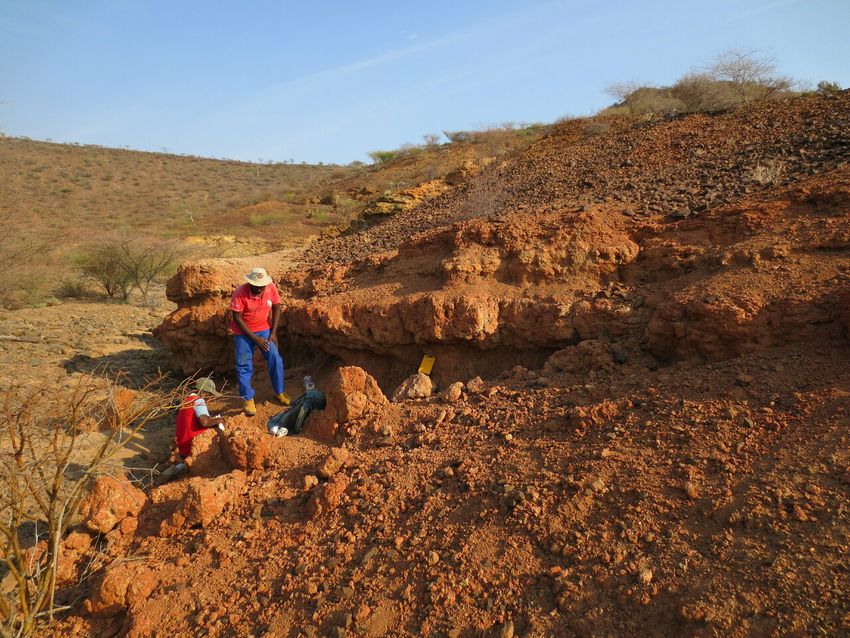
Sedimentary rocks exposed in the eroded badlands of
                                                       Museums of Kenya. "But millions of years ago, it
Nakwai, Kenya, where the remains of an ancient species
of Old World monkey named Alophia were discovered.
                                                       was a forest and woodland landscape crisscrossed
Credit: Reproduced with the permission from            by rivers and streams. These ancient monkeys
Proceedings of the National Academy of Sciences USA were living the good life."

The teeth of a new fossil monkey, unearthed in the
badlands of northwest Kenya, help fill a 6-million-
year void in Old World monkey evolution,
according to a study by U.S. and Kenyan scientists
published in the Proceedings of the National
Academy of Sciences.

The discovery of 22-million-year-old fossilized
monkey teeth—described as belonging to a new
species, Alophia metios—fills a void between a
previously discovered 19-million-year-old fossil
tooth in Uganda and a 25-million-year-old fossil
tooth found in Tanzania. The finding also sheds
light on how their diet may have changed the
course of their evolution.

"For a group as highly successful as the monkeys      A fossil jaw of the newly discovered ancient Old World
                                                      monkey named Alophia. It is dated to 22 million years in
of Africa and Asia, it would seem that scientists
                                                      age. Credit: Reproduced with the permission from
would have already figured out their evolutionary
                                                      Proceedings of the National Academy of Sciences

                                                                                                        1/3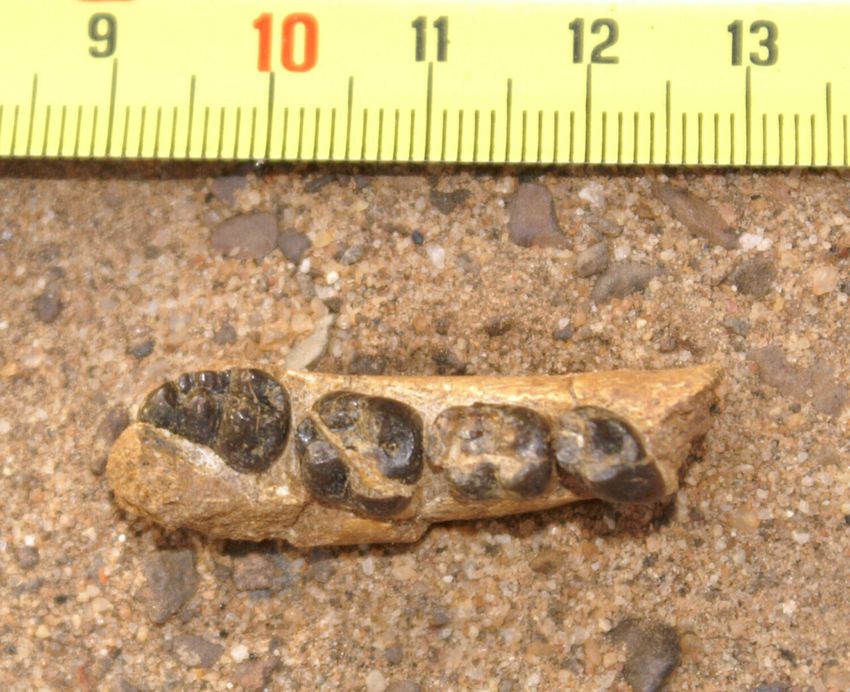
While in the field, the team uncovered hundreds of
mammal and reptile jaws, limbs and teeth ranging
from 21 million to more than 24 million years old,
including remains of early elephants. The newly
discovered monkey teeth are more primitive than
geologically younger monkey fossils, lacking what
researchers referred to as "lophs," or a pair of
molar crests, thus earning the new species its
name, Alophia, meaning "without lophs."

"These teeth are so primitive that when we first
showed them to other scientists, they told us, "Oh
no, that isn't a monkey. It's a pig," said Ellen Miller,
an anthropology professor at Wake Forest
University. "But because of other dental features, Scientists collecting rock samples for dating the
we are able to convince them that yes, it is in fact a sediments at Nakwai, Kenya, where the Alophia was
monkey."                                                 discovered. Credit: Reproduced with the permission from
                                                        Proceedings of the National Academy of Sciences.
The success of Old World monkeys appears to be
closely tied to their unique dentition, researchers  "It is usually assumed that the trait responsible for a
said. Today, the configuration of cusps and lophs    group's success evolved when the group
on the molar teeth enable them to process the wide   originated, but Alophia shows us this is not the
range of plant and animal foods encountered in the   case for Old World monkeys," said Samuel Muteti,
diverse environments of Africa and Asia.             a researcher at the National Museums of Kenya.
                                                     "Instead, the characteristic dentition of modern
"You can think of the modern-day monkey molar as monkeys evolved long after the group first
the uber food processor, able to slice, dice, mince appeared."
and crush all sorts of foods," said Mercedes
Gutierrez, an anatomy professor at the University of The researchers hypothesized that the inclusion of
Minnesota.                                           leaves in the diet is what later drove monkey dental
                                                     evolution.
"How and when this unique dentition evolved is one
of the unanswered questions in primate evolution,"      Monkeys originated at a time when Africa and
said James Rossie, an anthropology professor at         Arabia were joined as an island continent, with its
Stony Brook University. The researchers                 animals evolving in isolation until docking with
speculated that Alophia's primitive dentition was       Eurasia sometime between 20 million and 24
adapted to a diet that consisted of hard fruits,        million years ago. It was only after docking that the
seeds and nuts, and not leaves, which are more          mammals today typically considered
efficiently processed by the more evolved dentition     "African—antelope, pigs, lions, rhinos, etc. - made
of fossil monkeys dating from after 19 million years    their entry onto the continent. So, researchers
ago.                                                    asked: Could this event and possible competition
                                                        between the residents and the newly arrived
                                                        Eurasian species have driven monkeys to exploit
                                                        leaves, or did changing climates serve to make
                                                        leaves a more attractive menu entrée?

                                                        "The way to test between these hypotheses is to
                                                        collect more fossils," Kappelman said. "Establishing

                                                                                                         2/3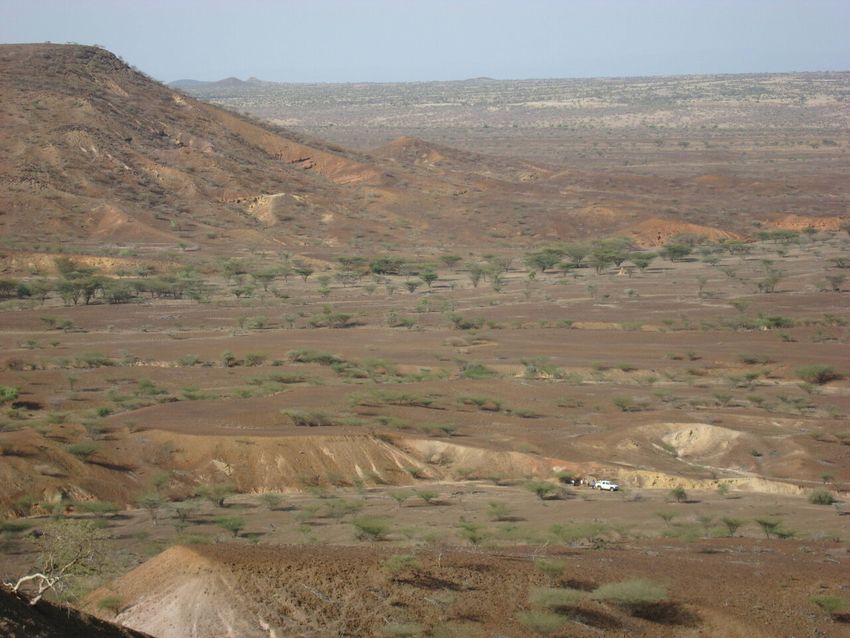
when, exactly, the Eurasian fauna entered Afro-
                                   Arabia remains one of the most important questions
                                   in paleontology, and West Turkana is one of the
                                   only places we know of to find that answer."

                                   The team intends to be back in the field later this
                                   year.

                                    More information: D. Tab Rasmussen el al.,
                                   "Primitive Old World monkey from the earliest
                                   Miocene of Kenya and the evolution of
                                   cercopithecoid bilophodonty," PNAS (2019).
                                   www.pnas.org/cgi/doi/10.1073/pnas.1815423116

                                    Provided by University of Texas at Austin
                                   APA citation: Fossil teeth from Kenya solve ancient monkey mystery (2019, March 11) retrieved 17 May
                                   2019 from https://phys.org/news/2019-03-fossil-teeth-kenya-ancient-monkey.html

                                   This document is subject to copyright. Apart from any fair dealing for the purpose of private study or research, no
                                   part may be reproduced without the written permission. The content is provided for information purposes only.

                                                                                                                                                3/3

Powered by TCPDF (www.tcpdf.org)
You can also read


