TEACHER BACKGROUND: NOAA Earth System Research ...
←
→
Page content transcription
If your browser does not render page correctly, please read the page content below
TEACHER BACKGROUND:
          NATURAL CLIMATE CHANGE

The natural variability and the climate fluctuations of the climate system
have always been part of the Earth’s history. To understand climate change
fully, the causes of climate change must be first identified. The earth’s
climate is influenced and changed through natural causes like volcanic
eruptions, ocean currents, the Earth’s orbital changes, solar variations and
internal variability.

      Volcanic eruptions - The main effect volcanoes have on the climate
      is short-term cooling. Volcanic eruptions pump out clouds of dust and
      ash, which block out some sunlight. Because the ash particles are
      relatively heavy, they fall to the ground within about three months, so
      their cooling
      effect is very
      short-lived. But
      volcanic debris
      also includes
      sulfur dioxide.
      This gas combines
      with water vapor
      and dust in the
      atmosphere to
      form sulfate aerosols, which reflect sunlight away from the Earth’s
      surface. These aerosols are lighter than ash particles and can remain
      in the atmosphere for a year or more. Their cooling effect outweighs
      the warming caused by volcanic greenhouse gases – the eruption of
      Mount Pinatubo in 1991 caused a 0.5 °C drop in global temperature.
      Volcanic eruptions spew out lava, carbon dioxide (CO2) ash and
      particles. Although CO2 has a warming effect, average volcanic CO2
      emissions are less than 1% of emissions from current human activities.
      .Large volumes of gases and ash can influence climatic patterns for
      years by increasing planetary reflectivity causing atmospheric cooling.

      Ocean currents - The oceans are a major component of the climate
      system. Ocean currents are located at the ocean surface and in deep
      water below 300 meters (984 feet). They can move water horizontally

                                                                               1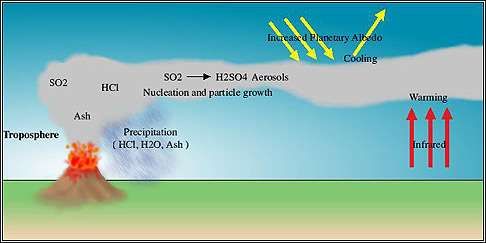
and vertically and occur on both local and global scales. The ocean has
      an interconnected current, or circulation, system powered by wind,
      tides, the Earth’s rotation (Coriolis effect), the sun (solar energy),
      and water density differences. The topography and shape of ocean
      basins and nearby landmasses also influence ocean currents.

      Deep ocean currents are
      density-driven and differ
      from surface currents in
     scale, speed, and energy.
     Water density is affected by
     the temperature, salinity
     (saltiness), and depth of the
     water. The colder and saltier
     the ocean water, the denser
     it is. The greater the density
     differences between different layers in the water column, the greater
     the mixing and circulation. Density differences in ocean water
     contribute to a global-scale circulation system, also called the global
     conveyor belt

The global conveyor belt includes both surface and deep ocean currents that
circulate the globe in a 1,000-year cycle. This circulation is the result of two
simultaneous processes: warm surface currents carrying less dense water
away from the Equator toward the poles, and cold deep ocean currents
carrying denser water away from the poles toward the Equator. The ocean’s
global circulation system plays a key role in distributing heat energy,
regulating weather and climate, and cycling vital nutrients and gases.

                             Earth orbital changes - Shifts and wobbles in
                      the Earth’s orbit can trigger changes in climate such as
                      the beginning and end of ice ages. The last ice age
                      ended about 12,000 years ago and the next cooling
                      cycle may begin in about 30,000 years. But orbital
                      changes are so gradual they’re only noticeable over
                      thousands of years – not decades or centuries. The
                      earth makes one full orbit around the sun each year. It
                      is tilted at an angle of 23.5° to the perpendicular plane
                      of its orbital path. Changes in the tilt of the earth can

                                                                               2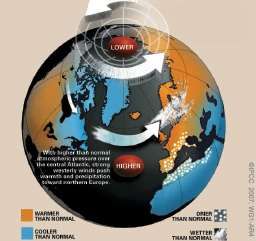
lead to small but climatically important changes in the strength of the
      seasons, more tilt means warmer summers and colder winters; less tilt
      means cooler summers and milder winters. Slow changes in the Earth’s
      orbit lead to small but climatically important changes in the strength
      of the seasons over tens of thousands of years. Climate feedbacks
      amplify these small changes, thereby producing ice ages.

      Solar variations - The Sun is the source of energy for the Earth’s
      climate system. Although the Sun’s energy output appears constant
      from an everyday point of view, small changes over an extended period
      of time can lead to climate changes. Some scientists suspect that a
      portion of the warming in the first half of the 20th century was due
      to an increase in the output of solar energy. As the sun is the
      fundamental source of energy that is instrumental in our climate
      system it would be reasonable to assume that changes in the sun's
      energy output would cause the climate to change. Scientific studies
      demonstrate that solar variations have performed a role in past
      climate changes. For instance a decrease in solar activity was thought
      to have triggered the Little Ice Age between approximately 1650 and
      1850, when Greenland was largely cut off by ice from 1410 to the
      1720s and glaciers advanced in the Alps.

Current global warming however cannot
be explained by solar variations. Since
1750, the average amount of energy
coming from the Sun either remained
constant or increased slightly. If
global warming was caused by a more
active sun, scientists would expect to
see warmer temperatures in all layers
of the atmosphere. They have only
observed a cooling in the upper
atmosphere, a warming at the surface and in the lower parts of the
atmosphere. This is due to greenhouse gasses capturing heat in the lower
atmosphere. Also climate models that include solar irradiance changes
cannot reproduce last century's observed temperature trend without
including a rise in greenhouse gases.

                                                                            3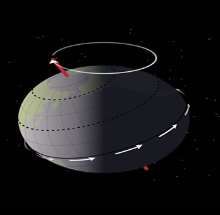
Internal variability-
      Some changes in
      climate have no
      external trigger.
      These changes are
      instead caused by
      interactions within the
      climate system itself,
      often involving
      positive feedbacks.
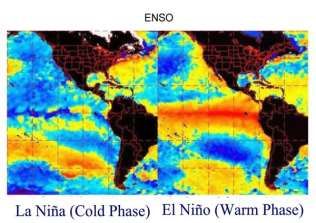
      One example is the El
      Niño–La Niña cycle, which can cause temporary warming and cooling.
      Both phenomena affect atmospheric circulation patterns and influence
      global climate. While El Niño increases global temperature, La Niña
      decreases it. This cycle repeats itself on a timescale of about five
      years. But these changes are short-term, only lasting a few years.

                                   Another example of internal variability is
                                   the Arctic oscillation (AO), which is
                                   associated with changing patterns of air
                                   pressure in the northern hemisphere. This
                                   phenomenon brings warmer weather to
                                   parts of Europe and North America, leaving
                                   the Arctic colder than usual. The other
                                   phase of the AO brings the opposite
                                   conditions, resulting in a warmer-than-usual
Arctic and colder weather in the sub-polar regions. Because of this seesaw
effect, the AO has little effect on global temperatures, but can
significantly influence local and regional weather.

Many natural factors affect the climate, including changes in the Sun’s
output or the Earth’s orbit, large volcanic eruptions and internal variability
such as El Niño. Scientists measure these effects, but none can account for
the observed trend since 1970. Scientists can only account for recent global
warming by including the effects of human greenhouse gas emissions.

                                                                              4
You can also read


