Fundamental academic values strengthen democratic societies - a student perspective
←
→
Page content transcription
If your browser does not render page correctly, please read the page content below

Fundamental academic values
strengthen democratic societies –
a student perspective
Text: Hans Leifgen

At the workshop “Fundamental Academic Values in the European Higher Education Area – From a Student Perspective” in April
2021, representatives of various European student organisations discussed the importance of fundamental academic values in
connection with European higher education policy. Debate focused particular on the relevance of such values in terms of the
successful contribution of the higher education sector to active participation in democratic life in Europe.

                                                                                        European education policy focuses on
                                                                                        democratic participation

Academic freedom, accountability, equitable access,                                     Currently, fundamental academic values are increasingly
institutional autonomy and social responsibility: these                                 coming into focus in the debate on higher education
“fundamental academic values”– as they are called in the
                                               1
                                                                                        policy, especially in view of the increasing pressure on
Bologna context – are closely linked to active social                                   democracy. In a video message for the 2021 annual
engagement and participation in democratic life. They                                   conference of the European University Association, for
include various aspects relevant to human rights                                        instance, the President of the European Council, Charles
compliance: freedom of expression, democratic                                           Michel, emphasised the key role of universities in this
participation, equality, prohibition of discrimination and                              debate on fundamental values and rights.
social responsibility. What is more, adherence to academic
values is fundamental to ensuring that higher education                                 In keeping with this, European education policy focuses
institutions are able to perform those essential tasks                                  on providing students with critical skills relevant to social
assigned to them in the service of and as part of a                                     responsibilities and civic duties. This is why fundamental
democratic society.                                                                     academic values have been part of the Bologna Process
                                                                                        from the very outset and the European Commission has
                                                                                        long advocated for them. The new Erasmus+ programme
                                                                                        generation 2021-2027 will therefore prominently feature
                                                                                        academic values too, underlining the importance of higher
                                                                                        education to democratic societies and in promoting
                                                                                        critical thinking among students.

                                                        The five fundamental
                                                       academic values in the
                                                       European Higher Education
                                                       Area

                                                               “Our democracies are coming under increased pressure and our
                                 universities must therefore continue to be home to academic freedom and democratic values,
                                  free speech, gender equality and fundamental rights. These principles must be cherished and
                                      nurtured, today more than ever, as they are threatened across the globe.” Charles Michel

1 The five fundamental academic values listed here were defined by the Scholars at Risk network. See Scholars at Risk, Promoting Higher Education Values. A Guide for
Discussion, New York 2020, S. 4, available online at https://t1p.de/a30k [01.06.2021].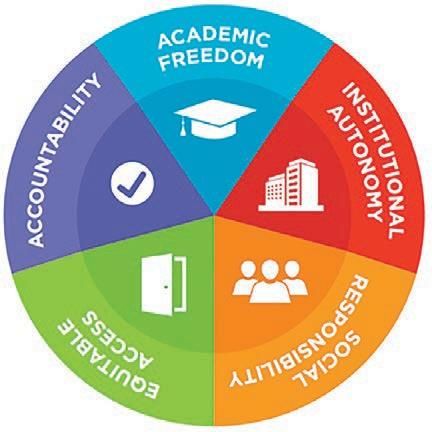
The bologna hub project aims to support higher education
                                                         institutions in implementing the central elements of the
                                                         Bologna reform.
                             One priority of the BMBF-funded project bologna hub is to address current education
                             policy topics in the European Higher Education Area through events as well as
                             publications and studies.

Students engaged in discussion on fundamental academic
values

At the workshop in April 2021, which was organised                            In the course of a lively debate, it became clear that
within the framework of the DAAD project bologna hub,                         academic values have a key role to play in the day-to-day
representatives of various major student organisations                        work of the student organisations and are highly
exchanged views on fundamental academic values.                               significant to their self-image. Workshop participants

Participants from the European Students’ Union (ESU),                         stated that all five fundamental values are closely linked:

the Erasmus Student Network (ESN), the Association des                        they should therefore be conceived of as being equal and

Etats Généraux des Etudiants de l'Europe (AEGEE-Europe)                       belonging together.

and the fzs (Free Federation of Student Unions), as well as
student representatives on the DAAD Executive                                 The student representatives also agreed that higher

Committee and DAAD Board of Trustees, talked about                            education institutions have a social responsibility to share

past activities, existing obstacles, the effects of the                       their academic knowledge with all members of society and
coronavirus crisis and future potential in connection with                    to address current problems and the needs of all citizens.

academic values.                                                              Phuong Anh Nguyen, representative of the student bodies
                                                                              on the DAAD Executive Committee, argued that “[t]he
                                                                              participation of students in democratic life [...] has the
                                                                              potential to underpin democracy and the solidarity of a
                                                                              society”.

                             In order to support students and doctoral candidates who are at risk in their home country
                             and unable to continue their studies or research in their home country, the DAAD has set
                             up its own study programme – the “Hilde Domin Programme”.

                             At its presentation, DAAD President Prof Dr Joybrato Mukherjee stressed that a free and
                             democratic society only functions where the academic pursuit of knowledge and the free
                             development of personality go unhindered.
                             Source: New scholarship programme for students and doctoral candidates at risk, DAAD, press release 14.04.2021, available online at
                             https://www.daad.de/en/the-daad/communication-publications/press/press_releases/hilde-domin-programm
“Academic freedom performs two roles in democratic societies. On the one hand, the lively, vibrant debate within
the academic community (students included) is necessary for nurturing critical thinking and advancing public
discourse within broader society. On the other hand, since academic freedom is based upon other rights such as
freedom of expression and of dissent, a descent into authoritarianism will inevitably lead to a crackdown on
academic freedom, making it a good proxy on the health of democracy within a country.” Matteo Vespa
Academic freedom as an indicator of Student participation in the governance and
democratic stability management of higher education institutions
Nonetheless, it is not always easy for higher education In order to better support democracy and solidarity in a
institutions to meet the objectives of European society, the student representatives called for greater
education policy in the area of civic education and student participation in university bodies and in
ensure the unhindered academic pursuit of knowledge: educational policy decision-making processes. In addition,
they are often particularly affected by state restrictions they underlined the relevance of approaches that aim to
because students and university members support secure students’ academic freedom and autonomy in
democratic protest and opposition movements. university representation.
During the workshop, Matteo Vespa, member of the Besides academic freedom, the student representatives
Executive Committee of the ESU, described a direct link particularly identified student participation in the
between academic freedom and the state of democracy in governance and management of higher education
a country. He said he believed academic freedom and institutions as being the key interface between
democracy were mutually dependent. Matteo Vespa fundamental academic values and participation in
referred to the need for open exchange at universities in democratic processes. In this way, as was stated by
order to promote critical thinking. He also said that Phuong Anh Nguyen, diverse points of view could be put
“academic freedom was a good indicator of the stability of forward for discussion and comprehensive solutions found
democracy in a country”. to controversial issues. This would make procedures more
transparent and higher education policy as a whole more
effective.“Through student participation, different opinions and perspectives can be integrated and discussed
in order to find comprehensive solutions to controversial issues.
When students actively participate and are involved in decisions that are made in the governance
and management of higher education institutions, transparency in higher education policymaking
can be increased and more effective policies can be established.” Phuong Anh Nguyen
Integrating students’ perspectives and Promoting democratic action and active social
measuring academic freedom engagement
Central concerns relating to the future of student In principle, the student organisations welcomed the fact
representatives, are focussing on the area of that political statements emphasised the relevance of
communication: firstly – as also called for by Phuong academic values and participation in democratic life. They
Anh Nguyen– they said they wanted to be more involved said they would like to see a greater focus on these issues
in debate on education policy, with greater weight in European higher education in the long term, however.
being given to their perspective. Secondly, they said For example, training in democratic action and critical
they would seek to intensify dialogue between student thinking ought to be further anchored in both teaching
organisations in the future, as well as enhancing and day-to-day university life.
cooperation to uphold academic values and boost
participation in democratic life. In order to make this happen and promote an inclusive
and open society, the student representatives said it was
Furthermore, the student organisations advocated that a necessary to engage in open discussion about our society
working group of the Bologna Follow-Up Group is now and the world we want to live in. At the same time, they
about to develop a coherent framework for measuring and said, university projects had to be carried out on the
monitoring the degree of academic freedom and violations subject of academic values and democratic participation,
of this freedom. Matteo Vespa emphasised that raising the and it was important to enable international mobility.
issue of limited academic freedom at the European level They said that both contributed to social progress in the
could encourage states to rethink their position. He said European Higher Education Area, as students would be
that measuring academic freedom offered the opportunity taught shared values and active social engagement –
to strengthen democratic action. something that would benefit Europe as a whole.
Hans Leifgen
EU04 – Policy Support
> bologna@daad.de
Further links
bologna hub: https://t1p.de/75hx ESN: https://esn.org/
Workshop “Fundamental Academic Values in AEGEE: https://www.aegee.org/
the EHEA – From a Student Perspective”:
fzs: https://www.fzs.de/
https://t1p.de/qurs
EUA: https://www.eua.eu/
DAAD Executive Committee
https://www.daad.de/en/the-daad/who-we- Academic Freedom Index: https://t1p.de/3g6j
are/organisational-structure/committees Bologna Follow-Up Group: https://t1p.de/8lcg
ESU: https://www.esu-online.orgYou can also read


