Gambling Act 2005 Statement of Principles 2019 2021 - Rhondda Cynon Taff County Borough Council
←
→
Page content transcription
If your browser does not render page correctly, please read the page content below
Rhondda Cynon Taff
  County Borough Council

  Gambling Act 2005
Statement of Principles
     2019 - 2021

  Date effective from 31st January 2019

                                          1
Contents
Item Page
Foreword 3
Part A – Background information
1. The Licensing Objectives 4
2. Statement of Principles 4
3. The County Borough of Rhondda Cynon Taf 5
4. Consultation 7
5. Responsible Authorities 7
6. Interested parties 8
7. Licensing Authority functions 9
8. Exchange of Information 10
9. Compliance & Enforcement 10
10. Betwatch 11
11. Fees 12
12. Safeguarding of Children and Vulnerable Adults 12
13. Local Area Profiling 12
14. Significant changes in local circumstances 14
15. Significant changes to the premises 15
Part B - Premises Licences
16. General Principles 16
17. Adult Gaming Centres 24
18. (Licensed) Family Entertainment Centres 24
19. Casinos 25
20. Bingo Premises 25
21. Betting Premises 26
22.Tracks 26
23. Travelling Fairs 28
24. Provisional Statements 28
25. Reviews 29
Part C - Permits / Temporary and Occasional Use Notices
26. Unlicensed Family Entertainment Centre Gaming Machine 31
Permits
27. (Alcohol) Licensed Premises Gaming Machine 32
Permits
28. Prize Gaming Permits 33
29. Club Gaming and Club Machines Permits 34
30. Temporary Use Notices 34
31. Occasional Use Notices 35
32. Small Society Lotteries 35
33. Licensing Conditions & Codes of Practice 2015 (LCCP) 36
Appendix A; List of Consultees 38
Appendix B; Table of Delegation 39
Useful Contacts 40
21. Foreword
1.1 Apart from the National Lottery and Spread Betting, gambling is regulated by
the Gambling Commission, whose duties include the licensing of operators
and individuals involved in the provision of gambling & betting facilities.
1.2 Rhondda Cynon Taf CBC (the Licensing Authority) is responsible for certain
types of premises in respect of the issue of licences, permits and temporary
use notices (amongst other matters).
1.3 As part of this process, the Licensing Authority is required to determine and
publish a ‘Statement of Principles’, which details the criteria to be applied
when exercising its licensing functions and determining applications.
1.4 The ‘Statement of Principles’ is intended to set the context of the Licensing
Authority’s approach to gambling matters in it’s area and aid applicants,
residents, businesses, statutory consultees and the Licensing Committee in
decision making, based on relevant local issues.
1.5 This document accordingly sets out the Council’s ‘Statement of Principles’,
within the parameters of the Gambling Act 2005 (and the Statutory Guidance
issued to accompany it), which will in turn provide the framework governing
the Licensing Authority when considering applications.
1.6 The Council will have regard to the Gambling Commission’s Guidance issued
February 2015 (or any subsequent amendments) in determining applications
and also reserves the right to amend this policy without consultation where it
is necessary to ensure that it reflects any revised national legislation or
statutory guidance.
1.7 This Statement of Principles was approved by Full Council at the meeting held
on 28th November 2018 and is effective from 31st January 2019, for a period
of 3 years, (unless revised).
3PART A
1. The Licensing Objectives
1.1 The Licensing Authority is required to exercise most of its functions under the
Gambling Act 2005 with a view to promoting the licensing objectives, namely:-
Preventing gambling from being a source of crime or disorder, being
associated with crime or disorder or being used to support crime;
Ensuring that gambling is conducted in a fair and open way;
Protecting children and other vulnerable persons from being harmed or
exploited by gambling.
2. Statement of Principles
2.1 This statement of principles is intended to meet the Council’s obligations
under S.349 of the Act. As per Section 153, in carrying out its’ functions in
relation to Premises Licences & Temporary Use Notices, the Council will
generally aim to permit the use of premises for gambling as long as it is
considered to be:
In accordance with any relevant Codes of practice issued by the
Gambling Commission
In accordance with any guidance issued by the Gambling
commission
Reasonably consistent with the licensing objectives
In accordance with this statement of principles
2.2 It should be noted that this policy statement will not override the right of any
person to make an application, make representations about an application, or
apply for a review of a licence, as each will be considered on its own merits
and according to the statutory requirements of the Gambling Act 2005.
43. The County Borough of Rhondda Cynon Taf
3.1 Rhondda Cynon Taff covers an area of the South Wales Valleys stretching
from the Brecon Beacons in the north, to the outskirts of Cardiff in the south. It
comprises a mixture of urban, semi-suburban and rural communities, situated
in mountains and lowland farmland.
3.2 Rhondda Cynon Taf is the second largest Local Authority in Wales, formed in
1996 from the former Boroughs of Rhondda, Cynon Valley and Taff Ely (part).
The County Borough covers an area of 424 square kilometres with an
estimated population of 239,127 (2017). The area has 75 electoral wards.
3.3 Townships include Pontypridd, Llantrisant, Aberdare, Mountain Ash,
Tonypandy and Porth, however there are numerous smaller commercial areas
situated throughout the Borough, consistent with the communities they serve.
3.4 The area is land locked and lies between the County Boroughs of Powys,
Merthyr, Neath Port Talbot, Caerphilly, Vale of Glamorgan, Bridgend and
Cardiff.
3.5 Strategic highway links with the wider regions are provided by the M4, A470
and A465. A range of bus and rail services provides public transportation links
across the region.
3.6 A key priority for the Council is the consideration of the Well-being of Future
Generations (Wales) Act 2015 and contribution to the seven associated national
goals:
1. A more prosperous Wales
2. A resilient Wales
3. A healthier Wales
4. A more equal Wales
5. A Wales of cohesive communities
6. A Wales of vibrant culture and thriving Welsh language
7. A globally responsible Wales
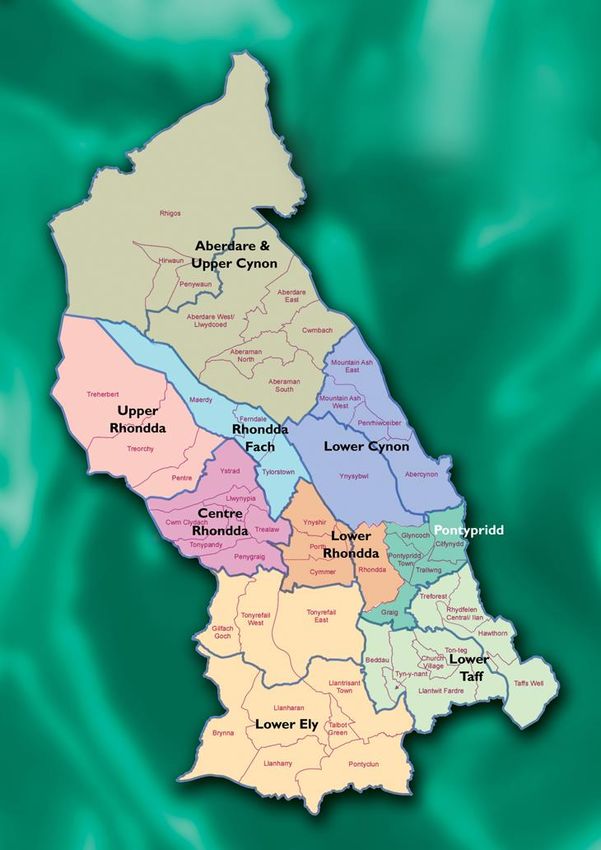
53.7 Map of Council Area
64. Consultation
4.1 The statement of principles has been subject to consultation with: -
The Chief Officer of Police;
One or more persons who appear to the Authority to represent the
interests of persons carrying on gambling businesses in the Authority’s
area;
One or more persons who appear to the Authority to represent the
interests of persons who are likely to be affected by the exercise of the
Authority’s functions under the Gambling Act 2005.
4.2 A list (not exhaustive) of those persons consulted is provided at Appendix A.
4.3 Enquiries regarding this policy statement can be made to the following
contact:
Name: Martyn Owen (Assistant Licensing Manager)
Address: Ty Elai, Williamstown, Tonypandy CF40 1NY
Tel: 01443 425477
E-mail: licensing.section@rhondda-cynon-taff.gov.uk
Declaration
In producing this policy document, Rhondda Cynon Taff County Borough
Council declares that it has had regard to the licensing objectives of the
Gambling Act 2005, the Guidance to Licensing Authorities issued by the
Gambling Commission and any responses from those consulted on the
statement.
5. Responsible Authorities
The Licensing Authority is required by regulations to state the principles it will
apply in exercising its powers under Section 157(h) of the Act to designate, in
writing, a body which is competent to advise the Authority about the protection
of children from harm. The principles are:
a) The need for the body to be responsible for an area covering the whole of
the Licensing Authority’s area;
b) The need for the body to be answerable to democratically elected persons,
rather than any particular vested interest group.
75.3 In accordance with the suggestion in the Gambling Commission’s Guidance
for Local authorities, this Authority designates the Cwm Taf Safeguarding
Board for this purpose.
5.4 The contact details of all the Responsible Authorities under the Gambling Act
2005 are available on request from the Licensing Team or via the Council’s
website at: www.rctcbc.gov.uk
6. Interested Parties
6.1 Interested parties can make representations about licence applications, or
apply for a review of an existing licence. These parties are defined in the
Gambling Act 2005 as follows:
“For the purposes of this Part a person is an interested party in relation to an
application for or in respect of a premises licence if, in the opinion of the
Licensing Authority which issues the licence or to which the applications is
made, the person
a) Lives sufficiently close to the premises to be likely to be affected by the
authorised activities,
b) Has business interests that might be affected by the authorised
activities, or
c) Represents persons who satisfy paragraph (a) or (b)”
6.2 The Licensing Authority is required by regulations to state the principles it will
apply in exercising its powers under the Act to determine whether a person is
an interested party. The principles are:
Each case will be decided upon its merits. The Authority will not apply a
rigid rule to its decision-making. In the case of doubt, the benefit will be
given to the party making the representation until the contrary can be
shown.
Interested parties can include trade associations and residents’/tenants’
associations, providing that they can show they represent someone who
would be classed as an interested party in their own right. Councillors &
MPs may also be interested parties, provided they act in respect of their
own ward. Elected councillors may also represent interested parties,
providing they do not also sit on the Licensing sub-committee determining
the application in question.
Other than these however, the Authority will generally require written
evidence that a person/body (e.g. an advocate / relative) ‘represents’
someone who either lives sufficiently close to the premises to be likely to
be affected by the authorised activities and/or has business interests that
might be affected by the authorised activities. A letter from one of these
persons, requesting the representation is sufficient.
8 In determining whether someone’ lives sufficiently close’ to a particular
premises as to be likely to be affected by authorised activities, or has
business interests likely to be affected, the Licensing Authority will have
due regard to the Gambling Commission’s Guidance to Local Authorities
in this respect, together with any other matters it considers relevant to the
particular application and /or locality.
7. Licensing Authority Functions
7.1 Licensing Authorities are required under the Act to:
Be responsible for the licensing of premises where gambling activities are
to take place by issuing Premises Licences
Issue Provisional Statements
Regulate Members’ Clubs and Miners’ Welfare Institutes who wish to
undertake certain gaming activities via issuing Club Gaming Permits
and/or Club Machine Permits
Grant permits for the use of certain lower stake gaming machines at
unlicensed Family Entertainment Centres
Receive notifications from alcohol licensed premises (under the Licensing
Act 2003) for the use of two or fewer gaming machines
Issue Licensed Premises Gaming Machine Permits for premises licensed
to sell/supply alcohol for consumption on the licensed premises, under the
Licensing Act 2003, where there are more than two machines
Register small society lotteries below prescribed thresholds
Issue Prize Gaming Permits
Receive and Endorse Temporary Use Notices
Receive Occasional Use Notices
Provide information to the Gambling Commission regarding details of
licences issued (see section above on ‘information exchange)
Maintain registers of the permits and licences that are issued under these
functions
7.2 It should be noted that local Licensing Authorities would not be involved in
licensing remote gambling at all. This will fall to the Gambling Commission
via operating licences.
7.3 The Council recognises that the licensing function is only one means of
promoting delivery of the three objectives and should not therefore be seen as
a means for solving all problems within the community. The Council will
therefore continue to work in partnership with neighbouring authorities,
South Wales Police, the Community Safety Partnership, Public Health, local
businesses, local people and those involved in child protection to promote the
licensing objectives as outlined. In addition, the Council recognises its duty`
under Section 17 of the Crime and Disorder Act 1998, with regard to the
prevention of crime and disorder.
98. Exchange of Information
8.1 The Licensing Authority, in fulfilling its functions under sections 29, 30 & 350
of the Act, with respect to the exchange of relevant information with other
regulatory bodies, will
Ensure compliance with provisions of Data Protection Act (DPA) 2018 and
the General Data Protection Regulation (GDPR) in accordance with
Rhondda Cynon Taf existing policies;
Have regard to any Guidance issued by the Gambling Commission to
Local Authorities on this, as well as any relevant regulations issued by the
Secretary of State under the powers provided in the Gambling Act 2005.
8.2 The Authority may, from time to time exercise its powers under S.115 of the
Crime & Disorder Act to exchange data with the Police and other partners to
fulfil its statutory objective of reducing crime in the area.
The Authority wishes to make its decision making process as transparent as
possible and all representations made to it will be shared with all parties to an
application.
9. Compliance & Enforcement
9.1 Licensing Authorities are required by regulation under the Gambling Act 2005
to state the principles to be applied by the Authority in exercising the functions
under Part 15 of the Act with respect to the inspection of premises; and the
powers under section 346 of the Act to institute criminal proceedings in
respect of the offences specified.
9.2 The Authority has adopted the Government’s principles of good enforcement,
in accordance with the Regulator’s Code. The Corporate Enforcement Policy
is available on the Council’s web site http://www.rctcbc.gov.uk and in hard
copy from the Licensing Team.
9.3 The Licensing Authority will be guided by the Gambling Commission’s
Guidance for Local authorities and will endeavour to be:
Proportionate: regulators should only intervene when necessary:
remedies should be appropriate to the risk posed, and costs identified and
minimised;
Accountable: regulators must be able to justify decisions, and be subject
to public scrutiny;
Consistent: rules and standards must be joined up and implemented
fairly;
Transparent: regulators should be open, and keep regulations simple
and user friendly; and
10 Targeted: regulation should be focused on the problem, and minimise
side effects.
9.4 As per the Gambling Commission’s Guidance for Local authorities the
Licensing Authority will endeavour to avoid duplication with other regulatory
regimes so far as possible.
Officers of the Council may inspect licensed premises as follows: -
As part of the application process to assess the risk they pose;
Random visits following complaint;
Routine monitoring to ensure premises are operating in accordance with
licence provisions
9.5 The Licensing Authority has established a risk based inspection programme.
This provides for the targeting of agreed problem and higher-risk premises,
but with less regular inspections of those lower-risk premises which are well
managed and maintained.
9.6 Test Purchase activities may be undertaken to determine compliance as a
complimentary measure to the risk based inspection programme. Such
activity will be carried out by Trading Standards Officers. When undertaking
test purchase activities, the Licensing Authority (on behalf of the Trading
Standards Team) will undertake liaison with the Gambling Commission and
the Operator to determine what other, if any, test purchasing schemes may
already be in place. Irrespective of the actions of the operator on their overall
estate, test purchasing may be deemed to be an appropriate course of action.
9.7 The main enforcement and compliance role for the Licensing Authority in
terms of the Gambling Act 2005 will be to ensure compliance with the
premises licences and other permissions that it authorises.
9.8 The Gambling Commission will be the enforcement body for the Operating
and Personal licences. Concerns regarding manufacture, supply or repair of
gaming machines will not be dealt with by the Licensing Authority but will be
notified to the Gambling Commission.
9.9 The local authority will conduct multi agency visits to licensed premises to
ensure compliance with the licensing objectives.
10. Betwatch
10.1 The council encourage and will support local operators to create and maintain
an information sharing network to discuss issues of problem gamblers that are
identified. This will also be an opportunity for operators to discuss issues with
the licensing officers.
1111. Fees
11.1 Premises Licence fees are set within the prescribed maximum levels in
accordance with The Gambling (Premises Licence) Fees (England and
Wales) Regulations 2007 and will be limited to full cost recovery. Fees for
Permits and other services are set by the Secretary of State.
11.2 Information regarding the fees to be charged will be made available to the
public via the Council’s website or in writing upon request.
11.3 Where the annual fee for a premises licence or permit is not paid the
Licensing Authority will revoke that licence/permit unless we believe it is
attributable to administrative error.
11.4 Where a payment of an application fee is not honoured by the applicant’s
bank, the Licensing Authority will not regard the application as properly made
and any licensable activity undertaken will be considered unlawful.
11.5 All non-payment of annual premises licence and permit fees will be reported
to the Gambling Commission.
12. Safeguarding of Children and Vulnerable Adults
12.1 There has been an increasing awareness of the problems in society generally
connected with Child Sexual Exploitation. It is the Authority’s opinion that
Safeguarding of both children and vulnerable adults is everyone’s
responsibility and that gambling premises should be vigilant in this regard.
Operators should have in place appropriate Safeguarding measures and
should seek appropriate advice where necessary to ensure that they are
aware of both national and local issues, best practice and/ or priorities.
13. Local Area Profiling
13.1 The Gambling Commission has introduced provisions in its social
responsibility code within the Licence Conditions and Codes of Practice
(LCCP), which require gambling operators to assess the local risks to the
Licensing Objectives posed by the provision of gambling facilities at each of
their premises, and to have policies, procedures and control measures to
mitigate those risks. The change in national policy is intended to provide a
well evidenced and transparent approach to considering and implementing
measures to address the risks associated with gambling.
13.2 The risk based approach provides a better understanding of risk, and enables
a proportionate response. This approach includes looking at future risks and
thinking of probable risks. Risk is not necessarily related to an event that has
happened. Risk is related to the probability of an event happening and the
likely impact of that event. In this case it is the risk of the impact on the
licensing objectives.
1213.3 Gambling operators are required to undertake a risk assessment for all of
their premises. Operators must also undertake a review of those
assessments when circumstances change. These triggers, along with the
Council’s views on what would instigate either a new assessment or the
review of an existing one are detailed within this part of the document.
13.4 The Council considers that these local risk assessments are a key component
of the overall assessment and management of the local risks.
13.5 Risk assessments can make reference to the Council’s area profile which may
be compiled with respect to reported gambling-related problems in an area. At
the time of preparing this edition of the Statement of Licensing Policy there
has been no evidence presented to the Authority to support the assertion that
any part had or is experiencing problems from gambling activities. This
position will be kept under review and, in the event that it changes, further
research will be carried out to discover the extent of the problems and to
prepare an Area Profile accordingly.
13.6 Applicants and operators will need to consider factors such as:
The types of premises and their operation in the local area surrounding
these premises
The footfall in the local area, for example, does it predominately
comprise residents, workers or visitors
Whether it is a family orientated area, popular with children and young
people
Transport links and parking facilities
Educational facilities
Community centres
Hospitals, mental health or gambling care providers
Homeless or rough sleeper shelters, hostels and support services
The ethnicity, age, economic make-up of the local community
Significant presence of young children
High crime/unemployment area
Alcohol or drug support facility nearby
Pawn broker/pay day loan businesses in the vicinity
Other gambling premises in the vicinity
Community centres
Hospitals, mental health or gambling care providers
1314. Significant changes in local circumstances
14.1 Operators are required to review their local risk assessment if significant
changes in local circumstances occur. Changes to local circumstances
happen frequently and can be either temporary or permanent depending on
the change, how long that change will remain in place and how it affects the
local area. However, the requirement for review of the risk assessment is only
applicable when that change is significant.
14.2 The following lists sets out some examples of what the Licensing Authority
considers to be significant changes in local circumstances:
• The local area is classified or declassified by the Licensing Authority as being
an area of heightened risk within its Statement of Licensing Principles.
• Any substantial building development or conversion of existing premises in
the local area which may increase or decrease the number of visitors. For
example, where premises are converted to a local supermarket or a new
office building is constructed nearby.
• Any new pay day loan or pawn brokers open in the local area.
• Changes are made to the provision, location and/or timings of public transport
in the local area, such as a bus stop which is used by children to attend
school is moved to a location in proximity to gambling premises.
• Educational facilities increase in the local area. This may occur as a result of
the construction of a new school/college or where a significant change is
made to an existing establishment.
• The local area is identified as a crime hotspot by the police and/or Licensing
Authority.
• Any vulnerable group is identified by the Licensing Authority or venues
relating to those vulnerable groups are opened in proximity to gambling
premises (e.g. additional homeless hostels or gambling or mental health
care/support facilities are opened in the local area).
• A new premises involving gambling activity opens in the local area.
14.3. The list above is not an exhaustive list of significant changes in local
circumstances. The Licensing Authority will provide information to gambling
operators when it feels a significant change has occurred in the local area.
The Licensing Authority will set out what that change is and may provide
information on any specific concerns it may have that should be considered
by operators. However, operators must also consider what is happening in
their local areas and it is their responsibility to identify significant changes
which may require a review and possibly an amendment to their risk
assessment. A significant change can be temporary and any temporary
changes should be considered and adjustments made to the local risk
assessment if necessary.
1415. Significant changes to the premises
15.1 From time to time operators will undertake to refresh the premises' layout and
décor, which is unlikely to prompt a review of the risk assessment for that
premises. However, where there is a significant change at the premises that
may affect the mitigation of local risks, then an operator must review its risk
assessment and if necessary update it, taking into account the change and
how it may affect one or more of the licensing objectives.
15.2 The following list sets out some examples of what the Licensing Authority
considers to be significant changes to the premises (some of which may also
require a variation to the existing premises licence). As with the examples of
significant changes in local circumstances set out above, the following list is
not an exhaustive list of significant changes to premises - operators must
consider whether any change that they are proposing to their premises is one
that may be considered significant.
• Any building work or premises refit where gambling facilities are relocated
within the premises.
• The premises licence is transferred to a new operator who will operate the
premises with its own procedures and policies which are different to those of
the previous licensee.
• Any change to the operator’s internal policies which as a result requires
additional or changes to existing control measures; and/or staff will require
retraining on those policy changes.
• The entrance or entrances to the premises are changed, for example, the
door materials are changed from metal with glazing to a full glass door or
doors are reallocated from egress to ingress or vice versa.
• New gambling facilities are made available on the premises which were not
provided previously, for example, bet in play, handheld gaming devices for
customers, Self-Service Betting Terminals, or a different category of gaming
machine is provided.
• The premises operator makes an application for a licence at that premises to
provide an activity under a different regulatory regime, for example, to permit
the sale of alcohol or to provide sexual entertainment on the premises.
15PART B
PREMISES LICENCES
16. General Principles
16.1 Premises licences will be subject to the requirements set out in the Gambling
Act 2005 and regulations, as well as specific mandatory and default
conditions, which will be detailed in regulations issued by the Secretary of
State. Licensing Authorities are able to exclude default conditions and also
attach others, where it is believed to be appropriate.
The Licence Conditions and Code of Practice (LCCP) issued by the Gambling
Commission commencing in May 2015 places further obligations on
applicants/licensees to complete a risk assessment based on Code 8, the
Social Responsibility Code. The Council will have regard to this Code when
considering applications. This is covered in detail in Section 27 of this
Statement.
(i) Decision Making
16.2 The Licensing Authority is aware that in making decisions about premises
licences it should aim to permit the use of premises for gambling in so far as it
thinks it:
In accordance with any relevant code of practice issued by the Gambling
Commission;
In accordance with any relevant guidance issued by the Gambling
Commission;
Reasonably consistent with the licensing objectives; and
In accordance with the Authority’s statement of licensing policy.
It is appreciated that as per the Gambling Commission's Guidance for Local
Authorities "moral objections to gambling are not a valid reason to reject
applications for premises licences" (except as regards any 'no casino
resolution' - see section on Casinos below – page 14) and also that unmet
demand is not a criterion for a Licensing Authority.
16.3 The Licensing Authority also notes the Gambling Commission guidance on
ensuring that betting is the primary activity of a licensed premise. Gaming
machines may be made available for use in licensed betting premises only at
times when there are also sufficient facilities for betting available. Operators
will need to demonstrate that betting will continue to be the primary activity of
the premises when seeking variations to licences.
In making this determination, the licensing Authority will have regard to the six
indicators of betting as a primary gambling activity, as follows:-
The offer of established core products (including live event pictures &
bet range);
16 The provision of information on products & events;
The promotion of gambling opportunities & products;
The actual use made of betting facilities;
The size of premises;
The delivery of betting facilities.
(ii) Definition of “premises”-
16.4 Premises is defined in the Act as “any place”. Section 152 therefore prevents
more than one premises licence applying to any place. However, it is possible
for a single building to be subject to more than one premises licence, provided
they are for different parts of the building and the different parts of the building
can be reasonably regarded as being different premises.
This approach has been taken to allow large, multiple unit premises such as a
pleasure park, pier, track or shopping mall to obtain discrete premises
licences, where appropriate safeguards are in place. However, licensing
authorities should pay particular attention if there are issues about sub-
divisions of a single building or plot and should ensure that mandatory
conditions relating to access between premises are observed.
The Gambling Commission states in its Guidance to Licensing Authorities
that: “In most cases the expectation is that a single building / plot will be the
subject of an application for a licence, for example, 32 High Street. But, that
does not mean 32 High Street cannot be the subject of separate premises
licences for the basement and ground floor, if they are configured acceptably.
Whether different parts of a building can properly be regarded as being
separate premises will depend on the circumstances. The location of the
premises will clearly be an important consideration and the suitability of the
division is likely to be a matter for discussion between the operator and the
licensing officer. However, the Commission does not consider that areas of a
building that are artificially or temporarily separated, for example by ropes or
moveable partitions, can properly be regarded as different premises.”
16.5 The Licensing Authority takes particular note of the Gambling
Commission’s Guidance for Local Authorities which states that:
Licensing Authorities should take particular care in considering
applications for multiple licences for a building and those relating to a
discrete part of a building used for other (non-gambling) purposes. In
particular they should be aware of the following:
The third licensing objective seeks to protect children from being harmed
by gambling. In practice that means not only preventing them from taking
part in gambling, but also preventing them from being in close proximity to
gambling. Therefore premises should be configured so that children are
not invited to participate in, have accidental access to or closely observe
gambling where they are prohibited from participating.
17 Entrances to and exits from parts of a building covered by one or more
premises licences should be separate and identifiable so that the
separation of different premises is not compromised and people do not
“drift” into a gambling area. In this context it should normally be possible to
access the premises without going through another licensed premises or
premises with a permit.
Customers should be able to participate in the activity named on the
premises licence.
The Guidance also gives a list of factors which the licensing authority should
be aware of, which may include:
Do the premises have a separate registration for business rates
Is the premises’ neighbouring premises owned by the same person
or someone else?
Can each of the premises be accessed from the street or a public
passageway?
Can the premises only be accessed from any other gambling
premises?
This Authority will consider these and other relevant factors in making its
decision, depending on all the circumstances of the case.
The Gambling Commission’s relevant access provisions for each
premises type are reproduced below:
Casinos
The principal access entrance to the premises must be from a street (as
defined at 7.23 of the Guidance)
No entrance to a casino must be from premises that are used wholly or
mainly by children and/or young persons
No customer must be able to enter a casino directly from any other
premises which holds a gambling premises licence
Adult Gaming Centre
No customer must be able to access the premises directly from any other
licensed gambling premises
Betting Shops
Access must be from a street (as per paragraph 7.23 Guidance to
Licensing Authorities) or from another premises with a betting premises
licence
No direct access from a betting shop to another premises used for the
retail sale of merchandise or services. In effect there cannot be an
18entrance to a betting shop from a shop of any kind and you could not have
a betting shop at the back of a café – the whole area would have to be
licensed.
Tracks
No customer should be able to access the premises directly from:
a casino
an adult gaming centre
Bingo Premises
No customer must be able to access the premise directly from:
a casino
an adult gaming centre
a betting premises, other than a track
Family Entertainment Centre
No customer must be able to access the premises directly from:
a casino
an adult gaming centre
a betting premises, other than a track
Part 7 of the Gambling Commission’s Guidance to Licensing Authorities
contains further guidance on this issue, which this authority will also take into
account in its decision-making.
(iii) Premises “ready for gambling”
16.7 The Guidance states that a licence to use premises for gambling should only
be issued in relation to premises that the licensing authority can be satisfied
are going to be ready to be used for gambling in the reasonably near future,
consistent with the scale of building or alterations required before the
premises are brought into use.
If the construction of a premises is not yet complete, or if they need alteration,
or if the applicant does not yet have a right to occupy them, then an
application for a provisional statement should be made instead.
In deciding whether a premises licence can be granted where there are
outstanding construction or alteration works at a premises, this authority will
determine applications on their merits, applying a two stage consideration
process:-
First, whether the premises ought to be permitted to be used for
gambling
Second, whether appropriate conditions can be put in place to cater for
the situation that the premises are not yet in the state in which they
ought to be before gambling takes place.
19Applicants should note that this Authority is entitled to decide that it is
appropriate to grant a licence subject to conditions, but it is not obliged to
grant such a licence.
(iv) Location
16.8 The Licensing Authority is aware that demand issues cannot be considered
with regard to the location of premises but that considerations in terms of the
licensing objectives can. As per the Gambling Commission’s Guidance for
Local Authorities, this Authority will pay particular attention to the protection of
children and vulnerable persons from being harmed or exploited by gambling,
as well as issues of crime and disorder. Should any specific policy be
decided upon as regards areas where gambling premises should not be
located, this statement will be updated. It should be noted that any such
policy does not preclude any application being made and each application will
be decided on its merits, with the onus upon the applicant showing how
potential concerns can be overcome.
(v) Duplication with other regulatory regimes (including Planning)
16.9 This Licensing Authority will seek to avoid any duplication with other statutory/
regulatory systems where possible, including Planning. The Authority will not
consider whether a licence application is likely to be awarded planning
permission or building regulations approval, in its consideration of it. It will
though, listen to, and consider carefully, any concerns about conditions, which
cannot be met by licensees due to planning restrictions, should such a
situation arise.
When dealing with a premises licence application for finished buildings, this
authority will not take into account whether those buildings have to comply
with the necessary planning or buildings consents. Fire or health and safety
risks will not be taken into account, as these matters are dealt with under
relevant planning control, buildings and other regulations and must not form
part of the consideration for the premises licence.
(vi) Licensing objectives
16.10 Premises licences granted must be reasonably consistent with the licensing
objectives. With regard to these objectives, the Licensing Authority has
considered the Gambling Commission’s Guidance to Local Authorities and
some comments are made below.
(i) Preventing gambling from being a source of crime or disorder,
being associated with crime or disorder or being used to support
crime
The Gambling Commission will be taking a leading role in preventing
gambling from being a source of crime. The Gambling Commission's
20Guidance does however envisage that licensing authorities should pay
attention to the proposed location of gambling premises in terms of this
licensing objective.
Thus, where an area has known high levels of organised crime this Authority
will consider carefully whether gambling premises are suitable to be located
there and whether conditions may be suitable such as the provision of door
supervisors.
The Licensing Authority is aware of the distinction between disorder and
nuisance and will consider factors such as whether police assistance was
required and how threatening the behaviour was to those who could see it, so
as to make that distinction. Issues of nuisance cannot be addressed via the
Gambling Act provisions.
(ii) Ensuring that gambling is conducted in a fair and open way
The Gambling Commission does not generally expect Licensing Authorities to
become concerned with ensuring that gambling is conducted in a fair and
open way, as this will be addressed via operating and personal licences.
There is however, more of a role with regard to tracks, which is explained in
more detail in the 'tracks' section.
(iii) Protecting children and other vulnerable persons from being
harmed or exploited by gambling
Apart from limited exceptions, the intention of the Act is that children & young
persons should not be allowed to gamble and should therefore be prevented
from entering gambling premises, which are ‘adult only’ environments.
There may also be restriction of advertising so that gambling products are not
aimed at or are, particularly attractive to children.
The Licensing Authority will therefore consider, as suggested in the Gambling
Commission's Guidance, whether specific measures are required at particular
premises, with regard to this licensing objective. Appropriate measures may
include supervision of entrances / machines, segregation of areas etc.
This Licensing Authority will also make itself aware of the Codes of Practice,
which the Gambling Commission issues as regards this licensing objective, in
relation to specific premises.
The Licence Conditions and Codes of Practice (LCCP) issued in 2015
prescribe how Operators must prevent children from using age restricted
gaming or gambling activities, particularly where gaming machines are
licensed.
21In particular, Operators must ensure that:
All staff are trained;
All customers are supervised when on gambling premises’;
Procedures are in place for identifying customers who are at risk of
gambling related harm.
The Council will expect all operators to have policies & procedures in place as
required by LCCP in respect of social responsibility to cover all aspect of the
code, in particular staff training and self-exclusion records.
As regards the term “vulnerable persons” it is noted that the Gambling
Commission is not seeking to offer a definition but states that “it will for
regulatory purposes assume that this group includes people who gamble
more than they want to; people who are gambling beyond their means; and
people who may not be able to make informed or balanced decisions about
gambling due to a mental impairment, alcohol or drugs.”
(vii) Conditions
16.11 Any conditions attached to licences will be proportionate and will be:
Relevant to the need to make the proposed building suitable as a
gambling facility;
Directly related to the premises and the type of licence applied for;
Fairly and reasonably related to the scale and type of premises; and
Reasonable in all other respects.
Decisions upon individual conditions will be made on a case by case basis,
although there will be a number of measures this licensing Authority will
consider utilising should there be a perceived need, such as the use of
supervisors, appropriate signage for adult only areas etc. There are specific
comments made in this regard under some of the licence types below. This
Licensing Authority will also expect the licence applicant to offer his/her own
suggestions as to way in which the licensing objectives can be met effectively.
16.12 This Licensing Authority will also consider specific measures which may be
required for buildings which are subject to multiple premises licences. Such
measures may include the supervision of entrances; segregation of gambling
from non-gambling areas frequented by children; and the supervision of
gaming machines in non-adult gambling specific premises in order to pursue
the licensing objectives. These matters are in accordance with the Gambling
Commission's Guidance.
16.13 This Authority will also ensure that where category C or above machines are
on offer in premises to which children are admitted:
all such machines are located in an area of the premises which is
separated from the remainder of the premises by a physical barrier
22which is effective to prevent access other than through a designated
entrance;
only adults are admitted to the area where these machines are located;
access to the area where the machines are located is supervised;
the area where these machines are located is arranged so that it can
be observed by the staff or the licence holder; and
at the entrance to and inside any such areas there are prominently
displayed notices indicating that access to the area is prohibited to
persons under 18.
These considerations will apply to premises including buildings where multiple
premises licences are applicable.
16.14 This Licensing Authority is aware that tracks may be subject to one or more
than one premises licence, provided each licence relates to a specified area
of the track. As per the Gambling Commission's Guidance, this licensing
authority will consider the impact upon the third licensing objective and the
need to ensure that entrances to each type of premises are distinct and that
children are excluded from gambling areas where they are not permitted to
enter.
It is noted that there are conditions which the Licensing Authority cannot
attach to premises licences which are:
any condition on the premises licence which makes it impossible to
comply with an operating licence condition;
conditions relating to gaming machine categories, numbers, or method of
operation;
conditions which provide that membership of a club or body be required
(the Gambling Act 2005 specifically removes the membership requirement
for casino and bingo clubs and this provision prevents it being reinstated);
and
conditions in relation to stakes, fees, winning or prizes.
(viii) Door Supervisors
16.15 The Gambling Commission advises in its Guidance to Licensing Authorities
that if a licensing authority is concerned that a premises may attract disorder
or be subject to attempts at unauthorised access (for example by children and
young persons) then it may require that the entrances to the premises are
controlled by a door supervisor, and is entitled to impose a premises licence
condition to this effect.
Where it is decided that supervision of entrances/machines is appropriate for
particular cases, a consideration of whether these need to be SIA licensed or
not will be necessary. It will not be automatically assumed that they need to
be licensed, as the statutory requirements for different types of premises vary
(as per the Guidance, Part 33).
2317. Adult Gaming Centres (AGC’s)
17.1 The Licensing Authority will specifically have regard to the need to protect
children and vulnerable persons from harm or being exploited by gambling
and will expect the applicant to satisfy the Authority that there will be sufficient
measures to, for example, ensure that under 18 year olds do not have access
to the premises.
17.2 The Licensing Authority will expect applicants to offer their own measures to
meet the licensing objectives however appropriate measures / licence
conditions may cover issues such as:
Proof of age schemes
CCTV
Supervision of entrances / machine areas
Physical separation of areas
Location of entry
Notices / signage
Specific opening hours
Self-barring schemes
Provision of information leaflets/helpline numbers for organisations
such as GamCare.
This list is not mandatory, nor exhaustive, and is merely indicative of
example measures.
18. Licensed Family Entertainment Centres:
18.1 The Licensing Authority will have specific regard to the need to protect
children and vulnerable persons from harm or being exploited by gambling
and will expect the applicant to offer their own measures to promote the
licensing objectives and ensure that under 18 year olds do not have access to
the ‘Adult Only’ gaming machines. However appropriate measures / licence
conditions may cover issues such as:
CCTV
Supervision of entrances / machine areas
Physical separation of areas
Location of entry
Notices / signage
Specific opening hours
Self-barring schemes
Provision of information leaflets / helpline numbers for organisations
such as GamCare.
Measures / training for staff on how to deal with suspected truant
school children on the premises
24This list is not mandatory, nor exhaustive, and is merely indicative of
example measures.
18.2. The Licensing Authority will, as per Gambling Commission’s guidance, refer to
the commission’s website to see any conditions that apply to operating
licences covering the way in which the area containing the ‘category C’
machines should be delineated. The Licensing Authority will also make itself
aware of any mandatory or default conditions on these premises licences,
when they have been published.
19. Casinos
There are currently no casinos operating within Rhondda Cynon Taf, it not
being a designated area under the provisions of the Gambling Act 2005.
Rhondda Cynon Taf has not passed a resolution to prohibit casinos at this
time. The Licensing Authority reserves the right to review the position on
casinos at any time.
20. Bingo premises
20.1 This Licensing Authority notes that the Gambling Commission’s guidance
states:
20.2 Licensing authorities will need to satisfy themselves that bingo can be played
in any bingo premises for which they issue a premises licence. This will be a
relevant consideration where the operator of an existing bingo premises
applies to vary their licence to exclude an area of the existing premises from
its ambit and then applies for a new premises licence, or multiple licences, for
that or those excluded areas.
20.3 This Authority also notes the Guidance at paragraph 18.8 which states
S.172(7), as amended, provides that the holder of a bingo premises licence
may make available for use a number of category B gaming machines not
exceeding 20% of the total number of gaming machines on the premises. For
example, a premises with a total of 25 gaming machines available for use can
make five or fewer category B3 gaming machines available on that premises.
Premises that were licensed before 13 July 2011 are entitled to make
available eight category B gaming machines, or 20% of the total number of
gaming machines, whichever is the greater. There are no restrictions on the
number of category C or D machines that can be made available. Regulations
state that category B machines at bingo premises are restricted to sub-
category B3 (SI 2007/2158: Categories of Gaming Machine Regulations
2007) (but not B3A) and B4 machines.
2520.4 Children and young people are allowed into bingo premises; however they are
not permitted to participate in the bingo and if category B or C machines are
made available for use these must be separated from areas where children
and young people are allowed.
21. Betting Premises
Persons wishing to operate a Betting Premises will require a betting premises
licence from the Licensing Authority and any premises holding such licence
must not be accessible to children & young persons.
Betting Machines (bet receipt terminals) in Betting Premises
The Licensing Authority will, as per Gambling Commission’s Guidance, take
into account the size of the premises, the number of counter positions
available for person to person transactions, and the ability of the staff to
monitor the use of the machines by vulnerable adults, children & young
persons (it is an offence for those under 18 to bet), when considering the
number/nature/circumstances of betting machines an operator wishes to offer.
22. Tracks
22.1 There are currently no opportunities for betting at tracks within Rhondda
Cynon Taf.
22.2 Tracks may be subject to one or more than one premises licence, provided
each licence relates to a specified area of the track. As per the Gambling
Commission's Guidance, this Licensing Authority will especially consider the
impact upon the third licensing objective (i.e. the protection of children and
vulnerable persons from being harmed or exploited by gambling) and the
need to ensure that entrances to each type of premises are distinct and that
children are excluded from gambling areas where they are not permitted to
enter.
22.3 The Authority will therefore expect the premises licence applicant to
demonstrate suitable measures to ensure that children do not have access to
adult only gaming facilities. It is noted that children and young persons will be
permitted to enter track areas where facilities for betting are provided on days
when dog-racing and/or horse racing takes place, but that they are still
prevented from entering areas where gaming machines (other than category
D machines) are provided.
22.4 This Licensing Authority will expect applicants to offer their own measures to
meet the licensing objectives however appropriate measures / licence
conditions may cover issues such as:
Proof of age schemes
CCTV
26 Supervision of entrances / machine areas
Physical separation of areas
Location of entry
Notices / signage
Specific opening hours
Self-baring schemes
Provision of information leaflets / helpline numbers for organisations
such as GamCare
This list is not mandatory, nor exhaustive, and is merely indicative of
example measures.
22.5 Gaming machines - Where the applicant holds a pool betting operating
licence and is going to use the entitlement to four gaming machines,
machines (other than category D machines) should be located in areas from
which children are excluded.
22.6 Betting machines - This Licensing Authority will, as per the Gambling
Commission's Guidance, take into account the size of the premises and the
ability of staff to monitor the use of the machines by children and young
persons (it is an offence for those under 18 to bet) or by vulnerable people,
when considering the number/nature/circumstances of betting machines an
operator wants to offer.
22.7 Applications and plans - The Gambling Act (S.151) requires applicants to
submit plans of the premises with their application, in order to ensure that the
licensing authority has the necessary information to make an informed
judgement about whether the premises are fit for gambling. The plan will also
be used for the licensing authority to plan future premises inspection activity..
Plans for tracks do not need to be in a particular scale, but should be drawn to
scale and should be sufficiently detailed to include the information required by
regulations.
Some tracks may be situated on agricultural land where the perimeter is not
defined by virtue of an outer wall or fence, such as point-to-point racetracks.
In such instances, where an entry fee is levied, track premises licence holders
may erect temporary structures to restrict access to premises.
In the rare cases where the outer perimeter cannot be defined, it is likely that
the track in question will not be specifically designed for the frequent holding
of sporting events or races. In such cases betting facilities may be better
provided through occasional use notices where the boundary premises do not
need to be defined.
This Authority appreciates that it is sometimes difficult to define the precise
location of betting areas on tracks. The precise location of where betting
facilities are provided is not required to be shown on track plans, both by
virtue of the fact that betting is permitted anywhere on the premises and
because of the difficulties associated with pinpointing exact locations for some
27types of track. Applicants should provide sufficient information that this
authority can satisfy itself that the plan indicates the main areas where betting
might take place. For racecourses in particular, any betting areas subject to
the “five times rule” (commonly known as betting rings) must be indicated on
the plan.
23. Travelling Fairs
23.1 It will fall to the Licensing Authority to decide whether, where category D
machines and / or equal chance prize gaming without a permit is to be made
available for use at travelling fairs, the statutory requirement that the facilities
for gambling amount to no more than an ancillary amusement at the fair is
met.
23.2 The Licensing Authority will also consider whether the applicant falls within
the statutory definition of a travelling fair.
23.3 It has been noted that the 27 day statutory maximum for the land being used
as a fair, is per calendar year, and that it applies to the piece of land on which
the fairs are held, regardless of whether it is the same or different travelling
fairs occupying the land. The Licensing Authority will work with its
neighbouring authorities to ensure that land, which crosses our boundaries, is
monitored so that the statutory limits are not exceeded.
24. Provisional Statements
24.1 Developers may wish to apply to this authority for provisional statements
before entering into a contract to buy or lease property or land to judge
whether a development is worth taking forward in light of the need to obtain a
premises licence. There is no need for the applicant to hold an operating
licence in order to apply for a provisional statement.
S.204 of the Gambling Act provides for a person to make an application to the
licensing authority for a provisional statement in respect of premises that he or
she:
expects to be constructed;
expects to be altered; or
expects to acquire a right to occupy.
24.2 The process for considering an application for a provisional statement is the
same as that for a premises licence application. The applicant is obliged to
give notice of the application in the same way as applying for a premises
licence. Responsible authorities and interested parties may make
representations and there are rights of appeal.
24.3 In contrast to the premises licence application, the applicant does not have to
hold or have applied for an operating licence from the Gambling Commission
28(except in the case of a track) and they do not have to have a right to occupy
the premises in respect of which their provisional application is made.
24.4 In terms of representations about premises licence applications, following the
grant of a provisional statement, no further representations from relevant
Authorities or interested parties can be taken into account unless they
concern matters which could not have been addressed at the provisional
statement stage, or they reflect a change in the applicant’s circumstances. In
addition, the Authority may refuse the premises licence (or grant it on terms
different to those attached to the provisional statement) only by reference to
matters:
(a) which could not have been raised by objectors at the provisional
licence stage; or
(b) which is in the Authority’s opinion reflect a change in the
operator’s circumstances.
(c) where the premises has not been constructed in accordance with the
plan submitted with the application. This must be a substantial change
to the plan and this licensing authority notes that it can discuss any
concerns it has with the applicant before making a decision.
25. Reviews:
25.1 Interested parties or Responsible Authorities can make requests for a
review of a premises licence.
25.2 However, it is for the Licensing Authority to decide whether the review is to be
carried-out. This will be on the basis of whether the request for the review is
relevant to the matters listed below,
frivolous,
vexatious,
will certainly not cause the Authority to wish to alter/revoke/suspend the
licence,
whether it is substantially the same as previous representations or
requests for review.
in accordance with any relevant code of practice issued by the Gambling
Commission;
in accordance with any relevant guidance issued by the Gambling
Commission;
reasonably consistent with the licensing objectives; and
in accordance with the Authority’s statement of licensing policy.
25.3 The Licensing Authority can also initiate a review of a licence on the
basis of any reason that it thinks is appropriate.
25.4 Once a valid application for a review has been received by the licensing
authority, representations can be made by responsible authorities and
29You can also read


