Geography STUDENT HANDBOOK - NUI Galway
←
→
Page content transcription
If your browser does not render page correctly, please read the page content below
Geography

STUDENT HANDBOOK

Second Year Undergraduate Programme

2018 – 2019

                                      1
TABLE OF CONTENTS
DESCRIPTION Page
2BA Staff Contact Details 3
Academic Calendar 2018/2019 5
Lecture Schedule & Venues, Time Management, & Module Grade Descriptors, Timetable 7
Syllabus File 2018/2019 8
Summary Module Descriptions………..…………………………………………………………… 9
TI216 Weather and Climate …………………………………………………………………………. 10
TI218 Rural Geography: Society, Space and Economy…………………………………………… 11
TI229 Political and Cultural Geography……………………………………………………………… 12
TI230 Economic Geography …………………………………………………………………………. 13
TI235 Biogeography …………………………………………………………………………………... 14
TI236 Environmental Planning: Principles and Processes ……………………………………….. 15
TI251 Theory & Practice I …………………………………………………………………………….. 16
TI252 Theory & Practice II…………………………………………………………………………….. 17
TI254 Space, Place and the Irish Landscape……………………………………………………….. 18
TI255 Earth Surface Landforms and Processes …………………………………………………… 19
TI2102 Introduction to GIS …………………………………………………………………………… 20
TI2103 Food Geographies: Theory and Practice ………………………………………………… 22
TI2104 Marine Spatial Planning …………………………………………………………………… 23
Lectures and Other Classes..………………………………………………………………………. 24
Attendance…………………………………………………………………………………………. 24
Absence from lectures and course activities due to illness/other reasons………………….. 24
Absence from scheduled examinations…………………………………………………………. 24
Course Work ………………………………………………………………………………………….. 24
Submission of printed coursework……………………………………………………………….. 24
Late submission of coursework…………………………………………………………………... 24
Plagiarism…………………………………………………………………………………………... 25
Code of practice for dealing with plagiarism……………………………………………………. 25
Course grades……………………………………………………………………………………… 25
Communicating with staff members……………………………………………………………... 26
2Student welfare……………………………………………………………………………………….. 26
Student code of conduct……………………………………………………………………………. 26
Post-primary teaching – Geography undergraduate requirements…………………………….. 26
32BA STAFF CONTACT DETAILS
2BA Year Co-ordinator: Dr. Pat Collins
Room 1123b
E-mail: geography2ba@nuigalway.ie
Tel: 353 91 493326
Geography Administrator: Ms. Christina Costello
Room 101
E-mail: christina.costello@nuigalway.ie
Tel: 353 91 495908
Geography Staff-Student Liaison
and Senior Technician: Dr. Siubhan Comer
Room 107
E-mail: siubhan.comer@nuigalway.ie
Tel: 353 91 492643
4ACADEMIC CALENDAR 2018-2019
5LECTURE SCHEDULE AND VENUES
Please note that the schedules and venues may change at short notice. These changes will be notified
in various ways, e.g. posted on Blackboard and on the internal Geography noticeboards and through
announcements at lectures. It is your responsibility to remain informed and up to date on any
announced changes.
Time management and study plans
It is very important that you are realistic about time management, and that you devise a schedule that
allows you to devote sufficient time to study and to preparing for assignment deadlines. The academic
calendar above outlines the key dates for the year. Deadlines for continuous assessment are normally
communicated to you at the start of the semester; in other words, you should usually receive several
weeks advance notice from module co-ordinators about the due dates for assignments. One of the most
frequent requests for extensions to submission dates relates to other assignments being due around the
same date. We do not grant extensions for these reasons. This situation is easily avoided through
planning your time in a professional manner from the start of the term, and not leaving preparation of
assignments until the last few days.
The current schedules and list of venues are outlined below. Please make sure you double-check times
and venues during the first week of lectures in case of any changes.
MODULE GRADE DESCRIPTORS
The link below brings you to the Exams Office Module Grade Descriptors document for undergraduate
degree programmes. This document provides an outline of the different grade bands and the level of
academic performance required to meet each one.
http://www.nuigalway.ie/exams/gradedescriptors.html
62018/2019 2BA Timetable
Semester 1
Code Module Name Day Time Venue
TI 216 Weather and Climate Monday 10.00-11.00am AUC G002, Aras Ui Chathail Theatre
1.00-2.00pm AM 150, Mairtin O Tnuthail Theatre
TI229 Political and Cultural Monday 10.00-11.00am IT 125G Ground Floor
Geography 1.00-2.00pm AC 002, Anderson Lecture Theatre
TI 235 Biogeography Tuesday 1.00-2.00pm AC003 Darcy Thompson Lecture Theatre
Thursday 10.00-11.00am IT 250, IT Building, First Floor
TI254 Space Place and the Irish Tuesday 1.00-2.00pm IT 250, IT Building, First Floor
Landscape Friday 9.00-10am SC 005, Tyndall Lecture Theatre
TI 251 Theory and Practice I Wednesday 3.00-4.00pm IT 250, IT Building, First Floor
5.00-6.00pm AM 200, Fottrell Theatre
Semester 2
Code Module Name Day Time Venue
TI 2102 Introduction to GIS Monday 10-11am TBC
TI 236 Environment and Planning Monday 10-11am TBC
1-2pm
TI 2103 Food Geographies: Theory Monday 10-11am TBC
and Practice 1-2pm
TI2104 Marine Spatial Planning Monday 10-11am TBC
1-2pm
TI 252 Theory & Practice II Tuesday 1-2pm TBC
Friday 9-10am
TI 218 Rural Geography: Society, Wednesday 3-4pm TBC
Sjpace and Economy 5-6pm
(As Gaeilge)
TI 230 Economic Geography Wednesday 3-4pm TBC
5-6pm
TI 255 Earth Surface Landforms Wednesday 3-4pm TBC
and Processes 5-6pm
72018-2019 SYLLABUS
ECTS 30 Semester Optional/Core Module
5 1 Core TI251 Theory & Practice I
5 1 Optional TI216 Weather and Climate
1 TI229 Political and Cultural Geography
5 1 Optional TI235 Biogeography
1 TI254 Space, Place and the Irish Landscape
5 2 Core TI252 Theory & Practice I
2 TI236 Environmental Planning: Principles and Processes
5 2 Optional TI2104 Food Geographies: Theory and Practice
2 TI2103 Marine Spatial Planning
2 TI255 Earth Surface Landforms and Processes
5 2 Optional TI218 Rural Geography: Society, Space and Economy
2 TI230 Economic Geography
10 2 Optional TI2102 Introduction to GIS
* Full-year modules are not available to students attending for one Semester only.
* BA Connect students register for 25 ects
8SUMMARY MODULE DESCRIPTIONS
Below are draft summary descriptions of the available modules for this academic year. Please note that
these are subject to revision. The full details of all modules will be provided by the module co-ordinator
via Blackboard. As soon as you complete registration, you should have full access to the relevant
Blackboard sites.
9TI 216: Weather and Climate
Co ordinator: Dr Audrey Morley
E-mail audrey.morley@nuigalway.ie
Office Room 109, Geography
Telephone 091-494104
Teaching Assistant: Ms. Michelle Curran (M.CURRAN18@nuigalway.ie)
Module Outline:
This course is designed to provide students with applied example of weather and climate phenomena
that have a strong impact on human lives. Each week will focus on an acute environmental problem that
will be explained and analysed with in-class exercises. Case studies will focus on weather (e.g. storms,
hurricanes, drought, flooding) and climate (e.g. past climate change and future global warming) events to
provide students with context.
Learning Outcomes:
This module provides context to the theoretical basics of meteorology covered in first year. By providing
students with detailed case studies on current environmental issues using a variety of datasets (e.g.
tables, graphs, and images) this course will allow students to become familiar with interpreting
geographical information and apply learned concepts into practical examples.
• Explain extreme weather events (including storms and heat waves) in Ireland.
• Explain risks associated with global warming for Ireland and Europe.
• Diagram and explain positive and negative feedbacks in climate systems
• Use examples from Earth history to explain how Earth’s climate changes on a variety of different
timescales
• Comprehend a basic weather map
Method of Assessment:
Assessment: 100% Continuous Assessment – NO EXAM
20% - In class participation via clickers (see instructions below)
80% - Case Study Reports: These case studies will teach you how to process, graph, and interpret
weather and climate data. Each exercise consists of analysing a weather or climate event and you will
be asked to produce your own graphs, maps, or diagrams. There will be a total of three assignments:
(1) Online Assignment via Blackboard (25%)
(2) Poster presentation (25%)
(3) Written Report of 1000-1500 words (30%)
Reading Material:
• Ahrens, C.D. Meteorology today: an introduction to weather, climate, and the
environment. Tenth Edition. Cengage Learning 2013. E-BOOK access freely available
through Hardiman Library.
10TI 218: Rural Geography: Society, Space and Economy
Co ordinator: Aoife Ni Fhlatharta
E-mail a.nifhlatharta7@nuigalway.ie
Office n/a
Telephone n/a
Module Outline:
Is iomaí fás agus forbairt atá tagtha ar cheantair tuaithe na hEorpa le roinnt blianta anuas. In ainneoin an
gaol agus bá láidir steiréitíopach idir iad agus cursaí talamhaíochta, tá feidhm na ceantair tuaithe
athruithe go mór agus ról lárnach le n-imirt acu anois chun dul i ngleic le fadhbanna móra an tsaoil
(athruithe aeráide, fás daonra, slándáil bia, srl.) Is í aidhm an mhodúil seo go gheobhfaidh micleinn
leargas níos doimhne ar ghnéithe de cheantair tuaithe na hEorpa agus go mbeadh saineolas acu ar na
coincheapa acadúla atá tagtha chun cinn. Breathnófar ar na hathruithe atá tartlaithe laistigh de shochaí
na tuaithe de bharr tionchar domandaithe agus pléifear céard atá i ndán dóibh dar bharr i dtearmaí
sóisialta, cultúrtha agus eacnamaíochta. Ó d’fhógair an Coimisiún Eorpach an tábhacht a bhaineann le
cursaí inbhuanaitheachta, tá tús aite tugtha do fhorbairt tuaithe ó thaobh cursaí polsaithe de agus é níos
minice ná a mhalairt sáite i straitéisí eacamaíochta an Choimisiúin; déanfar iniúchadh ar an
bhunchuspóir atá le na polsaithe seo agus an athchóiriú atá siad á dhéanamh ar cheantair tuaithe na
hEorpa. Forbrófar scileanna anailíse, teanga agus léitheoireachta an mhic léinn.
Ar chríochnú an mhodúil seo beidh
• Tuiscint ag an mac léinn ar chuid de theoiricí acadúla atá snáitheithe le na ceantair tuaithe.
• Léargas ag an mac léinn ar thionchar domhandú ar cheantair tuaithe na hEorpa.
• Eolas ar ról na polsaithe agus an tábhacht a bhaineann leo le haghaidh forbairt tuaithe.
• Tuiscint ar struchtúr fostaíochta agus ról na mban sna cheantair tuaithe.
Method of Assessment: Scrúdú scríofa ag deireadh an tseimeastair.
Reading Material:
Cloke, P., Marsden, T., and Mooney, P.H. (eds.) (2006) Handbook of Rural Studies. London: Sage.
Shucksmith, M., and Brown, D. (eds.)(2016) Routledge International Handbook of Rural Studies.
London: Routledge.
Woods, M. (2005) Rural Geography - Processes, Responses and Experiences in Rural Restructuring.
London: Sage.
Woods, M. (2010) Rural. London: Routledge.
11TI229: Political and Cultural Geography
Co-ordinator Dr Richard Scriven
E-mail richard.scriven@nuigalway.ie
Office Room 110, Block T, Distillery Road
Telephone 091-493608
Module Outline:
This module provides a critical analysis of key concepts in cultural and political geography. It examines a
range of key socio-cultural and political theories to provide a framework for understanding contemporary
events with respect to culture, politics and the nation-state. It is divided into a series of distinct sections.
The course begins with an analysis of issues linked to territoriality and the concepts of nationalism and
the development of the nation-state. It progresses to examine focal events and issues associated with
social and political issues in Ireland and Europe. Discussions of representation, heritage, and film and
music will consider how understandings of the world are shaped by these mediums. This module also
provides an introduction to the arenas of classical and critical geopolitics, interrogating aspects of the
“war on terror” discourse. A number of political and cultural geographies will be examined to illustrate
concepts from the lectures and key readings, including: the construction of national identity in Ireland;
the contemporary refugee crisis; the politics of movies and music; and the globalisation of terror.
Key Learning Outcomes:
• Cultivate the student’s interest in contemporary cultural and political issues and provide a focused
analysis of the links between nation-building and the fostering of discrimination and disparity.
• Encourage the student’s ability to appreciate and apply geographic theoretical concepts to better
understand the constant struggles encountered by those striving for the celebration of diversity and
difference.
• Advance an understanding of how various discourses develop to legitimise and justify political action
and highlight the key role which geographers play in their deconstruction.
• Strengthen the student’s capacity to read critically, apply greater analytical skills and write informed
and well-articulated, insightful arguments.
Method of Assessment:
Continuous assessment
End of term final examination
Key Readings:
• Agnew, J. et al. (eds), 2002, A Companion to Political Geography, Blackwell, Oxford (esp. ch. 1)
• Atkinson, D. et al. (eds), 2005, Cultural Geography: A Critical Dictionary of Concepts, I.B. Tauris,
London
• Castree, M., Kitchin, R., and Rogers, A. 2013, ‘cultural geography’ & ‘political geography’, in A
Dictionary of Human Geography, Oxford University Press, available online.
• Dodds, K. 2005, Global Geopolitics: A Critical Introduction, Pearson, Harlow
12TI230: Economic Geography
Co-ordinator Dr Pat Collins
E-mail p.collins@nuigalway.ie
Office Room 123b, Geography
Telephone 091-493326
Module Outline:
Economic geography offers a unique perspective on many of today’s key issues. From the global
economic crash to the ongoing globalisation experiment, the aim of this course is to offer students an
alternative viewpoint that comes from the plurality of approaches in economic geography.
The course will introduce you to some of the key thinking in economic geography, which seeks to explain
the clustering and unevenness of economic activity throughout the world. It will explore the process of
globalisation and the role of transnational corporations and foreign investment in that process.
An underlying theme of the course will be the impact of technology on the evolution and changing nature
of economic activity. From infrastructure investments to smart phone, the new geography of economic
activity is changing rapidly. Throughout the course you will be reminded of policy relevance of economic
geography. In addition to examining regional development challenges, attention will also be given to the
challenge faced by peripheral rural areas in exploiting the benefits of new technologies. The approach
taken in this course will be very applied and related to the policy issues focused on by government
agencies in Ireland such as the IDA Ireland, Enterprise Ireland and case studies of emerging industries
(App developers and craft beer brewers). The course will consider economic geographies of recession
as well as focus on the rise of creative and cultural economic geographies.
Key Learning Outcomes:
• An understanding of key issues in todays global economy
• An ability to critically engage with current debates on uneven development
• An understanding of the theory – policy – reality continuum and the place of academic thought.
• Exploration of case studies of particular industrial sectors
Method of Assessment:
50% of the course assessment will be examination based and 25% will be awarded for a 1,500-word
project, which should be typed and referenced to an academic standard. The remainder will be accorded
to an in-class assessment while participation in the course will also be taken into account.
Exam: 2 hours, two questions from five.
Key Readings:
• ‘Economic Geography: A Contemporary Introduction’ 2013 Coe, Kelly, Yeung. Wiley
• Reading Economic Geography by Barnes, T, Peck, J, Sheppard, E and Tickell, A. Blackwell
Publishing.
• Dicken, P (2010) Global Shift Sage
• Malecki, E J and Moriset B The Digital Economy, Routledge, 2008
• Collins, P and Cunningham, J (2017) Creative Economies in Peripheral Regions. Palgrave
13TI 235: Biogeography
Co ordinator: Dr Terry Morley
E-mail terry.morley@nuigalway.ie
Office: Room 102, Geography
Telephone: 091 – 493897
Module Outline:
This class provides an introduction to the study of biogeography. Bridging the fields of biology
(particularly ecology) and geography, biogeography is the study of the spatial patterns of biological
diversity and its causes. We will identify how historical, physical, and biological factors affect present and
past distributions of individuals, species, populations, communities, and ecosystems. The actions of
humans are a critical force impacting other species, and the human influence on past, present, and
future species distributions is a central topic in this module.
Key Learning Outcomes:
This course offers a survey of the basics of biogeography and introduces students to various
methodologies used in biogeographic research. Hands-on field, lab, and data analysis exercises will
allow students to put learned concepts into practice, and give students experience working with the
techniques used by biogeographers. The following learning outcomes are expected upon completion of
this course:
• To identify and differentiate the basic principles and theories of biogeography
• Application of standard field methodologies and data analysis techniques used in biogeography
to analyse and examine applied problems
• To assess and evaluate human impacts on species distributions and apply modern conservation
strategies to these issues
Method of Assessment:
Continuous Assessment (first sitting)
2 Hour Examination (second sitting).
Key Readings:
• Biogeography: An Ecological and Evolutionary Approach, 7th edition. 2005. C.B. Cox and P.D.
Moore. Blackwell Publishing, Oxford, UK, 440 pp.
• E-BOOK access available through James Hardiman Library (Biogeography: An Ecological and
Evolutionary Approach, 8th edition (2010) also available in printed form.)
• Hugget, R. J. (2004). Fundamentals of biogeography. Routledge Fundamentals of Physical
Geography, New York.
14TI 236: Environmental Planning: Principles and Processes
Co ordinator: Dr. Eimear Heaslip
E-mail eimear.heaslip@nuigalway.ie
Office: Room 117, Geography
Module Outline:
Drawing on contemporary national and international examples this course will explore the principles and
processes of environmental planning. The course is divided up into three sections. The first section
provides an introduction to (i) the relationship between human geography, society, and the environment,
and (ii) the nature of environmental planning. Following an examination of the principles of environmental
planning the second section of the course will examine environmental planning policies and processes at
a range of scales – global, trans-national, national and local. This section also critically considers the
many tools employed in environmental planning including Environmental Impact Assessment,
sustainability indicators, and ecological foot-printing.
Using topical examples from an Irish context, the third section of the course identifies the practical issues
involved with putting environmental planning into practice. Individual lectures will be dedicated to a
number of key environmental areas (e.g. food, energy and transport) to explore the issues and conflicts
involved with contemporary environmental planning in Ireland. Throughout the semester a number of
guest speakers and practitioners will contribute to certain lectures and case studies.
Method of Assessment:
Continuous Assessment
End of term written examination.
Key Readings:
• Connelly, J., Smith, G., Benson, D. and Saunders, C. (2012) Politics and the Environment.
London: Routledge 3rd edition
• Wheeler, S. (2013) Planning for Sustainability: Creating Livable, Equitable, and Ecological
Communities. New York: Routledge (either 1st edition from 2004 or this 2nd edition is
appropriate)
• Whitehead, M. (2014) Environmental Transformations. London: Routledge
15TI 251: Theory and Practice I (compulsory)
Co-ordinator Dr Pat Collins
E-mail p.collins@nuigalway.ie
Office Room 123b, Geography
Telephone 091-493326
* This course is taught by various members of staff.
Module Outline:
The intention of this course is to further develop students’ understanding of the various aspects of doing
geographical research and producing geographical knowledge, focusing on four main areas: rural change and
development, environmental change, geopolitics and justice, and planning and sustainability. Students will be
introduced to the key concepts and development within these areas, together with empirically-minded, theory-
based case studies. Students will gain a deeper understanding of the integrated theory and practice in
geography, providing a basis for developing their undergraduate research projects in the final year as well as
the potential future studies in the postgraduate programmes in Geography.
Key Learning Outcomes:
Upon completion of this course, students will have:
• a deeper understanding of knowledge production in geographical research;
• a critical understanding of contemporary theoretical and methodological approaches to doing
research in geography;
• the ability to think critically about what it means to ’do’ geography.
Method of Assessment:
Continuous Assessment, by means of weekly (date-limited) Blackboard tests based on the lecture
material and designated readings. Attendance at lectures is therefore of crucial importance.
Key Readings:
Available on Blackboard
16TI 252: Theory and Practice 2 (compulsory)
Co-ordinator Dr Pat Collins
E-mail p.collins@nuigalway.ie
Office Room 123b, Geography
Telephone 091-493326
* This course is taught by various members of staff.
Module Outline:
The intention of this course is to develop students’ understanding of the various traditions of doing
geographical research and producing geographical knowledge. The course introduces students to both theory
and practice in geography, focusing in particular on relationships between geographical concepts and the
practices of geographical research. Geographical thought will be considered through lectures and
assignments that examine the wide range of interconnected theoretical and methodological assumptions that
underwrite analysis and evidence gathering in the discipline. In addition, the course aims to familiarise
students with the different ways that geographers do research. Critical analysis of all approaches to
geographical knowledge will be stressed. Particular emphasis is put on developing a critical understanding of
what it means to do geography and make geographical claims.
Key Learning Outcomes:
Upon completion of this course, students are expected:
• to gain an understanding of the history and practice of the discipline;
• to gain a critical understanding of the different theoretical and methodological approaches to all
knowledge production in geography;
• to develop the ability to think critically about geography and what it means to 'do' geography.
Method of Assessment:
Continuous Assessment, by means of weekly (date-limited) Blackboard tests based on the lecture material
and designated readings. Attendance at lectures is therefore of crucial importance.
Key Readings:
All Readings will be made available on Blackboard
17TI 254: Space, Place and the Irish Landscape
Co-ordinators* Professor Ulf Strohmayer, Geography
Ms. Maggie Ronayne, Archaeology
E-mail ulf.strohmayer@nuigalway.ie
maggie.ronayne@nuigalway.ie
Office Room 112, Geography
Room ARC 211, Archaeology
Telephone TBC
Module Outline:
This jointly taught module aims critically to explore the historical and contemporary complexities of Irish
culture, place and landscape through select case-studies, thematic and/or locational, and through a
range of theoretical concerns from both Archaeology and Geography. The module engages the key
challenge of carefully contextualising and historicising understandings of landscape, heritage and
environment, and exploring urgent contemporary questions of landscape/environment sustainability,
governmentality and management. The module will provide an introduction to the various ways in which
human societies interact(ed) with their environment, and will be able to provide both chronological depth
and thematically-specific case-study knowledge of key sites and spaces across the island of Ireland.
Key Learning Outcomes:
The course aims to promote
• the ability critically to read the rich diversity of landscape, culture and heritage across the island
of Ireland and to understand its key historical contexts
• the proficiency to deconstruct the various political, cultural, economic and symbolic significances
of a range of Irish urban and rural landscapes
• the capability to see landscape, memory and heritage as concepts which are fluid, politically and
socially constructed and reproduced, and ultimately contested
• the capacity to interpret representations of historical and contemporary landscapes from a range
of theoretically informed and multi-disciplinary perspectives.
Method of Assessment:
Continuous assessment
End of term examination.
Key Readings:
• Bender, B. and M. Winer (eds), 2001, Contested Landscapes: Movement, Exile and Place.
Berg:Oxford and New York
• Casey, E.S., 2002, Representing Place. Landscape Painting & Maps, Minneapolis, University of
Minnesota Press
• Brett, D. 1996, The Construction of Heritage, Cork University Press, Cork
• Cosgrove, D. and S. Daniels (eds), 1988, The Iconography of Landscape, Cambridge University
Press, Cambridge
• Duncan, J., 1990, The City as Text: The Politics of Landscape Interpretation, Cambridge
University Press, Cambridge
18TI 255: Earth Surface Landforms and Processes
Co ordinator: Dr Eugene Farrell
E-mail eugene.farrell@nuigalway.ie
Office: Room 101a, Geography
Telephone: 091 - 494336
Module Outline:
These are questions that have been in the news the past year(s): Why was Trumps coastal protection
seawall at Doonbeg rejected? What are the barriers and enablers for communities to become climate
resilient? Why are people upset about the OPW decision to build flood walls in Cork City? Should the
Salthill Promenade be rebuilt to protect against storm surge flooding? The goal of this course is to teach
TI255 students the Science used to understand some basic questions about the Earths physical
landscape: How does it behave today? How did it behave in the past? Based on the answers to the first
two questions, can we predict how it will behave in the future? In order to answer these questions we
examine different processes (water, wind, slope, weather) that shape different landforms in different
regions of the world, including some classic case studies that exist in Ireland. This course examines
landscape form and function, working through from the theoretical understanding of the landscape to
hands-on practical field work. A core aspect of the course will be the systems approach, emphasizing the
interconnectedness of the physical, chemical and biological components of our environment and the role
humans play in shaping these systems. All these skills will be used to then tackle the questions above in
class.
Key Learning Outcomes:
On successful completion and active participation of this course students should be able to:
• Identify a single landform unit and the controlling processes that formed it and shaped it.
• Identify the short- and long-term drivers shaping a landscape through different temporal and
spatial scales of analyses.
• Critically assess and identify physical vs. human controls on our physical landscape;
Communicate and interpret human impacts on the environments and conceptualize the problems
of managing natural systems.
• Critically evaluate the different field and laboratory methods used in analyzing and interpreting
the origin and evolution of landforms.
• Hone key professional skills such as research preparation, data collection and analysis; and
report-writing; these will be done using a field based assignment.
• Stimulate the development of a constructive interdisciplinary culture of peer collaboration, review
and consultation.
Method of Assessment:
Continuous Assessment
End of term written examination
Key Readings:
• Huggett (2011) Fundamentals of Geomorphology, Routledge [Online Access from NUIG Library].
• Charlton (2008) Fundamentals of Fluvial Geomorphology, Routledge [Online Access].
• Goudie (1990) Geomorphological Techniques, Routledge, London.
• Goudie (2010) Geomorphological hazards and disaster prevention, Cambridge University Press.
• Harvey (2012) Introducing Geomorphology, Dunedin
19TI2102: Introduction to GIS
Co-ordinator Dr Chaosheng Zhang
E-mail Chaosheng.Zhang@nuigalway.ie
Office Room 108, Geography
Telephone 091 - 492375
Module Outline:
This course covers the basic concepts and applications of a geographic information system (GIS). The
topics of GIS data concept, data modelling, attribute management, data input and analysis are
explained. GIS software ArcGIS is selected as the main training software package for computer practical
in this course. Students will get general knowledge of a GIS and acquire the basic techniques of GIS
software to independently produce professional maps and carry out spatial queries and basic GIS
analyses. Upon successful completion of this course, students will be able to independently complete a
simple GIS project.
Learning Outcomes
• Understand basic concepts in GIS
• Solve basic GIS application problems
• Acquire computer skills in GIS, including data collection, editing, database management, base
analysis, and map design
• Produce professional GIS maps
12 hours Lecture (1 hour per week)
44 hours Computer practical: 2 hours per session, 2 sessions per week
Extra hours Tutorial (Optional, for students needing help for the assignments)
Method of Assessment:
Three assignments: No. 1, 25%, Due Week 6;
No. 2, 25%, Due Week 9;
No. 3, 50%, Due Week 12
There is no final exam for this course. All the marks will be given based on continuous assessment of the
assignments. The assignments are designed to help students to get familiar with the basic concepts and
techniques of GIS and critically evaluate their potential applications. Specific requirements and GIS data
for the assignments are provided separately on Q: drive of the campus network.
Reading Material:
• Ian Heywood, Sarah Cornelius, and Steve Carver (2011). An Introduction to Geographical
Information Systems. 4th Edition, Prince Hall: Harlow, England. ISBN-10: 027372259X. 444pp.
• Tor Bernhardsen (2002). Geographic Information Systems: An Introduction. 3rd Edition. John
Wiley: New York. ISBN-10: 0471419680. 448pp.
• Julie Delaney (2007). Geographical information systems: an introduction. 2nd Edition. Oxford
University Press: Oxford. ISBN-10: 0195556070. 224pp.
• Keith C. Clarke (2010) Getting Started with Geographic Information Systems. 5th Edition,
Prentice Hall: New Jersey. ISBN: 0131494988. 384pp.
20• Paul A. Longley, Michael F. Goodchild, David J. Maguire, and David W. Rhind (2005).
Geographic Information Systems and Science. Wiley: Chichester, 2nd Edition, 517pp.
• Christopher D. Lloyd, Spatial data analysis : an introduction for GIS users, Oxford ; New York :
Oxford University Press 2010.
• Francis Harvey (Francis James), A primer of GIS: fundamental geographic and cartographic
concepts, New York : Guilford Press c2008.
• Michael Law and Amy Collins (2015/2013). Getting to Know ArcGIS for Desktop. Environmental
Systems Research Institute: Redlands, CA. 4th Edition. ISBN: 1589483820.
21TI 2103: Food Geographies: Theory and Practice
Co ordinator: Dr Aisling Murtagh
E-mail aisling.murtagh@nuigalway.ie
Office: n/a
Telephone: n/a
Module Outline:
The journey our food takes from farm to table in the globalisation era is increasingly complex.
Understanding this fundamental commodity with a geographic lens is perhaps more pertinent in
contemporary times than ever before. Food geographies explores food production and consumption
issues, concepts and processes. Key concepts are explored, such as the global food system, food
supply chains, food security and food justice. The module looks in-depth at key parts of the food system,
focusing on production and consumption, but also processes in between such as global trade and food
culture. Critical assessment of key challenges facing our world today in relation to food are explored,
such as food waste, the environmental consequences of increased food demand, and the co-existence
of under and over-nutrition. The module also assesses policy responses to contemporary issues in
different places and at different scales. Focused on linking concepts to practice, food geographies
explores case studies emerging from a variety of inter-linked geographic places (rural and urban) and
scales (local and global), as well as from different viewpoints, such as the individual consumer, farm and
global business. Exploring food geographies provides a focused, cross-section of a number of areas of
human geography, such as cultural, economic and environmental, enabling students to think beyond
traditional subject boundaries and apply interlinked concepts in practice.
Key Learning Outcomes:
• Discuss and evaluate key concepts and processes in food geography
• Analyse the complexity of the modern food system and the inter-relationships between different
places and scales
• Critique and relate concepts to practice through the exploration of contemporary examples and
case studies
• Evaluate key challenges facing society in relation to the nature of the modern food system
• Demonstrate the cross-cutting nature of human geography sub-disciplines and concepts, by
exploring economic, social, cultural, environmental and political issues in the food system
Method of Assessment:
• Continuous assessment – 40%
• Exam – 60%
Key Readings:
• Joassart-Marcelli, P. and Bosco, F. 2017. Food and Place: A Critical
Exploration. Maryland: Rowman and Littlefield.
• Millstone, E. and Lang, T. 2013. The Atlas of Food: Who Eats What, Where, and
Why. Berkeley: University of California Press.
• Sage, C. 2012. Environment and Food. Oxon: Routledge. Shaw, H. 2014. The Consuming
Geographies of Food: Diet, Food Deserts and Obesity. Oxon: Routledge.
22TI 2104: Marine Spatial Planning
Co ordinator: Dr Liam Carr
E-mail liam.carr@nuigalway.ie
Office: Room 104, Geography
Telephone: 091 - 4942314
Module Outline:
Marine spatial planning is promoted as a means of managing multiple human uses of the marine
environment in a more sustainable manner than other approaches. This module focuses on the historical
importance and context of the marine sector in securing economic and cultural goods, critiquing various
single- and multi-sector management regimes and policies. Using case studies both from Ireland and
abroad, this module covers: social-ecological systems, the social construction of the marine
environment, ocean governance and citizenship, drivers of marine spatial planning, ecosystem-based
management, and the collaborative planning of marine resources.
Key Learning Outcomes:
• Identify formal and informal institutions which structure human uses of the marine environment
• Interrogate formal and informal institutions through the application of appropriate geographic
theories and concepts to develop an informed and intellectually grounded critique
• Apply geographic theories and concepts to marine and coastal social-ecological systems
• Creatively analyse, synthesise and present results and conclusions effectively and
comprehensively, both orally and in written form
• Contribute effectively to the existing body of geographical and environmental knowledge through
discussion, reading interpretation and analyses, and formative writing
Method of Assessment:
• Continuous assessment – 40%
• Essay – 20%
• Exam – 40%
Key Readings:
• Arkema, KK 2006, Marine ecosystem-based management from characterization to
implementation, Frontiers in Ecology and the Environment, 4, 7
• Crowder, L. 2008, Essential ecological insights for marine ecosystem-based management and
marine spatial planning, Marine Policy, 32, 6
• de la Mare, WK 2005, Marine ecosystem-based management as a hierarchical control
system, Marine Policy, 29, 11
• Douvere, F 2008, The importance of marine spatial planning in advancing ecosystem-based sea
use management, Marine Policy, 32, 9
• Website: Ehler, C 2009, Marine Spatial Planning: a step-by-step approach toward ecosystem-
based management, UNESCO, Paris http://unesdoc.unesco.org/images/0018/00 1865/186559e.pdf
23LECTURES AND OTHER CLASSES
Attendance
It is your duty under University regulations to attend every lecture and to undertake other academic
activities (such as laboratory classes, project work, seminars, tutorials, completion of course work, etc.)
as required in each of the modules, unless prevented by some unavoidable cause of absence.
Most Geography lectures and other classes are held on the main campus, and details of the venues are
to be found in the 2BA timetable on pages 5 above. For anyone not familiar with the venues, you should
consult a member of staff, or the NUIG Campus Map: http://nuigalway.ie/campus-map/
Absence from lectures and course activities due to illness or other circumstances
If your absence is due to illness, a medical certificate should be obtained and uploaded using the
following link to the College Office:
http://www.nuigalway.ie/colleges-and-schools/arts-social-sciences-and-celtic-
studies/links/studentformsandlinks/#tab1 (select the relevant form from the menu provided). . If your
absence relates to other circumstances, it is your responsibility to communicate in a timely way with your
module co-ordinator, and/or with the relevant year co-ordinator. You may also communicate with Dr.
Siubhan Comer, Geography’s Student Liaison Officer. If you are experiencing difficulties in keeping up
with course work during the year for whatever reason, please let us know about this while there is time to
offer constructive advice and assistance. If we are not aware of issues until towards the end of a
module, it is usually very difficult at that stage to provide practical support. You will find that we are very
approachable and willing to be accommodating, and in making your situation known to us, we will regard
you as having acted in a mature and responsible way. It is our wish to see you perform to the best of
your ability and enjoy Geography as a subject.
Absence from scheduled examinations
In exceptional circumstances where you may be unable to sit an examination on the scheduled date, you
must bring your request to defer the examination until the second sitting date to the Dean of Arts, Social
Sciences and Celtic Studies. These arrangements cannot be made by Geography. The first point of
contact in this regard is Ms. Deirdre Finan.
Ms. Deirdre Finan (e-mail: deirdre.finan@nuigalway.ie )
COURSE WORK
Submission of printed coursework
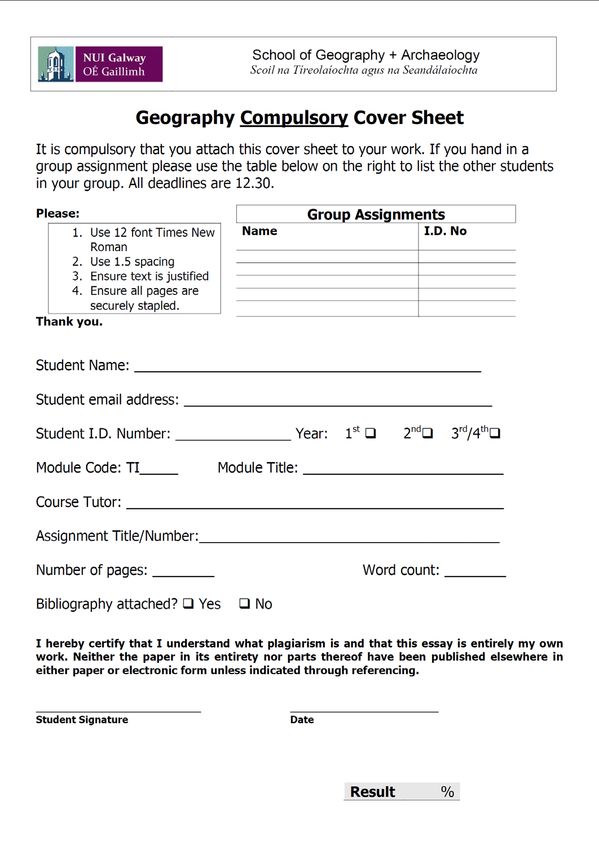
Please make sure that you include the cover sheet (copy at end of document) with each individual piece
of coursework so that your work can be identified and accounted for. We cannot accept materials
submitted by e-mail for reasons of authenticity except in cases where an e-mail submission has been
agreed with a member of staff. In such cases, an exact hard copy must also be submitted.
Late Submission of Coursework
Per College guidelines, students have up to two weeks past the deadline to hand in assessments, after
which the student will receive a mark of zero with no exceptions.
24Plagiarism
Plagiarism means presenting the words of another writer as if they were your own. This amounts to straight
copying from other author’s texts, including fellow students’ work. Copying another student’s essay or
assignment is as reprehensible as plagiarising an academic text. It is a serious matter, and if it is detected in
your continuous assessment it may result in an automatic failure mark. The way to avoid plagiarism is very
simple: always put quotation marks around someone else’s words, credit them to their source, and discuss
their content and ideas in your own words.
It is your responsibility to familiarise yourself with the guidelines relating to plagiarism and the University’s
Code of Practice in this regard.
University’s code conduct: www.nuigalway.ie/current_students/university_code_conduct/index.php#7
University’s plagiarism guidelines: http://www.nuigalway.ie/plagiarism/
Further guidance on recognising and avoiding plagiarism is provided by the James Hardiman Library. You
can access this resource by logging on to Blackboard and self-enrolling in the ‘Learning Centre’. Full details
are available at:
http://www.library.nuigalway.ie/media/jameshardimanlibrary/content/documents/support/Skills4Study%20Stud
ent%20Guide.pdf
Course Grades
Most staff provide detailed explanations of the standard of work that reflects each of the grade bands
outlined below. These would usually be tailored to suit an individual piece of assessment. Many staff
now use Blackboard’s Grade Centre facilities to provide initial direction and subsequent feedback, using
a template or rubric that explains how different criteria were applied to assess the work.
Percentage Grade
70-100 First Class Honours
60-69 Second Class Grade 1
50-59 Second Class Grade 2
40-49 Third Class Honours
0-39 Fail
Final Degree Calculation
At degree level, honours will be calculated on the basis of 30% of the aggregate mark being obtained
at the pre-final stage examination (e.g. end of 2nd or 3rd year depending on if you take an ERASMUS
year, etc.) and 70% of the aggregate mark obtained at the final stage examination. (Aggregate = the
combination of marks from both of your subjects).
Therefore, your pre-final exams will count towards 30% of your Final Degree Mark.
* What does this mean for me?
If you are now in 2nd year of a three year programme, your end of year results in June 2018 will
contribute 30% of your overall degree mark in June 2019.
25Communicating with staff members
For all communications with staff members, do make sure to consult all materials on the departmental
webpages and Blackboard prior to e-mailing additional questions that you may have. Also, please make
sure to e-mail in advance to arrange any meeting with staff members outside of their stated consultation
hours. When writing an e-mail to staff it is important to be professional and concise. For example, you
should make sure that your opening address conveys a professional tone; e.g. Dear, etc. If your query is
directed at teaching staff, please ensure that your e-mail includes your name, student ID and the
name/code of their class in which you are participating. Please be aware that due to the large number of
e-mails received by academic staff on a daily basis, you must allow time for them to respond. Finally,
please check your NUIG e-mail account regularly as this is the main way that university staff will contact
you.
STUDENT WELFARE
In the Discipline of Geography, we recognise that students may have particular circumstances that
impact upon their capacity to complete their studies to the best of their ability. Every effort will be made
to accommodate individual circumstances, and we would encourage you in this regard to communicate
your situation to us if you feel we can be of assistance. You should also be aware of a number of
support services available to you on Campus, whose role is also to help students fulfil their potential both
academically and personally. Details are available on the following link:
http://www.nuigalway.ie/student_services/
STUDENT CODE OF CONDUCT
As a student, you also have certain responsibilities in relation to conduct on and off campus. The
University has outlined a comprehensive explanatory statement in this regard, which we would urge you
to read and be familiar with. Once you accept a place as a student at NUIG, you are automatically
bound by its code of conduct:
http://www.nuigalway.ie/current_students/university_code_conduct/index.php#7
POST-PRIMARY TEACHING
Geography undergraduate requirements
Attached is the link to the Teaching Council of Ireland’s subject criteria for post-primary teaching. The
requirements for geography are 15 ECTS in physical and 15 ECTS in human geography modules.
Please consult the Teaching Council’s website directly for more detailed information.
http://www.teachingcouncil.ie/teachers-not-newly-qualified-qualifications-awarded-in-ireland/new-post-
primary-teachers.2960.htm
2627
You can also read


