German Rectors' Conference The Voice of the Universities
←
→
Page content transcription
If your browser does not render page correctly, please read the page content below
German Rectors‘ Conference
The Voice of the Universities

Welcome

    Dear reader,

    The German Rectors’ Conference draws its strength from the strength           Dialogue and cooperation: The HRK is convinced that universities have
    of its members: Universities are the heart of the German academic             to enter into a dialogue with society on scientific work and its best
    and research system. They combine higher education and research, con-         framework conditions, as well as to actively explore the expectations
    duct the major share of basic and applied research, qualify tomorrow‘s        and concerns of all stakeholders with regard to higher education,
    specialists, train early career researchers, are key drivers of innovation    research and innovation. The HRK invites the broader public as well
    and serve as cultural institutions as well as interdisciplinary think tanks   as the federal and state governments to be constructively involved
    of the nation. In all these endeavours, they are supported by the             in this process and to support universities in their public tasks and
    German Rectors’ Conference, Hochschulrektorenkonferenz (HRK).                 services.

    Like German universities themselves, the HRK stands for academic              Sustainable funding and appropriate legal framework: The HRK calls
    autonomy and freedom, diversity and innovation, open-mindedness               for increased stability and reliability in public funding. This will enable
    and internationality. As the alliance and voice of German universities,       universities to meet the needs of their excellent staff and the millions
    the HRK is a strong partner for other science organisations, for politics,    of students enrolled and to deal with the requirements of digital
    media, business and civil society.                                            transformation and the steadily growing number of research projects.
                                                                                  Moreover, the HRK stands up for an appropriate legal framework that
    This publication offers you insights into key issues the HRK and the          preserves and strengthens the universities’ autonomy in a time of new
2   German universities are tackling at present. What is our position,            challenges and global academic competition.
    what principles are we guided by, and what do we have achieved
    recently? A few highlights:                                                   I hope you will be able to find a few quiet minutes to read more
                                                                                  about these and other issues. The enclosed leaflet offers you some
    Freedom in scholarship and social responsibility: The HRK campaigns           quick impressions of Germany‘s diverse higher education landscape.
    for academic freedom across the globe and in particular for academic
    freedom of individual scholars or institutions at risk. Moreover, an HRK      I wish you a pleasant read.
    initiative is helping universities in Germany to communicate a powerful
    message of openness and opposition to xenophobia and discrimination.

                                                                                  Professor Peter-André Alt
                                                                                  HRK President
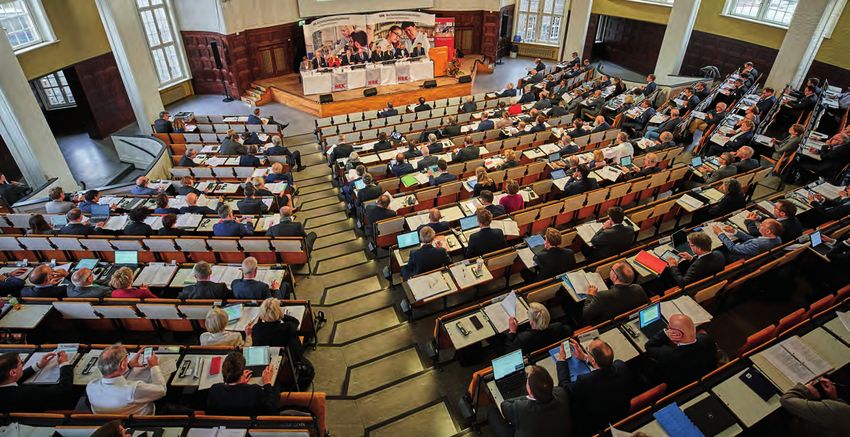
Universities in Dialogue with Society

                                                                        mindedness and giving wider exposure to what is, in fact, the general
                                                                        stance of German academics on these issues. Since 2015, the HRK
In Germany, universities’ academic freedom and self-governance are      has also been supporting universities in their successful efforts to
guaranteed under the constitution both on federal and state level. At   integrate increased numbers of refugees who were students in their
the same time, universities themselves as key actors in the dynamic     home countries or who are interested in higher education.
‘knowledge rectangle’ of education, research, innovation and culture
are an integral part of society and thus need to respond to societal    To promote dialogue with society, the HRK supports the outreach
expectations. Both the institution and its individual members, there-   activities of German universities and has been providing ongoing
fore, are committed to transparency and accountability, promoting       advice and strategic guidance. The HRK awarded a prize for university
an open dialogue with all stakeholders in society.                      communications between 2005 and 2019 in cooperation with ZEIT
                                                                        Verlag and the Robert Bosch Foundation and recently introduced an
The German Rectors’ Conference (HRK) supports its member univer-        Excellence in Community Engagement Award for universities together
sities in their endeavour to build on their academic strengths and      with these partners. In addition, HRK takes part in networks and
develop their profiles. The HRK believes this continuous task and       public initiatives which seek to foster competence in digital environ-
challenge is inextricably linked to a clear acknowledgement of the      ments or which encourage young female students, in particular, in
universities’ role in society. It encourages dialogue with the public   the STEM fields (science, technology, engineering, and mathematics).
and wants universities to engage with other players, especially in
business and industry, education and civil society. The HRK stresses,   In 2020, the HRK’s executive board set up a working group that
however, that this must always be a fair dialogue from which all        deliberates on the future of university communications in Germany.
sides benefit.                                                          The German Rectors’ Conference promotes the exploration of up-to-
                                                                        date modes and forms of science and humanities communication.            3
Protecting researchers who are at risk and insisting on freedom in      This is about more than merely communicating new research findings
scholarship are top priorities for the HRK. It has been collaborating   in an engaging way; it is also about promoting a comprehensive
closely with the international Scholars at Risk network and has been    public understanding of academic work and standards. The HRK is
involved in the German section since September 2016. It regularly       co-founder of the “Wissenschaft im Dialog” initiative, which tests
issues calls to actively counter any anti-academic sentiments. And      innovative dialogical communication formats. As a member of the
the HRK consistently lobbies governments when academic freedoms         Alliance of Science Organisations in Germany, the HRK also takes
or individual academics or researchers are threatened.                  part in a joint communication initiative on animal research.

The German Rectors’ Conference stands for diversity in higher edu-
cation and research and through the “German Universities. Open
to the world” campaign, launched in 2015, it counters prejudice,
xenophobia, racism and chauvinism while encouraging open-
Universities and their Legal Framework

                                                                                  From the HRK’s perspective, the state governments should focus on
                                                                                  the legal supervision of the universities and should not go down the
    The Basic Law of the Federal Republic of Germany, the country’s con-          route of ministerial decrees and individual directives. The HRK is
    stitution, guarantees the freedom of sciences, research and teaching.         campaigning for the introduction of global budgets for universities.
    It therefore forms the foundation of the German higher education              Moreover, universities should have the right to nominate and appoint
    system. As universities are predominantly regulated by the sixteen            professors autonomously. The interests of the states, and thus the
    federal states, the respective state laws and constitutions are the           taxpayer, should be taken into consideration in multi-year target
    most important legal framework for universities. By contrast, only a          agreements and institutional contracts. At the same time, the regula-
    few matters may be regulated at federal level, for example higher             tory system within the university should strike a balance between the
    education qualifications and university admission.                            university’s development as an institution and individual interests,
                                                                                  particularly those of academic staff.
    Broadly speaking, public universities have a high level of self-gover-
    nance when it comes to regulating academic matters. However, the              Against this backdrop, the HRK continuously addresses various aspects
    exact extent of this autonomy is often the subject of political debate        of university governance. Recently, the HRK outlined organisational
    and negotiations between the universities and the respective federal          structures that aim at achieving maximum productivity from the com-
    states. Universities strive for autonomy, particularly when it comes          plex interaction between the various institutional bodies. The HRK also
    to managing and distributing funds and making decisions on staff              touched on important individual issues, such as freedom of speech and
4   structure, the appointment of professors and matters of general               the freedom of science, competent processing of data and information
    organisation.                                                                 in the digital age, systematic staff development and promoting diversity
                                                                                  and equal opportunities for women in academia and science.
    The German Rectors’ Conference (HRK) supports universities in their
    endeavour to preserve maximum autonomy. It believes the universi-
    ties’ freedom of action, flexibility and planning security are essential
    for facing global competition. At the same time, it acknowledges that
    universities are accountable to state and federal parliaments, govern-
    ments and the country’s citizens for their actions. In that spirit, the HRK
    weighs in on the drafting and redrafting of state and federal laws as
    well as of EU regulation. As the voice of German universities, the HRK
    challenges and makes suggestions stating its position on legislation
    and case law in higher education.
University Funding

The budgets of German universities consist of three main components:
basic funding, programme funding and third-party funding. Overall,
around 90 per cent of this funding for German universities comes
from the public purse.

The universities receive basic funding from the federal states, which,
because of their constitutional mandate for education, science and
culture, bear the responsibility for public universities. This basic
funding makes up around 60 per cent of the total budgets of the
public universities.

Programme funding is made available to universities by the federal
states, the federal government or jointly by the federal and state
governments for a limited period, generally three to five years, and
for a particular purpose (e.g. development of the quality of study
and teaching, establishment of new study programmes). This means           Over recent years, the funding streams of public universities have
that these funds are not available to universities over the long term.     undergone a structural shift in several respects. On the one hand, there
Hence, the structures and services established with them must either       has been above-average growth in the proportion of the universities’
become self-funded or be discontinued after funding ceases. Pro-           budgets coming from third-party funding, which increases dependency
gramme funding makes up around ten per cent of university budgets          on competitive, project-based and fixed-term funding sources. On
on average but varies widely between the individual universities.          the other hand, the federal government, with its “Future Contract
                                                                           for Strengthening Studying and Teaching in Higher Education,” has
In contrast, third-party funding can be allocated to universities by all   committed to permanently taking on the part-funding – and thus the
public and private sources, as well as third-sector organisations. This    shared responsibility long demanded by the HRK – of additional study
third-party funding is provided through competitive processes, mostly      places. Nevertheless, in the HRK‘s view the federal government cannot
for a defined project period, to support research and development,         now hold back in other problem areas such as higher education facility
early career researchers and academic teaching. Intermediary funding       construction and renovation or improvements to digital infrastructures.
organisations such as the German Research Foundation (Deutsche             For this reason, the HRK advocates an adequate, task- and performance-
Forschungsgemeinschaft, DFG) play a particularly prominent role in         based funding structure, in which the federal and state governments
this extramural funding. Third-party funding makes up around 30 per        work in concert to safeguard and further strengthen the strong appeal
cent of German university budgets on average but varies between the        of German universities for prospective German and international
individual universities.                                                   students and their competitiveness in research and innovation.

Tuition fees from students or graduates play only a minor role in the
funding of Germany‘s public universities. Privately run universities,
however, depend to a considerable extent on tuition fees.                                                                                             5
Research and Innovation

                                                                                At national and international level, the HRK promotes the view that
                                                                                the core of doctoral education is the independent research work of
    Publicly financed research in Germany is predominantly conducted            the doctoral candidate. This first independent research makes it the
    at universities. They collaborate closely with non-university research      key phase for early career researchers. At the same time, the HRK
    institutions – not just on research projects, but also in the form of       stresses that the right to confer a doctoral degree is the privilege of a
    joint professorships and in joint doctoral training programmes. Tra-        university.
    ditionally, German universities also cooperate in research, develop-
    ment and innovation with business and industry both in Germany              At EU level, the HRK supports the creation of a European education,
    and abroad.                                                                 research and innovation community with universities at its very centre.
                                                                                This community should be based on creative political collaboration
    Higher education institutions conduct research and teaching across          between the European Union, member states and regions/federal
    the full spectrum of scientific and scholarly disciplines. The variety      states on a level playing field.
    of institutional types and the disciplines they represent make them
    the perfect place for cross-disciplinary collaboration. The unity of        Doctoral graduates are in high demand in German companies requi-
    research and teaching is essential for German universities; teaching        ring managers and researchers. Hence, doctoral training collabora-
    benefits from proximity to the latest research processes.                   tions have been established between universities and businesses. The
                                                                                HRK engages in regular dialogue with major industry associations on
    The German Rectors’ Conference (HRK) emphasises the key role of             this topic as well as others. The HRK and the industry associations
    universities in the knowledge rectangle of education, research, inno-       jointly published guidelines for doctoral training collaborations in
6   vation and culture. It supports the claim that substantial funding for      March 2018. These guidelines underline the fact that universities
    both fundamental and application-oriented research must be provi-           have sole responsibility for academic procedures and standards.
    ded but is strongly opposed to university research being subjected
    to commercial pressures.

    The HRK supports universities in the process of defining key areas
    in research and development based on their chosen strategy. This
    allows the university to develop priorities in academic disciplines and
    form the necessary critical mass of staff and infrastructures in certain
    areas. The HRK supports this process in several ways, including its
    Research Map, which visualises the research priorities of each individual
    university and thus of the entire German higher education system.
The HRK is a strongly advocate for adequate conditions and funding
of research at universities – across all disciplines and from basic to
applied research. Recently, the HRK proposed a new funding pro-
gramme for bottom-up and science-driven projects in applied research
to be adopted by the Federal Government. Such an approach could
complement existing applied research programmes that primarily
address industry and research institutions as their partners.

Science-friendly, future-oriented copyright legislation is one of the
HRK‘s key concerns, both at national and European level. The HRK
is actively involved in preparing new legislation to align copyright
law with the current and prospective demands of the knowledge-
based society. German universities are in favour of immediate and
permanent open access publishing of new research articles and a
fair and reasonable pricing policy on the part of academic publishers.
On behalf of the Alliance of Science Organisations in Germany, the
HRK has been working on the DEAL project to negotiate nationwide,
comprehensive, transparent and transformative “publish and read”
agreements with the largest commercial publishers of scholarly
journals.

In spring 2018, the HRK adopted guidelines for stating affiliations
in publications so that the research work conducted by universities
can be adequately acknowledged. For example, an institutional
affiliation may be established through an employment contract or
acceptance as a doctoral candidate. Authors may also have more
than one affiliation. These guidelines are particularly important in
the case of collaborations between universities and non-university
research institutions.                                                     The HRK’s Research Map provides information
                                                                           on the key research areas of German universities
Stating the correct affiliations in publications is also highly relevant
                                                                           and universities of applied sciences. The research
to the assessment of research performance by third parties such
                                                                           priorities listed here are central to a university’s
as ranking agencies. Good ranking results are beneficial to the
internationalization of universities, as they may enhance Germany‘s        institutional profile. The Research Map thus helps
attractiveness as a location for research to international researchers     to identify centres of expertise and helps resear-
and students. However, strategic participation in a university ranking     chers to explore opportunities for collaboration.        7
should not be equated with its non-critical endorsement in terms of        Ranging from additive manufacturing to zoonotic
methodology or marketing. In February 2019, a service project was          diseases and spread out across the country, the
set up in the HRK to support universities in their informed partici-
                                                                           research priorities listed in the Research Map reflect
pation in international rankings.
                                                                           the distributed excellence of German universities.
                                                                           Information is available in both German and English.
                                                                           www.researchmap.de
The German Rectors‘ Conference

    The German Rectors’ Conference (HRK) is the association of universities
    in Germany. The HRK is an independent organisation, representing
                                                                              Roots
    all types of higher education institutions. More than 92 percent of
    all students in Germany are enrolled at its member universities.
                                                                              The HRK was set up as the West German Rectors’
    Hence, the HRK is the voice of German universities vis-à-vis policy-      Conference (WRK) in 1949, the same year in which
    makers and the public.                                                    the Federal Republic of Germany was established.
                                                                              Its founding was part of Germany’s democratic
    The German Rectors’ Conference                                            development. To this day, the HRK speaks out for
                                                                              academic autonomy, freedom of opinion, tolerance
    > shapes opinion and represents interests
                                                                              and open-mindedness. Following the unification of
    The HRK helps to set the political agenda and lead public discussion
    on all issues relating to the universities. It develops basic positions   the two German states, the first universities from
    at German, European and international level. In this process, it often    the new federal states joined in 1990 and the WRK
    collaborates with partners from academia and science as well as           was renamed the German Rectors’ Conference (HRK).
    policymakers, employers’ associations and trade unions. The HRK
    represents the universities’ positions in Germany and Europe as well
    as on an international scale.
                                                                              Funding
8   > provides services                                                       The budget of approximately €7.9 million per
    By hosting events and issuing publications the HRK supports its           annum comes from university contributions and
    member institutions and provides them with a platform for exchange        funds provided by the German Federal Ministry of
    with each other. Furthermore, the HRK offers individual consultation      Education and Research. State governments pay
    and has set up specific services on key issues relating to university
                                                                              the university contributions for their respective
    development so that its members can obtain systematic advice and
                                                                              state institutions of higher education. Fixed-term
    support, for example on how to implement the European Study
    Reform, on internationalisation and on digitalisation. The HRK also       projects receive third-party funding. The Founda-
    provides policymakers, the media and society in general with infor-       tion for the Promotion of the HRK is the legal and
    mation on the higher education system.                                    financial body of the HRK.
How the HRK works

> The General Assembly is the supreme decision-making
body. It is convened twice a year to discuss and decide on key issues,
changes to the HRK’s rules of procedure and the budget. The General
Assembly is always hosted by one of the HRK member institutions.

> The Senate meets three times a year. Its main purpose is to
ensure exchange between the universities of all 16 states (Bundes-
länder). The Senate consists of 36 university representatives from
across the country.

> The Executive Board is the HRK’s governing body. Serving
on it are the President, five Vice-Presidents elected by the General
Assembly and the spokespeople elected by the member groups of the
universities and universities of applied sciences. All Vice-Presidents
are current or former university leaders.

> The President represents the HRK both internally and exter-
nally. He or she is responsible for day-to-day business and convenes
and chairs the meetings of the various bodies. The General Assembly
elects the President. Only current or former university leaders are
                                                                               How to get in touch with the experts for
eligible for this office. The term of office is three years, with the option
                                                                               international affairs at the HRK’s Secretariat:
of being re-elected once.
                                                                               Cooperation with Africa and the Middle East
> The Standing Committees prepare the HRK’s resolutions                        Thomas Böhm (boehm@hrk.de)
and recommendations. Alongside university leaders, their members
include other university representatives and non-university experts.           Cooperation with Asia, Australia and Oceania
                                                                               Marijke Wahlers (wahlers@hrk.de)
> The HRK Secretariat’s offices in Berlin, Bonn and                            Cooperation with Central and Eastern Europe
Brussels support the work of the bodies and commissions, and pro-              and Central Asia
vide information and services to both the HRK member universities              Rudolf Smolarczyk (smolarczyk@hrk.de)
and the general public.
                                                                               Cooperation with Western and Southern Europe
                                                                               Constanze Probst (probst@hrk.de)
                                                                                                                                     9
                                                                               Cooperation with Latin America
                                                                               Iris Danowski (danowski@hrk.de)

                                                                               Cooperation with North America, the UK and Ireland,
                                                                               the Nordic countries, Turkey and South Asia
                                                                               Dr Gordon Bölling (boelling@hrk.de)

                                                                               Cooperation at EU level and HRK Brussels Office
                                                                               Nils Wörner (woerner@hrk.de)

                                                                               General enquiries
                                                                               post@hrk.de
Study and Teaching

                                                                               The HRK is significantly involved in quality assurance based on the
                                                                               European Standards and Guidelines (ESG) and strives for processes
     In Germany, higher education study programmes are predominantly           to ensure and develop the quality of degree programmes while doing
     offered by different types of universities, ranging from comprehen-       justice to the individual profiles of universities. In so doing, the HRK
     sive universities and technical universities to universities of applied   assumes that the unity of research and teaching is key to the quality
     sciences, colleges of arts and music and pedagogical universities.        of teaching and that good teaching primarily depends on capable staff.
                                                                               Sufficient basic funding is required to attract and keep that staff.
     The introduction of bachelor’s and master’s degree programmes ini-
     tiated by the European Study Reform (or “Bologna Process”) shifted the    In 2020, around 2.9 million students were enrolled at German uni-
     focus to students’ learning processes; alongside gaining knowledge        versities – a record figure. The number of university entrants has
     in a given discipline, acquiring key competences is systematically en-    remained constant at around 500,000 since 2011. The number of
     couraged. From developing student-centred study programmes and            study programmes has risen sharply to the current 20,000. In re-
     innovative forms of assessment to the accreditation of degree courses,    sponse to the fact that state financing has clearly fallen short of the
     this has major consequences for the organisation of teaching and          needs dictated by student numbers and the new forms of study, the
     learning. Nevertheless, the overall aim remains unchanged, i.e. to        HRK successfully lobbied for the Future Contract for Strengthening
10   provide an academic education which enhances the students’ perso-         Studying and Teaching in Higher Education. Starting in 2021, this
     nal development while at the same time reflecting the needs of the        agreement provides a stable basis for the higher education funding
     labour market.                                                            through a system of co-financing from the federal and state govern-
                                                                               ments.
     The German Rectors’ Conference (HRK) is deeply committed to the
     aims of the European Study Reform and points to the impressive re-        A revised version of the Qualifications Framework for Higher Educa-
     form efforts on the part of universities, thanks to which the Bologna     tion Qualifications (HQR) was adopted in early 2017. This framework
     Process has now been implemented virtually everywhere in Germany.         plays an important role in accreditation, as the process verifies
     It continuously identifies important steps for further development,       whether a degree programme complies with the HQR’s description
     for example the facilitation of mobility through improved recognition     of competencies. The new version of the HQR, drafted together with
     procedures, the appropriate expansion of system accreditation and         the Standing Conference of the Ministers of Education and Cultural
     better use of flexibility in organising individual learning paths.        Affairs of the German states and the Federal Ministry of Education
and Research, now provides an in-depth description of the compe-
tences that should be evident with the completion of a bachelor’s or
master’s programme or a doctoral degree. The HQR relates directly
to the German Qualifications Framework, which covers all areas of
education. The HRK represents the universities’ interests in the national
German Qualifications Framework working group.
In the newly structured accreditation system, the Accreditation Council
(representing all stakeholders, among which the number of represen-
tatives from academia and science has significantly increased) has
been making decisions on programme or system accreditation and
alternative procedures since early 2018. The introduction of this -
third type of process was welcomed by the HRK. It includes external
quality assurance procedures at individual universities that comply
with the ESG and the requirements stipulated in the ordinances but
that go beyond this in terms of quality development.
The HRK is also focusing on the digitalisation of teaching. It creates The HRK supported German universities in
significant momentum here as an initiator of and project partner for their study reform efforts with the project
the “Hochschulforum Digitalisierung” (Higher Education Forum on
“nexus – Forming Transitions, Promoting
Digitalisation) that aims to inform, advise and connect stakeholders
Student Success” from 2014 to 2020. This
from higher education institutions, politics and civil society. As a
member of the Alliance of Science Organisations in Germany, the HRK initiative focused on optimising the initial
takes part in the Digital Information priority initiative 2018-2022 as phase of a study programme, facilitating
well as in the steering committee of the “Digital learning, teaching student mobility through improved recogni-
and networking” working group. tion and the transition of graduates to the
labour market.
www.hrk-nexus.de/ (in German only)
In August 2020, HRK started the project
“MODUS – Strengthening mobility and tran-
sitions: Academic recognition and recognition
of prior learning at HEI”, which supports uni-
versities in the enhancement of recognition
11
processes. The measures within the project
include coordination and the establishment
of standards, the development of technical
solutions and information and advice.
www.hrk-modus.de/ (in German only)International Affairs
concrete services. Recently, the HRK Executive Board adopted guide-
Today, the German higher education landscape is more international lines and standards in international university cooperation designed
than ever before. Germany is one of the most popular destinations to provide key players – both the universities as institutions and
for internationally mobile students and an attractive teaching and the individual members of universities – with support and guidance
research location for scholars and researchers from all over the world. on the ground when setting up and maintaining resilient university
All areas within universities contribute to this internationality of partnerships.
research, teaching and learning. Along with collaboration between
universities at the institutional level, there are innumerable coope- In addition, the HRK represents the interests of German universities
ration arrangements at faculty and department level, and between internationally. This involves cooperating with universities, university
institutes and individual researchers. The forms taken by these associations and other partner organisations in Europe and across the
cooperation arrangements are equally diverse. Internationality can world. Regular meetings are held between the HRK and the British,
be described as part of the natural fabric of the German higher French, Austrian, Polish, Russian and Swiss rectors’ conferences. This
education landscape. is complemented by an intensive exchange in the framework of
European platforms, such as the European University Association or
German universities benefit substantially from cross-border coope- the newly established network ‘Universities for Enlightenment’ which
ration. Only by means of close collaboration with its international focusses on safeguarding academic freedom and university auto-
12 partners can the German higher education system remain competi- nomy. Dialogue and exchange also take places with international
tive in the long term, both in its curricula and its research and tea- partners outside of Europe, for instance with American, Colombian,
ching methods. Openness to the world, the capacity for discourse, Japanese, Iranian, Peruvian and Taiwanese university partners.
and cultural understanding all critically depend on international
contact. For this reason, the German Rectors’ Conference (HRK) In addition, the HRK has long been putting its commitment to de-
believes that a future-ready university must see itself as a formative velopment policy into practice through the Dialogue on Innovative
part of the global university community and act accordingly. This Higher Education Strategies (DIES). The programme, developed jointly
creates many challenges at the strategic level and in the university’s by the DAAD and the HRK, offers a package of measures – training
day-to-day teaching, learning and administration activities. courses, dialogue events, projects and partnerships – through which
universities in the Global South can align their training courses with
The HRK assists member universities with the internationalisation international quality standards, expand their research capacities and
process by providing recommendations for action and a range of develop their organisational structures.One of the HRK’s established formats is the bi-annual Global Univer- Various formats – topic workshops, process workshops, round tables
sity Leaders Council Hamburg, to which the HRK, together with the and peer-to-peer consultation – address specific aspects of inter-
Körber-Stiftung and the Universität Hamburg, invites the presidents nationalisation in dialogue with a university’s relevant stakeholders
of around 50 research universities from six continents. The key topic and in a manner responsive to their needs. In addition, the HRK-
of the most recent meeting was the role of universities in society. The EXPERTISE Manuals address pressing questions and topics of im-
Hamburg Declaration adopted at the meeting formulates recommen- plementation processes in internationalisation and provide a well-
dations how universities can live up to societal expectations while reflected range of examples from German universities. So far, the
at the same time safeguarding academic freedom and university published manuals have touched on topics such as the internationa-
autonomy. lisation of curricula and the outgoing mobility of junior researchers
or fostered support structures for international researchers through
The HRK also promotes the internationalisation of individual uni- regional cooperation.
versities, thus enhancing the internationality of the German higher
education system as a whole. For example, the HRK Audit ’Inter-
nationalisation of Universities’ helps German universities develop
a strategic approach to their internationalisation process. More than The HRK information portal “International
90 universities have so far completed the Audit, and a series of university partnerships” documents the high
audited universities are now in the Re-Audit phase. The HRK also degree of international networking by German
provides consultancy services for smaller, specialised universities universities. The website offers up-to-date
through its “Audit kompakt” and Audit Strategy Workshop. information in German and English on over
38,300 agreements that exist between German
The project HRK-EXPERTISE Internationalisation, funded by the
Federal Ministry of Education and Research, builds on experience
universities and their more than 5,800 partner
gained in the HRK Audit and aims to further develop the internationali- institutions in around 160 foreign countries.
sation of universities while focussing on quality and to integrate www.internationale-hochschulkooperationen.
internationalisation into all dimensions of higher education activities. de/en/
13European Policy
To implement the aforementioned principles, the HRK maintains a
continuous policy dialogue with universities and other national rectors’
In a landmark resolution in response to Brexit and the rise of nati- conferences in Europe, on a bilateral level and in the arena of the
onalist parties in many EU member states, the HRK stated in 2016 European University Association. Together with these allies, the HRK
that “European universities see themselves more clearly than ever has recently put a strong emphasis on the pilot phase of the new
as a stronghold of the European Idea and a global mind-set” and EU university network programme, lobbying for the inclusion of all
as a “crucial pillar of a dynamically developing European civil and sides of the knowledge rectangle, appropriate funding, and a true
knowledge society.” This strong claim is built on the observation bottom up approach.
that universities represent ground-breaking research, high-quality
teaching and cutting-edge innovation. Moreover, universities are Comparable activities are targeted at the design phase of Horizon
keepers of cultural achievements and centres of critical thinking. Europe, the 9th EU Framework Programme for Research and Inno-
In short, they represent a dynamic ‘knowledge rectangle’ of educa- vation (2021-2027), for which the HRK advocates excellence as
tion, research, innovation and culture, unmatched by any other the relevant benchmark, science-driven content, and a cooperation-
institution in civil society. Located all over Europe and connected by oriented structure to ensure European added value.
the mobility of students and researchers inherent to research and
higher education, universities safeguard and transmit European In relation to teaching and study, the HRK supports the “shift from
values and the idea of a diverse and yet closely connected Europe. teaching to learning” stipulated by the Bologna Process. Thus, the
The HRK promotes the ever-stronger cooperation of universities in HRK participated in a range of European projects that aim at improving
14 the European Union and beyond – not by harmonization but by academic recognition and promote pedagogical reforms, such as
improving the compatibility of the European university landscape. Mastermind Europe, FAIR – Focus on Automatic Institutional Recog-
nition and EFFECT – the European Forum for Enhanced Cooperation
For several years, the German Rectors’ Conference (HRK) has been in Teaching and Learning.
deducing a set of policy positions from this key concept and estab-
lishing university activities in the knowledge rectangle as its over-
arching EU leitmotif. The positions stated by the HRK in its dialogue
with all relevant players include the demand to make EU-wide
“distributed excellence” a fundamental building block of any policy
activity, to stress the universities’ linking function between the
European Higher Education Area and the European Research Area
and to advocate for multi-level funding support appropriate to the
essential role of universities for the European University Alliances
from the EU, member states, and regions.Imprint
Published by the German Rectors‘ Conference
Editors:
Christoph Hilgert
Svenja Gertheiss
Magda Ohly
Henning Rockmann
Thimo von Stuckrad
Christian Tauch
Marijke Wahlers
Nils Wörner
Contact:
Email: post@hrk.de
www.hrk.de
Leipziger Platz 11
10117 Berlin
Phone: +49 30 206292-11
Fax: +49 30 206292-15
Ahrstraße 39
53175 Bonn
Phone: +49 228 887-0
Rue d‘Alsace-Lorraine 44
B-1050 Ixelles/Brussels
Phone: +32 27810061
Translation and proofreading:
oneword GmbH, Böblingen
www.oneword.de
Layout:
The Office Cross Media GmbH, Köln
www.theoffice.de
Printed by:
Photos by:
Heider Druck, Bergisch Gladbach
Title: HRK/Claudia Höhne
Berlin, November 2020 p.2: HRK/David Ausserhofer
p.3: University of Hohenheim/Oskar Eyb
ISBN: p.4: Hochschule Düsseldorf – University of Applied Sciences/TobiasVollmer
978-3-942600-91-0 p.5: top: Karlsruhe Institute of Technology
bottom: Hochschule Ruhr West/Christa Lachenmaier Photography
p.6: top: Jade University of Applied Sciences
bottom: Universität Regensburg
p.7: FH Aachen/www.thilo-vogel.com
p.8: HRK/Claudia Höhne
p.9: HRK/Eric Lichtenscheid
p.10: Uwe Bellhäuser/Universität des Saarlandes
p.11: top: TH Bingen/Carsten Costard
bottom: University of Music Wuerzburg/Christoph Weiss
p.12: Reutlingen University
p.13: University of Bayreuth
p.14: IUBH University of Applied Sciences
Imprint/p.15: HRKYou can also read


