2019/2020 Getting started - A guide to accessing CIT Disability Support Service supports - myCIT
←
→
Page content transcription
If your browser does not render page correctly, please read the page content below
DISABILITY
                         SUPPORT SERVICE

Getting started -
A guide to accessing
CIT Disability Support
Service supports

2019/2020
www.mycit.ie/dss
Section 1 - CIT DISABILITY SUPPORT SERVICE

    Welcome                                   3
    Who works in the DSS?                     4
    Where is the DSS?                         5
    Who does the DSS support?                 6
    Disclosure                                8
    Confidentiality                           9
    Section 2 - APPLYING FOR SUPPORTS
    How do I apply for DSS supports?          10
    Documents needed                          11
    Needs Assessment                          12
    Apprentices                               13
    Incoming Erasmus/International Students   14
    Section 3 - SUPPORTS
    DSS Supports Overview                     15
    Assistive Technology                      16
    Learning Support                          18
    Workplace preparation / BalanCIT          20
    Transitions Support                       21
    Other DSS Supports                        22
    Section 3 - EXAM SUPPORTS
    Bishopstown campus                        24
    CIT Cork School of Music /Crawford
    College of Art & Design                   26
    National Maritime College of Ireland      27
    Section 4 - CIT SUPPORTS
    CIT Supports                              28
    Financial Supports                        29
    Support on Erasmus/Studying abroad        30
    Things to Note                            31

2
Section 1
                                    CIT DISABILITY SUPPORT SERVICE

                         Welcome
                         If you are a new student or are already
                         studying in CIT you may need to contact the
                         Disability Support Service (DSS) if you feel
                         like you may need some extra support due to
                         your learning difference, disability or health
                         condition.

We can guide and support you to access your course, achieve your
academic goals and become a more independent learner.

This guide will give you valuable information on the DSS and how to
apply for supports/reasonable accommodations.

If you have any queries at any time, please e-mail dss@cit.ie

Laura Coleman
CIT Disability Support Officer

                             Marian O’Mahony - Community
                             Development student

                             “Since I started in CIT, I would
                             be lost without the support and
                             encouragement of the college... I
                             know that my own determination
                             and the support I receive in CIT will
                             lead me to a greater potential in the
                             future.”

                                 www.mycit.ie/dss                         3
Section 1
CIT DISABILITY SUPPORT SERVICE

 Who works in the Disability Support Service?
                    Laura Coleman
                    Disability Support Officer
                    Access Service
                    Tel. 021 433 5107
                    Text: 087 177 6755
                    E-mail: dss@cit.ie

                   Ruth Murphy
                   Disability Projects Coordinator
                   Access Service
                   Tel. 021 433 5137
                   Text: 087 138 9772
                   E-mail: dss@cit.ie
                    Mark Burleigh
                    Assistive Technology Officer
                    Assistive Technology Service
                    Tel. 021 433 5125
                    E-mail: mark.burleigh@cit.ie

                    Fiona Downey
                    Learning Support Coordinator
                    Assistive Technology Service
                    Tel. 021 432 6744
                    E-mail: fiona.downey@cit.ie

                   Julie O’Donovan
                   Disability Transitions Programme
                   Coordinator
                   Assistive Technology Service
                   E-mail: JulieA.ODonovan@cit.ie
 4
Section 1
                                                 CIT DISABILITY SUPPORT SERVICE

Where is the DSS?
The DSS provides support to students across all CIT campuses.

You can find the DSS office in the CIT Access Service which is located
in the heart of the Student Centre, Bishopstown Campus. The DSS
includes the Assistive Technology/Learning Support Services and the
Transitions Programme, also based in the Student Centre.

There are DSS Learning Support tutors based in CIT Cork School of
Music, CIT Crawford College of Art and Design, and the National
Maritime College of Ireland.

Map of Student Centre, Bishopstown Campus

                                                                 EXIT/ENTRANCE
                                                                  FROM STAFF
                                                                   CAR PARK

                                                                      ASSISTIVE
                                                                    TECHNOLOGY
                                                                 SERVICE/ LEARNING
                                                                      SUPPORT

                                                                       BANK
                                CIT STUDENT CENTRE                  OF IRELAND
                      ATM
 CIRCULAR COURTYARD
 EXIT/ENTRANCE FROM

                                GROUND FLOOR
                                                                  NEXUS MARKET

                                ACCESS SERVICE                           STAIRS
                             (INCLUDES DISABILITY     BISTRO
                            SUPPORT SERVICE - DSS)                       TOILETS

                                              www.mycit.ie/dss                       5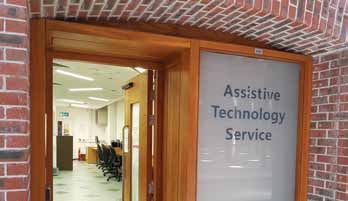
Section 1
CIT DISABILITY SUPPORT SERVICE
Who does the DSS support?
The DSS currently supports over 850 full-time and part-time students
with learning differences, health conditions, and disabilities such as:
Autism Spectrum /Asperger’s
ADD/ADHD
Blind/Vision impaired
Deaf/Hard of hearing
Development Coordination Disorder (dyspraxia/dysgraphia)
Mental health conditions, e.g. depression, bipolar, anxiety
Neurological conditions, e.g. epilepsy, brain injury
Significant ongoing illnesses, e.g. diabetes type 1, cystic fibrosis,
chronic fatigue
Physical disability, e.g. arthritis, cerebral palsy
Specific learning differences (including dyslexia and dyscalculia)
Speech and language communication difficulty
6 Queries by e-mail to dss@cit.ieSection 1
CIT DISABILITY SUPPORT SERVICE
Meet some DSS students
Emma Barrow
Social Care Work student
“Having the support releases a lot of pressure
from me… I wouldn’t be where I am today
without these supports. I have a hidden
disability but I am very proud being a deaf
person. I have the best of both worlds!”
Seán O’Shaughnessy
Hospitality Studies student
“Early DSS orientation was beneficial to me,
I had an opportunity to explore the campus
before the rest of the students returned. The
lecturers in CIT are always on hand to help or to
answer any questions. There is always help!”
Nisha O’Mahony
Nutrition and Health Science student
“I got into CIT thanks to the DARE scheme. I
use the Assistive Technology lab. I find using a
laptop a lot easier than writing in exams and
having the extra time also helps a lot.”
Richard Cross
Creative Digital Media graduate
“The DSS team have been fantastic, they
helped me prepare for my Erasmus year in
Austria and helped me whenever I reached out
to them”.
www.mycit.ie/dss 7Section 1 CIT DISABILITY SUPPORT SERVICE Disclosure Does CIT need to know that I have a learning difference/ health condition/disability? If you think you will need any supports for your studies, we strongly advise that you apply for DSS supports/reasonable accommodations as early as possible. It is a confidential service and you can apply to the DSS at any point during your studies but it is best if you do this when you start studying in CIT. If you have applied to DARE through the CAO, the DSS will receive your information and documents but you will still need to apply for DSS supports/reasonable accommodations in order to access supports in college. Students who received reduced points DARE places must apply to the DSS. Note to parents/guardians about queries We welcome general queries from parents and guardians and we appreciate and understand their role in supporting the student. As CIT students are adults and over the age of 18, we cannot disclose any information about a student without their permission to any third party. Students must give advance consent to the DSS to discuss any aspect of their DSS application, academic progress, etc. with a third party on each occasion. 8 Queries by e-mail to dss@cit.ie
Section 1
                                 CIT DISABILITY SUPPORT SERVICE

Confidentiality
The DSS is a confidential service and we do not share any of your
information with anyone outside the DSS without your consent - this
includes lecturers, college staff, parents/guardians, support workers,
etc.

If you wish to use DSS supports such as exam supports, access notes,
etc., you will be asked to agree to share this information with the
relevant CIT staff/ departments.

Your documents are stored securely in the Institute’s DSS/ secure
document storage in compliance with Data Protection legislation with
access only to authorised DSS staff.

The DSS cannot discuss information about your registration, or any
other aspect of your academic progress or supports without your
permission.

If you disclose information to the DSS which may be considered to put
us on notice of a serious health and safety risk to you and/or other
students/staff, the college has a legal duty of care to ensure that you
and/or other students/ staff are safe. In this case we may need to share
this information but we would ideally speak to you first.

                              www.mycit.ie/dss                             9
Section 2
APPLYING FOR SUPPORTS
How do I apply for supports?
If you wish to apply for supports/reasonable accommodations for
lectures, exams, etc. from the DSS, you need to take three steps:
STEP 1 Fill out the Online Application Form
1
You can enter your details in the online DSS application form -
available on the DSS website in mid August: www.mycit.ie/dss
You can e-mail us to request it in an alternative format, or if
you are having any difficulties filling out the form.
STEP 2 Provide supporting documents
2
We need to have evidence of your learning difference,
disability, or health condition (see next page for details). You
can upload to your application form, e-mail a copy of your
documents to dss@cit.ie, hand them into the Access Service
office, or post them to us (if you have not sent these already to
the CAO/DARE).
STEP 3 Needs Assessment
3
You will receive a needs assessment document which confirms
your reasonable accommodations/supports. You will have the
option of meeting a DSS staff member to discuss this in more
detail/the DSS may request a meeting with you.
IMPORTANT: If you need an academic personal assistant, sign
language interpreters, access to campus/buildings, or mobility training
to access college please e-mail us for an early needs assessment
meeting in July/August or well in advance before you start college.
10 Queries by e-mail to dss@cit.ieSection 2
APPLYING FOR SUPPORTS
Documents needed for my application
You must give us evidence of your learning difference, disability
or health condition in order for the DSS to confirm your supports/
reasonable acccommodations. We have access to your documents
if you sent them to the CAO/ DARE. You may need to give us more
documents if you have new/ updated reports, or if we need more
information.
Full educational psychologist
Specific learning difference report OR evidence of a history
(e.g. dyslexia or dyscalculia) of a specific learning difference
and receiving support from
your school/college
Full occupational therapist/
OR evidence of a history of
Dyspraxia (DCD)
DCD and receiving support
from your school/college
Report or letter from the
appropriate consultant
or specialist detailing the
diagnosis, type, and extent of
Health conditions or disabilities the health condition /disability
and supports/treatment. A GP/
other health professional letter
with the same level of detail
may also be accepted.
For more details on specific documents needed please check
www.mycit.ie/dss
www.mycit.ie/dss 11Section 2
APPLYING FOR SUPPORTS
Needs Assessment
Once you have completed your online application form and we have
your documents, you will receive a needs assessment document which
confirms your reasonable accommodations/supports. You will have the
option of meeting a DSS staff member to discuss this in more detail/the
DSS may request a meeting with you. Make sure to check your myCIT
email.
You can use your needs assessment document to inform your academic
lecturers of your reasonable accommodations and/or request supports.
You can review your reasonable accommodations/supports at any time
during your studies.
You must fully complete your DSS application for supports
before certain dates in order to request exam supports for end-
of-semester exams (see page 23) or SOLAS apprentice exams
(see next page).
September and October is a very busy time for us with a high
number of students applying for DSS supports.
If you have an urgent query, e-mail is the best way to contact us
during this time
12 Queries by e-mail to dss@cit.ieSection 2
APPLYING FOR SUPPORTS
Apprentices
SOLAS apprentices are welcome to apply for DSS supports/reasonable
accommodations.
• You will need to fill out the online DSS application form on the DSS
website: www.mycit.ie/dss-apprentices
• You need to give us a copy of your documents by the dates below in
order to access exam supports and other DSS supports.
• If you accessed DSS supports before September 2018 and need
exam supports etc. for your repeat/Phase 6 exams please fill out the
online DSS application form by the dates below. We do not need a
copy of your documents.
SOLAS Phase DSS application deadlines
4/6 blocks for exam supports
September – December block Friday 18th October 2019
January – March block Friday 31st January 2020
April – June block Friday 1st May 2020
Once you have your needs assessment – we will inform Mary
O’Sullivan, the Disability Administrator in the CIT Exams Office,
Melbourn Building. Mary will organise your exam supports.
Tel: 021 433 5090
E-mail: examsdss@cit.ie
www.mycit.ie/dss 13Section 2 APPLYING FOR SUPPORTS Incoming Erasmus/International Students to CIT If you are coming to CIT on Erasmus study exchange/internship or as an International student and need DSS supports you should contact us well in advance before you arrive to CIT for your study. Please note that the DSS supports available in CIT may be different from those you receive in your home institution. You should ask your home institution to fill out a CIT DSS Statement of Support form to confirm what supports you receive there – please e-mail us for this form. You will also be asked to provide us with copies of your documents in English as evidence of your learning difference, disability or health condition. Erasmus students You may be able to apply for Erasmus+ funding for additional costs of personal and academic supports while in Cork, such as a personal assistant, aids and equipment, adapted accommodation, travel assistance, and medical attendance. • Erasmus funding information: https://tinyurl.com/ya8tvn7n • CIT Erasmus Office: http://international.cit.ie/erasmus/incoming International students You may need to make a financial plan which includes additional disability related costs and investigate any funding that may be available to cover these extra costs. • CIT International Office: http://international.cit.ie/ 14 Queries by e-mail to dss@cit.ie
Section 3
                                                                      SUPPORTS

DSS Supports overview
The DSS has a range of supports to ensure that students with
learning differences, health conditions, and disabilities have the same
opportunities for participation and progression as their peers.

Our supports are designed to be enabling and to equip you with the
necessary skills and knowledge to become independent learners, which
can help you reach your full academic potential, and transferrable to
the workplace.

                               Alternative
                                 Media            Sign
                Assistive       Formats        language
               Technology                     interpreters

           Learning                               Physical access
           Support                                  to campus

       Exam supports                               Early Orientation/
                                                   College Preparation

          Personal
                                                               Liaising
          Assistants                    Work Placement         with CIT
                              Note       Preparation/           staff /
         Transitions         taking        Wellness          departments
          Support           support      Programmes

We will confirm your supports/reasonable accommodations in your
Needs Assessment document which can be reviewed at any time.
You can use your needs assessment document to request supports
from your lecturers such as copies of notes, exam supports, and
considerations around academic work.

                                www.mycit.ie/dss                              15
Section 3
SUPPORTS
Assistive Technology
Assistive Technology (AT) is software or equipment that can help you
with your learning and access your lectures and notes such as:
• Proofreading /Mind-mapping/ Reading software
• Apps for phones and tablets
• Typing training (Touch Type Read and Spell)
• Recording devices (Live scribe pens/Digital recorders - use with
lecturer permission)
• Digital magnifier technologies (Optiverso)
• Hearing support technologies (Soundfield/Phonak Roger)
• Speech to text software (Dragon Naturally Speaking)
What is the DSS Assistive Technology Service (AT Service)?
The AT Service includes a dedicated computer lab in the Student
Centre on the Bishopstown campus (see page 5).
The computer lab is only available to DSS students and you access it
with your student ID card. The lab has 14 computers, study space,
a printer, and a scanner for scanning notes and handouts, plus a
bookable room for voice-to-text software use.
There is also Texthelp
Read Write Gold
reading/proofreading
and Inspiration
mind-mapping
software available on
open access/library
computers in the
different campuses.
16 Queries by e-mail to dss@cit.ieSection 3
SUPPORTS
Assistive Technology support and training
Mark Burleigh is the full-time DSS Assistive Technology Officer. You
may need to meet him for an Assistive Technology assessment/training
if this is recommended in your DSS Needs Assessment. He runs training
workshops during the year and manages any equipment that you
might be loaned by the DSS.
Mark meets students by appointment in all CIT
campuses Monday to Friday 9.00am – 5.00pm.
Online booking for appointments is available.
E-mail: mark.burleigh@cit.ie
Tel: 021 433 5125
Assistive Technology Service, Student Centre, Centre, Bishopstown.
DSS Assistive Technology online guides
www.youtube.com/user/AccessATS
The AT Service YouTube channel provides online guides
that students can access at any time around their Assistive Technology
software or equipment.
Visit AT Service Twitter: https://twitter.com/ATS_CIT 17Section 3
SUPPORTS
Learning Support
The DSS Learning Support Service supports DSS students to develop
their academic and study skills for their assignments, reports and
research. This is done in small groups, workshops, and one-to-one
appointments where appropriate.
Learning Support works closely with Assistive Technology to enable you
to use the tools to study independently, and to develop your skills in:
Planning and Quoting,
Academic
structuring referencing and
writing skills
assignments plagiarism
Managing Exam and revision
Taking good notes
deadlines techniques
Reading and
Presentation skills Essay writing
research
Online DSS Learning Support videos
DSS Learning Support tutorial videos are available for students to
access at any time at: www.mycit.ie/learning-support-resources
Students are also advised to check their individual modules for their
course to see the kinds of assessments, exams, and coursework that
are involved in each module at http://courses.cit.ie
18 Queries by e-mail to dss@cit.ieSection 3
SUPPORTS
Who do I contact for Learning Support?
Bishopstown Campus
Fiona Downey, DSS Learning Support
Coordinator
Meets students by appointment Monday to
Friday 8.30am - 4.30pm.
Online booking for appointments is available.
E-mail: fiona.downey@cit.ie Tel: 021 432 6744
Assistive Technology Service, Student Centre, Bishopstown.
CIT Crawford
College of Art
and Design/CIT
Cork School
of Music/ Cork
Centre for
National Maritime
Architectural
College of Ireland (NMCI)
Education
Barbara Hempel, DSS
Jessica Amberson, DSS
Learning Support tutor
Learning Support tutor
Meets NMCI students by
Meets students by appointment.
appointment.
She is available on Mondays (all
Online booking for
day) and Tuesday mornings.
appointments is available.
Online booking for
E-mail: barbara.hempel@cit.ie
appointments is available.
E-mail: jessica.amberson@cit.ie
www.mycit.ie/dss 19Section 3
SUPPORTS
Work Placement Preparation
Programme
It includes
• Improving your CV and
communication skills
• Giving you experience in practical
workplace conversations
• Earning a unique Digital Badge for
your CV
• Advice and support on Reasonable
Accommodations/Disclosure
at work
Students will be e-mailed on how to book their place in September.
BalanCIT – DSS Student Wellness Programme
Do you need support with balancing student life?
This programme offers support and guidance
around relationships, study, nutrition and much
more! The DSS wants to support you to have a
positive student experience in CIT.
It includes
• Guidance to support you to balance study, work and friendships
• Support with managing your stress and day to day life as a student
• Information on how to improve nutrition & exercise
• Mindfulness sessions for students
BalanCIT will be running in Semester 2. Students will be e-mailed on
how to book their place.
20 Queries by e-mail to dss@cit.ieSection 3
SUPPORTS
TRANSITIONS SUPPORT PROGRAMME (NEW!)
The Transitions Support Programme
is a support for new DSS students as
they begin the process of integration
and transition to college, specifically for
students on the autism spectrum or with
mental health difficulties.
The Transitions Programme Coordinator,
Julie O’Donovan, will provide guidance
as a student adapts and adjusts to the
demands of a new environment. This support can help you translate
the skills you have acquired and found helpful in the past, and
collaborate with you to identify new skills relevant to your current
educational needs.
You may find your new environment challenging and you will be
offered the opportunity to engage with Julie to work together on
connecting successfully to your educational goals and to CIT.
Students will be contacted about the Transitions Support Programme
activities running throughout the year.
Email: JulieA.ODonovan@cit.ie
The Transitions Programme Coordinator is supported by the PATH
(Programme for Access to Higher Education) fund from the HEA and
Department of Education and Skills.
www.mycit.ie/dss 21Section 3
SUPPORTS
Other DSS Supports available
If you need any of the following supports – please
contact the DSS well in advance before college starts, as
arranging these supports can take some time.
Alternative media Parking and Academic
formats – Students Transport – Personal Assistant
may need Students with – Students with
their course physical disabilities physical disabilities
material, or mobility or mobility
books, difficulties may difficulties may
etc. in alternative require access to require an assistant
media formats parking on campus for tasks such as
such as large with their EU carrying bags,
print, alternative parking permit, accessing buildings,
electronic format, or support with or some
Braille, and audio transport to access personal
versions. their care.
campus.
Mobility training Access around campuses – Students
– Students with with mobility difficulties may have specific
visual loss may requirements in order to access rooms
require mobility with stairs, access lifts and/or buildings.
training around Note: Class timetables with room details are
their campus. only available just before the start of each
semester.
ISL Interpreter/Speed text –
For students with hearing loss to
access their classes/lectures and
exams.
22 Queries by e-mail to dss@cit.ieSection 4
EXAM SUPPORTS
Examination Supports
You may be entitled to access exam supports, such as extra time, use
of a computer to type, use of reading software, or a smaller shared
exam room, which are confirmed in your Needs Assessment.
With your permission, the DSS will also inform the Examinations staff
in your campus of these supports.
End-of-semester exams DSS registration deadlines
You must have your needs asssessment by the dates below in order to
request exam supports for end-of-semester (final) timetabled exams.
This applies to students in all campuses.
Semester 1 exams Friday 1st November 2019
Semester 2 exams Friday 20th March 2020
August (repeat) exams Friday 10th July 2020
If you have a needs assessment after these dates - you will be
accommodated in the next exam session.
Students with temporary disabilities such as broken hands should
contact the Examinations staff in their campus directly to see what
supports are possible.
www.mycit.ie/dss 23Section 4
EXAM SUPPORTS
Bishopstown campus exams
Mary O’Sullivan, Disability Administrator in the Examinations
Office, is responsible for organising exam supports for Bishopstown
campus DSS students for final exams.
E-mail: examsdss@cit.ie Tel. 021 433 5090
There are two kinds of exams in CIT: End-of-semester exams are
final exams which are timetabled by the Exams Office, and In-class
assessments run by your lecturer/department.
Requesting exam supports for end-of-semester exams
If you wish to request exam supports for these exams, such as reading
software, use of computer to type, or a smaller/separate room, you must
e-mail Mary O’Sullivan at examsdss@cit.ie to request these for each set
of exams by the dates below.
Students with extra time only can use this support in the main exam
venue.
Bishopstown Campus DSS Exam Support
Exam Dates* Request Deadline
Semester 1 exams
Friday 8th November 2019
13th - 21st December 2019
Semester 2 exams
Friday 27th March 2020
9th - 21st May 2020
August (repeat) exams
17 - 28th August 2020
Friday 17th July 2020
*Please note that some students may have other exam
dates based on their course/work placement – always check
this with your department.
24Section 4
EXAM SUPPORTS
Requesting supports for in-class written assessments
Most DSS students sit their in-class written tests/assessments without
supports or just extra time in consultation with your lecturer where this
is possible. You must give your lecturer at least 1 week’s notice.
If you are a Bishopstown campus student who wishes to use reading
software, use of computer to type, or a smaller/separate room for in-
class written assessments timetabled by your lecturer/department, you
need to fill out the online request form with 1 week’s notice:
www.mycit.ie/examinations/support
If possible, the Exams Office will assist depending on room availability
and other resources.
The CIT Exams website has information about the exam dates, online
exam timetables, appeals, past exam papers. at www.mycit.ie/exams
www.mycit.ie/dss 25Section 4
EXAM SUPPORTS
CIT Cork School of Music
(CSM) exams
Rocky Falzon, CSM administrator, is
responsible for organising exam supports
for Cork School of Music DSS students.
E-mail: rocky.falzon@cit.ie Tel. 021 480 7309
If you need exam supports for your end-of-semester exams you must
e-mail Rocky Falzon to request these with as much notice as possible
for each set of exams. Your email must include the details of the time
and date of exam(s) and the entitled support(s) being requested.
If you have in-class written tests and you need extra time, a separate
room, reader/laptop for these tests, you should speak to your lecturer
first well in advance to see what is possible, as sometimes students find
extra time is enough.
CIT Crawford College of Art and Design exams
CIT Crawford College of Art and Design students do not usually have
official exams, however, you may have an Art History test in first year.
Please speak to your lecturer well in advance if you think you may need
any exam supports.
26 Queries by e-mail to dss@cit.ieSection 4
EXAM SUPPORTS
National Maritime College of Ireland (NMCI)
exams
For students studying the Bachelor Degrees
in Nautical Science, Marine Engineering, and
Marine Electrotechnology, the Department
of Transport is the body that accredits your professional licence. They
have different regulations regarding which exam supports are allowed
in your NMCI exams if you wish to gain your professional licence.
The Department of Transport Marine Notice No 65 of 2013 outlines the
exam accommodations allowed for students with dyslexia:
www.dttas.ie/sites/default/files/65%20of%202013_0.pdf
This includes:
• 10 minutes per hour extra time allowance and use of tinted
overlays. The extra time may be allowed in the main venue or
a separate centre – this will be decided by the NMCI.
• Allowances for spelling errors and composition of passages
are also allowed if the meaning of the answer is clear.
• The use of a reader, scribe or laptop is not allowed.
If you apply to the DSS for exam supports, the information is
confidential and is sent only to Capt. Sinéad Reen, the NMCI Head of
Academic Studies, and the NMCI Examinations Secretary with your
permission.
Theresa Brien, NMCI Examinations Secretary
E-mail: theresa.brien@cit.ie Tel. 021 433 5645
If you have any questions please contact, in confidence, the DSS or
Capt. Sinéad Reen
E-mail: sinead.reen@cit.ie Tel. 021 433 5612
www.mycit.ie/dss 27Section 5 Here are some CIT supports that our
CIT SUPPORTS students have found useful:
Academic Learning Centre
Free drop-in subject classes in maths, business, science,
engineering, computing and IT/academic skills.
https://studentengagement.cit.ie/alc
Counselling Service
One to one counselling sessions available in all campuses.
www.mycit.ie/counselling
Careers Service (2nd floor Student Centre)
Guidance on improving your CV, interview skills, employment
searches.
www.mycit.ie/careers
Academic Success Coaching
Academic Success Coaching work with students to develop
motivation and study skills.
https://studentengagement.cit.ie/asc
Barrier Free CIT
Student Society who promotes diversity and accessibility in CIT.
barrierfree@citsocieties.ie
Medical Centre (Mezzanine floor, Student Centre)
Access to doctors and nurses
www.mycit.ie/medical
Emergency Response Team (ERT) (Bishopstown Campus)
If you have a medical condition such as epilepsy where you MAY
need immediate emergency care on campus, you should call the
ERT if you feel unwell.
Tel: 021 4326112
28 Queries by e-mail to dss@cit.ieSection 5
CIT SUPPORTS
Financial Supports
Fund for Students with Disabilities
The ESF Fund for Students with Disabilities
is run by the Higher Education Authority
and provides funding to eligible students
for specific academic supports, personal
assistance/sign language interpreters, and
transport costs (outside of typical costs of going to college). The DSS
applies for funding on your behalf to provide supports.
The Fund is co-funded by the Department of Education and Skills
and the European Social Fund as part of the ESF Programme for
Employability, Inclusion and Learning (PEIL) 2014 – 2020.
www.studentfinance.ie
Student Assistance Fund
If you need additional financial help for the costs of going to college
you can apply to the Student Assistance Fund. It is managed by the
Access Service and paper application forms are available from the
office at the start of September. Check the website to see if you are
eligible to apply: www.mycit.ie/saf
1916 Student Bursary Fund
There are up to 7 bursaries of €5,000 available for each year of an
undergraduate programme. Students who wish to come to CIT in
2019/20 and who come from socio-economically disadvantaged
backgrounds in a range of categories, including disability, must apply
by 30th August 2019.
Visit the website for more information and online application form:
www.cit.ie/studentlife/access_disability/1916-bursary
www.mycit.ie/dss 29Section 5 CIT SUPPORTS CIT DSS students needing supports while studying abroad If you are going abroad to study for a semester/year, you may need to consider whether you need DSS supports in your host college. Make sure you research the disability and student supports available in your host college and any funding available. Remember there may be some big differences in supports between countries and colleges. • DSS study abroad checklist: www.mycit.ie/dss - under Erasmus/ International page • AHEAD guide for studying abroad: https://ahead.ie/studyabroad Erasmus+ funding Erasmus+ has additional funding available for eligible DSS students for the additional costs of personal and academic support, such as a personal assistant, aids and equipment, adapted accommodation, travel assistance, medical attendance, and learning support. Please contact the DSS or the CIT Erasmus Office: erasmus@cit.ie for a copy of the funding application form. The DSS can support you to complete the form and provide necessary information about your supports such as your needs assessment and copies of your documents to your host institution with your permission/ for your funding application. You will need to get the exact costs of the supports from your host institution and/or external provider. • EURIreland: http://EURIreland.ie 30 Queries by e-mail to dss@cit.ie
Section 5
                                                       CIT SUPPORTS

Things to Note

MyCIT e-mail
You need to check your myCIT e-mail regularly as this is the
main way the college and the DSS will contact you about
important college and DSS information, and deadlines.

Take Responsibility
As a student, it is your responsibility to apply for DSS supports/
reasonable accommodations. Your needs assessment may advise
you to engage with specific support, such as Learning Support or
Assistive Technology, and it is YOUR responsibility to engage
with these services and with the DSS.

The DSS will inform you how to make initial contact with the various
supports/services. It is also important for you to notify DSS at the
start of every semester/year if your existing supports need to be
reviewed, and ensure the information given to the DSS is up to date.

                           www.mycit.ie/dss                          31
DISABILITY
SUPPORT SERVICE
Mailing list:
www.cit.ie/dssmailinglist
If you would like this guide in an
alternative format please e-mail
dss@cit.ie or telephone
021 433 5138
CIT Disability Support Service (DSS)
Address:
Access Service,
Ground Floor, Student Centre,
Cork Institute of Technology,
Bishopstown, Cork
Tel: 021 433 5107 / 5137
Tel: 021 433 5138 Access Service
Text: 087 177 6755 / 087 138 9772
E-mail: dss@cit.ie
Web: www.mycit.ie/dss
https://www.facebook.com/citdss
https://www.twitter.com/CITDSS
Opening Hours:
Monday to Friday 8.30am to 4.30pm
AUGUST 2019
(Access Service desk is closed for lunch
1.30pm – 2.00pm with a post-box
available for documents/messages)You can also read


