GOING GREEN - ISDA Quarterly - International Swaps ...
←
→
Page content transcription
If your browser does not render page correctly, please read the page content below

BENCHMARKS                                 INTERVIEW                                CAPITAL
Fallbacks for derivatives linked       Kepos Capital’s Bob Litterman               Banks adopt benchmarking
    to key IBORs take effect                  on climate risk                     for standardised approaches

                                   ISDA® Quarterly
                                   Vol 7, Issue 1: February 2021 | www.isda.org

              * GOING GREEN
          As the world shifts to a green economy, the derivatives market will play
                            an important role in the transition
Annual General Meeting
                              Virtual
                                       May 10 -12, 2021

        The ISDA Annual General Meeting (AGM) is the premier event for derivatives
        professionals globally. Running since 1985, the AGM has consistently brought
       together industry leaders and decision makers from across the globe to debate the
        issues that matter to the derivatives market. Available live or via on-demand
       catch-up, ISDA’s first virtual AGM will allow a truly global audience to engage
              with pressing industry issues and network virtually with their peers.

                                       Keynote speakers include:
      Ashley Alder, Chairman of the Board, IOSCO,           Mairead McGuinness. Commissioner for
      and Chief Executive Officer, Securities and Futures   Financial Services, European Commission
      Commission, Hong Kong
                                                            Daniel Pinto, Co-President and Chief Operating
      José Manuel Campa, Chairperson, European              Officer, J.P. Morgan Chase, and CEO, Corporate
      Banking Authority                                     & Investment Bank, J.P. Morgan

Visit agm.isda.org for more information and to book your delegate pass
FOREWORD 03

                                   A Flying Start
  In a year that began with the inauguration of a new US administration, the start of a post-
  Brexit relationship between the European Union and the UK and an ongoing global pandemic, the
  derivatives agenda might not be at the top of everyone’s watchlist. But two big developments took
  place in January that will have significant, ongoing impacts on derivatives markets.
       The first is new fallbacks for derivatives linked to certain key interbank offered rates (IBORs),
  which came into effect on January 25. It means that, from now on, a fallback based on a consistent
  and transparent methodology will automatically apply if an IBOR permanently ceases to exist or, for
  LIBOR, is deemed to be non-representative of its underlying market. This introduces a vital, viable
  safety net for the derivatives market, and significantly reduces the risk of disruption in the event a
  cessation occurs before IBOR transition efforts are complete. At the point the fallbacks took effect,
  more than 12,000 entities globally had adhered to an ISDA protocol that allows firms to incorporate
  the new fallbacks into existing IBOR derivatives contracts (see pages 26-28).
       The other big development is the launch of a digital ISDA Master Agreement on ISDA Create,
  the online documentation negotiation platform. For the first time, market participants will be able to
  access and negotiate the ISDA Master Agreement, a cornerstone of the derivatives market, in digital
  form, bringing with it increased efficiencies and resource savings for firms (see page 7). This is an
  important step on the path to greater standardisation, digitisation and automation, and other initiatives
  will emerge in the months ahead, including ISDA’s first natively digital definitional booklet and a user
  platform that will allow market participants to access ISDA documentation in electronic form.
       The rest of 2021 will see an equally busy agenda, with the implementation of phase five of the
  initial margin requirements for non-cleared derivatives, finalisation of the latest Basel measures
  in individual jurisdictions, and further development of environmental, social and governance
  (ESG) markets. We take a dive into that latter topic in this issue of IQ. Our cover story looks at
  the development of the ESG space and explores the important role that derivatives will play (see
  pages 12-17).

  Nick Sawyer
  Global Head of Communications & Strategy
  ISDA

                  International Swaps and Derivatives Association | www.isda.org
                  NEW YORK | WASHINGTON | LONDON | BRUSSELS | HONG KONG | SINGAPORE | TOKYO

                         Global Head of Communications & Strategy, Nick Sawyer, nsawyer@isda.org
                             Global Head of Public Policy, Steven Kennedy, skennedy@isda.org
                                       Art Director, Nick Palmer, nick@sidelong.co.uk

IQ: ISDA Quarterly is an official publication of ISDA. Statements of fact and opinion expressed are not intended as endorsements.
                              Copyright 2021 by ISDA with all rights reserved. Published February 2021

                                                                                                                                ISDA® | www.isda.org
04 WELCOME

CONTENTS
   REGULARS                                                              ALSO IN THIS ISSUE
   03 Foreword                                                           26 Fallbacks Take Effect
                                                                         	New fallbacks for derivatives linked to key interbank
   06 Letter from the CEO                                                  offered rates came into effect at the end of January,
   	Benchmark reform, Brexit, initial margin requirements                 marking a major step in reducing the systemic impact of
     and ongoing challenges posed by the coronavirus                       an IBOR permanently ceasing or, in the case of LIBOR,
     pandemic will keep the derivatives industry busy in 2021              being deemed non-representative

   07 In Brief                                                           30 Promoting Consistency
          •
             ISDA     Master Agreement Goes Digital on ISDA Create       	A number of banks are using ISDA’s Standardised Approach
          •  Kinetix and Linklaters Selected for User Platform            Benchmarking initiative to make sure their method for
          •   SEF Trading Spikes After Brexit Transition Ends             calculating trading book risk capital is consistent
          •    Report Recommends Reduction in Procyclical IM
          •    EC Calls on Industry to Reduce UK Clearing Post-Brexit   34 Transformational Change
          •     COVID Crisis Highlights Need to Reduce Trading          	The new 2021 ISDA Interest Rate Derivatives Definitions
                 Book Procyclicality                                       will bring major benefits to derivatives market participants,
          • Pandemic Adds to Basel III Implementation Challenge           including a web-based user interface that will make the
                                                                           definitions much easier to navigate
PAGE 36
                                                                         36 ISDA in Focus
                                                                         	With just seven months to go until the implementation
                                                                           of phase-five initial margin requirements, Tara McCloskey
                                                                           of MetLife Investment Management discusses the firm’s
                                                                           preparations

                                                                         40 An International Focus
                                                                         	Sir Bernard Eder, an international judge at the Singapore
                                                                           International Commercial Court, talks to IQ about how
                                                                           the court has continued to operate during the pandemic

                                                                         44 Net Positive
                                                                         	Following the passing of legislation on the enforceability
PAGE 50                                                                    of close-out netting in India, Sanjeev Sanyal, principal
                                                                           economic adviser to the government of India, talks to IQ
                                                                           about the outlook for India’s capital markets

                                                                         48 Quiet Reformation
                                                                         	Habib Motani, consultant at Clifford Chance, explores
                                                                           ISDA’s ongoing work to promote netting certainty in
                                                                           emerging markets

                                                                         50 ISDA Office Locations

                                                                         52 ISDA Board

                                                                         54 ISDA Conferences

    ISDA® | www.isda.org
WELCOME 05

                                Volume 7, Issue 1: February 2021

*GOING GREEN
 THE COVER PACKAGE

 11 Introduction

 12 Scaling a Market
 	As countries around the world step up their efforts to reduce carbon
   emissions, the derivatives market will be critically important in
   managing risks and facilitating the transition to a green economy

 18 Call to Action
 	In September 2020, the Commodity Futures Trading Commission
   published a major report on managing climate risk in the US financial
   system. Bob Litterman, founding partner at Kepos Capital and chair
   of the climate-related market risk subcommittee of the CFTC’s
   market risk advisory committee, discusses the report’s findings and
   recommendations
                                                                                                      PAGE 18
 21 Innovating in ESG
 	The universe of ESG-related derivatives includes a wide range of
   standardised and bespoke instruments that are used to manage many
   different types of risk

         “Not pricing climate risk is the root cause of climate
           change. Financial markets are incredibly efficient
            at directing capital towards profit opportunities,
           but those opportunities depend on the incentives
                          embedded in the prices they face”
                                                                           Bob Litterman, Kepos Capital

                                                                                      ISDA® | www.isda.org
06 LETTER FROM THE CEO

                              Ready for the Challenge
     Benchmark reform, Brexit, initial margin requirements and ongoing challenges posed by the
    coronavirus pandemic will keep the derivatives industry busy in 2021, writes Scott O’Malia

Last year was unique in so many ways, with all of us having a one-year deferral during the coronavirus pandemic – the final Basel III
to adapt to living and working in the midst of a global pandemic. measures were also postponed until January 2023. That means 2021 will be
Despite the many challenges this posed, real progress was made on critical for the development of local rules to implement the Fundamental
several key industry priorities, notably benchmark reform. While Review of the Trading Book and revised credit valuation adjustment
the arrival of vaccines should hopefully bring some semblance of standards. ISDA will continue to support industry implementation with
normality, 2021 brings with it a succession of big deadlines that will fact-based advocacy, quantitative analysis and mutualised solutions like
continue to test the industry to the limit.                                            the ISDA Standardised Approach Benchmarking initiative, which
     Given end-2021 is expected to be set as the end point                                    promotes consistent implementation of the standardised
for most LIBOR settings, benchmark transition will                                                 approaches for calculating capital requirements.
continue to be a top priority. The good news is                                                            This year will also see increased focus on
that some important steps have already been                                                             environmental, social and governance (ESG)
taken. In October 2020, ISDA launched the                          “Given end-2021 is                      issues, the impact of Brexit and engagement
IBOR Fallbacks Supplement and protocol,                         expected to be set as                        with the new administration in the US. On
enabling market participants to incorporate                                                                   Brexit and broader global coordination, we
robust fallbacks into new and existing                          the end point for most                        will continue to advocate for an effective
derivatives trades from the effective date of               LIBOR settings, benchmark                         cross-border framework for derivatives.
January 25, 2021. This will go a long way                                                                     For example, we believe trading venue
to reducing the systemic impact of a key
                                                              transition will continue to                    equivalence between the EU and UK is
interbank offered rate becoming unavailable.                        be a top priority”                     needed to avoid fragmentation following the
     However, several challenges remain – for                                                           end of the Brexit transition period – a point we
example, dealing with ‘tough legacy’ exposures and                                                    will continue to raise with EU and UK authorities.
encouraging greater liquidity in alternative reference                                                 On ESG, we are focusing on a variety of areas,
rates. As we approach the end-2021 deadline, ISDA will                                        including the promotion of consistent standards,
continue to support the industry by seeking clarity on areas of                        taxonomies and practices to enable operational efficiency and
uncertainty, developing standards and documentation where necessary, consistent measurement of ESG progress. ISDA documentation
and producing educational materials and events to promote transition.            and definitions are already being used to document ESG derivatives
     Benchmarks won’t be the only big-ticket item. Following a one-year transactions, and we will adapt and/or add to these if needed.
deferral at the peak of the coronavirus crisis, phase five of the initial margin     On top of all this, we will be pushing forward with our various
(IM) requirements for non-cleared derivatives will come into force on initiatives to promote greater automation and efficiency in derivatives
September 1, bringing more than 3,600 counterparty relationships into markets. Central to that effort has been the development of standards
scope. That’s far in excess of the numbers captured in previous phases, and to enable the digitisation of documentation and automation of post-
will put an immense strain on the industry’s ability to comply.                  trade operations – for instance, through the launch of the Common
     ISDA has developed a number of solutions to help firms meet Domain Model (CDM), ISDA Create and the ISDA Clause Library.
the requirements, including documentation and user guides, the                       This drive for efficiency will remain a key priority for ISDA.
ISDA Standard Initial Margin Model and ISDA Create, an online During 2021, we will continue doing what we’ve always done –
documentation negotiation tool. We are also working on initiatives to deliver industry solutions to reduce costs and make it easier for our
drive best practice and improve operational processes in the collateral members to do business.
management space. Ultimately, though, time will be the key factor. If
firms haven’t begun their regulatory IM compliance projects, they need
to start now – this is something that will take months, not weeks or days.   Scott O’Malia
     Phases five and six of the IM requirements weren’t the only rules to see ISDA Chief Executive Officer

     ISDA® | www.isda.org
IN BRIEF 07

ISDA Master Agreement Goes Digital on ISDA Create
ISDA and Linklaters have made the ISDA            data to be shared accurately and                    will introduce greater consistency in how
Master Agreement digitally available for the      consistently across the organisation. This will     firms agree provisions when negotiating
first time on ISDA Create, bringing greater       make it easier for firms to quickly identify        a Master Agreement, making the process
efficiency, transparency and automation to        relationships affected by market events or          more efficient.
the negotiation process and enabling firms        regulatory changes and analyse the impact                The inclusion of the ISDA Master
to capture key relationship data for risk         without needing to manually trawl through           Agreement and ISDA Clause Library on
management and other purposes.                    paper documents and PDFs.                           ISDA Create is part of a broader initiative
     ISDA Create allows users to produce               “It has long been ISDA’s core mission          by ISDA to standardise and digitise its
and agree documentation completely                to develop industry standards and legal             definitions and legal documentation, and to
online, as well as digitally catch, process       documentation to support safe and                   enable that data to flow directly through to
and store legal data from these documents.        efficient use of derivatives, and to update         trading, operational and risk management
Originally launched in January 2019 to help       those documents to reflect market events            systems in a consistent way.
firms negotiate initial margin documentation      and regulatory changes, from benchmark                   “More than 30 years ago, the launch
to comply with global margin requirements,        reform to margin requirements. Making               of the ISDA Master Agreement brought
the platform was extended last year to other      our documentation and other products                greater standardisation and efficiency
documents, including generic amendment            and services available in digital formats           to the derivatives market. We’re now
agreements to ISDA published documents            is a further extension of that and                  taking another big step towards improved
and an interest rate reform bilateral             reflects developments in technology and             efficiency by digitising this foundational
template package to facilitate the transition     increasing demand from derivatives users            document. Bringing the ISDA Master
to risk-free rates.                               for greater automation, interconnectivity           Agreement and the ISDA Clause Library
     The latest extension includes the 1992       and efficiency,” says Scott O’Malia, ISDA’s         onto ISDA Create means market participants
ISDA Master Agreement (Multicurrency –            chief executive.                                    can, for the first time, negotiate the various
Cross Border) and the ISDA 2002 Master                 The ISDA Clause Library, which provides        provisions of this agreement online and
Agreement. Using ISDA Create will bring           standardised drafting options for certain           electronically consume the resultant legal
complete real-time transparency to the            ISDA Master Agreement provisions, has               data automatically,” says Katherine Tew
negotiation process and enable relationship       also been added to ISDA Create. This                Darras, general counsel at ISDA.

Kinetix and Linklaters Selected for User Platform
ISDA has selected Kinetix Trading Solutions and Linklaters to              with ISDA’s strategy to facilitate greater automation and efficiency
develop a user platform that will allow market participants to access      in derivatives markets.
ISDA documentation in electronic form with enhanced navigation                  The 2021 ISDA Interest Rate Derivatives Definitions are due
and other features.                                                        for launch later this year, and will be ISDA’s first natively digital
    Kinetix, a financial technology company, and Linklaters                definitional booklet. By publishing them via the user platform rather
>Nakhoda were selected following a request for quotation issued in         than in traditional paper and PDF form, ISDA will be able to amend
June 2020 for the development of a user-friendly, state-of-the-art         and restate the definitions in full each time they are updated, avoiding
platform that will enable industry participants to more easily navigate    the need for parties to manually assemble the definitional booklet and
and use ISDA’s documentation.                                              various supplements in order to determine the terms of each trade at
    The forthcoming 2021 ISDA Interest Rate Derivatives Definitions        the time of execution.
and the ISDA 2002 Master Agreement will be the first documents to               Users will also be able to quickly and easily compare different versions
be delivered through the new platform. Other documentation will be         of the definitions as they evolve over time, use hyperlinked terms within
made available in electronic form via the platform over time, in line      the text to move to other parts of the document, and download or print.

                                                                                                                                 ISDA® | www.isda.org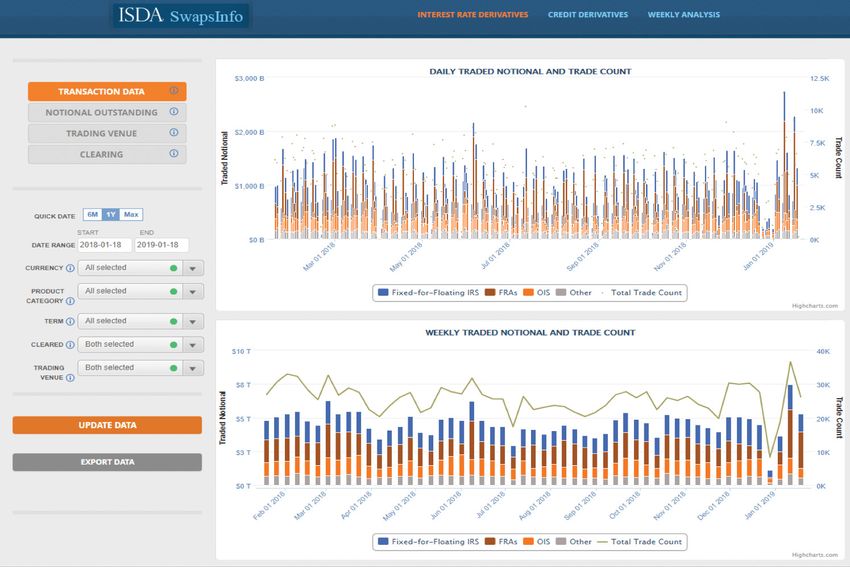
08 IN BRIEF

SEF Trading Spikes After Brexit
Transition Ends
Trading of euro- and sterling-denominated interest rate                     to the UK DTO to trade with or on behalf of EU clients subject to
derivatives (IRD) on US swap execution facilities (SEFs) rose sharply       the EU DTO on EU venues, so long as those clients have no means of
in January after the Brexit transition period ended on December             accessing SEFs and the EU venue used has the necessary regulatory status
31, 2020 without an equivalence arrangement in place for European           to do business in the UK. This approach will be kept under review and a
Union (EU) and UK derivatives trading venues.                               decision on whether to change it will be made by March 31.
     Average weekly traded notional in euro-denominated IRD on SEFs              While the FCA’s temporary modification of the UK DTO helps
during the first four full weeks of the year was $882.2 billion, up from    EU clients wishing to conduct business with or through UK firms in
$246.2 billion in the first four weeks of 2020, according to ISDA           products subject to the EU DTO, the approach only addresses part
SwapsInfo.org, which is based on derivatives                                                         of the problem, says Roger Cogan, head of
subject to US regulations reported to the                                                            European public policy at ISDA.
Depository Trust & Clearing Corporation and                “Brexit will impact the                       “EU and UK authorities have it in their
Bloomberg swap data repositories. For sterling-                                                      power to resolve the other major issues faced
denominated IRD, the average was $567.6                functioning of markets and by firms in their jurisdiction, including the
billion for the first four weeks of 2021, up from     will inevitably result in some inability for EU and UK dealers to trade with
$395.9 billion in the first four weeks of 2020.         fragmentation of liquidity”                  each other in products subject to the DTO on
     Following the end of the Brexit transition                                                      EU or UK venues, the inability of UK branches
period, a barrier exists for EU and UK firms                   Fabrizio Planta, ESMA                 of EU-nexus firms to trade with third-country
that want to trade derivatives with each other                                                       clients or other UK branches of EU firms,
that are subject to the EU and UK derivatives                                                        and the inability of UK-nexus firms to use
trading obligations (DTOs), because the EU DTO requires                     EU venues to trade with third-country clients in contracts subject to
transactions to be executed on an EU-recognised trading venue, and          the UK DTO. They should find each other’s jurisdictions equivalent,
the UK DTO requires execution to take place on a UK-recognised              preventing this balkanisation of the market and negative pricing and
venue. Without equivalence between EU and UK trading venues, in-            liquidity impacts for firms in their own jurisdictions,” says Cogan.
scope trades between EU and UK counterparties can only take place                Speaking at the ISDA event on December 2, Gilles Hervé, policy
on US SEFs, which are recognised by both jurisdictions.                     officer at the European Commission, said European authorities had
     In a statement on November 25, the European Securities                 listened to the challenges and would monitor the situation, but
and Markets Authority (ESMA) confirmed the EU DTO would                     reiterated the view that changes were unlikely.
apply without changes after the Brexit transition period. While                  “We always knew that Brexit would have consequences on
acknowledging this would create challenges, it insisted this would          financial markets and on market participants. The idea is to reduce
not create risks to the stability of the financial system.                  the consequences to the best extent, but we are living in a complicated
     “Brexit will impact the functioning of markets and will inevitably     world where the things that could be seen as pragmatic are mixed
result in some fragmentation of liquidity. While this is unfortunate,       with political decisions,” said Hervé.
I believe it is an unavoidable consequence of the decision of the UK
to leave the EU,” said Fabrizio Planta, head of markets and data
reporting department at ESMA, speaking at ISDA’s European public             SEF IRD TRADED NOTIONAL (US$ BILLIONS) 2020-2021
policy event on December 2.
     However, others have warned this could have severe consequences
for liquidity and pricing. Speaking in a keynote address at the same
event, Robert Ophèle, chairman of France’s Autorité des Marchés
Financiers, noted that even though some trading platforms had
established EU venues ahead of the end of the transition period, it
does not mean liquidity in all instruments will concentrate in Europe.
     “For these instruments, there is therefore a huge probability that
European firms’ ability to tap deep liquidity pools for derivatives
pricing will be impaired, despite the relocation to the US of part of
their trades and, consequently, also of their clearing,” said Ophèle,
adding that he hoped the EU DTO could be re-scoped by product
and/or be territorially adjusted.
     In response to the challenges, the UK Financial Conduct Authority
(FCA) announced on December 31 that it would allow firms subject            Source: DTCC/Bloomberg swap data repositories

     ISDA® | www.isda.org
IN BRIEF 09

Report Recommends Reduction in Procyclical IM
Central counterparties (CCPs) generally dealt well with the                          While VM reflects the profits and losses of members and redistributes
market volatility triggered by COVID-19 in March and April 2020,                liquidity so a large increase was unavoidable given the extreme market
but there was a significant increase in both variation margin (VM)              volatility, procyclical IM drains liquidity from the market at greater levels
and initial margin (IM), analysis by the ISDA Clearing Member                   during times of stress. The increases seen globally during the period of
Committee has found.                                                            volatility last year are therefore concerning, the report notes.
    In a paper published on January 6, COVID-19 and CCP Risk                         The ISDA Clearing Member Committee recommends that anti-
Management Frameworks, ISDA explores the impact of the pandemic                 procyclicality tools should be calibrated to ensure margin increases
on CCPs and makes recommendations to reduce the procyclicality in               in response to volatility are less extreme in future. The committee
IM. The analysis is based on responses to questionnaires sent to all major      also recommends greater transparency of CCP models to enable
CCPs and calls held with several between April and August 2020.                 predictability of margin levels during benign and stressed markets
    While there were three small member and some client defaults                for clearing participants.
and close-outs in the US and Europe, none affected market stability or               “The only way to reduce procyclicality is to call for more margin
the capacity of clearing members to meet their financial obligations.           in benign times. That might make clearing more expensive, but there
Other than these defaults, no CCP reported near misses or issues with           needs to be sufficient margin in the system throughout the cycle. This
members paying margin.                                                          is a big discussion area for 2021 so the industry and regulators need
    The stability of CCPs during the most volatile market period                to find the right balance between the cost of clearing and financial
since 2008 reflects the resilience of the system, high levels of capital        stability,” says Ulrich Karl, head of clearing services at ISDA.
among clearing members and quick intervention by central banks to
bolster liquidity during the crisis, the study found.                             Read the ISDA paper here: bit.ly/2MS0hae

EC Calls on Industry to Reduce UK Clearing Post-Brexit
The 18-month temporary equivalence                  “We expect the industry to list the technical problems and
granted to UK central counterparties
(CCPs) by the EU will not be extended,              find solutions to these problems”
and EU market participants should work              Gilles Hervé, European Commission
now to tackle any problems preventing
them from reducing their exposure to UK
clearing houses, according to a European                 Speaking on the same panel, Emma                  out of positions on UK CCPs and reopening
Commission (EC) official speaking at ISDA’s         Tan, vice president of regulatory affairs at           them on EU CCPs, and that in itself would
European public policy virtual event on             JP Morgan, said the industry had “got the              bring pricing and volatility concerns if the
December 2.                                         message” that there would be no extension              whole industry was trying to do that at the
    “We expect the industry to list the             of the temporary equivalence, but noted                same time,” she said.
technical problems and find solutions to            there are a variety of factors that influence              In response, Hervé said regulators
these problems, not use technical problems          a client’s decision on where to clear.                 would work with market participants to find
as an excuse, as a wall of technical                     “Clients and firms will always want               solutions to the issues, but noted EU CCPs
problems that could be unsurmountable               to clear at places that provide them with              already provide good liquidity and pricing
and that would make the commission                  the best prices, the deepest liquidity and             for euro-denominated interest rate swaps
in the position to be forced to renew an            the greatest netting efficiencies, and that            – something clearing members should be
equivalence decision, because yes, this is          is going to drive a lot of decisions,” she             making clear to their clients.
the last one. This is the last 18 months that       said.                                                      “I think it is something for financial
we are providing the industry,” said Gilles              Any initiative by the industry to collectively    intermediaries to sell to their clients. Of
Hervé, policy officer at the EC.                    move clearing from the UK to the EU could              course, the clients, they don’t want to think
    In September 2020, the EC adopted               fall foul of antitrust authorities, she added.         too much about the post-trade and about
a time-limited equivalence decision for             In addition, there are potential systemic              clearing – they want to do things the way
UK CCPs, explicitly stating that market             risks associated with moving cleared legacy            they used to do. But I think if they are sold
participants should use the time to reduce          portfolios from the UK to the EU.                      something interesting, then they might be
their reliance on these infrastructures.                 “That would obviously require the close           attracted to it,” he said

                                                                                                                                      ISDA® | www.isda.org
10 IN BRIEF

COVID Crisis Highlights Need to
Reduce Trading Book Procyclicality
Analysis of the impact of market                  procyclicality in the revised trading book           exceeds VaR estimates more than four times
volatility in March and April 2020 on             capital standards,” said Scott O’Malia, ISDA’s       in a year, with the multiplier increasing as the
trading book capital requirements has             chief executive, during his opening remarks at       number of exceptions continues to climb.
demonstrated the importance of reducing           the ISDA Trading Book Capital virtual event          As a result of the crisis, regulators in several
procyclicality in the final Basel III standards   on November 19, sponsored by EY.                     jurisdictions moved quickly to smooth the
due for implementation in January 2023.                                                                volatility induced procyclical effect of the
    An analysis of 20 banks compiled                                                                   multiplier – for example, by freezing it for a
by ISDA, the Global Financial Markets                   “Consistency in the                            temporary period.
Association and the Institute of International      timing and content of the                               The new trading book capital
Finance showed a sharp increase in trading        requirements must remain a                           requirements, now due to be implemented
book risk-weighted assets (RWAs) during                                                                by January 1, 2023, are designed to be less
the first quarter of 2020, at the height of       priority as we move through                          procyclical. With legislative proposals on
the COVID-19 crisis. For credit valuation             the legislative process”                         the new requirements expected in the US,
adjustment, RWAs increased by more than                       Scott O’Malia, ISDA
                                                                                                       EU and UK this year, O’Malia stressed
45%, while counterparty credit risk and                                                                the importance of consistency and risk
market risk RWAs rose by 20% and 22%,                                                                  appropriateness.
respectively.                                         For market risk, part of the issue was caused         “Consistency in the timing and content
    “Procyclical capital requirements threaten    by an increase in the number of value-at-risk        of the requirements must remain a priority
to choke off banks’ support for the real          (VaR) backtesting exemptions, caused by              as we move through the legislative process.
economy at a time when it is needed most.         severe market volatility due to the coronavirus      When regulators diverge from globally
During the COVID crisis, some regulators          pandemic. Under the current Basel 2.5 regime,        agreed standards, it introduces additional
stepped in to mitigate these procyclical          banks are required to add a multiplier to their      complexity and can lead to distortions in
effects where possible, but the experience        capital calculations if actual or hypothetical       cost and risk management for internationally
underscores the importance of reducing            P&L over the course of a single trading day          active firms,” said O’Malia.

Pandemic Adds to Basel III Implementation Challenge
The continued spread of the coronavirus pandemic will create                 international affairs at France’s Autorité de contrôle prudentiel et de
additional challenges for banks in their efforts to implement the            résolution, said regulators are striving to meet that new deadline.
final Basel III measures, prompting questions over whether further                 “Even with an extra year, this deadline is certainly challenging,
flexibility from regulators might be necessary.                              taking into account that the banks have to be prepared. But we
     Noting that banks have a number of implementation initiatives           so far have no indication that this deadline is no longer the target
under way simultaneously, Shaun Abueita, partner, financial services         for EU implementation, and everyone is working hard to reach this
and risk consulting at EY, said firms face a complex juggling act.           target,” he said.
     “Understanding those overlaps and interdependencies and                       In a keynote address at the event, Norah Barger, senior adviser,
managing implementation and delivery to avoid duplication of effort          director of supervision and regulation at the Federal Reserve Board,
and inefficiency and regrettable spend is a difficult implementation         said US prudential regulatory agencies would issue a notice of
challenge,” he said, speaking at the ISDA Trading Book Capital               proposed rulemaking for the remaining Basel III measures this year.
virtual event on November 19.                                                This will be followed by a US-specific hypothetical portfolio exercise
     Global regulators acted quickly to provide regulatory relief in         and lengthy comment period, with the aim of implementing the rules
response to the rapid spread of COVID-19 in March and April 2020,            at the start of 2023.
including a one-year delay to the final Basel III measures, which                  “The path of the pandemic can obviously affect any part of this, and
include the Fundamental Review of the Trading Book and the revised           it leads to a lot of the uncertainty that we will have around timing. And
credit valuation adjustment (CVA) framework.                                 it is of course not just the pandemic, but also what happens in terms
     Speaking on a separate panel, Frédéric Hervo, director for              of the general economy because of the pandemic,” said Barger.

     ISDA® | www.isda.org
INTRODUCTION 11
THE COVER
PACKAGE
Going Green
As the world focuses on tackling climate change, derivatives will play an important
role in transitioning to a green economy
There is no doubt that tackling climate change will be one of the greatest challenges of our age.
Governments around the world have recognised the need to reduce carbon emissions, with a common
target to reach net-zero emissions by 2050 to protect the future of the planet.
This will require the contribution of many different sectors, but the financial world will be critical
in mobilising the funding needed to transition to a green economy. Issuance of green bonds to finance
sustainable projects has been rising rapidly and this will continue as the pace of change accelerates.
The derivatives market also has a vital role to play in enabling issuers and investors to manage
the risks associated with this transition. Conventional derivatives can be used to hedge green
instruments, but a new wave of sustainability-linked derivatives and exchange-traded environmental,
social and governance (ESG) derivatives has also developed in recent years, alongside emissions
trading derivatives, renewable energy and renewable fuels derivatives, and catastrophe and weather
derivatives.
This issue of IQ explores recent developments at both the policy and industry levels. While
ESG markets are growing quickly, a survey of ISDA members suggests a consensus on global ESG
standards and metrics is necessary to ensure consistency, alongside greater clarity on regulatory,
capital and accounting standards.
Regulators are increasingly engaged in these and other issues. In September 2020, the US
Commodity Futures Trading Commission (CFTC) published a major report on managing climate
risk that listed 53 recommendations, with the most urgent being to establish a price for carbon.
The incentives to reduce emissions are currently too low and the pricing of carbon is the only way
to reverse this, says Bob Litterman, founding partner at Kepos Capital and chair of the CFTC
committee that produced the report (see pages 18-20).
A further report published by ISDA in January outlines the range of product structures and
transaction types that make up the universe of ESG-related derivatives (see pages 21-25). Given
the urgency of climate change and the need for concerted action, supporting the development of
sustainable finance will be a priority for ISDA and the derivatives industry in 2021 and beyond.
“It is important that everyone in society helps to get
this transition right, and the derivatives market has
a major role to play”
Eric Litvack, chairman, ISDA
ISDA® | www.isda.org12 SUSTAINABLE FINANCE
* Scaling a
Market
As countries around the world step up their efforts to reduce carbon emissions,
the derivatives market will be critically important in managing risks and
facilitating the transition to a green economy
In the annual Reith Lectures, broadcast by the BBC in role to play in facilitating the financing of the transition.
December 2020, former Bank of England governor Mark There is consensus on the need for coordinated action on
Carney set out to explore the trade-off between financial climate change among most countries and policy-makers
value and human value through the prism of three crises – around the world, and ISDA is ready to help the derivatives
the financial crisis, the COVID-19 crisis and the climate market to forge a critical evolutionary path when it comes
crisis. The challenge of shifting economies to net-zero to sustainable finance,” says Eric Litvack, chairman of ISDA.
carbon emissions over the coming years, he concluded,
will need to involve every company in every sector in every Towards net zero
country in the world. The inauguration of Joe Biden as US president marks a
“Building a sustainable future will be capital intensive significant turning point in the global journey to net-zero
€225 BILLION: after a long period when there’s been too little investment. carbon emissions. The new administration has put climate
Amount of the EU’s It will be job heavy when unemployment is soaring. It will change at the heart of its agenda and has taken immediate
coronavirus recovery be global when we’re being pulled to the local. It’s what steps to rejoin the 2015 Paris Climate Agreement.
package that will be
raised through green the world needs for its future and it’s what we need right Elsewhere, momentum has been building for some time,
bonds now,” Carney declared. with countries around the world setting ambitious targets
With major economies around the world still in the to reduce emissions and with policy-makers working to
grip of the coronavirus pandemic and a new administration support the evolution of sustainable finance.
taking office in the US, Carney’s call to action was a timely For example, the European Union’s (EU) Sustainable
reminder of what it will take to realise the global transition to Europe Investment Plan, which is the investment pillar
a green, carbon-neutral economy over the coming decades. of its Green Deal, is set to mobilise at least €1 trillion
Every industry, every entity and every individual will need to in sustainable investments over the next decade. A €750
play its part. This includes the derivatives market, which will billion recovery package known as NextGenerationEU was
perform a number of vital roles – including allowing market also put in place last year to help repair the economic and
participants to hedge their exposures to environmental, social damage caused by the coronavirus pandemic. With a
social and governance (ESG) assets. Derivatives are also vision of a greener future, 30% of that budget – amounting
essential in facilitating the allocation of capital towards to roughly €225 billion – will be raised through green
sustainable investments, as well as enabling price discovery bonds. European Commission (EC) president Ursula von
and fostering market transparency. der Leyen has pledged to reduce emissions by at least 55%
“It is important that everyone in society helps to get by 2030, putting it on track to reach net zero by 2050.
this transition right, and the derivatives market has a major Europe is not alone. Over the past two years, more
ISDA® | www.isda.orgSUSTAINABLE FINANCE 13
Illustration: James Fryer
than 100 countries around the globe, including the UK, Dealogic. Assets under management at investment funds
Japan and South Korea, have pledged to bring greenhouse with ESG mandates have roughly tripled since 2015,
gas emissions to net zero by 2050. This means emissions with a little more than half of those funds domiciled in
in those countries will be cut drastically over the next 30 the euro area, according to the European Central Bank.
years, and any emissions must be balanced by schemes that Given the ambitious targets countries have set themselves,
offset the equivalent amount of greenhouse gases, such as the demand for sustainable financial products is likely to
tree planting or carbon capture technologies. continue growing in the years to come.
The financial sector will be critically important in “The financial sector is responding to the challenge of
meeting these targets, both by reducing its own emissions climate change and emissions reduction in myriad ways:
and by financing the broader transition. Green bonds by supporting ‘green capital’ issuance, developing green
that raise funds for projects delivering environmental investment products, offering risk management solutions
benefits have been growing in recent years, with global to hedge risk, and providing financing that enables green
issuance exceeding $250 billion in 2019, representing power initiatives to scale. The rapid growth of sustainable
around 3.5% of total global bond issuance, according to finance will require the full support of policy-makers,
“It is important that everyone in society
helps to get this transition right, and the
derivatives market has a major role to play
in facilitating the financing of the transition”
Eric Litvack, ISDA
ISDA® | www.isda.org14 SUSTAINABLE FINANCE
“Capital will flow very precisely in the direction
that the incentives give – where you can make
profits – and capital won’t flow where those
incentives don’t direct it. That’s why all the
participants in financial markets unanimously
agree that we’ve got to price carbon”
Bob Litterman, Kepos Capital
regulators and the derivatives industry to ensure the identify projects and investments that are in line with
market operates safely and efficiently and the risks are the EU’s sustainability goals. In addition, new disclosure
properly managed,” says Steven Kennedy, global head of obligations will pave the way towards greater transparency
public policy at ISDA. on sustainability through the Taxonomy Regulation,
the EU Disclosures Regulation and the Non-Financial
Developing policies Reporting Directive, which is being reviewed to enhance
As with any nascent, fast-growing financial market, the quality of ESG information that companies are
effective oversight will be key to the long-term success and expected to disclose.
viability of sustainable finance. The EC adopted an action ISDA has worked with other trade associations to
plan on financing sustainable growth in 2018 that has respond to multiple consultations as the EU taxonomy
formed the basis of its work in this area. Its building blocks and disclosure requirements have evolved over the past
include the creation of a clear and detailed EU taxonomy year. These responses have consistently made the case
to classify sustainable finance activities, the incorporation that financial market participants need to be able to use
of sustainability into risk management practices, the derivatives in an ESG context, as their use can increase
creation of new categories of low-carbon benchmarks and liquidity and the supply of credit to the market.
the strengthening of sustainability disclosures. The EC is ISDA’s policy work on sustainable finance extends
expected to launch a more comprehensive and ambitious beyond Europe, however. In December 2020, ISDA
strategy in March to accelerate the pace of transition to a replied to the International Financial Reporting Standards
low carbon economy. Foundation’s consultation paper on sustainability
“The idea is really that we want to mobilise every level reporting, welcoming the prospect of global standards that
and every actor in finance, from the investee companies build on existing practices and take regional and sectoral
and the issuers to the financial market participants, retail characteristics into consideration.
investors and institutional investors. In every decision “There are many different sustainable finance
that is being taken by these actors in financial markets, initiatives being pursued by policy-makers around the
ESG considerations should play a role and that is what world to support the transition to a greener economy and
we want to achieve with the various initiatives we have there is certainly a risk of fragmentation, so we would
already launched,” said Sven Gentner, head of unit for asset very much support and welcome a globally coordinated
management in the EC’s directorate-general for financial international approach to disclosures and other key policy
stability, financial services and capital markets union. objectives,” says Stevi Iosif, director of European public
Speaking at a virtual conference hosted by ISDA policy at ISDA.
on ESG and derivatives in September 2020, Gentner
highlighted the benefits of the EU taxonomy. This Pricing carbon
is intended to act as a basic language to define what is One important international development in recent
sustainable, enabling financial market practitioners to months has been the work of the Taskforce on Scaling
ISDA® | www.isda.orgSUSTAINABLE FINANCE 15
Voluntary Carbon Markets, which is sponsored by the immediately,” said Bob Litterman, chairman of the
Institute of International Finance and was launched in climate-related market risk subcommittee and founding
September 2020 by Mark Carney, now United Nations partner at Kepos Capital, in a recent edition of ISDA’s
special envoy for climate action and UK prime minister podcast, The Swap.
Boris Johnson’s finance adviser for the COP26 conference. In recent months, officials in the US have clearly
As efforts to reduce emissions gather pace around the recognised the critical role the financial services industry
world, the taskforce estimates the voluntary carbon market will play in tackling climate change. At a recent global
will need to grow by more than 15 times by 2030 to summit, John Kerry, the former secretary of state appointed
support the rising demand for voluntary offsetting. by president Biden as the first special presidential envoy for
The taskforce moved quickly to establish a roadmap climate, said the US government intends to significantly
for the development of a well-functioning, transparent increase the flow of funding to adaptation efforts.
and resilient voluntary carbon market, publishing a Meanwhile, the Federal Reserve has now joined the
consultation document in November 2020. The paper Network of Central Banks and Supervisors for Greening
makes a series of recommendations covering the principles, the Financial System (NGFS). Established in 2017, the
infrastructure and other components needed for an NGFS provides a forum for public-sector entities to
effective voluntary carbon market, and a final blueprint share best practices and contribute to the development
was published on January 27. of environmental and climate risk management. The
One of the taskforce’s recommendations is to create addition of the Fed, the European Securities and Markets
carbon spot and futures contracts, with the aim of more Authority and six other new members in December 2020
efficiently matching suppliers’ products with buyers’ brings participation in the NGFS to 83 central banks and
preferences. Critically, this would provide a daily reference supervisors and 13 observers, representing around 75% of
carbon price for a standardised product. global emissions.
In the US, a landmark paper, Managing Climate Risk Speaking at the ISDA event in September, Morgan
in the US Financial System, published in September 2020 Després, deputy head of the financial stability department
by the climate-related at the Banque de France
market risk subcommittee and head of the NGFS
of the Commodity Futures secretariat, explained
Trading Commission’s that the creation of the
(CFTC) market risk NGFS was triggered by a
advisory committee,
also recognised the
“Climate risk has a recognition that climate
risk is not always properly
critical importance of
carbon trading. Financial
number of specificities. priced and managed. The
official sector needs to
markets will only be able
to efficiently channel It’s not a random risk – collaborate to develop
the necessary supervisory
resources to activities practices and tools to
that reduce emissions
if a price on carbon is
not something you can address this, he said.
“Climate risk has a
in place at a level that
reflects the true social cost
forecast or predict with number of specificities. It’s
not a random risk – not
of emissions, the paper
noted. Establishing a price a very great level of something you can forecast
or predict with a very great
on carbon was listed as the level of certainty. As we
most urgent of the report’s
53 recommendations
certainty” usually say, it’s foreseeable
but not predictable. It’s not
to mitigate the risks to Morgan Després, Banque de France something that is linear –
financial markets posed by you have tipping points,
climate change. and so it’s quite difficult to
“Capital will flow very capture that. You cannot
precisely in the direction just copy and paste the
that the incentives give current risk methodologies
– where you can make profits – and capital won’t flow and use them for climate risk analysis. You also need to
where those incentives don’t direct it. That’s why all the have a forward-looking approach to your risk, because
participants in financial markets unanimously agree that it’s going to develop over a longer time horizon,” Després
we’ve got to price carbon. We’ve got to create appropriate explained.
incentives to reduce emissions and we’ve got to do it In July 2020, the Financial Stability Board (FSB)
ISDA® | www.isda.org16 SUSTAINABLE FINANCE
6%
4%
10%
published a stocktake “Clearly, there is a massive
of financial authorities’ Chart 1: How would you assess need for investment in the
experience in including the potential growth opportunity coming years and there
physical and transition in the ESG derivatives markets over will be room for the
climate risks as part of the next decade? development of new and
their financial stability more specific types of
50%
monitoring. The paper ■ Strong growth derivatives but, broadly, the
notes that climate-related ■ Moderate growth existing derivatives market
risks may affect how the ■ Some growth is already fit for purpose to
global financial system ■ Minimal growth support this financing. Just
responds to shocks. In its ■ Not sure/none of the above as you can use a standard
2021 work programme, the shovel to dig an irrigation
FSB committed to exploring 30% canal or a screwdriver to build
ways to promote globally a wind generator, conventional
comparable, high-quality and interest rate swaps can and should
auditable standards of ESG disclosures, be used to hedge the issuance of green
as well as reviewing regulatory and bonds,” says Litvack.
supervisory approaches to addressing climate The role of derivatives in managing climate
risks at financial institutions. risk is highlighted in the CFTC report and explored in
Source: ISDA ESG greater detail in a July 2020 paper, Derivatives in Sustainable
Member Survey,
The role of derivatives November 2020
Finance: Enabling the Green Transition, published by
Given the critical role of the financial sector in facilitating the Centre for European Policy Studies (CEPS) and the
the transition to a more sustainable, carbon-neutral European Capital Markets Institute (ECMI). A further
economy, derivatives are set to play an important part. paper published by ISDA in January 2021 provides
One element of this is the hedging of interest rate, foreign an overview of ESG-related derivatives products and
exchange and credit risks resulting from the issuance of transactions that have emerged in recent years, including a
trillions of dollars of capital that will be required to finance new breed of bespoke sustainability-linked derivatives, ESG
the transition. Hedging exposures to green bonds will, for exchange-traded derivatives, emissions trading derivatives
the most part, be achieved using conventional products and renewable energy derivatives (see pages 21-25).
like interest rate swaps and credit default swaps, but a As the CEPS-ECMI report noted, derivatives enable
variety of other derivatives have developed in recent years businesses to better manage their risks and also enhance
(see pages 21-25). transparency through the provision of forward information
on the underlying commodities, securities or assets,
contributing to long-term sustainability objectives. While
Chart 2: Which factors do you think will be most important to the
conventional derivatives will be used to hedge interest rate
growth and liquidity of ESG-related derivatives?
and other risks arising from the financing of the transition
to a green economy, there is also demand for ESG-related
Greater market understanding derivatives products that link returns with sustainability
of product structures and how 73% performance and impact.
they relate to ESG goals Such sustainability-linked derivatives come in varying
forms, with differing key performance indicators (KPIs)
Clarity on regulatory/capital/ that are typically tailored to the bespoke needs of the
margin treatment/accounting 53% issuer. One of the earliest examples was a ‘sustainability
standards improvement derivative’, executed by Dutch bank ING
in August 2019 to hedge the interest rate risk of a $1
Development of a consensus billion five-year floating rate revolving credit facility. The
73% derivative adds a positive or negative spread to the fixed
on ESG standards and metrics
rate set at the inception of the swap based on the issuer’s
ESG performance.
Enhanced legal
“ESG has clearly become much more mainstream
documentation for ESG 40%
in recent years, and the sustainability improvement
derivatives
derivative was an extension of the work we had done with
sustainability improvement loans. Setting effective KPIs
Other 2%
that go out to three or more years is really important if these
structures are to have a real impact on the sustainability
Source: ISDA ESG Member Survey, November 2020 of a company. There have now been lots of different types
ISDA® | www.isda.orgSUSTAINABLE FINANCE 17
Chart 3: Do you agree or disagree with the
of transactions and we welcome the EU’s effort
following statement: derivatives are
to bring greater standardisation to the market
neither green nor brown and regulation
with the taxonomy and other initiatives,”
and supervision of derivatives
says Bernard Coopman, global head of the
activities should reflect this?
client solutions group at ING.
Bespoke sustainability-linked Agree - 62%
derivatives have developed alongside
exchange-traded derivatives in recent
years, with multiple exchanges launching Disagree - 38%
new contracts linked to ESG benchmarks.
“The demand for ESG derivatives has
increased more rapidly than any other segment
over the past year, and the pandemic has acted as Source: ISDA ESG Member Survey, November 2020
a catalyst for investors to think more about socially
responsible investing and to move faster in that direction. contracts or indices beyond those already covered in
The demand we have seen has been mainly in Scandinavia existing documentation templates.
and Europe, but there is no doubt that president Biden’s ISDA templates have been used for many years
focus on climate change in the US will filter down to asset to support trading of certain types of environmental
managers and investors and further accelerate the growth in derivatives, including those referenced to weather and
this segment,” says Zubin Ramdarshan, head of equity and natural catastrophe transactions, but substantial work has
index product research and development at Eurex. taken place in recent months to extend this. Templates
have already been expanded to include RECs, and ISDA
Developing documentation will further develop its suite of documentation to meet
Given the growing focus on sustainable finance across the member demand in the months ahead.
globe and the likely acceleration of issuance in the months “There is a distinction in ESG derivatives between
and years ahead, ISDA has been working to identify the transactions that reference a green underlying such as a
industry’s priorities in this area. In November 2020, more renewable energy certificate and transactions based on ESG
than 200 members were surveyed on issues ranging from indices or share baskets. The survey highlighted demand for
legal documentation to capital requirements, so that the development of documentation to improve efficiency
resources can be effectively allocated to meet their needs. in both areas and this is where we will focus our efforts in
Respondents clearly indicated they expect the ESG 2021,” says Peter Werner, senior counsel at ISDA.
derivatives markets to grow significantly over the next
decade (see Chart 1) and identified certain factors that
would be important to support that growth. These include
greater understanding of product structures and how they FURTHER READING
relate to ESG goals, clarity on regulatory, capital, margin
and accounting standards, and the development of • Derivatives in Sustainable Commodity Futures Trading
consensus on ESG standards and metrics (see Chart 2). On Finance: Enabling the Green Commission, September 2020:
the important issue of classification, 62% of respondents Transition, Centre for European bit.ly/2NurOPx
agreed with ISDA’s view that derivatives are neither green Policy Studies, European Capital • Taskforce on Scaling Voluntary
nor brown and the future path of regulation should reflect Markets Institute, July 2020: Carbon Markets Consultation
this (see Chart 3). bit.ly/393XEuJ Document, Institute of
“By surveying our members, we were able to clearly • Financial Stability Board International Finance, November
identify their priorities and expectations. There is certainly Stocktake of Financial 2020: bit.ly/361yTgI
growing interest in ESG derivatives and market participants Authorities’ Experience • Financial Stability Board Work
have highlighted standardisation and understanding of in Including Physical and Programme for 2021, January
products as priorities. The market is still at a relatively early Transition Climate Risks as 2021: bit.ly/3pnYacF
stage of development, with different KPIs across different Part of Their Financial Stability • Overview of ESG-related
products, but we will work with policy-makers and market Monitoring, July 2020: Derivatives Products and
participants to support effective risk mitigation, product bit.ly/39pmIwg Transactions, ISDA, January
innovation and standardisation,” says ISDA’s Kennedy. • Managing Climate Risk in 2021: bit.ly/3c1gpAU
The survey also indicated widespread support for a the US Financial System, • The Swap podcast episode 6,
range of new ESG documentation projects, including Climate-related Market Risk Derivatives and Sustainable
ESG derivatives, renewable energy certificates (RECs) Subcommittee, Market Risk Finance, January 2021:
and emissions allowance transactions. This would involve Advisory Committee of the US bit.ly/3pGxrIx
creating or amending definitions to reference specific
ISDA® | www.isda.orgYou can also read


