Guide to the use of the Royal College of General Practitioners (RCGP) Self Care for Minor Ailments e-learning course
←
→
Page content transcription
If your browser does not render page correctly, please read the page content below
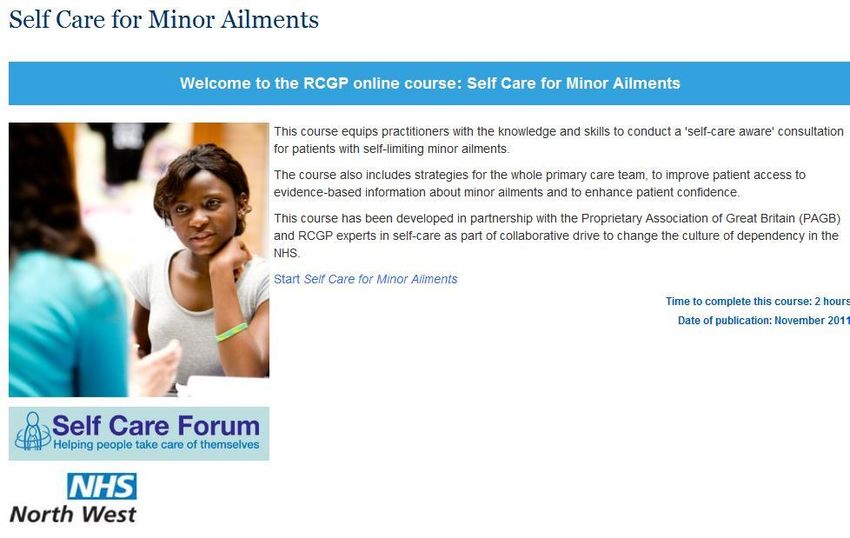
Minor ailments

 Part of a series of guides for pharmacists and pharmacy technicians

Guide to the use of the
Royal College of General
Practitioners (RCGP) Self Care for
Minor Ailments e-learning course

          Educational solutions for the NHS pharmacy workforce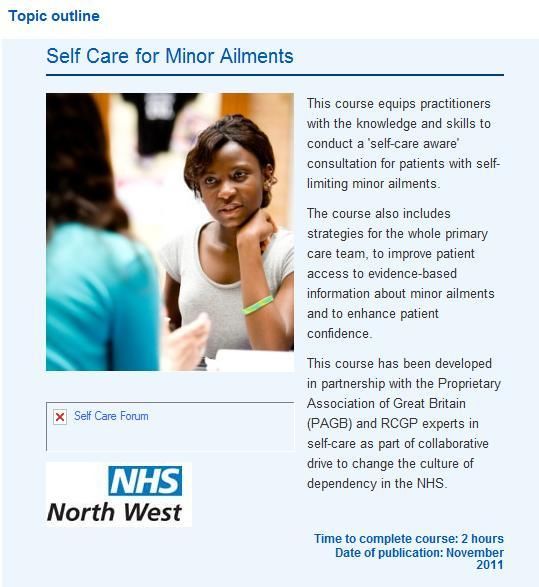
Acknowledgements
Lead writer and programme developer
Anne Cole, regional manager, South West

Reviewers
Gopa Mitra, director of health policy and public affairs, Proprietary Association of
Great Britain (PAGB)

Susan Summers, head of long-term conditions, NHS England

Professor Nigel Sparrow, head of revalidation, Royal College of General
Practitioners (RCGP) and medical advisor, CQC

Clare Kerr, head of Condition Development, Celesio UK

CPPE reviewers
Chris Cutts, director, CPPE

Paul Davies, local tutor, Newcastle upon Tyne, North Tyneside and
Northumberland

Editor
Isabel Dennis, Outset Publishing

Thanks
CPPE acknowledges the support of the Royal College of General Practitioners
(RCGP) self care training steering group for allowing us to use their resource,
Self care for minor ailments e-learning course, as the basis for this guide.

Published in June 2013 by the Centre for Pharmacy Postgraduate Education, School of
Pharmacy and Pharmaceutical Sciences, University of Manchester, Oxford Road,
Manchester M13 9PT. http://www.cppe.ac.uk

Guide to the use of the RCGP
Self Care for Minor Ailments e-learning course

Welcome to this guide
The Centre for Pharmacy Postgraduate Education (CPPE) has developed this
guide as part of a series of learning and support resources for minor ailments.

Learning with CPPE

About CPPE
The Centre for Pharmacy Postgraduate Education (CPPE) offers a wide range of
learning opportunities in a variety of formats for pharmacy professionals from all
sectors of practice. We are funded through the NHS Multi-professional Education
and Training Fund from Health Education England to offer continuing professional
development for all pharmacists and pharmacy technicians providing NHS
services in England. For further information about our learning portfolio,
visit: http://www.cppe.ac.uk

CPPE guides
We have developed a series of guides within our learning portfolio to advise you
and support your learning in many different areas. Each guide covers a range of
approaches to help you develop and apply key skills and techniques to your own
practice.

Many of the guides provide toolkits to help you to document and plan your
development, while others demonstrate pharmacy-specific situations to help you
put your learning into context. Some of them recommend that you work with a
mentor to support you in your development.

Our full portfolio of guides is online at: http://www.cppe.ac.uk/guides

1
                                                         www.cppe.ac.uk/guides
Guide to the use of the RCGP
Self Care for Minor Ailments e-learning course

About this guide for pharmacy professionals to
the use of the RCGP self care for minor ailments
e-learning course

The Royal College of General Practitioners (RCGP) self care for minor ailments
e-learning course was developed in partnership between the Proprietary
Association of Great Britain (PAGB) and RCGP experts in self care, as part of a
collaborative drive to promote self care and change the culture of dependency in
the NHS. The course provides general practitioners (GPs) with the knowledge
and skills to conduct a 'self care aware' consultation for patients with self-limiting
minor ailments. The course also includes strategies for the whole primary care
team to improve patient access to evidence-based information about minor
ailments and enhance patient confidence in self care.

Background
Self care is about encouraging and empowering people to take care of their own
health. By promoting this concept among patients and increasing awareness that
there are alternatives to GP appointments, it is hoped that patients will be more
likely to explore self care in the future, before making an unnecessary
appointment with their GP.

A report published by Deloitte1 in 2012 looked at the capacity and capability of
general practice now and in the future. The report highlights the need for general
practice to work differently to cope effectively with the increasing demands it
faces. This is especially important now because demand is set to rise as people
are living longer. If people are not equipped with the knowledge to look after
their own health and the pattern of consultations remains unchanged, the report
predicts that by 2035 there could be a total of 433 million GP consultations, of
which 180 million would be for people aged 65 and over, nearly double the
current number.

According to the report, general practices need to improve information for and
communication with patients, and develop self care educational strategies to
enable patients to take care of their own health.

The report suggests that healthcare professionals do not always encourage
patients to self care, or provide them with enough information to make them feel
empowered and confident to do so. As a result, patients will return to their GP
for continued advice and support. Multiple interventions are often required to
prompt patients to consider self care. The NHS needs to ensure that patients are
consistently encouraged and informed about self care at every intervention, at
every level of the NHS, in order to facilitate this behaviour change.

2
                                                            www.cppe.ac.uk/guides
Guide to the use of the RCGP
Self Care for Minor Ailments e-learning course
Relevance to pharmacy
Self care in the pharmacy context is about the pharmacist and pharmacy staff
providing advice and support, to enable the public to get the maximum benefit
from caring for themselves or their dependants.
Community pharmacies are ideally suited to support people with long-term
conditions to self care, because:
pharmacies are located where people live, shop and work in all
communities, including the most deprived areas
both well and unwell people frequently use pharmacies
pharmacies provide the mainstay of advice for the general public on self
care of minor ailments and are often the first port-of-call when a condition
arises
more products are being reclassified from prescription-only to pharmacy
only medicines, providing pharmacists with an increasingly broad range of
treatments to offer those seeking to self care, including medicines for the
prevention of disease
the degree of access that community pharmacy enjoys means that
services aimed at supporting people to change their lifestyles, for
example: smoking cessation, weight management and sexual health
services, have an impact and reach when provided from a pharmacy
setting, which is unrivalled in primary care
pharmacies provide convenient locations for providing diagnostic and
therapeutic monitoring services that help people to care for their own
condition effectively
pharmacy professionals can also support those who are self monitoring at
home, with advice on both management of their condition and the quality
control and interpretation of the testing process itself.
3
www.cppe.ac.uk/guidesGuide to the use of the RCGP
Self Care for Minor Ailments e-learning course
Purpose of this guide
The RCGP self care for minor ailments e-learning course is written primarily for
GPs; however, it is recognised that it is essential for all healthcare professionals,
including pharmacy, to be involved in the promotion of self care in order for
widespread behaviour change among patients to take place. Pharmacy
professionals are already comfortable with the management of minor ailments
and supporting patients’ choice of over-the-counter (OTC) medicines.
Supporting self care fits well with this existing, holistic approach that pharmacy
already takes to the care of patients.
The purpose of this guide is to:
provide instructions for accessing and using the RCGP e-learning course
support pharmacy professionals to gain the most from the course
provide contextual information for pharmacy practice
support pharmacists to promote self care of long term and acute
conditions
promote inter-professional working
ensure that pharmacy professionals have parity in terms of access to
learning in order to deliver similar self care messages as other healthcare
professionals.
It is expected that this guide will be used by pharmacy professionals, in
conjunction with the e-learning course.
To view video clips and animations in the e-learning course, you will need Adobe
Flash Player installed on your computer. There is a link on the course menu
screen to download this when you reach that stage.
4
www.cppe.ac.uk/guidesGuide to the use of the RCGP
Self Care for Minor Ailments e-learning course
Definitions
A minor ailment can be defined in many ways. In this course, it is considered a
straightforward, common, usually self-limiting condition, which may require little
or no medical intervention.
Self care is a part of daily living and can be defined as the care taken by
individuals towards their own health and well-being. This includes the care
extended to their children, family, friends and others in their neighbourhoods and
local communities. Self care includes the actions individuals and carers take for
themselves, their children and their families to stay fit and maintain good
physical and mental health; meet social, emotional and psychological needs;
prevent illness or accidents; care for minor ailments and long-term conditions;
and maintain health and wellbeing after an acute illness or discharge from
hospital (Department of Health, 2005).
Supporting self care is about working in partnership, in a process of two-way
communication, negotiation and decision-making, in which the individual and the
healthcare professional contribute to the care planning process to achieve the
best possible outcomes; it is not about care professionals handing over
responsibility to the patient (Skills for Health and Skills for Care, 2006).
A note about web links
Where we think it will be helpful we have provided the web links to take you
directly to an article or specific part of a website. However, we are also aware
that web links can change. A new website: http://www.gov.uk/government
encompasses the Department of Health website, as well as the new executive
agency, Public Health England. To search for any Department of Health
publication or information mentioned in this programme either visit
the gov.uk home page and enter the title into the search facility, or search via
Google or your preferred internet search provider.
If you have difficulty in accessing any other web links, please go to the
organisation’s home page and use appropriate key words to search for the
relevant item.
5
www.cppe.ac.uk/guidesGuide to the use of the RCGP
Self Care for Minor Ailments e-learning course
What this guide covers
This guide is divided into the following sections:
Accessing the RCGP self care
for minor ailments e-learning course page 7
Pre-course assessment page 12
Why do people consult with minor ailments? page 15
Principles of managing minor ailments page 19
Improving your practice page 21
Post-course assessment page 22
6
www.cppe.ac.uk/guidesGuide to the use of the RCGP
Self Care for Minor Ailments e-learning course
Accessing the RCGP self care for minor ailments e-learning
course
1. The RCGP e-learning courses can be found at:
http://www.elearning.rcgp.org.uk/selfcare
7
www.cppe.ac.uk/guidesGuide to the use of the RCGP
Self Care for Minor Ailments e-learning course
2. Click ‘Start Self Care for Minor Ailments’.
Registration
3. The first time you access the e-learning course you will need to register with
the RCGP website for an e-learning account.
4. All healthcare professionals, trainees and students can register for a RCGP
e-learning account, which provides free access to selected RCGP courses and
updates. Select ‘click here’ under ‘Register here for FREE access’.
8
www.cppe.ac.uk/guidesGuide to the use of the RCGP
Self Care for Minor Ailments e-learning course
5. Complete the registration details. Enter your GPhC number in place of the
Nursing and Midwifery Council (NMC) number.
6. When you have completed the form click ‘Register’ and you will receive an
email confirming your login details.
7. Return to: http://www.elearning.rcgp.org.uk/selfcare and click ‘Start
Self Care for Minor Ailments’.
8. Enter your login details in the left-hand panel.
9. On the first occasion you follow this process you will be taken to a screen
entitled ‘Site policy agreement’.
9
www.cppe.ac.uk/guidesGuide to the use of the RCGP
Self Care for Minor Ailments e-learning course
10. Once you have agreed to the Site policy agreement you will be taken to the
opening screen.
10
www.cppe.ac.uk/guidesGuide to the use of the RCGP
Self Care for Minor Ailments e-learning course
11. Now work your way through the course by clicking on the links towards the
bottom of the screen, starting with the ‘Pre-course assessment’.
11
www.cppe.ac.uk/guidesGuide to the use of the RCGP
Self Care for Minor Ailments e-learning course
Session 1
Pre-course assessment
The pre-course assessment consists of 23 questions that assess your knowledge,
attitudes and decision-making skills.
The first section (Questions 1-16) prompts you to reflect on your own attitudes
towards supporting patients with minor ailments to self care. You will have a
chance to complete these questions again at the end of the course to compare
your responses. There are no right or wrong answers to this section of questions.
The second section (Questions 17-23) consists of a series of clinical questions
and is concerned with testing your knowledge. These questions will be scored
and you will be able to revisit them again at the end of the course to compare
your results.
Work through and answer all the questions. Although this e-learning course was
written with GPs as the original intended audience and some of the questions in
the pre-course assessment are GP specific, you can still reflect and respond from
your own viewpoint as a pharmacy professional.
For example:
Question 3
This question asks you to rate how likely you are to use the internet to locate
and share information with a patient during a consultation.
Consider your own practice situation; you may be involved in an over-the-
counter patient consultation; a medicines use review (MUR); or you may be a
non-medical prescriber.
The first answer option is: ‘I do this every surgery’; if you do not run ‘surgeries’,
substitute this with: ‘I do this during every consultation’.
If you do not have internet access during your patient consultations choose
answer 5 ‘I never do this’ for this question.
12
www.cppe.ac.uk/guidesGuide to the use of the RCGP
Self Care for Minor Ailments e-learning course
Question 4
Similarly, the first answer option is: ‘I do this every surgery’; which you can
substitute with: ‘I do this during every consultation’.
Question 5
You are asked to rate how likely you are to write a prescription for an over-the-
counter medication. You can amend the question to reflect the pharmacy
context and instead answer: 'How likely are you to recommend an OTC
medication?’.
Question 8
This question asks you how important is it to address the reason why patients
think their minor illness needs a GP opinion in a minor illness consultation.
To give this a pharmacy context imagine a situation where a patient consults you
over the counter, describes a list of symptoms indicative of a minor ailment to
you, and then says to you “I need to see my doctor don’t I?” How important is it
then to address the reason why the patient thinks they need a GP opinion?
Question 10
You are asked to consider how important it is to explore any self care approaches
the patient has already considered before visiting the GP for a minor illness
consultation.
In the pharmacy context this may be a conversation you have when a patient
visits you for advice and/or to purchase an OTC medicine. This conversation
offers you the opportunity to explore how far the patient is prepared to try self
care before making an appointment with their GP. So the question in the
pharmacy context would be: ‘How important is it to explore the patient’s self
care behaviour during their visit to your pharmacy?’
Question 12
This question asks you to choose which options you would consider to be most
important in the promotion of self care. Answer this question from the viewpoint
of your local GP practice(s). It would be interesting to compare your answers to
this question with the answer that your GPs would give, in order to promote
cross professional working.
Question 14
Substitute ‘Feedback from GPs’ as the fifth answer option.
13
www.cppe.ac.uk/guidesGuide to the use of the RCGP
Self Care for Minor Ailments e-learning course
Question 15
Substitute ‘To save NHS resources’ as the fourth answer option.
Question 21
Substitute ‘NHS 111’ as the third answer option.
If you need to break off while completing the pre-course assessment you can
click ‘Save without submitting’ at the bottom of the screen.
Once you are happy with your responses click ‘Submit and finish’.
You will then receive a review of your answers to the pre-course assessment and
a score. By scrolling through the review of answers you will find your score for
each of the individual scoring questions and a summary of the correct answers.
When you have read through this screen click ‘Finish review’ at the bottom of the
screen. You can then select ‘Click here to go to the first lesson’.
Alternatively, if you would like to work through the questions again click
‘re-attempt quiz’.
14
www.cppe.ac.uk/guidesGuide to the use of the RCGP
Self Care for Minor Ailments e-learning course
Session 2
Why do people consult with minor ailments?
This lesson explores the reasons why a patient might seek help with a minor
ailment. It examines the background context within which patients present and
explores the ideas, concerns and expectations of patients with minor ailments
who can be encouraged and supported to self care.
Objectives
After completing this lesson, you will be able to:
define a minor ailment
describe health-seeking behaviour and changes in the lay understanding of
minor ailments
identify the reasons for attendance, by exploring the patient’s ideas,
concerns and expectations
clarify the importance of the context within which the patient presents and
the social factors that influence their ability to self care
develop strategies to encourage patients to self care and to conduct a 'self
care aware' consultation.
Estimated time: 30 minutes
15
www.cppe.ac.uk/guidesGuide to the use of the RCGP
Self Care for Minor Ailments e-learning course
Work through the lesson by clicking on the forward button at the top or bottom
of the screen:
You can view your progress with the lesson on the progress bar at the bottom of
the screen:
Work through the first lesson, completing your responses in the spaces provided.
When you reach the end of the lesson click ‘Yes’ to confirm you have completed
it to activate your CPD certificate.
You can break off at any point during the lesson and return to complete it later.
Pharmacy context for this session
Your previous experiences
This screen looks at consultations and the doctor-patient relationship. In the
pharmacy context you can think about patient consultations with pharmacy
professionals that may occur over the counter in a community pharmacy, or in a
pharmacy consultation room during an MUR or a new medicine service (NMS)
appointment. Depending on your role there may be other occasions when you
consult with patients, perhaps in a surgery or in a patient’s home. As you work
through this part of the course, think about the trust that the patient may have
in your advice (in place of the ‘doctor-patient’ relationship).
Substitute ‘pharmacy professionals’ for ‘GP’ or ‘GPs’ or ‘doctors’, as appropriate.
Feedback
This screen discusses the findings of a study conducted by Ahluwahlia, et al
(2010) about the way GPs deal with situations involving patients coming to a
consultation with information they have gathered from the internet.
In the pharmacy context how you might deal with this situation? Could you apply
the techniques used by GPs in your discussions with patients?
16
www.cppe.ac.uk/guidesGuide to the use of the RCGP
Self Care for Minor Ailments e-learning course
Reasons for consultation – Common minor ailments
This screen contains examples of why people might consult a doctor or practice
nurse for common minor ailments. You can read and listen (if you have speakers
or headphones connected) to the patients’ or carers’ requests by clicking on each
case.
Similar requests for advice about minor ailments may occur in pharmacy. We
have reflected on each scenario below and made suggestions, as appropriate;
although, you may well think of others.
Constipation
Eric may be phoning the pharmacy for advice about his constipation as he is
unable to leave his wife at home alone.
Dermatitis
Katrina may be in your pharmacy describing and showing the rash on her wrist
to you.
Hayfever
Toby may equally be in your pharmacy requesting to buy an antihistamine
over the counter.
Simple headache
Consider this in the pharmacy context of paracetamol previously bought over
the counter. Ewa is now asking whether she can use this during pregnancy.
Upper respiratory chest infection
In the pharmacy context it is unlikely that a mother would ask for a pharmacy
professional to listen to her baby’s chest; however, she might ask you whether
she needs to make a doctor’s appointment.
Addressing attendance reasons
This screen discusses the range of reasons why patients may consult with a
doctor about a minor ailment. Pharmacy professionals play a major role in
helping to reduce unnecessary GP appointments for minor ailments by educating
and signposting patients about self care. In most cases reassurance can be
offered, but bear in mind that patients may also use a minor ailment as a
precursor to discussing more worrying, sensitive or serious problems and it is
essential that any such patients are signposted to their GPs. You may also
contact the GP directly - with the patient’s permission - depending on the
situation and urgency.
17
www.cppe.ac.uk/guidesGuide to the use of the RCGP
Self Care for Minor Ailments e-learning course
Consultation
This screen provides an opportunity to read and view a GP consultation for lower
back pain. As a pharmacy professional it is useful to have an awareness of the
way GPs approach patient consultations for minor ailments.
Try to answer the question on the following screen.
Once you have submitted your answer you will see a ‘Feedback’ screen that
highlights some relevant issues concerning the consultation. The next screen is
a summary of ‘Key points’.
End of lesson
Choose ‘Yes’ and ‘Submit’ on the next screen if you have completed this session.
Then click ‘continue’ to review your responses to the Reflection points, make any
amendments and then click submit once you are happy with them.
You then have the option to:
- print your responses to the reflection questions as a Word document
- go to Session 3
- return to the Self Care for Minor Ailments home screen.
18
www.cppe.ac.uk/guidesGuide to the use of the RCGP
Self Care for Minor Ailments e-learning course
Session 3
Principles of managing minor ailments
This lesson reviews the principles of managing minor ailments; a patient’s reason
for attending, addressing your and the patient’s concerns about serious illness
and using descriptions of the likely path of the illness to agree a shared
management plan.
Objectives
After completing this lesson, you will be able to:
describe the importance of explaining the natural history and trajectory of
self-limiting conditions
explain how the patient can manage their symptoms in the normal
trajectory of the ailment - and how to act if the condition deviates from this
identify red flag symptoms, or signs that indicate a potentially dangerous
condition in minor ailments
explain the need to address the reason for the patient’s attendance and the
techniques and skills required to successfully do so
describe the features of phone/email consulting in comparison with face-to-
face consulting that may influence the practitioner’s decision to prescribe or
to recommend self care measures.
Estimated time: 30 minutes
Pharmacy context for this session
Patient access to advice – Reflection points
How might your approach to over-the-counter healthcare advice for minor
ailments influence the patient’s subsequent expectations of their GP?
Consider what percentage of patient consultations in your pharmacy are not
face-to-face, then consider your most recent five telephone consultations as
described in the question.
Have you met with your local GPs to discuss your approach to patients with
minor illness? Such a meeting may be helpful in establishing a common
understanding and approach and encourage GPs to refer patients with minor
illnesses to you to obtain over-the-counter medicines, thereby increasing the
likelihood that the patient will consider this as their first option the next time
they have a concern.
Scenario 1
Approach this scenario in the context of Mrs P calling into your pharmacy for an
over-the-counter consultation and complete your responses to the further
questions you would ask Mrs P.
Take a look at the Clinical Knowledge Summary ‘Headache tension type’ for more
information: http://www.cks.nhs.uk/headache-tension-type
19
www.cppe.ac.uk/guidesGuide to the use of the RCGP
Self Care for Minor Ailments e-learning course
Scenario 2
Approach this scenario in the context of a telephone call from Mrs A to your
pharmacy for advice. She is asking whether she should give paracetamol to her
two-year-old child or if she should make an appointment to see the doctor.
Complete your responses to the further questions you would ask Mrs A. Then
decide on the action you would take as a result of the additional information you
are provided about the case.
Would you sell paracetamol over the counter in this case?
What would you advise Mrs A to do?
Do you need to contact anyone else, if so, who and when?
Reflect on how confident you feel in dealing with this type of case over the
telephone.
Feedback (for Scenario 2)
Take a look at the Clinical Knowledge Summaries:
- ‘Feverish children - risk assessment’
http://www.cks.nhs.uk/feverish-children-risk-assessment
and
- ‘Feverish children – management’
http://www.cks.nhs.uk/feverish-children-management
The consultation so far
You are now given the opportunity to revisit the patient/GP consultation for lower
back pain that you viewed and listened to in Session 2 (Why do people consult
with minor ailments?) Once you have reminded yourself about part 1, listen to
part 2 of the consultation where the GP encourages the patient in self
management of the minor ailment.
Listen to the video clips and complete your responses to the questions on the
next few screens in the boxes provided.
20
www.cppe.ac.uk/guidesGuide to the use of the RCGP
Self Care for Minor Ailments e-learning course
Session 4
Improving your practice
This lesson covers the processes in practice that may encourage or hinder self-
treatment of minor ailments and how efforts to encourage self care might be
introduced and evaluated.
Objectives
After completing this lesson, you will be able to:
describe the impact on the NHS of managing minor ailments, including the
direct and indirect costs and the effects on clinicians’ time
explain the techniques for encouraging patients to self care, including
responsible use of OTC medication and stocking a home medicine cupboard
analyse how aspects of your practice may inappropriately reinforce
dependency
describe the research that has been undertaken to identify effective ways of
encouraging self care for minor ailments
identify the ways to improve individual, team and organisational support for
self care.
Estimated time: 30 minutes
Pharmacy context for this session
Promoting self care
Scenario
Reflect on how the doctor might have managed the consultation differently and
why the doctor providing the out-of-hours care might have made different clinical
decisions.
A significant event
The scenario shows Mr T’s experience in trying to make an appointment with his
GP. In your reflection points you could also consider how you could best work
with your local GP practice(s) to encourage patients with minor illnesses to self
care.
Auditing minor ailments
Have you audited minor ailments in your pharmacy? Working together with your
local GP practice(s) you could use audit to see if the strategies you have
implemented are working in practice and to identify any further areas for
improvement. Reflect on the audit criteria you would include.
Minor ailments information
Are there any other common minor ailments that you see in your practice? Have
you thought about running educational events for patients, in conjunction with
your local GP practice(s)?
21
www.cppe.ac.uk/guidesGuide to the use of the RCGP
Self Care for Minor Ailments e-learning course
Session 5
Post-course assessment
When you reach the end of Session 4 and you have ‘submitted’ your answers you
have the opportunity to return to the home screen of the ‘Self Care for Minor
Ailments’ course to select ‘Post-course assessment’ to revisit the questions you
completed in the pre-course assessment to check your understanding of the key
topics. Please refer to the notes about the questions in Session 1 above (the
numbering sequence is slightly different to the pre-course assessment, but the
same notes apply).
Further learning
If you would like to learn more about how pharmacy can support and advise
patients with minor ailments, then take a look at the CPPE learning below, via
the CPPE website: http://www.cppe.ac.uk
Open learning:
Minor ailments services: a starting point for pharmacists
(available for download)
e-assessment:
Minor ailments: A clinical approach (2013)
22
www.cppe.ac.uk/guidesGuide to the use of the RCGP
Self Care for Minor Ailments e-learning course
Reference
1. Deloitte UK Centre for Health Solutions. Primary care: today and tomorrow -
Improving general practice by working differently. May 2012.
http://www.deloitte.com/view/en_GB/uk/research-and-
intelligence/deloitte-research-uk/deloitte-uk-centre-for-health-
solutions/bb6e38f609817310VgnVCM3000001c56f00aRCRD.htm
Bibliography and further reading materials
(All web links were accessed17 June 2013)
Ahluwalia S, et al. A heartbeat moment: qualitative study of GP views of patients
bringing health information from the internet to a consultation. British Journal of
General Practice 2010; 60 (571): 88–94.
http://www.ncbi.nlm.nih.gov/pmc/articles/PMC2814261
Banks I. Self care of minor ailments: a survey of consumer and healthcare
professional beliefs and behaviour. SelfCare 2010; (1):1-13.
http://www.selfcarejournal.com/view.abstract.php?id=10000
Blenkinsopp A, Holmes J, Mitra G, Pringle M. Joining up self-care: evaluation of a
PCT-wide programme of support for self-care. Primary Health Care Research and
Development 2009; (10): 83-89.
Department of Health. Self care - a real choice: self care support - a practical
option. London: DH; 2005.
http://webarchive.nationalarchives.gov.uk/20130107105354/http://w
ww.dh.gov.uk/prod_consum_dh/groups/dh_digitalassets/@dh/@en/do
cuments/digitalasset/dh_4101702.pdf
IMS Health, 2008. Unlocking self care: driving the self care agenda.
Commissioned by the PAGB. 2008.
http://www.pagb.co.uk/publications/pdfs/AndyTismanarticle.pdf
Matthys J, et al. Patients’ ideas, concerns and expectations in general practice:
impact on prescribing. British Journal of General Practice 2009; 1; 59 (558):29-
36. http://www.ncbi.nlm.nih.gov/pmc/articles/PMC2605528/
National Collaborating Centre for Women’s and Children’s Health.
(Commissioned by NICE) Clinical guideline CG47: Feverish illness in children.
London: Royal College of Obstetricians and Gynaecologists; 2007.
http://www.nice.org.uk/nicemedia/pdf/CG47Guidance.pdf
National Institute for Health and Clinical Excellence. Clinical guideline CG69:
Respiratory tract infections - antibiotic prescribing. London: NICE; 2008.
http://www.nice.org.uk/nicemedia/pdf/CG69FullGuideline.pdf
23
www.cppe.ac.uk/guidesGuide to the use of the RCGP
Self Care for Minor Ailments e-learning course
National Pharmaceutical Association. Implementing a community pharmacy
minor ailment scheme. A practical toolkit for primary care organisations and
healthcare professionals. St Albans: NPA; 2003.
http://www.npa.co.uk/Documents/Docstore/PCO_LPCs/implementing_
a_community_pharmacy_minor_ailment_scheme.pdf
Proprietary Association of Great Britain. PAGB Annual review 2010: The
campaign for real self care. London: PAGB; 2010.
http://www.pagb.co.uk/publications/pdfs/annualreview2010.pdf
Proprietary Association of Great Britain Self Care Forum. Report of 14th annual
self care conference. Mission impossible: Self care for life – Growing older
healthily. London: PAGB; 2012.
http://www.pagb.co.uk/media/events/PDFs/SelfCareConferencereport
2012.pdf
Proprietary Association of Great Britain and Working in Partnership Programme.
Self-care aware: joining up self care in the NHS. Evaluation report, October
2006. [online only]
http://www.selfcareforum.org/wp-
content/uploads/2011/07/JUSCFullReport.pdf
Richards S. Putting self care into practice. Practice Nurse; 17 August 2012.
http://www.selfcareforum.org/wp-content/uploads/2011/07/Self-
Care-Aug-17.pdf
Richards S. Self care – a nursing essential. Practice Nurse 20 July 2012.
http://www.selfcareforum.org/wp-content/uploads/2011/07/Self-
Care-July-20.pdf
Schroeder K, Chan W, Fahey T. Recognising red flags in general practice.
InnovAiT 2011; 4(3): 171-176.
http://ino.sagepub.com/content/4/3/171.full.pdf+html
Scottish Intercollegiate Guidelines Network. SIGN publication 107: Diagnosis and
management of headaches in adults., Edinburgh: SIGN; 2008.
http://www.sign.ac.uk/pdf/sign107.pdf
Self Care Forum website home page. http://www.selfcareforum.org
Skills for Care and Skills for Health. Common core principles to support self care:
a guide to support implementation. Leeds: Skills for Care; Bristol: Skills for
Health; 2006.
http://www.selfmanagement.co.uk/sites/default/files/files/Common%
20Core%20Principles%20in%20Self%20Care%20-
%20Skills%20for%20Health.pdf
24
www.cppe.ac.uk/guidesGuide to the use of the RCGP
Self Care for Minor Ailments e-learning course
Association of the European Self-Medication Industry. Self-care in an enlarged
Europe: more benefits for more people. 40th Annual meeting conference report:
Madrid, Spain. 2-4 June 2004. AESGP
http://www.aesgp.eu/media/cms_page_media/68/Madrid2004Confere
nceReport.pdf
Wady J. Friends in the know. Practice Business 2012.
http://www.selfcareforum.org/wp-content/uploads/2013/01/Practice-
Business-Article-Dec.pdf
25
www.cppe.ac.uk/guidesContacting CPPE
Email: info@cppe.ac.uk
Telephone: 0161 778 4000
Fax: 0161 778 4030
http://www.cppe.ac.uk/
Do you have any comments on this guide? Email: feedback@cppe.ac.uk
Follow us on Facebook, Twitter, LinkedIn and YouTube:
http://www.facebook.com/cppeengland
http://twitter.com/cppeengland
http://www.linkedin.com/company/centre-for-pharmacy-
postgraduate-education
http://www.cppe.ac.uk/videos
© Copyright controller HMSO 2013You can also read


