HAPPY FATHERS DAY - Augustine House
←
→
Page content transcription
If your browser does not render page correctly, please read the page content below

HAPPY FATHERS DAY

RESIDENT FORUM MINUTES
Held Thursday, May 20th @ 2:30 pm
Present: Tim, Anne, Jackie, Joy, Joanne and 55 residents attended.
Jackie:
Jackie welcomed everyone.
Protocol for visits still remains the same, visitors must make an appointment.
Visits are fine within a resident suite, good idea for the window to be open.
Proper infection control measures must remain in place, (mask wearing,
hand hygiene).
Thursday through Sunday late visits until 8 pm can be accommodated.
Currently, we are unable to have visits in our garden pathways, only in
designated areas outside.
We are in touch with Fraser Health and as soon as we can implement
changes, we will let staff and residents know.
Tim:
Thanks to our new Resident Council who are meeting on a monthly basis.
Issue of Name Tags for residents was discussed, most residents would rather
not have a Name Tag.
We are enjoying the new pool table and it seems to work very well in the
space. Thanks again to Jack and Bob for their help with this project.
Bob is offering to provide lessons to residents who would like to learn how to
play pool.
Summer is on the way and we are looking forward to more summer activities.
We will be enjoying floats on the patio when it’s sunny.
Picnics coming up, first one will be at MacDonald Beach in Richmond, we will
also be going to Deas Island park.
Pancake Breakfast coming up on June 18th and we will also be having a
special Father’s Day Event which will involve beer & wings!
Even though we have not been permitted to have music inside we are thankful
to Richard for entertaining us on the piano during Happy Hour for these past
few weeks.
Important to get outside and exercise when the weather is nice, walking, line
dancing on Saturday mornings and yoga.
Yoga will be starting again with a new instructor – stay tuned.
We have received positive feedback on the movies and hope residents still
continue to come to Move Night on Friday’s and again on Sunday afternoon.
Check the June Calendar for more activities and hope everyone enjoys the
nicer weather.
Augustine House Resident Council Meeting
        MINUTES OF RESIDENCE COUNCIL MEETING HELD TUESDAY May 4th 2021

ATTENDANCE: Ed, Hazel, Lannet, Peggy. GUEST: Tim B.
REGRETS: Carla, Anne..

Call to Order: Ed .

Adoption of Agenda: Hazel, 2nd Lannet.

Minutes of Last Meeting: Ed.

Fire and Safety: No report.

Hospitality: Michelle, Barbara, Elizabeth, to be introduced at Birthday Tea and
welcome Packages delivered.

Treasurer’s Report. As of May 3rd 2021, balance is $6,856,83.

Haven House: No Report.

Recycling: No report.

New Business: Maintenance is working on uneven Blacktop on NW side of
property, this will be attended to ASAP, we are on shortlist to speed this up.

Resident Council agreed to donate the following funds.

Delta Assist $250.00     Delta Foodbank $250.00

Covenant House $250.00         Legion #61 $250.00

Adjournment by Ed .

Next Meeting: TUESDAY JUNE 1ST 2021
FRIDAY NIGHT MOVIES
FRIDAY JUNE 4TH @ 7:00 pm                “PARIS CAN WAIT“
Anne is at a crossroads in her life. Married to a successful but inattentive
movie producer, she unexpectedly finds herself taking a car trip from
Cannes to Paris with her husband's business associate. What should be a
seven-hour drive turns into a carefree two-day adventure replete with
diversions involving picturesque sights, fine food and wine, humor, wisdom
and romance, reawakening Anne's senses and giving her a new look on life.

FRIDAY JUNE 11TH @ 7:00 pm “THE BOOKSHOP”
The Bookshop is a 2017 drama film written and directed by Isabel
Coixet, based on the 1978 novel of the same name by Penelope
Fitzgerald, in which the lead character attempts against opposition to
open a bookshop in the coastal town of Hardborough, Suffolk.

FRIDAY JUNE 18TH @ 7:00 pm “THE SONG OF NAMES”
Several years after Martin's adoptive brother Dovid disappeared, he
hears a violinist play a style that only Dovid could have taught, and
sets out in search of his long lost friend.

FRIDAY JUNE 25TH @ 7:00 pm “MOULIN ROUGE”
Moulin Rouge, the British dramatic film, released in 1952, that
chronicles the life of Henri de Toulouse-Lautrec. José Ferrer’s
performance as the legendary French artist was widely acclaimed.

     Please note : Our Sunday Matinee will now be Closed Captoned (CC)
DID YOU KNOW……………

We have a website – check it out at

     We have a Facebook Page – just go to www.facebook.com and search
     Augustine House Society and “Like” us or Google Facebook Augustine
House Society

        We even have a Twitter page!     Our name is     @augustinehouse

       We also have areas in the building that have wireless access, so if
       grandkids are visiting and they want to play on their electronic
devices, they can connect to the internet for free!    Get the passwords
from                                                      reception

 PLEASE NOTE: FROM TUESDAY JUNE 1ST, ALL BUS
    TRIPS WILL LEAVE FROM THE MAIN LOUNGE.
WHO’S NEW IN THE HOUSE
Elizabeth
Elizabeth was born in Germany, in a little city
called Bielefeld. She lived there with her parents &
3 sisters. Elizabeth went to a Catholic school until
grade 9 then left to work in a book binding
factory. Elizabeth met Franz when she was 19, at a
community garden party. They were wed shortly
afterwards. They came to Canada after their
wedding had a son and a daughter, and lived in
Lynn Valley. They later moved to Hope to run a
Motel for a few years. Franz & Elizabeth began
traveling after 25 years of marriage and there are
not a lot of places they have not been. Some of
Elizabeth’s favorites are Brazil, Peru, China, Russia, Croatia, Holland, Greece &
Italy, and more. Elizabeth likes to do puzzles, read, and tend to her patio
garden. Elizabeth has 4 grandchildren and 4 great grandchildren. Welcome to
Augustine House Elizabeth.

Barbara
Barbara Fitzpatrick was born in Vancouver to Dorothy and Bob Hale. She has an
older brother and a younger sister. She graduated from David Thompson
Secondary and then to UBC for her teaching degree.

During the summer holidays, she worked as a telephone operator and once
took a call from the actor Raymond Burr.

While in high school, she and a friend tried out and made the BC Lions
cheerleading team.

Barbara taught in Richmond for 20 years before
getting her Master’s degree to become a school
principal. Later Barbara moved to the Delta
school board where she supervised the
teaching assistants.

Barbara moved to Ladner in 1999 when she
retired. She has 3 daughters, 2 grandsons, and
1 granddaughter. She was a member of Rotary
in Richmond and came to Augustine House as
an Elder College member.

She loves to read and has travelled to Italy,
France, Scotland, and a cruise through the
Panama Canal.

Welcome to Augustine House Barbara.

                                ICE CREAM FLOATS
                                    TUESDAYS
                           MAIN LOUNGE OR PATIO
                                    3:30 PM
D DAY
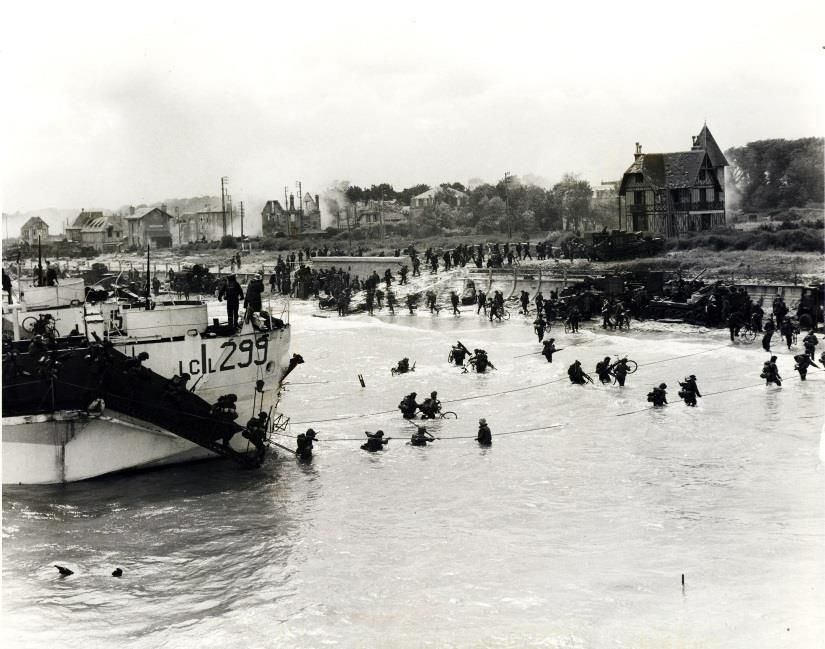
On June 6 1944, known as D-Day, Allied troops stormed German defenses on the beaches
of Normandy (France) to open the way to Germany from the West. The task was
formidable. The Germans had turned the coastline into a continuous fortress of guns,
pillboxes, razor wire, mines and beach obstacles.
Against difficult odds, the Canadians advanced against the best troops the enemy had.
Victory in the Normandy campaign, however, would come at a terrible cost. The Canadians
suffered the most casualties of any division in the British Army Group.

           D-Day and the Battle of Normandy

By the spring of 1944, Germany had occupied France and much of the European
continent for almost four years. A narrow stretch of water, the English Channel, was
all that separated the German forces from Great Britain.
An Allied raid on the French coast at Dieppe in August 1942 had resulted in heavy
losses, particularly for Canada, but by 1944 the Allies had made strong gains
against German troops in both Italy and the Soviet Union.
The Allies knew they would have to defeat Germany in Western Europe to win the
war and decided to mount a major campaign for 1944. Planning lasted more than a
year, taking great effort and involving many elements. Ground, sea and air forces
rehearsed endlessly to make sure their timing and coordination was perfect. Great
numbers of troops, boats, tanks, supplies and equipment were gathered in total
secrecy in southern England. Portable docking facilities were built for the supply
ships to off-load their cargoes in the days after the Allies had landed. A long flexible
pipe, called “Pluto,” (Pipe Lines Under The Ocean) was even built to carry fuel
under the sea from England to Normandy, the region of northwestern France where
the Allies would come ashore.

Fortress Europe
Even with all these preparations, the Normandy campaign would be very difficult.
The shores of Northwest Europe were littered with German land mines, barbed
wire, heavy artillery batteries and machine-gun nests. There were also anti-tank
walls, shelters constructed of thick concrete, anti-aircraft guns and many other
types of defensive positions. For these reasons, the coastline from Denmark to the
south of France was known as “Fortress Europe.”
For the Allied offensive to be successful, harbours along the continent’s coastline
would have to be secured for the many transport ships that would be needed to
ferry food, medical supplies, weapons and fresh troops after the initial landings. As
well, Allied armies would continue to need “Pluto” to help transport the fuel needed
to liberate occupied Europe.
An Allied defeat on the beaches of Normandy would have meant certain disaster as
there would be no way to remove troops to safety. But if the landings succeeded,
the Allied forces would finally gain that all-important foothold in western Europe and
a chance to liberate France, Belgium, the Netherlands and Denmark from German
occupation.

On Land, By Sea, In the Air
Allied aircraft paved the way for the landings, bombing the coastal defence in the
months leading up to the attack. On June 6, 1944—D-Day—a massive Allied force
crossed the English Channel to engage in Operation Overlord. Their destination:
an 80-kilometre stretch of the heavily-defended coast of Normandy. There were five
landing zones, given special code names: Juno Beach (Canada); Gold Beach
(United Kingdom); Sword Beach (United Kingdom and France); and Utah Beach
and Omaha Beach (United States).
Seven thousand vessels of all types, including 284 major combat vessels, took part
in Operation Neptune, the assault phase of the D-Day offensive. Destroyers and
supporting craft of the Royal Canadian Navy did their part and shelled German
targets while many Royal Canadian Air Force planes were among the 4,000 Allied
bombers (plus some 3,700 fighters and fighter bombers) which attacked the
German beach defences and inland targets.
More than 450 Canadians parachuted inland before dawn on June 6 and engaged
the enemy. A few hours later, some 14,000 Canadian troops began coming ashore
at Juno Beach in the face of enemy fire. Their mission: to establish a beachhead
along an eight-kilometre stretch fronting the villages of Courseulles-sur-Mer,
Bernières-sur-Mer, and Saint Aubin-sur-Mer. Once secure, the troops would push
inland to capture the city of Caen, an important communications centre for the
Germans.

A Hard-Won Victory
Many Canadian soldiers in the Normandy campaign were young and new to battle,
but their courage and skill meant they often helped lead the Allied advance against
a determined enemy. Canadians soon captured three shoreline positions on D-Day
and established themselves near the village of Creully, but this was to be only the
beginning of the struggle to liberate France. Savage fighting in Normandy continued
and grew even more intense as Canadian forces faced powerful German Panzer
tank divisions in the struggle for Caen.
Through the summer of 1944, the fighting continued through choking dust and
intense heat. The conditions were terrible and the enemy was ruthless, but the
troops moved forward. Canadians played an important role in closing the “Falaise
Gap” in mid-August as the Germans finally retreated in the face of the Allied
offensive. On August 25, 1944, Paris was liberated by the Allies, bringing the
Normandy campaign officially to a close.

Sacrifice
Against difficult odds, the Canadians advanced against the best troops the enemy
had. Victory in the Normandy campaign, however, would come at a terrible cost.
Three hundred and forty Canadians were killed on Juno Beach on D-Day alone and
the Canadians would suffer the most casualties of any division in the British Army
Group during the Battle of Normandy. More than 5,000 made the ultimate sacrifice,
losing their lives, and lie buried in a place far from their homes and loved ones.
Others returned home with injuries to body and mind that they carry to this day.

The Legacy
Victory in Normandy would be only the beginning of many months of hard fighting
on the ground in Western Europe. Canadians would play an important role in the
offensives that would finally defeat the Germans and end the war in this part of the
world.
The brave Canadians who served in the Normandy Campaign were among the
more than one million men and women who served in the cause of peace and
freedom during the Second World War.

Canada Remembers Program
The Canada Remembers Program of Veterans Affairs Canada encourages all
Canadians to learn about the sacrifices and achievements made by those who have
served—and continue to serve—during times of war and peace. As well, it invites
Canadians to become involved in remembrance activities that will help preserve
their legacy for future generations.
FATHER’S DAY

Father's Day is a celebration honoring fathers and celebrating fatherhood, paternal
bonds, and the influence of fathers in society. Many countries celebrate it on the
third Sunday of June, though it is also celebrated widely on other days by many
other countries.
Father's Day was inaugurated in the United States in the early 20th century to
complement Mother's Day in celebrating fathers and male parenting.
First observance
Grace Golden Clayton may have been inspired by Anna Jarvis' work to
establish Mother's Day; two months prior, Jarvis had held a celebration for her dead
mother in Grafton, West Virginia, a town about 15 miles (24 km) away from
Fairmont.
After the success obtained by Anna Jarvis with the promotion of Mother's Day in
Grafton, West Virginia, the first observance of a "Father's Day" was held on July 5,
1908, in Fairmont, West Virginia, in the Williams Memorial Methodist Episcopal
Church South, now known as Central United Methodist Church. Grace Golden
Clayton was mourning the loss of her father when, on December 1907,
the Monongah Mining Disaster in nearby Monongah killed 361 men, 250 of them
fathers, leaving around a thousand fatherless children. Clayton suggested her
pastor Robert Thomas Webb to honor all those fathers.
Clayton's event did not have repercussions outside of Fairmont for several reasons,
among them: the city was overwhelmed by other events, the celebration was never
promoted outside of the town itself and no proclamation was made in the city
council. Also two events overshadowed this event: the celebration of Independence
Day July 4, 1908, with 12,000 attendants and several shows including a hot air
balloon event, which took over the headlines in the following days, and the death of
a 16-year-old girl on July 4. The local church and council were overwhelmed and
they did not even think of promoting the event, and it was not celebrated again for
many years. The original sermon was not reproduced in press and it was lost.
Finally, Clayton was a quiet person, who never promoted the event or even talked
to other persons about it.
In 1910, a Father's Day celebration was held in Spokane, Washington, at
the YMCA by Sonora Smart Dodd, who was born in Arkansas. Its first celebration
was in the Spokane YMCA on June 19, 1910. Her father, the civil
war veteran William Jackson Smart, was a single parent who raised his six children
there. After hearing a sermon about Jarvis' Mother's Day in 1909 at Central
Methodist Episcopal Church, she told her pastor that fathers should have a similar
holiday honoring them. Although she initially suggested June 5, her father's
birthday, the pastors did not have enough time to prepare their sermons, and the
celebration was deferred to the third Sunday of June. Several local clergymen
accepted the idea, and on June 19, 1910, the first Father's Day, "sermons honoring
fathers were presented throughout the city."
However, in the 1920s, Dodd stopped promoting the celebration because she was
studying in the Art Institute of Chicago, and it faded into relative obscurity, even in
Spokane. In the 1930s, Dodd returned to Spokane and started promoting the
celebration again, raising awareness at a national level. She had the help of those
trade groups that would benefit most from the holiday, for example the
manufacturers of ties, tobacco pipes, and any traditional present to fathers. By
1938 she had the help of the Father's Day Council, founded by the New York
Associated Men's Wear Retailers to consolidate and systematize the commercial
promotion. Americans resisted the holiday for its first few decades, viewing it as
nothing more than an attempt by merchants to replicate the commercial success of
Mother's Day, and newspapers frequently featured cynical and sarcastic attacks
and jokes. However, said merchants remained resilient and even incorporated
these attacks into their advertisements. By the mid-1980s, the Father's Council
wrote that "(...) [Father's Day] has become a Second Christmas for all the men's
gift-oriented industries." A bill to accord national recognition of the holiday was
introduced in Congress in 1913. In 1916, President Woodrow Wilson went to
Spokane to speak in a Father's Day celebration and wanted to make it official, but
Congress resisted, fearing that it would become commercialized. US
President Calvin Coolidge recommended in 1924 that the day be observed by the
nation, but stopped short of issuing a national proclamation. Two earlier attempts to
formally recognize the holiday had been defeated by
Congress. In 1957, Maine Senator Margaret Chase Smith wrote a proposal
accusing Congress of ignoring fathers for 40 years while honoring mothers, thus
"[singling] out just one of our two parents" In 1966, President Lyndon B.
Johnson issued the first presidential proclamation honoring fathers, designating the
third Sunday in June as Father's Day Six years later, the day was made a
permanent national holiday when President Richard Nixon signed it into law in
1972.
In addition to Father's Day, International Men's Day is celebrated in many countries
on November 19 for men and boys who are not fathers.
Failed attempts at establishing a Father's Day
In 1911, Jane Adams proposed a citywide Father's Day in Chicago, but she was
turned down.
In 1912, there was a Father's Day celebration in Vancouver, Washington In 1912,
there was a Father's Day celebration in Vancouver, Washington, suggested by
Methodist pastor J. J. Berringer of the Irvingtom Methodist Church. They believed
mistakenly that they had been the first to celebrate such a day. They followed a
1911 suggestion by the Portland Oregonian.
Harry C. Meek, member of Lions Clubs International, claimed that he had first the
idea for Father's Day in 1915. Meek said that the third Sunday of June was chosen because it was
his birthday. The Lions Club has named him "Originator of Father's Day". Meek made many
efforts to promote Father's Day and make it an official holiday.
                    *****************************************************************

        PRESSURE WASHING AND WINDOW WASHING
           RESIDENTS BALCONIES WILL BEGIN ON
                   MONDAY JUNE 14TH
NATIONAL ABORIGINAL DAY
In cooperation with Indigenous Peoples’ national organizations, the
Government of Canada designated June 21 National Indigenous Peoples
Day, a celebration of Indigenous Peoples’ culture and heritage. This date
was chosen because it corresponds to the summer solstice, the longest
day of the year, and because for generations, many Indigenous Peoples’
groups have celebrated their culture and heritage at this time of year.
National Indigenous Peoples Day is a wonderful opportunity to become
better acquainted with the cultural diversity of First Nations, Inuit and
Métis peoples, discover the unique accomplishments of Indigenous
Peoples in fields as varied as agriculture, the environment and the arts,
and celebrate their significant contribution to Canadian society.NEW BOOKS
We have had a new delivery
of large print fiction and non-
fiction books in the East
Lounge.
Take a look, there is
something for everyone.
Hand Chime Choir
With Music Therapist Christine!
Join us for a fun evening of playing Handchimes.
Open to all, No experience necessary.
Wednesdays
Beginning June 2nd
7:00 pm
Multipurpose RoomCHAIR YOGA WITH CHRIS
TUESDAYS AND THURSDAYS
MULTIPURPOSE ROOM
11:00 AM
COME AND GIVE IT A TRY.
Father,” By Edgar Albert Guest
My father knows the proper way
The nation should be run;
He tells us children every day
Just what should now be done.
He knows the way to fix the trusts,
He has a simple plan;
But if the furnace needs repairs,
We have to hire a man.FATHER’S DAY HUMOUR
MASS
              TUESDAYS
               9:30 AM
            MEDIA ROOM
     FROM HOLY ROSARY CATHEDRAL
             VANCOUVER

      Thank you to Audrie ”Twinkle Toes” for the beautiful
lap blanket she made for Haven House residents on cold
                       mornings
                What a rock star she is!
Top 20 Dad phrases:
1. Do you think I'm made of money?
2. Money doesn't grow on trees
3. He's thick as two short planks
4. When I was your age...
5. I'm not sleeping; I'm just resting my eyes
6. I'm not going to tell you again
7. Were you raised in a barn?
8. Don't talk back to your mother
9. If you were told to jump off a cliff, would you?
10. They don't make them like they used to
11. Stop crying or I'll give you something to cry about
12. Don't tell your mother
13. Waste not, want not
14. You're not going out in that
15. We were grateful to have an orange for Christmas
16. Now, don't go spending a lot on me
17. A little hard work never hurt anybody
18. You'll understand when you're older
19. You don't know you're born
20. Don't let the bedbugs biteMEET THE STAFF # 72 NAME: IAN POSITION: DINING SERVER WHAT IS YOUR BASIC PHILOSOPHY IN LIFE: TODAY WILL BE AS GOOD AS YOU MAKE IT. WHAT ARE YOUR FAVORITE BOOKS/MOVIES: SAME ANSWER FOR BOTH BOOK AND MOVIE, “THE LORD OF THE RINGS”. WHAT DID YOU WANT TO BE GROWING UP: A TEACHER. MY FATHER WAS A HIGH SCHOOL MUSIC TEACHER. WHAT KIND OF MUSIC DO YOU LIKE: CLASSIC ROCK. KISS, AC/DC, PINK FLOYD, AEROSMITH. WHAT DO YOU DO FOR FUN: LONG WALKS WITH MY WIFE LISA, THROUGH FORESTS OR BEACHES., WHAT MAKES YOU HAPPY: COMING HOME AFTER WORK. WHAT IS YOUR IDEAL DATE NIGHT: SITTING ON THE COUCH WITH MY WIFE LISA, WATCHING A MOVIE WITH A BEVERAGE. WHAT IS YOUR PERFECT VACATION: A CRUISE AROUND THE HAWAIIAN ISLANDS WHAT IS YOUR FAVORITE FOOD: TEX/MEX BBQ, SOUTHERN STYLE BBQ. WHAT ADVICE WOULD YOU GIVE A 12 YEAR OLD: DON’T BE IN A HURRY TO GROW UP, IT’LL HAPPEN SOON ENOUGH. WHAT WERE YOUR HIGH SCHOOL GRADES LIKE: B AVERAGE. PARTING WORDS TO THE MASSES ARE…: BE KIND TO THOSE YOU KNOW AND PEOPLE YOU MEET FOR THE FIRST TIME, KINDNESS CAN BE INFECTIOUS.
Augustine House

    3820 Arthur Drive
   Delta, B.C. V4K 5E6
 Telephone: (604) 940-6005
   Fax: (604) 940-6015
Email: info@augustinehouse.ca
 Website: augustinehouse.ca
You can also read


