Head Injuries & American Football - Ethics Unwrapped
←
→
Page content transcription
If your browser does not render page correctly, please read the page content below
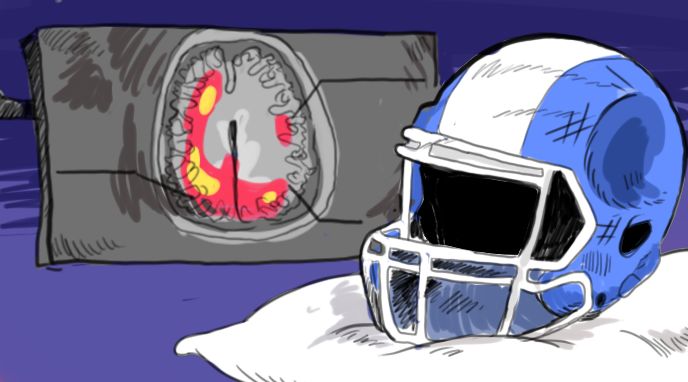
Head Injuries & American Football

American football is a rough and dangerous game. “Football is both notorious and cherished for
its unapologetic, brute-force violence.”1 Players suffer bruises, lacerations, torn muscles,
dislocated shoulders, torn knee ligaments, broken bones, internal organ damage, and,
occasionally, even paralysis. Football rules intentionally create high speed collisions between
human beings, making such injuries inevitable and the sport controversial. And new knowledge
about brain injuries have caused many people to call football immoral2 and to advocate its
abolition.3

A traumatic brain injury (TBI) is “a disruption in the normal function of the brain that can be
caused by a bump, blow, or jolt to the head, or penetrating head injury.”4 A concussion is a
form of TBI where the blow causes the brain to move rapidly back and forth, bouncing around
in the skull and suffering various types of structural damage. 5 Although concussions can carry
serious consequences, they are termed a “mild” form of TBI because they are not typically life
threatening. Chronic traumatic encephalopathy (CTE) is “brain degeneration likely caused by
repeated head traumas.”6 Repetitive head impacts (RHIs) can cumulatively lead to CTE and early
death, even though no single RHI results in a concussion.7

If only one thing is clear about the current science surrounding sports-related concussions
(SRCs) and related brain injuries, it is that very little is clear about the current science. The field
is surprisingly new. As told in the movies, a significant scientific breakthrough occurred in 2002
when an African-American neuropathologist in Pittsburgh named Bennet Omalu (played by Will
Smith in the 2015 movie “Concussion”) performed an autopsy on Hall of Fame center Mike
Webster. Dr. Omalu identified abnormal clumps of the protein tau in Webster’s brain, which he
believed to be evidence of CTE.8 Such proteins
develop in tangles that slowly strangle
neurons and, consequently, inhibit brain
function.9

Many recent studies point to how dangerous
football is to players’ long-term brain health.
These studies are broken down by football
league level:

National Football League (NFL):

   •   Over two regular seasons (2012-2014), NFL players sustained 4,384 injuries, including
       301 concussions. This statistic is up 61% from 2002-2007, perhaps reflecting an
       improvement of awareness and reporting.10
   •   In a study of 14,000 NFL players, researchers found that even head impacts insufficient
       to cause concussions can mount up over the years, leading to CTE and premature death.

                                     Case Study – Head Injuries and American Football - Page 1 of 14
An NFL player who plays 24 games increases the likelihood of premature death by
16%.11
• A 2019 study of the brains of 223 football players with CTE and 43 players without CTE
found that for each additional 2.6 years of play, the risk of developing CTE doubled.12
• Another study found that greater RHI exposure correlated with higher levels of plasma
t-tau (a biomarker for CTE) in symptomatic former NFL players as compared to the
study’s control group.13
• Of 111 NFL players whose brains were donated for one study, 110 were diagnosed with
CTE.14
• A 2012 study of 3,439 NFL players with five years or more in the NFL found that their
neurogenerative mortality was three times that of the general U.S. population, and four
times higher for two subcategories: Alzheimer’s disease, and Lou Gehrig’s Disease
(amyotrophic lateral sclerosis or ALS).15
• Other studies found that NFL players who suffered concussions were more likely to later
be diagnosed with depression, 16 dementia-related syndromes,17 Lou Gehrig’s Disease
(ALS),18 and erectile dysfunction.19
College & High School:
• A study of former high school and college football players found that RHI exposure
predicted later-life apathy, depression, executive dysfunction, and cognitive
impairment.20
• After a single season, college football players had less midbrain white matter than they
had started with.21
• High school athletes are reluctant to report concussions.22
• A 2017 study found CTE in 21% of donated brains of deceased high school football
players.23
• Over time more evidence has indicated that even mild concussions suffered by high
school football players can cause serious consequences.24
• Football causes more concussions than any other high school sport,25 and these
concussions can cause death.26
Youth Leagues (Under 14):
• Youth football players average 240 head impacts per season. Some of these are high
impacts comparable to those experienced in high school and college games.27
• Children between the ages of 9 and 14 make up the largest cohort of football players in
the U.S. They can suffer concussions from milder collisions than would be required to
concuss a collegiate or professional player.28
• According to research by neuroscientists, “There seems to be greater consequences if
you’re getting your head hit when the brain is rapidly developing [below age 12].”29
Case Study – Head Injuries and American Football - Page 2 of 14• A study of former NFL players found that those who began playing football before age
12 tended to show greater later-life cognitive impairments as compared to those who
began after age 12.30
THE OTHER SIDE OF THE STORY
Given the results of the studies above, it is not surprising that there has been a strong outcry
against football. However, the science in this area is truly not settled. Part of the reason is that
“[m]ost of the time when a player has a concussion, standard medical imaging techniques do
not show damage.”31 No “gold standard” for diagnosing concussions currently exists.32 Many
researchers in the area recently published an article saying:
Contrary to common perception, the clinical syndrome of CTE has not yet been fully
defined. Its prevalence is unknown, and the neuropathological diagnostic criteria are no
more than preliminary. We have an incomplete understanding of the extent or
distribution of pathology required to produce neurological dysfunction or to distinguish
diseased from healthy tissue, with the neuropathological changes reported in
apparently asymptomatic individuals.”33
Neuropsychologist Munro Cullum argues: “I worry the pendulum has swung too far. The reality
is that we still don’t know who is most likely to suffer a concussion, who will take longer to
recover, how anatomic or genetic differences influence concussions, and who may be at risk of
prolonged symptoms or developing cognitive problems later in life.”34
Furthermore, many of the studies cited by those who would like to abolish tackle football have
involved relatively small sample sizes.35 Other studies have involved skewed samples, including
one where all the NFL players’ brains had been donated because of mental declines that the
donors had suffered before their deaths.36
Most importantly, other studies seem to indicate that concussions may be more benign. Again,
these studies are broken down by league level:
NFL
• A 2016 study found no elevated risk of suicide in a population of players with at least
five years in the league.37
• Another study of 35 former NFL players over age 50 who had sustained multiple
concussions during their careers found no significant association between the length of
careers, the number of concussions, and their level of cognitive function later in life.38
• One study found no statistically significant difference between the all-cause mortality
among career NFL players and NFL replacement players who played just three games
during the strike of 1987.39
Case Study – Head Injuries and American Football - Page 3 of 14• A 2007 study found that retired NFL players experienced levels of depressive symptoms
no worse than those of the general population.40
College & High School
• Suicide rates among NCAA football players are the highest among all sports, but they
are substantially lower than the general population age 18-22 or college students in that
age range.41
• A study of 3,904 Wisconsin men found no significant harmful association between
playing football in high school and cognitive impairment or depression later in life.42
• Reducing tackling in practices has reduced overall concussion numbers among high
school players, even though the number of concussions in games has risen slightly. And
concussion recurrence has been reduced, most likely by protocols guiding when it is safe
to return to play.43
• One expert said “It really seems right now that if your [football] practices are highly
controlled and reduced as much as possible and you only play four years of high school,
your [CTE] risk is probably pretty low.”44
Youth Leagues (Under 14)
• Despite their heightened susceptibility to concussions, youth football players rarely
sustain concussions because they are lighter and collide with less force than older
players.45
• In one study, use of newly-designed football helmets and safe tackling techniques
eliminated concussions for 20 middle school aged players for an entire season.46
Studies such as these provide ammunition for those who defend organized football as an
institution. However, many such studies were funded or carried out by the NFL, owners of NFL
franchises, universities that earn millions of dollars from football, and other interested parties.
Given the obvious conflict of interest, the studies have been criticized on that ground.47 There is
also evidence that the NFL sought to influence the findings of some of the research it funded. 48
In addition, evidence indicates (and is consistent with the self-serving bias) that industry
funding of research often influences results.49
The NFL has taken other concrete steps to respond to the controversy. It paid more than $750
million to settle a civil lawsuit by former players.50 The NFL has also changed rules to discourage
helmet-to-helmet contact,51 and has instituted protocols for safely returning concussed players
to the field.52
On the other hand, while football helmets can prevent fractured skulls, they will likely never be
able to prevent concussions.53 Studies indicate that there are helmets that may decrease
concussions,54 but neuroscientist Julie Stamm says: “No helmet will ever be concussion-proof,
because the brain still moves inside the skull. And for the same reason, a helmet alone will not
prevent CTE.”55 Furthermore, while the NFL has banned helmet-to-helmet hits, these are
Case Study – Head Injuries and American Football - Page 4 of 14neither the only nor the most common cause of concussions.56 Professor Goldberg argues that
“there is little evidence that such incremental changes [e.g., in tackling techniques] have a
substantial risk-reducing effect.”57
Some people accuse the media (and others) of hysterically overhyping the dangers of tackle
football to the brain.58 Other people believe that media discussions have impeded needed
change in minimizing sports violence.59 At the end of the day, the jury still seems to be out on
the question of whether you can go to a football game or watch one on television and still feel
good about yourself for supporting a sport that seems to cause irreversible traumatic brain
injuries.
General Discussion Questions
1. Which approach do you think should be used to determine the ethicality of banning, or at
least seriously reforming, football to reduce head trauma? Utilitarian? Deontological?
Explain why and how using that approach might play out.
2. If you apply Systematic Moral Analysis to the question of whether or not it is moral to
continue to support and/or play football, do you get different results for different league
categories and age groups? Explain. Is there a case to be made for “justified harm” in any of
these leagues? Why or why not?
3. New Yorker writer Ingfei Chen observed that Fisher-Price had been required to recall a
collapsible crib that was associated with 32 infant deaths. Five million cribs had been sold.
Chen noted that “there is no such thing as an acceptably risky crib,” but contrasted it with
sports like football where “hazards are part of their attraction.” She asked: “How much risk
is too much?”
a. How do we answer that question? What factors go into each side of the
equation?
b. Are the answers different for NFL players, college players, high school players,
and under-14 players? Discuss your reasoning.
c. Is this an ethical issue? A policy issue? A political issue? All three? Explain.
4. Chen also points to the uncertainties of the science, noting: “For now, these complexities
make certain questions about the disease unanswerable. If subconcussive blows are the
cause of C.T.E., how much impact is too much? How do the tau clumps relate to the clinical
syndrome—do the lesions fully explain the mood and memory problems? (Probably not;
other kinds of brain abnormalities, such as inflammation or damage to neural wiring from
head injuries, may play a role.)”60 Chen further notes that the type of decades-long study
that might resolve these issues would be terribly expensive and that no such study is on the
horizon.61 In light of this continuing uncertainty, how do we decide whether (and how) to
Case Study – Head Injuries and American Football - Page 5 of 14reform or even abolish football when we have lives on one side of the scales and livelihoods
on the other?
a. Do these choices remind you of the COVID-19 pandemic when governments, in
deciding whether to shut down society and later when to reopen it, had to weigh
lives vs. livelihoods? Why or why not?
5. The NFL and universities, among others, urge no rash actions until there is more concrete
proof of a causal link between concussions and adverse health outcomes. Others suggest
that the uncertainty favors taking actions now rather than waiting until too much damage is
done, as happened with tobacco.62 Sports sociologist Matt Ventresca argues: “As sports
executives and researchers issue precautionary calls for more conclusive evidence,
countless athletes are exposed to repeated head impacts without the benefits of future
knowledge gained from pending scientific investigations.”63 Professor Daniel Goldberg
claims that the Precautionary Principle64 demands that we prevent youngsters from playing
football even if the evidence that it will cause serious damage to their brains is not yet
clearly established:65 “[W]aiting for robust evidence of causality is historically a very poor
guideline for maximizing population health.”66 Other public health experts similarly argue
that the evidence of risk is sufficiently high to meet both parts of OSHA’s test for “significant
risk of material impairment of health” that justifies government intervention.67 In the face
of medical uncertainty, what is the proper approach to this debate?
a. Where should the burden of proof lie?
b. Which approach do you find more persuasive, and why?
c. Do you think this an ethical issue or just a policy issue? Explain.
6. Regarding sports concussions, President Obama stated: “We have to change a culture that
says ‘you suck it up and play through a brain injury…. [Reporting a concussion] doesn’t make
you weak, it means you’re strong.” On the other hand, President Trump has stated that rule
changes to diminish head injuries are “ruining the game.”68 Are politics, as well as ethics,
involved in this debate? Discuss your reasoning.
7. One scientist said: “Don’t forget there’s risk in everything we do. Riding a bicycle carries risk
and not a whole lot of parents are not letting their kids ride a bike. So, we just need to kind
of put it in context.”69 Do you find this argument persuasive? Why or why not?
a. Is your opinion altered by the fact that the scientist quoted above is the
neurologist for the Michigan State University football team?
8. Some argue against paternalism and in favor of individual choice, believing that adults (at
least) should be able to choose to engage in boxing (and presumably to play football)
despite its potentially adverse consequences for brain health.70 Using John Stuart Mill’s
Harm Principle,71 others argue that the individualists overlook the damage that such a
choice by a football player might have on others. For example, on the people the player
might later beat up in a rage caused by brain deterioration, on the burden on caregivers of
caring for a dementia-ridden patient, or the sorrow a premature death might cause
Case Study – Head Injuries and American Football - Page 6 of 14relatives, and the burden on society caused by high medical expenses to take care of an
impaired ex-player.72 Where do you stand on the paternalism vs. individual choice debate?
Support your position with data and facts.
Case Study – Head Injuries and American Football - Page 7 of 14Discussion Questions on the NFL
1. Many people who are in favor of abolishing football or significantly reforming the way it is
played are pro-choice when it comes to abortion, minor drug use, and assisted suicide.
Why, then, do you think they oppose letting adults choose freely to play football? 73 Can
these contradictory positions be reconciled? Explain.
a. How about the reverse—why do many people who believe football players should
be free to decide what they do with their bodies take decidedly un-libertarian
positions on issues such as abortion, marijuana legalization, and assisted suicide?
Explain.
2. Our society allows people to voluntarily choose to undertake many risky professions,
including coal miners, fire jumpers, soldiers, underwater oil rig welders, and others.74 Why,
then, should NFL players not be able to do the same?
3. Steve Almond argues that “a civilian leisure class … has created, for its own entertainment,
a caste of warriors too big and strong and fast to play a child’s game without grievously
injuring one another.”75 Do you think this a moral issue? Why or why not?
a. Relatedly, should fans of the game be ashamed of themselves? Why or why not?
4. One suggested solution to the concussion problem is to outlaw helmets on the theory that
players will be forced to reduce headfirst collisions and other trauma-causing actions.76
Does this sound like a viable solution to you? Explain your reasoning.
a. The co-chair of the NFL’s Health and Safety Advisory Committee has said that the
committee thinks helmets are part of the culture and tradition and will not be
outlawed in the foreseeable future.77 Football’s rules have been changed frequently
over the years, so why do you think this is different? Or is it?
5. Some take the view that the NFL has acted like the tobacco industry did when it was
confronted with lawsuits seeking to prove to juries that smoking caused cancer.78 In light of
very strong evidence associating football violence with brain injuries, the NFL’s goal has
simply been to “manufacture doubt” and thereby delay regulation.79 Do you think that is
true? Why or why not? Do you find it to be a moral issue? Explain.
6. African-Americans make up 12.6% of the American population but 68% of NFL rosters.
Thus, they are disproportionately exposed to concussions and other injuries that arise from
the game. This has led some to suggest that the NFL is a modern plantation.80 And that
concussions present not just a public health issue but also a social justice issue.81 Are these
fair criticisms? Discuss your reasoning.
a. Do you think these critiques are counterbalanced by the fact that the riches that
are often lavished upon NFL players go disproportionately to African-Americans as
well? Explain.
Case Study – Head Injuries and American Football - Page 8 of 14b. Do you think that the NFL would make more safety-related changes if white players
dominated rosters? Why or why not?
7. It has been suggested at both the NFL and collegiate level that team physicians are faced
with conflicting loyalties. They have a duty to preserve the players’ health, but
simultaneously feel pressure to get players back out on the field so the team can win.82
What is your opinion?
a. How might the self-serving bias impact team physicians’ and trainers’ judgments
and actions?
Discussion Questions on High Schools & Colleges
1. In the wake of the recent pandemic, Oklahoma State head football coach Mike Gundy said
“In my opinion, if we have to bring our players back, test them. They’re all in good shape.
They’re all 18, 19, 20, 21 and 22-year-olds. They’re healthy … And people say that’s crazy.
No, it’s not crazy because we need to continue and budget and run money through the
state of Oklahoma.”83 One commentator cited this remark as stark evidence that “[t]he
supremacy of commercial and hedonic interests over the social welfare has, unfortunately
become indelibly imprinted into the ethical fiber of American culture.”84 Do you agree?
Why or why not?
a. Do you see parallels between the debate as to whether to begin playing football
again in the wake of the pandemic and the debate as to whether to abolish or
reform football in light of the evidence on brain trauma? Explain.
2. Ramogi Huma, executive director of the National College Players Association, argued that
schools should be required to fully inform [college] players about the risks of playing
football now, including information about their susceptibilities to underlying health
conditions. Do you agree?85
a. Is this disclosure enough? Explain.
b. Are college (and high school) players sufficiently mature to make reasoned
judgments based on such disclosures? Support your position with data and facts.
3. Statistician Ted Tatos86 cites the California Supreme Court in University of California v.
Rosen as ruling that “[s]tudents are comparatively vulnerable and dependent on their
colleges for a safe environment. Colleges have a superior ability to provide that safety with
respect to activities they sponsor or facilities they control.”87 Do you agree with this
statement? Why or why not? How does it impact your position on the debate about
concussions in football?
Case Study – Head Injuries and American Football - Page 9 of 14Discussion Questions on Youth Leagues (Under 14)
1. A public health professor has said that letting pre-teens play tackle football is “an
abdication of moral responsibility for children’s welfare.”88 Do you agree, or is this getting
a little hysterical? Explain.
2. Empirical research supports the notion that allowing children to engage in dangerous
forms of play is key to their optimal development.89 It helps them learn to assess risks, for
example. Based on such findings, philosopher John Russell has argued that children should
be allowed to play tackle football.90 He believes in the distinctive value of physically “self-
affirming” behavior which he argues is available mainly in childhood. Russell states:
“Dangerous sport in its best exemplars, particularly those in which substantial bodily
danger is an immediate and ever-present risk, represents an opportunity for confronting
and pressing beyond certain apparent limits of personal, and indeed human, physical and
psychological capacities in ways not afforded by other normally available human
activities.”91 On the other hand, Philosopher Patrick Findler argues that children may not
be able to fully realize the dangers they face when playing football, and that other, less
dangerous activities, can provide the benefits Russell desires.92 Whose argument do you
find more persuasive, and why?
3. Daniel Goldberg observes that “there is also a crucial social and political question that is
not simply a function of that empirical evidence base: to what risks is it acceptable to
expose youths and adolescents?”93 Is that risk level different than it would be for older
players? Explain.
4. Would you prevent kids under 14 from playing tackle football? Why or why not?
Author:
Robert Prentice, J.D.
Department of Business, Government and Society
McCombs School of Business
The University of Texas at Austin
Case Study – Head Injuries and American Football - Page 10 of 14End Notes:
1
Ingfei Chen, Exactly How Dangerous Is Football?, The New Yorker, Feb. 1, 2020.
2
Steve Almond, Is It Immoral to Watch the Super Bowl?, New York Times, Jan. 24, 2014; Pamela R. Sailors,
Personal Foul: An Evaluation of the Moral Status of Football, Journal of the Philosophy of Sport, 42(2): 269-286
(2015).
3
Dave Bry, American Football is Too Dangerous, and It Should Be Abolished, The Guardian (UK), Jan. 4, 2016.
4
Center for Disease Control, at https://www.cdc.gov/traumaticbraininjury/index.html.
5
Center for Disease Control, at https://www.cdc.gov/headsup/basics/concussion_whatis.html.
6
Mayo Clinic, at https://www.mayoclinic.org/diseases-conditions/chronic-traumatic-encephalopathy/symptoms-
causes/syc-20370921.
7
Julian E. Bailes et al., Role of Subconcussion in Repetitive Mild Traumatic Brain Injury: A Review, Journal of
Neurosurgery, 119: 1235-1245 (2013); Breton M. Asken, Research Gaps and Controversies in Chronic Traumatic
Encephalopathy: A Review, JAMA Neurology 74(10): 1255-1262 (2017); Philip H. Montenigro et al., Cumulative
Head Impact Exposure Predicts Later-Life Depression, Apathy, Executive Dysfunction, and Cognitive Impairment in
Former High School and College Players, Journal of Neurotraumua 34(2) (2017); Ann C. McKee et al., The
Neuropathology of Sport, Acta Neuropathologica, 127: 29-51 (2014).
8
Jeanne Marie Laskas, Concussion (2015). See Bennet I. Omalu et al, Chronic Traumatic Encephalopathy in a
National Football League Player, Neurosurgery, 57: 128-134 (2005);
9
Ann McKee et al., The Neuropathology of Chronic Traumatic Encephalopathy, Brain Pathology, 25: 350-364
(2015).
10
David W. Lawrence et al., Descriptive Epidemiology of Musculoskeletal Injuries and Concussions in the National
Football League, 2021-2014, Orthopedic Journal of Sports Medicine, 2015:3(5):2325967115583653.
11
Justin Ehrlich et al., Mortality Risk Factors Among National Football League Players: An Analysis Using Player
Career Data, F1000Research 2019, 8:2022. See also Ann C. McKee et al., The Spectrum of Disease in Chronic
Traumatic Encephalopathy, Brain, 136(1)): 43-64 (2013)(study of donated brains of 64 athletes found “the stage of
[CTE] correlated with increased duration of football play, survival after football and age at death” for 34 football
players).
12
Jesse Mez et al., Duration of American Football Play and Chronic Traumatic Encephalopothy, Annals of
Neurology, 2019; DOI: 10.1002/ana.25611.
13
Michael L. Alosco et al., Repetitive Head Impact Exposure and Later-Life Plasma Total Tau in Former National
Football League Players, Alzheimer’s & Dementia: Diagnosis, Assessment and Disease Monitoring, 7: 33-40
(2017).
14
Jesse Mez et al., Clinicopathological Evaluation of Chronic Traumatic Encepahalopathy in Players of American
Football, JAMA, 318(4): 360-370 (2017).
15
Everett J. Lehman et al., Neurodegenerative Causes of Death Among Retired National Football League Players,
Neurology, 79(19): 1970-1974 (2012).
16
Kevin M. Guskiewicz et al., Recurrent Concussion and Risk of Depression in Retired Professional Football
Players, Medicine & Science in Sports & Leisure, 39(6): 903-909 (2007).
17
Kevin M. Guskiewicz et al., Association between Recurrent Concussion and Late-Life Cognitive Impairment in
Retired Professional Football Players, Neurosurgery 57(4): 719-726 (2005).
18
Ernest L. Abel, Football Increases the Risk for Lou Gehrig’s Disease, Amyotrophic Lateral Sclerosis, Perceptual
Motor Skills, 104(3): 1251-1254 (20007).
19
Rachel Grashow et al., Association of Concussion Symptoms with Testosterone levels and Erectile Dysfunction in
Former Professional US-Style Football Players, JAMA Neurology, 2019: DOI: 10.1001/jamaneurol.2019.2664.
20
Philip H. Montenigro et al., Cumulative Head Impact Exposure Predicts Later-Life Depression, Apathy, Executive
Dysfunction, and Cognitive Impairment in Former High School and College Players, Journal of Neurotraumua
34(2) (2017).
21
Adnan A. Hirad, A Common Neural Signature of Brain Injury in Concussion and Subconcussion, Science
Advances 5(8), Aug. 2019.
Case Study – Head Injuries and American Football - Page 11 of 1422
Steven Senne, Student Athletes Still Reluctant to Report Concussions, Nationwide Children’s Study Finds,
Columbus Dispatch, Nov. 24, 2019, at https://www.dispatch.com/news/20191124/student-athletes-still-reluctant-to-
report-concussions-nationwide-childrens-study-finds.
23
Steven Senne, Student Athletes Still Reluctant to Report Concussions, Nationwide Children’s Study Finds,
Columbus Dispatch, Nov. 24, 2019, at https://www.dispatch.com/news/20191124/student-athletes-still-reluctant-to-
report-concussions-nationwide-childrens-study-finds.
24
Michael W. Collins et al., Adolescent Sports Concussion, Physical Medicine and Rehabilitation Clinics of North
America, 19(2): 247-269 (2008); Mark R. Lovell et al., Recover from Mild Concussion in High School Athletes,
Journal of Neurosurgery, 98(2): 296-301 (2003).
25
Jacqueline Howard, These High School Sports Have the Highest Concussion Rates, CNN, Oct. 15, 2019, at
https://www.cnn.com/2019/10/15/health/concussion-high-school-sports-study/index.html.
26
James P. Kelly et al., Concussion in Sports: Guidelines for the Prevention of Catastrophic Outcome, JAMA,
266(20): 2867-2869 (1991).
27
Bryan R. Cobb et al., Head Impact Exposure in Youth Football: Elementary School Ages 9-12 Years and the
Effect of Practice Structure, Annals of Biomedical Engineering, 41: 2463-2473 (2013).
28
Eamon T. Campolettano et al., Development of a Concussion Risk Function for a Youth Population Using Heal
Linear and Rotational Acceleration, Annals of Biomedical Engineering, 48(1): 92 DOI: 10.1007/s10439-019-
02382-2.
29
Julie Mack, What Parents Need to Know about Football, Concussions and Head Injuries, mlive.com, Nov. 24,
2019, at https://www.mlive.com/news/2019/11/what-parents-need-to-know-about-football-and-head-injuries.html
(quoting neuroscientist Julie Stamm).
30
Julie M. Stamm et al., Age of First Exposure to Football and Later-life Cognitive Impairment in Former NFL
Players, Neurology, 84(11): 1114-1120 (2015).
31
Christie Aschwanden, Football’s Concussion Crisis is Awash with Pseudoscience, Wired.com, Oct. 2, 2019.
32
Matt Ventresca & Mary G. McDonald, Forces of Impact: Critically Examining Sport’s “Concussion Crisis,” in
Sociolcultural Examinations of Sports Concussions (Ventresca & McDonald, eds., 2019).
33
William Stewart et al., Primum Non Nocere: A Call for Balance When Reporting on CTE, Lancet Neurology,
18:231-232 (2019).
34
Munro Cullum, Is Football Bad for the Brain? We Know Little About the Long-term Effects of Concussions,
Statnews, Sept.27, 2019.
35
Munro Cullum, Is Football Bad for the Brain? We Know Little About the Long-term Effects of Concussions,
Statnews, Sept.27, 2019.
36
Munro Cullum, Is Football Bad for the Brain? We Know Little About the Long-term Effects of Concussions,
Statnews, Sept.27, 2019.
37
Everett J. Lehman et al., Suicide Mortality Among Retired National Football League Players Who Played 5 or
More Seasons, American Journal of Sports Medicine, 44(10): 2486-2491 (2016).
38
Jesse Mez et al., Duration of American Football Play and Chronic Traumatic Encephalopothy, Annals of
Neurology, 2019; DOI: 10.1002/ana.25611.
39
Atheendar S. Venkataramani et al, Association Between Playing American Football and Long-term Mortality,
JAMA, 319(8): 800-806 (2018).
40
Thomas L. Schwenk, Depression and Pain in Retired Professional Football Players, Medicine & Science in
Sports & Leisure, 39(4): 599-605 92007)(but finding that when coupled with difficult with pain, problems with
sleep and social relations often followed).
41
Ashwin L. Rao et al., Suicide in National Collegiate Athletic (NCAA) Athletes: a 9-Year Analysis of the NCAA
Resolutions Database, Sports Health 7(5): 452-457 (2015).
42
Sameer K. Deshpande et al, Association of Playing High School Football with Cognition and Mental Health Later
in Life, JAMA Neurology, 74(8): 909-918 (2017).
43
Zachary Y. Kerr et al., Concussion Incidence and Trends in 20 High School Sports, Pediatrics 144(5): e20192190.
44
Julie Mack, What Parents Need to Know about Football, Concussions and Head Injuries, mlive.com, Nov. 24,
2019, at https://www.mlive.com/news/2019/11/what-parents-need-to-know-about-football-and-head-injuries.html
(quoting neuroscientist Julie Stamm).
45
Eamon T. Campolettano et al., Development of a Concussion Risk Function for a Youth Population Using Heal
Linear and Rotational Acceleration, Annals of Biomedical Engineering, 48(1): 92 DOI: 10.1007/s10439-019-
02382-2.
Case Study – Head Injuries and American Football - Page 12 of 1446
Robert F. Heary et al., Is Youth Football Safe? An Analysis of Youth Football Head Impact Data, Neurosurgery
(Jan. 2020), available at https://doi.org/10.1093/neuros/nyz563.
47
Ingfei Chen, Exactly How Dangerous Is Football?, The New Yorker, Feb. 1, 2020.
48
Kathleen Bachynski & Daniel S. Goldberg, Time Out: NFL Conflicts of Interest with Public Health Efforts to
Prevent TBI, Injury Prevention, at https://injuryprevention.bmj.com/content/24/3/180.full; Ingfei Chen, Exactly How
Dangerous Is Football?, The New Yorker, Feb. 1, 2020; Mark Fainaru-Wada & Steve Fainaru, League of Denial:
The NFL, Concussions, and the Battle for Truth (2013).
49
Lisa Bero, Industry Sponsorship and Research Outcome: A Cochrane Review, JAMA Internal Medicine, 173(7):
580-581 (2013).
50
Ken Belson, Judge Approves Deal in N.F.L. Concussion Suit, New York Times, April 22, 2015.
51
Kevin Seifer, Did the Helmet Rule Actually Work? And How Will It Change in 2019?, ESPN, Aug. 19, 2019, at
https://www.espn.com/nfl/story/_/id/27372974/did-helmet-rule-actually-work-2018-how-change-2019.
52
Janine Armstrong, NFL Concussion Protocol Explained: How Does It Work?, Sportcasting, Oct. 13, 2019, at
https://www.sportscasting.com/nfl-concussion-protocol-explained-how-does-it-work/.
53
Christie Aschwanden, Football’s Concussion Crisis Is Awash with Pseudoscience, Wired.com, Oct. 2, 2019.
54
Marc Siegel, Concussions and Football: New Helmets, New Tools, The Hill, Aug. 19, 2019.
55
Julie Mack, What Parents Need to Know about Football, Concussions and Head Injuries, mlive.com, Nov. 24,
2019, at https://www.mlive.com/news/2019/11/what-parents-need-to-know-about-football-and-head-injuries.html
(quoting neuroscientist Julie Stamm).
56
Christie Aschwanden, Football’s Concussion Crisis Is Awash with Pseudoscience, Wired.com, Oct. 2, 2019
(quoting brain scientists Adnan Hirad).
57 Daniel Goldberg, What Does the Precautionary Principle Demand of Us? Ethics, Population Health Policy, and
Sports-Related TBI, in Sociolcultural Examinations of Sports Concussions (Matt Ventresca & Mary McDonald eds,
2020).
58
Daniel Engber, Concussion Lies, Slate, Dec. 21, 2015, at https://slate.com/culture/2015/12/the-truth-about-will-
smiths-concussion-and-bennet-omalu.html; Kevin Lomangino, Journalists Drop the Ball on Big Concussion/CTE
Story, HEALTHNEWSREVIEW.ORG, Jan. 19, 2018, at https://www.healthnewsreview.org/2018/01/sports-desks-
drop-the-ball-on-big-concussion-story/;
59
Matt Ventresca, The Curious Case of CTE: Mediating Materialities of Traumatic Brain Injury, Communication &
Sport, 7(2): 135-156 (2019).
60
Ingfei Chen, Exactly How Dangerous Is Football?, The New Yorker, Feb. 1, 2020.
61
Ingfei Chen, Exactly How Dangerous Is Football?, The New Yorker, Feb. 1, 2020.
62
Matt Ventresca, The Curious Case of CTE: Mediating Materialities of Traumatic Brain Injury, Communication &
Sport, 7(2): 135-156 (2019).
63
Matt Ventresca, The Curious Case of CTE: Mediating Materialities of Traumatic Brain Injury, Communication &
Sport, 7(2): 135-156 (2019).
64
https://en.wikipedia.org/wiki/Precautionary_principle
65
Daniel Goldberg, What Does the Precautionary Principle Demand of Us? Ethics, Population Health Policy, and
Sports-Related TBI, in Sociolcultural Examinations of Sports Concussions (Matt Ventresca & Mary McDonald eds,
2020).
66
Daniel Goldberg, Mild Traumatic Brain Injury, the National Football League, and the Manufacture of Doubt: An
Ethical, Legal, and Historical Analysis, Journal of Legal Medicine, 34: 157-191 (2013).
67
Adam M. Finkel & Kevin F. Bieniek, How Public Helath Science Evaluates Evidence, Human and Ecological
Risk Assessment: An International Journal, 25(3): 564-589 (2019).
68
Bill Pennington, Trump Says N.F.L. Is Getting Soft. Players Hit Back, New York Times, Sept. 26, 2017.
69
Julie Mack, What Parents Need to Know about Football, Concusions and Head Injuries, mlive.com, Nov. 24,
2019, at https://www.mlive.com/news/2019/11/what-parents-need-to-know-about-football-and-head-injuries.html
(quoting neurologist David Kaufman).
70
Nicholas Dixon, Boxing, Paternalism, and Legal Moralism, Social Theory and Practice, 27(2): 323-344 (2001).
71
https://en.wikipedia.org/wiki/Harm_principle.
72
Daniel Goldberg, Mild Traumatic Brain Injury, the National Football League, and the Manufacture of Doubt: An
Ethical, Legal, and Historical Analysis, Journal of Legal Medicine, 34: 157-191 (2013). Pamela R. Sailors, Personal
Foul: An Evaluation of the Moral Status of Football, Journal of the Philosophy of Sport, 42(2): 269-286 (2015).
Case Study – Head Injuries and American Football - Page 13 of 1473
Dave Bry, American Football is Too Dangerous, and It Should Be Abolished, The Guardian (UK), Jan. 4, 2016.
Bry’s answer is that it’s not the players who are immoral, it is the fans who are comparable to Romans sitting in the
Colosseum watching lions devour Christians.
74
Dave Bry, American Football is Too Dangerous, and It Should Be Abolished, The Guardian (UK), Jan. 4, 2016.
Bry’s answer is that only the football players are being paid to do this “for our entertainment.”
75
Steve Almond, Is It Immoral to Watch the Super Bowl?, New York Times, Jan. 24, 2014.
76
Dave Bry, American Football is Too Dangerous, and It Should Be Abolished, The Guardian (UK), Jan. 4, 2016.
Bry believes that this will never happen.
77
Dave Bry, American Football is Too Dangerous, and It Should Be Abolished, The Guardian (UK), Jan. 4, 2016
(quoting CBS News quoting, in turn, Dr. John York).
78
David Gee, Doubt is Their Product: How Industry’s Assault on science Threatens Your Health, Journal of Public
Health Policy, 29(4): 474-479 (2008)
79
Peter Benson, Big Football: Corporate Social Responsibility and the Culture and Color of Injury in America’s
Most Popular Sport, Journal of Sport and Social Issues, 41(4): 307-334 (2017); Daniel Goldberg, What Does the
Precautionary Principle Demand of Us? Ethics, Population Health Policy, and Sports-Related TBI, in
Sociolcultural Examinations of Sports Concussions (Matt Ventresca & Mary McDonald eds, 2020); Alan Schwarz et
al., N.F.L.’s Flawed Concussion Research and Ties to Tobacco Industry, New York Times, March 24, 2016.
80
Anthony E. Prior, The Slave Side of Sunday (2006).
81
Peter Benson, Big Football: Corporate Social Responsibility and the Culture and Color of Injury in America’s
Most Popular Sport, Journal of Sport and Social Issues, 41(4): 307-334 (2017). Alan Schwarz et al., N.F.L.’s
Flawed Concussion Research and Ties to Tobacco Industry, New York Times, March 24, 2016.
82
Stephen S. Hanson, ‘He Didn’t Want to Let His Team Down’: The Challenge of Dual Loyalty for Team
Physicians, Journal of the Philosophy of Sport, 45(3): 215-227 (2018).
83
Des Bieler, Oklahoma State’s Mike Gundy Says His Team Needs to Play for Benefit of State Economy,”
Washington Post, April 7, 2020, at https://www.washingtonpost.com/sports/2020/04/07/oklahoma-states-mike-
gundy-says-his-team-needs-play-benefit-state-economy/. See also Michael Cunningham, Player Safety Takes Back
Seat as NCAA Rushes to Allow Campus Workouts, Atlanta Journal-Constitution, May 22, 2020.
84
Ted Tatos, Playing Games with College Athletes’ Lives, The American Prospect, May 20, 2020.
85
Michael Cunningham, Player Safety Takes Back Seat as NCAA Rushes to Allow Campus Workouts, Atlanta
Journal-Constitution, May 22, 2020 (quoting Huma).
86
Ted Tatos, Playing Games with College Athletes’ Lives, The American Prospect, May 20, 2020.
87
4 Cal. 5th 607 (2018).
88
Kathleen Bachynski, Youth Football is a Moral Abdication, The Atlantic, Feb. 1, 2020.
89
Mariana Brussoni et al., Risky Play and Children’s Safety: Balancing Priorities for Optimal Child Development,
International Journal of Environmental Research and Public Health, 9:3134-3148 (2012).
90
J.S. Russell, Children and Dangerous Sport and Recreation, Journal of the Philosophy of Sport, 34: 176-193
(2007).
91
J.S. Russell, The Value of Dangerous Sport, Journal of the Philosophy of Sport, 32: 1-19 (2005).
92
Patrick Findler, Should Kids Play (American) Football?, Journal of the Philosophy of Sport, 42(3): 443-462
(2015).
93
Daniel Goldberg, What Does the Precautionary Principle Demand of Us? Ethics, Population Health Policy, and
Sports-Related TBI, in Sociolcultural Examinations of Sports Concussions (Matt Ventresca & Mary McDonald eds,
2020). Daniel Goldberg, What Does the Precautionary Principle Demand of Us? Ethics, Population Health Policy,
and Sports-Related TBI, in Sociolcultural Examinations of Sports Concussions (Matt Ventresca & Mary McDonald
eds, 2020).
Case Study – Head Injuries and American Football - Page 14 of 14You can also read


