Health Inequalities in Old Age - Health inequalities exist in access to health care as well as health outcomes - the United Nations
←
→
Page content transcription
If your browser does not render page correctly, please read the page content below
Department of Economic and Social Affairs programme on ageing
            The focal point on ageing in the United Nations system
            social.un.org/ageing   ɪ   @UN4Ageing

Health Inequalities
in Old Age
Health inequalities exist in access to health care as well as health
outcomes
Sustainable Development Goal 3, to ensure healthy lives and promote well-being for all at all ages,
recognizes that health needs and considerations evolve throughout the life cycle. Although many
older persons retain overall good health and functioning well into old age, the process of ageing
entails an increasing risk of poor health.1 Age is in fact estimated to be the most important
determinant of health. Yet while older persons on average have greater health care needs than
younger age groups, they also face distinct disadvantages in accessing appropriate, affordable and
quality care.
Ageing involves biological changes, but also reflects the accumulated effects of one’s exposure to
external risks, such as poor diet, and can further be influenced by social changes, such as isolation
and loss of loved ones.2 Genetics are estimated to be responsible for about 25 per cent of
differences in health and function in old age, with other determining factors including aspects of the
natural and physical environment such as air pollution and accessibility, risky behaviors such as
smoking and inactivity, and individual characteristics such as occupation and level of income or
education.3 Moreover, these factors are often intertwined, such that individual characteristics
among older persons may hold sway over other health determinants.
In other words, disparities in old age in health and other areas often reflect accumulated
disadvantage, due to factors such as one’s location, gender and socio-economic status, as well as to
ageist attitudes and practices and to lacking or inadequate laws and policies—or their
enforcement—that provide for equality and the rights to health and social security. In the context of
rapid population ageing, age-related inequalities take on greater urgency. Between 2015 and 2030,
the number of people aged 60 and over is expected to increase from 901 million to 1.4 billion.4

The newly-adopted Sustainable Development Goals5 give priority attention to promoting equality
and inclusion. In addition to Goal 3 on good health and well-being “for all at all ages”, Goal 5 is to
achieve gender equality and empower all women and girls, among whose targets is ending “all forms
of discrimination against all women and girls everywhere.” As well, Goal 10 is to reduce inequality
within and among countries. Among the targets laid out to achieve the goal are to “ensure equal
opportunity and reduce inequalities of outcome,” including through measures to eliminate
discrimination, and to “empower and promote the social, economic and political inclusion of all,
irrespective of age, sex, disability, race, ethnicity, origin, religion or economic or other status.”

Source: United Nations General Assembly, Resolution on transforming our world: the 2030 Agenda for Sustainable Development, 21
October 2015 (A/RES/70/1).

1 United Nations, World Population Ageing 2015 (ST/ESA/SER.A/390).
2
  Ibid.
3 World Health Organization, World Report on Ageing and Health (Geneva, 2015).
4 United Nations, World Population Ageing 2015 (ST/ESA/SER.A/390).
5 United Nations General Assembly, Resolution on transforming our world: the 2030 Agenda for Sustainable Development, 21 October

2015 (A/RES/70/1).
Department of Economic and Social Affairs programme on ageing
                   The focal point on ageing in the United Nations system
                   social.un.org/ageing   ɪ   @UN4Ageing

       Older persons confront multiple barriers in accessing quality health care

       Despite their increased health risks, a large number of older persons across countries lack access to
       adequate levels and quality of health care.6 A 2010 multi-country survey7 revealed that 63 per cent
       of respondents found it difficult to access health care when needed.8 Among the barriers that older
       persons confront is affordability. Older persons often work in low-paying jobs, live off of family
       support or assets, or receive limited income from pensions. Where health care is not provided
       universally and at no or very low cost, many older persons avoid preventive care and even treatment
       or pay medical fees at the expense of other basic needs. When health care is accessed, older
       persons, particularly in developing countries, often encounter health care professionals who have
       little knowledge of their distinct health issues and health care services that are not age-appropriate.9
       Rural areas, where many older persons live, are especially prone to shortages of skilled health
       workers. Accessibility is another significant barrier to health care, particularly for those older persons
       with limited mobility and in rural areas with poor transportation infrastructure and where long
       distances must be travelled to reach health facilities.10

       Age discrimination and age-related stigma additionally function as a barrier to health care, both
       deterring older persons from accessing health services and also resulting in reduced quality of care.
       Stigma is sometimes attached to health conditions most often experienced by older persons, in
       particular dementia, hindering early diagnosis, and has been estimated to be the dominant factor
       behind the large gap between prevalence estimates and diagnosis rates for Alzheimer’s disease.11
       Preconceived notions and negative attitudes about older persons among health care workers
       sometimes result in care rationing, such that care is limited or withheld entirely because patients are
       deemed too old for treatment and not due to the expectation of poor treatment outcomes. This
       effect is illustrated by a 2009 poll of 200 doctors with membership in the British Geriatrics Society,
       which found that 72 per cent of respondents felt that older persons were less likely to be referred
       for surgery or chemotherapy, and that 66 per cent believed that symptoms were less likely to be
       investigated among older persons.12 In addition, symptoms of depression among older persons are
       often overlooked due to the prevalent belief that such symptoms are a normal feature of the ageing
       process and to lack of knowledge on the part of medical professionals and caregivers.

       Research and data on the health status and quality of life of older persons are inadequate and
       mainly found only in developed countries. Gaps in these areas are reflected in and perpetuated by
       common health indicators which exclude older ages, such as prevalence rates for HIV that are
       reported only for those between the ages of 15 and 49.13 Many drug and treatment trials also either
       exclude or include only few older persons; in the United States, although older persons constitute

       6 United Nations General Assembly, Report of the Secretary-General on follow-up to the Second World Assembly on Ageing, 26 July 2012
       (A/67/188).
       7 The survey covered 1,265 people over age 60 from 32 countries across Africa, Asia, Europe and the Caribbean.
       8
         HelpAge International, Insights on Ageing: A Survey Report (London, 2011).
       9 United Nations General Assembly, Report of the Secretary-General on follow-up to the International Year of Older Persons: Second World

       Assembly on Ageing, 24 July 2015 (A/70/185).
       10 United Nations General Assembly, Report of the Secretary-General on follow-up to the Second World Assembly on Ageing, 26 July 2012

       (A/67/188) and HelpAge International, “The right to health in old age: unavailable, inaccessible and unacceptable,” August 2011. Available
       from http://www.helpage.org/silo/files/the-right-to-health-in-old-age-unavailable-inaccessible-and-unacceptable.doc.
       11 Alzheimer’s Disease International, World Alzheimer Report 2012: Overcoming the Stigma of Dementia (London, Alzheimer’s Disease

       International, 2012), in United Nations General Assembly, Report of the Secretary-General on follow-up to the Second World Assembly on
       Ageing, 19 July 2013 (A/68/167).
       12 See http://news.bbc.co.uk/2/hi/health/7850881.stm, cited in United Nations General Assembly, Report of the Secretary-General on
2

       follow-up to the Second World Assembly on Ageing, 26 July 2012 (A/67/188).
Page

       13 United Nations General Assembly, Report of the Secretary-General on follow-up to the International Year of Older Persons: Second World

       Assembly on Ageing, 24 July 2015 (A/70/185).
Department of Economic and Social Affairs programme on ageing
The focal point on ageing in the United Nations system
social.un.org/ageing ɪ @UN4Ageing
over 60 per cent of cancer patients, they are 25 per cent of participants in clinical treatment trials.14
The need for comprehensive and comparable data and research on health and well-being in old age
has implications not only for the quality of care but also for monitoring and assessing health-related
progress and trends.
In addition to disparities in health care between older persons and the rest of the population,
disparities are also evident among older persons themselves, such as by gender, income level and
racial or ethnic background. Although disadvantaged older persons tend to be more exposed to
health risks and to experience more health problems, they often confront more challenges in
accessing health-related services.15 A study of 12 European countries observed disparity by
education level among people aged 50 and over in visits to medical specialists and dentists.16 In the
UK, lower socio-economic groups of older persons are disadvantaged in terms of access to and
utilization of several health services, including mammography screening, vaccinations, eye and
dental exams, and heart surgery.17
Inequalities are also evident in health outcomes
“…healthy ageing is significantly influenced by social determinants of health, with
people from socioeconomically disadvantaged groups experiencing markedly poorer
health in older age and shorter life expectancy”
Source: World Health Organization, 69th World Health Assembly, The Global strategy and action plan on ageing and
health 2016-2020: towards a world in which everyone can live a long and health life, Eighth plenary meeting, 28 May
2016 (A69/VR/8).
Life expectancy
Inequalities are similarly reflected in life expectancy and patterns of mortality and poor health
throughout the life cycle and into old age. While life expectancy at birth continues to climb across
regions, differences are significant according to countries’ levels of socio-economic development and
are also evident by gender and other factors–namely education.18 In 2010-2015, life expectancy was
highest in Northern America, at 79.2 years, followed by Oceana, Europe, Latin America and the
Caribbean, Asia and Africa, the latter region in which it stands at 59.5 years, well below the global
average of 70.5 years. In all regions, women’s life expectancy at birth is higher than men’s. Life
expectancy at age 60 has also improved in each region, though at varying paces. As life expectancy
at birth rises, reflecting reduced mortality at all ages, improved survival in old age accounts for a
greater part of longevity gains. Persons at age 60 can expect to live longest–an additional 23.7 and
23.5 years, respectively–in Oceania and Northern America, declining to an additional 16.7 years in
Africa, with a global average of 20.2 years. Globally, women at age 60 can expect to live an
additional 2.8 years on average than can men. Differences in survival by sex are greatest in Europe,
14
Phoebe Weaver Williams, “Age discrimination in the delivery of health care services to our elders”, Marquette Elder’s Advisor, vol. 11,
No. 1, Article 3 (Fall 2009), see Ref 125. Available from
http://scholarship.law.marquette.edu/cgi/viewcontent.cgi?article=1012&context=elders.
15 World Health Organization, World Report on Ageing and Health (Geneva, 2015).
16
Marco Terraneo, “Inequities in health care utilization by people aged 50+: evidence from 12 European countries”, Social Science &
Medicine, vol. 126 (February 2015), pp. 154–63, cited in World Health Organization, World Report on Ageing and Health (Geneva, 2015).
17 Equality and Human Rights Commission, Age Concern and Help the Aged, Just Ageing? Fairness, Equality and the Life Course: Socio-Economic
3
Inequalities in Older People’s Access to and Use of Public Services (2009). Available from http://justageing.equalityhumanrights.com/socio-
Page
economic-inequalities-in-older-peoples-access-to-and-use-of-public-services/.
18 United Nations, World Population Ageing 2015 (ST/ESA/SER.A/390).Department of Economic and Social Affairs programme on ageing
The focal point on ageing in the United Nations system
social.un.org/ageing ɪ @UN4Ageing
where women live an average of four years longer than men, and smallest in Africa, where women
live an average of 1.5 years longer.
Education level has a strong influence on life expectancy. In OECD countries, persons who have
attained the highest education level can expect to live an average of six year longer than persons
with the lowest level. For men, in particular, the average gap is nearly eight years.19
Causes of death
Patterns of causes of death and poor health are closely connected to the level of development
where one lives. Across countries and regions, mortality among older persons is primarily due to
non-communicable diseases (NCDs).20 In low- and middle-income countries, however, deaths from
NCDs result at earlier ages than in high-income countries, and communicable disases continue to
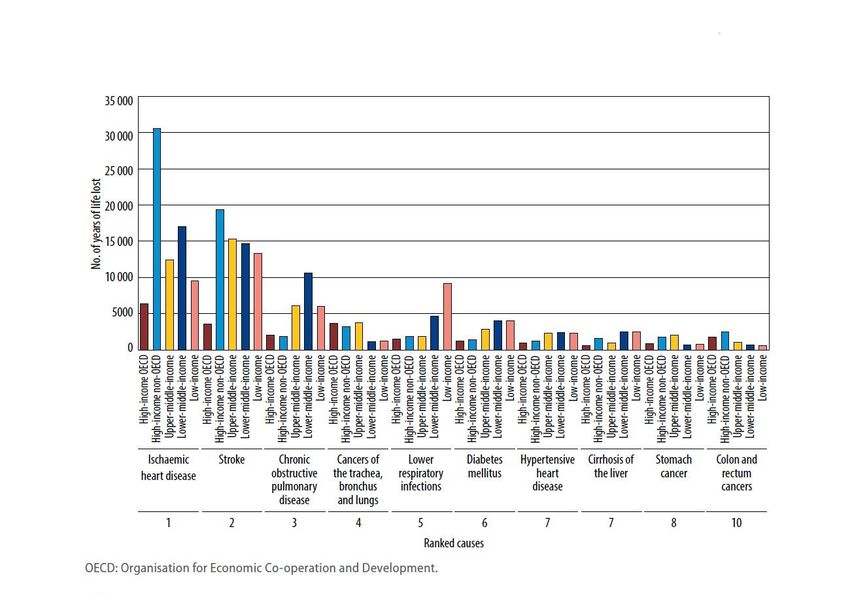
cause a significant number of deaths at all ages. Globally, most of the diseases responsible for
mortality among older persons, led by ischaemic heart disease, stroke and chronic obstructive
pulmonary disease, have significantly greater impact in middle- and low-income countries than in
high-income OECD countries (see Figure 1).21
Figure 1: Number of years of life lost to mortality (YLL) per 100 000 population for the top 10
causes of lost years, in populations aged 60 years and older, 2012
Source: Global health estimates 2013: deaths by cause, age, sex and regional grouping, 2000–2012. In: World Health Organization, Global
health estimates [website]. Geneva: World Health Organization; 2015 (http://www.who.int/healthinfo/global_burden_disease/en,
accessed 24 July 2015). In: World Health Organization, World Report on Ageing and Health (Geneva, 2015), p. 61.
4
19 Organization for Economic Cooperation and Development, Health at a Glance 2015: OECD Indicators (Paris, OECD Publishing, 2015).
Page
20 World Health Organization, World Report on Ageing and Health (Geneva, 2015).
21 The high impact of cardiovascular disease in high-income non-OECD countries is largely due to high rates in the Russian Federation.Department of Economic and Social Affairs programme on ageing
The focal point on ageing in the United Nations system
social.un.org/ageing ɪ @UN4Ageing
Causes of disability
The greatest causes of disability in old age world-wide are estimated to be sensory impairments,
such as hearing and vision loss, back and neck pain, chronic obstructive pulmonary disease,
depressive disorders, falls, diabetes, dementia and osteoarthritis. Yet sensory impairments and
chronic obstructive pulmonary diseases have a higher burden in low- and lower-middle-income
countries, whereas basic interventions such as eyeglasses and medication in wealthier countries
improve one’s functioning. The higher burden from sensory impairments may also be due to greater
cumulative exposure to noise and sun, among other factors, and that from chronic obstructive
pulmonary diseases to greater cumulative exposure to air pollutants in the home and outdoors. At
the same time, dementia has a higher burden in high-income countries, which is likely caused in part
by their proportionately larger older populations and greater awareness of–and capacity to
diagnose–types of dementia.22
Other inequalities can be observed in older persons’ health status. Among other factors, socio-
economic status has been shown to have influence on the decline in cognitive functions with age.23
Multimorbidity
The likelihood of simultaneously experiencing multiple chronic conditions–or multimorbidity–
increases for everyone with age.24 While there is limited evidence from low- and middle-income
countries, multimorbidity is likely to be more common in these than in high-income countries. In
addition, in the mostly high-income countries studied, it affects more than half of older people, yet
has a higher prevalence among those with low socio-economic status.25 Moreover, a study from
Scotland found that multimorbidity presented itself earlier–by 10 to 15 years–among those living in
the most deprived areas than those in the most wealthy.26 Race or ethnicity is also associated with
higher risk of multimorbidity; in the United States, Blacks had a higher–and Asians a lower–incidence
than did Whites.27
Conclusions and priority policy issues to be considered
Many older persons face distinct challenges in accessing quality healthcare services. Moreover, most
disparities in old age health are not random, but are associated with disadvantage that has
accumulated over the life course. Those persons in the poorest health are the least likely to have
access to the interventions they need. That experiences of health among older persons differ so
greatly underscores the message that poor health in old age is not an inevitability. Policies can
influence some health determinants, such as access to care, risky behaviors and individuals’
capacities such as health literacy, enabling persons to enter old age in a healthier state. Such types
of policy responses, which should direct particular attention to people living in poverty and
belonging to other disadvantaged groups, should be undertaken alongside broader efforts to better
align health systems with the general needs and concerns of all older persons.
22 Ibid.
23 Ibid.
24 Ibid.
25
Ibid., Chapter 3, see Refs 81, 82 and 85.
26 Ibid., Chapter 3, see Ref 84.
5
27 Jennifer L. St. Sauver and others, “Risk of developing multimorbidity across all ages in an historical cohort study: differences by sex and
Page
ethnicity”, BMJ Open, vol. 5, No. e006413. Available from http://bmjopen.bmj.com/content/5/2/e006413.full. Cited in World Health
Organization, World Report on Ageing and Health (Geneva, 2015).Department of Economic and Social Affairs programme on ageing
The focal point on ageing in the United Nations system
social.un.org/ageing ɪ @UN4Ageing
In this regard, it is important to emphasize that increases in the proportion of older persons in the
population are not strongly or clearly associated with increases in health care costs.28 Even though
older persons generally have greater need for health care than younger persons, as has been
described above--many older persons who need care do not access it. Yet even where demand for
care more closely aligns with the need for it, increasing age does does not consistently correlate with
increasing expenditure on health. Evidence from high-income countries reveals that such
expenditure per person tends to peak and then decline markedly at around age 70, after which
expenditures outside the traditional health system rise. The type of health care system has been
shown to have an important effect on the relationship between age and health costs, which may
relate to variations in, for instance, provider systems and cultural norms, especially prior to time of
death. In fact, time to death may well be a more important determinant of health expenditure than
age, as research in some countries points to a significant proportion of medical costs being incurred
in the last year of life, and to such costs declining with increasing age. Given gains in life expectancy,
the last year of life is increasingly experienced in advanced old age, when health expenditures tend
to decline. In many cases, growth in health-care expenditure is more closely linked to other factors,
including changes in clinical practice such as those relating to technological advancements, and
expanding access to care to all segments of the population. Accordingly, population ageing does not
likely pose a major economic burden, and should not deter Governments from directing investments
towards improving the health and well-being of older persons and the promotion of good health
across the life cycle.
To reduce health inequalities that adversely affect older persons and to promote their social
inclusion, the following policy suggestions are proposed:
• Ensure the availability of affordable, quality and accessible social services, including health
care and long-term care, to all older persons, and increase support to education and training
in geriatrics and gerontology;
• Introduce or enhance legislation to promote equality and non-discrimination on the basis of
age in the provision of health and health insurance services and in social protection policies
and programming, and undertake measures to prevent multiple discrimination against older
persons;
• Adopt a life-course approach to the promotion of good health and well-being, including
through the design of health systems that promote healthy ageing;
• Improve the collection, analysis and use of health and other data disaggregated by age, as
well as sex, race, ethnicity, disability and migrant status, and income, across the life course,
including through upper age bands to age 100;
• Elicit the views of representatives of older persons’ assosications and older persons
themselves, of diverse backgrounds, on their respective needs and concerns regarding
policies that address health and well-being, and establish and implement follow-up
mechanisms; and
• Enhance policy and programme coordination on issues affecting health across sectors, such
as labour and the environment.
6
Page
28 See World Health Organization, World Report on Ageing and Health (Geneva, 2015), pp. 95-98.Department of Economic and Social Affairs programme on ageing
The focal point on ageing in the United Nations system
social.un.org/ageing ɪ @UN4Ageing
For further detailed reading
• Equality and Human Rights Commission, Age Concern and Help the Aged. Just Ageing?
Fairness, Equality and the Life Course: Socio-Economic Inequalities in Older People’s Access to
and Use of Public Services. 2009. Available from
http://justageing.equalityhumanrights.com/socio-economic-inequalities-in-older-peoples-
access-to-and-use-of-public-services/.
• United Nations. Political Declaration and Madrid International Plan of Action on Ageing.
Report of the Second World Assembly on Ageing, Madrid, 8-12 April 2002. United Nations
publication, Sales No. E.02.IV.4, chap. I, resolution 1, annex II.
• United Nations. World Population Ageing 2015. ST/ESA/SER.A/390.
• United Nations, General Assembly. Report of the Secretary-General on follow-up to the
International Year of Older Persons: Second World Assembly on Ageing. 24 July 2015.
A/70/185.
• United Nations, General Assembly. Resolution on transforming our world: the 2030 Agenda
for Sustainable Development. 21 October 2015. A/RES/70/1.
• United Nations, General Assembly. Report of the Secretary-General on follow-up to the
Second World Assembly on Ageing. 19 July 2013. A/68/167.
• United Nations, General Assembly. Report of the Secretary-General on the follow-up to the
Second World Assembly on Ageing. 26 July 2012. A/67/188.
• World Health Organization. World Report on Ageing and Health. Geneva, 2015.
• World Health Organization, 69th World Health Assembly. The Global strategy and action
plan on ageing and health 2016-2020: towards a world in which everyone can live a long and
health life. Eighth plenary meeting, 28 May 2016. A69/VR/8.
7
PageYou can also read


