Healthcare Modelling for Pandemic Planning and Recovery - Michael O'Sullivan Joint work with: Cameron Walker, Ilze Ziedins University of Auckland ...
←
→
Page content transcription
If your browser does not render page correctly, please read the page content below
Healthcare Modelling for
Pandemic Planning and Recovery
                 Michael O’Sullivan
    Joint work with: Cameron Walker, Ilze Ziedins
               University of Auckland
     Summary of work from Te Pūnaha Matatini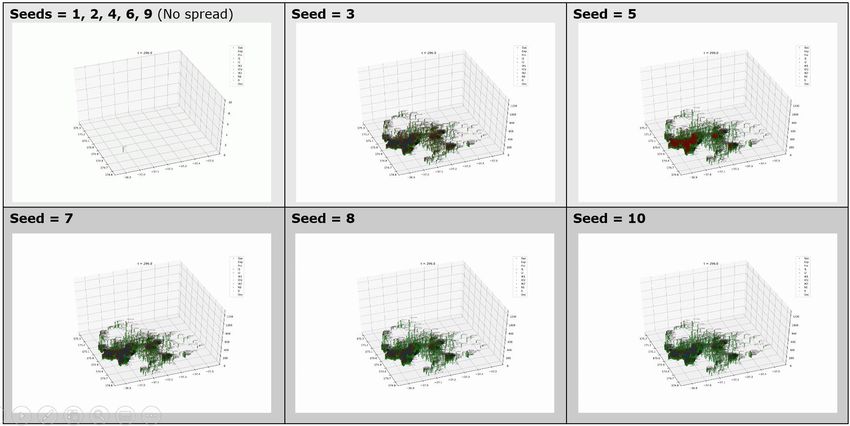
Dr Michael O’Sullivan
Ko Maungakiekie te maunga
Ko Waitemata te moana                                   Dept of Engineering Science
Ko waka moana te waka                                   University of Auckland (UoA)
Ko Te Atatu te marae
Ko Airangi me Haina te iwi                              University of Auckland
Ko O’Sullivan te hapu
                                                        • BSc (Hons), MPhil (Disc)
Ko Mike ahau                                            Stanford University alumni
                                                        • MS, PhD
One Tree Hill is my mountain
Waitemata is my ocean               President, OR Society of NZ
My waka (canoe) comes from
over the sea                        Theme Leader, Precision Driven Health
My community is Te Atatu            Investigator, Te Punaha Matatini
I am of Irish and Chinese descent
                                    (Complex Systems)
My family is O’Sullivan
                                    Research/consulting in Operations Research and (Computational)
I am Mike
                                    Analytics for Health, Social Investment, Cloud Computing,
                                    Infrastructure Planning, Finance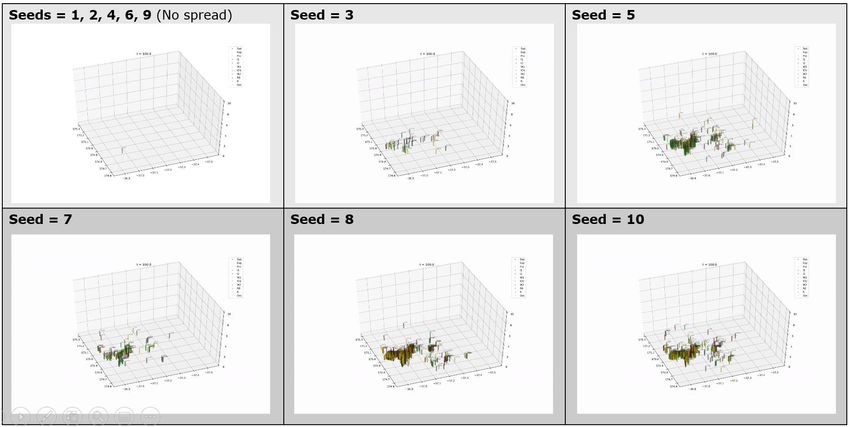
University of Auckland/Te Pūnaha
Matatini Researchers

              Associate                 Associate                   Dr Mike
            Professor Ilze              Professor                  O’Sullivan
               Ziedins                Cameron Walker
          Associate Professor         Associate Professor       Senior Lecturer in
              of Statistics,             of Engineering        Engineering Science,
          University of Auckland     Science, University of    University of Auckland
• Ilze, Cameron and Mike are all   Associate   Investigators
                                            Auckland     with Auckland/Te Pūnaha Matatini
• Involved in the response to Covid-19 – translating disease spread into hospital/ICU admissio
• Have worked with Waitemata DHB and other DHBs previously
    • Surgery scheduling, CVICU planning, patient transit simulation, whole-of-hospital modelli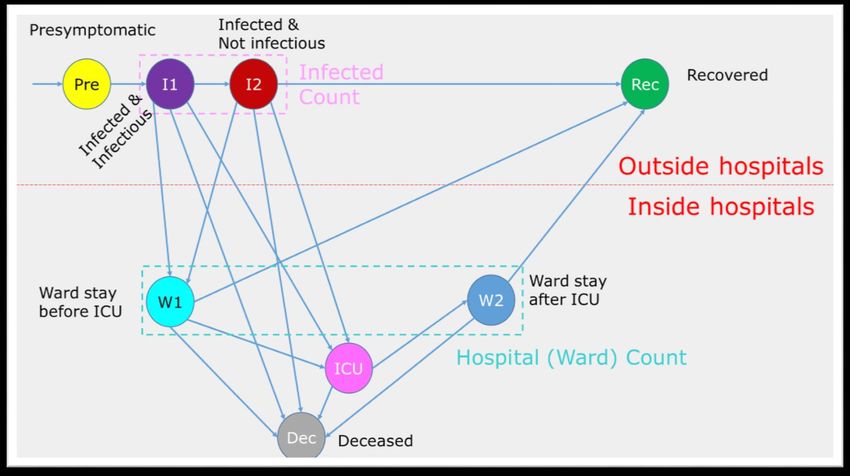
Te Pūnaha Matatini Researchers

   Alex James       Audrey Lustig       Mike Plank      Rachelle Binny       Shaun Hendy          Nic Steyn
Associate Professor Quantitative Ecologist  Professor      Mathematical        Professor           Researcher
College of Engineering Manaaki Whenua/      School of     Modeller Wildlife Department of      Te Pūnaha Matatini
     University of    Landcare Research Mathematics and     Ecology and         Physics
      Canterbury                            Statistics   Management Team University of Auckland
                                           University of  Manaaki Whenua/
                                           Canterbury    Landcare Research
    https://www.tepunahamatatini.ac.nz/?s=covid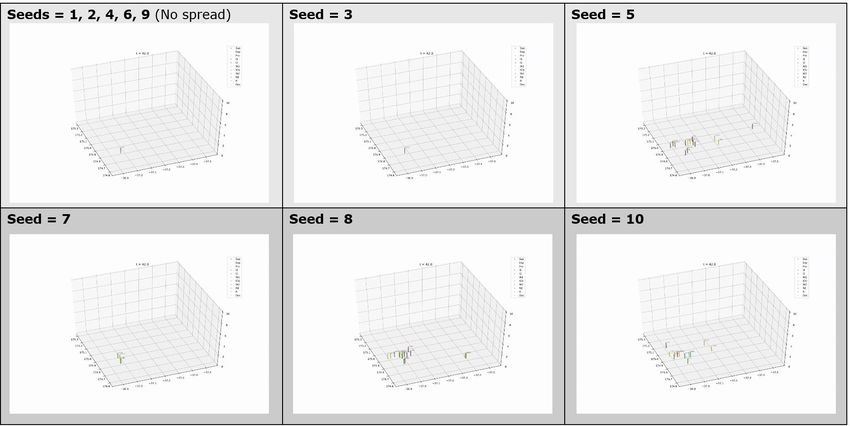
(Some of) The Team
• Siouxsie Wiles      •   Kevin Ross        • Tahu Kukutai
• Kate Hannah         •   Pieta Brown       • Melissa McLeod
• Giulio Dalla Riva   •   Matt Parry        • Kannan Ridings
• Max Soar            •   Barry Milne
• Andrew Sporle       •   Richard Arnold
• Dion O’Neale        •   Krushil Watene
• Emily Harvey        •   Mick Roberts
• Oliver Maclaren     •   Genevieve Dawick
• Adrian Ortiz-       •   Rebecca Priestley
  Cervantes           •   David Welch
• Thomas Lumley       •   Suzie Greenhalgh
Background
• New Zealand has followed a policy of “go hard and go early”.
• Early decision to aim for elimination of Covid-19 in New Zealand.
• NZ has had 2088 confirmed and probable cases (9 Dec), of whom 122 were
  hospitalized and 18 entered ICU.
   • Ministry of Health website, https://www.health.govt.nz/our-work/diseases-and-
     conditions/covid-19-novel-coronavirus/covid-19-data-and-statistics/covid-19-case-
     demographics
• We were a very small part of a large team built and led by Shaun Hendy,
  mostly within Te Pūnaha Matatini
   • This talk gives very brief overview of some of the models of patient flow we
     developed, as part of the team built by Shaun Hendy. First case reported 28 February.
     By 26 March we are in lockdown.
• Detailed modelling of patient flow was not needed in the end.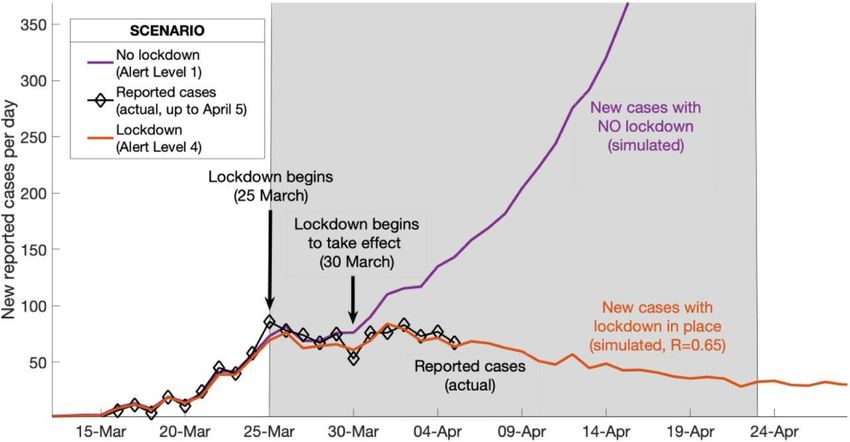
Simple SEIR model of epidemic growth
• Compartmental model, both deterministic and stochastic versions

• Based on original model from Suppression and Mitigation Strategies for Control
  of COVID-19 in New Zealand Alex James, Shaun C Hendy, Michael J Plank,
  Nicholas Steyn
Effect on Health System
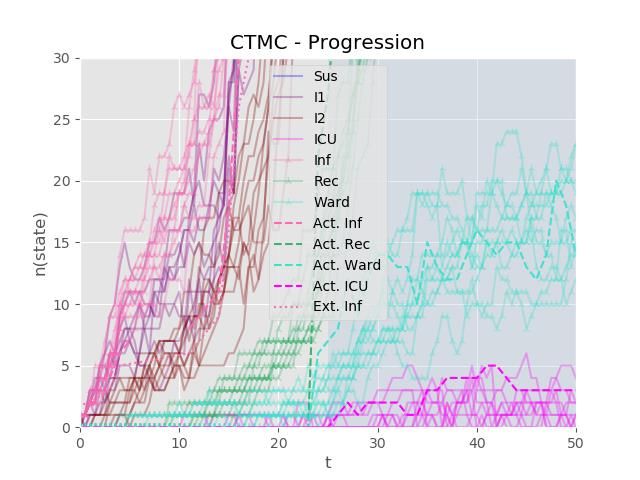
Compartmental model expanded (CTMC model)

                                            • W1 pre-ICU/
                                              no ICU ward stay
                                            • ICU stay
                                            • W2, post-ICU ward stay
                                            • R0, Recovered,
                                              unconfirmed
                                            • Rec(overed), confirmed
                                            • Dec(eased)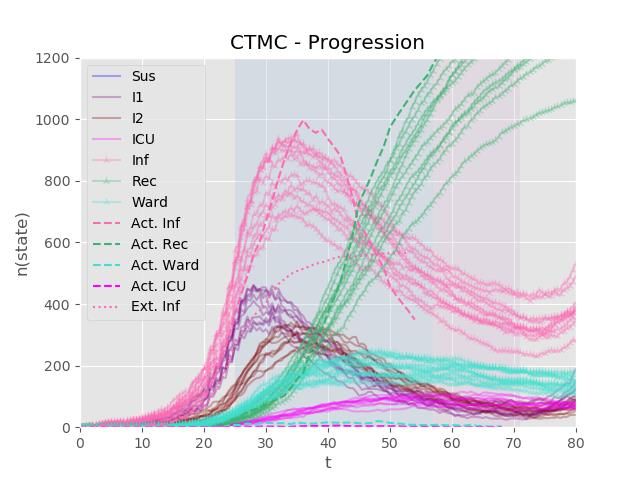
Effect on
 Health
 System
Effect on
 Health
 System
Extensions of basic model

1. Staff absence due to illness
2. More complex arrival process e.g. meshblock level
   spatial modelling of disease incidence.
3. More complex disease progression
Modelling Patient Pathways
• Patient pathway through hospital   The core inputs for
                                     these models include:
                                     • Parameters as for CTMC, or,
                                       alternatively, entry rates to
                                       hospital/ICU
                                     • Progression from ward to ICU to ward
                                     • Length of stay in ward, ICU

                                     Outputs for these
                                     models include
                                     estimates of:
                                     • Load on ICUs and Ward, and change
                                       over time
Including staff absences due to illness
• Daily admissions to hospital
(from, for example, SEIR model)
• Patients proportionally follow
5 pathways with distributional LoS
• ward -> discharge
• ward -> ICU -> discharge
• ward -> ICU -> ward -> discharge
• ICU -> discharge
• ICU -> ward -> discharge
• Each day ward and ICU staff can contract
Covid-19 based on patient occupancy
and number of infectious but non-symptomatic staff
• Staff follow infection cycle
• Bed availability reduced by staff unavailability
• ICU overflow to ward (deceased), affects staff/patient ratio in wardStochastic Model Based on Branching Process
A stochastic model for COVID-19 spread and the effects of Alert Level 4 in Aotearoa New Zealand
Michael J. Plank, Rachelle N. Binny, Shaun C. Hendy, Audrey Lustig, Alex James, Nicholas Steyn
medRxiv 2020.04.08.20058743; doi: https://doi.org/10.1101/2020.04.08.20058743Day 21, Level 2, R0 = 1.49 (rest of NZ), 2.533 within meshblocks
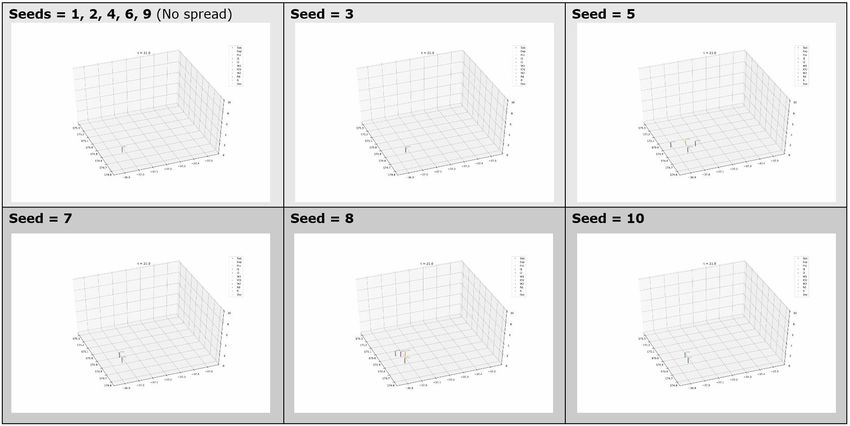
Day 21, Level 2, R0 = 1.49 (rest of NZ), 2.533 within meshblocks
Day 42, Level 2, R0 = 1.49 (rest of NZ), 2.533 within meshblocks
Day 100, Level 2, R0 = 1.49 (rest of NZ), 2.533 within meshblocks
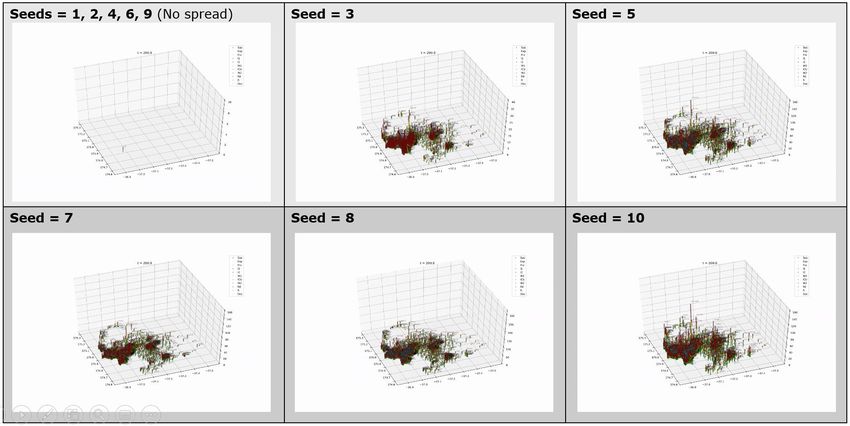
Day 200, Level 2, R0 = 1.49 (rest of NZ), 2.533 within meshblocks
Day 296, Level 2, R0 = 1.49 (rest of NZ), 2.533 within meshblocks
Multilayer Networks
Harvey, Emily, Oliver
Maclaren, Dion O’Neale,
Adrian Ortiz-Cervantes,
Frankie Patten-Elliott, Steven
Turnbull, Demival Vasques
Filho, and David Wu.
"Network-based simulations
of re-emergence and spread
of COVID-19 in Aotearoa New
Zealand."

Hammoud, Z., Kramer, F. Multilayer networks: aspects, implementations, and application in
biomedicine. Big Data Anal 5, 2 (2020). https://doi.org/10.1186/s41044-020-00046-0
Models (thankfully) were not really
used
• Single most important
  observation was that
  any growth would
  quickly overwhelm the
  capacity of our ICUs and
  Ward
• NZ has relatively low
  number of ICU beds per
  100,000 inhabitants
Recovery from Pandemics
• Clearing backlog of diagnoses and procedures missed during
  lockdown.
• This includes:
    • surgical scheduling
    • nurse rostering
    • matching flow through
      surgery with available
      capacity in ward
Recovery from
Pandemics
• Pathway modelling
• SimulationBottom Line • Modelling is a very useful planning tool for pandemics • Modelling is also very useful for the recovery from pandemics • Modelling can be performed very quickly by large-ish teams working together • It would be better if modelling was used for planning outside of pandemics (BAU) and was ready for pandemics
Bottom Line
• Modelling is a very useful planning tool for pandemics
• Modelling is also very useful for the recovery from
  pandemics
• Modelling can be performed very quickly by large-ish teams
  working together
• It would be better if modelling was used for planning outside
  of pandemics (BAU) and was ready for pandemics
You can also read


