HORIZON 2020 Avoiding Common Financial Errors Vittorio Morelli - Deputy Head of the CAS - Common Audit Service - Europa EU
←
→
Page content transcription
If your browser does not render page correctly, please read the page content below

HORIZON
      HORIZON 2020 2020

Avoiding Common Financial Errors

            Vittorio Morelli
  Deputy Head of the CAS - Common Audit Service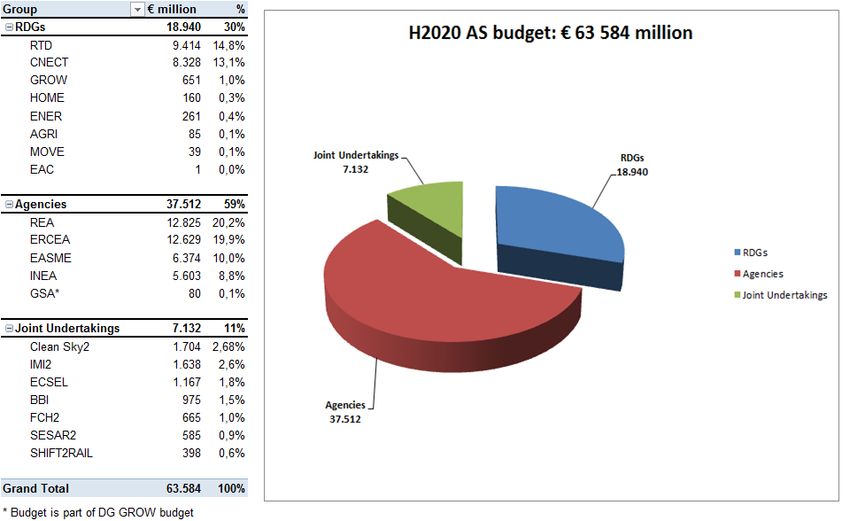
Table of Contents

 1. What is this presentation about?

 2. Why do we do audits?

 3. Background: H2020 vs FP7 – what changed?

 4. What are the elements of the H2020 audit strategy?

 5. Audit cycle

 6. Common errors expected in H2020

 7. Closing remarks

 2                    Disclaimer: Information not legally binding
1.1.What is this presentation about?

              Advices on How To Avoid Errors
                 few, clear, simple words

            • Discipline (keep your files in order).
            • Prudence (use the budget, do research, but do not
              drive at a speed of 131,9 km/h all the time).
            • Perseverance (keep fighting for your rights, but
              choose the forum – rules must be adopted by way of
              legislation, not by way of audit approach).
            • Reality (only if impossible, always stick to the reality)

    • AND in case of doubt, consult the NCP, the PO/FO, the EC
      enquiry service.

3                          Disclaimer: Information not legally binding
DG Declaration
2.1. Why do we do audits of Assurance
I, the undersigned Director-General, in my capacity as authorising
officer by delegation,
Declare that the information contained in this report gives a true and fair
view[1]…
State that I have a reasonable assurance […] based on my own judgement
and on the information at my disposal such as ex-post controls…
However the following reservation should be noted:
Reservation concerning the rate of residual errors with
regard to the accuracy of financial statements in the Seventh
Framework Programme (FP7) grants.
Brussels, 31 April 2016
"Signed"
The Director-General Robert-Jan Smits
[1] True and fair in this context means a reliable, complete and correct view on the state of affairs
in the service.
4 Disclaimer: Information not legally binding2.2. Balance between ex-ante controls and ex-post audits
Overview Other ex-ante
controls
Preventive Certification
controls (COMUC, CFS)
Ex-ante
assessments
EU Budget
(LRI)
Compliance
with
Research the legal
Budget and regulatory Detection Representative Representative
framework controls audits error rate
Extrapolation
Corrective
controls Corrective audits
Residual error
rate
H2020 Audit Strategy
5 Disclaimer: Information not legally binding3.1. Background: H2020 vs FP7 – What changed?
• Single reimbursement rate
• More flexible rules for third
parties and subcontracting costs
Main
changes • Differentiation between contracts
and subcontracts
(1) • Single 25% flat rate for indirect
costs
• 3 options for productive hours
6 Disclaimer: Information not legally binding3.2. Background: H2020 vs FP7 – What changed?
• Clearer and simpler obligations on
time records
• More flexibility for average
Main personnel costs
changes
• Eligibility of non-deductible VAT
(2) • Less audit burdens (2 years
auditability)
• Common Support Centre (CSC)
7 Disclaimer: Information not legally binding3.3. Framework for ex-post audits in H2020
Horizon 2020
One governing body One Audit Strategy Equality of
Common Support
AND treatment
Centre (CSC) One Indicative Audit
One set One set of Programme & set of
of rules AND
annotations consequences of Consistency of
MGA AMGA One Common Audit findings
Service (CAS) audit reports
applied by CAS,
performing the KPMG, PwC, and
audits Moore Stephens
Legal certainty
8 Disclaimer: Information not legally binding4.1. What are the elements of the Audit Strategy?
Legal Basis
Article 29 of the H2020 Reg. defines the principles of control and audit:
• §2. The control system shall ensure an appropriate balance between trust
and control, (…).
• §3. (…) the audit strategy (…) under Horizon 2020 shall be based on the
financial audit of a representative sample of expenditure across Horizon
2020 as a whole (…) complemented by a selection based on an assessment
of the risks related to expenditure. [every two years]
• Audits (…) shall be carried out in a coherent manner in accordance with the
principles of economy, efficiency and effectiveness in order to minimise the
audit burden on the participants”. [one Common Audit Service; synchronised
sampling cycles]
Objective
To provide the relevant AODs with necessary elements of assurance
• assessing the legality and regularity of H2020 project payments;
• attaining residual error rates at an acceptable level, multi-annually.
Research and
Innovation4.2. What are the elements of the Audit Strategy?
Constraints
• Article 30§2 of the H2020 Regulation:
• "audits may be carried out up to two years after the payment of
the balance".
• Article 22.5.2 of the Model Grant Agreement:
• the entities "may extend findings … if ... those findings are
formally notified to the beneficiary concerned … no later than
two years after the payment of the balance".
• The Commission proposal indicates a maximum of 7% of
the number of beneficiaries to be audited.
The creation of the CSC - and the CAS in particular – should
allow a better coordination of Horizon 2020 audits and avoid
over-auditing the beneficiaries.
Research and
Innovation4.3. What are the elements of the Audit Strategy?
The principles:
H2020 2013->2020=> H2020 Audit strategy 2016-2025
Financial audits => compliance with the legal and
regulatory framework ≠ performance audits
A corporate approach [H2020 expenditure as a whole]
Three layers of sampling:
the 'corporate sample' via the Common Representative Sample (CRS)
complemented by a risk-based selection;
the 'additional sample': for entities with specific grant agreements
[Marie-Curie Grants; ERC Grants] or a proper discharge procedure;
the 'Article 10 sample': explicit request of the JUs.
Research and
Innovation4.4. What does the Audit Strategy cover?
H2020 Audit Strategy: 20 'clients'
In:
DG RTD CleanSky
DG CNECT IMI
DG GROW ECSEL
DGs
JUs
DG HOME BBI
DG ENER/MOVE* FCH
DG AGRI* Sesar
DG EAC* Shift2Rail
* Implement budget via EAs
REA GSA - Prague
(Regulatory Agency)
ERCEA
EAs
EASME Other
Out:
INEA EIT - Budapest
ESA
P2Ps (Article 185)
Research and
Innovation
EIB4.5. What does the Audit Strategy cover?
Research and
Innovation4.6. What does the Audit Strategy cover?
Forecasted requests for contribution
Research and
Innovation4.7. In-house or outsourced audits
External audits ARE ruled by Article 22.1 of the H2020 Model Grant
Agreements: H2020 General MGA
Ex-post controls
• in-house
(CAS) +/-20%
• outsourced
(EAFs) +/– 80%
External audits ARE NOT :
Agreed Upon Procedures performed by CFS auditors
Controls done by operational officers on deliverables Ex-ante
controls
Controls done by financial officers on Financial Statements (Forms C)
15 Disclaimer: Information not legally binding4.8. How does the CAS select audit companies?
• Selection of the External Audit Firms
• (e-Tendering)
Exclusion Selection Award
criteria criteria criteria Winners
Technical criteria
9 Offers Civil, criminal
Execution and reporting standards
and tax record Working methods (e.g. IAP)
Methods to identify and report CoI
Absence of CoI Communication solutions 1. KPMG
Best
2. PwC
price-quality ratio
Capacity 3. Moore
Stephens
Legal and regulatory
Allowed to pursue the professional activity
Economic and financial
Minimum volume of business
Professional risk insurance
Technical and professional
Recognition by competent authorities
Proven professional experience
Capacity to draft reports in native EN level
16 Disclaimer: Information not legally binding5.1. Audit cycle 17 Disclaimer: Information not legally binding
Auditors vs beneficiaries:
who does what?
Who is who in this picture?
The auditors:
• Don't invent evidence
• Don't invent rules
• Don't interpret rules
The beneficiaries:
• The same! But don't wait for an audit!!!
18 Disclaimer: Information not legally binding5.2. Audit Strategy & Selection Statistical method: Monetary Unit Sampling (MUS) Audits of biggest beneficiaries Risk based analysis: high amounts, large proportion of subcontracting, new beneficiaries, etc. Audits on request Fraud-risk audits 19 Disclaimer: Information not legally binding
5.3. Audit Planning & Preparation Concrete selection of actions to be audited Initial contact with responsible auditors to agree on dates and logistics for audit visit Formal “Letter of announcement” of audit including detailed annex with information and documents to be provided prior and during the on site examination 20 Disclaimer: Information not legally binding
5.4. Audit process – Main steps
Initiation Cooperation is critical
Letter of Announcement during all stages of the audit process
Planning & Examination Reporting & Closure
Preparation Desk review 1. Preliminary Audit Report (PAR)
Visit on-the-spot reviewed by CAS
Agree fieldwork dates
Collection of audit evidence consulted internally (units
Information request
Provide appropriate, managing the actions)
Collection of audit
evidence
! sufficient and persuasive 2. Contradictory procedure
evidence carefully review preliminary
Indicative Audit Programme
Preliminary findings
! findings and recommendations
submit appropriate, sufficient and
Closing meeting persuasive evidence
3. Draft Audit Report (DAR) incorporating
beneficiary's comments
reviewed by CAS (including by the
quality control)
all comments are carefully
reviewed and responded
consulted internally (units
Implementation of audit findings
managing the actions, legal advice,
Post audit internal committees etc.)
Managed by the EC operational services 4. Final Audit Report (FAR)
(not the CAS) 5. Letter of conclusion
21 Disclaimer: Information not legally binding5.5. Communication after the closure of the audit
Who does what?
The CAS (Common Audit Service) closures the audit by
issuing:
• the Final Audit Report (after the contradictory procedure) with the Letter of
Conclusion
• The Letter of Conclusion summarises the audit findings and informs the
beneficiary that the final audit report will be distributed to the relevant
Commission services for the implementation of the audit findings
The "Operational" Services:
• Calculate the amount of EU financial contribution (to recover or to offset)
and send a letter informing the beneficiary (and giving him another contradictory
period)
• In case of a recovery, the pre-information letter will contain the detailed
reasons
• Taking in due account the comments and observations submitted by the
beneficiary the EC services may decide to:
• revise the amount of the EU financial contribution
• and/or to confirm the amount to be recovered;
• offset (deduction from a next payment)
22 Disclaimer: Information not legally binding5.6. Communication after the closure of the audit
Who does what?
The "Operational" Services:
• In this case a debit note will be sent to the beneficiary which can be
challenged before the Court of Justice of the European Union ;
• The Court of Justice is the competent court for any dispute regarding the
validity, application or interpretation of the H2020 grant in accordance with
the Art 57.2 of the H2020 MGA
The Beneficiary:
• The beneficiary has the opportunity to reply to the pre-information letter and
submit comments and observations within a deadline indicated in the letter
23 Disclaimer: Information not legally binding6. H2020 most common errors expected
1. Direct costs apportioned, not measured
2. Time sheets (we hope no more hourly rates)
3. Best value for money (subcontracting and purchase of goods)
4. Basic vs additional remuneration
5. In-house, near off-site, semi-permanent, teleworking consultants
5+. Same old friends: no papers, UAP, depreciation "in one shot"
24 Disclaimer: Information not legally binding• Direct costs apportioned, not measured
• In FP7, energy and power supply was an indirect cost:
-> can I charge it as direct in H2020?
• Yes, if I can measure it…
• Administrative staff members doing project accounting:
-> can I charge them to the project?
• Yes, with time sheets…
• I have a big multi-purpose equipment and I use it for
several activities and projects:
-> can I charge its depreciation to an EC project as a %
based on my experience?
• No. I have to measure its use.
25 Disclaimer: Information not legally binding• Time sheets
I work 100% on the project
so I don't have to fill in TS, correct?
Correct, but pay attention:
• Did I spend a significant part of my time building up a network with other
entities or other laboratories of my company, for future projects?
• Did I spend time in writing proposals for the next calls?
• Did I give lectures for the University?
• Did I travel for other unforeseen activities?
• What do I have to indicate in the box of the self-declaration requesting an
indication of the activities carried out, per work package?
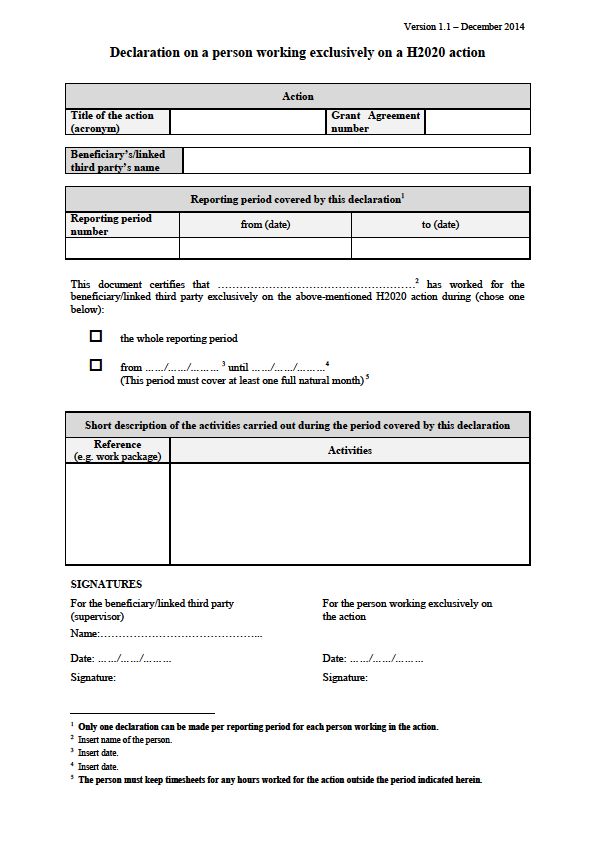
26 Disclaimer: Information not legally bindingDeclaration for persons working
exclusively on the action:
Model available in the AGA
(version 19/12/2014)
Only one declaration can be
! made per reporting period for
each person
27 Disclaimer: Information not legally binding• Time sheets (continued)
I don't keep TS, or they are too inaccurate
I can always go for the
'alternative evidence option', correct?
YES but NO
• First of all, why are your time sheets not in order ? IT solutions exist.
• Secondly, why don't you fill them in?
• Thirdly: TS? I don't use them because in my specific case I use…
What? How do you follow your projects?
28 Disclaimer: Information not legally bindingPersonnel costs: hours worked for the action
You cannot declare:
→ Budgeted time (what you indicated for the budget)
→ Estimated time (e.g. person 'guessing' at the end of the year)
→ Time allocation (e.g. x % of the contractual time of the person)
Hours declared to the action must be supported by
! reliable records and documentation !
29 Disclaimer: Information not legally bindingBest value for money (subcontracting AND purchase of goods)
• My subcontractor is a friend:
is it a problem?
• As such not. But you must be in a position to prove that his/her offer
represents the best price-quality ratio.
• The conflict of interests rule requires you to adopt every measure to
avoid it (including family and emotional ties).
• I have named my subcontractor in the Annexes to the
G.A.: is it enough?
• No because you are still deemed to have respected the best value for
money.
• I use the same IT provider since 20 years, with a
written framework contract: is it ok?
• If you use it for you and for us, then ok. However, maybe it is time to
look for better prices…
30 Disclaimer: Information not legally bindingEstablishing systems from the start
You must demonstrate 'best value for money'
and take measures to avoid 'conflict of interests'
in sub-contracting and in Purchase of Goods
Regular errors
• 'Best value' not demonstrated – no tender, no counter-
offers, no market survey.
• Participants' own normal practices not applied.
• No documentation kept.
• Conflict of interests overriding any competition.
31 Disclaimer: Information not legally bindingEstablishing systems from the start
You may not
under any circumstances
sub-contract to a project partner
(MGA Article 13)
Please!
32 Disclaimer: Information not legally binding• Basic vs additional remuneration
• I pay a bonus to my staff when a baby is born:
is this eligible as basic remuneration?
• Yes, it is.
• I pay a part of the remuneration only if my company makes 1M€
profit and distributes dividends:
is this eligible as basic remuneration?
• Yes, provided that the bonus does not represent any distribution of
the profit earned.
• I am the boss and I decide who gets the bonus and who doesn't:
is this considered as ineligible?
• A bonus scheme can be discretionary, yet based on objective
conditions (merit, performance, potential – no matter how these are
assessed by the boss - but as part of the usual remuneration policies,
and documented). The scheme cannot be arbitrary or discriminatory,
i.e. a bonus paid only if and when a researcher works on a H2020
project.
33 Disclaimer: Information not legally binding• In-house, near off-site, semi-permanent, teleworking
consultants
• I have a contract with ABC Interim for some personnel:
can I charge the invoices issued by ABC Interim as personnel
costs?
• No, the person must have a contract directly with the beneficiary.
• During the project it appeared that some personnel of the
University, partner in the same project, were familiar with the
issue and did the work, partly in my premises:
is it ok?
• The advice is: inform and consult the PO/FO in advance.
34 Disclaimer: Information not legally bindingWhat contract under what budget category
What you CANNOT declare under personnel costs?
Contracts with companies (e.g. temporary work agencies) to
provide staff.
Natural persons (e.g. consultants) not fulfilling the conditions
(hierarchical dependence, premises, similar cost for similar
tasks, ownership of results).
e.g. working autonomously on the tasks assigned to them
Natural persons (e.g. consultants) paid for deliverables rather
than for working time
In the cases above the costs may be eligible under 'Other goods and
! services' or under 'Subcontracting' but never as personnel costs
35 Disclaimer: Information not legally bindingAdditional info
Participant Portal
At: http://ec.europa.eu/research/participants/portal/desktop/en/home.html
Horizon 2020 Annotated Grant Agreement
http://ec.europa.eu/research/participants/data/ref/h2020/grants_manual/amga/h2020-amga_en.pdf
Horizon 2020 On-line Manual
http://ec.europa.eu/research/participants/portal/desktop/en/funding/guide.html#
Questions? Research Enquiry Service
http://ec.europa.eu/research/enquiries
36 Disclaimer: Information not legally bindingHORIZON 2020
Thank you
for your attention!
Find out more:
http://ec.europa.eu/programmes/horizon2020/You can also read


