How Can Psychological Science Help Counter the Spread of Fake News?
←
→
Page content transcription
If your browser does not render page correctly, please read the page content below
The Spanish Journal of Psychology (2021), 24, e25, 1–9.
                   © Universidad Complutense de Madrid and Colegio Oficial de Psicólogos de Madrid 2021. This is an
                   Open Access article, distributed under the terms of the Creative Commons Attribution-NonCommercial-Share
                   Alike licence (http://creativecommons.org/licenses/by-nc-sa/4.0/), which permits non-commercial re-use,
                   distribution, and reproduction in any medium, provided the same Creative Commons licence is included and the
                   original work is properly cited. The written permission of Cambridge University Press must be obtained for commercial re-use.
                   doi:10.1017/SJP.2021.23

                   How Can Psychological Science Help Counter the
                   Spread of Fake News?

                   Sander van der Linden , Jon Roozenbeek , Rakoen Maertens                                     , Melisa Basol         , Ondřej Kácha          ,
                   Steve Rathje and Cecilie Steenbuch Traberg
                   University of Cambridge (UK)

                   Abstract. In recent years, interest in the psychology of fake news has rapidly increased. We outline the various interven-
                   tions within psychological science aimed at countering the spread of fake news and misinformation online, focusing
                   primarily on corrective (debunking) and pre-emptive (prebunking) approaches. We also offer a research agenda of open
                   questions within the field of psychological science that relate to how and why fake news spreads and how best to counter it:
                   the longevity of intervention effectiveness; the role of sources and source credibility; whether the sharing of fake news is
                   best explained by the motivated cognition or the inattention accounts; and the complexities of developing psychometrically
                   validated instruments to measure how interventions affect susceptibility to fake news at the individual level.

                   Received 28 December 2020; Revised 10 January 2021; Accepted 25 February 2021

                   Keywords: debunking, fake news, inoculation, misinformation, prebunking

                   Fake news can have serious societal consequences                                Current Approaches to Countering Misinformation
                   for science, society, and the democratic process
                                                                                                   Scholars have largely offered two different approaches
                   (Lewandowsky et al., 2017). For example, belief in fake
                                                                                                   to combat misinformation, one reactive, the other pro-
                   news has been linked to violent intentions (Jolley &
                                                                                                   active. We review each approach in turn below.
                   Paterson, 2020), lower willingness to get vaccinated
                   against the coronavirus disease 2019 (COVID-19; Roo-
                   zenbeek, Schneider, et al., 2020), and decreased adher-                         Reactive Approaches: Debunking and Fact-Checking
                   ence to public health guidelines (van der Linden,
                                                                                                   The first approach concerns the efficacy of debunking
                   Roozenbeek, et al., 2020). Fake rumours on the What-
                                                                                                   and debiasing (Lewandowsky et al., 2012). Debunking
                   sApp platform have inspired mob lynchings (Arun,
                                                                                                   misinformation comes with several challenges, as doing
                   2019) and fake news about climate change is undermin-
                                                                                                   so reinforces the (rhetorical frame of the) misinforma-
                   ing efforts to mitigate the biggest existential threat of our
                                                                                                   tion itself. A plethora of research on the illusory truth
                   time (van der Linden et al., 2017).
                                                                                                   effect suggests that the mere repetition of information
                     In light of this, interest in the “psychology of fake
                                                                                                   increases its perceived truthfulness, making even suc-
                   news” has skyrocketed. In this article, we offer a rapid
                                                                                                   cessful corrections susceptible to unintended conse-
                   review and research agenda of how psychological sci-
                                                                                                   quences (Effron & Raj, 2020; Fazio et al., 2015;
                   ence can help effectively counter the spread of fake news,
                                                                                                   Pennycook et al., 2018). Despite popular concerns
                   and what factors to take into account when doing so.1
                                                                                                   about potential backfire-effects, where a correction
                                                                                                   inadvertently increases the belief in—or reliance on—
                     Correspondence concerning this article should be addressed to                 misinformation itself, research has not found such
                   Sander van der Linden. University of Cambridge. Department of                   effects to be commonplace (e.g., see Ecker et al., 2019;
                   Psychology. Downing Street. CB2 3EB Cambridge (UK).                             Swire-Thompson et al., 2020; Wood & Porter, 2019). Yet,
                     E-mail: sander.vanderlinden@psychol.cam.ac.uk
                     Conflicts of Interest: None.
                     Funding Statement: This research received no specific grant from any             How to cite this article:
                   funding agency, commercial or not-for-profit sectors.                              van der Linden, S., Roozenbeek, J., Maertens, R., Basol, M.,
                     1
                      For more comprehensive reviews of misinformation research, we                  Kácha, O., Rathje, S., & Traberg, C. S. (2021). How can
                   refer to Lazer et al. (2018), Lewandowsky et al. (2017), Flynn et al. (2017),     psychological science help counter the spread of fake news? The
                   Greifeneder et al. (2020), Lewandowsky and van der Linden (2021) and              Spanish Journal of Psychology, 24. e25. Doi:10.1017/SJP.2021.23
                   van Bavel et al. (2021).

Downloaded from https://www.cambridge.org/core. IP address: 46.4.80.155, on 14 Aug 2021 at 02:23:54, subject to the Cambridge Core terms of use, available at https://www.cambridge.org/core/terms
. https://doi.org/10.1017/SJP.2021.23
2 S.van der Linden et al.
there is reason to believe that debunking misinforma- et al., 2017; van der Linden et al., 2017), conspiracy
tion can still be challenging in light of both (politically) theories (Banas & Miller, 2013; Jolley & Douglas, 2017),
motivated cognition (Flynn et al., 2017), and the contin- and astroturfing by Russian bots (Zerback et al., 2020).
ued influence effect (CIE) where people continue to In particular, the distinction between active vs. passive
retrieve false information from memory despite defences has seen renewed interest (Banas & Rains,
acknowledging a correction (Chan et al., 2017; Lewan- 2010). As opposed to traditional passive inoculation
dowsky et al., 2012; Walter & Tukachinsky, 2020). In where participants receive the pre-emptive refutation,
general, effective debunking requires an alternative during active inoculation participants are tasked with
explanation to help resolve inconsistencies in people’s generating their own “antibodies” (e.g., counter-
mental model (Lewandowsky, Cook, et al., 2020). But arguments), which is thought to engender greater resis-
even when a correction is effective (Ecker et al., 2017; tance (McGuire & Papageorgis, 1961). Furthermore,
MacFarlane et al., 2020), fact-checks are often outpaced rather than inoculating people against specific issues,
by misinformation, which is known to spread faster and research has shown that making people aware of both
further than other types of information online (Petersen their own vulnerability and the manipulative intent of
et al., 2019; Vosoughi et al., 2018). others can act as a more general strategy for inducing
resistance to deceptive persuasion (Sagarin et al., 2002).
Perhaps the most well-known example of active inoc-
Proactive Approaches: Inoculation Theory and
ulation is Bad News (Roozenbeek & van der Linden,
Prebunking
2019b), an interactive fake news game where players
In light of the shortcomings of debunking, scholars are forewarned and exposed to weakened doses of the
have called for more proactive interventions that common techniques that are used in the production of
reduce whether people believe and share misinforma- fake news (e.g., conspiracy theories, fuelling intergroup
tion in the first place. Prebunking describes the process polarization). The game simulates a social media feed
of inoculation, where a forewarning combined with a and over the course of 15 to 20 minutes lets players
pre-emptive refutation can confer psychological resis- actively generate their own “antibodies” in an interac-
tance against misinformation. Inoculation theory tive environment. Similar games have been developed
(McGuire, 1970; McGuire & Papageorgis, 1961) is the for COVID-19 misinformation (Go Viral!, see Basol et al.,
most well-known psychological framework for confer- in press), climate misinformation (Cranky Uncle, see
ring resistance to persuasion. It posits that pre-emptive Cook, 2019) and political misinformation during elec-
exposure to a weakened dose of a persuasive argu- tions (Harmony Square, see Roozenbeek & van der Lin-
ment can confer resistance against future attacks, den, 2020). A growing body of research has shown that
much like a medical vaccine builds resistance against after playing “fake news” inoculation games, people
future illness (Compton, 2013; McGuire, 1964). A large are; (a) better at spotting fake news, (b) more confident
body of inoculation research across domains has dem- in their ability to identify fake news, and (c) less likely to
onstrated its effectiveness in conferring resistance report sharing fake news with others in their network
against (unwanted) persuasion (for reviews, see Banas (Basol et al., 2020; Roozenbeek, van der Linden, et al.,
& Rains, 2010; Lewandowsky & van der Linden, 2021), 2020; Roozenbeek & van der Linden, 2019a, 2019b,
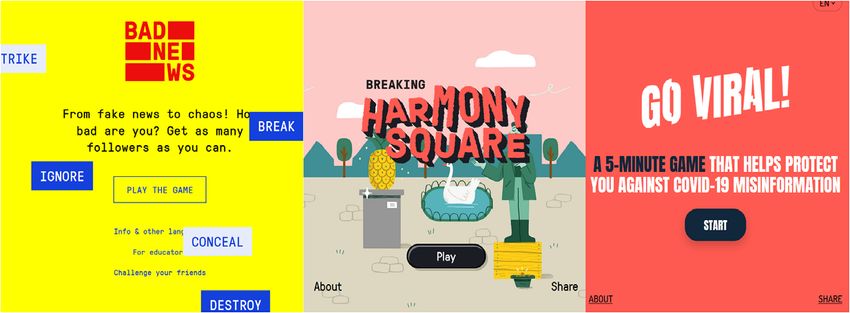
including misinformation about climate change (Cook 2020). Figure 1 shows screenshots from each game.
Figure 1. Screenshots of the Bad News (www.getbadnews.com), Go Viral! (www.goviralgame.com), and Harmony Square (www.
harmonysquare.game) landing pages.
Downloaded from https://www.cambridge.org/core. IP address: 46.4.80.155, on 14 Aug 2021 at 02:23:54, subject to the Cambridge Core terms of use, available at https://www.cambridge.org/core/terms
. https://doi.org/10.1017/SJP.2021.23The Psychology of Countering Fake News 3
An Agenda for Future Research on Fake News contributing to source credibility is similarity between
Interventions the source and message receiver (Chaiken & Mahes-
waran, 1994; Metzger et al., 2003), particularly attitudi-
Although these advancements are promising, in this
nal (Simons et al., 1970) and ideological similarity
section, we outline several open questions to bear in
(Marks et al., 2019).
mind when designing and testing interventions aimed
Indeed, when readers attend to source cues, source
at countering misinformation: How long their effective-
credibility affects evaluations of online news stories
ness remains detectable, the relevance of source effects,
(Go et al., 2014; Greer, 2003; Sterrett et al., 2019; Sundar
the role of inattention and motivated cognition, and the
et al., 2007) and in some cases, sources impact the
complexities of developing psychometrically validated
believability of misinformation (Amazeen & Krishna,
instruments to measure how interventions affect sus-
2020; Walter & Tukachinsky, 2020). In general, individ-
ceptibility to misinformation.
uals are more likely to trust claims made by ideologi-
cally congruent news sources (Gallup, 2018) and
The Longevity of Intervention Effects discount news from politically incongruent ones (van
Reflecting a broader lack of longitudinal studies in der Linden, Panagopoulos, et al., 2020). Furthermore,
behavioural science (Hill et al., 2013; Marteau et al., polarizing sources can boost or retract from the persua-
2011; Nisa et al., 2019), most research on countering siveness of misinformation, depending on whether or
misinformation does not look at effects beyond two not people support the attributed source (Swire,
weeks (Banas & Rains, 2010). While Swire, Berinsky, Berinsky, et al., 2017; Swire, Ecker, et al., 2017).
et al. (2017) found that most effects had expired one For debunking, organizational sources seem more
week after a debunking intervention, Guess et al. (2020) effective than individuals (van der Meer & Jin, 2020;
report that three weeks after a media-literacy interven- Vraga & Bode, 2017) but only when information recip-
tion effects can either dissipate or endure. ients actively assess source credibility (van Boekel et al.,
Evidence from studies comparing interventions indi- 2017). Indeed, source credibility may matter little when
cates that expiration rates may vary depending on the individuals do not pay attention to the source
method, with inoculation-based effects generally staying (Albarracín et al., 2017; Sparks & Rapp, 2011), and
intact for longer than narrative, supportive, or consensus- despite highly credible sources the continued influence
messaging effects (e.g., see Banas & Rains, 2010; of misinformation may persist (Ecker & Antonio, 2020).
Compton & Pfau, 2005; Maertens, Anseel, et al., 2020; For prebunking, evidence suggests that inoculation
Niederdeppe et al., 2015; Pfau et al., 1992). Although interventions are more effective when they involve
some studies have found inoculation effects to decay high-credibility sources (An, 2003). Yet, sources may
after two weeks (Compton, 2013; Pfau et al., 2009; not impact accuracy perceptions of obvious fake news
Zerback et al., 2020), the literature is converging on an (Hameleers, 2020), political misinformation (Dias et al.,
average inoculation effect that lasts for at least two 2020; Jakesch et al., 2019), or fake images (Shen et al.,
weeks but largely dissipates within six weeks (Ivanov 2019), potentially because these circumstances reduce
et al., 2018; Maertens, Roozenbeek, et al., 2020). news receivers’ attention to the purported sources.
Research on booster sessions indicates that the longevity Overall, relatively little remains known about how peo-
of effects can be prolonged by repeating interventions or ple evaluate sources of political and non-political
regular assessment (Ivanov et al., 2018; Maertens, fake news.
Roozenbeek, et al., 2020; Pfau et al., 2006).
Gaining deeper insights into the longevity of different Inattention versus Motivated Cognition
interventions, looking beyond immediate effects, and
unveiling the mechanisms behind decay (e.g., interfer- At present, there are two dominant explanations for
ence and forgetting), will shape future research towards what drives susceptibility to and sharing of fake news.
more enduring interventions. The motivated reflection account proposes that reason-
ing can increase bias. Identity-protective cognition
occurs when people with better reasoning skills use
Source Effects
this ability to come up with reasons to defend their
When individuals are exposed to persuasive messages ideological commitments (Kahan et al., 2007). This
(Petty & Cacioppo, 1986; Wilson & Sherrell, 1993) and account is based on findings that those who have the
evaluate whether claims are true or false (Eagly & Chai- highest levels of education (Drummond & Fischhoff,
ken, 1993), a large body of research has shown that 2017), cognitive reflection (Kahan, 2013), numerical
source credibility matters (Briñol & Petty, 2009; Chaiken ability (Kahan et al., 2017), or political knowledge
& Maheswaran, 1994; Maier et al., 2017; Pornpitakpan, (Taber et al., 2009) tend to show more partisan bias
2004; Sternthal et al., 1978). A significant factor on controversial issues.
Downloaded from https://www.cambridge.org/core. IP address: 46.4.80.155, on 14 Aug 2021 at 02:23:54, subject to the Cambridge Core terms of use, available at https://www.cambridge.org/core/terms
. https://doi.org/10.1017/SJP.2021.234 S.van der Linden et al.
The inattention account, on the other hand, suggests Pennycook et al., 2015) or the conspiracy mentality scales
that people want to be accurate but are often not think- (Brotherton et al., 2013; Bruder et al., 2013; Swami et al.,
ing about accuracy (Pennycook & Rand, 2019, 2020). 2010), these are only proxies. To measure the efficacy of
This account is supported by research finding that delib- fake news interventions, researchers often collect (e.g.,
erative reasoning styles (or cognitive reflection) are asso- Cook et al., 2017; Guess et al., 2020; Pennycook et al.,
ciated with better discernment between true and false 2020; Swire, Berinsky, et al., 2017; van der Linden et al.,
news (Pennycook & Rand, 2019). Additionally, encour- 2017) or create (e.g., Roozenbeek, Maertens, et al., 2020;
aging people to pause, deliberate, or think about accu- Roozenbeek & van der Linden, 2019b) news headlines
racy before rating headlines (Bago et al., 2020; Fazio, and let participants rate the reliability or accuracy of these
2020; Pennycook et al., 2020) can lead to more accurate headlines on binary (e.g., true vs. false) or Likert (e.g.,
identification of false news for both politically congru- reliability 1-7) scales, resulting in an index assumed to
ent and politically-incongruent headlines (Pennycook & depict how skilled people are at detecting misinforma-
Rand, 2019). tion. These indices are often of limited psychometric
However, both theoretical accounts suffer from sev- quality, and can suffer from varying reliability and
eral shortcomings. First, it is difficult to disentangle specific item-set effects (Roozenbeek, Maertens, et al.,
whether partisan bias results from motivated reasoning 2020).
or selective exposure to different (factual) beliefs Recently, more attention has been given to the correct
(Druckman & McGrath, 2019; Tappin et al., 2020). For detection of both factual and false news, with some
instance, although ideology and education might inter- studies indicating people improving on one dimension,
act in a way that enhances motivated reasoning in cor- while not changing on the other (Guess et al., 2020;
relational data, exposure to facts can neutralize this Pennycook et al., 2020; Roozenbeek, Maertens, et al.,
tendency (van der Linden et al., 2018). Paying people 2020). This raises questions about the role of general
to produce more accurate responses to politically con- scepticism, and what constitutes a “good” outcome of
tentious facts also leads to less polarized responses misinformation interventions in a post-truth era
(Berinsky, 2018; Bullock et al., 2013; Bullock & Lenz, (Lewandowsky et al., 2017). Relatedly, most methods
2019; Jakesch et al., 2019; Prior et al., 2015; see also fail to distinguish between veracity discernment and
Tucker, 2020). On the other hand, priming partisan response bias (Batailler et al., in press). In addition,
identity-based motivations leads to increased moti- stimuli selection is often based on a small pool of news
vated reasoning (Bayes et al., 2020; Prior et al., 2015). items, which limits the representativeness of the stimuli
Similarly, a recent re-analysis of Pennycook and Rand and thus their external validity.
(2019) found that while cognitive reflection was indeed A validated psychometric test that provides a general
associated with better truth discernment, it was not score, as well as reliable subscores for false and factual
associated with less partisan bias (Batailler et al., in news detection (Roozenbeek, Maertens, et al., 2020), is
press). Other work has found large effects of partisan therefore required. Future research will need to harness
bias on judgements of truth (see also Tucker, 2020; van modern psychometrics to develop a new generation of
Bavel & Pereira, 2018). One study found that animosity scales based on a large and representative pool of news
toward the opposing party was the strongest psycho- headlines. An example is the new Misinformation Sus-
logical predictor of sharing fake news (Osmundsen ceptibility Test (MIST, see Maertens, Götz, et al., 2020).
et al., 2020). Additionally, when Americans were asked Better measurement instruments combined with an
for top-of-mind associations with the word “fake informed debate on desired outcomes, should occupy a
news,” they most commonly answered with news central role in the fake news intervention debate.
media organizations from the opposing party (e.g.,
Republicans will say “CNN,” and Democrats will say
Implications for Policy
“Fox News”; van der Linden, Panagopoulos, et al.,
2020). It is therefore clear that future research would A number of governments and organizations have
benefit from explicating how interventions target both begun implementing prebunking and debunking strat-
motivational and cognitive accounts of misinformation egies as part of their efforts to limit the spread of false
susceptibility. information. For example, the Foreign, Commonwealth
and Development Office and the Cabinet Office in the
United Kingdom and the Department of Homeland Secu-
Psychometrically Validated Measurement Instruments
rity in the United States have collaborated with
To date, no psychometrically validated scale exists that researchers and practitioners to develop evidence-
measures misinformation susceptibility or people’s ability based tools to counter misinformation using inoculation
to discern fake from real news. Although related scales theory and prebunking games that have been scaled
exist, such as the Bullshit Receptivity scale (BSR; across millions of people (Lewsey, 2020; Roozenbeek
Downloaded from https://www.cambridge.org/core. IP address: 46.4.80.155, on 14 Aug 2021 at 02:23:54, subject to the Cambridge Core terms of use, available at https://www.cambridge.org/core/terms
. https://doi.org/10.1017/SJP.2021.23The Psychology of Countering Fake News 5
& van der Linden, 2019b, 2020). Twitter has also placed Amazeen, M., & Krishna, A. (2020, August 7). Correcting
inoculation messages on users’ news feeds during the vaccine misinformation: Recognition and effects of source
2020 United States presidential election to counter the type on misinformation via perceived motivations and
spread of political misinformation (Ingram, 2020). credibility. SSRN. https://doi.org/10.2139/ssrn.3698102
An, C. (2003). Efficacy of inoculation strategies in promoting
With respect to debunking, Facebook collaborates
resistance to political attack messages: Source credibility
with third-party fact checking agencies that flag mis-
perspective [Unpublished doctoral dissertation]. University of
leading posts and issue corrections under these posts Oklahoma.
(Bode & Vraga, 2015). Similarly, Twitter uses algorithms Arun, C. (2019). On WhatsApp, rumours, lynchings, and the
to label dubious Tweets as misleading, disputed, or Indian Government. Economic & Political Weekly, 54(6), 30–35.
unverified (Roth & Pickles, 2020). The United Nations Bago, B., Rand, D. G., & Pennycook, G. (2020). Fake news, fast
has launched “Verified”—a platform that builds a and slow: Deliberation reduces belief in false (but not true)
global base of volunteers who help debunk misinforma- news headlines. Journal of Experimental Psychology: General,
tion and spread fact-checked content (United Nations 149(8), 1608–1613. https://doi.org/10.1037/xge0000729
Department of Global Communications, 2020). Banas, J. A., & Miller, G. (2013). Inducing resistance to
Despite these examples, the full potential of applying conspiracy theory propaganda: Testing inoculation and
metainoculation strategies. Human Communication Research,
insights from psychology to tackle the spread of mis-
39(2), 184–207. https://doi.org/10.1111/hcre.12000
information remains largely untapped (Lewandowsky,
Banas, J. A., & Rains, S. A. (2010). A meta-analysis of research
Smillie, et al., 2020; Lorenz-Spreen et al., 2020). More- on inoculation theory. Communication Monographs, 77(3),
over, although individual-level approaches hold prom- 281–311. https://doi.org/10.1080/03637751003758193
ise for policy, they also face limitations, including the Basol, M., Roozenbeek, J., McClanahan, P., Berriche, M.,
uncertain long-term effectiveness of many interventions Uenal, F., & van der Linden, S. (in press). Towards
and limited ability to reach sub-populations most sus- psychological herd immunity: Cross-cultural evidence for
ceptible to misinformation (Nyhan, 2020; Swire, two prebunking interventions against COVID–19
Berinsky, et al., 2017). Hence, interventions targeting misinformation. Big Data & Society.
consumers could be complemented with top-down Basol, M., Roozenbeek, J., & van der Linden, S. (2020). Good
approaches, such as targeting the sources of misinfor- news about bad news: Gamified inoculation boosts confidence
and cognitive immunity against fake news. Journal of
mation themselves, discouraging political elites from
Cognition, 3(1), Article 2. https://doi.org/10.5334/joc.91
spreading misinformation through reputational sanc-
Batailler, C., Brannon, S. M., Teas, P. E., & Gawronski, B.
tions (Nyhan & Reifler, 2015), or limiting the reach of (in press). A signal detection approach to understanding the
posts published by sources that were flagged as dubious identification of fake news. Perspectives on Psychological Science.
(Allcott et al., 2019). Bayes, R., Druckman, J. N., Goods, A., & Molden, D. C.
(2020). When and how different motives can drive motivated
Conclusion political reasoning. Political Psychology, 41(5), 1031–1052.
https://doi.org/10.1111/pops.12663
We have illustrated the progress that psychological Berinsky, A. J. (2018). Telling the truth about believing the lies?
science has made in understanding how to counter fake Evidence for the limited prevalence of expressive survey
news, and have laid out some of the complexities to take responding. The Journal of Politics, 80(1), 211–224. https://
into account when designing and testing interventions doi.org/10.1086/694258
aimed at countering misinformation. We offer some Bode, L., & Vraga, E. K. (2015). In related news, that was
promising evidence as to how policy-makers and social wrong: The correction of misinformation through related
media companies can help counter the spread of mis- stories functionality in social media. The Journal of
Communication, 65(4), 619–638. https://doi.org/10.1111/
information online, and what factors to pay attention to
jcom.12166
when doing so.
Briñol, P., & Petty, R. E. (2009). Source factors in persuasion: A
self-validation approach. European Review of Social
Psychology, 20(1), 49–96. https://doi.org/10.1080/
References
10463280802643640
Albarracín, D., Kumkale, G. T., & Vento, P. P.-D. (2017). How Brotherton, R., French, C. C., & Pickering, A. D. (2013).
people can become persuaded by weak messages presented Measuring belief in conspiracy theories: The generic
by credible communicators: Not all sleeper effects are created conspiracist beliefs scale. Frontiers in Psychology, 4, Article
equal. Journal of Experimental Social Psychology, 68, 171–180. 279. https://doi.org/10.3389/fpsyg.2013.00279
https://doi.org/10.1016/j.jesp.2016.06.009 Bruder, M., Haffke, P., Neave, N., Nouripanah, N., & Imhoff,
Allcott, H., Gentzkow, M., & Yu, C. (2019). Trends in the R. (2013). Measuring individual differences in generic beliefs
diffusion of misinformation on social media (Working Paper in conspiracy theories across cultures: Conspiracy Mentality
25500). National Bureau of Economic Research. https:// Questionnaire. Frontiers in Psychology, 4(279), Article 225.
doi.org/10.3386/w25500 https://doi.org/10.3389/fpsyg.2013.00225
Downloaded from https://www.cambridge.org/core. IP address: 46.4.80.155, on 14 Aug 2021 at 02:23:54, subject to the Cambridge Core terms of use, available at https://www.cambridge.org/core/terms
. https://doi.org/10.1017/SJP.2021.236 S.van der Linden et al.
Bullock, J. G., Gerber, A. S., Hill, S. J., & Huber, G. A. (2013). hindering its retraction? Journal of Applied Research in Memory
Partisan bias in factual beliefs about politics (Working Paper and Cognition, 6(2), 185–192. https://doi.org/10.1016/
19080). National Bureau of Economic Research. https:// j.jarmac.2017.01.014
doi.org/10.3386/w19080 Ecker, U. K. H., Lewandowsky, S., Jayawardana, K., &
Bullock, J. G., & Lenz, G. (2019). Partisan bias in surveys. Mladenovic, A. (2019). Refutations of equivocal claims: No
Annual Review of Political Science, 22, 325–342. https:// evidence for an ironic effect of counterargument number.
doi.org/10.1146/annurev-polisci-051117-050904 Journal of Applied Research in Memory and Cognition, 8(1),
Chaiken, S., & Maheswaran, D. (1994). Heuristic processing 98–107. https://doi.org/10.1016/j.jarmac.2018.07.005
can bias systematic processing: Effects of source credibility, Effron, D. A., & Raj, M. (2020). Misinformation and morality:
argument ambiguity, and task importance on attitude Encountering fake-news headlines makes them seem less
judgment. Journal of Personality and Social Psychology, 66(3), unethical to publish and share. Psychological Science, 31(1),
460–473. https://doi.org/10.1037//0022-3514.66.3.460 75–87. https://doi.org/10.1177/0956797619887896
Chan, M. S., Jones, C. R., Hall Jamieson, K., & Albarracín, D. Fazio, L. K. (2020). Pausing to consider why a headline is true
(2017). Debunking: A meta-analysis of the psychological or false can help reduce the sharing of false news. Harvard
efficacy of messages countering misinformation. Kennedy School Misinformation Review, 1(2). https://doi.org/
Psychological Science, 28(11), 1531–1546. https://doi.org/ 10.37016/mr-2020-009
10.1177/0956797617714579 Fazio, L. K., Brashier, N. M., Payne, B. K., & Marsh, E. J.
Compton, J. (2013). Inoculation theory. In J. P. Dillard & L. (2015). Knowledge does not protect against illusory truth.
Shen (Eds.), The Sage handbook of persuasion: Developments in Journal of Experimental Psychology. General, 144(5), 993–1002.
theory and practice (2nd Ed., pp. 220–237). Sage. https:// https://doi.org/10.1037/xge0000098
doi.org/10.4135/9781452218410.n14 Flynn, D. J., Nyhan, B., & Reifler, J. (2017). The nature and
Compton, J. A., & Pfau, M. (2005). Inoculation theory of origins of misperceptions: Understanding false and
resistance to influence at maturity: Recent progress in theory unsupported beliefs about politics. Advances in Political
development and application and suggestions for future Psychology, 38, 127–150. https://doi.org/10.1111/
research. Annals of the International Communication pops.12394
Association, 29(1), 97–146. https://doi.org/10.1080/ Gallup. (2018). An online experimental platform to assess trust in
23808985.2005.11679045 the media. https://knightfoundation.org/reports/an-online-
Cook, J. (2019). Using mobile gaming to improve resilience against experimental-platform-to-assess-trust-in-the-media
climate misinformation (American Geophysical Union: Fall Go, E., Jung, E. H., & Wu, M. (2014). The effects of source cues
Meeting Abstracts, Abstract PA13A–10). SAO/NASA on online news perception. Computers in Human Behavior, 38,
Astrophysics Data System. https://ui.adsabs.harvard.edu/ 358–367. https://doi.org/10.1016/j.chb.2014.05.044
abs/2019AGUFMPA13A..10C Greer, J. D. (2003). Evaluating the credibility of online
Cook, J., Lewandowsky, S., & Ecker, U. K. H. (2017). information: A test of source and advertising influence. Mass
Neutralizing misinformation through inoculation: Exposing Communication and Society, 6(1), 11–28. https://doi.org/
misleading argumentation techniques reduces their 10.1207/S15327825MCS0601_3
influence. PLOS ONE, 12(5), Article e0175799. https:// Greifeneder, R., Jaffe, M. E., Newman, E. J., & Schwarz, N.
doi.org/10.1371/journal.pone.0175799 (2020). The psychology of fake news: Accepting, sharing, and
Dias, N., Pennycook, G., & Rand, D. G. (2020). Emphasizing correcting misinformation. Routledge. https://doi.org/
publishers does not effectively reduce susceptibility to 10.4324/9780429295379
misinformation on social media. Harvard Kennedy School Guess, A. M., Lerner, M., Lyons, B., Montgomery, J. M.,
Misinformation Review, 1(1). https://doi.org/10.37016/mr- Nyhan, B., Reifler, J., & Sircar, N. (2020). A digital media
2020-001 literacy intervention increases discernment between
Druckman, J. N., & McGrath, M. C. (2019). The evidence for mainstream and false news in the United States and India.
motivated reasoning in climate change preference formation. Proceedings of the National Academy of Sciences of the United
Nature Climate Change, 9(2), 111–119. https://doi.org/ States of America, 117(27), 15536–15545. https://doi.org/
10.1038/s41558-018-0360-1 10.1073/pnas.1920498117
Drummond, C., & Fischhoff, B. (2017). Individuals with Hameleers, M. (2020). Separating truth from lies: Comparing
greater science literacy and education have more polarized the effects of news media literacy interventions and fact-
beliefs on controversial science topics. Proceedings of the checkers in response to political misinformation in the US
National Academy of Sciences of the United States of America, 114 and Netherlands. Information, Communication and Society.
(36), 9587–9592. https://doi.org/10.1073/pnas.1704882114 https://doi.org/10.1080/1369118X.2020.1764603
Eagly, A. H., & Chaiken, S. (1993). The psychology of attitudes. Hill, S. J., Lo, J., Vavreck, L., & Zaller, J. (2013). How quickly
Harcourt Brace Jovanovich College Publishers. we forget: The duration of persuasion effects from mass
Ecker, U. K. H., & Antonio, L. M. (2020). Can you believe it? An communication. Political Communication, 30(4), 521–547.
investigation into the impact of retraction source credibility on the https://doi.org/10.1080/10584609.2013.828143
continued influence effect. PsyArXiv. https://doi.org/ Ingram, D. (2020, October 26). Twitter launches “pre-bunks” to
10.31234/osf.io/qt4w8 get ahead of voting misinformation. NBC News. https://
Ecker, U. K. H., Hogan, J. L., & Lewandowsky, S. (2017). www.nbcnews.com/tech/tech-news/twitter-launches-pre-
Reminders and repetition of misinformation: Helping or bunks-get-ahead-voting-misinformation-n1244777
Downloaded from https://www.cambridge.org/core. IP address: 46.4.80.155, on 14 Aug 2021 at 02:23:54, subject to the Cambridge Core terms of use, available at https://www.cambridge.org/core/terms
. https://doi.org/10.1017/SJP.2021.23The Psychology of Countering Fake News 7
Ivanov, B., Parker, K. A., & Dillingham, L. L. (2018). Testing prebunking. European Review of Social Psychology.
the limits of inoculation-generated resistance. Western Journal Advance online publication. https://doi.org/10.1080/
of Speech Communication, 82(5), 648–665. https://doi.org/ 10463283.2021.1876983
10.1080/10570314.2018.1454600 Lewsey, F. (2020). Cambridge game “pre-bunks” COVID–19
Jakesch, M., Koren, M., Evtushenko, A., & Naaman, M. conspiracies as part of the UK government’s fight against fake
(2019). The role of source, headline and expressive news. University of Cambridge. https://www.cam.ac.uk/
responding in political news evaluation. SSRN. https:// stories/goviral
doi.org/10.2139/ssrn.3306403 Lorenz-Spreen, P., Lewandowsky, S., Sunstein, C. R., &
Jolley, D., & Douglas, K. M. (2017). Prevention is better than Hertwig, R. (2020). How behavioural sciences can promote
cure: Addressing anti-vaccine conspiracy theories. Journal of truth, autonomy and democratic discourse online. Nature
Applied Social Psychology, 47(8), 459–469. https://doi.org/ Human Behaviour, 4(11), 1102–1109. https://doi.org/
10.1111/jasp.12453 10.1038/s41562-020-0889-7
Jolley, D., & Paterson, J. L. (2020). Pylons ablaze: Examining MacFarlane, D., Tay, L. Q., Hurlstone, M. J., & Ecker, U. K. H.
the role of 5G COVID–19 conspiracy beliefs and support for (2020). Refuting spurious COVID–19 treatment claims
violence. The British Journal of Social Psychology, 59(3), reduces demand and misinformation sharing. PsyArXiv.
628–640. https://doi.org/10.1111/bjso.12394 http://doi.org/10.31234/osf.io/q3mkd
Kahan, D. M. (2013). Ideology, motivated reasoning, and Maertens, R., Anseel, F., & van der Linden, S. (2020).
cognitive reflection. Judgment and Decision Making, 8(4), Combatting climate change misinformation: Evidence for
407–424. longevity of inoculation and consensus messaging effects.
Kahan, D. M., Braman, D., Gastil, J., Slovic, P., & Mertz, C. K. Journal of Environmental Psychology, 70, Article 101455.
(2007). Culture and identity-protective cognition: Explaining https://doi.org/10.1016/j.jenvp.2020.101455
the white-male effect in risk perception. Journal of Empirical Maertens, R., Götz, F. M., Schneider, C., Roozenbeek, J.,
Legal Studies, 4(3), 465–505. https://doi.org/10.1111/j.1740- Kerr, J., Stieger, S., McClanahan, W. P., Drabot, K., & van
1461.2007.00097.x der Linden, S. (2021). The Misinformation Susceptibility Test
Kahan, D. M., Peters, E., Dawson, E. C., & Slovic, P. (2017). (MIST): A psychometrically validated measure of news veracity
Motivated numeracy and enlightened self-government. discernment [Paper presentation]. Society for Personality and
Behavioural Public Policy, 1(1), 54–86. https://doi.org/ Social Psychology (SPSP) Annual Convention 2021. Virtual
10.1017/bpp.2016.2 Convention.
Lazer, D. M. J., Baum, M. A., Benkler, Y., Berinsky, A. J., Maertens, R., Roozenbeek, J., Basol, M., & van der Linden, S.
Greenhill, K. M., Menczer, F., Metzger, M. J., Nyhan, B., (2020). Long-term effectiveness of inoculation against
Pennycook, G., Rothschild, D., Schudson, M., Sloman, misinformation: Three longitudinal experiments. Journal of
S. A., Sunstein, C. R., Thorson, E. A., Watts, D. J., & Zittrain, Experimental Psychology: Applied. Advance online
J. L. (2018). The science of fake news. Science, 359(6380), publication. https://doi.org/10.1037/xap0000315
1094–1096. https://doi.org/10.1126/science.aao2998 Maier, M., Adam, S., & Maier, J. (2017). Does the messenger
Lewandowsky, S., Cook, J., Ecker, U. K. H., Albarracín, D., matter? A comparison of the effects of Eurosceptic messages
Amazeen, M. A., Kendeou, P., Lombardi, D., Newman, E. J., communicated by mainstream and radical right-wing parties
Pennycook, G., Porter, E., Rand, D. G., Rapp, D. N., Reifler, on citizens’ EU attitudes. Journal of Elections, Public Opinion
J., Roozenbeek, J., Schmid, P., Seifert, C. M., Sinatra, G. M., and Parties, 27(3), 330–349. https://doi.org/10.1080/
Swire-Thompson, B., van der Linden, S., … Zaragoza, M. S. 17457289.2016.1273227
(2020). The debunking handbook 2020. Databrary. https:// Marks, J., Copland, E., Loh, E., Sunstein, C. R., & Sharot, T.
doi.org/10.17910/b7.1182 (2019). Epistemic spillovers: Learning others’ political views
Lewandowsky, S., Ecker, U. K. H., & Cook, J. (2017). Beyond reduces the ability to assess and use their expertise in
misinformation: Understanding and coping with the “post- nonpolitical domains. Cognition, 188, 74–84. https://
truth” era. Journal of Applied Research in Memory and Cognition, doi.org/10.1016/j.cognition.2018.10.003
6(4), 353–369. https://doi.org/10.1016/j.jarmac.2017.07.008 Marteau, T. M., Ogilvie, D., Roland, M., Suhrcke, M., &
Lewandowsky, S., Ecker, U. K. H., Seifert, C. M., Schwarz, N., Kelly, M. P. (2011). Judging nudging: Can nudging improve
& Cook, J. (2012). Misinformation and its correction: population health? BMJ, 342, Article d228. https://doi.org/
Continued influence and successful debiasing. Psychological 10.1136/bmj.d228
Science in the Public Interest, 13(3), 106–131. https://doi.org/ McGuire, W. J. (1964). Inducing resistance to persuasion: Some
10.1177/1529100612451018 contemporary approaches. Advances in Experimental Social
Lewandowsky, S., Smillie, L., Garcia, D., Hertwig, R., Psychology, 1, 191–229. https://doi.org/10.1016/S0065-2601
Weatherall, J., Egidy, S., Robertson, R. E., O’Connor, C., (08)60052-0
Kozyreva, A., Lorenz-Spreen, P., Blaschke, Y., & Leiser, McGuire, W. J. (1970). Vaccine for brainwash. Psychology
M. R. (2020). Technology and democracy: Understanding the Today, 3(9), 36–39.
influence of online technologies on political behaviour and McGuire, W. J., & Papageorgis, D. (1961). The relative efficacy
decision-making. Publications Office of the European Union. of various types of prior belief-defense in producing
https://doi.org/10.2760/709177 immunity against persuasion. Journal of Abnormal and Social
Lewandowsky, S., & van der Linden, S. (2021). Countering Psychology, 62(2), 327–337. https://doi.org/10.1037/
misinformation and fake news through inoculation and h0042026
Downloaded from https://www.cambridge.org/core. IP address: 46.4.80.155, on 14 Aug 2021 at 02:23:54, subject to the Cambridge Core terms of use, available at https://www.cambridge.org/core/terms
. https://doi.org/10.1017/SJP.2021.238 S.van der Linden et al.
Metzger, M. J., Flanagin, A. J., Eyal, K., Lemus, D. R., & conundrum of the timing of counterarguing effects in
Mccann, R. M. (2003). Credibility for the 21st Century: resistance: Strategies to boost the persistence of
Integrating perspectives on source, message, and media counterarguing output. Communication Quarterly, 54(2),
credibility in the contemporary media environment. 143–156. https://doi.org/10.1080/01463370600650845
Annals of the International Communication Association, Pfau, M., Semmler, S. M., Deatrick, L., Mason, A., Nisbett, G.,
27(1), 293–335. https://doi.org/10.1080/ Lane, L., Craig, E., Underhill, J., & Banas, J. (2009). Nuances
23808985.2003.11679029 about the role and impact of affect in inoculation.
Niederdeppe, J., Heley, K., & Barry, C. L. (2015). Inoculation Communication Monographs, 76(1), 73–98. https://doi.org/
and narrative strategies in competitive framing of three 10.1080/03637750802378807
health policy issues. The Journal of Communication, 65(5), Pfau, M., van Bockern, S., & Kang, J. G. (1992). Use of
838–862. https://doi.org/10.1111/jcom.12162 inoculation to promote resistance to smoking initiation
Nisa, C. F., Bélanger, J. J., Schumpe, B. M., & Faller, D. G. among adolescents. Communication Monographs, 59(3),
(2019). Meta-analysis of randomised controlled trials testing 213–230. https://doi.org/10.1080/03637759209376266
behavioural interventions to promote household action on Pornpitakpan, C. (2004). The persuasiveness of source
climate change. Nature Communications, 10(1), Article 4545. credibility: A critical review of five decades’ evidence. Journal
https://doi.org/10.1038/s41467-019-12457-2 of Applied Social Psychology, 34(2), 243–281. https://doi.org/
Nyhan, B. (2020). Facts and myths about misperceptions. The 10.1111/j.1559-1816.2004.tb02547.x
Journal of Economic Perspectives, 34(3), 220–236. https:// Prior, M., Sood, G., & Khanna, K. (2015). You cannot be
doi.org/10.1257/jep.34.3.220 serious: The impact of accuracy incentives on partisan bias in
Nyhan, B., & Reifler, J. (2015). The effect of fact-checking on reports of economic perceptions. Quarterly Journal of Political
elites: A field experiment on U.S. state legislators. American Science, 10(4), 489–518. https://doi.org/10.1561/
Journal of Political Science, 59(3), 628–640. https://doi.org/ 100.00014127
10.1111/ajps.12162 Roozenbeek, J., Maertens, R., McClanahan, W., & van der
Osmundsen, M., Bor, A., Vahlstrup, P. B., Bechmann, A., & Linden, S. (2020). Disentangling item and testing effects in
Petersen, M. B. (2020). Partisan polarization is the primary inoculation research on online misinformation: Solomon
psychological motivation behind “fake news” sharing on revisited. Educational and Psychological Measurement.
Twitter. PsyArXiv. https://doi.org/10.31234/osf.io/v45bk Advance online publication. https://doi.org/10.1177/
Pennycook, G., Cannon, T., & Rand, D. G. (2018). Prior 0013164420940378
exposure increases perceived accuracy of fake news. Journal Roozenbeek, J., Schneider, C. R., Dryhurst, S., Kerr, J.,
of Experimental Psychology: General, 147(12), 1865–1880. Freeman, A. L. J., Recchia, G., van der Bles, A. M., & van der
https://doi.org/10.1037/xge0000465 Linden, S. (2020). Susceptibility to misinformation about
Pennycook, G., Cheyne, J. A., Barr, N., Koehler, D. J., & COVID–19 around the world. Royal Society Open Science, 7
Fugelsang, J. A. (2015). On the reception and detection of (10), Article 201199. https://doi.org/10.1098/rsos.201199
pseudo-profound bullshit. Judgment and Decision Making, 10 Roozenbeek, J., & van der Linden, S. (2019a). The fake news
(6), 549–563. game: Actively inoculating against the risk of
Pennycook, G., McPhetres, J., Zhang, Y., Lu, J. G., & Rand, misinformation. Journal of Risk Research, 22(5), 570–580.
D. G. (2020). Fighting COVID–19 misinformation on social https://doi.org/10.1080/13669877.2018.1443491
media: Experimental evidence for a scalable accuracy-nudge Roozenbeek, J., & van der Linden, S. (2019b). Fake news game
intervention. Psychological Science, 31(7), 770–780. https:// confers psychological resistance against online
doi.org/10.1177/0956797620939054 misinformation. Palgrave Communications, 5(1), Article 65.
Pennycook, G., & Rand, D. G. (2019). Lazy, not biased: https://doi.org/10.1057/s41599-019-0279-9
Susceptibility to partisan fake news is better explained by Roozenbeek, J., & van der Linden, S. (2020). Breaking
lack of reasoning than by motivated reasoning. Cognition, Harmony Square: A game that “inoculates” against political
188, 39–50. https://doi.org/10.1016/j.cognition.2018.06.011 misinformation. The Harvard Kennedy School Misinformation
Pennycook, G., & Rand, D. G. (2020). The cognitive science of Review, 1(8). https://doi.org/10.37016/mr-2020-47
fake news. PsyArXiv. https://doi.org/10.31234/osf.io/ar96c Roozenbeek, J., van der Linden, S., & Nygren, T. (2020).
Petersen, A. M., Vincent, E. M., & Westerling, A. L. (2019). Prebunking interventions based on the psychological theory
Discrepancy in scientific authority and media visibility of of “inoculation” can reduce susceptibility to misinformation
climate change scientists and contrarians. Nature across cultures. Harvard Kennedy School Misinformation
Communications, 10(1), Article 3502. https://doi.org/ Review, 1(2). http://doi.org/10.37016//mr-2020-008
10.1038/s41467-019-09959-4 Roth, Y., & Pickles, N. (2020, May 11). Updating our approach
Petty, R. E., & Cacioppo, J. T. (1986). The elaboration to misleading information. Twitter Blog. https://
likelihood model of persuasion. In R. E. Petty & J. T. blog.twitter.com/en_us/topics/product/2020/updating-
Cacioppo (Eds.), Communication and persuasion: Central and our-approach-to-misleading-information.html
peripheral routes to attitude change. Springer Series in Social Sagarin, B. J., Cialdini, R. B., Rice, W. E., & Serna, S. B. (2002).
Psychology (pp. 1–24). Springer. https://doi.org/10.1007/ Dispelling the illusion of invulnerability: The motivations
978-1-4612-4964-1_1 and mechanisms of resistance to persuasion. Journal of
Pfau, M., Compton, J., Parker, K. A., An, C., Wittenberg, Personality and Social Psychology, 83(3), 526–541. https://
E. M., Ferguson, M., Horton, H., & Malyshev, Y. (2006). The doi.org/10.1037//0022-3514.83.3.526
Downloaded from https://www.cambridge.org/core. IP address: 46.4.80.155, on 14 Aug 2021 at 02:23:54, subject to the Cambridge Core terms of use, available at https://www.cambridge.org/core/terms
. https://doi.org/10.1017/SJP.2021.23The Psychology of Countering Fake News 9
Shen, C., Kasra, M., Pan, W., Bassett, G. A., Malloch, Y., & amid COVID–19 crisis. United Nations. https://www.un.org/
O’Brien, J. F. (2019). Fake images: The effects of source, en/coronavirus/%E2%80%98verified%E2%80%99-initiative-
intermediary, and digital media literacy on contextual aims-flood-digital-space-facts-amid-covid-19-crisis
assessment of image credibility online. New Media & van Bavel, J. J., Harris, E. A., Pärnamets, P., Rathje, S.,
Society, 21(2), 438–463. https://doi.org/10.1177/ Doell, K. C., & Tucker, J. A. (2021). Political psychology in
1461444818799526 the digital (mis) information age: A model of news belief and
Simons, H. W., Berkowitz, N. N., & Moyer, R. J. (1970). sharing. Social Issues and Policy Review, 15(1), 84–113. https://
Similarity, credibility, and attitude change: A review and a doi.org/10.1111/sipr.1207
theory. Psychological Bulletin, 73(1), 1–16. https://doi.org/ van Bavel, J. J., & Pereira, A. (2018). The partisan brain: An
10.1037/h0028429 identity-based model of political belief. Trends in Cognitive
Sparks, J. R., & Rapp, D. N. (2011). Readers’ reliance on source Sciences, 22(3), 213–224. https://doi.org/10.1016/
credibility in the service of comprehension. Journal of j.tics.2018.01.004
Experimental Psychology. Learning, Memory, and Cognition, van Boekel, M., Lassonde, K. A., O’Brien, E. J., & Kendeou, P.
37(1), 230–247. https://doi.org/10.1037/a0021331 (2017). Source credibility and the processing of refutation
Sternthal, B., Dholakia, R., & Leavitt, C. (1978). The texts. Memory & Cognition, 45(1), 168–181. https://doi.org/
persuasive effect of source credibility: Tests of cognitive 10.3758/s13421-016-0649-0
response. Journal of Consumer Research, 4(4), 252–260. van der Linden, S., Leiserowitz, A., & Maibach, E. (2018).
https://doi.org/10.1086/208704 Scientific agreement can neutralize politicization of facts.
Sterrett, D., Malato, D., Benz, J., Kantor, L., Tompson, T., Nature Human Behaviour, 2(1), 2–3. https://doi.org/10.1038/
Rosenstiel, T., Sonderman, J., & Loker, K. (2019). Who s41562-017-0259-2
shared it?: Deciding what news to trust on social media. van der Linden, S., Leiserowitz, A., Rosenthal, S., &
Digital Journalism, 7(6), 783–801. https://doi.org/10.1080/ Maibach, E. (2017). Inoculating the public against
21670811.2019.1623702 misinformation about climate change. Global Challenges, 1(2),
Sundar, S. S., Knobloch-Westerwick, S., & Hastall, M. R. Article 1600008. https://doi.org/10.1002/gch2.201600008
(2007). News cues: Information scent and cognitive van der Linden, S., Panagopoulos, C., & Roozenbeek, J.
heuristics. Journal of the American Society for Information (2020). You are fake news: Political bias in perceptions of fake
Science and Technology, 58(3), 366–378. https://doi.org/ news. Media Culture & Society, 42(3), 460–470. https://
10.1002/asi.20511 doi.org/10.1177/0163443720906992
Swami, V., Chamorro-Premuzic, T., & Furnham, A. (2010). van der Linden, S., Roozenbeek, J., & Compton, J. (2020).
Unanswered questions: A preliminary investigation of Inoculating against fake news about COVID–19. Frontiers in
personality and individual difference predictors of 9/11 Psychology, 11, Article 566790. https://doi.org/10.3389/
conspiracist beliefs. Applied Cognitive Psychology, 24(6), fpsyg.2020.566790
749–761. https://doi.org/10.1002/acp.1583 van der Meer, T. G. L. A., & Jin, Y. (2020). Seeking formula for
Swire, B., Berinsky, A. J., Lewandowsky, S., & Ecker, U. K. H. misinformation treatment in public health crises: The effects
(2017). Processing political misinformation: Comprehending of corrective information type and source. Health
the Trump phenomenon. Royal Society Open Science, 4(3), Communication, 35(5), 560–575. https://doi.org/10.1080/
Article 160802. https://doi.org/10.1098/rsos.160802 10410236.2019.1573295
Swire, B., Ecker, U. K. H., & Lewandowsky, S. (2017). The role Vosoughi, S., Roy, D., & Aral, S. (2018). The spread of true and
of familiarity in correcting inaccurate information. Journal of false news online. Science, 359(6380), 1146–1151. https://
Experimental Psychology. Learning, Memory, and Cognition, 43 doi.org/10.1126/science.aap9559
(12), 1948–1961. https://doi.org/10.1037/xlm0000422 Vraga, E. K., & Bode, L. (2017). Using expert sources to correct
Swire-Thompson, B., DeGutis, J., & Lazer, D. (2020). health misinformation in social media. Science Communication,
Searching for the backfire effect: Measurement and design 39(5), 621–645. https://doi.org/10.1177/1075547017731776
considerations. Journal of Applied Research in Memory and Walter, N., & Tukachinsky, R. (2020). A meta-analytic
Cognition, 9(3), 286–299. https://doi.org/10.1016/ examination of the continued influence of misinformation in
j.jarmac.2020.06.006 the face of correction: How powerful is it, why does it
Taber, C. S., Cann, D., & Kucsova, S. (2009). The motivated happen, and how to stop it? Communication Research, 47(2),
processing of political arguments. Political Behavior, 31(2), 155–177. https://doi.org/10.1177/0093650219854600
137–155. https://doi.org/10.1007/s11109-008-9075-8 Wilson, E. J., & Sherrell, D. L. (1993). Source effects in
Tappin, B. M., Pennycook, G., & Rand, D. G. (2020). communication and persuasion research: A meta-analysis of
Rethinking the link between cognitive sophistication and effect size. Journal of the Academy of Marketing Science, 21(2),
politically motivated reasoning. Journal of Experimental Article 101. https://doi.org/10.1007/bf02894421
Psychology: General. Advance online publication. https:// Wood, T., & Porter, E. (2019). The elusive backfire effect: Mass
doi.org/10.1037/xge0000974 attitudes’ steadfast factual adherence. Political Behavior, 41(1),
Tucker, J. A. (2020, October 21). The truth about fake news: 135–163. https://doi.org/10.1007/s11109-018-9443-y
Measuring vulnerability to fake news online. Digital Life Zerback, T., Töpfl, F., & Knöpfle, M. (2020). The
Seminar @Cornell Tech. https://www.dli.tech.cornell.edu/ disconcerting potential of online disinformation:
seminars/The-Truth-About-Fake-News%3A-Measuring- Persuasive effects of astroturfing comments and three
Vulnerability-to-Fake-News-Online strategies for inoculation against them. New Media & Society.
United Nations Department of Global Communications. (2020, Advance online publication. https://doi.org/10.1177/
May 28). “Verified” initiative aims to flood digital space with facts 1461444820908530
Downloaded from https://www.cambridge.org/core. IP address: 46.4.80.155, on 14 Aug 2021 at 02:23:54, subject to the Cambridge Core terms of use, available at https://www.cambridge.org/core/terms
. https://doi.org/10.1017/SJP.2021.23You can also read


