The Importance of Rumors in the Spanish Sports Press: An Analysis of News about Signings Appearing in the Newspapers Marca, As, Mundo Deportivo ...
←
→
Page content transcription
If your browser does not render page correctly, please read the page content below
publications

Article
The Importance of Rumors in the Spanish Sports Press: An
Analysis of News about Signings Appearing in the Newspapers
Marca, As, Mundo Deportivo and Sport
Francisco-Javier Herrero-Gutiérrez 1, * and José-David Urchaga-Litago 2

                                          1   Department of Sociology and Communication, University of Salamanca, 37008 Salamanca, Spain
                                          2   Department of Communication, Pontifical University of Salamanca, 37002 Salamanca, Spain;
                                              jdurchagali@upsa.es
                                          *   Correspondence: javiherrero82@usal.es; Tel.: +34-923-294-500 (ext. 3139)

                                          Abstract: The front pages of newspapers are the main showcase to sell the product. Those first pages
                                          are a perfect hook for newspapers to attract readers; thus, it becomes vital to show striking pieces of
                                          information, captivating the audience. In the case of the written sport press in Spain, there is a key
                                          period in which true information is mingled with half-truths and even rumors: The summer transfer
                                          window. This paper shows an analysis of the front-page news appearing in the Spanish sports
                                newspapers Marca, As, Mundo Deportivo, and Sport, over a five-year period (2015–2019), based on a

                                          sample of 120 different issues of the newspaper. Many times, the media present information either as
Citation: Herrero-Gutiérrez, F.-J.;       something true or as a hypothesis or possibility. After quantitatively analyzing that, it can be noticed
Urchaga-Litago, J.-D. The Importance
                                          that in more than 50% of the cases, the signing or sale of the player referenced on the front page (the
of Rumors in the Spanish Sports Press:
                                          main news) does not occur. Similarly, it can be observed that there is a direct link connecting the news
An Analysis of News about Signings
                                          referring to Real Madrid with Marca and As, and Fútbol Club Barcelona with Mundo Deportivo
Appearing in the Newspapers Marca,
                                          and Sport. Finally, almost 100% of this news is showed along with real photographs, using photo
As, Mundo Deportivo and Sport.
Publications 2021, 9, 9. https://
                                          montage in just a few cases.
doi.org/10.3390/publications9010009
                                          Keywords: sport press; Marca; As; Mundo Deportivo; sport; rumor; signing; transfer; Real Madrid;
Academic Editors:                         Barcelona; journalistic rumor
Belén Puebla-Martínez,
Jorge Gallardo-Camacho,
Carmen Marta-Lazo and Luis
Miguel Romero-Rodríguez                   1. Introduction
                                               Nowadays, Marca—a sports newspaper—stands for the most widely read newspaper
Received: 13 December 2020
                                          in Spain, representing more readers than any other general-interest newspaper, such as
Accepted: 22 February 2021
                                          El País or El Mundo. That is according to results that have arisen from the General
Published: 26 February 2021
                                          Media Study (Estudio General de Medios—EGM) [1], released on a quarterly basis by the
                                          Spanish Association for Media Research (Asociación para la Investigación de los Medios
Publisher’s Note: MDPI stays neutral
                                          de Comunicación—AIMC).
with regard to jurisdictional claims in
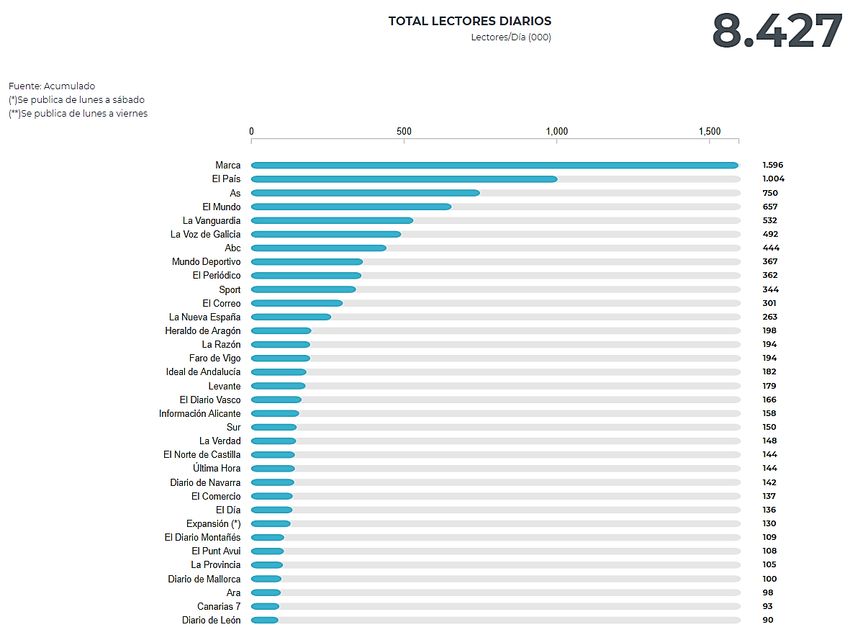
                                               Then, it is no mere anecdote that, according to the AIMC, amongst the 10 most-read
published maps and institutional affil-
                                          newspapers in Spain, there are four specialized in sports news. Apart from Marca, we have
iations.
                                          to mention As, Mundo Deportivo, and Sport, also in the top 10 (Figure 1).

Copyright: © 2021 by the authors.
Licensee MDPI, Basel, Switzerland.
This article is an open access article
distributed under the terms and
conditions of the Creative Commons
Attribution (CC BY) license (https://
creativecommons.org/licenses/by/
4.0/).

Publications 2021, 9, 9. https://doi.org/10.3390/publications9010009                                 https://www.mdpi.com/journal/publications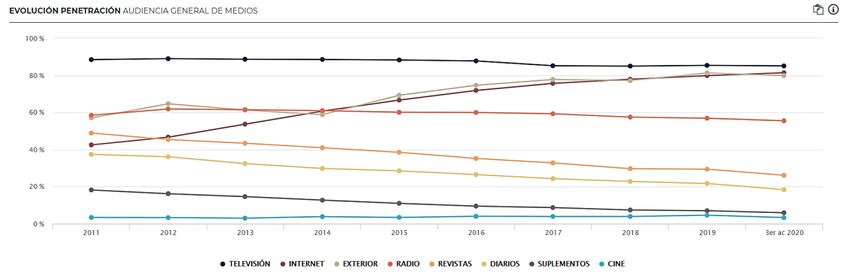
2021, 9,
Publications 2021, 9, 9x FOR PEER REVIEW 22 of
of 15
Publications 2021, 9, x FOR PEER REVIEW 2 of 15
Figure 1.
Figure Ranking of
1. Ranking of the
the most
most read
read newspapers
newspapersin inSpain
Spainaccording
accordingtotothe
theEstudio
EstudioGeneral
Generaldede
Medios
Me-
(EGM)
dios carried
(EGM) out by
carried outthe
byAsociación para para
the Asociación la Investigación de losdeMedios
la Investigación de Comunicación
los Medios (AIMC).
de Comunicación
Source: EGM
(AIMC). 2020.
Source: EGMSource:
2020.https://reporting.aimc.es/index.html#/main/diarios.
Source: https://reporting.aimc.es/index.html#/main/diarios.
It is true that there is a declining trend in the number of readers, as it is the case of
the rest of in-print newspapers in this country, and virtually worldwide. This situation is
Figure 1. Ranking of the most read newspapers in Spain according to the Estudio General de Me-
similar
dios (EGM)for both theout
carried written
by thepress (newspapers)
Asociación and magazines
para la Investigación de losorMedios
newspapers supplements
de Comunicación
(Figure 2).
(AIMC). Source: EGM 2020. Source: https://reporting.aimc.es/index.html#/main/diarios.
Figure 2. In-print media trend over the last decade according to the EGM. Source: EGM 2020. Source: https://report-
ing.aimc.es/index.html#/main/cockpit.
Apart from the one already mentioned, that of the written press, we cannot ignore
the fact that the most watched TV programs in Spain are related to sports. Amongst them,
2. In-print
Figure 2. In-printmedia sports
mediatrend
trend over
overbroadcasts
the
thelastlast are in
decade
decade the lead,toaccording
according
according the EGM.
to the to different
Source:
EGM. EGM
Source: companies
2020.
EGM Source:
2020. specialized in audience
https://reporting.
Source: https://report-
measuring, such as the Kantar group.
aimc.es/index.html#/main/cockpit.
ing.aimc.es/index.html#/main/cockpit.
For example, on the Formulatv.com website [3], which draws on data from Kantar
Media, In terms
Aparttakingfromofas
media
the impact,
one
a reference Spaniards
already
the consume
mentioned,
last three far
that
years, inofmore
the sport
2020, written news
3 of the 10than
press,
most inwatched
we any otherignore
cannot coun-
televi-
try,
the applying
fact that thethe classic
most division
watched TV between
programs sport-practice
in Spain are and sport-entertainment
related to sports.
sion events of the year (the first 3) were sporting events [4]; in 2019, 6 of the top 10 most Amongst [2] (p.
them,4).
This
viewed is verifiable.
sports broadcasts
events of are To do
the in so, we
thewere
year could
lead,sportingtake
according any media
to different
events as
[5]; and an example.
companies
in 2018, thespecialized
top 10 mostin audience
viewed
Apartevents
measuring,
television from
such as the
were one
the already
Kantar
sports mentioned,
group.
content [6]. that of the written press, we cannot ignore
the fact
Forthat
Moreover, the it
example, most
ison watched
that TVtheprograms
the Formulatv.com
noted in Spain
website
main generalist are
[3],
radio related
which to sports.
draws
broadcasters onindataAmongst
from
Spain, them,
Kantar
including
sports
Media, broadcasts are in the lead, according to different companies specialized in audience
the fourtaking as a reference
most listened (Cadena theSER,
last three
COPE, years,
Onda inCero,
2020, and
3 of Radio
the 10 Nacional
most watched televi-
de España),
measuring, such asyear
the (the
Kantar group.
devote a lot of their time to sport issues, especially during the weekends. Those lastmost
sion events of the first 3) were sporting events [4]; in 2019, 6 of the top 10 are
viewed Forevents
example,the on year
the Formulatv.com website [3], which draws on
topdata from viewed
Kantar
seized by sportof events, were sporting
especially events
association [5];
football and in 2018,
(henceforth, the
football)10 broadcasting.
most
Media, taking
television events as awere
reference
sportsthe last three
content [6].years, in 2020, 3 of the 10 most watched television
Besides, we cannot forget to mention Radio Marca, exclusively focused on sport news.
Moreover, it is noted that the main generalist radio broadcasters in Spain, including
the four most listened (Cadena SER, COPE, Onda Cero, and Radio Nacional de España),
devote a lot of their time to sport issues, especially during the weekends. Those last are
seized by sport events, especially association football (henceforth, football) broadcasting.
Besides, we cannot forget to mention Radio Marca, exclusively focused on sport news.Publications 2021, 9, 9 3 of 15
events of the year (the first 3) were sporting events [4]; in 2019, 6 of the top 10 most viewed
events of the year were sporting events [5]; and in 2018, the top 10 most viewed television
events were sports content [6].
Moreover, it is noted that the main generalist radio broadcasters in Spain, including
the four most listened (Cadena SER, COPE, Onda Cero, and Radio Nacional de España),
devote a lot of their time to sport issues, especially during the weekends. Those last are
seized by sport events, especially association football (henceforth, football) broadcasting.
Besides, we cannot forget to mention Radio Marca, exclusively focused on sport news.
It is common for mass media to analyze the most popular shows after each sporting
event. Among the 10 most followed, from Monday to Friday, there are almost always
night sports programs such as “El Larguero” (SER channel) or “El Partidazo” (COPE); and
broadcast shows are the most listened to on weekends [7].
Nor should we ignore the importance of websites such as marca.com [8], as.com [9],
mundodeportivo.com [10], or sport.es [11]. Some of them are supported by the num-
ber of users whose data have been certified by comscore.com or introl.es, a subdivision
of the interactive Spanish Broadcast Verification Office (Oficina de Justificación de la
Difusión—OJD) [12]. Along with all this, we have social media, where sport news is
shared referencing the previous media and others [13–15]. In conclusion, the importance of
sport-entertainment within Spain has been clearly demonstrated [16,17].
Usually, when we refer to all these mass media, including the written press (under
consideration on this paper) we can divide sports information into two large groups: Sport
broadcasts, that is, live information; and news (news, articles, reports, interviews), that is,
on-demand information.
When dealing with live information (especially broadcasts), it can rarely be conveyed
as rumors or false news, nowadays encompassed in the term fake news. If a football
game is broadcasted, the result will be immovable and hence, difficult to fake. A certain
team will win and that is irrefutable. There is a different issue regarding the greater or
lesser subjectivity with which said event is broadcasted, influenced by multiple factors. As
an example of that, we can find the mere placing of opinion remarks next to the factual
information, and even the opinion itself disguised as information, thus trying to share
as factual information something that, in fact, is not. However, we would find ourselves
surrounded by subjectivity and shifting words, since it becomes especially difficult to
measure statements such as “a team played well/badly” or “such an athlete deserved/did
not deserve to win”.
It is in the second group that we mentioned where we can face information that, in
fact, is not such. Within this second group, we encounter a wide range of journalistic genres
(report, interview, news, articles . . . ); amongst them, there is perhaps one that stands out
in terms of rumors contained: The news. It is precisely that which is intended to be carried
out and reflected on this paper, focusing on the front pages of newspapers and the news
showed in them. We will limit the sample to news about possible player signings or sales
carried out during a specific period, which will be later detailed.
2. Theoretical Framework
Founded in Barcelona in 1856, El Cazador can be considered as the first sports publica-
tion in Spain [18–20]. Since this very first publication appeared, many others have emerged
in the field, showing different particularities especially on periodicity and changing lifecy-
cles.
These days, as far as sports press is concerned—not taking into account specialized
magazines but only daily published press with varied sports information—there are four
widely read sports newspapers; as already indicated in the introduction: Marca, As, Mundo
Deportivo, and Sport, with Marca in the lead.
Currently based in Madrid, Marca was founded in San Sebastián as a weekly newspa-
per in 1938, amidst the Spanish Civil War. Currently, its main headquarters are in Madrid.
In terms of information, its most requested one is that related to Madrid teams, especiallyPublications 2021, 9, 9 4 of 15
Real Madrid. As dates from 1967 and it is also based in Madrid. Its target is focused on
Madrid as well, especially in its two main teams: Real Madrid and Atlético de Madrid.
First published in 1906, Mundo Deportivo has its headquarters in Barcelona. It is one
of the 10 most widely read Spanish newspapers and its target group comprises mainly FC
Barcelona fans. Founded in 1979, also established in Catalonia, and a pioneer in the use of
color in its pages, Sport also bases its information on FC Barcelona.
The four mentioned sports newspapers offer information on all Spanish clubs, with
football being their main topic (between 50% and 80% of the information on their pages,
depending on the period of the year and the newspaper).
2.1. The Importance of the Front Page
Obviously, as it is the case of all printed media, the front page is an ideal showcase, the
first thing the reader sees, an “open window” [19] (p. 89). We will focus the study on front
pages because “within the agenda settings established by the media, in this case by the
newspapers, the preferential news will take large spaces on the front page and, therefore,
will be considered as the main news” [21] (p. 1355).
The front page is the first contact with the reader [22] (p. 145). Therefore, “it is important
to amaze and inform, using for that ‘content inserted into a container’” [19] (p. 89). In
addition, “there are great differences between the front pages appearing on the general
information press and those of sports press” [21] (p. 1355). Similarly, when using headlines
or photographs: “The design of general information newspapers tend to be somehow
visually organized, whereas the sports press uses more daring and silhouetted images
on many occasions” [23]. Moreover, we cannot forget the importance of the linguistic
flow [24].
However, anything goes when talking about information? We must consider the
importance of newspapers sales [25]. Those sales will be based on the amount of striking
information showed, especially on the front page—frequently considered as collectible
products. It is precisely there where the thin red line between information, rumor, and
semi-truths comes into play. Does anything go? Which of the information is true on those
front pages? To answer those questions will be the object of this study.
When flicking though a newspaper, the reader “will expect information to be displayed
in the usual way of his often-read newspaper, from the very front page to the end. A good,
witty cover that you like [...]” [25] (p. 471). However, this is where another question arises:
Do newspapers show real information or, on the contrary, just information that the reader
would like to be real?
We could pose many questions related to this issue; nevertheless, we do not intend to
embrace all of them here. To do so, we would require methodological techniques different
from those used to conduct this study. It is difficult to identify what is being told in the
newspapers and its intention. Likewise, it is difficult to determine the number of sources
of information, their credibility, and whether there has been a cross-checking process. To
clarify those aspects, we could interview newspaper editors and journalists. Neither is it
easy to measure the satisfaction rate of readers with the information received; however, it
could be useful to go further on this, conducting surveys or setting focus groups. Here, we
introduce potential lines of research that could be designed considering future data.
The objective of this work is to discover to what extent the news appearing during the
summer transfer window is true.
2.2. The Thin Line between Rumor, Semi-Truths and Fake News
In the field of journalism, information is clearly differentiated from opinion. The
news is information, and it must be based on cross-checked facts (coming from a plurality
of sources); thus, it is objective. On the contrary, opinion is subjective. Any journalistic
content perceived by the reader as news should be objective and cross-checked [26]. That
said, in the sports press, it is quite common to find headlines announcing possible signings
that are later not materialized. In those cases, the media justify themselves saying thatPublications 2021, 9, 9 5 of 15
there existed rumors; or even, that there was an intention to effect those signings but it
did not happen, due to different circumstances. In this case, they argue that the headline
did have a true content, but that it could not be entirely realized—which would be a
semi-truth. Nevertheless, there is also a third possibility: It was fake news, referring to
false information—which may include a part of real content—and has an intention to harm
or/and clearly benefit a specific group. There is a thin line between rumor, semi-truths,
and fake news, leaving the reader unprotected and journalism called into question.
In order to understand the concept of fake news in any of these variants, research is
based on the fact that, almost always, these news are given as true even though they are
not, nor will they ever be, beyond the fact that there could be fond indications of veracity
which may occur (for example, a transfer), either with a greater or lesser probability. The
problem here is the lack of use of the conditional tense, which would surely detract from
the ultimate goal of the headline. So it is preferable to start for example “Luis Suárez will
sign for Atlético de Madrid” instead of “Luis Suárez could sign for Atlético de Madrid”.
Obviously, the use of the conditional indicates that “could” or “could not” and the news
would cease to be such, when all options were left open.
These three concepts (rumor, semi-truth, and fake news) share a common feature:
cContent is not cross-checked. In the case of fake news, they are based on false or misleading
information: The reason that they are included within the term misinformation [27–30].
According to Merriam Webster Dictionary (2020), rumor is a “talk or opinion widely
disseminated with no discernible source”. From this definition two conclusions can be
derived. On the one hand, there exists a message; however, we do not know to what extent
it is true. On the other hand, there is a mention to a discernible source, who/which we
do not know. In his research project, Mazo [31] (p. 47) concludes that rumor in the social
communication field is “spontaneous, elusive and spreads exponentially, developing an
interesting and ambiguous content which is modified in a metamorphic process; all that
with the intention of appearing credible to their audience”.
This author explains that rumor possesses some unique characteristics. Its sources
are anonymous, but paradoxically they are perceived as very credible. The message
is very attractive, appealing, and can create uncertainty, pose questions, and provide
impartial answers—for which we need more information. In many cases, it mostly refers to
confidential information, the reason that the reader considers it to be something valuable
and interesting [32] that has not been officially published yet. Moreover, it also tends to be
perceived as true. Telling this information is considered an “imperative need”, the reason
that it is spread (p. 47). It is shared with a selected and like-minded audience, considered
to be interested in the subject and willing to embrace it. The spread of rumor is directly
proportional to the interest in the subject and its ambiguity [33].
In the case of sports press readers, rumors about signings are very appealing, since
the entering/exiting of players in a team directly affects its performance on the field. Due
to these particularities, rumors spread faster than cross-checked news. This is because they
are surrounded by some uncertainty, which allows people to take positions for or against.
Sharing this type of content reinforces the sense of belonging to a group [31] (pp. 40–41).
In the case of sport, this has been utilized to establish ideological links, thus supporting
the construction of identities, which are even in some cases ethnic and territorial [34]. In
Spain, a country where great internal nationalist political positions and territorial disputes
are ubiquitous, football is not alien to this situation. That is the reason that certain teams
are usually considered as supporters of certain political views (for example, FC Barcelona
regarding the Catalan independence movement, and Real Madrid as defender of the unity
of Spain), a situation reflected in the bias of the different media [35].
Hoax is something accepted or established by fraud or fabrication (Merriam Webster,
2020) [26], so it can be considered a synonym for fake news, with the difference that this
term is only used by mass media. Shudsonand Zelizer [36] reminds us that the intentional
spreading of false news seeking a particular purpose has been on scene since the very
beginning of journalism. Thus, they mention how in the USA, Thomas Jefferson told aPublications 2021, 9, 9 6 of 15
friend in 1807: “the man who never looks into a newspaper is better informed than he who
reads them; inasmuch as he who knows nothing is nearer to truth than he whose mind is
filled with falsehoods & errors”.
Lazer has coordinated a group of 16 researchers who have studied the media pub-
lishing fake news, proposing this definition: “We define “fake news” to be fabricated in
formation that mimics news media content in form but not in organizational process or
intent”. These media lack of processes and standards to guarantee the truthfulness of their
content. In this context, they call for interdisciplinary research to be carried out in order to
reduce the spread of fake news, since professionals in journalism must provide objective
and reliable information [37] (p. 1094).
3. Objectives and Hypotheses
The main objective of this study is to determine to what extent the news appearing on
the front pages of newspapers during the summer transfer window (2015–2019) were true;
therefore, focusing on a specific type of news: signings and sales of players. It was our
decision to not include the year 2020 in our study, since it does not represent an average
year for the signing/transfer market (hardly any), due to the COVID-19 pandemic.
The baseline scenarios (hypotheses) are:
1. At least 50% of the signings, possible signings, renewals, or players leaving the teams,
announced on the front pages, are not materialized.
2. More than 25% of the signings, possible signings, renewals, or players leaving the
teams, announced on the covers, are accompanied by photo montages. In those, the
players wear the shirt of the hypothetical team in which they would play.
3. More than 80% of Marca and As front pages are devoted to Real Madrid players,
either as a source or as a target.
4. More than 80% of Mundo Deportivo and Sport front pages are devoted to Barcelona
players, either as a source or as a target.
5. More than 80% of this news is accompanied by photographs.
4. Methodology
The methodology appearing on this paper exclusively responds to quantitative tech-
niques. A series of variables was established (Table 1), in order to resolve the previously
formulated hypotheses. It has been deemed appropriate to use this methodology as it
includes “a set of, increasingly perfect and constantly improving, methodological instruments
applied to extremely diversified forms of speech (both content and container)” [38] (p. 7).
Table 1. Variables to analyze. Compiled by author.
Newspaper Marca/As/Mundo Deportivo/Sport
According to criteria stated in “population and
Date
sample”
Piece of news Indicate the piece of news
Headline Indicate the main headline on the front page
Indicate the name of the player, subject of the front
Name of the player
page
Team involved Indicate name of the team, subject of the front page
Indicate whether the information referred in the
The piece of news is materialized
piece of news is materialized
Indicate if it includes a photograph of the player
Includes photograph(s)
referred.
Indicate if it includes a photo montage featuring the
Includes photo montage player referred
Here we face a content analysis, defined by Krippendorff [39] (p. 21) as: “[...] a research
technique for making replicable and valid inferences from data to their context”. Likewise,Publications 2021, 9, 9 7 of 15
Berelson [40] (p. 18) defines it as “a research technique for the objective, systematic and
quantitative description of the manifest content of communication”, in the same line as
other authors [41].
After conducting a systematic research through the main bibliographic reference
sources (mainly WOS and Scopus), as well as recent review papers [42–45], we do not
know of any other research papers similar to the analysis proposed here, with content
methodology of a representative sample of news items that appeared in the press, in which
the researchers themselves contrasted the truth of the news, with the exception of an
isolated case taken to the United States sports arena [46]. Therefore, this methodological
approach is novel and can be applied to any type of news, not only in the sports field.
However, we can find approximations in studies related to fake news in digital media as
blogs or online newspapers [47–49], but our study addresses the traditional press where
the computerized possibilities of detecting fake news are not so many.
The final veracity of the news was contrasted with knowing if a certain player was
still part of the squad or not, through the official data from La Liga (https://www.laliga.
com/) [50] taking into account that all players who appear on this headline would have a
relationship with the Spanish League (either because they were signing for a Spanish club
or were no longer part of the squad of a Spanish club).
4.1. Scope of Study
The scope of this study extends only to news about football signings or possible
signings analyzed according to certain factors previously detailed.
4.2. Population and Sample
The population would be made up of Marca, As, Mundo Deportivo, and Sport copies
published in a period of five years (2015–2019) (Table 2).
Table 2. Sample. Compiled by author.
MUNDO
MARCA AS SPORT TOTAL
DEPORTIVO
JUL 3 3 3 3 12
2015
AUG 3 3 3 3 12
JUL 3 3 3 3 12
2016
AUG 3 3 3 3 12
JUL 3 3 3 3 12
2017
AUG 3 3 3 3 12
JUL 3 3 3 3 12
2018
AUG 3 3 3 3 12
JUL 3 3 3 3 12
2019
AUG 3 3 3 3 12
TOTAL 30 30 30 30 120
The convenience sample will be delimited according to these criteria:
(A) Firstly, we will only consider front pages published over the months of July and
August, thus coinciding with summer transfer window period in the Spanish football
league.
(B) We will only use the front pages published on the three first days of July; consequently,
the first three front pages. Those shall be related to a signing, possible signing, renewal,
or a player leaving (cross-checked or hypothetical), starting from July 1.
(C) Regarding August, the same procedure (indicated in subparagraph b) will be applied.
(D) We will not take into account front pages dealing on the news event. Just the first one
will be considered.Publications 2021, 9, 9 8 of 15
The convenience sample was delimited according to the criteria set by Riffe, Lacy,
and Fico: “The material being studied must be difficult to obtain [ . . . ] Resources limit
the ability to generate a random sample of the population [ . . . ] The third condition
justifying convenient sampling is when a researcher is exploring some underresearched
but important task” [51] (p. 85).
5. Results
The total number of front pages analyzed, following the criteria described above, was
104. It should be noted that the expected total (120) does not correspond to the actual total.
That is so because, in at least in three days each month, the front pages did not coincide
with the object of this study, applying the above-established sampling criteria. The selected
were the following (Table 3):
Table 3. Days chosen to be part of the sample. Compiled by author.
2015 2016 2017 2018 2019
Newspaper Total
JUL AGO JUL AGO JUL AGO JUL AGO JUL AGO
Marca 3, 7, 15 17, 20, 22 5, 16 5, 6, 13 3, 12 3, 14, 18 28 14, 16, 17 2, 7, 9 23
As 2, 7, 16 2y3 16, 18, 20 7 2, 4, 6 3, 10, 11 6 y 26 8, 23 y 29 2 y 22 2, 5, 9 25
Mundo
2, 22, 28 7 1, 2 y 3 1, 2 y 13 2, 3, 5 1, 2, 13 5, 6, 8 2, 3, 9 2, 3, 19 1, 7, 9 28
Deportivo
Sport 1, 2, 12 1, 2, 25 1, 2 y 5 8, 13 y 16 2, 3, 6 1, 2, 6 3, 4, 6 3, 8, 20 1, 3, 4 10 28
The first matter analyzed was focused on estimating how many pieces of news (con-
sidering hypothetical and assured ones, by newspapers) were, in the end, materialized.
The results show that in 56.7% of the cases, those announced events did not happen, so it
was just fulfilled by just 43.3% of cases. If we focus our analysis on different newspapers,
we note that the most reliable one is Mundo Deportivo, with half of their information, in
the end, materialized; however, another 50% is not. Marca and As did not comply with
the proclaimed news by 61% and 60% of the cases, respectively, and Sport by 57.1%. The
observed differences cannot be considered significant (χ2 = 0.788; p = 0.852) (Table 4). Some
of the examples related to this are (Table 5):
Table 4. Compliance rate depending upon newspaper. Compiled by author.
Compliance with the Piece of News
Newspaper Yes No (Fake News) Total
n % n %
Marca 9 39.1% 14 60.9% 23
As 10 40.0% 15 60.0% 25
Sport 12 42.9% 16 57.1% 28
Mundo
14 50.0% 14 50.0% 28
Deportivo
Total 45 43.3% 59 56.7% 104Publications 2021, 9, 9 9 of 15
Table 5. Headline examples. Compiled by author.
Headline Translation into English: URL Portada
Marca
André Gomes, the ace in the https://es.kiosko.net/es/20
André Gomes signing André Gomes es el tapado
hole 16-07-05/np/marca.html
https://es.kiosko.net/es/20
Di María signing Di María a tiro del Barça Barça. Di Maria in range
17-08-12/np/marca.html
James signing (Atlético del Bombazo a la vista ¡James Bombshell. James wants to https://es.kiosko.net/es/20
Madrid) quiere jugar en el Atlético! play in Atletico! 19-07-14/np/marca.html
https://es.kiosko.net/es/20
Mbappé signing Espéranos, Mbappé Wait for us, Mbappé!
17-07-06/np/marca.html
https://es.kiosko.net/es/20
Neymar signing Never never never Never never never
18-07-14/np/marca.html
https://es.kiosko.net/es/20
Neymar signing Neymar en el horizonte Neymar ahoy!
19-08-09/np/marca.html
United doesn’t let up on https://es.kiosko.net/es/20
Pogbá signing El United no afloja con Pogba
Pogba 19-07-17/np/marca.html
Erikesen podría ser la llave de Erikesen could be the key for https://es.kiosko.net/es/20
Pogbá signing
Pogba Pogba 19-08-07/np/marca.html
Se reactiva la opción Van de Van de Beek option https://es.kiosko.net/es/20
Van de Beek signing
Beek reactivated 19-08-02/np/marca.html
https://es.kiosko.net/es/20
De Gea arrival to Real Madrid Blindado De Gea De Gea: armored
15-07-15/np/marca.html
Sergio Ramos leaves Real https://es.kiosko.net/es/20
No da marcha atrás No backtrack
Madrid 15-07-03/np/marca.html
https://es.kiosko.net/es/20
Asensio leaving Hola Kovacic, adiós Asensio Hi Kovacic, bye Asensio
15-08-20/np/marca.html
https://es.kiosko.net/es/20
Bale leaving Bale tiene una salida Bale has a way out
19-07-16/np/marca.html
https://es.kiosko.net/es/20
James leaving La Premier tienta a James Premier League wants James
16-07-16/np/marca.html
As
Andre Gomés espera al Andre Gomes awaits Real https://es.kiosko.net/es/20
André Gomes signing
Madrid Madrid 16-07-20/np/as.html
Cavai lets himself be https://es.kiosko.net/es/20
Cavani signing Cavai se deja querer
pampered 18-07-26/np/as.html
El United pone precio: De Gea United puts a price for De https://es.kiosko.net/es/20
De Gea signing
35 M Gea: 35m 15-07-02/np/as.html
Gabriel Jesús más cerca del Gabriel Jesus closer to Real https://es.kiosko.net/es/20
Gabriel Jesús signing
Real Madrid Madrid 16-07-16/np/as.html
https://es.kiosko.net/es/20
Mbappé signing Mbappé aún es posible Mbappé. Still possible
18-08-23/np/as.html
El Madrid pide paciencia a Madrid asks Pogbá for https://es.kiosko.net/es/20
Pogbá signing
Pogbá patience 16-07-18/np/as.html
https://es.kiosko.net/es/20
Pogba signing Pogba cuenta atrás Countdown: Pogba
19-08-05/np/as.html
https://es.kiosko.net/es/20
Van de Beek signing Plan Van de Beek Van de Beek operation
19-08-02/np/as.htmlPublications 2021, 9, 9 10 of 15
Table 5. Cont.
Headline Translation into English: URL Portada
https://es.kiosko.net/es/20
Meunier signing Opción Meunier Meunier, an option
17-08-11/np/as.html
https://es.kiosko.net/es/20
Isco leaving El Milán quiere a Isco Milan wants Isco
16-08-07/np/as.html
https://es.kiosko.net/es/20
Bale leaving Gareth sale Gareth leaves
19-07-22/np/as.html
https://es.kiosko.net/es/20
Benzemá leaving El Arsenal quiere a Benzemá Arsenal wants Benzemá
15-08-02/np/as.html
https://es.kiosko.net/es/20
Neymar leaves PSG Neymar a subasta Neymar to auction
19-08-09/np/as.html
https://es.kiosko.net/es/20
Ramos leaving La semana clave de Ramos Key week for Ramos
15-08-03/np/as.html
Mundo Deportivo
https://es.kiosko.net/es/20
Alaba signing Alaba, el tapado Alaba, the ace in the hole 19-07-19/np/
mundodeportivo.html
https://es.kiosko.net/es/20
Ceballos signing Operación Ceballos Operation Ceballos 17-07-02/np/
mundodeportivo.html
https://es.kiosko.net/es/20
Último intento por Gabriel
Gabriel Jesús signing Last shot for Gabriel Jesus 16-08-02/np/
Jesús
mundodeportivo.html
https://es.kiosko.net/es/20
Gignac signing Alternativa Gignac Alternative Gignac 16-08-01/np/
mundodeportivo.html
https://es.kiosko.net/es/20
Neymar signing Un truque de 170 “kilos” 170m all-in 19-07-03/np/
mundodeportivo.html
https://es.kiosko.net/es/20
Barcelona signs Neymar Neymar prioridad Barça Neymar prioritizes Barça 19-08-09/np/
mundodeportivo.html
https://es.kiosko.net/es/20
Nolito signing Oferta por Nolito Offer for Nolito 15-08-07/np/
mundodeportivo.html
https://es.kiosko.net/es/20
Pogbá signing Pogbá, el deseado Pogba, the desired 18-08-02/np/
mundodeportivo.html
https://es.kiosko.net/es/20
Sciglio signing Operación carrilero Operation carrilero 16-07-03/np/
mundodeportivo.html
https://es.kiosko.net/es/20
Verratti signing Cambio de táctica Shift in tactics 17-07-03/np/
mundodeportivo.html
https://es.kiosko.net/es/20
William and Rabiot signings William y Rabiot en cabeza William and Rabiot in the lead 18-07-08/np/
mundodeportivo.html
https://es.kiosko.net/es/20
Marca de Samper Wenger ataca de nuevo Wenger attacks again 15-07-22/np/
mundodeportivo.htmlPublications 2021, 9, 9 11 of 15
Table 5. Cont.
Headline Translation into English: URL Portada
https://es.kiosko.net/es/20
Coutinho to Tottenham Negocian por Coutinho Coutinho: in negociations 19-08-07/np/
mundodeportivo.html
https://es.kiosko.net/es/20
Rakitic leaving Ofertas por Rakitic Offers for Rakitic 18-08-09/np/
mundodeportivo.html
Sport
https://es.kiosko.net/es/20
Neymar continues ¡Bloqueado! Blocked!
17-08-02/np/sport.html
https://es.kiosko.net/es/20
Ceballos signing Ofensiva por Ceballos Fighting for Ceballos
17-07-02/np/sport.html
Guerra Madrid-Barça por Madrid-Barça war for Gabriel https://es.kiosko.net/es/20
Gabriel Jesús signing
Gabriel Jesús Jesús 16-07-02/np/sport.html
https://es.kiosko.net/es/20
Griezmann signing Griezmann es el favorito Griezmann favorite
17-08-01/np/sport.html
https://es.kiosko.net/es/20
Luan signing Cuenta atrás por Luan Countdown for Luan
16-08-08/np/sport.html
https://es.kiosko.net/es/20
Lucas Pérez signing Atención a Lucas Pérez Lucas Pérez!
16-07-05/np/sport.html
https://es.kiosko.net/es/20
Barcelona signs Neymar Reunión Messi-Neymar Messi and Neymar meet
19-07-04/np/sport.html
Superoferta de Florentino a Florentino superbid for https://es.kiosko.net/es/20
Real Madrid signs Neymar
Neymar Neymar 19-08-10/np/sport.html
https://es.kiosko.net/es/20
Paulinho signing 50 millones por Paulinho 50m for Paulinho
18-07-06/np/sport.html
https://es.kiosko.net/es/20
Pogba signing Las exigencias de Pogba Pogba demands
15-07-01/np/sport.html
https://es.kiosko.net/es/20
Verratti signing Verratti Día D Day D: Verrati
17-07-03/np/sport.html
https://es.kiosko.net/es/20
Yarmolenko signing Yarmolenko opción para enero Yarmolenko. January option
15-08-25/np/sport.html
https://es.kiosko.net/es/20
Abdennour signing Habrá fichaje Signing to happen
15-08-02/np/sport.html
https://es.kiosko.net/es/20
Gerson signing ¡Peligra Gerson! Gerson at stake!
15-08-01/np/sport.html
Acuerdo Coutinho-PSG en la Operation Neymar: https://es.kiosko.net/es/20
Coutinho to PSG
operación Neymar Coutinho-PSG agreement 19-07-03/np/sport.html
Ofensiva del PSG por Rakitic PSG battles for Rakitic and https://es.kiosko.net/es/20
Rakitic and Busquets leaving
y Busquets Busquets 18-08-20/np/sport.html
As far as photo montages are concerned, they have only been found in 2.9% of the
cases. As and Sport did not use any, whereas Marca published two and Mundo Deportivo
one. The observed differences cannot be considered significant (χ2 = 4.39; p = 0.222)
(Table 6).Publications 2021, 9, 9 12 of 15
Table 6. Use of photo montage depending upon newspaper. Compiled by author.
Photo Montage
Newspaper Yes No
n % n %
Marca 2 8.7% 21 91.3%
As 0 0.0% 25 100.0%
Sport 0 0.0% 28 100.0%
Mundo Deportivo 1 3.6% 27 96.4%
Total 3 2.9% 101 97.1%
Thirdly, the existing link between Marca/As newspapers and news events related
to one Real Madrid player is analyzed. Similarly, the existing link between Mundo De-
portivo/Sport and news events related to one FC Barcelona player is analyzed. It is
observed that Marca and As mainly focus their news about signings on Real Madrid (78.3%
and 88%, respectively: Average 83.2%), while Mundo Deportivo and Sport do likewise with
FC Barcelona (96.4% and 92.9%, respectively: Average 94.6%). There are only five pieces
of news not related to either Real Madrid or FC Barcelona: Two about Atlético de Madrid
(appearing in Marca) and three referring to other teams (two in As and one in Marca).
Similarly, Mundo Deportivo and Sport did not mention any signing not referring either
to Real Madrid or FC Barcelona on their front pages (Table 7). If we compare As-Marca
with Mundo Deportivo-Sport, significant differences are found, especially in the number
of stories devoted to the different football teams (χ2 = 78.21; p < 0.001).
Table 7. Team affected by the signing, depending upon newspaper. Compiled by author.
Team Affected at Origin or Destination
Real Madrid Barcelona Atlético de Madrid Otros No Indicado
n % n % n % n % n %
Marca 18 78.3 2 8.7 2 8.7 1 4.3
As 22 88.0 1 4.0 2 8.0
Mundo Deportivo 1 3.6 27 96.4
Sport 2 7.1 26 92.9
Total 43 41.3 56 53.8 2 1.9 2 1.9 1 1.0
Finally, 97.1% are accompanied by photographs. Marca accompanied all their news
about signings with a photograph. In other newspapers, it can be noted that there is one
piece of news in each with no photograph attached. This is not a significant difference
(χ2 = 0.888; p = 0.828) (Table 8).
Table 8. Use of photography, depending upon newspaper. Compiled by author.
Photography
Newspaper Yes No
n % n %
Marca 23 100.0% 0 0.0%
As 24 96.0% 1 4.0%
Sport 27 96.4% 1 3.6%
Mundo Deportivo 27 96.4% 1 3.6%
Total 101 97.1% 3 2.9%Publications 2021, 9, 9 13 of 15
6. Conclusions
First of all, we assume the first hypothesis to be correct, since at least 50% of the
signings, possible signings, renewals, or sale of players announced on the front pages did
not materialize. This constitutes a general trend in sports journalism, especially during
the summer. The summer transfer window is usually the perfect occasion for newspapers
to speculate with rumors. That is so, precisely because of the lack of sports competitions,
especially in the football field. That is why many of these pieces of news do not materialize
in the end.
In this sense, from the perspective of the practice of journalism, especially sports press,
rumor is a common way of journalists establishing authority. In addition, in this type of
information, where there is logically no exclusivity (as for example in sports broadcasts), it
is a strategy to maintain interest on the part of the reader, especially in the period studied
(summer period) where the number of broadcasts is much lower than at any other time
of the year. In addition, as other authors did in previous research [46], there are many
occasions when sports media are followed by the “historically symbiotic relationship” that
can be established between the journalist and their audience and, for example, in that same
study, the lack of sources in the commercial forecast is contemplated.
Secondly, a minimal percentage of these front pages were accompanied by photo
montage, so we reject the second hypothesis, which stated just the opposite premise. It is
true that quite often there are photographs of the players (news events); however, they are
usually related to the team that the player is part of, at that specific time.
On the other hand, there is a direct relationship between Marca/As and news events
related to Real Madrid, and Mundo Deportivo/Sport and news events related to FC
Barcelona. As a consequence of that, the third and fourth hypotheses are broadly accepted.
Nevertheless, if a thorough analysis is carried out, we note that Marca does not reach the
expected 80% stated in the hypothesis. All of this is in line with the editorial biases of the
different newspapers and their own target groups. In this case, we can conclude that Marca
publishes the widest range of news, including more news (not referring to Real Madrid)
than was expected in the first place.
Finally, the fifth hypothesis is accepted, since photography is present in more than
80% of the front pages analyzed. In this aspect, there were not any significant differences
among newspapers.
Future lines of research, or retort publications, could try to delve into whether the
results and conclusions presented here could have significant differences if the whole of
the news (text analysis) were analyzed beyond the headline of the cover; and if the title
page would be a mere “clickbait” on a text, which would clarify what is specified there, in
a less blunt and more speculative way (rumor).
Author Contributions: Conceptualization, F.-J.H.-G. and J.-D.U.-L.; methodology F.-J.H.-G. and
J.-D.U.-L.; software, F.-J.H.-G. and J.-D.U.-L.; validation, J.-D.U.-L.; formal analysis, F.-J.H.-G. and
J.-D.U.-L.; investigation, F.-J.H.-G. and J.-D.U.-L.; resources, F.-J.H.-G. and J.-D.U.-L.; data curation,
J.-D.U.-L.; writing—original draft preparation, F.-J.H.-G.; writing—review and editing, F.-J.H.-G. and
J.-D.U.-L.; supervision, F.-J.H.-G. project administration, F.-J.H.-G.; funding acquisition, F.-J.H.-G. All
authors have read and agreed to the published version of the manuscript.
Funding: This research received no external funding.
Institutional Review Board Statement: Not applicable.
Informed Consent Statement: Not applicable.
Data Availability Statement: Not applicable.
Acknowledgments: The authors thank the Department of Sociology and Communication at the
University of Salamanca, for the financial support in the translation of this article.
Conflicts of Interest: The authors declare no conflict of interest.Publications 2021, 9, 9 14 of 15
References
1. Estudio General de Medios (EGM) de la Asociación para la Investigación de los Medios de Comunicación (AIMC). Available
online: https://www.aimc.es/ (accessed on 2 December 2020).
2. Cagigal, J.M. Deporte: Espectáculo y acción; Salvat: Barcelona, España, 1981.
3. Available online: Formulatv.com (accessed on 1 November 2020).
4. Formulatv.com. Telecinco Lidera 2020 (14,6%) por 9◦ año Consecutivo, Antena 3 Crece (11,8%) y La 1 se Mantiene (9,4%).
Available online: https://www.formulatv.com/noticias/audiencias-anuales-2020-telecinco-antena-3-la-1-105657/ (accessed on
2 January 2021).
5. Formulatv.com. Telecinco (14,8%) Lidera 2019 por Octavo año Consecutivo y Aumenta su Distancia Sobre Antena 3 (11,7%).
Available online: https://www.formulatv.com/noticias/audiencias-anuales-telecinco-lidera-2019-octavo-ano-consecutivo-98
393/ (accessed on 2 January 2020).
6. Formulatv.com. Telecinco (14,1%) Lidera 2018 por Séptimo año Consecutivo y Antena 3 Repite su Anterior Dato (12,3%).
Available online: https://www.formulatv.com/noticias/telecinco-sube-2018-lidera-septimo-ano-consecutivo-87529/ (accessed
on 2 January 2018).
7. Prnoticias.com. ¿Cuáles son los Diez Programas más Escuchados de la Radio en Nuestro país? Available online: https:
//prnoticias.com/2020/08/10/cuales-son-los-diez-programas-mas-escuchados-de-la-radio-en-nuestro-pais/ (accessed on 10
August 2020).
8. Available online: https://www.alexa.com/siteinfo/marca.com (accessed on 1 February 2021).
9. Available online: https://www.alexa.com/siteinfo/as.com (accessed on 1 February 2021).
10. [Website of Alexa for Digital Newspaper mundodeportivo.com]. Available online: https://www.alexa.com/siteinfo/
mundodeportivo.com (accessed on 1 February 2021).
11. Available online: https://www.alexa.com/siteinfo/sport.es (accessed on 1 February 2021).
12. Oficina de Justificación de la Difusión. Available online: https://www.ojd.es/ (accessed on 1 February 2021).
13. Merino Bobillo, M.; Lloves-Sobrado, B.; Pérez-Guerrero, A.M. La interacción de los usuarios en los perfiles de Facebook de la
prensa española. Palabra Clave 2013, 16, 842–872.
14. Piñeiro Otero, T. De las ondas a los 140 caracteres. El uso de Twitter por los principales programas de la radio española. Palabra
Clave 2013, 16, 815–841.
15. Gallardo Camacho, J.; Lavín, E.; Fernández-García, P. Los programas de televisión deportivos y su relación con la audiencia social
en Twitter en España. Rev. Lat. Comun. Soc. 2016, 71, 272–286.
16. Marta Lazo, C.; Segura-Anaya, A.; Traver, D. Análisis comparativo de retransmisiones y programas deportivos entre Cadena SER
y COPE. Rev. Asoc. Española Investig. Comun. 2017, 4, 148–156.
17. Herrero Gutiérrez, F.J. La locución de los narradores deportivos radiofónicos en España. Rev. Lat. Comun. Soc. 2009, 64, 968–987.
18. Castañón Rodríguez, J. El Lenguaje Periodístico del Fútbol; Universidad de Valladolid: Valladolid, Spain, 1993.
19. Alcoba López, A. La Prensa Deportiva: Tratamiento Inédito Sobre el Género Específico del Deporte, y Cómo Hacer una Publicación
Deportiva Ideal; Instituto Universitario Olímpico de Ciencias del Deporte: Madrid, Spain, 1999.
20. Paniagua Santamaría, P. Cultura y Guerra del Fútbol. Análisis del Mensaje Informative; UOC: Barcelona, Spain, 2009.
21. Herrero-Gutiérrez, F.J. Los periódicos deportivos españoles. Análisis comparativo de la noticia principal de portada en los
diarios Marca, As, Mundo Deportivo y Sport. Estud. Sobre Mensaje Periodístico 2018, 24, 1353–1365. Available online: https:
//revistas.ucm.es/index.php/ESMP/article/view/62221/4564456548514 (accessed on 15 October 2020).
22. Pou Amérigo, M.J. Los titulares de prensa y los nuevos servicios de información por correo electrónico y teléfono móvil. Estud.
Sobre Mensaje Periodístico 2001, 7, 145–157. Available online: https://revistas.ucm.es/index.php/ESMP/article/view/ESMP01011
10145A/12831 (accessed on 15 November 2020).
23. Herrero Gutiérrez, F.J. España gana el Mundial 2010 de fútbol. El triunfo visto por la prensa española: Aspectos deportivos
y extradeportivos. Comun. Hombre 2011, 7, 159–171. Available online: http://www.comunicacionyhombre.com/pdfs/07_i_
fcojavierherrero.pdf (accessed on 1 November 2020). [CrossRef]
24. Castañón Rodríguez, J. El Idioma Español en la Prensa Deportiva. Texto de la Conferencia Pronunciada el 15 de Febrero de 2006
en el Salón de Actos del BBVA de Valladolid, en el acto Organizado por la Fundación del Español Urgente. 2006. Available online:
https://www.idiomaydeporte.com/traducciones/es/el-idioma-espanol-en-la-prensa-deportiva.php (accessed on 15 November
2020).
25. Marrone Otero, J.M. La importancia de la portada en las ventas del diario Marca. Doctoral Thesis, Universidad Complutense de
Madrid, Madrid, Spain, 2009.
26. Martínez-Vallvey, F. Teoría del Periodismo; Ediciones CEF: Madrid, Spain, 2011.
27. Coromina, O.; Padilla, A. Análisis de las desinformaciones del referéndum del 1 de octubre detectadas por Maldito Bulo. Quad.
CAC 2018, 44, 17–26.
28. Rodríguez-Fernández, L. Disinformation and organisational communication: A study of the impact of fake news. Rev. Lat. Comun.
Soc. 2019, 1714–1728. [CrossRef]
29. Wardle, C.; Derakhshan, H. Information Disorder: Toward an Interdisciplinary Framework for Research and Policymaking; Council of
Europe: Strasbourg, France, 2017.Publications 2021, 9, 9 15 of 15
30. Marco-Franco, J.E.; Pita-Barros, P.; Vivas-Orts, D.; González-de-Julián, S.; Vivas-Consuelo, D. COVID-19, Fake News, and Vaccines:
Should Regulation Be Implemented? Int. J. Environ. Res. Public Health 2021, 18, 744. [CrossRef] [PubMed]
31. Marzo, H. El Rumor, mensaje metamórfico que crea reacciones atípicas en la Red. Rev. Int. Investig. Comun. Adresearch Esic 2019,
20, 36–49. [CrossRef]
32. Brown, H. Rumor’s Fury; Indepedently Published: Michigan, MI, USA, 2019.
33. Allport, G.W.; Postman, L. The Psychology of Rumor; Henry Holt: New York, NY, USA, 1947.
34. Herrero-Andreu, E.; García-Jiménez, L. Media construction of peripheral regional identities: Real Murcia Football Club as a
symbolic space for negotiation and sense-making. Mediterr. J. Commun. 2019, 11, 195–212. [CrossRef]
35. Urchaga, J.D.; Carballa, N.; García, A. Media coverage of the prohibition of bullfighting in Cataluña through a multivariate
analysis HJ-BIPLOT. Prism. Soc. Rev. Investig. Soc. 2017, 19, 450–470.
36. Schudson, M.; Zelizer, B. Fake News in Context. 2017. Available online: https://pdfs.semanticscholar.org/9d91/58807cbf03fff609
e74ef9e0e61c2e6088d8.pdf (accessed on 15 November 2020).
37. Lazer, D.M.; Baum, M.A.; Benkler, Y.; Berinsky, A.J.; Greenhill, K.M.; Menczer, F.; Metzger, M.J.; Nyhan, B.; Pennycook, G.;
Rothschild, D.; et al. The science of the fake news. Science 2018, 359, 1094–1096. [CrossRef] [PubMed]
38. Laurence, B. Análisis de Contenido; Akal: Madrid, Spain, 1996.
39. Klaus, K. Content Analysis; SAGE Publications Ltd: London, UK, 1980.
40. Bernard, B. Content Analysis in Communication Research; Free Press: Glencoe, IL, USA, 1952.
41. Wimmer, R.D.; Dominick, J.R. Content Analysis. In Mass Media Research, 10th ed.; Wimmer, R.D., Dominick, J.R., Eds.; Wadswoth:
Boston, MA, USA, 2016; pp. 158–190.
42. Baptista, J.P.; Gradim, A. Understanding Fake News Consumption: A Review. Soc. Sci. 2020, 9, 185. [CrossRef]
43. Celliers, M.; Hattingh, M. A Systematic Review on Fake News Themes Reported in Literature. In Responsible Design, Implementation
and Use of Information and Communication Technology; Hattingh, M., Matthee, M., Smuts, H., Pappas, I., Dwivedi, Y., Mäntymäki,
M., Eds.; Springer: Cham, Switzerland, 2020; pp. 223–234. [CrossRef]
44. Tandoc, E.C., Jr. The Facts of Fake News: A Research Review. Sociol. Compass 2019, 13, e12724. [CrossRef]
45. Valero, P.P.; Oliveira, L. Fake news: Una revisión sistemática de la literatura. Obs. (Obs*) 2018, 12, 54–78. [CrossRef]
46. Reed, S.; Harrison, G. “Insider Dope” and NBA Trade Coverage: A Case Study on Unnamed Sourcing in Sport Journalism. Int. J.
Sport Commun. 2019, 12, 419–430. [CrossRef]
47. Pérez-Rosas, V.; Kleinberg, B.; Lefevre, A.; Mihalcea, R. Automatic Detection of Fake News. In Proceedings of the 27th
International Conference on Computational Linguistics, Santa Fe, NM, USA, 21–25 August 2018; pp. 3391–3401. Available online:
https://www.aclweb.org/anthology/C18-1287.pdf (accessed on 18 November 2020).
48. Wang, W.Y. “Liar, Liar Pants on Fire”: A New Benchmark Dataset for Fake News Detection. In Proceedings of the 55th Annual
Meeting of the Association for Computational Linguistics (Short Papers), Vancouver, BC, Canada, 30 July–4 August 2017;
pp. 422–426.
49. Aker, A.; Derczynski, L.; Bontcheva, K. Simple Open Stance Classification for Rumour Analysis. In Proceedings of the Recent
Advances in Natural Language Processing, Varna, Bulgaria, 4–6 September 2017; pp. 31–39.
50. Available online: https://www.laliga.com/ (accessed on 15 November 2020).
51. Daniel, R.; Stephen, L.; Frederick, G. Analyzing Media Messages: Using Quantitative Content Analysis in Research; Lawrence Erlbaum:
Mahwah, NJ, USA, 1998.You can also read


