Cooperative enzymatic control of N-acyl amino acids by PM20D1 and FAAH - eLife
←
→
Page content transcription
If your browser does not render page correctly, please read the page content below
RESEARCH ARTICLE

                                    Cooperative enzymatic control of N-acyl
                                    amino acids by PM20D1 and FAAH
                                    Joon T Kim1,2, Stephanie M Terrell1,2, Veronica L Li1,2, Wei Wei1,2,3,
                                    Curt R Fischer2, Jonathan Z Long1,2*
                                    1
                                      Department of Pathology, Stanford University School of Medicine, Stanford,
                                    United States; 2Stanford ChEM-H, Stanford University, Stanford, United States;
                                    3
                                      Department of Biology, Stanford University, Stanford, United States

                                    Abstract The N-acyl amino acids are a family of bioactive lipids with pleiotropic physiologic
                                    functions, including in energy homeostasis. Their endogenous levels are regulated by an
                                    extracellular mammalian N-acyl amino acid synthase/hydrolase called PM20D1 (peptidase M20
                                    domain containing 1). Using an activity-guided biochemical approach, we report the molecular
                                    identification of fatty acid amide hydrolase (FAAH) as a second intracellular N-acyl amino acid
                                    synthase/hydrolase. In vitro, FAAH exhibits a more restricted substrate scope compared to
                                    PM20D1. In mice, genetic ablation or selective pharmacological inhibition of FAAH bidirectionally
                                    dysregulates intracellular, but not circulating, N-acyl amino acids. Dual blockade of both PM20D1
                                    and FAAH reveals a dramatic and non-additive biochemical engagement of these two enzymatic
                                    pathways. These data establish FAAH as a second intracellular pathway for N-acyl amino acid
                                    metabolism and underscore enzymatic division of labor as an enabling strategy for the regulation
                                    of a structurally diverse bioactive lipid family.

                                    Introduction
                                    The N-acyl amino acids are a large family of bioactive lipids composed of a fatty-acid tail conjugated
*For correspondence:
jzlong@stanford.edu                 to an amino acid head group. Structurally, N-acyl amino acids are closely related to the other bioac-
                                    tive fatty acid amides including the endogenous cannabinoid receptor agonist anandamide (N-arach-
Competing interests: The            idonoylethanolamine) and the N-acyl-homoserine lactone family of bacterial quorum-sensing
authors declare that no
                                    molecules (Devane et al., 1992; Parsek et al., 1999). Individual members of the mammalian N-acyl
competing interests exist.
                                    amino acids have been previously implicated in appetite, nociception, vasoregulation, and bone
Funding: See page 15                health (Milman et al., 2006; Mostyn et al., 2019; Parmar and Ho, 2010; Smoum et al., 2010;
Received: 16 January 2020           Wu et al., 2017). We have recently identified a new role for certain N-acyl amino acids in stimulating
Accepted: 21 March 2020             oxidative metabolism via mitochondrial uncoupling (Long et al., 2016). These thermogenic N-acyl
Published: 09 April 2020            amino acids are characterized by medium-chain fatty acyl chains and neutral amino acid head
                                    groups, chemical features that are present in a subset of family members including N-acyl phenylala-
Reviewing editor: Arun
                                    nines, N-acyl leucines, N-acyl glycines, and N-acyl serines (Keipert et al., 2017; Lin et al., 2018).
Radhakrishnan, University of
Texas Southwestern Medical
                                    Consequently, administration of these N-acyl amino acids to mice rendered obese by feeding
Center, United States               a high-fat diet increases energy expenditure, reduces adiposity, and improves glucose homeostasis.
                                       Because of the potent effects of N-acyl amino acids on mitochondrial respiration and energy
   Copyright Kim et al. This
                                    expenditure, the enzymes of N-acyl amino acid biosynthesis and degradation represent candidate
article is distributed under the
                                    pathways for regulating organismal energy homeostasis. To date, only a single mammalian enzyme
terms of the Creative Commons
Attribution License, which          called PM20D1 (peptidase M20 domain containing 1) has been identified as a physiologic regulator
permits unrestricted use and        of endogenous N-acyl amino acid levels (Long et al., 2016; Long et al., 2018). PM20D1 is a classi-
redistribution provided that the    cally secreted enzyme present in the circulation in both mice and humans (Schwenk et al., 2017;
original author and source are      Uhlén et al., 2015). In vitro, recombinant PM20D1 functions as a bidirectional N-acyl amino acid syn-
credited.                           thase/hydrolase, catalyzing the biosynthesis of N-acyl amino acids from free fatty acids and free

Kim et al. eLife 2020;9:e55211. DOI: https://doi.org/10.7554/eLife.55211                                                           1 of 18
Research article Biochemistry and Chemical Biology
amino acids, as well as the reverse hydrolysis reaction. Overexpression of PM20D1 in mice, achieved
by adeno-associated viral vectors, drives the biosynthesis of circulating N-acyl amino acids in vivo.
These mice consequently have increased energy expenditure and reduced adiposity on high-fat diet.
Conversely, global ablation of PM20D1 leads to a complex, bidirectional dysregulation of N-acyl
amino acid levels and metabolic dysfunction characterized by glucose intolerance and decreased
insulin sensitivity. Polymorphisms within and near the human PM20D1 gene are linked to body mass
index (Benson et al., 2019; Bycroft et al., 2018), providing powerful genetic evidence that
PM20D1 may also regulate human obesity and metabolic disorders.
Beyond PM20D1, other mammalian enzymes are also likely to contribute to N-acyl amino acid
metabolism, especially considering the large and structurally diverse nature of this lipid family
(Aneetha et al., 2009; Bradshaw et al., 2009; Cohen et al., 2017; Waluk et al., 2010). To date,
the identity of these additional enzymes has remained unknown. Here we use PM20D1-KO tissues to
molecularly characterize a second, PM20D1-independent N-acyl amino acid hydrolysis activity. We
identify the responsible enzyme as fatty acid amide hydrolase (FAAH) and establish how PM20D1
and FAAH engage in extensive non-additive interactions in vivo to regulate the levels of N-acyl
amino acids cooperatively. These data provide evidence for enzymatic division of labor as an
enabling biochemical strategy for controlling the levels of a bioactive lipid family.
Results
Detection of a second, PM20D1-independent N-acyl amino acid
hydrolysis activity
To characterize additional pathways of N-acyl amino acid metabolism in the absence of PM20D1, we
analyzed tissue homogenates from wild-type and PM20D1-KO animals for a residual N-acyl amino
acid hydrolysis activity. This assay was selected because of the high sensitivity and signal-to-noise
ratio that it provides, which enables robust detection of any residual activities that might be present.
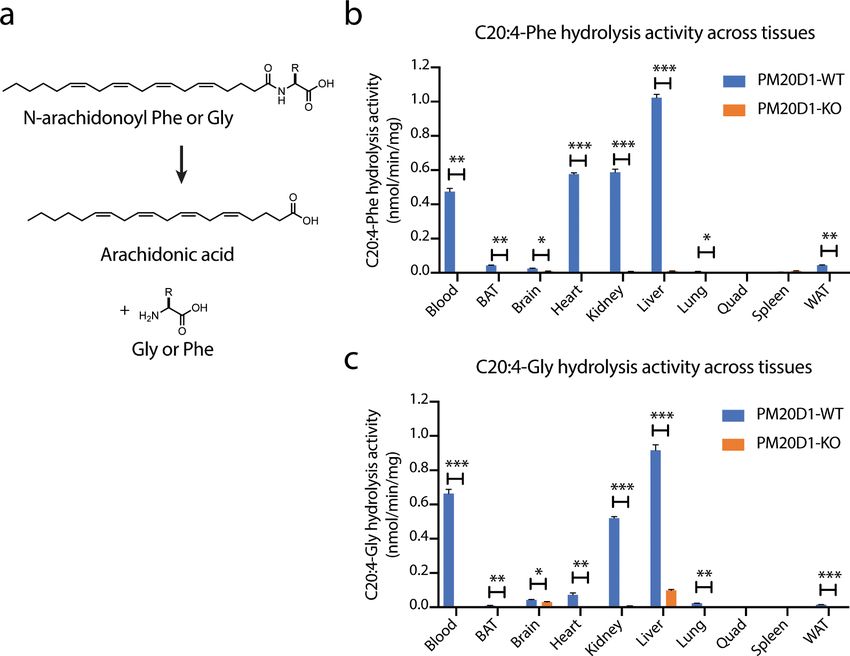
Two different prototypical N-acyl amino acid substrates, N-arachidonoyl-phenylalanine (C20:4-Phe)
and N-arachidonoyl-glycine (C20:4-Gly), were used as substrates. Following incubation with tissue
lysates, the hydrolysis of these N-acyl amino acid substrates to free fatty acid product was quantified
by liquid chromatography-mass spectrometry (LC-MS, Figure 1a). In wild-type mice, robust hydroly-
sis of C20:4-Phe was observed in eight of the ten tissues tested, with activities in the range of ~0.01
nmol/min/mg (lung) to 1.0 nmol/min/mg (liver). In PM20D1-KO tissues, the hydrolysis of C20:4-Phe
was completely abolished (>99% reduction in each tissue), establishing that PM20D1 is the only
enzyme responsible for C20:4-Phe hydrolysis activity (Figure 1b). The presence of PM20D1 activity
in tissue homogenates reflects potential interactions of PM20D1 with the extracellular matrix or with
cell surfaces, as has previously been observed with lipoprotein lipase and other secreted enzymes
(Cryer, 1981). By contrast, using C20:4-Gly as a substrate, both brain and liver from PM20D1-KO
mice maintained a robust second hydrolysis activity (Figure 1c). The second PM20D1-independent
activity accounted for 70% and 11% of the total C20:4-Gly hydrolysis in brain and liver, respectively.
In absolute terms, the residual activity in PM20D1-KO liver was higher (0.10 nmol/min/mg) than that
observed in the knockout brain tissue (0.03 nmol/min/mg). These data demonstrate the presence of
a second, PM20D1-independent hydrolysis activity in brain and liver for C20:4-Gly. That this residual
activity is only present for C20:4-Gly but not C20:4-Phe suggested that this second enzyme might
exhibit selectivity for regulating subsets of lipid species within the N-acyl amino acid family.
Molecular identification of fatty acid amide hydrolase (FAAH) as the
residual N-acyl amino acid hydrolase
Because liver homogenates exhibited the most robust PM20D1-independent hydrolysis activity, we
initiated an effort to identify the enzyme responsible for this activity. We first began with a candidate
approach. PM20D1 is one of five members of the mammalian M20 peptidase family, all of which
exhibit peptide bond hydrolysis and condensation activity on a variety of small molecule substrates
such as N-acetyl amino acids (Sass et al., 2006), N-lactoyl amino acids (Jansen et al., 2015), and
other dipeptides (Kim et al., 2019; Teufel et al., 2003). However, it was not known whether any of
the other mammalian M20 peptidases could also hydrolyze N-fatty acyl amino acids. We therefore
recombinantly expressed each of the mammalian M20 peptidases by transient transfection into
Kim et al. eLife 2020;9:e55211. DOI: https://doi.org/10.7554/eLife.55211 2 of 18Research article Biochemistry and Chemical Biology Figure 1. Detection of a residual N-acyl amino acid hydrolase activity in PM20D1-KO tissues. (a) Schematic of the enzymatic assay that monitors conversion of C20:4-Phe or C20:4-Gly into arachidonic acid. (b, c) C20:4-Phe (b) and C20:4-Gly (c) hydrolysis activities across the indicated wild-type (blue) or PM20D1-KO (orange) tissues. For (b) and (c), activity assays were conducted with 100 mM substrates and 100 mg tissue lysate in phosphate- buffered saline (PBS) for 1 hr at 37˚C. Data are shown as means ± SEM, N = 3/group. All experiments were performed once, with N corresponding to biological replicates. *, p
Research article                                                                                         Biochemistry and Chemical Biology

Figure 2. Identification of fatty acid amide hydrolase (FAAH) as the enzyme responsible for the PM20D1-independent N-acyl amino acid hydrolase
activity. (a, b) C20:4-Gly hydrolysis activity of cell lysates transfected with the indicated mammalian M20 peptidase (a) or of the indicated liver
homogenate fraction from PM20D1-KO animals (b). (c, d) Effect on the C20:4-Gly hydrolysis activity from PM20D1-KO liver membranes of the indicated
inhibitors. Activity assays were conducted with 100 mM substrates and 100 mg tissue lysate in PBS for 1 hr at 37˚C. For panel (b), membrane and soluble
fractions of liver lysate were separated by centrifugation at 100,000 x g for 1 hr. For panel (c), inhibitors were pre-incubated at 1 mM for EDTA
and 10 mM for all other compounds for 10 min before the start of the assay. Data are shown as means ± SEM, N = 3/group. All experiments were
performed once, with N biological replicates. *, p
Research article                                                                               Biochemistry and Chemical Biology

                                    ethanolamines and N-acyl taurines, both of which share considerable structural similarity with N-acyl
                                    amino acids (Grevengoed et al., 2019; Saghatelian et al., 2004). Last, FAAH exhibits highest
                                    expression in brain and liver in mice, the two anatomical locations where we observe the highest
                                    residual N-acyl amino acid hydrolysis activity in PM20D1-KO mice (Long et al., 2011).
                                        To determine whether FAAH could contribute to the residual hydrolysis activity in PM20D1-KO
                                    livers, we tested the effects of the potent and selective FAAH inhibitor PF-3845 (Ahn et al., 2009).
                                    This Pfizer compound has previously been shown to be highly selective and to inhibit only FAAH
                                    across multiple tissues following administration to mice. Pre-treatment of PM20D1-KO liver mem-
                                    brane lysates with PF-3845 (10 mM) completely blocked the residual hydrolysis activity exactly as was
                                    previously observed with MAFP (Figure 2c). By contrast, a distinct serine hydrolase inhibitor that
                                    does not inhibit FAAH (WWL70, 10 mM) had no effect on the residual C20:4-Gly hydrolysis activity. A
                                    dose–response curve established an EC50 of 290 nM for PF-3845, a concentration consistent with
                                    the previously reported potency of this compound towards FAAH (Figure 2d). Taken together, these
                                    data establish FAAH as the enzyme responsible for the residual N-acyl amino acid hydrolysis activity
                                    in PM20D1-KO tissues.

                                    PM20D1 and FAAH exhibit overlapping but distinct substrate
                                    specificity in vitro
                                    We next performed alignments of the primary amino acid sequences of mouse PM20D1 and mouse
                                    FAAH (Figure 3a). As additional comparisons, we also included QRSL1 (glutamyl-tRNA amidotrans-
                                    ferase subunit A, mitochondrial), which is the closest murine homolog to FAAH (17% identity), as
                                    well as the other four members of the murine M20 peptidase family. PM20D1 was most closely
                                    related to ACY1 (24% identity) and shared little identity with FAAH (11%). Our clustering also
                                    revealed a closer relationship of PM20D2 with both FAAH and QRSL1 than with the other M20 pep-
                                    tidase family members (Figure 3a).
                                        To determine whether N-acyl amino acids are direct FAAH substrates in vitro, we generated
                                    recombinant FAAH protein by transient transfection of a C-terminal flag-tagged FAAH construct
                                    into HEK293T cells. As a direct comparison, recombinant PM20D1 was generated in parallel. As
                                    expected, FAAH was localized entirely intracellularly, consistent with its previously described locali-
                                    zation as an ER-associated transmembrane enzyme, whereas PM20D1 protein was largely found in
                                    the conditioned media, consistent with its known annotation as a classically secreted enzyme
                                    (Figure 3b). Using these transfected lysates (for FAAH) and conditioned media (for PM20D1), hydro-
                                    lysis activity across a diverse panel of 14 N-acyl amino acid substrates was determined by LC-MS.
                                    These 14 substrates varied by both amino acid head group and fatty acid chain. FAAH-transfected
                                    cells showed robust hydrolysis activity for four N-acyl amino acids tested: C18:1-Gly, C18:1-Ser,
                                    C20:4-Gly, and C20:4-Ser (Figure 3c). A strong preference was observed for C20:4-Ser over the
                                    other three N-acyl amino acid substrates (~1.5 nmol/min/mg for FAAH hydrolysis of C20:4-Ser versus
                                    0.05–0.15 nmol/min/mg for any of the other substrates), at least under these in vitro conditions. In
                                    the N-acyl amino acid synthase direction, FAAH also catalyzed the condensation of arachidonic acid
                                    with Gly and Ser, but not Phe (Figure 3d). By contrast, robust hydrolysis activity was observed for
                                    PM20D1 across nearly all members of this N-acyl amino acid substrate panel over mock-transfected
                                    background (Figure 3e). PM20D1 also efficiently catalyzed the condensation of arachidonic acid
                                    with all three Gly, Ser, and Phe amino acids (Figure 3f).
                                        To better understand FAAH-mediated N-arachidonoyl glycine hydrolysis activity in the context of
                                    its previously described amidase activities, we directly compared the hydrolytic activity of trans-
                                    fected FAAH on C20:4-Gly, anandamide (C20:4-NAE), and N-arachidonoyl-taurine (C20:4-NAT). As
                                    expected, FAAH showed robust hydrolysis activity with anandamide as a substrate (0.5 nmol/min/
                                    mg) and lower but similar activities with C20:4-NAT and C20:4-Gly (0.04 and 0.02 nmol/min/mg,
                                    respectively, Figure 3—figure supplement 1a). Conversely, PM20D1 exhibited robust hydrolysis
                                    activity only on C20:4-Gly (0.6 nmol/min/mg) and was unable to hydrolyze either anandamide or
                                    C20:4-NAT (Figure 3—figure supplement 1a). We also determined that C20:4-NAT was not a direct
                                    inhibitor for PM20D1 (Figure 3—figure supplement 1b). Taken together, these data establish that
                                    recombinant FAAH is an N-acyl amino acid synthase/hydrolase in vitro. Our findings also underscore
                                    the PM20D1–FAAH pair as an example of convergence in enzymatic activity despite divergence in
                                    primary sequence.

Kim et al. eLife 2020;9:e55211. DOI: https://doi.org/10.7554/eLife.55211                                                            5 of 18
Research article Biochemistry and Chemical Biology Figure 3. N-acyl amino acid hydrolase and synthase substrate scope in vitro for FAAH and PM20D1. (a) Phylogenetic alignment of the five murine M20 peptidases with mouse FAAH and a FAAH-related enzyme, QRSL1. Orange, M20 peptidases; gray, FAAH-related sequences. (b) Anti-flag western blot for cell lysates (left) and conditioned media (right) transfected with the indicated plasmids. (c–f) N-acyl amino acid hydrolysis and synthase activities of FAAH- and mock-transfected cell lysates (b, c) or PM20D1-transfected and mock-transfected conditioned media (d, e). Activity assays were conducted with 100 mM substrates and 100 mg protein in PBS for 1 hr at 37˚C. Data are shown as means ± SEM, N = 3/group. All experiments were performed once, with N biological replicates. *, p
Research article                                                                                Biochemistry and Chemical Biology

                                    N-acyl amino acid levels following blockade of FAAH in mice. Because both genetic and pharmaco-
                                    logical reagents for selective FAAH blockade were available, we performed three independent com-
                                    parisons: global FAAH-KO versus FAAH-WT mice, a single administration of PF-3845 versus vehicle
                                    (10 mg/kg intraperitoneally, ‘acute’), or a three-day administration of PF-3845 versus vehicle (10 mg/
                                    kg intraperitoneally once per day, ‘chronic’). These three comparisons were selected because they
                                    had previously been validated to cause dramatic accumulation of other physiologic FAAH substrates
                                    in vivo (Long et al., 2011).
                                        Liver and blood were harvested and N-acyl amino acids were extracted by homogenization in
                                    acetonitrile/methanol. We developed a targeted liquid chromatography-triple quadrupole mass
                                    spectrometry (LC-QQQ) method to measure a panel of oleoyl- or arachidonoyl-containing N-acyl
                                    amino acids, reasoning that such a set would broadly capture a diverse and representative panel of
                                    this lipid family. In these experiments, we were able to detect 26 and 14 N-acyl amino acid species
                                    in liver and blood, respectively (Figure 4a and Figure 4—source data 1 and 2). In the liver, distinct
                                    bidirectional changes in N-acyl amino acids were observed in each of the three perturbations. Those
                                    changes that were statistically significant across all three conditions of FAAH blockade were eleva-
                                    tions in C20:4-Glu (by 2.1-fold) and decreases in C20:4-Gly (by 70%). In other cases, certain N-acyl
                                    amino acids changes were only observed in either the genetic (e.g., increased C20:4-Leu/Ile) or phar-
                                    macological (e.g., increased C18:1-Glu) model. In the blood, no N-acyl amino acids were significantly
                                    changed over controls across all three experiments (Figure 4b). We confirmed that PM20D1 activity
                                    is not altered in FAAH-KO plasma (Figure 4—figure supplement 1). By abundance, hepatic N-acyl
                                    amino acids levels were similar to N-acyl ethanolamine and N-acyl taurines in wild-type mice (Fig-
                                    ure 4—source data 1 and 2). Taken together, these data demonstrate that FAAH is a bidirectional
                                    regulator of a subset of intracellular, but not extracellular, N-acyl amino acids.

                                    Cooperative regulation of N-acyl amino acids by PM20D1 and FAAH in
                                    vivo
                                    Our data establish that at least two enzymes, PM20D1 and FAAH, contribute to the regulation of
                                    endogenous N-acyl amino acid levels. Individual blockade of PM20D1 or FAAH resulted in bidirec-
                                    tional dysregulation of N-acyl amino acids. We therefore considered the possibility that dual inhibi-
                                    tion of both PM20D1 and FAAH would result in a complete ablation of N-acyl amino acid synthase/
                                    hydrolase activities, and in concomitant global elevations or global depletions of endogenous N-acyl
                                    amino acid levels. To test this hypothesis, we used global PM20D1-KO animals in combination with a
                                    FAAH inhibitor to block both PM20D1 and FAAH simultaneously. PM20D1-KO animals were chroni-
                                    cally treated with PF-3845 (10 mg/kg intraperitoneally once per day for three days). As controls,
                                    PM20D1-KO or PM20D1-WT littermates were administered vehicle control (saline) in parallel. First,
                                    we measured liver N-acyl amino acid hydrolysis activity from each of the three groups of mice. As
                                    we described previously, livers from vehicle-treated PM20D1-KO mice exhibited a residual C20:4-
                                    Gly hydrolysis activity when compared to livers from PM20D1-WT mice. Following PF-3845 treat-
                                    ment in PM20D1-KO mice, the residual hepatic C20:4-Gly hydrolysis activity was entirely abolished
                                    (Figure 5a). These data establish that PM20D1 and FAAH are the only two C20:4-Gly hydrolysis
                                    activities in liver, at least under the assay conditions used here, and further validate our previous in
                                    vitro studies (Figure 2c,d).
                                        Next, we measured endogenous N-acyl amino acid levels in both liver and blood. Under basal
                                    conditions, PM20D1-KO mice exhibit bidirectional dysregulation of several N-acyl amino acids com-
                                    pared to PM20D1-WT mice (Figure 5b and Figure 5—source data 1). Surprisingly, complete abla-
                                    tion of N-acyl amino acid synthase/hydrolase activities did not uniformly change N-acyl amino acids
                                    in a positive or negative direction. Instead, dual inhibition of PM20D1 and FAAH uncovered a
                                    remarkable cooperativity of these two enzymatic pathways in the regulation of N-acyl amino acids.
                                    In general, individual regulation by PM20D1 or FAAH were not predictive of those N-acyl amino acid
                                    species that were regulated by both enzymatic pathways together or even the directionality of
                                    change. For instance, hepatic N-acyl serines were largely unaltered by individual blockade of either
                                    FAAH or PM20D1 alone (Figure 4a and Figure 5b). Following dual blockade of both enzymes,
                                    C18:1-Ser and C20:4-Ser were dramatically accumulated by 13-fold and 26-fold, respectively
                                    (Figure 5b). In other cases, dual blockade resulted in changes to N-acyl amino acids in the opposite
                                    direction compared to individual blockade alone. For instance, C18:1-Gly was reduced in PM20D1-
                                    KO livers and unaltered by FAAH blockade, but nevertheless accumulated to 8-fold over controls

Kim et al. eLife 2020;9:e55211. DOI: https://doi.org/10.7554/eLife.55211                                                             7 of 18
Research article Biochemistry and Chemical Biology Figure 4. Changes in N-acyl amino acids upon selective blockade of FAAH in vivo. (a, b) Fold change of the indicated N-acyl amino acids compared to the control for each of the indicated comparisons from liver (a) or blood (b). For drug treatment, PF-3845 was administered intraperitoneally at 10 mg/ kg once (acute) or for three consecutive days (chronic). Tissues were harvested 3 hr after the final dose. No bars are shown for N-acyl amino acids that were below the limit of detection. Data are shown as means ± SEM, N = 4–5 mice/group for each of the indicated comparisons. All experiments were performed once, with N biological replicates. *, p
Research article                                                                                        Biochemistry and Chemical Biology

Figure 5. Cooperative interactions between PM20D1 and FAAH regulate endogenous N-acyl amino acid levels. (a) C20:4-Gly hydrolysis activity in livers
from PM20D1-WT, PM20D1-KO, or PM20D1-KO treated with PF-3845. (b, c) Relative fold change of the indicated N-acyl amino acids in PM20D1-KO
mice or in PM20D1-KO mice treated with PF-3845 versus wild-type mice in liver (b) or blood (c). For drug treatment, PF-3845 was administered
intraperitoneally at 10 mg/kg for three consecutive days and tissues were harvested 3 hr after the final dose. No bars are shown for N-acyl amino acids
that were below the limit of detection. Data are shown as means ± SEM, N = 4–5 mice/group for each of the indicated comparisons. All experiments
were performed once, with N biological replicates. *, p
Research article                                                                                 Biochemistry and Chemical Biology

                                    Discussion
                                    The N-acyl amino acids are a diverse bioactive lipid family. Using PM20D1-KO tissues as a discovery
                                    tool, we establish FAAH as a second intracellular mammalian N-acyl amino acid synthase/hydrolase.
                                    In vitro, FAAH catalyzes the bidirectional synthesis and hydrolysis of a subset of N-acyl amino acids
                                    that have a narrower substrate specificity than PM20D1. Genetic ablation or pharmacological inhibi-
                                    tion of FAAH in vivo established that this enzyme is also a physiological regulator of intracellular but
                                    not of extracellular N-acyl amino acids. Our data uncover the PM20D1–FAAH pair as an example of
                                    enzymatic convergence, despite largely unrelated primary amino acid sequences. More generally,
                                    these findings underscore enzymatic and spatial division of labor as a mechanism for the control of
                                    subsets of a diverse thermogenic lipid family.
                                        The identification of two mammalian N-acyl amino acid synthase/hydrolase enzymes, one local-
                                    ized extracellularly and one intracellularly, raises important questions about the similarities and dif-
                                    ferences between the N-acyl amino acids within each of these localizations and about crosstalk
                                    between the intracellular and extracellular pools of N-acyl amino acids. What factors determine the
                                    compartmentalization of N-acyl amino acids? What are the mechanisms by which these lipids are
                                    imported into or exported out of cells? What functional differences are there between these two
                                    pools of N-acyl amino acids? One possibility is that certain N-acyl amino acid bioactivities require
                                    interactions within the cell (e.g., binding to mitochondria to stimulate respiratory uncoupling)
                                    whereas others involve extracellular interactions (e.g., engaging cell surface receptors), suggesting
                                    that certain compartmentalized pools of N-acyl amino acids might be more relevant for specific bio-
                                    activities. Identifying specific transporters for N-acyl amino acids may help to clarify the relative con-
                                    tribution of the intracellular versus extracellular pools of these lipids. The many examples of intra-
                                    and inter-cellular transport of sterols (Phillips, 2014), fatty acids (Pepino et al., 2014), and phospho-
                                    lipids (Hankins et al., 2015) provide a fertile starting point for discovering analogous pathways for
                                    the transport and compartmentalization of N-acyl amino acids.
                                        FAAH has also been implicated in diverse physiologic conditions in mice and humans. Pharmaco-
                                    logical or genetic blockade of FAAH has been shown to regulate pain and inflammation (Ahn et al.,
                                    2009; Cravatt et al., 2001), obesity and metabolic homeostasis (Brown et al., 2012; Touriño et al.,
                                    2010), and anxiety and depression (Gobbi et al., 2005; Kathuria et al., 2003), amongst many
                                    others. Polymorphisms in the FAAH gene have also provided human genetic evidence for these dis-
                                    ease associations (Sipe et al., 2002; Sipe et al., 2005). These phenotypes are classically associated
                                    with anandamide elevation and activation of the cannabinoid receptors upon FAAH inhibition or
                                    genetic deletion. However, beyond the endocannabinoid system, FAAH also regulates several other
                                    classes of bioactive lipids including other N-acyl ethanolamines, N-acyl taurines, and now, N-acyl
                                    amino acids. We propose that FAAH-regulated N-acyl amino acids may also contribute to some of
                                    these observed phenotypes. Projecting forward, critical tests of the FAAH/N-acyl amino acid contri-
                                    bution without confounding contributions from other FAAH-regulated lipids will require
                                    the identification of selective FAAH point mutants that only catalyze the synthesis or hydrolysis of
                                    specific species of N-acyl amino acids, but not other fatty acid amide substrates.
                                        Our data reveal that complete ablation of all C20:4-Gly synthase/hydrolase activities via dual
                                    blockade of both PM20D1 and FAAH was not sufficient to elevate or deplete all endogenous N-acyl
                                    amino acids globally. Instead, we observed extensive and non-additive interactions between these
                                    two enzymatic pathways in the regulation of specific subsets of N-acyl amino acids. In general, these
                                    non-additive interactions could not be predicted by in vitro substrate specificity or even individual
                                    N-acyl amino acid regulation. To the best of our knowledge, this type of cooperativity has not been
                                    previously described for any biochemical pathway. Quantitative flux analysis for the various amino
                                    acid, fatty acid, and N-acyl amino acid components will be required to understand how these meta-
                                    bolic fluxes are re-wired upon blockade of each enzyme individually or together.
                                        Last, our findings suggest that additional biochemical pathways beyond PM20D1 and FAAH con-
                                    tribute to regulating the endogenous levels of this lipid family. Potential candidate pathways include
                                    additional amidase enzymes on other N-acyl amino acid substrates, enzymes that catalyze the conju-
                                    gation of fatty acid CoAs with amino acids, or non-mammalian sources (Brady et al., 2004;
                                    Cohen et al., 2017; Jeffries et al., 2016; Van Wagoner and Clardy, 2006). Molecular identification
                                    of these additional pathways of N-acyl amino acid metabolism will ultimately enable the dissection

Kim et al. eLife 2020;9:e55211. DOI: https://doi.org/10.7554/eLife.55211                                                              10 of 18
Research article Biochemistry and Chemical Biology
and therapeutic manipulation of more specific subsets of this diverse bioactive lipid family in organis-
mal physiology.
Materials and methods
Key resources table
Reagent type
(species) or Source or Additional
resource Designation reference Identifiers information
Mouse line PM20D1-KO Long et al., 2018
(Mus musculus) (PMID:29967167)
Mouse line C57BL/6J Jackson Labs 000664
(M. musculus)
Transfected PM20D1-flag Addgene 84566
construct
(M. musculus)
Transfected FAAH-flag Origene MR209084
construct
(M. musculus)
Transfected ACY1-flag Origene MR206415
construct
(M. musculus)
Transfected CNDP1-flag Origene MR219018
construct
(M. musculus)
Transfected CNDP2-flag Origene MR207616
construct
(M. musculus)
Transfected PM20D2-flag Origene MR222068
construct
(M. musculus)
Cell line HEK293T ATCC CRL-3216
(Homo sapiens)
Antibody Anti-flag M2, Sigma F1804 (1:1000)
mouse monoclonal
Antibody Anti-tubulin, Abcam Ab6046 (1:1000)
rabbit polyclonal
Chemical PF-3845 Selleckchem S2666
compound
Chemical C20:4-Gly Cayman 90051
compound
Chemical C20:4-Ser Cayman 10005455
compound
Chemical C20:4-Phe Abcam Ab141612
compound
Chemical Arachidonic acid Sigma-Aldrich 10931
compound
Chemical WWL70 Sigma-Aldrich SML1641
compound
Chemical Talabostat R and D 3719
compound
Chemical MAFP Fisher Scientific 14-21-5
compound
Chemical C20:4-NAT Cayman 10005537
compound
Chemical Anandamide Sigma-Aldrich A0580
compound
Continued on next page
Kim et al. eLife 2020;9:e55211. DOI: https://doi.org/10.7554/eLife.55211 11 of 18Research article Biochemistry and Chemical Biology
Continued
Reagent type
(species) or Source or Additional
resource Designation reference Identifiers information
Chemical C16:0-Phe Lin et al., 2018
compound (PMID:29533650)
Chemical C18:0-Phe Lin et al., 2018
compound (PMID:29533650)
Chemical C20:0-Phe Lin et al., 2018
compound (PMID:29533650)
Chemical C22:6-Phe Lin et al., 2018
compound (PMID:29533650)
Chemical C18:1-Asn Lin et al., 2018
compound (PMID:29533650)
Chemical C18:1-Gly Cayman 90269
compound
Chemical C18:1-Lys Lin et al., 2018
compound (PMID:29533650)
Chemical C18:1-Met Lin et al., 2018
compound (PMID:29533650)
Chemical C18:1-Ser Cayman 13058
compound
Chemical C18:1-Trp Lin et al., 2018
compound (PMID:29533650)
Chemical C18:1-Tyr Lin et al., 2018
compound (PMID:29533650)
Chemical C18:1-Gln Lin et al., 2018
compound (PMID:29533650)
General animal information
Animal experiments were performed according to procedures approved by the Stanford University
IACUC. Mice were maintained in 12 hr light-dark cycles at 22˚C and fed a standard irradiated rodent
chow diet. All experiments on wild-type mice were performed with male C57BL/6J mice purchased
from Jackson Laboratories (stock number 000664). Global Pm20d1 knockout mice were obtained
from Bruce M. Spiegelman (Dana-Farber Cancer Institute) and are available from Jackson Laborato-
ries (stock number 032193). PF-3845 was administered to mice in a solution of 18:1:1 saline:kolliphor
EL:DMSO in a volume of 200 ml/mouse (intraperitoneally).
Materials
N-arachidonoyl glycine, N-arachidonoyl serine, and N-arachidonoyl-taurine were purchased from
Cayman. N-arachidonoyl phenylalanine was purchased from Abcam. Arachidonic acid, anandamide,
and WWL70 were purchased from Sigma-Aldrich. PF-3845 was purchased from Selleckchem. MAFP
and EDTA were purchased from Fisher. Talabostat was purchased from R and D. Non-commercially
available N-acyl amino acids were synthesized as previously described (Lin et al., 2018; Long et al.,
2016). Plasmids were obtained from the following sources: mouse PM20D1-flag (Addgene 132682),
mouse FAAH-flag (Origene MR209084), mouse ACY1-flag (Origene MR206415), mouse CNDP1-flag
(Origene MR219018), mouse CNDP2-flag (Origene MR207616), and mouse PM20D2-flag
(MR222068).
Statistics, sample size estimation, and replicates
All statistical comparisons were performed using Student’s t-test or ANOVA with Tukey or Dunnett’s
multiple comparison test. No explicit power analysis was used to determine sample sizes. Sample
sizes were determined on the basis of previous literature for biochemical or animal studies. All
experiments were performed once, with N corresponding to biological replicates. Outliers were not
removed from analyses. The experimentalist was not blinded to sample or treatment conditions.
Kim et al. eLife 2020;9:e55211. DOI: https://doi.org/10.7554/eLife.55211 12 of 18Research article Biochemistry and Chemical Biology
Cell culture
HEK293T cells were obtained from ATCC (CRL-3216) and cultured in DMEM with L-glutamine, 4.5 g/
L glucose and sodium pyruvate (Corning 10013CV) supplemented with 10% FBS (Corning 35010CV).
Cells were incubated at 37˚C in 5% CO2 for growth and tranfections. All cell lines were authenticated
by DNA fingerprint STR analysis by ATCC. Mycoplasma was not tested. Authentication of cell lines
beyond ATCC was not completed due to laboratory disruptions by COVID-19.
Production of recombinant enzymes
Plasmids were transiently transfected into HEK293T cells using PolyFect (Qiagen) according to the
manufacturer’s instructions. The medium was changed to serum-free DMEM one day post-transfec-
tion. After an additional 24 hr, the medium was collected and the cells were harvested by scraping.
Molecular studies
Western blotting was performed according to standard methods. The following antibodies were
used: anti-flag M2 antibody (Sigma F1804, diluted 1:10,000), and tubulin (Abcam ab6046, diluted
1:10,000).
Enzyme activity assays in vitro
Plasma was collected from mice and used directly for the activity assays. Tissues were homogenized
using a Benchmark BeadBlaster Homogenizer in ice-cold PBS, centrifuged to remove debris (5 min
at 1000 x g), and the supernatant was collected and used for activity assays. For assays using liver
membranes, total liver homogenates were transferred into ultracentrifuge inserts and spun at
100,000 x g on a Beckman Centrifuge I8-70M for 1 hr at 4˚C. In vitro enzymatic reactions were con-
ducted in glass vials and initiated by the addition of 100 mg protein. Final reaction conditions for the
hydrolase reactions were 100 mM substrate (C20:4-Gly or C20:4-Phe) and 100 mg protein in 100 ml
PBS, and for the synthase reactions were 1 mM Phe, 1 mM oleic acid, and 100 mg protein in 100 ml
PBS. After 1 hr at 37˚C, reactions were quenched with 400 ml 2:1 v/v acetonitrile:methanol and vor-
texed. Reaction vials were centrifuged at 2000 x g to remove debris, and the supernatant was col-
lected and analyzed by LC-MS as described below. For inhibitor assays, tissue lysates were treated
with the indicated inhibitors for 10 min at room temperature before the introduction of the indicated
substrates.
Extraction of N-acyl amino acids from blood and tissues
Frozen plasma (30 ml) were extracted in 160 ml of 1:1 v/v acetonitrile:methanol. Liver tissues were
extracted in 500 ml 2:2:1 v/v/v acetonitrile:methanol:water on a BeadBlaster homogenizer for 1 min.
Extracts were centrifuged (10 min, 5000 x g) to remove debris. The supernatant was isolated and
centrifuged again (10 min, 5000 x g). Finally, the twice-clarified supernatant was transferred to a
mass spectrometry vial and analyzed by LC-MS as described below.
Measurements of N-acyl amino acids in vivo and enzyme activities in
vitro by LC-MS
Mass spectrometry analysis was performed with an electrospray ionization (ESI) source on an Agilent
6470 Triple Quadrupole (QQQ). For separation of metabolites, normal-phase chromatography was
performed with a Luna 5 mm C5 100 Å LC column (Phenomenex 00B-4043-E0). The mobile phases
were as follows: Buffer A, 95:5 water/methanol; Buffer B, 60:35:5 isopropanol/methanol/water with
0.1% ammonium hydroxide in both Buffer A and B for negative ionization mode. For AJS ESI ion
source parameters, the drying gas temperature was set to 250˚C with a flow rate of 12 l/min, and
the nebulizer pressure was 25 psi. The sheath gas temperature was set to 300˚C with a flow rate of
12 l/min. The capillary voltage was set to 2500 V and the fragmentor voltage was set to 135 V. For
the measurement of in vitro enzyme activity assays, the flow rate for each run started at 95% A/5% B
for 3 min at 0.6 ml/min, followed by a gradient starting at 95% A/5% B changing linearly to 5% A/
95% B over the course of 3 min at 0.6 ml/min, followed by 5% A/95% B for 1.5 min at 0.6 ml/min.
For the measurement of metabolites from blood and liver in vivo, the flow rate for each run started
at 95% A/5% B for 1 min at 0.6 ml/min, followed by a gradient starting at 95% A/5% B changing
Kim et al. eLife 2020;9:e55211. DOI: https://doi.org/10.7554/eLife.55211 13 of 18Research article Biochemistry and Chemical Biology
linearly to 5% A/95% B over the course of 10 min at 0.6 ml/min, followed by 5% A/95% B for 3 min
at 0.6 ml/min, and back to 95% A/5% B over 1 min at 0.6 ml/min.
The QQQ acquisition parameters were as follows. For in vitro assays, the mass range was set
from 100 to 500 m/z. For measurement of endogenous N-acyl amino acids, metabolites were
detected by the SRM of the transition from precursor to product ions (corresponding to the amino
acid fragment) at collision energy 20. The following table includes the list of transitions used. N-acyl
taurines and N-acyl ethanolamines were measured as described previously (Long et al., 2011).
Compound name Precursor ion Product ion Dwell Fragmentor Collision energy Cell accelerator voltage Polarity
C18:1-Trp 467.3 203.1 50 135 20 5 Negative
C20:4-Tyr 466.3 180.1 50 135 20 5 Negative
C20:4-Arg 459.4 173.1 50 135 20 5 Negative
C20:4-Phe 450.3 164.1 50 135 20 5 Negative
C18:1-Tyr 444.3 180.1 50 135 20 5 Negative
C20:4-His 440.3 154.1 50 135 20 5 Negative
C18:1-Arg 437.4 173.1 50 135 20 5 Negative
C20:4-Met 434.3 148 50 135 20 5 Negative
C20:4-Glu 432.3 146.1 50 135 20 5 Negative
C20:4-Gln/Lys 431.3 145.1 50 135 20 5 Negative
C18:1-Phe 428.3 164.1 50 135 20 5 Negative
C18:1-His 418.3 154.1 50 135 20 5 Negative
C20:4-Asp 418.3 132 50 135 20 5 Negative
C20:4-Asn 417.3 131.1 50 135 20 5 Negative
C20:4-Leu/Ile 416.4 130.1 50 135 20 5 Negative
C18:1-Met 412.3 148 50 135 20 5 Negative
C18:1-Glu 410.3 146.1 50 135 20 5 Negative
C18:1-Gln/lys 409.3 145.1 50 135 20 5 Negative
C20:4-Cys 406.3 120 50 135 20 5 Negative
C20:4-Thr 404.3 118.1 50 135 20 5 Negative
C20:4-Val 402.3 116.1 50 135 20 5 Negative
C20:4-Pro 400.3 114.1 50 135 20 5 Negative
C18:1-Asp 396.3 132 50 135 20 5 Negative
C18:1-Asn 395.3 131.1 50 135 20 5 Negative
C18:1-Leu/Ile 394.4 130.1 50 135 20 5 Negative
C20:4-Ser 390.3 104 50 135 20 5 Negative
C15-Phe 388.3 164.1 50 135 20 5 Negative
C18:1-Cys 384.3 120 50 135 20 5 Negative
C18:1-Thr 382.3 118.1 50 135 20 5 Negative
C18:1-Val 380.3 116.1 50 135 20 5 Negative
C18:1-Pro 378.3 114.1 50 135 20 5 Negative
C20:4-Ala 374.3 88 50 135 20 5 Negative
C18:1-Ser 368.3 104 50 135 20 5 Negative
C20:4-Gly 360.3 74 50 135 20 5 Negative
C18:1-Ala 352.3 88 50 135 20 5 Negative
C18:1-Gly 338.3 74 50 135 20 5 Negative
C20:4-Trp 489.3 203.1 50 135 20 5 Negative
Kim et al. eLife 2020;9:e55211. DOI: https://doi.org/10.7554/eLife.55211 14 of 18Research article Biochemistry and Chemical Biology
Acknowledgements
We thank members of the Long and Svensson labs for helpful discussions and K Masuda and B F
Cravatt (Scripps Research) for tissues from the FAAH-KO mice. This work was supported by the US
National Institutes of Health (DK105203 and DK124265 to JZL), by the Stanford ChEM-H Institute
(CRF), and by the Stanford Diabetes Research Center (P30DK116074).
Additional information
Funding
Funder Grant reference number Author
National Institutes of Health DK105203 Jonathan Long
Stanford Diabetes Research P30DK116074 Jonathan Z Long
Center
National Institutes of Health DK124265 Jonathan Z Long
Stanford University Stanford ChEM-H Institute Curt R Fischer
The funders had no role in study design, data collection and interpretation, or the
decision to submit the work for publication.
Author contributions
Joon T Kim, Conceptualization, Formal analysis, Investigation, Methodology; Stephanie M Terrell,
Veronica L Li, Wei Wei, Investigation; Curt R Fischer, Investigation, Methodology; Jonathan Z Long,
Conceptualization, Data curation, Formal analysis, Supervision, Funding acquisition, Visualization,
Writing - original draft, Writing - review and editing
Author ORCIDs
Joon T Kim https://orcid.org/0000-0002-8663-1414
Curt R Fischer http://orcid.org/0000-0003-3386-9813
Jonathan Z Long https://orcid.org/0000-0003-2631-7463
Ethics
Animal experimentation: This study was performed in strict accordance with the recommendations
in the Guide for the Care and Use of Laboratory Animals of the National Institutes of Health. Animal
experiments were performed according to procedures approved by the Stanford University IACUC,
protocol APLAC-32841.
Decision letter and Author response
Decision letter https://doi.org/10.7554/eLife.55211.sa1
Author response https://doi.org/10.7554/eLife.55211.sa2
Additional files
Supplementary files
. Transparent reporting form
Data availability
All data generated or analysed during this study are included in the manuscript.
References
Ahn K, Johnson DS, Mileni M, Beidler D, Long JZ, McKinney MK, Weerapana E, Sadagopan N, Liimatta M, Smith
SE, Lazerwith S, Stiff C, Kamtekar S, Bhattacharya K, Zhang Y, Swaney S, Van Becelaere K, Stevens RC, Cravatt
Kim et al. eLife 2020;9:e55211. DOI: https://doi.org/10.7554/eLife.55211 15 of 18Research article Biochemistry and Chemical Biology
BF. 2009. Discovery and characterization of a highly selective FAAH inhibitor that reduces inflammatory pain.
Chemistry & Biology 16:411–420. DOI: https://doi.org/10.1016/j.chembiol.2009.02.013, PMID: 19389627
Aneetha H, O’Dell DK, Tan B, Walker JM, Hurley TD. 2009. Alcohol dehydrogenase-catalyzed in vitro oxidation
of anandamide to N-arachidonoyl glycine, a lipid mediator: synthesis of N-acyl glycinals. Bioorganic &
Medicinal Chemistry Letters 19:237–241. DOI: https://doi.org/10.1016/j.bmcl.2008.10.087
Bachovchin DA, Koblan LW, Wu W, Liu Y, Li Y, Zhao P, Woznica I, Shu Y, Lai JH, Poplawski SE, Kiritsy CP, Healey
SE, DiMare M, Sanford DG, Munford RS, Bachovchin WW, Golub TR. 2014. A high-throughput, multiplexed
assay for superfamily-wide profiling of enzyme activity. Nature Chemical Biology 10:656–663. DOI: https://doi.
org/10.1038/nchembio.1578, PMID: 24997602
Bachovchin DA, Cravatt BF. 2012. The pharmacological landscape and therapeutic potential of serine
hydrolases. Nature Reviews Drug Discovery 11:52–68. DOI: https://doi.org/10.1038/nrd3620, PMID: 22212679
Benson KK, Hu W, Weller AH, Bennett AH, Chen ER, Khetarpal SA, Yoshino S, Bone WP, Wang L, Rabinowitz
JD, Voight BF, Soccio RE. 2019. Natural human genetic variation determines basal and inducible expression of
PM20D1, an obesity-associated gene. PNAS 116:23232–23242. DOI: https://doi.org/10.1073/pnas.
1913199116, PMID: 31659023
Bradshaw HB, Rimmerman N, Hu SS, Benton VM, Stuart JM, Masuda K, Cravatt BF, O’Dell DK, Walker JM. 2009.
The endocannabinoid anandamide is a precursor for the signaling lipid N-arachidonoyl glycine by two distinct
pathways. BMC Biochemistry 10:14. DOI: https://doi.org/10.1186/1471-2091-10-14, PMID: 19460156
Brady SF, Chao CJ, Clardy J. 2004. Long-chain N-acyltyrosine synthases from environmental DNA. Applied and
Environmental Microbiology 70:6865–6870. DOI: https://doi.org/10.1128/AEM.70.11.6865-6870.2004,
PMID: 15528554
Brown WH, Gillum MP, Lee HY, Camporez JP, Zhang XM, Jeong JK, Alves TC, Erion DM, Guigni BA, Kahn M,
Samuel VT, Cravatt BF, Diano S, Shulman GI. 2012. Fatty acid amide hydrolase ablation promotes ectopic lipid
storage and insulin resistance due to centrally mediated hypothyroidism. PNAS 109:14966–14971.
DOI: https://doi.org/10.1073/pnas.1212887109, PMID: 22912404
Bycroft C, Freeman C, Petkova D, Band G, Elliott LT, Sharp K, Motyer A, Vukcevic D, Delaneau O, O’Connell J,
Cortes A, Welsh S, Young A, Effingham M, McVean G, Leslie S, Allen N, Donnelly P, Marchini J. 2018. The UK
biobank resource with deep phenotyping and genomic data. Nature 562:203–209. DOI: https://doi.org/10.
1038/s41586-018-0579-z, PMID: 30305743
Cohen LJ, Esterhazy D, Kim SH, Lemetre C, Aguilar RR, Gordon EA, Pickard AJ, Cross JR, Emiliano AB, Han SM,
Chu J, Vila-Farres X, Kaplitt J, Rogoz A, Calle PY, Hunter C, Bitok JK, Brady SF. 2017. Commensal Bacteria
make GPCR ligands that mimic human signalling molecules. Nature 549:48–53. DOI: https://doi.org/10.1038/
nature23874, PMID: 28854168
Cravatt BF, Giang DK, Mayfield SP, Boger DL, Lerner RA, Gilula NB. 1996. Molecular characterization of an
enzyme that degrades neuromodulatory fatty-acid amides. Nature 384:83–87. DOI: https://doi.org/10.1038/
384083a0, PMID: 8900284
Cravatt BF, Demarest K, Patricelli MP, Bracey MH, Giang DK, Martin BR, Lichtman AH. 2001. Supersensitivity to
anandamide and enhanced endogenous cannabinoid signaling in mice lacking fatty acid amide hydrolase.
PNAS 98:9371–9376. DOI: https://doi.org/10.1073/pnas.161191698, PMID: 11470906
Cryer A. 1981. Tissue lipoprotein lipase activity and its action in lipoprotein metabolism. International Journal of
Biochemistry 13:525–541. DOI: https://doi.org/10.1016/0020-711X(81)90177-4, PMID: 7016622
Devane WA, Hanus L, Breuer A, Pertwee RG, Stevenson LA, Griffin G, Gibson D, Mandelbaum A, Etinger A,
Mechoulam R. 1992. Isolation and structure of a brain constituent that binds to the cannabinoid receptor.
Science 258:1946–1949. DOI: https://doi.org/10.1126/science.1470919, PMID: 1470919
Gobbi G, Bambico FR, Mangieri R, Bortolato M, Campolongo P, Solinas M, Cassano T, Morgese MG, Debonnel
G, Duranti A, Tontini A, Tarzia G, Mor M, Trezza V, Goldberg SR, Cuomo V, Piomelli D. 2005. Antidepressant-
like activity and modulation of brain monoaminergic transmission by blockade of anandamide hydrolysis. PNAS
102:18620–18625. DOI: https://doi.org/10.1073/pnas.0509591102, PMID: 16352709
Grevengoed TJ, Trammell SAJ, McKinney MK, Petersen N, Cardone RL, Svenningsen JS, Ogasawara D, Nexøe-
Larsen CC, Knop FK, Schwartz TW, Kibbey RG, Cravatt BF, Gillum MP. 2019. N-acyl taurines are endogenous
lipid messengers that improve glucose homeostasis. PNAS 116:24770–24778. DOI: https://doi.org/10.1073/
pnas.1916288116, PMID: 31740614
Han B, Wright R, Kirchhoff AM, Chester JA, Cooper BR, Davisson VJ, Barker E. 2013. Quantitative LC-MS/MS
analysis of arachidonoyl amino acids in mouse brain with treatment of FAAH inhibitor. Analytical Biochemistry
432:74–81. DOI: https://doi.org/10.1016/j.ab.2012.09.031, PMID: 23044255
Hankins HM, Baldridge RD, Xu P, Graham TR. 2015. Role of flippases, scramblases and transfer proteins in
phosphatidylserine subcellular distribution. Traffic 16:35–47. DOI: https://doi.org/10.1111/tra.12233,
PMID: 25284293
Jansen RS, Addie R, Merkx R, Fish A, Mahakena S, Bleijerveld OB, Altelaar M, IJlst L, Wanders RJ, Borst P, van
de Wetering K. 2015. N-lactoyl-amino acids are ubiquitous metabolites that originate from CNDP2-mediated
reverse proteolysis of lactate and amino acids. PNAS 112:6601–6606. DOI: https://doi.org/10.1073/pnas.
1424638112, PMID: 25964343
Jeffries KA, Dempsey DR, Farrell EK, Anderson RL, Garbade GJ, Gurina TS, Gruhonjic I, Gunderson CA, Merkler
DJ. 2016. Glycine N-acyltransferase-like 3 is responsible for long-chain N-acylglycine formation in N18TG2 cells.
Journal of Lipid Research 57:781–790. DOI: https://doi.org/10.1194/jlr.M062042, PMID: 27016726
Kim et al. eLife 2020;9:e55211. DOI: https://doi.org/10.7554/eLife.55211 16 of 18Research article Biochemistry and Chemical Biology
Kathuria S, Gaetani S, Fegley D, Valiño F, Duranti A, Tontini A, Mor M, Tarzia G, La Rana G, Calignano A,
Giustino A, Tattoli M, Palmery M, Cuomo V, Piomelli D. 2003. Modulation of anxiety through blockade of
anandamide hydrolysis. Nature Medicine 9:76–81. DOI: https://doi.org/10.1038/nm803, PMID: 12461523
Keipert S, Kutschke M, Ost M, Schwarzmayr T, van Schothorst EM, Lamp D, Brachthäuser L, Hamp I, Mazibuko
SE, Hartwig S, Lehr S, Graf E, Plettenburg O, Neff F, Tschöp MH, Jastroch M. 2017. Long-Term cold adaptation
does not require FGF21 or UCP1. Cell Metabolism 26:437–446. DOI: https://doi.org/10.1016/j.cmet.2017.07.
016, PMID: 28768181
Kim JT, Li VL, Terrell SM, Fischer CR, Long JZ. 2019. Family-wide annotation of enzymatic pathways by parallel
in Vivo Metabolomics. Cell Chemical Biology 26:1623–1629. DOI: https://doi.org/10.1016/j.chembiol.2019.09.
009
Lin H, Long JZ, Roche AM, Svensson KJ, Dou FY, Chang MR, Strutzenberg T, Ruiz C, Cameron MD, Novick SJ,
Berdan CA, Louie SM, Nomura DK, Spiegelman BM, Griffin PR, Kamenecka TM. 2018. Discovery of Hydrolysis-
Resistant isoindoline N-Acyl amino acid analogues that stimulate mitochondrial respiration. Journal of
Medicinal Chemistry 61:3224–3230. DOI: https://doi.org/10.1021/acs.jmedchem.8b00029, PMID: 29533650
Long JZ, LaCava M, Jin X, Cravatt BF. 2011. An anatomical and temporal portrait of physiological substrates for
fatty acid amide hydrolase. Journal of Lipid Research 52:337–344. DOI: https://doi.org/10.1194/jlr.M012153,
PMID: 21097653
Long JZ, Svensson KJ, Bateman LA, Lin H, Kamenecka T, Lokurkar IA, Lou J, Rao RR, Chang MR, Jedrychowski
MP, Paulo JA, Gygi SP, Griffin PR, Nomura DK, Spiegelman BM. 2016. The secreted enzyme PM20D1 regulates
lipidated amino acid uncouplers of mitochondria. Cell 166:424–435. DOI: https://doi.org/10.1016/j.cell.2016.
05.071, PMID: 27374330
Long JZ, Roche AM, Berdan CA, Louie SM, Roberts AJ, Svensson KJ, Dou FY, Bateman LA, Mina AI, Deng Z,
Jedrychowski MP, Lin H, Kamenecka TM, Asara JM, Griffin PR, Banks AS, Nomura DK, Spiegelman BM. 2018.
Ablation of PM20D1 reveals N-acyl amino acid control of metabolism and nociception. PNAS 115:E6937–
E6945. DOI: https://doi.org/10.1073/pnas.1803389115, PMID: 29967167
Long JZ, Cravatt BF. 2011. The metabolic serine hydrolases and their functions in mammalian physiology and
disease. Chemical Reviews 111:6022–6063. DOI: https://doi.org/10.1021/cr200075y, PMID: 21696217
Milman G, Maor Y, Abu-Lafi S, Horowitz M, Gallily R, Batkai S, Mo FM, Offertaler L, Pacher P, Kunos G,
Mechoulam R. 2006. N-arachidonoyl L-serine, an endocannabinoid-like brain constituent with vasodilatory
properties. PNAS 103:2428–2433. DOI: https://doi.org/10.1073/pnas.0510676103, PMID: 16467152
Mostyn SN, Wilson KA, Schumann-Gillett A, Frangos ZJ, Shimmon S, Rawling T, Ryan RM, O’Mara ML,
Vandenberg RJ. 2019. Identification of an allosteric binding site on the human glycine transporter, GlyT2, for
bioactive lipid analgesics. eLife 8:e47150. DOI: https://doi.org/10.7554/eLife.47150, PMID: 31621581
Parmar N, Ho WS. 2010. N-arachidonoyl glycine, an endogenous lipid that acts as a vasorelaxant via nitric oxide
and large conductance calcium-activated potassium channels. British Journal of Pharmacology 160:594–603.
DOI: https://doi.org/10.1111/j.1476-5381.2009.00622.x, PMID: 20136843
Parsek MR, Val DL, Hanzelka BL, Cronan JE, Greenberg EP. 1999. Acyl homoserine-lactone quorum-sensing
signal generation. PNAS 96:4360–4365. DOI: https://doi.org/10.1073/pnas.96.8.4360, PMID: 10200267
Patricelli MP, Lashuel HA, Giang DK, Kelly JW, Cravatt BF. 1998. Comparative Characterization of a Wild Type
and Transmembrane Domain-Deleted Fatty Acid Amide Hydrolase: Identification of the Transmembrane
Domain as a Site for Oligomerization †. Biochemistry 37:15177–15187. DOI: https://doi.org/10.1021/bi981733n
Pepino MY, Kuda O, Samovski D, Abumrad NA. 2014. Structure-function of CD36 and importance of fatty acid
signal transduction in fat metabolism. Annual Review of Nutrition 34:281–303. DOI: https://doi.org/10.1146/
annurev-nutr-071812-161220, PMID: 24850384
Phillips MC. 2014. Molecular mechanisms of cellular cholesterol efflux. Journal of Biological Chemistry 289:
24020–24029. DOI: https://doi.org/10.1074/jbc.R114.583658
Saghatelian A, Trauger SA, Want EJ, Hawkins EG, Siuzdak G, Cravatt BF. 2004. Assignment of endogenous
substrates to enzymes by global metabolite profiling. Biochemistry 43:14332–14339. DOI: https://doi.org/10.
1021/bi0480335, PMID: 15533037
Sass JO, Mohr V, Olbrich H, Engelke U, Horvath J, Fliegauf M, Loges NT, Schweitzer-Krantz S, Moebus R, Weiler
P, Kispert A, Superti-Furga A, Wevers RA, Omran H. 2006. Mutations in ACY1, the gene encoding
aminoacylase 1, cause a novel inborn error of metabolism. The American Journal of Human Genetics 78:401–
409. DOI: https://doi.org/10.1086/500563, PMID: 16465618
Schwenk JM, Omenn GS, Sun Z, Campbell DS, Baker MS, Overall CM, Aebersold R, Moritz RL, Deutsch EW.
2017. The human plasma proteome draft of 2017: building on the human plasma PeptideAtlas from mass
spectrometry and complementary assays. Journal of Proteome Research 16:4299–4310. DOI: https://doi.org/
10.1021/acs.jproteome.7b00467, PMID: 28938075
Sipe JC, Chiang K, Gerber AL, Beutler E, Cravatt BF. 2002. A missense mutation in human fatty acid amide
hydrolase associated with problem drug use. PNAS 99:8394–8399. DOI: https://doi.org/10.1073/pnas.
082235799, PMID: 12060782
Sipe JC, Waalen J, Gerber A, Beutler E. 2005. Overweight and obesity associated with a missense polymorphism
in fatty acid amide hydrolase (FAAH). International Journal of Obesity 29:755–759. DOI: https://doi.org/10.
1038/sj.ijo.0802954
Smoum R, Bar A, Tan B, Milman G, Attar-Namdar M, Ofek O, Stuart JM, Bajayo A, Tam J, Kram V, O’Dell D,
Walker MJ, Bradshaw HB, Bab I, Mechoulam R. 2010. Oleoyl serine, an endogenous N-acyl amide, modulates
bone remodeling and mass. PNAS 107:17710–17715. DOI: https://doi.org/10.1073/pnas.0912479107,
PMID: 20876113
Kim et al. eLife 2020;9:e55211. DOI: https://doi.org/10.7554/eLife.55211 17 of 18Research article Biochemistry and Chemical Biology
Teufel M, Saudek V, Ledig JP, Bernhardt A, Boularand S, Carreau A, Cairns NJ, Carter C, Cowley DJ, Duverger
D, Ganzhorn AJ, Guenet C, Heintzelmann B, Laucher V, Sauvage C, Smirnova T. 2003. Sequence identification
and characterization of human carnosinase and a closely related non-specific dipeptidase. Journal of Biological
Chemistry 278:6521–6531. DOI: https://doi.org/10.1074/jbc.M209764200, PMID: 12473676
Touriño C, Oveisi F, Lockney J, Piomelli D, Maldonado R. 2010. FAAH deficiency promotes energy storage and
enhances the motivation for food. International Journal of Obesity 34:557–568. DOI: https://doi.org/10.1038/
ijo.2009.262
Uhlén M, Fagerberg L, Hallström BM, Lindskog C, Oksvold P, Mardinoglu A, Sivertsson Å, Kampf C, Sjöstedt E,
Asplund A, Olsson I, Edlund K, Lundberg E, Navani S, Szigyarto CA, Odeberg J, Djureinovic D, Takanen JO,
Hober S, Alm T, et al. 2015. Proteomics tissue-based map of the human proteome. Science 347:1260419.
DOI: https://doi.org/10.1126/science.1260419, PMID: 25613900
Van Wagoner RM, Clardy J. 2006. FeeM, an N-acyl amino acid synthase from an uncultured soil microbe:
structure, mechanism, and acyl carrier protein binding. Structure 14:1425–1435. DOI: https://doi.org/10.1016/j.
str.2006.07.005, PMID: 16962973
Waluk DP, Schultz N, Hunt MC. 2010. Identification of glycine N-acyltransferase-like 2 (GLYATL2) as a transferase
that produces N-acyl glycines in humans. FASEB J 24:2795–2803. DOI: https://doi.org/10.1096/fj.09-148551,
PMID: 20305126
Wu J, Zhu C, Yang L, Wang Z, Wang L, Wang S, Gao P, Zhang Y, Jiang Q, Zhu X, Shu G. 2017. N -Oleoylglycine-
Induced Hyperphagia Is Associated with the Activation of Agouti-Related Protein (AgRP) Neuron by
Cannabinoid Receptor Type 1 (CB1R) . Journal of Agricultural and Food Chemistry 65:1051–1057. DOI: https://
doi.org/10.1021/acs.jafc.6b05281
Kim et al. eLife 2020;9:e55211. DOI: https://doi.org/10.7554/eLife.55211 18 of 18You can also read


