Lancaster County Human Services Block Grant Plan Narratives - FY 2018-2019 - Lancaster County BHDS, PA
←
→
Page content transcription
If your browser does not render page correctly, please read the page content below
LANCASTER LANCASTER COUNTY HUMAN SERVICES BLOCK GRANT 2018-2019
1

     Lancaster County
    Human Services Block
    Grant Plan Narratives
       FY 2018-2019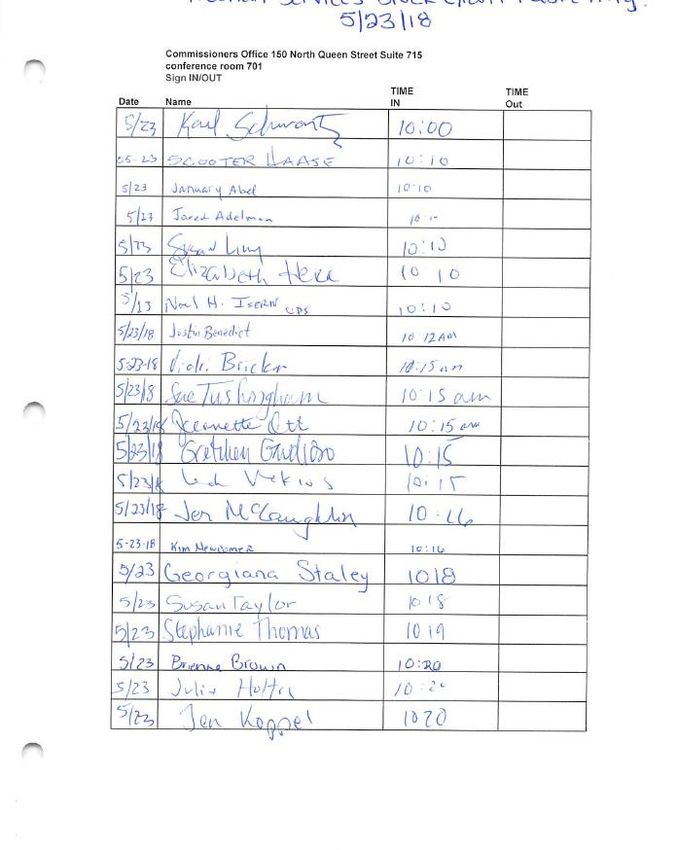
LANCASTER LANCASTER COUNTY HUMAN SERVICES BLOCK GRANT 2018-2019
2

                                                                                 “Appendix B”

                               PART I: COUNTY PLANNING PROCESS

    1. The Lancaster County Human Services Block Grant Committee meets on a monthly basis
    throughout the year to review programming and expenditures specific to each of the categorical
    allocations, in addition to planning for the Fiscal Year to come. Members of the Block Grant
    Committee include:

    •   Chief Clerk, Lancaster County Board of Commissioners

    •   Executive Director of Lancaster County Office of Aging

    •   Executive Director of Lancaster County Children & Youth

    •   Executive Director of Lancaster County Drug & Alcohol (Single County Authority)

    •   Executive Director of Lancaster County Coalition to End Homelessness

    •   Executive Director of Lancaster County Behavioral Health & Developmental Services

    •   Deputy Director of Behavioral Health Services

    •   Deputy Director of Intellectual Disability Services

    •   Deputy Director of Administration

    •   Representative from Lancaster County Controller’s Office

    Additionally, each of these departments conducts regular consumer and provider forums throughout
    the year in which stakeholders are engaged with and offered an opportunity for feedback and input.
    Further, Children & Youth, Drug & Alcohol, Homeless Assistance and BHDS all have Advisory
    Boards that are utilized for the planning process specific to each categorical. Independent Consumer
    Groups are also consulted, including Mental Health America, The ARC of Lancaster County and the
    National Alliance of the Mentally Ill (NAMI).

    2. Quarterly or bi-monthly meetings occur with Behavioral Health, Intellectual Disability and
    Homeless Assistance provider associations in which agendas are set and minutes are taken. For the
    third consecutive year, Lancaster County conducted three (3) public hearings on the development of
    the Human Services Block Grant.

    3. The Behavioral Health & Developmental Services Advisory Board, which is comprised of
    individual utilizers of Agency services, their family members, professionals from various human
    service realms and community stakeholders.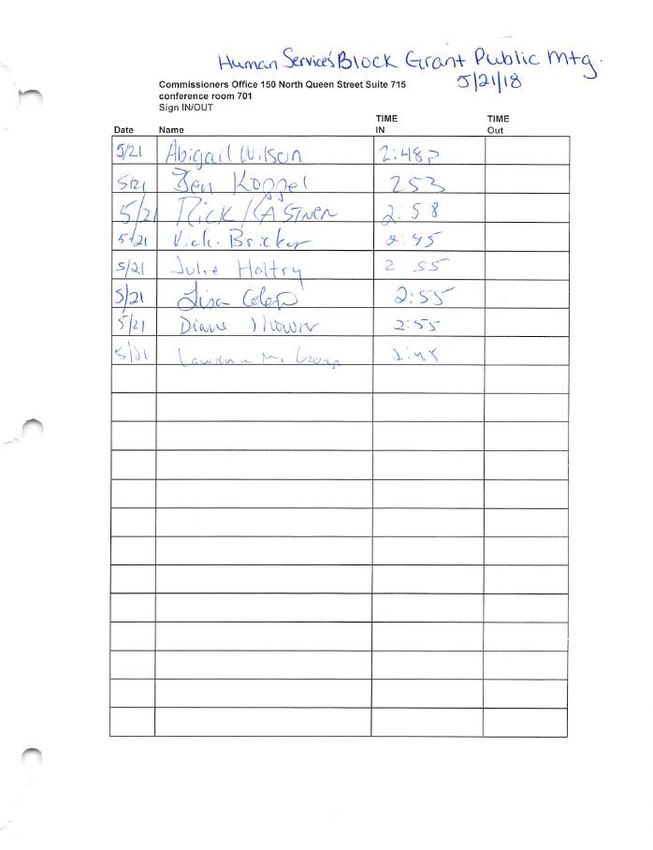
LANCASTER LANCASTER COUNTY HUMAN SERVICES BLOCK GRANT 2018-2019
3

    4. The County of Lancaster fully embraces the ‘least restrictive’ ethos, in principle and application.
    To this end, the County utilizes various tools and mechanisms to ensure fidelity to this philosophy.
    Each system has internal processes and protocols specific to this ‘best practice’ approach, among
    which are:

    • Mental Health Utilization Review; a forum of mental health professionals who make service and
    need determinations based upon medical necessity criteria.

    • Child Welfare Placement Review Committee; a multi-systemic team approach to decision
    making and planning for children and families at risk, with maintenance, or reunification, of the
    natural family the primary directive, when possible and appropriate.

    • Drug and Alcohol Screening; a variety of empirically-based tools and surveys designed to assess
    level of need and appropriate treatment.

    • Coordinated Assessment for Homeless; a thorough assessment of multiple factors impacting an
    individual’s ability to achieve and maintain safe and stable housing.

    • Supports Intensity Scoring (SIS) in Intellectual Disabilities; a comprehensive review of an
    individual’s needs and abilities and utilizing the findings to arrive at an amount of support and
    associated funding thought necessary to allow for maximized functioning.

    • Child & Adolescent Service System Program (CASSP); a bi-weekly, multi-systemic forum in
    which the County’s child serving agencies seek to resolve particularly challenging child and family
    dynamics while adhering to the ‘least restrictive’ philosophy.

    5. There are no substantial programming or funding changes being made as a result of last year’s
    outcomes.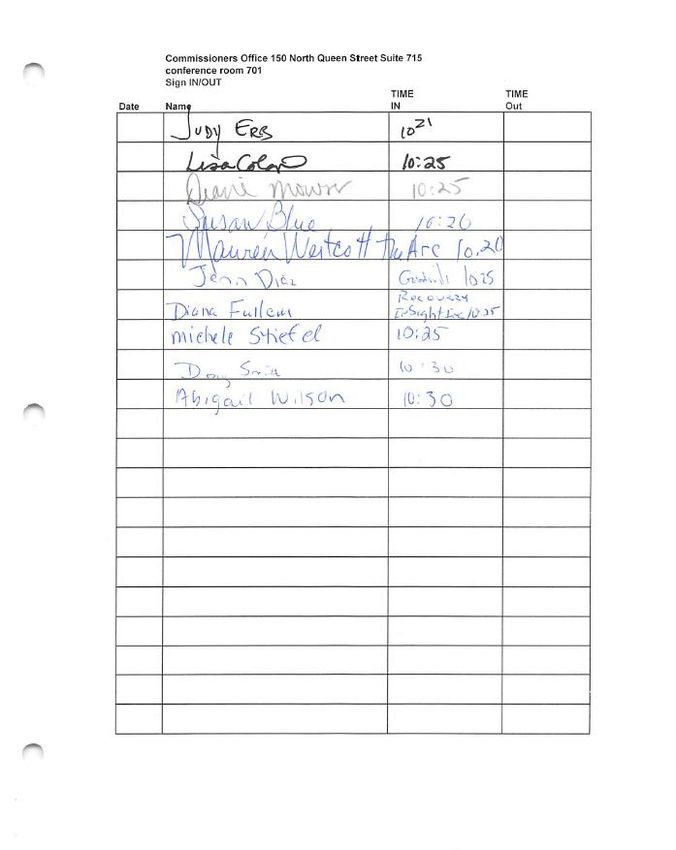
LANCASTER LANCASTER COUNTY HUMAN SERVICES BLOCK GRANT 2018-2019
4

                                  PART II: PUBLIC HEARING NOTICE

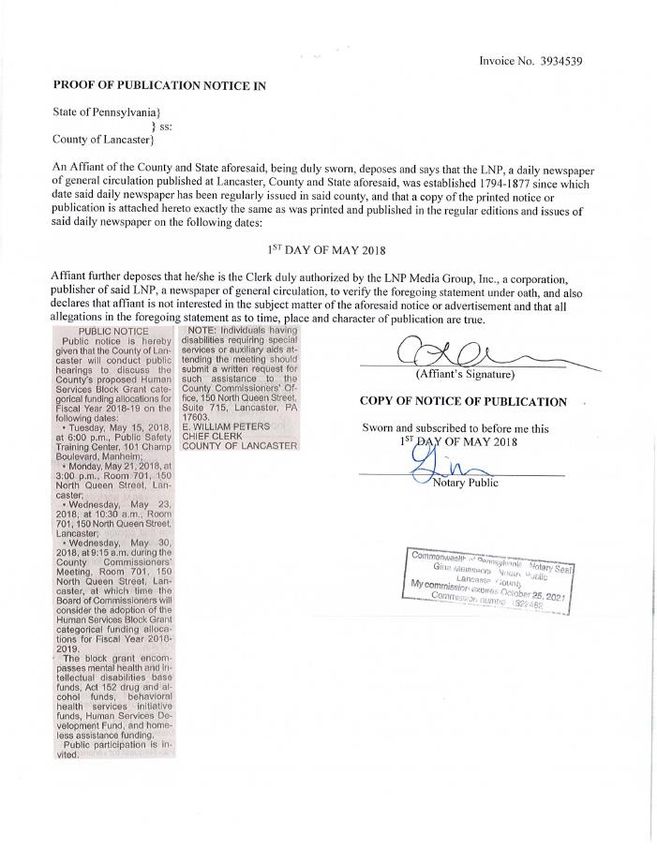
    Public notice is hereby given that the County of Lancaster will conduct public hearings to discuss the
    County’s proposed Human Services Block Grant categorical funding allocations for Fiscal Year 2018-19
    on the following dates:

    •     Tuesday, May 15, 2018 at 6:00 p.m., Public Safety Training Center, 101 Champ Boulevard,
    Manheim;

    •       Monday, May 21, 2018 at 3:00 p.m., Room 701, 150 North Queen Street, Lancaster;

    •       Wednesday, May 23, 2018 at 10:30 a.m., Room 701, 150 North Queen Street, Lancaster;

    •      Wednesday, May 30, 2018 at 9:15 a.m. during the County Commissioners’ Meeting, Room 701,
    150 North Queen Street, Lancaster, at which time the Board of Commissioners will consider the
    adoption of the Human Services Block Grant categorical funding allocations for Fiscal Year 2018-2019.

    The block grant encompasses mental health and intellectual disabilities base funds, Act 152 drug and
    alcohol funds, behavioral health services initiative funds, Human Services Development Fund, and
    homeless assistance funding.

    Public participation is invited.

    NOTE: Individuals having disabilities requiring special services or auxiliary aids attending the meeting
    should submit a written request for such assistance to the County Commissioners’ Office, 150 North
    Queen Street, Suite 715, Lancaster, PA 17603.

    E. WILLIAM PETERS

    CHIEF CLERK

    COUNTY OF LANCASTER

    Advertise in the Lancaster Newspapers on Tuesday, May 1, 2018. Send bill and proof of publication to E.
    William Peters, County Commissioners’ Office, 150 North Queen Street, Suite 715, Lancaster,
    Pennsylvania 17603.
LANCASTER LANCASTER COUNTY HUMAN SERVICES BLOCK GRANT 2018-2019 5
LANCASTER LANCASTER COUNTY HUMAN SERVICES BLOCK GRANT 2018-2019
6

                        PART III: CROSS-COLLABORATION OF SERVICES

    Employment:

    Lancaster County Behavioral Health & Developmental Services embraces the Office of
    Developmental Programs (ODP) ‘Best Practices’ prescription that supported employment
    opportunities be sought over site-based workshop settings. The “Employment First” philosophy has
    been promoted to County-based providers through the “Think Big” initiative, the main objective of
    which is to create a paradigm shift away from the traditional “workshop” model of post-graduation
    employment expectations to one that aligns with and supports the Employment First policy.
    Collaborative efforts have been to engage pre-transition age students with ID (under age 14), their
    parents, and schools, in discussions and activities designed to encourage exploration and planning for
    post-graduation integrated competitive employment. An “Employment Tool Box” has been
    specifically designed for educators to use with third and fourth grade students. Based on education
    curriculum standards the ‘tool box’ provides teachers with fully developed lesson plans centered on
    the various aspects of employment, including job exploration and preparation. The “Think Big”
    collaborative is made up of stakeholder agencies, including; Intermediate Unit-13, the Office of
    Vocational Rehabilitation (OVR), the Arc of Lancaster/Lebanon County, and local school districts.
    The collaborative members are pleased to have been presenters at the 2017 Pennsylvania Transition
    Conference and anticipate launching a multi-school district pilot of the “Employment Tool Box” in
    September 2018.

    Additionally, the Lancaster Clubhouse has programming which focuses on supported employment
    opportunities. The Clubhouse, though traditionally considered to be within the Behavioral Health
    ‘domain,’ has increasingly come to serve dually-diagnosed individuals. With the Intellectual
    Disability system’s pending inclusion of Autism, the collaboration between the Behavioral Health
    and Intellectual Disability systems is expected to increase exponentially.

    Housing:

    Lancaster County Behavioral Health & Developmental Services partners with the Lancaster County
    Coalition to End Homelessness, which encompasses multiple housing, community agencies, religious
    organizations and businesses that work together to expand availability of safe and affordable housing
    in Lancaster County. This Coalition is leading the County’s “Heading Home – The Ten Year Plan to
    End Homelessness in Lancaster County”. Through a partnership with the Coalition we were
    successful in securing three Housing and Urban Development (HUD) grants to specifically secure
    permanent supported housing for individuals with a mental illness. This is a housing first model and
    follows both the Coalitions as well as HUD’s requirement that all housing be housing first. There are
    currently 47 subsidized housing opportunities for seriously mentally ill adults, older adults and
LANCASTER LANCASTER COUNTY HUMAN SERVICES BLOCK GRANT 2018-2019
7
transitional age youth to reside in an apartment of their choice with a HUD defined subsidy to make it
affordable. Over the last 6 years 64 individuals have successfully graduated from the program as they
have been able to secure an income to support themselves in their own apartment. This allows for
additional individuals to enter the programs and to work toward self-sufficiency. It is anticipated that
9 new individuals will enter one of the three programs annually.
In addition, we will continue to leverage “Projects for Assistance in Transition from Homelessness”
(PATH) funds to house individuals who have a mental illness and are in need of permanent housing.
We have utilized our PATH funds and housing support funds to assist individuals to successfully
transition from our Community Residential Rehabilitation Programs (CRR) to independent living. It
is anticipated that 3 individuals will enter independent living from one of our CRR programs
annually. In addition, Lancaster County BH/DS continues its partnership with Community Basics
Housing Development Corporation to subsidize 6 set aside apartments, using the housing first
approach, in the Park Avenue Apartments project funded through PHFA. Six individuals will remain
in their own apartments throughout the year. Lancaster County will continue to explore opportunities
through our Coalition to End Homelessness and HUD to further expand these programs. An
additional program is our Master Leasing program, which has a capacity for providing four
individuals who would otherwise be homeless a safe and secure place to stay for up to three months
at a time while they seek employment/income and permanent housing. Sixteen individuals have
utilized the program during the current fiscal year.
Lancaster County has made referrals to the 811 housing voucher system, with one of the referrals for
a dually diagnosed individual currently receiving treatment at Wernersville State Hospital. Lancaster
County also leverages matching funds through reinvestment for contingency funds to be used for first
months’ rent, security deposits, utility needs, bridge subsidies, and household items to include beds.
Lancaster County has HUD funds to support housing for families and children in both permanent
supported housing options as well as rapid re-housing funds. All of these housing interventions are
designed to meet the needs of the transitional age youth, adults and older adults. Finally, the Single
County Authority (SCA) is expanding housing options for individuals with primary drug and alcohol
issues by creating a Latino halfway house; adding a second men’s halfway house, and helping four
non- profit agencies create ten recovery houses. Many of these individuals have co-occurring
behavioral health diagnoses.
Finally, though no less notable, Lancaster County has partnered with the State Department of Human
Services in an effort to address the ramifications of the State’s Norristown State Hospital initiative,
which has resulted in a reallocation of forensic and civil beds. To this end, Lancaster has created a
Forensic Diversion Program which has alleviated the need and wait time for inmates with serious
mental illnesses to be committed to Norristown. Since its inception in May, 2017, the program has
admitted 31 individuals, and has been so successful it will be expanded from six to eight beds at the
start of the ’18-’19 Fiscal Year.LANCASTER LANCASTER COUNTY HUMAN SERVICES BLOCK GRANT 2018-2019
8
PART IV: HUMAN SERVICES NARRATIVE
MENTAL HEALTH SERVICES
a) Program Highlights
As a community, the Lancaster County Mental Health system continues to move forward; expanding
our knowledge, recovery-oriented services, employment, forensic resources and housing
opportunities with the goal of ensuring that all individuals with a mental illness have access to and
choices of supports and services they need. The Lancaster County Mental Health Program has
several processes in place to ensure regular and ongoing input from adults and older adults with
serious mental illness, persons in recovery, transitional age youth, Lesbian, Gay, Bisexual,
Transgender, Questioning, Intersex (LGBTQI), Veterans, family members and professionals
regarding the county system of mental health care. We firmly believe that interested and involved
persons should have many options to provide input throughout the year and that input is utilized to
develop new programs or expand existing programs. These processes include a variety of venues
from individual conversations with family members and individuals experiencing mental health
issues to standing meetings with providers, County agencies, PerformCARE, our managed care
organization, Lancaster County Coalition to End Homelessness, Local Lead Agency, Community
Support Program, Community Support Plan (CSP) meetings at Wernersville State Hospital,
Lancaster County Jail, Lancaster General Health, Child and Adolescent Services System Program
(CASSP) meetings and advocacy organizations. All the meetings occur throughout the year and
Lancaster County depends on the input from all stakeholders within the community to identify gaps
in services, unmet needs and when existing services may need to be altered/changed to better meet
the needs of individuals with a mental illness. These needs are not solely Mental Health treatment
needs but also includes physical healthcare, leisure and recreation, employment opportunities,
education, transportation, housing and natural supports. Lancaster County actively participates on the
Adult, Older Adult and Children’s subcommittee of the Mental Health Planning Council to ensure
continued partnership with varied stakeholders and we continuously explore funding options from
varied sources to expand our service system.
There are many prevention/training opportunities available within the County with Crisis Intervention
Training (CIT), Mental Health First Aid (MHFA), Wellness Recovery Action Plan (WRAP) and
suicide prevention activities to name a few. As a nationally recognized curriculum on education
regarding mental illness and improving communication with (and understanding of) those
experiencing symptomatology, MHFA is being offered by several local providers to specialized
professions such as educators, sheriffs, Adult Probation and Parole, and law enforcement. The much
more comprehensive Crisis Intervention Training continues to be provided for our police
departments, as well as correctional officers within the county jail. The CIT training is a cooperative
effort between the Adult Probation and Parole Department and Behavioral Health and is currentlyLANCASTER LANCASTER COUNTY HUMAN SERVICES BLOCK GRANT 2018-2019
9
offered two times per year. Lancaster County has 177 officers trained from 29 departments including
3 University departments and the Pennsylvania State Police. Additionally, there are 101 Lancaster
County Prison staff, 16 Adult Probation and Parole staff, 10 Park Rangers and 3 Sheriff deputies who
are also trained in CIT.
Our suicide prevention committees have continued to grow in membership and include many family
members, transitional age youth, professionals and concerned citizens. There are currently two
separate but equally important Suicide Prevention Coalition committee meetings to address and talk
about suicide as well as prevention. The Stakeholder based Coalition, led by Mental Health America,
has been providing events and fundraising activities to educate the community and get people talking
about suicide. We are partnering with our managed care organization and Mental Health America to
offer a one-day conference related to suicide prevention for professionals. Annually, the Coalition
will co-sponsor the “Walk for DES,” an event created by the father of a young man who took his life
several years ago. Last year the event raised more than $15,000 for suicide prevention and awareness.
The second committee is addressing ongoing needs within the Lancaster County Jail for inmates with
a mental illness and suicide prevention. This is a County lead initiative that will continue meeting
over the coming year with a vision to reduce/eliminate suicide within our County Jail. The County
facilitated Prison Suicide Prevention Committee meets monthly and is credited with identifying
various environmental and assessment strategies that have improved conditions in the Lancaster
County Prison, among them being the creation of a Suicide Hotline that friends or family of inmates
can call to report concerns for incarcerated loved ones.
The Lancaster County Mental Health Program partners with the Lancaster County Coalition to End
Homelessness, which encompasses multiple housing, community agencies, religious organizations
and businesses that work together to expand availability of safe and affordable housing in Lancaster
County. This Coalition is leading the County’s “Heading Home – The Ten-Year Plan to End
Homelessness in Lancaster County”. Through a partnership with the Coalition we were successful in
securing three Housing and Urban Development (HUD) grants to specifically secure permanent
supported housing for individuals with a mental illness. This is a housing first model and follows
both the Coalitions as well as HUD’s requirement that all housing be housing first. There are
currently 47 subsidized housing opportunities for adults, older adults and transitional age youth to
reside in an apartment of their choice with a HUD defined subsidy to make it affordable. Over the
last 7 years 66 individuals have successfully graduated from the program as they have been able to
secure an income to support themselves in their own apartment. This allows for additional individuals
to enter the programs and to work toward self-sufficiency. In addition, we will continue to use
Projects for Assistance in Transition from Homelessness (PATH) funds to house individuals who
have a mental illness and need permanent housing. We have utilized our PATH funds and housing
support funds to assist individuals to successfully transition from our Community Residential
Rehabilitation Programs (CRR) to independent living. It is anticipated that 3 individuals will enter
independent living from one of our CRR programs annually. In addition, Lancaster County BH/DS
continues its partnership with Community Basics Housing Development Corporation to subsidize 6
set aside apartments, using the housing first approach, in the Park Avenue Apartments project fundedLANCASTER LANCASTER COUNTY HUMAN SERVICES BLOCK GRANT 2018-2019
10
through PHFA. Six individuals will remain in their own apartments throughout the year. One
additional program is our Master Leasing program and this program offers four individuals a place to
stay who otherwise would be homeless. Individuals can remain at the residence for up to three
months while they seek employment/income and housing. In addition, our Philhaven Diversion
program is a treatment option available to individuals who are receiving treatment on an acute
inpatient unit but need some additional time/supports to be successful. This program is designed to
meet the needs of individuals who otherwise would be going to Wernersville State Hospital and has
been very successful in diverting many individuals from institutionalization. Lancaster County has
made some referrals to the 811-housing voucher system with one of the referrals for an individual
who had received treatment at Wernersville State Hospital. Lancaster County also utilizes funds
through reinvestment for contingency funds to be used for first months’ rent, security deposits, utility
needs, bridge subsidies, and household items to include beds. Lancaster County has HUD funds to
support housing for families and children in both permanent supported housing options as well as
rapid re-housing funds. These housing interventions are designed to meet the needs of the transitional
age youth, adults and older adults.
Lancaster County is a large county both geographically and in population size and for that reason
accessibility to treatment sites can be difficult. Expansion of treatment providers to varied sites
throughout the county will increase both the availability and accessibility to needed mental health and
drug and alcohol treatment. This will include both outpatient therapy and psychiatry. This current
year we worked with our managed care organization using reinvestment funds and opened an
outpatient Drug and Alcohol (D&A) clinic in one of the areas. This new program offers dually
diagnosed services using the Hazelden Model and should serve around 80 individuals annually aged
18 years of age and older.
Mobile services are an important treatment option in the array of services that are available to
individuals seeking services within Lancaster County. Our crisis intervention component offers
mobile outreach, phone contact and walk-in services. This program is accessible to anyone 24 hours a
day seven days a week. In addition to staffing at our site, there is one identified crisis worker who is
stationed at the Lancaster City Police Station to accompany the police to locations when either a call
is received regarding someone with a mental illness or when an officer calls back to the station to ask
for the crisis worker to respond to their location to assist with a mental health issue. This year we
have been exploring a partnership with the National Suicide Prevention Lifeline. Conversations are
continuing and we are both determining the ability of our office to meet their criterion.
Case management is an integral part of ensuring that individuals get connected with services and
supports that they need. Lancaster County offers 4 levels of case management to ensure that anyone
who has the need for case management can receive the service. To ensure that individuals have a
choice in their provider of services, the case management services are provided by both Community
Services Group and Behavioral Health/Developmental Services (BH/DS). There is administrative
case management, resource coordination, blended case management and intensive case management
and both programs meet weekly to ensure fluidity and collaboration between the programs. Case
management is available to youth, adolescents, transitional age youth, adults and older adults. In
addition to the levels of case management we have several specialty case managers to ensure thatLANCASTER LANCASTER COUNTY HUMAN SERVICES BLOCK GRANT 2018-2019
11
individuals can easily access case management and other services/supports. There are two case
managers who serve individuals participating in Mental Health Court, two case managers who
outreach to individuals who are homeless, one case manager who is the contact for acute hospitals
and can perform intakes on the mental health unit and one forensic case manager who spends time
within our County Jail and is also the contact for the State Correctional Institutions. This year we will
be expanding our case management services to include a second forensic case manager.For residents
with the greatest need is the ability to receive services utilizing an evidence based program, Assertive
Community Treatment Team (ACT) which is funded by our managed care organization. Case
management supports and services are available to over 2000 individuals annually.
Mobile psychiatric Nursing and mobile therapy for adults is offered to individuals through County
funding and PerformCARE. While the mobile psychiatric nurse is experienced and knowledgeable
about medical issues, there continue to be gaps in getting medical nursing supports to individuals that
we serve. Many individuals have complex medical issues/concerns that would be best served by
daily medical nursing visits, however, physical health plans do not cover such intensity in this
service. Most plans allow for twice a week nursing to address medial issues and an expanded service
is very much needed within the Lancaster Community. Moving forward we will be exploring ways to
get needed medical care into individual’s homes and Community Residential Rehabilitation programs
as well. This added intensity could reduce the number of individuals requiring inpatient medical care
and nursing home care. Waivers and other funding opportunities will be explored. This service could
reach approximately 40 people per year aged 18 years of age and older.
Psychiatric Rehabilitation is offered as both a mobile service and at our Tempo Clubhouse Program.
Engagement in the clubhouse model has many areas for growth and opportunity within our
community. There is an effort to educate the community about this service and to assist others to
become engaged in the service. As part of this model, individuals have been able to participate in
temporary employment opportunities to enhance their resume and to have job coaches support them
in permanent employment opportunities. Expanding job opportunities and employer contacts will
continue for this coming year to have more individuals have the opportunity to be gainfully
employed. It is anticipated that with the expansion, five more individuals will be able to have work
experience. The focus is to support transitional age youth, adults and older adults.
Socialization is a very important component to recovery and to the individuals that we serve.
Lancaster County has both site based and mobile socialization programs that offer individuals an
opportunity to make friends, establish relationships with others and to have a good time engaging in
various activites. In addition, Compeer and CompeerCORPS offer the opportunity to establish lasting
friendships and trusted relationships. Compeer is limited only by the number of volunteers willing to
engage in the matching with a friend. This service is available to individuals 18 years of age and
older.
Outpatient services within the County are offered by varied providers with varied expertise in
treatment modalities. The outpatient providers are trained and utilize evidence based services and
have expertise in trauma care, Multi Systemic Therapy (MST), Parent Child Interactive Therapy
(PCIT), Cognitive Therapy, Dialectical Behavioral Therapy (DBT) and this year we have Functional
Family Therapy (FFT). At this time, DBT is only available to individuals with PerformCARE asLANCASTER LANCASTER COUNTY HUMAN SERVICES BLOCK GRANT 2018-2019
12
there are no county dollars to pay for this service. These specialty treatment options vary across the
age span with PCIT having focus on youth, MST and FFT focusing on adolescents and DBT for
adolescents and adults/older adults. This year, training is being offered to clinicians by our managed
care organization for Eye Movement Desensitization and Reprocessing (EMDR) so that this can be
another therapeutic intervention available to our residents.
Outpatient services continue to expand to our youth and adolescents in a project titled Flexible
Outpatient. This service is a joint venture with PerformCARE and allows the clinician, who is based
at an outpatient setting to be able to leave that setting to provide some limited treatment in the
community setting as well. This was initially a pilot project with one provider within Lancaster
County, however, this has been expanded to multiple providers. The projection is that 50 youth
would be able to benefit from this service this fiscal year.
A Common Ground support center is being developed within an outpatient office in order to assist
individuals to be prepared for their psychiatric appointment. This will be fully operational next fiscal
year and has the potential to offer approximately 100 individuals the opportunity to use this web
based service with the assistance of a peer to address issues/concerns/ questions during their
psychiatric appointment. Research has shown this to be a valuable tool in taking
ownership/responsibility for their treatment and will be available to anyone aged 18 years of age or
older.
In collaboration with our Intellectual Disabilities (MH/ID) component and PerformCARE we
recently began a mobile Mental Health /Intellectual Disabilities behavioral intervention service. This
program provides a mobile MH/ID team consisting of two professionals who assist adults ages 21
years of age and older with a mobile team to address behavioral/psychiatric issues. This team works
with the individual and their existing team to provide service interventions and activites to reduce
escalations in behavior or divert a crisis. Three individuals from Lancaster County have benefited
from this service this fiscal year with planned expansion next fiscal year.
Lancaster County residents can engage in peer support services that are offered by two separate
programs. One such program, Recovery Insight is peer run and owned and offers WRAP training
within Lancaster and surrounding counties. This program receives funding from both PerformCARE
and the County. Our other program, Philhaven Clubhouse is also an option for individuals who
would like to engage with a peer and is solely funded by PerformCARE. Lancaster General Health
our largest hospital with inpatient psychiatric treatment has peer support embedded within their unit.
A warm line is often discussed at meetings and is a service that we would like to include if funds are
able to be identified. This service would serve approximately 200 individuals per year aged 18 years
or older.
Additionally, utilizing our CASSP process and strong partnerships with the child serving agencies
within the County we continue to look for gaps and needs within the community and ways to enhance
our service delivery system and reduce the number of youth in residential treatment facilities. One
such gap that has been identified within the County and can reduce the number of adolescents being
admitted to Residential Treatment Facilities is the development of a partial hospitalization program.
This program which will be jointly provided by a mental health provider and the Lancaster/LebanonLANCASTER LANCASTER COUNTY HUMAN SERVICES BLOCK GRANT 2018-2019
13
Intermediate Unit #13 and will be able to provide services to adolescents who are currently struggling
in the home and school setting and who require additional supports to be successful.
Families often find themselves unable to participate in treatment if their child is in a Residential
Treatment Facility (RTF) located a great distance from their home. Lancaster County currently has
57 youth receiving services in these facilities. Using reinvestment funds, we will be working with a
provider to have the ability to use the same technology as tele-psy to have sessions/visits between
families and their children. Two residential providers will be chosen for Lancaster County, however,
once the technology is in place at multiple RTF’s shared by the Capital Area 5, this will allow a
family access to multiple RTF’s. This new opportunity will be operational next fiscal year.
To meet the changing needs of families with young children who are struggling due to mental health
issues/behavioral difficulties within a day care setting we will expand our service delivery to include
Supporting Positive Environments for Children (SPEC). SPEC is rooted in evidenced based
practices, specifically utilizing principles of the Pyramid Model, as developed by the Center on the
Social Emotional Foundations for Early Learning and the Technical Assistance Center on Social
Emotional Intervention. This supportive model will be operational next fiscal year as the providers
are in the process of being identified and trained.
Goodwill Industries continues to focus on supported employment and not site based workshop.
Individuals aged 18 years of age or older will be referred for employment opportunities through this
program and will be supported to meet their goals of gainful employment. We are partnering with
Goodwill to support their systemic change to this new philosophy and will continue to provide
funding for individuals to gain skills necessary to be gainfully employed. Additionally, Ephrata Area
Rehabilitation Services (EARS) is also moving in the direction of supported employment and
changing their services from site based workshop. Lancaster County also has an active Clubhouse
which focus on supported employment opportunities.
Lancaster County currently has three treatment courts that offer additional supports to their
participants. They include Mental Health Court, Drug Court and Veterans Court. Lancaster County
BH/DS has staff that participate on both MH court and Drug Court and there are two designated case
managers who provide the case management services for the MH court participants. These courts are
designed to assist offenders to take responsibility for their crimes and to get connected with needed
services and supports. This integrated involvement with these courts has afforded the participants and
our county with a cooperative and collaborative relationship with the judicial system and Adult
Probation and Parole. Participation in the treatment courts is for individuals aged 18 years of age and
older.
CompeerCORPS, a Veteran-to-Veteran peer monitoring program is available to veterans in Lancaster
County aged 18 years of age or older. This program is designed to create a supportive network for
veterans who could benefit from a veteran peer mentor. With funding from the Office of Mental
Health and Substance Abuse Services, this program matches a veteran resident of Lancaster County
who has a diagnosed mental illness with a veteran Volunteer to enjoy friendship activities in the
community.LANCASTER LANCASTER COUNTY HUMAN SERVICES BLOCK GRANT 2018-2019
14
Lancaster County is exploring new ways to support individuals with a mental illness that are
incarcerated or have a criminal history. With additional funds from OMHSAS this fiscal year we
were able to develop a new program, Transition to Community (TTC), to serve individuals currently
incarcerated at either the Lancaster County Jail or the State Correctional Institutions. This program is
licensed as a Residential Treatment Facility for Adults (RTFA) and serves 6 individuals at a time for
a period of up to three months. This program provides an opportunity to get individuals out of
incarceration sooner and offer individuals the supports/treatment that they need to be successful. The
program has served 22 individuals since it’s opening in May 2017. Planned expansion will occur next
fiscal year to include 2 additional beds so that 8 individuals can be served at a time. In addition, the
development of a new “step-down” from TTC or “step-down” from incarceration is being developed
that will be able to serve 3 individuals for up to 6 months. This “step-down” program will offer
individuals with or without income the ability to reside in an efficiency “type” setting to practice their
skills and independence with staff support nearby. Development of 3 forensic Community Residential
Rehabilitation beds will also be developed with one of the beds being a specialized program for
individuals who are deaf.
In partnership with PerformCARE, managed care organization, 2 Extended Acute Care (EAC)
programs are available to Lancaster County residents with accessibility to 8 designated beds.
Expansion of this service is being explored by PerformCARE and additional beds for the county is a
critical need as we are participating in a 6-person CHIPP Project. Currently 3 identified CHIPP
residents have successfully transitioned from Wernersville State Hospital to a regionally based
enhanced personal care home. A 3-person home is being developed for the additional 3 CHIPP
individuals with planned discharges from the hospital in the fall of this year. This will reduce the total
number of allocated WeSH beds for Lancaster to 54.
In a partnership with Lancaster General Health there are three mobile services identified to support
individuals with complicated medical issues to ensure that their needs are being met. Care
Connections, ambulatory Collaborative Care and Community Health Workers. All three programs
offer the support of medical staff and social workers to address the needs of our medically fragile
individuals. Working cooperatively with our local AAA and Lancaster General Health to find
innovative ways to address the medical concerns of our aging population both within the community
and at Wernersville State Hospital will begin this year.
b) Strengths and Needs:
Older Adults Strengths: Our ongoing collaborative relationship with our local Office of Aging has
significantly enhanced our ability to improve the services for older adults that are served jointly by
our agencies. This relationship extends beyond the normal workday with both the on-call Office of
Aging worker and our crisis intervention program workers cooperatively addresses the needs of our
older adults. With innovative relationships developed with our intake/case management staff and
local physicians’ offices, we are better able to identify and support the needs of older adults. The peer
educator, employed by Mental Health America is providing outreach and groups to individuals at ourLANCASTER LANCASTER COUNTY HUMAN SERVICES BLOCK GRANT 2018-2019
15
senior centers and in our subsidized housing programs for the elderly. One of our local hospitals has
an inpatient mental health unit that specializes in treating older adults. Working with multiple
counties to utilize enhanced care home beds for three individuals needing this level of service as a
discharge option from Wernersville State Hospital. Needs: Continued outreach to our older adult
population through education so that they understand services that are available to them and to reduce
the misconceptions that this population has regarding mental health services. Working with our
provider network to ensure that adequate staff exist that are credentialed and able to bill Medicare for
service delivery.
Adults Strengths: Support and treatment for adults comes in many forms with services ranging from
outpatient treatment, mobile treatment services, peer support, Clubhouse, socialization programs,
employment opportunities, support groups, community residential rehabilitation services, housing
supports and HUD programs and case management. There are four levels of case management
available to include; administrative, resource coordination, blended and intensive case management
through either the county or another provider. Also, Assertive Community Treatment (ACT) is
available through our managed care program. Expansion of Extended Acute Care was developed
this year at Wellspan/Ephrata Hospital. Five beds have been designated for Lancaster County with
the availability of medical supports as needed. We worked with our managed care organization to
open an outpatient MH and D&A clinic in the borough of Columbia using the Hazelden model. This
new program will use an evidenced based model to address the needs of individuals with a mental
illness and substance abuse needs. Through our reinvestment dollars we can continue accepting
individuals into our Master Leasing program. This program is designed to be short term housing (up
to three months) for adults, older adults or transitional age youth who are being released from prison
or a local hospital and need housing. This short-term housing opportunity for five individuals allows
time to have benefits started or reinstated, for services to be started and for permanent housing
searches. There are also separate funds available for security deposits, first months’ rent, supported
housing services and housing searches. To reduce evictions and utility shut offs for individuals, funds
are available to pay for these hardships that individuals face so that they will not lose their housing.
Needs: Lancaster County is a large county both geographically and in population size and for that
reason accessibility to treatment sites can be difficult. Expansion of treatment providers to varied
sites throughout the county would increase both the availability and accessibility to needed mental
health treatment. These would include both outpatient therapy and psychiatry.
Transition-age Youth Strengths: The Lancaster County Mental Health Program provides
specialized transition age intensive case management to our youth as well as a specialized
support/educational group. We have five dedicated case managers to provide supports to this age
group. In addition, there is a transitional age coordinator who works closely with the transitional age
population to assist them in preparing for adulthood. The funding for this coordinator position is a
result of reinvestment funds through our Health Choices program. Utilizing a specialized
Community Residential Rehabilitation Program, we can provide five (5) transitional age youth the
opportunity to develop life skills and practice those skills in a safe environment. This program assistsLANCASTER LANCASTER COUNTY HUMAN SERVICES BLOCK GRANT 2018-2019
16
them in locating employment, completing their education, developing budgeting skills, and prepares
them to live independently within the community. Needs: Expansion of our transitional
age/specialized support group to reach additional youth and assist them with needed supports and
skills.
Children Strengths: Lancaster County currently has 57 youth receiving treatment within a
Residential Treatment Facility. Many of the youth are also involved in services with either
Intellectual Disabilities, Children and Youth or Juvenile Probation. Lancaster County has a strong
and influential CASSP system that is supported by the executive directors of all the County child
serving agencies. Our CASSP Coordinator reaches out to all agencies to ensure that children and
youth get the services and supports that they need. Evidenced based interventions such as Parent
Child Interaction Therapy, Multisystemic Therapy, Functional Family Therapy and Family Group
Decision Making are just a few avenues utilized to meet the challenging needs of our children and
youth. There are many school districts within the County that have school based behavioral health
services that can be easily accessed by children/youth experiencing mental health or drug and alcohol
issues. This year we will be able to expand our flexible outpatient services to additional providers.
The funding for this service is through our managed care organization. This enhances the outpatient
therapist’s ability to provide treatment both within the outpatient setting and within the home when
needed. This year we will continue to work with our local Children and Youth agency to participate
in their Placement Review Committee. This is an endeavor to provide them with information and
guidance to ensure that youth they are serving are getting the mental health treatment that they need.
We will continue our funding to include family based services for families who do not have medical
assistance or MCO funding. This year 45 youth will be able to attend summer camps that are
inclusive within the community so that they can fully experience this activity. Additionally, respite
services are available to our youth using reinvestment funds. Our local MHA has staff and consumers
providing education and awareness about mental health issues within the varied school districts.
Needs: Continued coordination with our Children and Youth agency as well as our Juvenile
Probation department to ensure that we are meeting the needs of youth with multiple system
involvement. Our CASSP Policy committee in collaboration with our local intermediate unit is
working on developing a school based partial program to support youth within the school setting.
This new service is being viewed as a means to reduce the need for Residential Treatment. In
addition, we are planning to implement an evidence based model, Supporting Positive Environments
for Children (SPEC) within identified day care settings. This model addresses a positive behavior
support framework that fosters socially and emotionally competent young learners. Also, we are
working closely with our managed care organization with the development and expansion of peer
support services to youth 14 years of age and older.
Individuals transitioning out of state hospitals Strengths: There are currently fifty-seven (57)
individuals from Lancaster County receiving treatment at Wernersville State Hospital. This number
reflects a reduction of 4 beds from the previous year due to the successful discharge of 3 individuals
involved in the CHIPP project and 1 individual who was identified through the Jimmie Lawsuit. WeLANCASTER LANCASTER COUNTY HUMAN SERVICES BLOCK GRANT 2018-2019
17
work jointly with the hospital through the Community Support Plan (CSP) process to identify
individual strengths/needs and community resources to ensure that any resident from Lancaster
County is discharged with the available treatment and resources that they need to be successful.
Through the (CSP) process many of our residents have been identified as needing Community
Residential Rehabilitation Supports (CRR) and nursing home level of care. The medical frailty of
many of our aging residents has warranted the need to explore and to look to develop programs that
would offer the increased nursing supports that they need. Needs: Funds sufficient to develop an
Enhanced Personal Care home with necessary staff, therapies and nursing supports. Availability of
nursing home openings in programs that can serve individuals with medical and psychiatric
issues/concerns.
Co-occurring Mental Health/Substance Abuse Strengths: The Lancaster County Mental Health
Program is a participant and active member on both the Lancaster County Court of Common Pleas
Adult Drug Court and the Lancaster County Court of Common Pleas Mental Health Court.
Attendance at weekly team meetings promotes coordination of appropriate and varying levels of
treatment in addition to providing intensive supervision and judicial monitoring. Both treatment
courts are a valuable resource and opportunity for individuals, some who are incarcerated, to
participate in a process to promote their recovery while they are taking responsibility for their crimes.
The purpose of these courts is to divert individuals from incarceration and if incarcerated to provide
services and supports upon release. The county has two providers, T. W. Ponessa and LG Health who
are identified as Centers of Excellence. This modality allows for additional supports/services for
individuals experiencing D&A addiction. With the utilization of reinvestment funds, we developed a
dual program within the borough of Columbia this year. This new program address both MH and
D&A issues utilizing the Hazelden model and was developed in a community with limited resources.
Needs: Accessibility for D&A treatment in surrounding communities within Lancaster County.
Justice-involved individuals Strengths: Participation in the Forensic Interagency Task Force has
afforded the County the opportunity to develop new relationships with the staff from the Department
of Corrections (DOC) and to learn about many new processes that other counties have developed to
better serve our justice involved individuals. Through a collaborative effort with our local County
Prison, we receive a daily listing of persons who were incarcerated the day prior. We can compare
this list with individuals who may be open with case management services. This alerts case managers
that someone with whom they are working has been incarcerated so that they can work with the
prison, attorneys, and the individual to ensure that mental health services are provided to them within
the jail and that services can be set up upon their release. If the County Prison identifies someone
with a serious mental illness who is not open with case management, then a referral is made to our
office and we complete an intake while the individual is still incarcerated. Services/supports can then
be arranged prior to their release. Our forensic case manager has the primary responsibilities for
working closely with individuals who are incarcerated, prison staff, assistant district attorneys, public
defenders and community providers to collectively assist individuals to get out of the prison sooner
and into treatment and supports that they need. We developed a new program, Transition toLANCASTER LANCASTER COUNTY HUMAN SERVICES BLOCK GRANT 2018-2019
18
Community (TTC) utilizing state funds that offers inmates in the County Jail and at the State
Correctional Institutions a resource upon release that assist in their successful reunification to the
community. The program provides services/supports for up to three months for the newly released
inmate to include therapy, residential programming, psychiatry, peer support and nursing. In a
cooperative endeavor between the prison, BH/DS and LG Health the County successfully developed
a protocol and practice to provide needed inpatient treatment for inmates who require that level of
care during their incarceration. Our local MHA provides education and support within the prison
utilizing both their staff and a peer educator. Needs: More intensive supports within the prison for
individuals who need additional group and individual therapy. Expansion of available resources
within the community for the justice involved to include; addition of 2 beds to our TTC program, a
step-down program from TTC that would enable 3 individuals to practice their skill development
with their own “efficiency” setting but have access to staff as needed, 3 CRR beds for individuals
with forensic involvement/history. Ability to connect individuals with medical assistance/insurance
so that coverage is available upon release. Availability of at least a 30-day supply of medication upon
release and the ability to have that medication refilled.
Veterans Strengths: CompeerCORPS, a Veteran-to-Veteran peer monitoring program is available to
veterans in Lancaster County. This program is designed to create a supportive network for veterans
who could benefit from a veteran peer mentor. With funding from the Office of Mental Health and
Substance Abuse Services, this new program matches a veteran resident of Lancaster County who has
a diagnosed mental illness with a veteran Volunteer to enjoy friendship activities in the community.
Lancaster County also has a specialized Veterans Court designed to assist Veteran offenders to take
responsibility for their crimes and to get connected with needed services and supports. In addition,
there is specialized housing program available to veterans who would otherwise be homeless. Needs:
Treatment providers with a military background that Veterans feel comfortable receiving supports
from.
Lesbian/Gay/Bisexual/Transgender/Questioning/Intersex Strengths: Growing awareness within
the County of the specialized needs of this population and some therapists with specialized training to
support individuals. Needs: A continued need within the County for providers with expertise to
provide services to individuals who are LGBTQI. The pressures that our youth struggle with
regarding the stigma related to identification of being LGBTQI and additionally having a mental
illness puts them at great risk for self-defeating behaviors and suicide. We will be working with both
our outpatient providers and the inpatient units to expand their expertise and abilities to appropriately
treat individuals who identify as LGBTQI. Our local inpatient units are ill equipped to serve LGBTQI
individuals especially individuals who are Transgender and decisions about which sex individual they
may need to share a room with.
Racial/Ethnic/Linguistic minorities Strengths: Lancaster County has a large population of
Hispanic individuals and within the past year the services provided by one of our identified Bi-LANCASTER LANCASTER COUNTY HUMAN SERVICES BLOCK GRANT 2018-2019
19
Lingual, Bi-Cultural providers has grown tremendously. This growth has shown not only the need
for outpatient services but that individuals are accessing this valuable service. This year we were
able to enhance services for Hispanic individuals by having another Bi-Lingual, Bi-Cultural provider
of outpatient services expand their service provision. Needs: Even with the expansion of services
within the community there is a need for additional psychiatric services, partial hospitalization
services and outpatient services for individuals who are non-English speaking.
Other -Medically involved individuals Strengths: Meeting the physical health needs of many of
our community members with no insurance is challenging and resources are very limited. In a
partnership with South East Health Services, a patient certified medical home and community health
center, one of our behavioral health providers is embedded within the daily schedule to provide
assessment/treatment. If a physician identifies that one of the patients that he/she is seeing could
benefit from behavioral health intervention then the patient is seen immediately by the clinician.
Utilizing an integrated behavioral health model, the individual can receive treatment for both medical
and behavioral health issues/concerns at the same site. Needs: Outreach to our community
physicians so that they are better able to understand mental illness and ways to connect their patients
with our agency for services as well as treatment providers within the community.
Other - Co-occurring Mental Health/Intellectual Disabilities Strengths: We are seeing a growing
number of individuals who need both mental health and intellectual disabilities services. This
population requires skilled professionals who have the knowledge and experience in working with
this specialized population. We currently have two identified supports coordinators who work
specifically with both adults and youth who are dually diagnosed as having a mental illness and an
intellectual disability. This year we have been able to offer a specialized MH/ID mobile treatment
program to adult individuals being served by the County’s Intellectual Disabilities program and who
are experiencing significant MH issues. This is a joint project with our managed care organization
and offers therapeutic interventions to a population of individuals who would not otherwise been able
to get such an intensive service. Three individuals have benefited from this service this year and it is
expected that additional individuals will be served next year. Needs: We continue to have a need for
therapy, partial hospitalization services, employment, and housing needs. We are seeing a growing
number of refugees who need services from multiple programs/providers and language as well as
cultural awareness and understanding is creating a barrier for service delivery. Expanding our
provider service capacity to meet the needs of our refugees will be explored this year.
Lancaster County is not currently utilizing Cultural and Linguistic Competence (CLC) training.20 LANCASTER LANCASTER COUNTY HUMAN SERVICES BLOCK GRANT 2018-2019
c) Supportive Housing:
DHS’ five- year housing strategy, Supporting Pennsylvanians through Housing, is a comprehensive plan to connect Pennsylvanians
to affordable, integrated and supportive housing.
This comprehensive strategy aligns well with OMHSAS planning efforts, and OMHSAS is an integral partner in its implementation.
Supportive housing is a successful, cost-effective combination of affordable housing with services that helps people live more stable,
productive lives. Supportive housing works well for people who face the most complex challenges—individuals and families who
have very low incomes and serious, persistent issues that may include substance use, mental illness, and HIV/AIDS; and may also
be homeless, or at risk of homelessness.
SUPPORTIVE HOUSING ACTIVITY Includes Community Hospital Integration Projects Program (CHIPP), Reinvestment, County
base funded or other projects that were planned, whether funded or not. Include any program activity approved in FY 17-18 that
is in the implementation process. Please use one row for each funding source and add rows as necessary. (Note: Data
from the current year FY17-18 is not expected until next year)
1. Capital Projects for Behavioral Health ☐ Check if available in the county and complete the section.
Capital financing is used to create targeted permanent supportive housing units (apartments) for consumers, typically, for a 15-30 year period.
Integrated housing takes into consideration individuals with disabilities being in units (apartments) where people from the general population
also live (i.e. an apartment building or apartment complex.
Project Name *Funding Total $ Projected $ Actual or Projected Number of Term of Year
Sources by Amount for Amount for Estimated Number to Targeted BH Targeted BH Project
Type FY 16-17 FY 18-19 Number be Served in Units Units first
(include grants, (only County (only County Served in FY FY 18-19 (ex: 30 started
federal, state & MH/ID MH/ID 16-17 years)
local sources) dedicated dedicated
funds) funds)
N/A N/A N/A N/A N/A N/A N/A N/A N/A
Notes:You can also read


